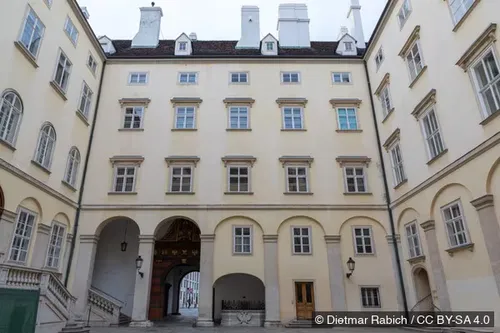
Free Walking Tour Vienna: Hofburg to Belvedere Loop

One 9.8 km loop from the Hofburg through the museum quarter, out to Karlskirche and Belvedere, and back past St. Stephen's to the Lipizzaner hall.

18 Stops 9.8 km ~2 h 17 min walking
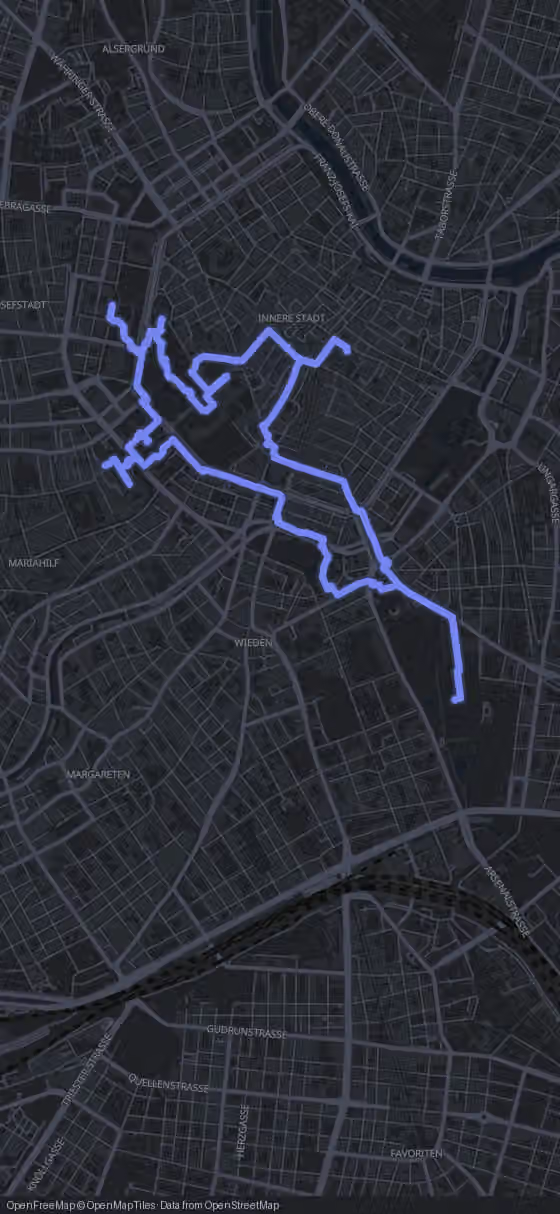
Route map for the Vienna walking tour
Stop 1 of 18
110 m·1 min
Hofburg Palace
Head west toward Heldenplatz
Grüß Gott, welcome to Vienna. I'm Alex, and few places show the scale of Habsburg ambition better than the Hofburg.
Try this tour with Alex

What This Vienna Loop Covers

This loop links 18 stops in 9.8 km, starting and ending at Hofburg Palace: the Ringstrasse, the museum quarter, Karlskirche and Belvedere Palace, then back through the old town. Pure walking time is 2 h 17 min; with short looks at each stop plan about five hours, or a full day with one big museum.

Heldenplatz, Volksgarten, Vienna City Hall, Maria-Theresien-Platz, the Plague Column and the interior of St. Stephen's Cathedral are free; museums, palaces and guided tours charge admission. Route, map and GPS navigation are free in your browser, and the optional AI Tour Guide tells the stories as you walk.

Open free GPS & optional AI Tour Guide
This short shows highlights of the route. All 18 stops follow below.

The Route

Walking Map of Vienna's Imperial Loop

18 stops 9.8 km 2 h 17 min walking
Tap to load interactive map

The 18 stops along this route

  1. Hofburg Palace in Vienna, stop 1 on the self-guided walking tour
    1Hofburg Palace
  2. Heldenplatz in Vienna, stop 2 on the self-guided walking tour
    2Heldenplatz
  3. Volksgarten in Vienna, stop 3 on the self-guided walking tour
    3Volksgarten
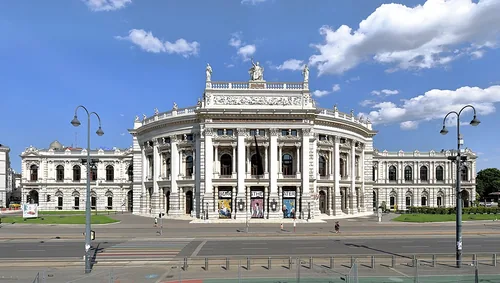
  4. Burgtheater in Vienna, stop 4 on the self-guided walking tour
    4Burgtheater
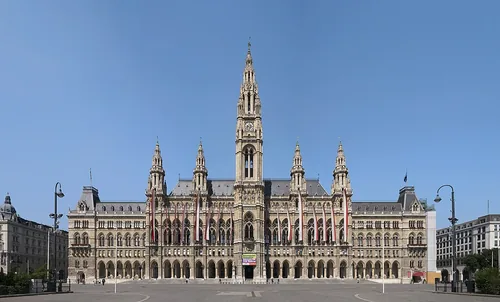
  5. Vienna City Hall, stop 5 on the self-guided walking tour
    5Vienna City Hall
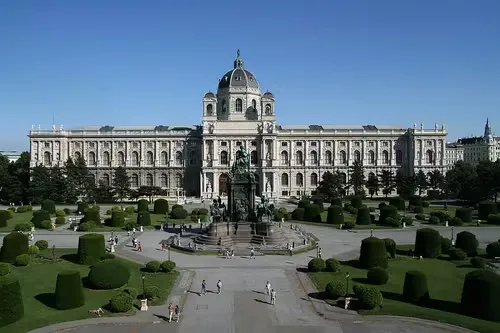
  6. Maria-Theresien-Platz in Vienna, stop 6 on the self-guided walking tour
    6Maria-Theresien-Platz
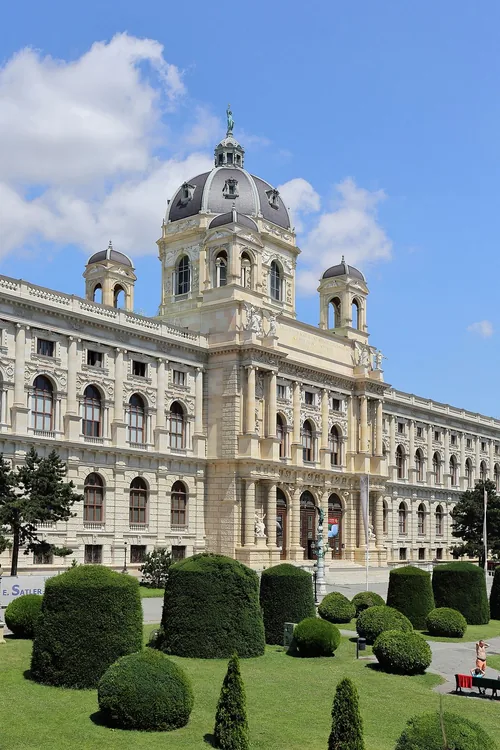
  7. Natural History Museum in Vienna, stop 7 on the self-guided walking tour
    7Natural History Museum
  8. MuseumsQuartier in Vienna, stop 8 on the self-guided walking tour
    8MuseumsQuartier
  9. Leopold Museum in Vienna, stop 9 on the self-guided walking tour
    9Leopold Museum
  10. MUMOK in Vienna, stop 10 on the self-guided walking tour
    10MUMOK
  11. Kunsthistorisches Museum in Vienna, stop 11 on the self-guided walking tour
    11Kunsthistorisches Museum
  12. Karlskirche in Vienna, stop 12 on the self-guided walking tour
    12Karlskirche
  13. Belvedere Palace in Vienna, stop 13 on the self-guided walking tour
    13Belvedere Palace
  14. Vienna State Opera, stop 14 on the self-guided walking tour
    14Vienna State Opera
  15. Albertina in Vienna, stop 15 on the self-guided walking tour
    15Albertina
  16. St. Stephen's Cathedral in Vienna, stop 16 on the self-guided walking tour
    16St. Stephen's Cathedral
  17. Plague Column in Vienna, stop 17 on the self-guided walking tour
    17Plague Column
  18. Spanish Riding School in Vienna, stop 18 on the self-guided walking tour
    18Spanish Riding School
  19. That's the full loop.

    Walk it with an AI Tour Guide talking you through every one of these streets.

    Start free in your browser
    You made it

The Vienna Walking Tour, Stop by Stop Around the Ring

  1. 1

    Hofburg Palace

    Hofburg Palace in Vienna, stop 1 on the self-guided walking tour

    You start at the Hofburg, for centuries the principal palace of the Habsburgs. It began in the 13th century under Ottokar II of Bohemia, and later rulers kept extending it, which is why you are looking at a complex that grew over hundreds of years rather than a single building planned in one go. As you walk around it today, you are passing wings and gates from very different eras of the dynasty.

    The Habsburgs used the Hofburg as their winter residence and moved out to Schönbrunn for the summer. The story did not end with the monarchy: since 1946 the palace has been the official residence and workplace of the Austrian president, so part of what you see is still the working seat of the head of state.

    The standard ticket combines three visits: the Sisi Museum, the Imperial Apartments and the Silver Collection, and there is a version with a guided tour. It is worth it if the private life of the imperial family and the myth of Empress Elisabeth interest you. If you only have room for one interior today and paintings matter more to you than imperial rooms, keep your time for the Kunsthistorisches Museum instead.

    Heldenplatz opens up right in front of the palace, just 120 m or 2 minutes away. The loop also comes back here at the end, from the Spanish Riding School, which sits inside the Hofburg itself.
    Hours
    Daily 09:00–17:30, last admission 16:30
    Price
    20 EUR adults, 12 EUR children 6-18 (Standortticket: Sisi Museum + Imperial Apartments + Silver Collection); with guided tour: 25 EUR adults, 17 EUR children 6-18
  2. 2

    Heldenplatz

    Heldenplatz in Vienna, stop 2 on the self-guided walking tour

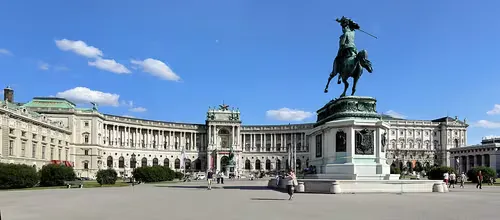
    Heroes' Square lies in front of the Hofburg. In the adjoining wing the Austrian president resides, and the Federal Chancellery stands on neighbouring Ballhausplatz, so this open space sits at the political centre of the country. Turn towards the Ringstrasse and you take in the Parliament, the Rathaus and the Burgtheater in one panoramic view.

    The square exists because of a defeat. After Austria lost to Napoleon at Wagram in 1809 and signed the Treaty of Schönbrunn, the remaining bastions of the palace were slighted and replaced by a curtain wall with the Outer Castle Gate, which still stands. Under Emperor Franz Joseph, the old outer plaza became part of the lavish Ringstrasse project, and in 1869 Gottfried Semper drew up a vast plan for an imperial forum reaching from the Hofburg across the Ring to the museums and the former imperial stables.

    Construction started in 1871, and from 1881 the Neue Burg wing went up. When the masons stopped in 1913, the northwestern part towards the Volksgarten stayed unfinished: the forum was never completed. Look at the two equestrian statues by Anton Dominik Fernkorn, with bases by Eduard van der Nüll; the statue of Archduke Charles, modelled on a popular painting by Johann Peter Krafft, was unveiled in 1860.

    This is also the place where Adolf Hitler announced the Anschluss of Austria to Nazi Germany on 15 March 1938, the darkest moment in the square's history. The square is free and open at all times. From here it is 320 m, about 4 minutes, into the Volksgarten.

    Hours
    24/7 (public square)
    Price
    FREE
  3. 3

    Volksgarten

    Volksgarten in Vienna, stop 3 on the self-guided walking tour

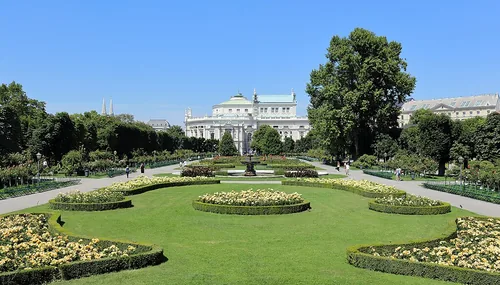
    The Volksgarten opened on 1 May 1823 as Vienna's first public park, and like Heldenplatz it grew out of war damage. In 1809 the French troops occupying Vienna blew up the Burgbastei, a major bastion of the Hofburg. Instead of rebuilding it, court architect Ludwig Gabriel von Remy redesigned the whole area, with Heldenplatz in the middle and two parks on either side, the Volksgarten and the Burggarten. The gardener Franz Antoine the Elder shaped the planting.

    The temple-like building you see is the Theseustempel by Pietro Nobile, a recreation of the Temple of Hephaestus in Athens. It was built specifically to house Antonio Canova's statue Theseus Slaying the Centaur. Pay attention to the two characters of the park: on the Hofburg side it is laid out as an English-style park with trees in a loose avenue, on the Ringstrasse side as a stricter French Baroque garden.

    In its early decades the park was a social hotspot. Peter Corti ran two coffee houses here, one in the park and one in the Paradeisgartel on the old fortification wall, and they hosted concerts by Joseph Lanner and Johann Strauss I. The park was later extended during the Ringstrasse years and redesigned in parts, and it was nearly lost altogether: the imperial forum plan foresaw a mirrored wing of the Neue Burg on this very spot, until the First World War and the collapse of Austria-Hungary ended the project.

    Entry is free, so take a few minutes on a bench. The Burgtheater is 250 m, 3 minutes, from here.

    Hours
    Mar: 07:00–19:00; Apr–Oct: 06:00–22:00; Nov–Feb: 07:00–17:30
    Price
    FREE
  4. 4

    Burgtheater

    Burgtheater in Vienna, stop 4 on the self-guided walking tour

    The Burgtheater is Austria's national theatre, known to the Viennese simply as die Burg, and one of the most important German-language stages. Its company developed a style and a way of speaking that is still recognised as typical of performances here.

    The theatre is older than the building in front of you. Empress Maria Theresa wanted a theatre next to her palace and opened it on 14 March 1741 in a former ball house, a tennis court that Ferdinand I had built in the palace gardens in 1540. Her son Joseph II named it the German National Theatre in 1776. That first house, beside the Hofburg at Michaelerplatz opposite St. Michael's Church, saw the premieres of three Mozart operas: Die Entführung aus dem Serail in 1782, Le nozze di Figaro in 1786 and Così fan tutte in 1790, plus his Piano Concerto No. 24 in 1786. Beethoven's First Symphony premiered there on 2 April 1800.

    The old house had famous acoustics but far too few seats; an 1884 description complained that the auditorium could hardly hold half of those who wanted to get in. After a last performance of Goethe's Iphigenie auf Tauris, the company moved on 14 October 1888 into this new building on the Ringstrasse, designed by Gottfried Semper and Karl von Hasenauer, the same pair behind the imperial forum plans.

    Guided tours run on certain days and charge admission; they are worth it if you love theatre or want to see the interior without a German-language play. From here it is 550 m, 8 minutes, to City Hall.

    Hours
    Tours Mon/Thu/Fri 16:00, Sun/holidays 11:00
    Price
    10 EUR adults, 9 EUR seniors 65+, 5 EUR students/children/under 27 (guided tour)
  5. 5

    Vienna City Hall

    Vienna City Hall, stop 5 on the self-guided walking tour

    The Wiener Rathaus is the Gothic Revival seat of the mayor and of the city and state government. Friedrich von Schmidt won the commission, and the building went up between 1872 and 1883. By 1850 Vienna had grown so fast by absorbing its suburbs that the old city hall on Wipplingerstraße was no longer adequate, and when the city walls were torn down for the Ringstrasse, a competition for a new one followed in 1868.

    The location was political. A site opposite the Stadtpark was considered first, but the city chose the Josefstädter Glacis, a former parade ground in front of the demolished walls, secured in 1870 after interventions by Mayor Cajetan Felder. The quarrel between city and imperial government over who would pay for the Ringstrasse turned the new city hall into a symbol of the confident bourgeoisie facing the Emperor across the boulevard.

    The dates were chosen with care, too. The foundation stone was laid on 14 June 1873, and the final stone was set on 12 September 1883, exactly two hundred years after the 1683 victory over the Ottoman army. The city council moved in on 23 June 1885, and the bill came to about 14 million florins, shared by the city and the imperial government.

    Going in is free, and there are free public guided tours on certain weekdays for which individuals do not need to register; if your timing fits, this is the easiest free interior of the whole loop. Then comes a slightly longer stretch: 860 m, 12 minutes, to Maria-Theresien-Platz.

    Local name
    Wiener Rathaus
    Hours
    Building Mon–Fri 07:30–17:00; free public guided tours Mon/Wed/Fri 13:00, no registration needed for individuals
    Price
    FREE
  6. 6

    Maria-Theresien-Platz

    Maria-Theresien-Platz in Vienna, stop 6 on the self-guided walking tour

    This large square joins the Ringstrasse with the MuseumsQuartier in the former imperial stables, and it is framed by two almost identical buildings facing each other: the Natural History Museum and the Kunsthistorisches Museum. In the middle sits the Maria Theresa Memorial, a large statue of the empress who gives the square its name.

    The fun here is spotting the difference. The two buildings match except for the statues on their façades. On the Natural History Museum you find personifications of Africa, Asia, Europe and the Americas; on the Kunsthistorisches Museum, famous European artists such as Bruegel. Stand in the middle by the monument and compare them side by side.

    The square was the core of Semper's imperial forum, the plan you saw beginning on Heldenplatz. The palace part was never finished, but the museums and this square were, which is why the forum idea is easiest to grasp right here.

    The square is free and open at all times. The Natural History Museum is only 110 m, 1 minute, across from the monument.

    Hours
    24/7 (public square)
    Price
    FREE
  7. 7

    Natural History Museum

    Natural History Museum in Vienna, stop 7 on the self-guided walking tour

    The Naturhistorisches Museum is one of Austria's largest museums and a working research institution: 39 exhibition rooms covering 8,460 square metres show more than 100,000 objects, while the full collection of 30 million objects is used by more than 60 scientists and many guest researchers.

    It all began with a purchase. In 1750 Emperor Francis I, Maria Theresa's husband, bought what was then the world's largest natural history collection from the Florentine scholar Jean de Baillou: 30,000 objects including rare fossils, snails, mussels, corals, minerals and precious stones. Francis also founded the Schönbrunn zoo in 1752 and the botanical garden in 1753, and in 1755 he sent Nicolaus Joseph Jacquin to the Caribbean, Venezuela and Colombia; Jacquin came back with live animals and plants and 67 cases of specimens. After her husband's death, Maria Theresa gave the collection to the state and opened it to the public, a museum in the spirit of the Enlightenment, and brought the mineralogist Ignaz von Born to Vienna to classify and expand it.

    Inside, look for the butterflies and insects, the Przewalski's horse, the baby Javan rhinoceros and the case of dodo remains. The Mikrotheater projects microscopic organisms, two spider crabs were a gift from the Emperor of Japan to Franz Joseph, and you can see the first human depiction of an underwater scene drawn from life, together with the diving bell it was made from.

    This is the museum to choose if you travel with children or prefer animals and minerals to paintings. The MuseumsQuartier is 270 m, 4 minutes, from here.

    Local name
    Naturhistorisches Museum Wien
    Hours
    Thu–Mon 09:00–18:00, Wed 09:00–20:00, closed Tuesday
    Price
    18 EUR adults, 14 EUR reduced (seniors/students), free under 19
    Website
    nhm.at ↗
  8. 8

    MuseumsQuartier

    MuseumsQuartier in Vienna, stop 8 on the self-guided walking tour

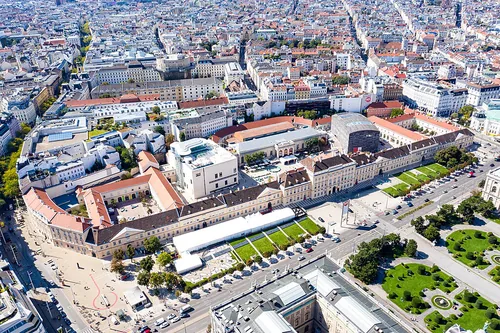
    The MQ fills the former imperial court stables, which once held up to 600 horses and 200 carriages. Today historic Baroque buildings stand next to contemporary museum architecture: 114,310 square metres, 61 cultural institutions and around five million visitors a year. Besides the Leopold Museum and MUMOK you find the Kunsthalle Wien, institutions for dance, architecture and children's culture, artist studios, cafés and restaurants.

    Before it became a cultural district, the stable buildings were used for trade fairs and exhibitions. Turning them into one large arts complex was debated for years: should the site serve big museums, public space, independent artists or urban renewal? Renovation began in April 1998, and the quarter opened in stages in June and September 2001.

    Not everyone was happy. Parts of Vienna's independent arts and media scene criticised the project, and Public Netbase, an internet culture initiative that had worked at the old trade fair site, never returned after the renovation. Researchers have since described the MQ as an Austrian cultural-policy experiment, mixing museums, cultural production, public space and city development in one place.

    The courtyards are free and open at all times, a good place to sit down between museums; each museum charges its own admission. The Leopold Museum is just 80 m, 1 minute, away.

    Hours
    Grounds/courtyards accessible 24/7; MQ ticket & info shop daily 10:00–19:00
    Price
    FREE (courtyards), museums charge separate admission
    Website
    mqw.at ↗
  9. 9

    Leopold Museum

    Leopold Museum in Vienna, stop 9 on the self-guided walking tour

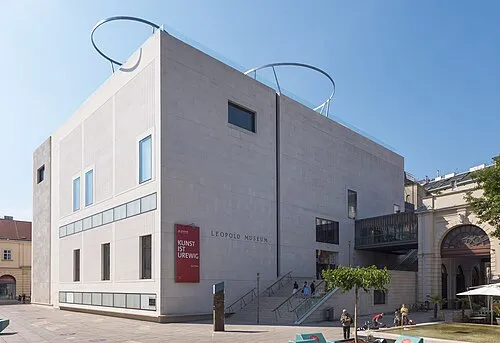
    The Leopold Museum holds one of the largest collections of modern Austrian art and the world's largest collection of Egon Schiele, alongside Gustav Klimt, Oskar Kokoschka and Richard Gerstl. The core is Austrian art of the first half of the 20th century, and walking through it you can follow the shift from the Vienna Secession and Jugendstil to Expressionism, with 19th century works for context.

    The collection is the life's work of a couple. Elisabeth and Rudolf Leopold gathered more than 5,000 works over five decades; in 1994 they were brought into a private foundation with the help of the Republic of Austria and the National Bank, and the museum opened in 2001.

    Rudolf Leopold's tough methods cast a long shadow. A 1997 profile called him a 'too passionate' collector, and the museum became entangled in disputes over art looted by the Nazis. The best known case was Schiele's Portrait of Wally, which had belonged to the Jewish art dealer Lea Bondi Jaray; after long court battles a settlement came only after Leopold's death. In 2008 the museum was accused of holding Schiele's Houses on the Lake, said to have been taken from Jenny Steiner, and in 2011 it settled with the heirs of Moriz Eisler over two paintings by Anton Romako.

    Go in if Schiele and Klimt are why you came to Vienna. MUMOK is 200 m, 3 minutes, across the quarter.

    Hours
    Mon, Wed, Thu, Fri, Sat, Sun 10:00–18:00; closed Tue
    Price
    19 EUR adults, 16 EUR reduced (under 26/over 65/disabled/unemployed), 2.50 EUR youth under 19, free under 7
  10. 10

    MUMOK

    MUMOK in Vienna, stop 10 on the self-guided walking tour

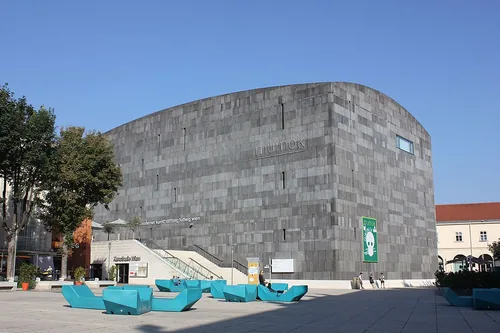
    The stone-clad building by Ortner & Ortner houses the Museum moderner Kunst Stiftung Ludwig Wien, here since 2001. Its collection of 10,000 modern and contemporary works includes Andy Warhol, Pablo Picasso, Joseph Beuys, Nam June Paik, Wolf Vostell, Gerhard Richter, Jasper Johns and Roy Lichtenstein, and it is known for its large holdings of Viennese Actionism.

    The museum started far from here. It was founded on 21 September 1962 as the Museum of the Twentieth Century in the Swiss Garden, inside the Austrian Pavilion that Karl Schwanzer had built for Expo 58 in Brussels. Founding director Werner Hofmann had the difficult task of building a modern collection almost from scratch, and within a few years he bought major works of classical modernism.

    The Ludwig name came later. In 1977 Hans Mayr, then president of the Vienna Künstlerhaus, brought an exhibition from the Aachen collection of Peter and Irene Ludwig to Vienna, and while it was still running the couple agreed to lend works. Around one hundred loans were agreed in a first contract, almost double that by the time the second venue opened in the Palais Liechtenstein on 26 April 1979, and in 1981 the Ludwigs gave the museum more than 230 works.

    If you can only manage one museum in the MQ, pick the Leopold for Vienna around 1900 and MUMOK for international art after the war. From here it is 390 m, 6 minutes, back to the Kunsthistorisches Museum on Maria-Theresien-Platz.

    Hours
    Tue–Sun and public holidays 10:00–18:00, closed Monday
    Price
    18 EUR adults, 15 EUR reduced (65+/students under 27/disabled), free under 19
    Website
    mumok.at ↗
  11. 11

    Kunsthistorisches Museum

    Kunsthistorisches Museum in Vienna, stop 11 on the self-guided walking tour

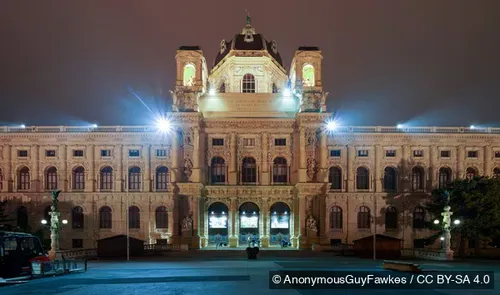
    The Kunsthistorisches Museum is the largest art museum in Austria, a festive palace on the Ringstrasse crowned by an octagonal dome 60 metres high. Gottfried Semper and Karl von Hasenauer planned it together with the Natural History Museum opposite, and Emperor Franz Joseph opened it around 1891. His goal was a worthy home for the Habsburg art collection and, for the first time, access for the public.

    Look at the sandstone Renaissance Revival façade with its large arched windows, then step inside if you can: the interior is lavish with marble, stucco, gold leaf and murals, among them paintings by Gustav Klimt, his brother Ernst Klimt, Franz Matsch, Hans Makart and Mihály Munkácsy.

    The collections come from Habsburg collectors: the portraits and armour of Ferdinand of Tirol, the treasures of Emperor Rudolph II and the paintings of Archduke Leopold Wilhelm. In the picture gallery you meet Jan van Eyck's Cardinal Niccolò Albergati, Antonello da Messina's San Cassiano Altarpiece, Raphael's Madonna of the Meadow, Dürer's Adoration of the Trinity, Titian's The Bravo and his Isabella d'Este, and Bruegel's Tower of Babel. The Egyptian collection even contains the tomb of an Egyptian prince, brought to Vienna and reassembled for Franz Joseph.

    If you enter only one museum on this loop, make it this one, and give it a couple of hours. Then comes one of the longer stretches: 1340 m, 18 minutes, to Karlskirche.

    Hours
    Daily 10:00–18:00, Thursday until 21:00
    Price
    22 EUR adults, 19 EUR reduced (students under 25/seniors 65+), free under 19
    Website
    khm.at ↗
  12. 12

    Karlskirche

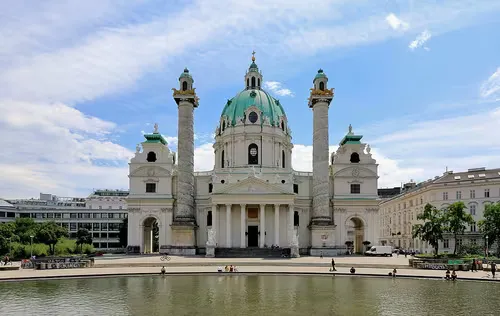
    Karlskirche in Vienna, stop 12 on the self-guided walking tour

    Karlskirche began as a promise. In 1713, a year after the last major plague epidemic in Vienna, Emperor Charles VI vowed to build a church for his namesake saint, Charles Borromeo, revered as a healer of plague victims. Johann Bernhard Fischer von Erlach won the competition against Ferdinando Galli-Bibiena and Johann Lukas von Hildebrandt. Building began in 1716; after Fischer's death in 1723 his son Joseph Emanuel finished it in 1737, shortening and altering the dome.

    The façade is a deliberate mix of quotations. In the centre a portico like a Greek temple leads to the entrance; the two columns beside it, by Lorenzo Mattielli, were inspired by Trajan's Column in Rome; the tower pavilions show the Roman Baroque of Bernini and Borromini; and over it all the dome rises on a high drum. The church once had a direct line of sight to the Hofburg and served as the imperial patron parish church until 1918.

    Two stories stay with this place. Antonio Vivaldi was buried in the cemetery next to the church on 28 July 1741, but his grave has been lost, and the church honours him with regular Vivaldi concerts. And on 10 August 1933, the 19-year-old actress and later inventor Hedy Lamarr married the Austrofascist Friedrich Mandl in its chapel.

    Going inside costs admission and is worth it if Baroque churches are your thing. The Belvedere is 1220 m, 17 minutes, away, and fittingly it is the work of Hildebrandt, who lost the Karlskirche competition.

    Hours
    Mon–Sat 09:00–18:00, Sun/holidays 11:45–19:15
    Price
    9.50 EUR (adults), 6 EUR (students), FREE (under 10)
  13. 13

    Belvedere Palace

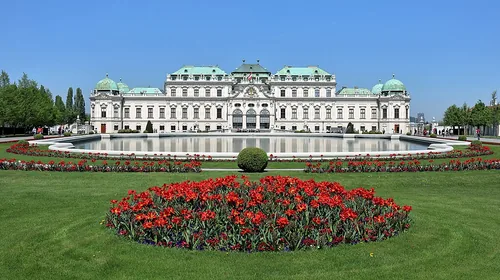
    Belvedere Palace in Vienna, stop 13 on the self-guided walking tour

    The Belvedere was the summer residence of Prince Eugene of Savoy: two Baroque palaces, the Upper and the Lower Belvedere, with the Orangery, the Palace Stables and a formal Baroque garden, on the south-eastern edge of the historic centre in the third district. Johann Lukas von Hildebrandt designed most of it, and it was completed in the early 18th century. It belongs to the Historic Centre of Vienna World Heritage Site.

    It was built on the wealth of victory. Prince Eugene's campaigns against the Ottoman Empire ushered in a building boom in the imperial capital, and on 30 November 1697 he bought land south of the Rennweg, the main road to Hungary. For his city palace he had used Fischer von Erlach, but here he chose Hildebrandt, whom he had met on campaign in Piedmont and who had already built Ráckeve Palace for him in 1702 on Csepel island in the Danube south of Budapest.

    Today the Belvedere is one of Austria's major art museums, presenting Austrian art from the Middle Ages to the present. The Upper Belvedere holds the permanent collection, the Lower Belvedere hosts special exhibitions, and Belvedere 21 is devoted to contemporary art, film and music. Upper and Lower have separate tickets; if you choose one, the Upper Belvedere with the permanent collection is the classic visit.

    Next comes the longest leg of the loop: 1690 m, 24 minutes, to the Vienna State Opera.

    Hours
    Daily 09:00–18:00 | Jul 15-Aug 31: Daily 09:00–19:00
    Price
    23 EUR Upper Belvedere, 20 EUR Lower Belvedere
  14. 14

    Vienna State Opera

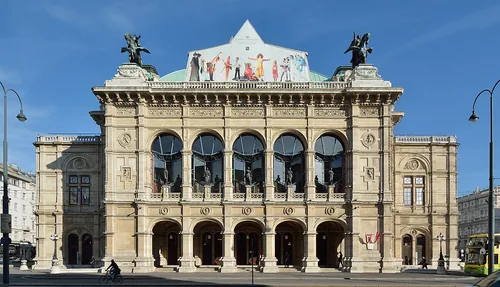
    Vienna State Opera, stop 14 on the self-guided walking tour

    The Staatsoper was the first major building on the Ringstrasse, commissioned by the city expansion fund and paid for by Emperor Franz Joseph, who chose the site in 1861. August Sicard von Sicardsburg and Eduard van der Nüll drew the plans, the Czech architect and contractor Josef Hlávka built it, and it opened in 1869 as the Court Opera in the presence of Franz Joseph and Empress Elisabeth. The Renaissance Revival house has 1,709 seats and took its current name in 1921, after the First Austrian Republic was founded.

    It continues a much older tradition: the old Court Opera stood inside the Hofburg from 1636. Today the house is home to the Vienna State Ballet, the members of the Vienna Philharmonic are recruited from its orchestra, and each carnival season it hosts the Vienna Opera Ball.

    Take a moment for the stone. The planned main stone, Kelheimer, could not be delivered in the quantity needed, so builders used a mix: Wöllersdorfer stone for plinths and buttresses, the famously hard Kaiserstein for the richly decorated parts, Breitenbrunner stone as a substitute for Kelheimer, and stone from Jois as a cheaper alternative. Van der Nüll, by the way, also designed the bases of the equestrian statues on Heldenplatz.

    A guided building tour charges admission and is the way in if you are not attending a performance; tickets for performances are sold at the box office. The Albertina is only 140 m, 2 minutes, away.

    Local name
    Wiener Staatsoper
    Hours
    Bundestheaterkassen box office Mon–Sat 10:00–18:00, Sun/holidays 10:00–13:00
    Price
    Guided building tour: 12 EUR adults, 7 EUR children from age 6
  15. 15

    Albertina

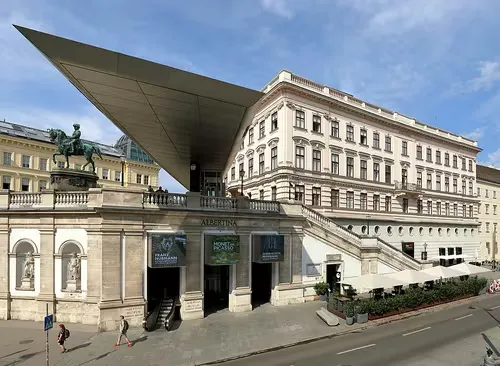
    Albertina in Vienna, stop 15 on the self-guided walking tour

    The Albertina houses one of the largest and most important print rooms in the world: about 65,000 drawings and about a million old master prints, plus modern graphics, photographs and architectural drawings. On permanent loan it also shows two significant collections of Impressionist and early 20th century art, alongside temporary exhibitions, and just over a million people visited in 2025.

    The palace stands on the Augustinian Bastion, one of the last remaining pieces of Vienna's fortifications. In the 17th century the court construction office stood here; in 1744 its director, Count Silva-Tarouca, turned it into his palace. Later Albert Casimir, Duke of Teschen, took it over, brought his graphics collection from Brussels, where he had been governor of the Habsburg Netherlands, and had Louis Montoyer extend the building. Since then the palace has bordered directly on the Hofburg.

    The collection itself began with a gift: in 1776 the Genoese count Giacomo Durazzo, Austria's ambassador in Venice, presented nearly 1,000 works to the duke and his wife Maria Christina, a daughter of Maria Theresa. Albert's successors expanded it, and his grandson Archduke Albrecht lived here until 1895.

    The Albertina charges admission and suits anyone who loves drawing or wants Impressionists without a long museum day. From here it is 810 m, 11 minutes, to St. Stephen's Cathedral.

    Hours
    Daily 10:00–18:00, Wednesday & Friday until 21:00
    Price
    20.90 EUR adults, 17.50 EUR reduced (19-26 / 65+), free under 19
  16. 16

    St. Stephen's Cathedral

    St. Stephen's Cathedral in Vienna, stop 16 on the self-guided walking tour

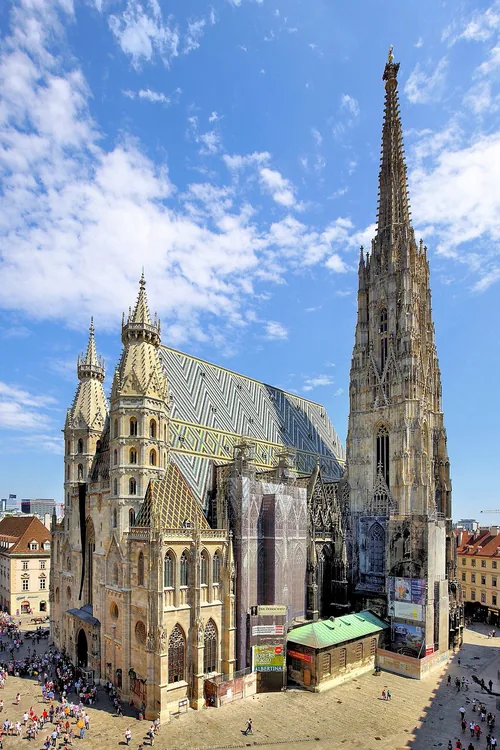
    The Stephansdom is the mother church of the Archdiocese of Vienna and the seat of Archbishop Josef Grünwidl, the most important religious building in the city and, with its multi-coloured tile roof, one of its best known symbols. Its present Romanesque and Gothic form was largely started by Duke Rudolf IV in the 14th century, on the ruins of two earlier churches, the first a parish church consecrated in 1147.

    The church goes back to a deal. In 1137 the Bishop of Passau and Margrave Leopold IV signed the Treaty of Mautern, which called Vienna a civitas for the first time and set aside land for a new parish church: this one. People long believed it was built in an open field outside the walls, but in 2000, digging for a heating system turned up graves 2.5 metres beneath the surface, carbon-dated to the 4th century. The church probably stands on an ancient Roman-era cemetery, and an even older religious building may have stood here before St. Rupert's, considered the oldest church in Vienna.

    The cathedral has witnessed many key moments in Habsburg and Austrian history. Going inside is free; the towers and the catacombs have their own tickets, and their visiting windows can shift around services. On the square, keep walking past costumed concert sellers.

    The Plague Column on the Graben is 430 m, 6 minutes, away.

    Local name
    Stephansdom
    Hours
    Cathedral Mon–Sat 06:00–22:00, Sun/holidays 07:00–22:00. Tower/catacomb visiting windows Mon–Sat 9:00–11:30 & 13:00–16:30, Sun/holidays 13:00–16:30 (subject to liturgical changes).
    Price
    FREE (interior), 6 EUR (towers), 7 EUR (catacombs)
  17. 17

    Plague Column

    Plague Column in Vienna, stop 17 on the self-guided walking tour

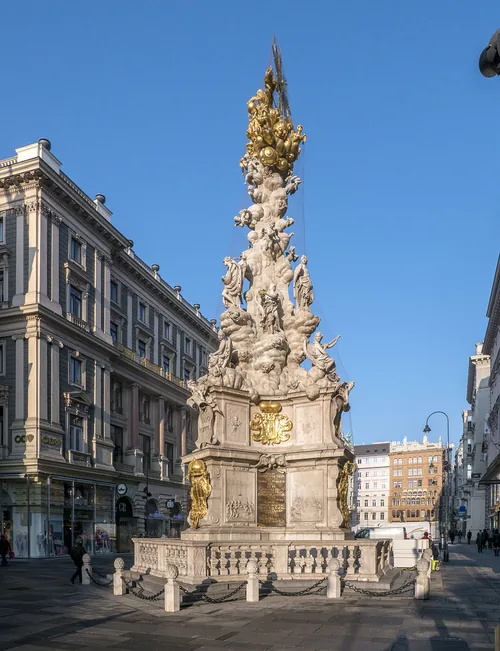
    The Pestsäule, also called the Trinity Column, stands on the Graben and is one of the best known sculptures in Vienna; an art historian has called it one of the most ambitious and innovative sculptural ensembles created in Europe after Bernini.

    It goes back to the plague of 1679, one of the last great epidemics in the city. Emperor Leopold I fled Vienna and vowed to build a mercy column if the plague ended. That same year a provisional wooden column by Johann Frühwirth was put up, with the Holy Trinity on a Corinthian column and nine angels for the nine choirs of angels. In 1683 Matthias Rauchmiller received the commission for the permanent monument; he died in 1686, but his basic idea and three of his angels survive on the column you see.

    More designs followed, including one by Johann Bernhard Fischer von Erlach, who created the sculptures at the base. Finally Paul Strudel took charge, working from a concept by the theatre engineer Lodovico Burnacini: a pyramid of clouds full of angels, with Emperor Leopold kneeling in prayer to a figure of Faith. Look for the kneeling emperor; he is the key to the whole story. Tobias Kracker and Johann Bendel were among the many sculptors involved.

    Inaugurated in 1694, the column still looks remarkably unified despite the long building period. It marks Vienna's turn to High Baroque theatre in stone and was copied throughout Austria. It is free to see at any time. The Spanish Riding School is 880 m, 12 minutes, from here.

    Local name
    Pestsäule
    Hours
    24/7 (public monument)
    Price
    FREE
  18. 18

    Spanish Riding School

    Spanish Riding School in Vienna, stop 18 on the self-guided walking tour

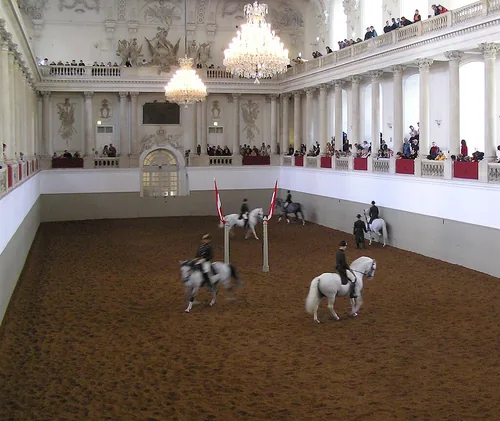
    The Spanische Hofreitschule preserves classical dressage and trains Lipizzaner stallions, and it counts among the 'Big Four' classical riding academies with the Cadre Noir, the Portuguese School of Equestrian Art and the Royal Andalusian School. It sits inside the Hofburg between Michaelerplatz and Josefsplatz, and it was first named in 1565, making it the oldest of its kind in the world. The name comes from the Spanish horses that formed one basis of the Lipizzan breed, the only breed used here.

    For a long time the school worked in a wooden arena at Josefsplatz. In 1729 Emperor Charles VI commissioned Joseph Emanuel Fischer von Erlach, the same architect who finished Karlskirche, to build the Winter Riding School, completed in 1735. The hall is mostly white with touches of beige and light grey, 55 by 18 metres and 17 metres high. Over the royal box hangs a portrait of Charles VI, and the riders salute it every time before they ride.

    The 68 resident stallions get a summer break: in July and August they spend seven weeks at the summer stables in Heldenberg-Wetzdorf in Lower Austria, where they are not schooled but ridden out in the forest.

    You can visit on a guided tour or watch the morning exercise with music, where the price depends on the seat category. If you want to see the horses at work, the morning exercise is the better choice. From here it is 200 m, 3 minutes, back to the Hofburg, and the loop is complete.

    Local name
    Spanische Hofreitschule
    Hours
    Daily 09:00–16:30; closed Mondays in the Oct–May season
    Price
    Guided tour: 24 EUR adults, reduced rate for children 6–18, children 3–6 free. Morning exercise with music (Morgenarbeit): 18–29 EUR depending on seating category
    Website
    srs.at ↗
Walking tour route map of Vienna Route loaded
Hofburg PalaceHeldenplatzVolksgartenBurgtheater+14
All 18 stops are already on the map.
You just press start.
AI Tour Guide

You know the route now. Walk it with a guide in your ear.

Press start wherever you are, even hundreds of kilometres from Vienna, and the guide begins telling its stories right away. In the city, pick any of the 18 stops to start from: it leads you there, then talks with you the whole route, asking, listening, remembering, and shaping the tour around your answers.

18stops 9.8km 2 h 17 minwalking 13languages
▶Start the tour free

Free to start · Runs in your browser · No app, no download

Shorter Ways to Walk the Loop

The loop splits neatly into a museum half and a baroque and old-town half, and the core around the cathedral works on its own as a short first outing.

Museums and the Ringstrasse

Stops: 1, 2, 3, 4, 5, 6, 7, 8, 9, 10, 11

For a day built around palaces and museums. From Hofburg Palace via Heldenplatz, the Volksgarten, the Burgtheater and City Hall to the twin museums and the MuseumsQuartier, ending at the Kunsthistorisches Museum: 44 minutes of walking. Heldenplatz, the Volksgarten, City Hall, Maria-Theresien-Platz and the MQ courtyards are free; the Hofburg, the theatre tour and the four museums charge admission.

Baroque Vienna and the old town

Stops: 12, 13, 14, 15, 16, 17, 18, 1

For a second day, or if you have already done the museums. From Karlskirche out to Belvedere Palace, back to the Opera and the Albertina, then via St. Stephen's Cathedral and the Graben to the Spanish Riding School and the Hofburg: 75 minutes of walking. The cathedral interior and the Plague Column are free; Karlskirche, the Belvedere, the Opera tour, the Albertina, the Riding School and the Hofburg charge admission.

Short centre loop

Stops: 14, 15, 16, 17, 18, 1, 2, 3

For a first look at the centre in a couple of hours. From the Vienna State Opera past the Albertina to St. Stephen's Cathedral, the Plague Column, the Spanish Riding School and the Hofburg, finishing on Heldenplatz and in the Volksgarten: 40 minutes of walking. The cathedral interior, the column, the square and the park are free, so you can walk it without buying a single ticket.

How Long Does This Vienna Loop Take?

Most of the walking comes in three stretches: 18 minutes from the Kunsthistorisches Museum to Karlskirche, 17 minutes on to Belvedere Palace and 24 minutes from there to the Vienna State Opera. Everything else is a chain of short hops, many of them under five minutes, so the first half feels like one continuous stroll through the palace, the parks and the Ringstrasse buildings.

Looking at each stop from outside and stepping into the free places, you need about five hours. Interiors change the day far more than the walking does: a big museum such as the Kunsthistorisches Museum is a visit of a couple of hours on its own. Choose one or two and you have a full day; eleven stops charge admission, and trying to enter all of them in one go does not work.

Split into halves, the museum half takes 44 minutes of walking, the baroque and old-town half 75 minutes, and the short centre loop 40 minutes, plus whatever time you spend inside.

Before You Set Off from the Hofburg

  • Start and finish: Hofburg Palace is the recommended start, and the loop brings you back there via the Spanish Riding School. You can join at any stop; the GPS navigation leads you from stop to stop in the recommended order.
  • Time of day: Start in the morning if you plan to go inside a museum or two: the walk with short stops already fills half a day, and the interiors keep daytime hours. Check the hours of any museum you want to enter on the day itself, as they differ from house to house.
  • Free and paid: Free: Heldenplatz, the Volksgarten, City Hall with its free public tours, Maria-Theresien-Platz, the MQ courtyards, the interior of St. Stephen's and the Plague Column. Everything else charges admission, including the towers and catacombs of the cathedral.
  • Saving on tickets: The Kunsthistorisches Museum is a little cheaper if you buy online instead of at the desk. The combined ticket 'Treasures of the Habsburgs' with the Imperial Treasury saves money only if you really plan both visits; the Treasury now works with time slots.

Food and Breaks Between Museums and Cathedral

Vienna eats well along this loop, from a sausage stand to a garden restaurant, and the classic coffeehouse break is easy to fit in if you skip the longest queues.

Bitzinger sausage standLocals call it the gold standard of Würstelstände. Order a Käsekrainer with an Ottakringer beer and look for the giant rabbit on the roof. (In front of the Albertina)
Glacis BeislA vine-covered garden on the old city walls, with a restaurant on the site since the 1940s and a strong list of natural wines. A relaxed, very Viennese lunch between museums. (Behind the Leopold Museum in the MuseumsQuartier)
TrzesniewskiOpen sandwiches on dark rye with 27 toppings, from truffle egg to lentil with beetroot. Pair them with a Pfiff, a tiny eighth of a beer. Genuinely good despite the crowds around it. (Stephansplatz and Graben area)
Kaiserschmarren from DemelWatch the shredded pancake being made fresh at the stand. Demel itself, a Vienna institution since 1786, is on Kohlmarkt and sells sweets, jams and gift boxes. (Stand outside St. Stephen's Cathedral)
Sachertorte without the Sacher queueThe cake is worth it, the queue at Café Sacher is not. Demel, Café Central, Café Oper Wien or Café Sperl, a coffeehouse since 1880 with homemade torte, serve it for noticeably less.
Gasthaus ReinthalerA family-run Gasthaus serving a proper breaded veal schnitzel with salad at a much lower price than the hotel dining rooms. Do not confuse it with the other Reinthaler places in town. (Gluckgasse 5, a few minutes' walk from the Opera)
MittagsmenüTraditional restaurants offer a set lunch menu at a steep discount over the evening card. Café Museum's two-course lunch is a good example.

Tourist Traps to Avoid in Vienna's Centre

  • Costumed Mozart concert sellers: Sellers in period dress imply prestigious performances; the shows are low-quality tourist productions. Book concerts directly with the venue instead. (Stephansplatz outside St. Stephen's Cathedral)
  • Shell games: They work in teams: anyone you see winning belongs to the crew. Walk on. (Stephansplatz)
  • Clipboard petitions: Someone pushes a petition for a charitable cause in front of you, then presses for a donation or uses the distraction to pick your pocket. Decline every clipboard and watch anyone standing unusually close. (Stephansplatz, outside the Kunsthistorisches Museum and on Heldenplatz)
  • Currency exchange kiosks: Hidden fees make these kiosks a poor deal. Use a bank card instead. (Around Stephansplatz)
  • Queuing at Figlmüller in the 1st district: Waits of 45 minutes are common without a booking, while the suburban branches serve the same quality.
Walking tour route map of Vienna
AI Tour Guide

Your guide is ready at the Hofburg whenever you are.

Press start and a voice AI Tour Guide takes it from here: leading the route through Vienna, telling the stories, and turning your walk into a real back-and-forth conversation. No app or download is needed; it runs in your browser.

18stops 9.8km 2 h 17 minwalking 13languages
▶Start the tour free

Free to start · Runs in your browser · No app, no download

What the AI Tour Guide Adds Around the Ring

On a loop this dense, the AI Tour Guide turns the walk into a conversation: it greets you at the Hofburg, tells the stories of each place and asks what you care about most, Habsburg family dramas, the Ringstrasse architects or the art. It remembers your answers and leans into them later, and you can interrupt it whenever something catches your eye, for instance to ask what Viennese Actionism actually was before you decide on MUMOK, or why Archduke Charles earned his statue on Heldenplatz. The route stays the same; the GPS navigation leads you from stop to stop. You start with 100 free credits; after that, this tour costs €19.99 all-inclusive with no time limit, or €5 per hour.

A Real Conversation A voice AI Tour Guide greets you, leads the whole route, and tells the stories and facts as you walk, asking what you want to see and keeping a real conversation going. Not a recording you press play on.
Map Navigation Follow the route on the map and walk at your own pace. You choose where to start and when to move to the next stop.
Ask Anything Curious about a building you pass? Ask your AI Tour Guide on the spot and the conversation carries on.
13 Languages Switch language anytime. No separate tour needed.
Start free in your browser

Common Questions About Walking Vienna

Which stops on this loop work best with children?

The Natural History Museum is the obvious pick. Several big museums on the route let visitors under 19 in free: the Natural History Museum, MUMOK, the Kunsthistorisches Museum and the Albertina. The MuseumsQuartier also houses an institution for children's culture.

Do I need to dress up for the Opera or the Burgtheater?

For a performance, yes. Culture is taken seriously in Vienna: clean, neat, ironed clothes are expected, even with the cheapest tickets. For a daytime building tour, normal walking clothes are fine.

Where can I see St. Stephen's from above without the tower ticket?

The Do&Co Onyx Bar on Stephansplatz looks straight onto the square and the cathedral; you pay for a drink instead of the tower.

What makes a good day trip once I have walked Vienna?

Bratislava is 56 km away, Eisenstadt 42 km and Melk 77 km, each with its own free walking route. For a longer trip, Graz is 144 km away.

Is the tour really free?

Yes. The whole tour is free: the route, the interactive map and the navigation cost you nothing. Only the voice AI Tour Guide is optional and paid: you test it with 100 free credits, then you pay either €5 per hour or €19.99 for this whole tour, with no time limit. Admission to 9 of the 18 stops is not included: Hofburg Palace, Natural History Museum, Leopold Museum, MUMOK, Kunsthistorisches Museum, Karlskirche, Belvedere Palace, Albertina and Spanish Riding School charge their own entry fees.

Do I need to download an app?

No. Everything runs in your phone browser. Open the route and start walking, no download and no sign-up required.

Do I need to book the walking tour in advance?

No booking needed. This self-guided tour is available anytime. Open the route in your browser and start walking. The AI Tour Guide works instantly, no app, no reservation required.

What languages is the AI Tour Guide available in?

The AI Tour Guide speaks 13 languages, so you take the tour in your own language and can switch at any time.

Can I skip stops or change the route?

Yes. Skip any stop, spend extra time at places you like, or start the route from any point. It is your walk, you set the pace.
Image credits
▶ Start free in your browser Runs in your browser, no app, no download