Free Walking Tour Burgos: Arch, Cathedral and El Cid

Pass under the Arco de Santa María, stand before a stone altarpiece and the cathedral, then follow the river promenade to El Cid on horseback, all in 1.7 km.

7 Stops 1.7 km ~24 min walking
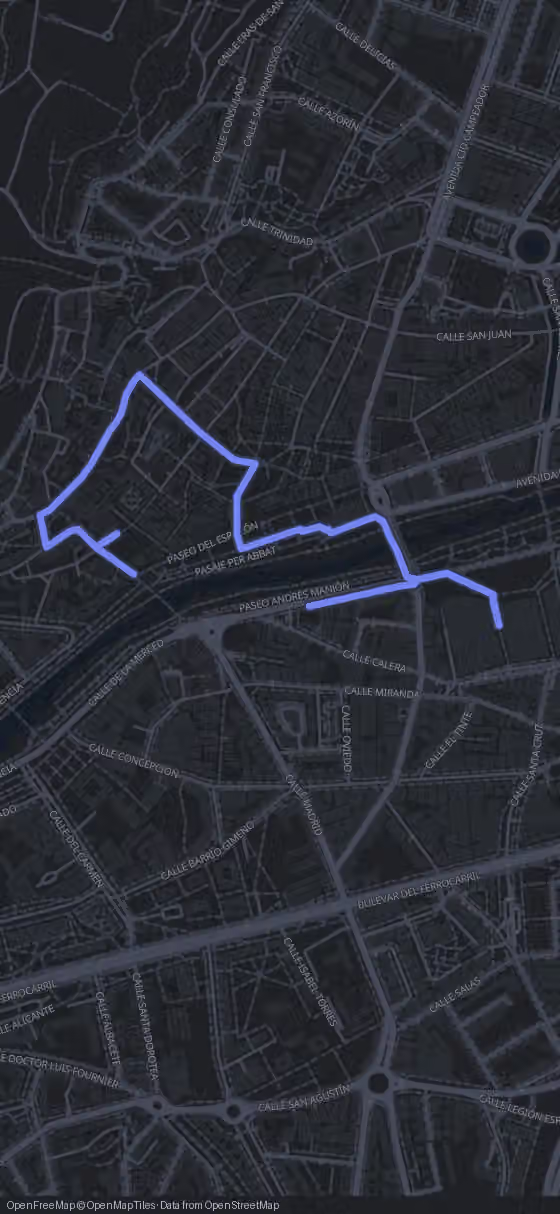
Route map for the Burgos walking tour
Stop 1 of 7
100 m·1 min
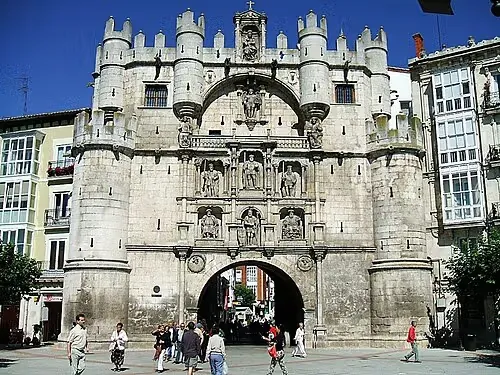
Arco de Santa María
Head north toward the Church of San Nicolás de Bari
Hola, welcome to Burgos. I'm Alex, and this city's smaller church holds a crowd carved in stone.
Try this tour with Alex

What this Burgos walk covers

Seven stops lead from the Arco de Santa María past the Church of San Nicolás de Bari, Burgos Cathedral, the Plaza Mayor and the Paseo del Espolón to the Museum of Human Evolution and the El Cid Statue: 1.7 km, 24 minutes of pure walking, about four and a half hours with all three paid interiors.

The arch, the square, the promenade and the statue cost nothing; the church, the cathedral and the museum charge entry. Route, map and GPS navigation in your browser are free, the AI Tour Guide is optional.

Open free GPS & optional AI Tour Guide
This short shows highlights of the route. All 7 stops follow below.

The Route

Walking map of Burgos, from the river gate to El Cid

7 stops 1.7 km 24 min walking
Tap to load interactive map

The 7 stops along this route

  1. Arco de Santa María in Burgos, stop 1 on the self-guided walking tour
    1Arco de Santa María
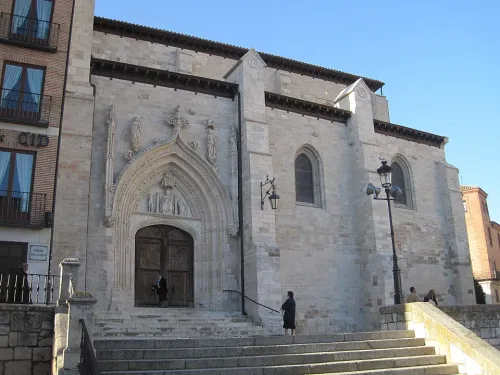
  2. Church of San Nicolás de Bari in Burgos, stop 2 on the self-guided walking tour
    2Church of San Nicolás de Bari
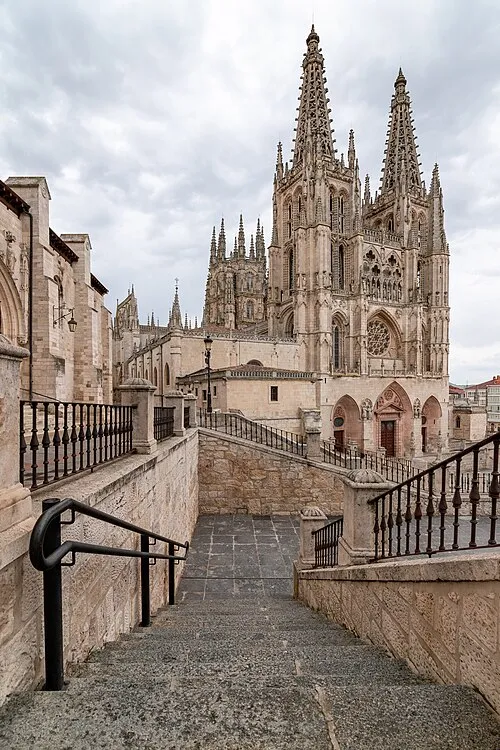
  3. Burgos Cathedral, stop 3 on the self-guided walking tour
    3Burgos Cathedral
  4. Plaza Mayor in Burgos, stop 4 on the self-guided walking tour
    4Plaza Mayor
  5. Paseo del Espolón in Burgos, stop 5 on the self-guided walking tour
    5Paseo del Espolón
  6. Museum of Human Evolution in Burgos, stop 6 on the self-guided walking tour
    6Museum of Human Evolution
  7. El Cid Statue in Burgos, stop 7 on the self-guided walking tour
    7El Cid Statue
  8. That's the full route.

    Walk it with an AI Tour Guide talking you through every one of these streets.

    Start free in your browser
    You made it

Your walking tour of Burgos, each stop explained

  1. 1

    Arco de Santa María

    Arco de Santa María in Burgos, stop 1 on the self-guided walking tour

    Begin on the river side of the Arco de Santa María, where the Santa María bridge over the Arlanzón runs straight into it. Pass through and you are in the Plaza del Rey San Fernando, facing the cathedral. In the Middle Ages this was one of the twelve gates in the city wall of Burgos, first called the Puerta de la Puente de Yuso. A simpler gate from the 11th century stood here before, and the Cantar de mio Cid names it as the way the Cid rode in and out of the city whenever his campaigns called him.

    What you see today is a 16th-century makeover with a political motive. After the revolt of the Comunidades, the city council decided on 7 March 1531 to rebuild the gate in honour of Emperor Charles V, recalling how Burgos had welcomed him in 1520. The new arch was meant to win back his favour. The tower itself had long belonged to the city government: already in the 14th century justice was handed down inside it.

    The building work turned into a quarrel in stone. The sculptor Felipe Bigarny drew the first plans and problems began at once. In 1536 the council rejected his new design, which he reworked with Cristóbal de Andino, who had helped rebuild the Santa María bridge after the flood of 1527. Then Francisco de Colonia tore down the old portal and raised the new gate in 1536 without following the agreed design. A councillor protested, backed by Juan de Vallejo, perhaps out of rivalry. Remember these names: several of them return in the cathedral.

    Going inside is free. If the door is open, take a quick look at the tower where the city once sat in judgement. Then walk 100 m, about a minute, to the Church of San Nicolás de Bari behind the cathedral.
    Hours
    Tue–Sat 11:00–14:00 and 17:00–21:00; Sun 11:00–14:00; closed Mondays and public holidays.
    Price
    Free
  2. 2

    Church of San Nicolás de Bari

    Church of San Nicolás de Bari in Burgos, stop 2 on the self-guided walking tour

    From the outside this church on Fernán González street, right beside the Camino de Santiago, looks modest. Inside waits one of the largest altarpieces in Spain, and the only one carved in limestone. The church was built in 1408 on the site of an older Romanesque one, and since the Church of San Esteban became a museum, San Nicolás has served as the seat of its parish.

    The altarpiece of St Nicholas was designed and made by Simón de Colonia and his son Francisco, the same Francisco who later raised the Arco de Santa María. It measures 15.55 by 9.04 metres and was paid for by the Burgos merchant Gonzalo López de Polanco before his death in 1505. The stone is a porous limestone from Hontoria de la Cantera, a small town in the province, normally used for buildings such as the cathedral, rarely for altarpieces. The great high altars of Toledo, Seville, Oviedo and El Paular are similar in scale, but most of them were carved in wood and painted. Here you look at the only stone altarpiece that survives from late medieval Burgos.

    Take time for the rest too: Gothic tombs, the Renaissance arch of María Sáez de Oña and Fernando de Mena, and the panels of the painter known as the Master of San Nicolás. Many of these works were also funded by the Polanco family. Spain declared the church a National Monument on 26 January 1917.

    Entry is paid, and if you like sculpture, it is well worth it. It also sets up the cathedral: same stone, same family of masters. From here it is 250 m, four minutes, to Burgos Cathedral.

    Hours
    Daily 11:30–19:00
    Price
    4 EUR; reduced 3 EUR; combined ticket San Nicolás, San Gil and San Esteban 7 EUR; free on Tuesdays 17:00-19:00
  3. 3

    Burgos Cathedral

    Burgos Cathedral, stop 3 on the self-guided walking tour

    Work on Burgos Cathedral began in 1221, following French Gothic models. Look at the main façade first: its design is related to the great cathedrals of Paris and Reims, with three tiers framed by two square towers. The openwork spires on top are later, added in the 15th century by Juan de Colonia with a clear German influence. They, the Constable's Chapel and the lantern tower over the crossing, all in late flamboyant Gothic, give the building the outline you recognise from a distance.

    Walk around before you go in. The Sarmental and Coronería portals are Gothic work of the 13th century, while the Pellejería portal from the 16th century already shows Renaissance and Plateresque touches. All of it, including later alterations, was built with limestone from the quarries of Hontoria de la Cantera, the stone you just saw in the altarpiece of San Nicolás. The last major additions, the sacristy and the chapel of Santa Tecla, date from the 18th century, when the Gothic portals of the main façade were also altered.

    Inside, the elevation of the nave takes the cathedral of Bourges as its model, and the furnishings run from Gothic through Renaissance to Baroque. This is where the names from the arch come together: the Colonia family, Juan de Vallejo, Felipe Bigarny (here often spelled Vigarny), Cristóbal de Andino as master of the ironwork grilles, alongside Gil de Siloé, Diego de Siloé, the glassmaker Arnao de Flandes and painters such as Sebastiano del Piombo and Mateo Cerezo.

    The interior is the one visit on this walk not to skip, and it is worth the ticket. Allow about an hour and a half. Afterwards it is 390 m, five minutes, to the Plaza Mayor.

    Hours
    1 Nov-18 March: daily 09:30–18:00; 19 March-31 Oct: daily 09:30–18:30
    Price
    11 EUR adults, 10 EUR seniors 65+/groups of 10+, 6 EUR pilgrims with credential, 5 EUR disabled/large families/unemployed/students 19-27, 3 EUR children 8-18, children 0-7 free
  4. 4

    Plaza Mayor

    Plaza Mayor in Burgos, stop 4 on the self-guided walking tour

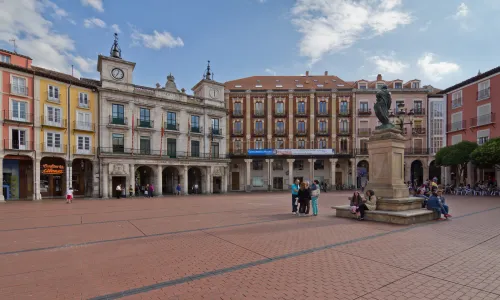
    The Plaza Mayor was once called the Plaza del Mercado Menor, the smaller market square. In the days of the city wall you reached it from outside through the Puerta de Carretas. After the walls were torn down in 1712, the city built its new town hall, the Casas Consistoriales, right over that old gate, to plans by the architect Fernando González de Lara.

    The square works as the hinge of this walk: behind you the cathedral and eight centuries of stone, ahead the trees of the Espolón. It is open at all hours and free, and you do not need to budget much time here. Get your bearings, then walk 140 m, about two minutes, to the Paseo del Espolón.

    Hours
    Open 24/7
    Price
    Free
  5. 5

    Paseo del Espolón

    Paseo del Espolón in Burgos, stop 5 on the self-guided walking tour

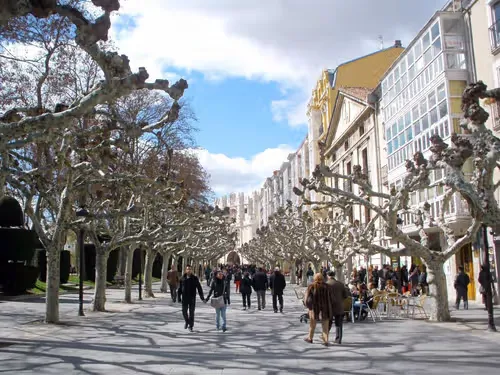
    The Paseo del Espolón is the tree-lined promenade that Burgos calls its salón, its living room. It links the Arco de Santa María, where you started, with the Teatro Principal. The name explains the place: this was flood-prone land on the bank of the Arlanzón, raised on buttresses to protect it from the river. Outside the old wall it was known as the ronda del Espolón and ran along the foot of the wall from the arch to today's provincial palace.

    Its central path, once called the paso de las Acacias, carried the road from Bayonne to Madrid. People came here to stroll and watch the stagecoaches go by. When the town hall was commissioned from Fernando González de Lara, he was also asked to lay out gardens 1,100 feet long on the right bank, between the Santa María and San Pablo bridges.

    Look for the four kings. The council agreed to set their statues in a square facing the Casas Consistoriales, but placing them dragged on until the autumn of 1795, and a dispute over widening the promenade had to go all the way to the Supreme Council of Castile. The first trees were planted at the start of the 19th century. In 1808, after the battle of Gamonal, Napoleon's troops entered the city, and General Paul Thiébault, governor of Old Castile, lodged right here in the Consulado building.

    The promenade is open at all hours and free. From here it is 470 m, seven minutes, to the Museum of Human Evolution; on the way you pass the Teatro Principal and the Puente de San Pablo.

    Hours
    Open 24/7
    Price
    Free
  6. 6

    Museum of Human Evolution

    Museum of Human Evolution in Burgos, stop 6 on the self-guided walking tour

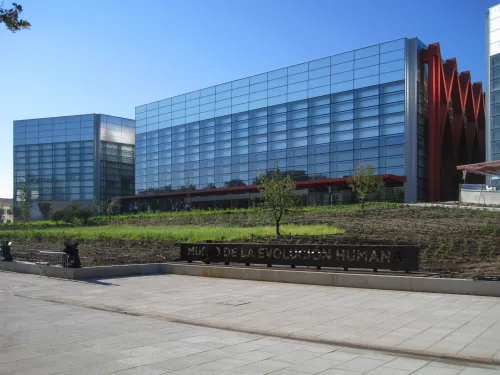
    The Museo de la Evolución Humana stands on the south bank of the Arlanzón, roughly 16 km from the Sierra de Atapuerca, home to some of the most important human fossil finds in the world. The archaeological site there was declared a World Heritage Site in 2000, and some of the exhibits come from it. The museum is the centrepiece of a complex that also includes a convention centre and the CENIEH research institute.

    The ground beneath it has its own history. This was the solar de Caballería, where the convent of San Pablo once stood, one of the leading Dominican houses in Castile. After the convent's end in the mid 19th century, military barracks replaced it; once they were demolished, the plot sat empty as a car park until the decision for a museum came in 2000. The architect Juan Navarro Baldeweg won the international competition against designs by Cruz y Ortiz, Steven Holl, Arata Isozaki and Jean Nouvel.

    It opened on 13 July 2010 and drew 279,000 visitors in its first year. Inside you find more than 25 large-format projections, a 360° projection and over 50 video sources, which makes it easy to follow even if you are not a prehistory specialist.

    If early humans interest you, or you travel with children, it is worth the ticket; allow about an hour and a half inside. Then walk 320 m, four minutes, to the El Cid Statue.

    Local name
    Museo de la Evolución Humana
    Hours
    Mon closed, Tue–Fri 10:00–14:30 and 16:30–20:00, Sat 10:00–20:00, Sun 10:00–15:00 (admission until 30 min before closing)
    Price
    6 EUR adults, 4 EUR reduced (students, 8-18 years, pilgrims, groups of 8+)
  7. 7

    El Cid Statue

    El Cid Statue in Burgos, stop 7 on the self-guided walking tour

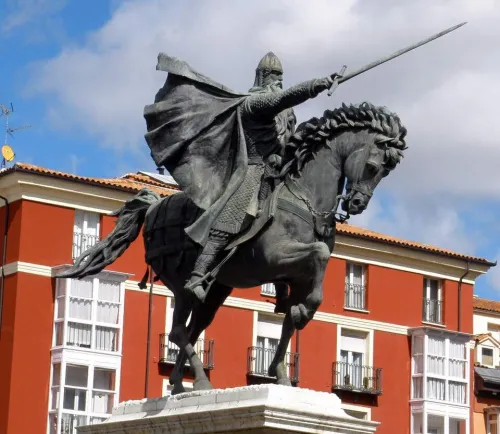
    The walk ends with the man whose name opened it. The Monumento al Cid Campeador shows Rodrigo Díaz de Vivar on horseback, a Castilian military leader born in Vivar in the province of Burgos, who at the end of the 11th century came to rule the Levante of the peninsula at the head of his own troop. At the Arco de Santa María you stood where the Cantar de mio Cid has him ride in and out of the city.

    The idea of a monument ran through the whole 20th century. King Alfonso XIII laid a first stone in 1905, but nothing followed until 1947, when mayor Carlos Quintana Palacios took it up. On 8 September 1947 the contract was signed with the Andalusian sculptor Juan Cristóbal González Quesada, working to a project by the architect Fernando Chueca Goitia.

    The statue was unveiled on 23 July 1955 by General Franco, with military parades on the ground and in the air, and the ceremony became the lead item of the NO-DO newsreel on 1 August 1955. It is one of seven equestrian monuments to the Cid worldwide, alongside those in New York, San Francisco, San Diego, Buenos Aires, Valencia and Seville. In July 2025 Burgos marked its 70th anniversary with a programme of events.

    The statue is free to see at any hour. This is where the route ends; if you want to return to the Arco de Santa María, the GPS navigation in your browser leads you back.

    Local name
    Monumento al Cid Campeador
    Hours
    Open 24/7
    Price
    Free
Walking tour route map of Burgos Route loaded
Arco de Santa MaríaChurch of San Nicolás de BariBurgos CathedralPlaza Mayor+3
All 7 stops are already on the map.
You just press start.
AI Tour Guide

You know the route now. Walk it with a guide talking you through it.

Press start wherever you are, even hundreds of kilometres from Burgos, and the guide begins telling its stories right away. In the city, pick any of the 7 stops to start from: it leads you there, then talks with you the whole route, asking, listening, remembering, and shaping the tour around your answers.

7stops 1.7km 24 minwalking 13languages
▶Start the tour free

Free to start · Runs in your browser · No app, no download

Shorter ways to walk Burgos

Not everyone wants three interiors in one day. These cuts follow the same order and keep the walking short.

Old town and cathedral

Stops: 1, 2, 3, 4, 5

For first-timers who care most about Gothic Burgos. From the Arco de Santa María to the Paseo del Espolón you walk 12 minutes in total. You pay entry at San Nicolás and the cathedral; the arch is free inside.

River, museum and the Cid

Stops: 5, 6, 7

For prehistory fans and families, or as a second half after a morning in the cathedral. Only 11 minutes on foot from the Espolón to the statue, with one ticket: the Museum of Human Evolution, with a reduced rate available.

The free outside walk

Stops: 1, 2, 3, 4, 5, 6, 7

For a first look or a tight budget: the whole route in 24 minutes of walking, every building seen from outside. The only interior you enter is the Arco de Santa María, which costs nothing.

How long the Burgos tour really takes

The 24 minutes of walking are the small part of the day. What fills it is inside: give Burgos Cathedral about 90 minutes, the Museum of Human Evolution another 90, San Nicolás around 25 and the arch some 20. The Plaza Mayor, the Espolón and the statue together need roughly half an hour.

If you start at the arch at 11:30, you reach the El Cid Statue shortly after 16:00, without a meal stop. The old town and cathedral cut takes just under three hours, the river half about two hours, and the free outside walk around one hour.

Before you set off in Burgos

  • Start and finish: The recommended start is the Arco de Santa María, but you can join at any stop. The route ends at the El Cid Statue; if you want, the GPS navigation leads you from there back to the start.
  • Best day: Before you set off, check that the arch and the museum are open on the day you go. These two interiors shape the timing of the walk more than any other stop.
  • Entrance fees: Three interiors charge admission: San Nicolás, the cathedral and the museum. The arch, the square, the promenade and the statue are free.
Walking tour route map of Burgos
AI Tour Guide

Your Burgos guide is ready whenever you are

Press start and a voice AI Tour Guide takes it from here: leading the route through Burgos, telling the stories, and turning your walk into a real back-and-forth conversation. No app or download is needed; it runs in your browser.

7stops 1.7km 24 minwalking 13languages
▶Start the tour free

Free to start · Runs in your browser · No app, no download

What the AI Tour Guide adds in Burgos

On this route the same names keep returning: the Colonia family, Bigarny, Andino, the stone from Hontoria. The AI Tour Guide leads the walk as a conversation, picks up those threads from stop to stop and follows what catches your interest, say why Charles V needed a peace offering after the Comuneros revolt, or what the Cantar de mio Cid actually tells about Rodrigo Díaz. You start with 100 free credits; after that you choose between €19.99 for this tour all-inclusive with no time limit, or €5 per hour.

A Real Conversation A voice AI Tour Guide greets you, leads the whole route, and tells the stories and facts as you walk, asking what you want to see and keeping a real conversation going. Not a recording you press play on.
Map Navigation Follow the route on the map and walk at your own pace. You choose where to start and when to move to the next stop.
Ask Anything Curious about a building you pass? Ask your AI Tour Guide on the spot and the conversation carries on.
13 Languages Switch language anytime. No separate tour needed.
Start free in your browser

Common questions about walking Burgos

Is there a combined ticket for the churches of Burgos?

Yes. One combined ticket covers San Nicolás de Bari, San Gil and San Esteban. If you only want San Nicolás, a single ticket is also available.

Do pilgrims on the Camino de Santiago pay less?

Yes, with a pilgrim credential you pay a reduced rate at the cathedral, and the Museum of Human Evolution also counts pilgrims among its reduced tickets.

Are there reduced tickets for families with children?

Yes. The youngest children enter the cathedral free, and older children and teenagers pay a reduced rate. At the museum, young people also get the reduced ticket. Large families get a reduced rate at the cathedral as well.

Which other cities nearby have a walk like this?

The closest are Bilbao at 120 km, León at 156 km and Segovia at 159 km. Madrid is 214 km away.

Is the tour really free?

Yes. The whole tour is free: the route, the interactive map and the navigation cost you nothing. Only the voice AI Tour Guide is optional and paid: you test it with 100 free credits, then you pay either €5 per hour or €19.99 for this whole tour, with no time limit. Admission to 3 of the 7 stops is not included: Church of San Nicolás de Bari, Burgos Cathedral and Museum of Human Evolution charge their own entry fees.

Do I need to download an app?

No. Everything runs in your phone browser. Open the route and start walking, no download and no sign-up required.

Do I need to book the walking tour in advance?

No booking needed. This self-guided tour is available anytime. Open the route in your browser and start walking. The AI Tour Guide works instantly, no app, no reservation required.

What languages is the AI Tour Guide available in?

The AI Tour Guide speaks 13 languages, so you take the tour in your own language and can switch at any time.

Can I skip stops or change the route?

Yes. Skip any stop, spend extra time at places you like, or start the route from any point. It is your walk, you set the pace.
Image credits
▶ Start free in your browser Runs in your browser, no app, no download