Free Walking Tour Madrid: Palace, Prado and Retiro

From Km 0 at Puerta del Sol past the Royal Palace and Picasso's Guernica to the ponds of El Retiro: Madrid's old core and its Golden Triangle of Art in one walk.

14 Stops 10.0 km ~2 h 19 min walking
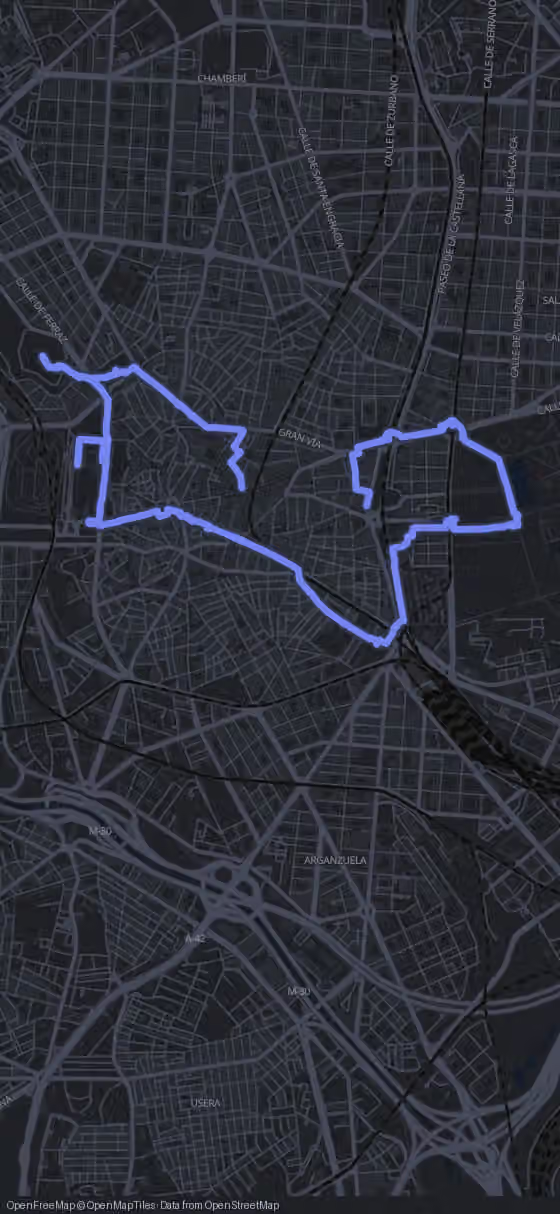
Route map for the Madrid walking tour
Stop 1 of 14
440 m·5 min
Puerta del Sol
Head north up Calle de Montera toward Gran Vía
¡Hola, welcome to Madrid. I'm Alex, and this city keeps some of its best surprises far from where they began.
Try this tour with Alex

Madrid on Foot: What This Route Covers

Fourteen stops on foot, from Puerta del Sol to the Thyssen-Bornemisza Museum: 10.0 km and 2 h 19 min of pure walking. With short stops everywhere that is about five hours; add the palace and one museum and it fills a full day.

Gran Vía, the Temple of Debod, Retiro Park, San Miguel Market and all the squares cost nothing. Tickets apply at the Royal Palace, Reina Sofía Museum and Prado Museum. Route, map and GPS navigation in your browser are free; the AI Tour Guide is optional.

Open free GPS & optional AI Tour Guide
This short shows highlights of the route. All 14 stops follow below.

The Route

Walking Map of Madrid, from Km 0 to the Paseo del Prado

14 stops 10.0 km 2 h 19 min walking
Tap to load interactive map

The 14 stops along this route

  1. Puerta del Sol in Madrid, stop 1 on the self-guided walking tour
    1Puerta del Sol
  2. Gran Vía in Madrid, stop 2 on the self-guided walking tour
    2Gran Vía
  3. Plaza de España in Madrid, stop 3 on the self-guided walking tour
    3Plaza de España
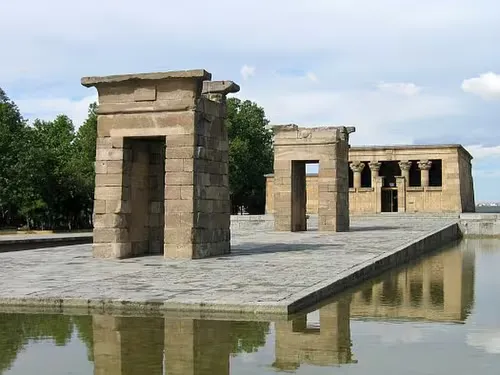
  4. Temple of Debod in Madrid, stop 4 on the self-guided walking tour
    4Temple of Debod
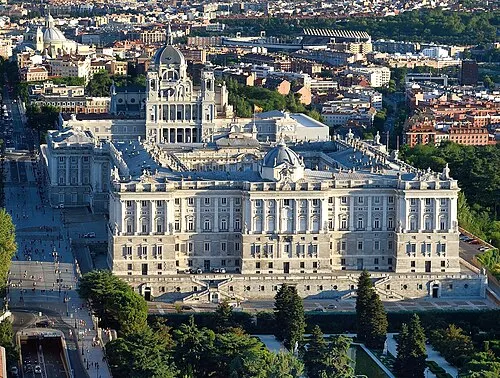
  5. Royal Palace in Madrid, stop 5 on the self-guided walking tour
    5Royal Palace
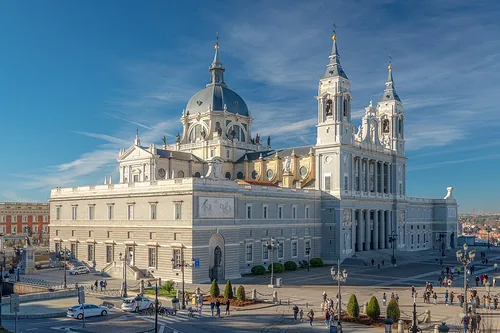
  6. Almudena Cathedral in Madrid, stop 6 on the self-guided walking tour
    6Almudena Cathedral
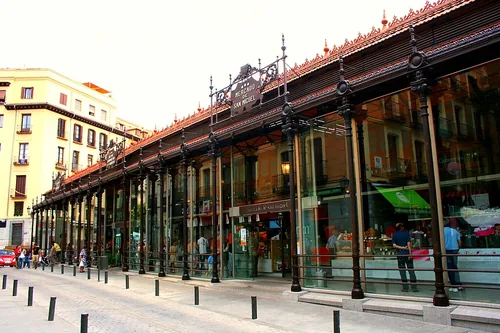
  7. San Miguel Market in Madrid, stop 7 on the self-guided walking tour
    7San Miguel Market
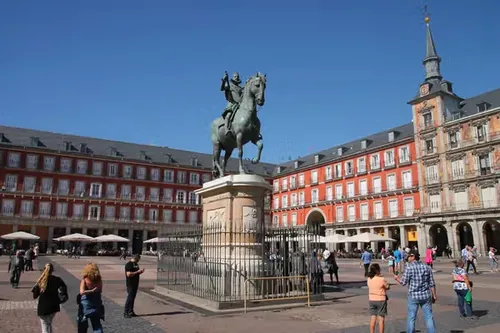
  8. Plaza Mayor in Madrid, stop 8 on the self-guided walking tour
    8Plaza Mayor
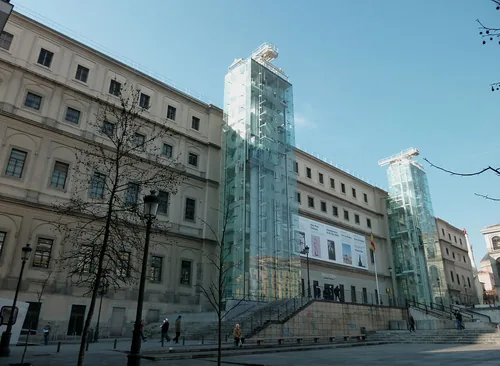
  9. Reina Sofía Museum in Madrid, stop 9 on the self-guided walking tour
    9Reina Sofía Museum
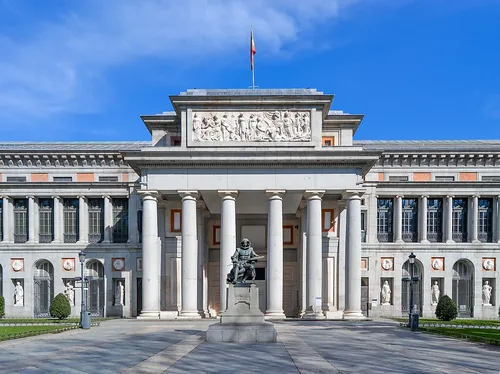
  10. Prado Museum in Madrid, stop 10 on the self-guided walking tour
    10Prado Museum
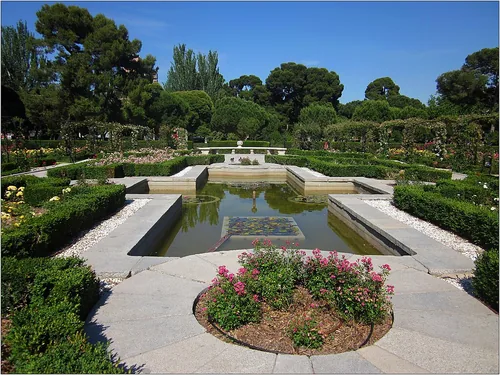
  11. Retiro Park in Madrid, stop 11 on the self-guided walking tour
    11Retiro Park
  12. Puerta de Alcalá in Madrid, stop 12 on the self-guided walking tour
    12Puerta de Alcalá
  13. Plaza de Cibeles in Madrid, stop 13 on the self-guided walking tour
    13Plaza de Cibeles
  14. Thyssen-Bornemisza Museum in Madrid, stop 14 on the self-guided walking tour
    14Thyssen-Bornemisza Museum
  15. That's the full route.

    Walk it with an AI Tour Guide talking you through every one of these streets.

    Start free in your browser
    You made it

The Madrid Walking Tour Stop by Stop: Plazas, Palace and Paintings

  1. 1

    Puerta del Sol

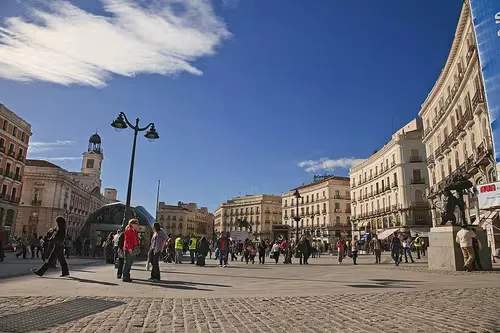
    Puerta del Sol in Madrid, stop 1 on the self-guided walking tour

    You start at Km 0. Puerta del Sol is the point from which Spain's radial road network is measured, and it is one of the busiest squares in the city. Find the clock on the old House of the Post Office: its bells mark the start of the new year, when Spaniards eat the Twelve Grapes, and the countdown from here has been broadcast live on radio and television since 31 December 1962.

    The name goes back to a gate. In the 15th century Madrid was ringed by a wall, and one of its gates faced east and was decorated with a rising sun, hence “Gate of the Sun”. Between the 17th and 19th centuries the square was the place to hear news: couriers from abroad and from all over Spain arrived at the Post Office here. The Gradas de San Felipe, by the church of Saint Philip, were one of the city's great mentideros. The word sounds like “lie factory”, but it comes from mentar, to talk about someone, so think of it as a gossip corner.

    The Post Office building was designed by the French architect Jacques Marquet between 1766 and 1768. Under Franco it housed the Ministry of the Interior and State Security, a dark address for many Madrileños; today it is the seat of the President of the Madrid Community. The square has stayed political: people gathered here after the 2004 train bombings and against the Iraq War, and on 15 May 2011 protesters set up camp in the middle of the plaza, the start of the anti-austerity movement that spread through social media.

    There is nothing to enter, so ten minutes is enough. From here it is 400 metres, about six minutes, to Gran Vía.
    Hours
    Open 24/7
    Price
    Free
  2. 2

    Gran Vía

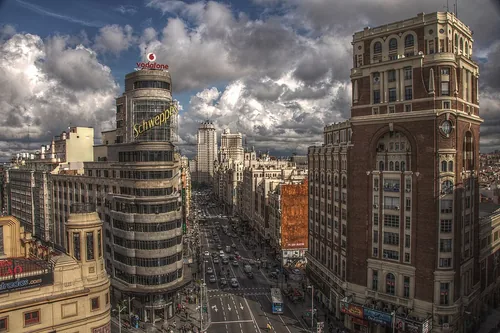
    Gran Vía in Madrid, stop 2 on the self-guided walking tour

    Gran Vía is Madrid's grand boulevard, sometimes called the Spanish Broadway: hotels, shops and big cinemas, although since the late 2000s many of those cinemas have turned into shopping centres. Keep looking up. The façades are a catalogue of early 20th-century revival styles, from Vienna Secession and Plateresque to Neo-Mudéjar and Art Deco.

    The street took a long time to happen. In the mid-19th century planners wanted a new axis from Calle de Alcalá to Plaza de España, in the spirit of Haussmann's Paris. It meant tearing down whole blocks of the old centre, and people called it “an axe blow on the map”. For decades nothing was built, and the press mocked the stalled project by calling it the Gran Vía, the Great Way. Approval finally came in 1904, digging began in 1910, and the last section was finished in 1929.

    Because it was built in three stages, it had three names. The first section, built between 1910 and 1917, was Calle del Conde de Peñalver; the second, finished in 1921, honoured the politician Francisco Pi y Margall; the third, begun in 1925, was named after Eduardo Dato, a prime minister whose violent death you will meet again at Puerta de Alcalá. Only later did the nickname become the official name.

    In 2018 the city gave one lane in each direction to pedestrians, part of a plan to widen pavements and reduce traffic in the centre. Walk the street rather than rushing it: it is 940 metres, about 12 minutes, to Plaza de España at its western end.

    Hours
    Open 24/7
    Price
    Free
  3. 3

    Plaza de España

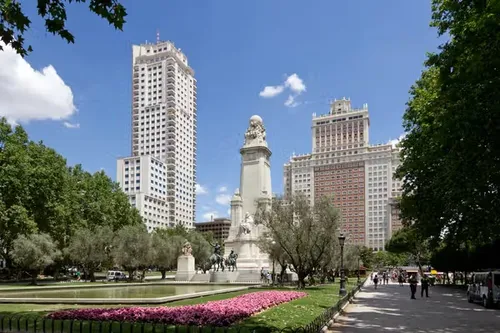
    Plaza de España in Madrid, stop 3 on the self-guided walking tour

    Plaza de España closes the western end of Gran Vía. After two and a half years of renovation it reopened to pedestrians on 22 November 2021, with planted areas around the centre for sitting. Two of Madrid's best-known towers rise over it, the Torre de Madrid and the Edificio España.

    The centrepiece is the monument to Miguel de Cervantes. Cervantes sits above; under his feet ride Don Quixote and Sancho Panza. In front of them lies a rectangular pond, and the view of the two figures with the pond and the towers behind is one of the classic pictures of the capital. The pond came later: originally the statues stood roughly where its centre is today.

    The monument was launched for the 300th anniversary of the second part of Don Quixote in 1915 and carried on into the tercentenary of Cervantes' death in 1916. The architect and sculptor Rafael Martínez Zapatero designed it with Pedro Muguruza Otaño, and Lorenzo Coullaut Valera made the sculptures: a granite base, figures in red stone from Sepúlveda with bronze additions. Look for Dulcinea and Aldonza Lorenzo, added to complete the set, and for the five continents, all shown reading the novel, a nod to how far Don Quixote travelled.

    Ten minutes here is plenty. The Temple of Debod is 560 metres away, about eight minutes on foot.

    Hours
    Open 24/7
    Price
    Free
  4. 4

    Temple of Debod

    Temple of Debod in Madrid, stop 4 on the self-guided walking tour

    An Egyptian temple in a Madrid park is not something you expect. The Temple of Debod stood for more than two thousand years 15 km south of Aswan, near the first cataract of the Nile and the great Isis sanctuary of Philae. When the Aswan High Dam threatened to flood Nubia, UNESCO launched an international campaign in 1960 to save its monuments. Spain took part, and in 1968 Egypt gave the temple as thanks. It was taken apart, shipped and rebuilt in the Parque de la Montaña between 1970 and 1972. It is one of the few ancient Egyptian buildings outside Egypt and the only one of its kind in Spain.

    Its story starts with a Kushite king, Adikhalamani of Meroë, who in the early 2nd century BC built a single small chapel to the god Amun. He is buried in pyramid number 9 at Meroe, in today's Sudan. The Ptolemaic kings, Ptolemy VI, VIII and XII, extended it on all four sides into a small temple of 12 by 15 metres dedicated to Isis of Philae, and the Roman emperors Augustus and Tiberius finished it.

    In Nubia a long processional way led from the quay through three stone gateways to the temple. Inside lay the original sanctuary of Amun, a room for offerings and a later sanctuary with side rooms; the porch with its four columns had already collapsed in 1868.

    Entry is free, which makes a short look inside worthwhile for anyone. Then comes the longest stretch of the morning: 1,350 metres, about 18 minutes, to the Royal Palace.

    Local name
    Templo de Debod
    Hours
    Winter (until 14 June / from 16 Sept): Tue–Sun + holidays 10:00–20:00 (last admission 19:30); summer (15 June-15 Sept): Tue–Sun + holidays 10:00–19:00 (last admission 18:30); Mon closed
    Price
    0 EUR (free)
  5. 5

    Royal Palace

    Royal Palace in Madrid, stop 5 on the self-guided walking tour

    The Royal Palace is still the official residence of the Spanish royal family, though it is used mainly for state ceremonies. With over 135,000 square metres and 3,418 rooms, it is the largest palace in Western Europe. Stand on the Plaza de la Armería in front of the main façade: a rusticated base, giant columns and pilasters, and the contrast of grey granite with white limestone, late Baroque at its most disciplined.

    The site is far older than the building. A Muslim fortress stood here in the 9th century; the Alcázar that replaced it held the royal treasure and housed the Trastámara kings. Expanded in the 16th century, it burned down on Christmas Eve 1734. The Bourbons built a larger palace from scratch on the same spot between 1738 and 1755, to a design by Filippo Juvarra and Giovanni Battista Marchetti, with Ventura Rodríguez, Francesco Sabatini and Martín Sarmiento. Under the Second Republic it was renamed the Palacio Nacional.

    Around it lie the Plaza de Oriente, the Sabatini Gardens beside the northern façade and the Campo del Moro gardens to the west. Inside, the draw is the sheer wealth of art and materials in the state rooms. If you care about interiors, the ticket and about an hour and a half are well spent; if you prefer stories in the open air, the façade and gardens give you a lot.

    EU citizens, EU residents with a work permit and Latin American citizens can get in free during set free-entry slots, at the ticket office only and with ID; come early. The Royal Kitchen is a separate ticket. Next, 880 metres, about 12 minutes, to Almudena Cathedral.

    Local name
    Palacio Real de Madrid
    Hours
    Winter (Oct–March): Mon–Sat 10:00–18:00, Sun/holidays 10:00–16:00; summer (Apr–Sept): Mon–Sat 10:00–19:00, Sun/holidays 10:00–16:00; last admission 1 hr before closing
    Price
    14 EUR
  6. 6

    Almudena Cathedral

    Almudena Cathedral in Madrid, stop 6 on the self-guided walking tour

    Almudena Cathedral faces the Royal Palace, and that is no accident: its grey and white baroque exterior was designed to match the palace. Yet it is surprisingly young. Building began in 1883 and the church was only consecrated in 1993, by Pope John Paul II.

    Why did Madrid wait so long for a cathedral? When the court moved here in 1561, the seat of the Spanish Church stayed in Toledo. A cathedral for the Virgin of Almudena was discussed from the 16th century on, but the costs of the empire always came first. Francisco de Cubas finally designed a parish church; in 1885 Pope Leo XIII created the bishopric of Madrid-Alcalá, and the plan became a Gothic Revival cathedral. The site may be that of a medieval mosque destroyed in 1083, when Alfonso VI took Madrid. The Civil War stopped the works, the site lay abandoned until 1950, and Fernando Chueca Goitia then reworked the exterior in baroque style.

    On 22 May 2004 the then crown prince, today King Felipe VI, married Letizia Ortiz Rocasolano here. Step inside to see the contrast: a Neo-Gothic interior filled with chapels and statues by contemporary artists, in styles from historical revival to something close to pop art.

    The cathedral is free, with a small donation requested; during services you cannot visit. The museum charges admission and suits anyone who wants more time with church history. The walk to San Miguel Market is 500 metres, about eight minutes, and leads past the Arab Wall of Madrid and Plaza de la Villa.

    Hours
    Cathedral: Sept–June 10:00–20:30 daily, July–Aug 10:00–21:00 daily (no access during services); museum: Mon–Sat 10:00–14:30
    Price
    Cathedral: 0 EUR (1 EUR donation requested); museum: 7 EUR adults, 5 EUR reduced, 3 EUR pupils
  7. 7

    San Miguel Market

    San Miguel Market in Madrid, stop 7 on the self-guided walking tour

    San Miguel Market is a hall of wrought iron and glass, 1,764 square metres of it, with marble and granite from two quarries near Madrid. The architect Alfonso Dubé took Les Halles in Paris as his model, and the market was inaugurated on 13 May 1916.

    Before the hall, there was a church: San Miguel de los Octoes, dating from the 13th century and demolished in 1809. An open-air fish market took its place, so badly kept that the city decided in the late 19th century to build a covered market instead.

    The market you walk into today is not the one locals once shopped at. Private investors bought it in 2003, restored the iron structure and reopened it in 2009. In 2017 Redevco and Are's Management acquired it for 70 million euros, and in 2018 it was relaunched as a high-end dining venue. More than 30 vendors sell freshly prepared tapas, ham, olives and baked goods, with beer, wine and champagne to go with them.

    Entry is free. It is a good place for a round of tasting and a look at the hall, less so for a cheap, filling lunch. Plaza Mayor is only 190 metres away, three minutes on foot.

    Hours
    Sun–Thu 10:00–24:00; Fri, Sat and eves of holidays 10:00–01:00
    Price
    0 EUR (Market hall, no ticket)
  8. 8

    Plaza Mayor

    Plaza Mayor in Madrid, stop 8 on the self-guided walking tour

    Walk in through one of the arches and the city noise drops away. Plaza Mayor is a closed rectangle of 129 by 94 metres, framed by uniform buildings with 237 balconies. Ten entrances lead in, each with its own name, among them Arco de Triunfo and Felipe III, Botoneras, Toledo and Cuchilleros. It was the centre of old Madrid.

    Long before the arcades, this was the Plaza del Arrabal, the town's busiest marketplace until the end of the 15th century, outside the old walls. In 1561 the site came under the city's control. Philip II commissioned Juan de Herrera to redesign it in classical style, but building only began in 1617 under Philip III, when Juan Gómez de Mora took charge; the square was finished in 1619.

    Its names read like a short history of Spain. After the Constitution of 1812 it became Plaza de la Constitución, like every main square in the country, and took that name again in each liberal period, the last time from 1876 until 1922. When the Bourbon king returned in 1814 it was the Plaza Real; in 1873 it became the Plaza de la República; only after the Civil War did it settle on Plaza Mayor.

    Take a slow lap and look at the balconies; the terraces here charge for the setting, so cheaper coffee and lunch are a few streets away. Then comes the longest leg of the route: 1,480 metres, about 19 minutes, to the Reina Sofía Museum, past the Anton Martin Market.

    Hours
    Open 24/7
    Price
    Free
  9. 9

    Reina Sofía Museum

    Reina Sofía Museum in Madrid, stop 9 on the self-guided walking tour

    The Reina Sofía Museum is Spain's national museum of 20th-century art, opened on 10 September 1992 and named after Queen Sofía. It stands near Atocha station at the southern end of the Golden Triangle of Art, the trio of museums along the Paseo del Prado.

    Most people come for one painting: Picasso's Guernica from 1937, the museum's most famous work. Around it the collection is mainly Spanish, with Picasso and Dalí at its heart and works by Joan Miró, Juan Gris, Julio González, Eduardo Chillida, Jorge Oteiza, Antoni Tàpies and others. Temporary exhibitions, national and international, fill many of the galleries, and the museum also runs a free art library with over 100,000 books. In 2025 it welcomed 1,601,732 visitors.

    The museum charges admission, but it also offers free entry at set times. Reserve the free ticket online; the start of the free slot is busy and rooms are cleared before closing, so it suits a focused visit to Guernica, not the whole collection.

    If modern art is your thing, give it at least an hour and a half. Then walk 770 metres, about 11 minutes, to the Prado Museum.

    Local name
    Centro Reina Sofía
    Hours
    Mon, Wed–Sat 10:00–21:00; Tue closed; Sun 10:00–14:30
    Price
    12 EUR
  10. 10

    Prado Museum

    Prado Museum in Madrid, stop 10 on the self-guided walking tour

    The Prado Museum is Spain's main national art museum, built on the old royal collection and covering European art from the 12th to the early 20th century. It holds the finest collection of Spanish painting anywhere. Goya is the most represented artist, alongside Bosch, El Greco, Rubens, Titian and Velázquez, whose eye brought many of the Italian masters to Spain. The collection counts around 7,600 paintings, 8,200 drawings, 4,800 prints and 1,000 sculptures; only a fraction, about 1,300 works, is on display.

    The building was never meant for paintings. Juan de Villanueva, the great architect of the Spanish Enlightenment, designed it in 1785 for Charles III as a Natural History Cabinet. It was Charles's grandson Ferdinand VII, urged on by his wife Queen María Isabel de Braganza, who turned it into a Royal Museum of Paintings and Sculptures. It opened to the public in November 1819. Since 2021 the Paseo del Prado and Retiro Park have been a UNESCO World Heritage Site.

    The Prado charges admission, with reduced tickets for concessions, a ticket that includes the official guidebook and an audio guide at extra cost. There is also a free slot towards the end of the day. You see the same masterpieces, but queue early and decide beforehand what you want to see: a long line can eat up the free time. Special exhibitions are not automatically free.

    For a full art day, pay and take your time; for two hours with Goya and Velázquez, the free evening works well. Retiro Park is 950 metres away, about 15 minutes on foot.

    Hours
    Mon–Sat 10:00–20:00; Sundays and public holidays 10:00–19:00; closed 1 January, 1 May and 25 December; 6 January, 24 and 31 December 10:00–14:00
    Price
    15 EUR; concessions 7.50 EUR; with official guidebook 24 EUR; audio guide +5 EUR; free for all visitors Mon-Sat 18:00-20:00 and Sundays and public holidays 17:00-19:00
  11. 11

    Retiro Park

    Retiro Park in Madrid, stop 11 on the self-guided walking tour

    After the museums, Retiro Park is where you breathe. It covers 1.4 square kilometres with gardens, monuments, galleries, an artificial lake and event venues. It belonged to the monarchy until 1868, when the Glorious Revolution opened it to the public; since 2021 it has shared UNESCO World Heritage status with the Paseo del Prado.

    It began as a royal retreat. In 1505 the Jeronimite monks moved to the site of today's Church of Saint Jerome the Royal, and the royal family had a retreat built next to the church. After Philip II brought the court to Madrid in 1561, his architect Juan Bautista de Toledo enlarged the grounds and laid out tree-lined avenues.

    The real expansion came under the Count-Duke of Olivares. In the 1620s he gave the king land for the court's leisure, then planned a second royal residence far grander than the existing villas. In the 1630s Giovanni Battista Crescenzi and Alonso Carbonell built the palace; two of its buildings survive, the Casón del Buen Retiro, once a ballroom, and the Hall of Realms. The gardens were designed by Cosimo Lotti, who had worked on the Boboli Gardens in Florence, around water: the great pond, the great canal, a narrow channel and the bellflower pond.

    Entry is free, and 45 minutes on a bench or by the water is time well spent between paintings. From the park it is 820 metres, about 11 minutes, to Puerta de Alcalá, which stands a few metres from its main entrance.

    Hours
    Spring/Summer (Apr–Sept): 06:00–00:00; Autumn/Winter (Oct–March): 06:00–22:00
    Price
    0 EUR (free)
  12. 12

    Puerta de Alcalá

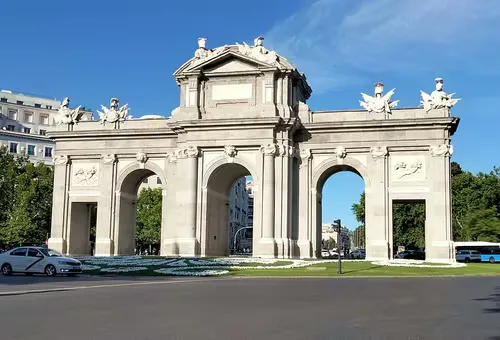
    Puerta de Alcalá in Madrid, stop 12 on the self-guided walking tour

    Puerta de Alcalá stands in the Plaza de la Independencia, a neoclassical gate in the former walls of Philip IV. Its name comes from the old road to Alcalá de Henares. In the late 18th century Madrid still looked like a rather drab town inside medieval walls, and around 1774 Charles III asked Francesco Sabatini to build a monumental gate for a widened road to Alcalá, replacing a smaller one nearby. It was inaugurated in 1778, and the central plaque still reads REGE CAROLO III ANNO MDCCLXXVIII.

    Look closely at the stone. The architecture is mainly granite from Segovia; the ornaments, carved by Francisco Gutiérrez and Roberto Michel, are white stone from Colmenar. Some surfaces still carry marks from a burst of cannon shrapnel.

    The gate has seen its share of drama. On 30 July 1854 the Count of Villahermosa, freshly defeated at Vicálvaro, paraded through with an enemy soldier's spear as a trophy, and Madrileños mockingly called him “Longinos” after the Roman soldier whose spear pierced Christ's side. On 8 March 1921, at 20:20, Prime Minister Eduardo Dato was driving home through the square when three Catalan anarchists on a motorcycle with sidecar shot him; he was dead on arrival at hospital. And because Calle de Alcalá was a livestock migration route, flocks of sheep once regularly passed through the gate.

    It is open to view at any hour and free. From here it is 500 metres, about seven minutes, to Plaza de Cibeles.

    Hours
    Open 24/7
    Price
    Free
  13. 13

    Plaza de Cibeles

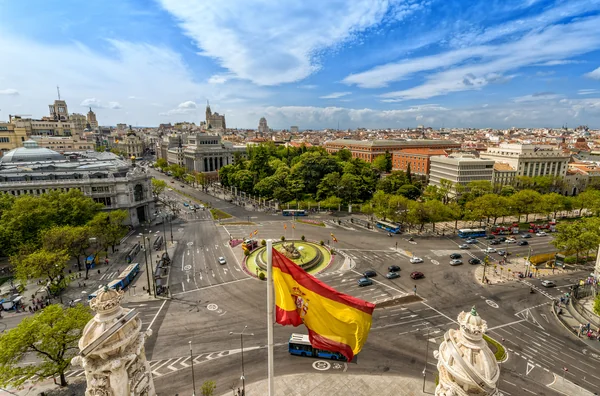
    Plaza de Cibeles in Madrid, stop 13 on the self-guided walking tour

    Plaza de Cibeles sits where Calle de Alcalá crosses the Paseo de Recoletos and the Paseo del Prado, on the border of three districts, Centro, Retiro and Salamanca. In the middle stands the Cibeles fountain, carved in 1782 to a design by Ventura Rodríguez. It shows Cybele, a Phrygian goddess linked with the Greek Rhea, wife of the titan Cronos.

    Each corner is held by a landmark built between the late 18th and early 20th centuries. The Palacio de Buenavista from 1777, home of the Army headquarters, is the oldest. Across from it stands the Palacio de Linares, now Casa de América. The Palacio de Cibeles has been Madrid's city hall since 2007, and the fourth corner belongs to the Banco de España. Over the years the Palacio de Cibeles and the fountain together have become the symbol of the city.

    The square was first called Plaza de Madrid; in 1900 the city renamed it Plaza de Castelar, before the fountain gave it its current name. Long before the traffic, this was part of a tree-lined promenade that in the Renaissance separated the town from monasteries and palaces: the Prado de los Recoletos Agustinos, the Prado de los Jerónimos and the Prado de Atocha. Philip II reshaped it in 1570, and Charles III remodelled it again in the 18th century.

    The square is free and always open. The last walk of the route is 660 metres, about nine minutes, to the Thyssen-Bornemisza Museum.

    Hours
    Always open
    Price
    Free
  14. 14

    Thyssen-Bornemisza Museum

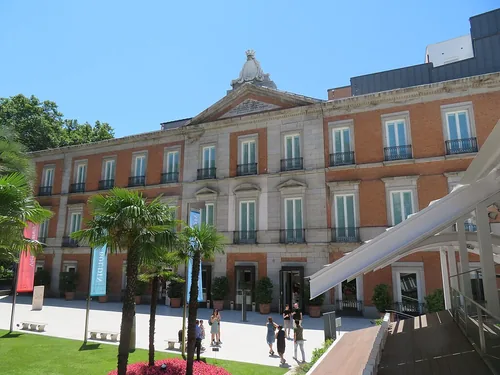
    Thyssen-Bornemisza Museum in Madrid, stop 14 on the self-guided walking tour

    The Thyssen-Bornemisza Museum completes the Golden Triangle of Art, and it was built to fill gaps. Where the Prado is thin, it has Italian primitives and English, Dutch and German painting; where the Reina Sofía stops, it has the Impressionists, Expressionists and 20th-century European and American art. With over 1,600 paintings, it was once the second largest private collection in the world after the British Royal Collection.

    The collection began in the 1920s with Baron Heinrich Thyssen-Bornemisza. In a reversal of the usual flow of European art to America, he bought from American millionaires struggling with the Great Depression and inheritance taxes, among them Ghirlandaio's portrait of Giovanna Tornabuoni and Carpaccio's Knight. His son, Baron Hans Heinrich (1921 to 2002), gathered works back from relatives and kept buying, from Gothic art to Lucian Freud.

    For decades the paintings hung in a twenty-room gallery at the family estate in Lugano, modelled on the Neue Pinakothek in Munich. When the city council there rejected an extension in 1988, the baron looked for a new home in Europe, and Madrid won.

    One ticket covers the collection and special exhibitions. The permanent collection is also free at set times, though special exhibitions are not included. If you have already seen one of the other two museums today, this is where to come back for what they lack.

    Local name
    Museo Nacional Thyssen-Bornemisza
    Hours
    Regular 10:00–19:00
    Price
    14 EUR (Collection + Special exhibitions)
Walking tour route map of Madrid Route loaded
Puerta del SolGran VíaPlaza de EspañaTemple of Debod+10
All 14 stops are already on the map.
You just press start.
AI Tour Guide

You've read the route. Now walk it from Sol with a guide in your ear.

Press start wherever you are, even hundreds of kilometres from Madrid, and the guide begins telling its stories right away. In the city, pick any of the 14 stops to start from: it leads you there, then talks with you the whole route, asking, listening, remembering, and shaping the tour around your answers.

14stops 10.0km 2 h 19 minwalking 13languages
▶Start the tour free

Free to start · Runs in your browser · No app, no download

Shorter Ways to Walk Madrid

The route falls neatly into two halves: royal and old Madrid around the palace, and the art museums with the park. Each works as a half day on its own.

Royal Madrid and the old centre

Stops: 1, 2, 3, 4, 5, 6, 7, 8

For a first morning in the city: Puerta del Sol, Gran Vía, the Egyptian temple, the palace and cathedral, then tapas and Plaza Mayor. 4.8 km and 67 minutes of walking. Only the Royal Palace and, if you want it, the cathedral museum charge admission; the Temple of Debod is free.

Art and park afternoon

Stops: 9, 10, 11, 12, 13, 14

For art lovers and anyone who wants green space: Reina Sofía Museum, Prado Museum, Retiro Park, Puerta de Alcalá, Plaza de Cibeles and the Thyssen-Bornemisza Museum. 3.7 km and 53 minutes of walking. All three museums charge admission; pick one for a proper visit and time it for its free hours if you can.

How Long Does This Madrid Tour Take with the Palace and a Museum?

Of a full day, only 2 h 19 min is walking; the rest goes into the interiors you choose. The palace deserves about an hour and a half, one of the big museums about the same or longer, and Retiro Park around 45 minutes. Trying to do the palace and all three art museums in one go does not work: pick the palace and one museum, and keep the others for another day.

A realistic day: leave Puerta del Sol at 9:40, reach Gran Vía at 9:46 and Plaza de España at 10:08. You are at the Temple of Debod at 10:26, once it has opened, and at the Royal Palace at 11:04. After an hour and a half inside, you reach Almudena Cathedral at 12:46, San Miguel Market at 13:14 for 45 minutes of tapas, and Plaza Mayor at 14:02. The Reina Sofía Museum follows at 14:36 with an hour and a half for Guernica, then you pass the Prado at 16:17, sit in Retiro Park from 16:42, and reach Puerta de Alcalá at 17:38, Cibeles at 17:50 and the Thyssen at 18:09. That is about eight hours and 45 minutes in total.

The royal half alone, with the palace interior and tapas, takes about four and a half hours. The art half with one museum visit and a proper break in the park takes about four hours.

Before You Set Off from Puerta del Sol

  • Start and finish: The recommended start is Puerta del Sol, but you can join the route at any of the 14 places. It ends at the Thyssen-Bornemisza Museum on the Paseo del Prado.
  • Best days: Pick a day when the Temple of Debod, the Royal Palace and the Reina Sofía Museum are all open for the full day.
  • Costs: Walking the route, the map and the GPS navigation from stop to stop cost nothing. The AI Tour Guide starts with 100 free credits; after that you choose between this tour all-inclusive for €19.99 with no time limit, or €5 per hour.
  • Water: Madrid's tap water is well regarded. In restaurants ask explicitly for “agua del grifo”, otherwise a paid bottle may arrive. Carry a refillable bottle and use fountains marked as drinking water.

Food and Breaks Along the Route: Calamares, Menús and Coffee

The stretch between the Royal Palace and Plaza Mayor is where you will want to eat, and also where prices climb fastest. A few places and habits help you eat well and sit down for less.

La CampanaThe place for Madrid's classic bocadillo de calamares, a fried squid sandwich, at a modest price. The hotel café on the square sells a far pricier brioche version with lemon mayonnaise. Expect a queue, bring cash and look at the portions before you order. (Calle Botoneras 6, just off Plaza Mayor)
El Anciano Rey de los VinosA named option for a sit-down menu right after the palace, at a fair price. Prices change, so read the board before you sit. (Calle Bailén, opposite the Royal Palace)
Café con leche in a side-street barA milky coffee costs noticeably more on the Plaza Mayor terraces than in an ordinary neighbourhood bar. Check the price list, and don't assume the next specialty café is cheaper. If you want to sit on the square itself, you are paying for the view. (From Plaza Mayor towards Calle Toledo and La Latina)

Tourist Traps to Avoid in Madrid's Old Centre

  • Tourist menus in the Plaza Mayor arcades: Set menus around Sol and Plaza Mayor are pricey, while a full menú del día in the side streets towards La Latina costs less, often with better home cooking. Don't order from a tout or under the arcades; walk a few streets on and read the board with its final price. Lunch menus are usually served on weekdays from about 13:30 until 16:00.
Walking tour route map of Madrid
AI Tour Guide

Your guide is ready when you are, at any of the 14 places.

Press start and a voice AI Tour Guide takes it from here: leading the route through Madrid, telling the stories, and turning your walk into a real back-and-forth conversation. No app or download is needed; it runs in your browser.

14stops 10.0km 2 h 19 minwalking 13languages
▶Start the tour free

Free to start · Runs in your browser · No app, no download

What the AI Tour Guide Adds Between Sol and the Prado

This route runs from a medieval gate to Picasso, and nobody wants every chapter at the same length. The AI Tour Guide greets you at your first stop, tells the stories of each place and asks what you'd like more of: kings and fires, revolutions, or painters. If you mention that Goya or the Civil War interests you, it remembers and picks the thread up again at the Prado or in front of Guernica. You can interrupt at any time, ask why a Nubian temple ended up in a Madrid park or what the figures on a façade mean, and it follows your lead while the route stays the same.

A Real Conversation A voice AI Tour Guide greets you, leads the whole route, and tells the stories and facts as you walk, asking what you want to see and keeping a real conversation going. Not a recording you press play on.
Map Navigation Follow the route on the map and walk at your own pace. You choose where to start and when to move to the next stop.
Ask Anything Curious about a building you pass? Ask your AI Tour Guide on the spot and the conversation carries on.
13 Languages Switch language anytime. No separate tour needed.
Start free in your browser

Common Questions About Walking Madrid

Is there a combined ticket for the Prado, Reina Sofía and Thyssen?

Yes, the Paseo del Arte pass covers all three and is cheaper than three separate tickets if you visit all three at paid times. If you see the Thyssen during its free slot, buying the other two tickets separately comes out cheaper than the pass. Not every special exhibition is included.

Can I walk the route in the evening?

The squares, Gran Vía and Puerta de Alcalá are open around the clock. San Miguel Market stays open late into the night, and Retiro Park is also open into the evening.

How do I get back to Puerta del Sol from the Thyssen?

The GPS navigation in your browser can lead you from the last stop back to the start if you ask it to.

Which day trips from Madrid pair well with this walk?

Toledo at 68 km, the old seat of the Spanish Church, and Segovia at 69 km, whose granite went into Puerta de Alcalá, are the closest. Ávila lies 88 km away.

Is the tour really free?

Yes. The whole tour is free: the route, the interactive map and the navigation cost you nothing. Only the voice AI Tour Guide is optional and paid: you test it with 100 free credits, then you pay either €5 per hour or €19.99 for this whole tour, with no time limit. Admission to 4 of the 14 stops is not included: Royal Palace, Reina Sofía Museum, Prado Museum and Thyssen-Bornemisza Museum charge their own entry fees.

Do I need to download an app?

No. Everything runs in your phone browser. Open the route and start walking, no download and no sign-up required.

Do I need to book the walking tour in advance?

No booking needed. This self-guided tour is available anytime. Open the route in your browser and start walking. The AI Tour Guide works instantly, no app, no reservation required.

What languages is the AI Tour Guide available in?

The AI Tour Guide speaks 13 languages, so you take the tour in your own language and can switch at any time.

Can I skip stops or change the route?

Yes. Skip any stop, spend extra time at places you like, or start the route from any point. It is your walk, you set the pace.
Image credits
▶ Start free in your browser Runs in your browser, no app, no download