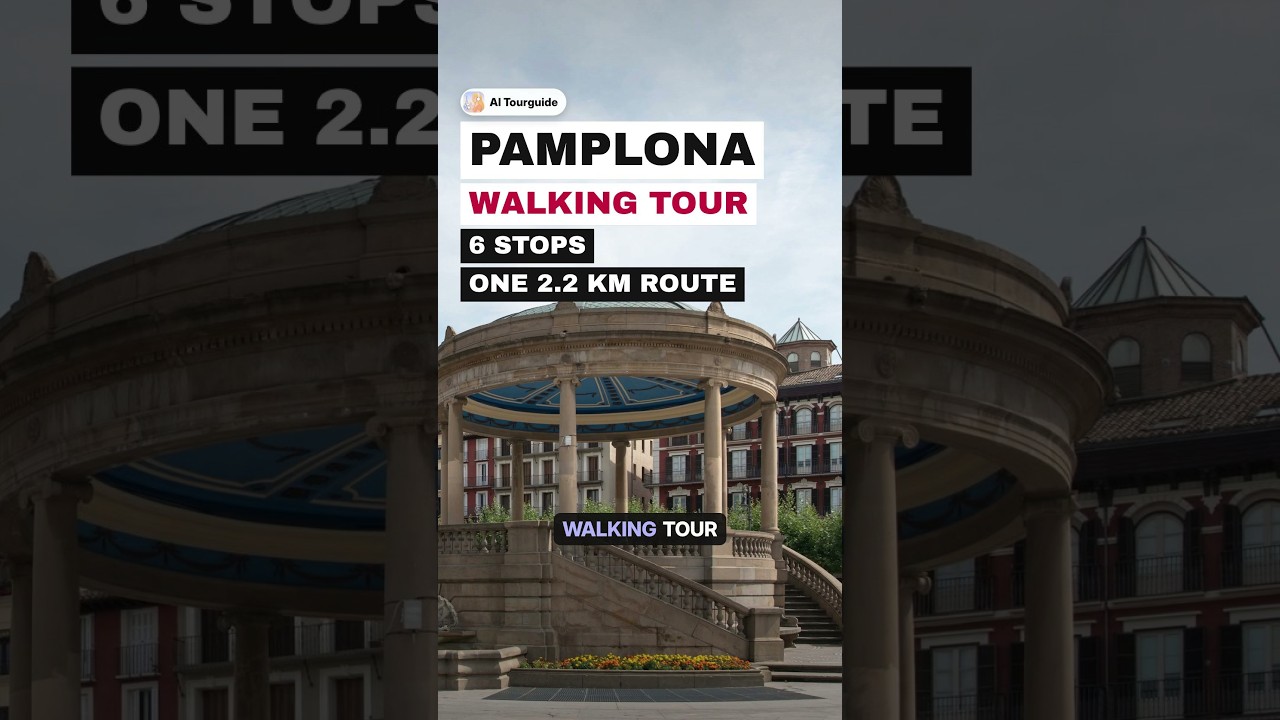
Free Walking Tour Pamplona: Citadel, Bulls and Hemingway

From a star-shaped fortress to the bull-run street and Hemingway's café: 2.2 km through Pamplona's history, ending in the square locals call their living room.

6 Stops 2.2 km ~30 min walking
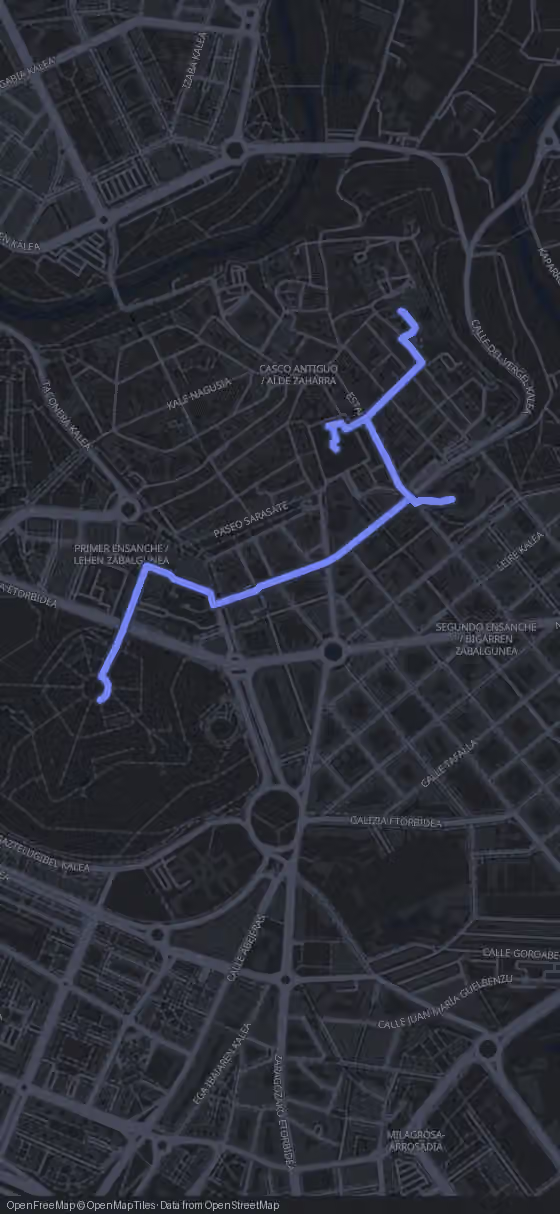
Route map for the Pamplona walking tour
Stop 1 of 6
1.1 km·14 min
Ciudadela de Pamplona
Head north-east toward the Plaza de Toros
Hola, welcome to Pamplona. I'm Alex, and the city's great fortress has traded control for everyday freedom.
Try this tour with Alex

This Route at a Glance

Six stops lead from the Ciudadela de Pamplona to the Plaza de Toros, along Calle Estafeta, past the Cathedral of Pamplona and into Café Iruña, ending in the Plaza del Castillo. The route covers 2.2 km with 30 min of pure walking; with the two big visits inside, plan a little over three hours.

Only the bullring charges admission; the rest is free. Map and GPS navigation in your browser cost nothing, and the AI Tour Guide is optional.

Open free GPS & optional AI Tour Guide
This short shows highlights of the route. All 6 stops follow below.

The Route

Walking Map of Pamplona, from the Citadel to Plaza del Castillo

6 stops 2.2 km 30 min walking
Tap to load interactive map

The 6 stops along this route

  1. Ciudadela de Pamplona, stop 1 on the self-guided walking tour
    1Ciudadela de Pamplona
  2. Plaza de Toros in Pamplona, stop 2 on the self-guided walking tour
    2Plaza de Toros
  3. Calle Estafeta in Pamplona, stop 3 on the self-guided walking tour
    3Calle Estafeta
  4. Cathedral of Pamplona, stop 4 on the self-guided walking tour
    4Cathedral of Pamplona
  5. Café Iruña in Pamplona, stop 5 on the self-guided walking tour
    5Café Iruña
  6. Plaza del Castillo in Pamplona, stop 6 on the self-guided walking tour
    6Plaza del Castillo
  7. That's the full route.

    Walk it with an AI Tour Guide talking you through every one of these streets.

    Start free in your browser
    You made it

Your Pamplona Walking Tour, from Fortress to Bandstand

  1. 1

    Ciudadela de Pamplona

    Ciudadela de Pamplona, stop 1 on the self-guided walking tour

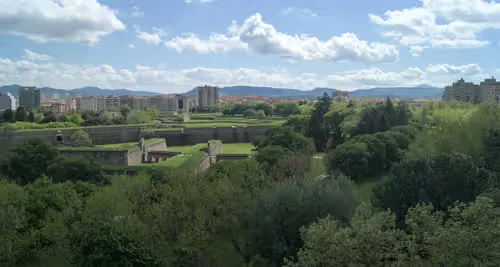
    You begin inside a fortress that is now a public park. The Ciudadela de Pamplona, also called the New Castle, is a bastion fort from the 16th and 17th centuries, and a large part of it survives. Walk along the old walls and you are tracing a five-pointed star: each bastion was angled so that its guns covered every possible approach. Today the old military buildings host cultural activities, and entry to the park is free.

    The order came from Philip II in 1571, as part of a wider plan to rebuild and strengthen the city walls. The design was by the military engineer Giacomo Palearo, known as el Fratin, working with the viceroy of Navarre, Vespasiano Gonzaga y Colonna. They followed the latest Italian Renaissance theory of fortification, the same ideas Francesco Paciotto had just used for the citadel of Antwerp.

    Look for the detail that tells you who the fort was really for. Two of the five points face inward, towards the city itself. Back in 1569 the engineer Antonelli had told the king that Pamplona needed a main fortress both against outside threats and to keep control within. Navarre had been conquered only decades earlier, and attempts to win it back had found active support among locals, so the guns watched the streets as much as the horizon.

    The citadel is also listed in Spain's UNESCO inventory for the Camino de Santiago, a reminder that pilgrims have passed through this city for centuries. From here it is 1090 m, about 15 minutes, to the bullring, the longest leg of the walk.
    Hours
    Mon–Fri: 07:30–21:30 | Sat: 08:00–21:30 | Sun: 09:00–21:30
    Price
    Free
  2. 2

    Plaza de Toros

    Plaza de Toros in Pamplona, stop 2 on the self-guided walking tour

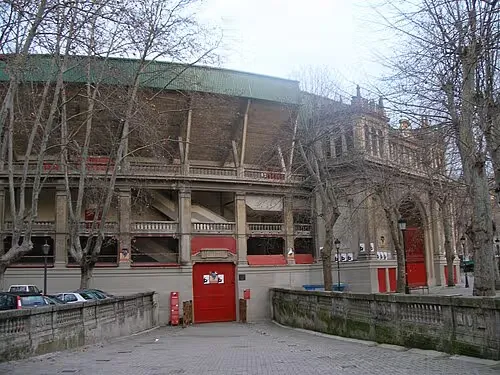
    The Plaza de Toros is world famous for one reason: the bull runs of San Fermín every July end here. Planned in 1920 in the Second Ensanche, the new part of town, it opened for the festival on 7 July 1922. With room for about 19,720 spectators it ranks as the fourth largest bullring in the world by capacity, and it fills its seats more consistently than any other in Spain. It also hosts concerts and shows, and since it was built it has belonged to the Casa de Misericordia, the city's charitable institution, which manages it.

    The architect from San Sebastián, Francisco Urcola, used the new material of his day, reinforced concrete, but dressed it in classical forms. The main façade works like a great triumphal arch, with an upper gallery and plateresque cresting along the top; giant Ionic columns frame the main body, Doric ones run around the ring. In 1966 Rafael Moneo, with the engineer Carlos Fernández Casado, enlarged it from the original 13,620 seats, exposing the concrete as a series of triangular ribs. The green metal roof dates from the early 1980s and replaced the original tiles, a colour many locals still find too loud.

    The building has a darker chapter too: in the first months of 1939, at the end of the Civil War, it served as a concentration camp for Republican prisoners. And when safety works were carried out in 2004 and 2005, a 16th-century fountain and canal turned up, which supplied the Navarrería district until 1852, along with a bridge from the same century.

    Going inside costs admission and suits anyone curious about the festival or the architecture; guided visits run in Spanish. From the bullring, Calle Estafeta is just 240 m away, about 3 minutes.

    Hours
    Mon–Fri 10:30–17:00 | Sat 10:30–19:30 | Sun 10:30–20:00. Guided visits (Spanish) at 11:00, 12:30, 16:30, 18:00. Times may vary depending on cultural events.
    Price
    Adults 8 EUR, under 12 4 EUR, under 6 free; reduced (groups >25, retirees 65+, students <30) 6 EUR
  3. 3

    Calle Estafeta

    Calle Estafeta in Pamplona, stop 3 on the self-guided walking tour

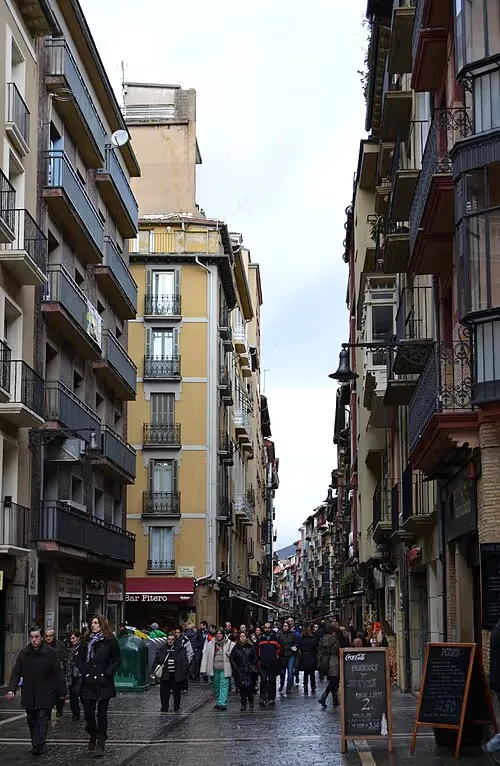
    Calle Estafeta is the street you have seen on television: the long, narrow stretch of the San Fermín bull run. It is about 315 m long, one of the longest streets in the old town, starting at the famous Mercaderes bend and ending at the stretch known as Telefónica. It rises with a gentle 2% gradient, and for most of its length it runs between two walls of houses, with nowhere to escape.

    That is exactly what makes it special for the runners. Here the herd, with its steers, often splits up and slows down, and the mozos use the moment to run directly in front of the horns. Locals call it coger toro, taking the bull. The paving tells its own story too: the old cobblestones were replaced by smooth slabs.

    Few streets in Pamplona have changed their name as often. Since the 14th century it has been the Rúa de Araya y de las Eras, the Carpentry of the Navarrería and the street behind the castle, named after the castle of Louis Hutin that stood nearby. In the 17th century a church of San Tirso gave it its next name. Only in the 18th century did it become Estafeta, because the post office, the estafeta, opened here.

    Walk it slowly and imagine the walls lined with spectators. From the end of the street it is 390 m, about 5 minutes, to the cathedral.

    Hours
    Open 24/7
    Price
    Free
  4. 4

    Cathedral of Pamplona

    Cathedral of Pamplona, stop 4 on the self-guided walking tour

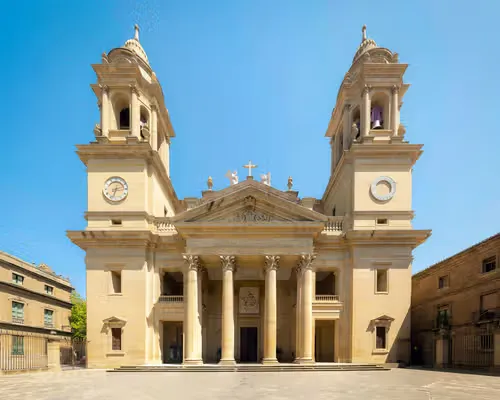
    The Cathedral of Pamplona, dedicated to Santa María de la Asunción, is the seat of the archdiocese of Pamplona and Tudela, and it is regarded as the most complete cathedral complex preserved in Spain. Besides the church, cloister and sacristies you find elsewhere, it still has the rooms of the canons' shared life: the cellar, refectory, chapter house and dormitory. In other Spanish cathedrals these were torn down over the centuries.

    Look at the main façade first. The west front is neoclassical, built at the end of the 18th century, and counts among the purest examples of that style on the peninsula. Behind it, the picture changes: a few Romanesque rooms survive, but most of the complex, including the church and the cloister, is Gothic, built between the 14th and 16th centuries.

    The reason to go in is the cloister, considered a marvel of European Gothic art and often called the finest 14th-century cloister anywhere. Do not miss the kitchen either: it is one of only three Gothic kitchens surviving in all of Europe. Entry to the museum and cloister is free, a guided visit is offered in Spanish, and the tower climb requires prior registration. If you only go inside one building on this walk, make it this one; allow about an hour.

    From the cathedral it is 430 m, about 6 minutes, to Café Iruña.

    Hours
    Museum/cloister (summer season, from the last week of March): Mon–Sat 10:30–19:00, Sun closed. Winter (from the last week of October): Mon–Sat 10:30–17:00, Sun closed. Guided visit (Spanish) 12:00, tower climb 11:15 (with prior registration). Church separately for services: weekday masses 9:30 and 19:30, Sundays/holidays different.
    Price
    Free
  5. 5

    Café Iruña

    Café Iruña in Pamplona, stop 5 on the self-guided walking tour

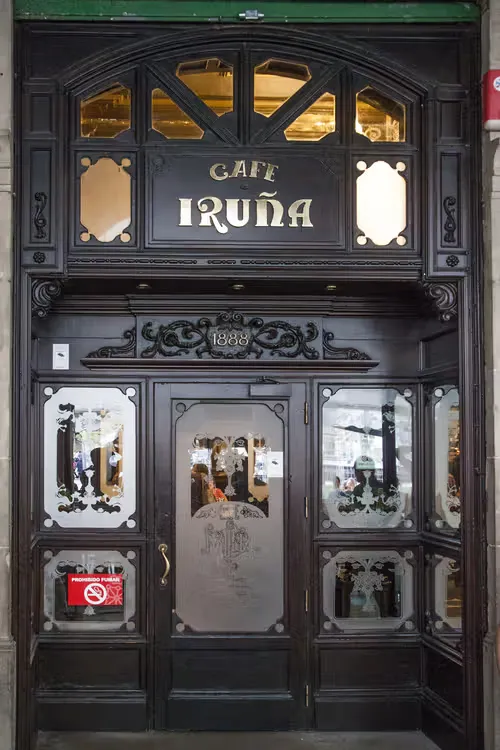
    Café Iruña opened its doors on the eve of San Fermín in 1888, and according to accounts of the time it was packed from the first day. It sits on the ground floor of the building raised by the Crédito Navarro, designed by the architect Maximiano Hijón and remodelled between 1932 and 1934 by Víctor Eusa. The building was the first to use iron in its floor structure, and the café was apparently the first business in Pamplona with electric light.

    Inside, the décor takes you back to the turn of the 20th century, and it quickly became the meeting place for residents and visitors alike. Its most famous regular was Ernest Hemingway, who returned to Pamplona again and again for San Fermín. The café's lore holds that he began several of his novels here, among them The Sun Also Rises and The Old Man and the Sea.

    Head for the Rincón de Hemingway, the Hemingway corner, where period photographs hang on the walls and a life-size statue of the writer by the sculptor José Javier Doncel presides over the room. Entry is free; order a coffee and take your time, either inside or at a terrace table. On the first floor of the same building is the Nuevo Casino Principal, and the café's look makes it a favourite setting for film and documentary shoots.

    Step back outside and you are already at the last stop: the Plaza del Castillo is just 70 m away, about a minute.

    Hours
    Mon–Thu: 09:00–00:00 | Fri–Sat: 09:00–02:00 | Sun: 09:00–00:00
    Price
    Free (entry, cafe)
  6. 6

    Plaza del Castillo

    Plaza del Castillo in Pamplona, stop 6 on the self-guided walking tour

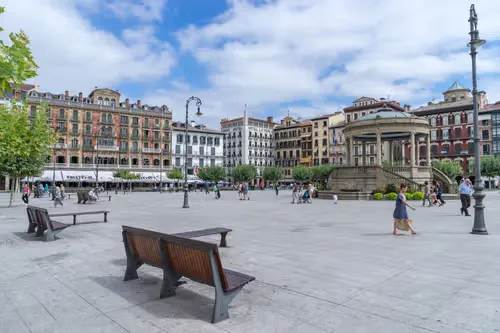
    The Plaza del Castillo is where Pamplona gathers, which is why locals call it the city's living room. Laid out in the mid-16th century, it has been the heart of social life ever since and still hosts the city's big moments. With almost 14,000 m² it is the second largest square in the city, after the Plaza de los Fueros.

    Turn slowly and look at the edges. The square is arcaded on every side, yet no two buildings match: they went up one by one, in different periods and at different heights, rather than as one planned project. On the south side you see a façade of the Palacio de Navarra, on the north side the old Casino building, and on the east side the Palacio de Goyeneche, a baroque mansion. From the southern end, Avenida Carlos III leads into the Second Ensanche.

    The square has always been a hinge. It lies between the old medieval burgos of San Nicolás and the Navarrería and joins the old town to the new district, built on a grid plan in the early 20th century. Today it is pedestrian, with flowerbeds shaded mostly by plane trees.

    In the centre stands the bandstand, there since 28 June 1943: 18 m tall, its dome carried by Ionic columns. Find a bench under the trees and let the walk end here.

    Hours
    Open 24/7
    Price
    Free
Walking tour route map of Pamplona Route loaded
Ciudadela de PamplonaPlaza de TorosCalle EstafetaCathedral of Pamplona+2
All 6 stops are already on the map.
You just press start.
AI Tour Guide

You've read the route. Now walk it with a guide beside you.

Press start wherever you are, even hundreds of kilometres from Pamplona, and the guide begins telling its stories right away. In the city, pick any of the 6 stops to start from: it leads you there, then talks with you the whole route, asking, listening, remembering, and shaping the tour around your answers.

6stops 2.2km 30 minwalking 13languages
▶Start the tour free

Free to start · Runs in your browser · No app, no download

Shorter Ways to Walk Pamplona

The full route is compact, but you can trim it to match your time or interests.

The full route

Stops: 1, 2, 3, 4, 5, 6

For a first visit with half a day to spare. 30 min of walking over 2.2 km; the bullring is the only stop with admission, and the cathedral cloister is worth the extra hour.

Bulls, cathedral and Hemingway

Stops: 2, 3, 4, 5, 6

Skip the fortress park if San Fermín is what drew you here. Starting at the bullring, the walking adds up to 1130 m and 15 min; admission applies only if you go inside the Plaza de Toros.

Old town only

Stops: 3, 4, 5, 6

For a short morning or a late arrival: 890 m and 12 min on foot, from the bull-run street to the cathedral and the main square, with no admission at any stop.

How Long This Pamplona Walk Takes, With and Without Visits

The pure walking time is 30 min, and the longest leg, 15 min from the citadel to the bullring, comes first. After that the stops sit close together in the old town, so the rest of the day is about looking, not walking.

Realistically, give the citadel park about 20 minutes, the bullring visit 45, the cathedral cloister and museum an hour, and Café Iruña time for a coffee. That brings you to a little over three hours. Staying outside the bullring and cathedral, you finish in about an hour and a quarter. The variant starting at the bullring takes roughly two and three quarter hours with both visits, the old town version about an hour and three quarters with the cathedral and a coffee.

Before You Set Off in Pamplona

  • Start: The recommended start is the Ciudadela de Pamplona, but you can join the route at any stop.
  • Finish: The walk ends in the Plaza del Castillo, not at the start; the GPS navigation in your browser can lead you back to the citadel if you need to return.
  • Time of day: Walk in the daytime, so the cathedral cloister and museum and the bullring are open for visits; keep the evening for Café Iruña and the square.
  • Admission: Only the Plaza de Toros charges admission. The citadel, Calle Estafeta, the cathedral, Café Iruña and the square are free to enter.
  • Cathedral tower: The tower climb needs prior registration, so sign up before you arrive if you want to go up.
Walking tour route map of Pamplona
AI Tour Guide

Your guide is waiting at whichever stop you choose.

Press start and a voice AI Tour Guide takes it from here: leading the route through Pamplona, telling the stories, and turning your walk into a real back-and-forth conversation. No app or download is needed; it runs in your browser.

6stops 2.2km 30 minwalking 13languages
▶Start the tour free

Free to start · Runs in your browser · No app, no download

What the AI Tour Guide Adds in Pamplona

On this route the AI Tour Guide turns the walk into a conversation: it greets you at the citadel, tells the stories of each place, asks what caught your eye and remembers it, so a fascination with fortresses or with Hemingway shapes what you hear next. You can interrupt anytime, for instance to ask how the conquest of Navarre changed daily life in the city or what the old burgos were like before the Plaza del Castillo joined them. You start with 100 free credits; after that you choose between this tour all-inclusive for €19.99 with no time limit, or credits at €5 per hour.

A Real Conversation A voice AI Tour Guide greets you, leads the whole route, and tells the stories and facts as you walk, asking what you want to see and keeping a real conversation going. Not a recording you press play on.
Map Navigation Follow the route on the map and walk at your own pace. You choose where to start and when to move to the next stop.
Ask Anything Curious about a building you pass? Ask your AI Tour Guide on the spot and the conversation carries on.
13 Languages Switch language anytime. No separate tour needed.
Start free in your browser

Pamplona Questions Before You Go

Can I see inside the bullring outside the festival?

Yes. The Plaza de Toros is open for visits with admission, and guided visits are offered in Spanish. Event days can change the schedule, so check at the entrance.

Can I climb the cathedral tower?

Yes, but only with prior registration. The guided visit of the cathedral is in Spanish.

Do I have to order something to see Hemingway's corner in Café Iruña?

Entry is free, but it is a working café, so ordering a coffee at the bar or on the terrace is the natural way to linger by the statue.

Where can I go after Pamplona?

San Sebastian is 63 km away and makes an easy next stop; Bilbao and Zaragoza also have their own walking routes.

Is the tour really free?

Yes. The whole tour is free: the route, the interactive map and the navigation cost you nothing. Only the voice AI Tour Guide is optional and paid: you test it with 100 free credits, then you pay either €5 per hour or €19.99 for this whole tour, with no time limit. Admission to one of the 6 stops is not included: Plaza de Toros charges its own entry fee.

Do I need to download an app?

No. Everything runs in your phone browser. Open the route and start walking, no download and no sign-up required.

Do I need to book the walking tour in advance?

No booking needed. This self-guided tour is available anytime. Open the route in your browser and start walking. The AI Tour Guide works instantly, no app, no reservation required.

What languages is the AI Tour Guide available in?

The AI Tour Guide speaks 13 languages, so you take the tour in your own language and can switch at any time.

Can I skip stops or change the route?

Yes. Skip any stop, spend extra time at places you like, or start the route from any point. It is your walk, you set the pace.
Image credits
▶ Start free in your browser Runs in your browser, no app, no download