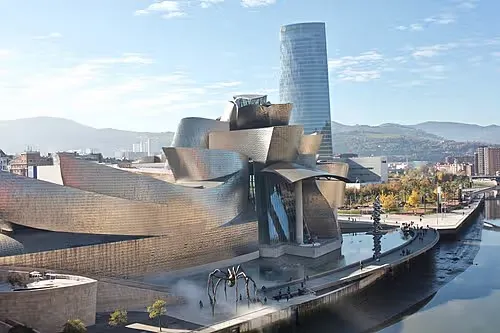
Free Walking Tour Bilbao: Old Town to the Guggenheim

From a museum in a park through the old town and one of Europe's biggest covered markets to Calatrava's white footbridge and Gehry's Guggenheim.

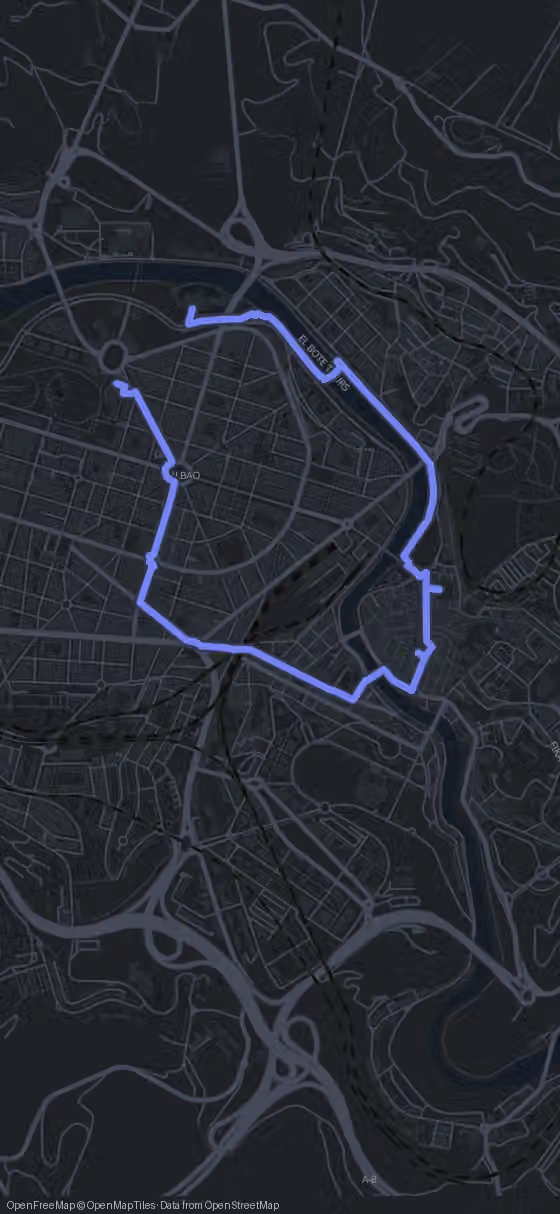
8 Stops 4.7 km ~1 h 6 min walking
Route map for the Bilbao walking tour
Stop 1 of 8
840 m·11 min
Fine Arts Museum of Bilbao
Head south toward Azkuna Zentroa
Kaixo, welcome to Bilbao. I'm Alex, and some of this city's boldest surprises are waiting overhead.
Try this tour with Alex

Bilbao on Foot at a Glance

Eight stops lead from the Fine Arts Museum of Bilbao through the old town to the Guggenheim Museum Bilbao: 4.7 km and 1 h 6 min of pure walking. With the market, the cathedral and the Guggenheim from the inside, plan a little over five hours.

La Ribera Market, Azkuna Zentroa, Plaza Nueva and the Zubizuri Bridge cost nothing; Santiago Cathedral and the Guggenheim charge entry, and Teatro Arriaga offers paid guided tours. Map and GPS route in your browser are free, and the optional AI Tour Guide can lead you the whole way.

Open free GPS & optional AI Tour Guide
This short shows highlights of the route. All 8 stops follow below.

The Route

Walking Map of Bilbao: From the Park to the Guggenheim

8 stops 4.7 km 1 h 6 min walking
Tap to load interactive map

The 8 stops along this route

  1. Fine Arts Museum of Bilbao, stop 1 on the self-guided walking tour
    1Fine Arts Museum of Bilbao
  2. Azkuna Zentroa in Bilbao, stop 2 on the self-guided walking tour
    2Azkuna Zentroa
  3. La Ribera Market in Bilbao, stop 3 on the self-guided walking tour
    3La Ribera Market
  4. Santiago Cathedral in Bilbao, stop 4 on the self-guided walking tour
    4Santiago Cathedral
  5. Plaza Nueva in Bilbao, stop 5 on the self-guided walking tour
    5Plaza Nueva
  6. Teatro Arriaga in Bilbao, stop 6 on the self-guided walking tour
    6Teatro Arriaga
  7. Zubizuri Bridge in Bilbao, stop 7 on the self-guided walking tour
    7Zubizuri Bridge
  8. Guggenheim Museum Bilbao, stop 8 on the self-guided walking tour
    8Guggenheim Museum Bilbao
  9. That's the full route.

    Walk it with an AI Tour Guide talking you through every one of these streets.

    Start free in your browser
    You made it

The Bilbao Walking Tour Stop by Stop: Old Town, River and Gehry

  1. 1

    Fine Arts Museum of Bilbao

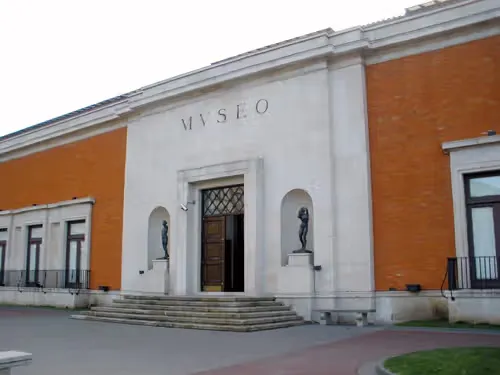
    Fine Arts Museum of Bilbao, stop 1 on the self-guided walking tour

    Your walk begins in Doña Casilda Iturrizar Park, where the Fine Arts Museum of Bilbao stands entirely inside the green. The museum is currently closed, so this is a stop for the outside: a large neoclassical building completed in 1945 and extended twice, in 1970 and in 2001, because the collection kept outgrowing it. Walk around it once and you see a museum that grew in layers over half a century.

    The institution is older than the building. It was founded in 1908 and moved through several venues before settling here. Today's collection came from merging the first Museo de Bellas Artes, opened in 1914, with the Museum of Modern Art of 1924. For its centenary in 2008 the museum chose a slogan that sums it up well: “100 Years of History, 10 Centuries of Art”. Much of what hangs inside arrived through bequests and donations from Bilbao patrons, alongside the museum's own purchases.

    It is the second largest museum in the Basque Country after the Guggenheim and one of the largest Spanish museums outside Madrid. The range is wide: Basque, Spanish and European art from the Middle Ages to today, with El Greco, Murillo, Goya, Van Dyck and Sofonisba Anguissola next to Sorolla, Mary Cassatt, Gauguin, Francis Bacon and Richard Serra. Once it reopens, it is the perfect counterweight to the Guggenheim for anyone who wants old masters as well as contemporary art.

    From here it is 850 m, about 12 minutes, to Azkuna Zentroa. On the way you pass the Chavarri Palace and the Hotel Carlton building, two reminders of the wealth that built this part of the city.
    Local name
    Museo de Bellas Artes de Bilbao
    Status
    Currently closed
  2. 2

    Azkuna Zentroa

    Azkuna Zentroa in Bilbao, stop 2 on the self-guided walking tour

    The block-sized building in front of you was built as a wine warehouse. Bilbao called it the Alhóndiga, and architect Ricardo Bastida designed it between 1905 and 1909 to fill an entire block of the new Ensanche district. It was a bold piece of engineering for its time: one of the first public buildings in Spain made of reinforced concrete, and at the same time meant to look like a proper part of the city rather than a mere storehouse.

    A fire damaged it in 1919, and after restoration it eventually stood closed for a long time. In the 1980s there was a plan to turn it into a cultural centre with the sculptor Jorge Oteiza. That project collapsed, and soon afterwards a different idea took its place: the Guggenheim. Oteiza criticised the switch loudly, and the controversy only died down when the new museum turned into an unexpected success. Keep that story in mind for the end of the walk.

    The warehouse finally reopened on 18 May 2010 as a multipurpose civic centre, redesigned with the French designer Philippe Starck. In 2015 it was renamed after Iñaki Azkuna, who served as mayor of Bilbao for more than three terms, and since 16 March 2015 its official name has been Azkuna Zentroa.

    Step inside: general access is free. Fifteen minutes are enough to take in the space and see what an old wine store looks like after Starck. Then comes the longest leg of the route, 1380 m and about 20 minutes, down to the river and La Ribera Market.

    Hours
    Daily 09:00–21:00
    Price
    Free (general building access)
  3. 3

    La Ribera Market

    La Ribera Market in Bilbao, stop 3 on the self-guided walking tour

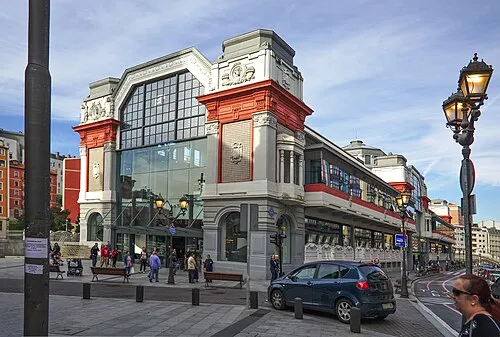
    La Ribera Market sits on the right bank of the Nervión at the edge of the old town, and with 10,000 m² of selling space it is one of the largest covered markets in Europe. It is organised by product, one floor at a time. On the ground floor are the fishmongers, seafood, pickles, salt cod specialists and even a knife grinder, plus an area where small Basque farmsteads, the caseríos, sell their own produce directly. The first floor belongs to butchers, charcuterie, poultry, pastries and preserves, with a bar; the second to fruit, vegetables, eggs, mushrooms, seeds and flowers.

    Trading here goes back a long way. In the 14th century Bilbao's market moved to the old Plaza Vieja, the main square next to the church of San Antón, then considered the nerve centre of the town. Around 1840 the stalls began to be roofed, and by 1870 every stall stood under a shed against the weather, the first step towards the hall you see today.

    Timing matters. The stalls are a morning affair, and while the gastrobars keep going much longer, the real market life happens early in the day. Come early, wander all three floors and give yourself at least half an hour.

    Leaving the market you are already in the Casco Viejo, the old town of the Siete Calles, the seven original streets. Santiago Cathedral is only 160 m away, about two minutes on foot.

    Hours
    Market stalls (summer schedule): Mon–Thu 08:00–14:30, Fri 08:00–14:30 & 17:00–20:00, Sat 08:00–15:00. Gastrobars: Mon–Sat 09:00–24:00, Sun/holidays 11:00–24:00. Restaurant: Mon–Tue closed, Wed 11:00–21:00, Thu 11:00–24:00, Fri 11:00–02:00, Sat 10:00–02:00, Sun 10:00–21:00
    Price
    Free (no admission fee, public market)
  4. 4

    Santiago Cathedral

    Santiago Cathedral in Bilbao, stop 4 on the self-guided walking tour

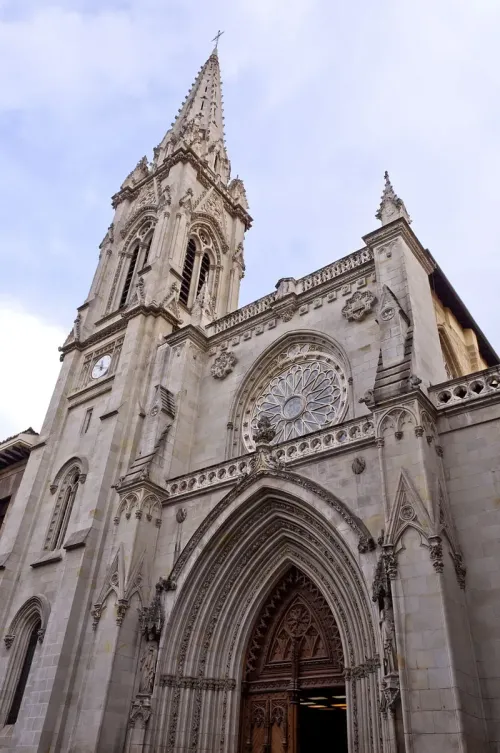
    Santiago Cathedral began as a pilgrim church on the coastal route of the Way of St James. A small Romanesque chapel for pilgrims stood here long before Bilbao was founded in 1300, and remains of it survive in the crypt. Look up at the north portal, the Puerta del Ángel: it is crowned with the scallop shell, the pilgrims' sign. The neo-Gothic main façade and the bell tower are much younger, rebuilt between 1885 and 1890 by local architect Severino Achúcarro, who dropped the second tower that had originally been planned.

    The Gothic church itself rose from the late 14th to the early 16th century, started around 1380 as a parish and collegiate church for a fast-growing town. In 1408 the preacher Vincent Ferrer spoke in the still unfinished nave, and in 1483 Queen Isabella I confirmed the town's privileges, its fueros, right here. Fires in 1571 and 1641 and the flood of 1593 damaged the building and destroyed most of its celebrated original furnishings. It became a minor basilica in 1819 and the cathedral of the new diocese of Bilbao in 1949.

    Inside, the church is inspired by French cathedral Gothic: three naves, a transept, an ambulatory ringed by eleven chapels, and a triforium gallery running around the whole space under the rib vaults. Despite the long building time, the proportions feel clear and unified; the altars are mostly Baroque, and the cloister lies on the north side.

    Is it worth the ticket? For anyone who likes Gothic architecture or follows the Camino, yes, and pilgrims pay a reduced rate. From here Plaza Nueva is 350 m away, about five minutes.

    Local name
    Catedral de Santiago Apóstol
    Hours
    Mon–Sat 10:00–18:30, Sun 13:00–18:30 (last entry 45 min before closing)
    Price
    10 EUR adults (18-64), 9 EUR seniors 65+, 8 EUR reduced (students under 25, unemployed, large families), 5 EUR groups 15+ / pilgrims
  5. 5

    Plaza Nueva

    Plaza Nueva in Bilbao, stop 5 on the self-guided walking tour

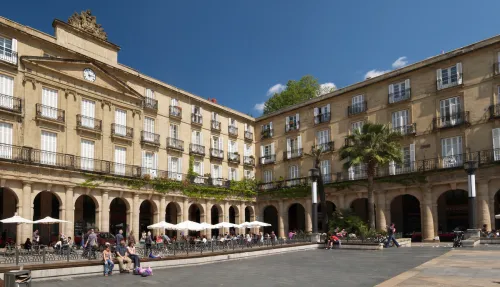
    Plaza Nueva is a closed, arcaded square: continuous porticoes, uniform façades and heights, five entrances and on one side a monumental building with a clock. It is a 19th-century neoclassical reinterpretation of the traditional Castilian plaza mayor, and it got its name to set it apart from the Plaza Vieja next to San Antón, the old main square you passed near the market.

    The idea came from Bilbao's Enlightenment spirit of the late 18th century: replace the cramped old centre with something practical, comfortable, hygienic and beautiful. Bureaucracy stretched the project over 65 years, planning from 1786 and building from 1829 until 1851, with three architects in turn. Silvestre Pérez drew the plans in 1821, Antonio de Echevarría took over in 1825 and revised them twice, and from 1840 Avelino de Goicoechea finished the job with his own changes.

    The square has lost some things along the way. Underground car park works in 1966 cost it its garden, leaving just a few trees in each corner, and a music bandstand was torn down. The clock building housed the provincial government of Bizkaia until 1900, later hotels and banks, and today the Royal Academy of the Basque Language. Since 1984 the square has been a protected historic monument.

    Under the arcades you'll find the densest cluster of pintxo bars on the route, popular with visitors but with plenty of locals too. If you started at 9:30 it is still before noon, so a first Gilda here is fair game. Then it is 240 m, about four minutes, to Teatro Arriaga on the river.

    Price
    Free
  6. 6

    Teatro Arriaga

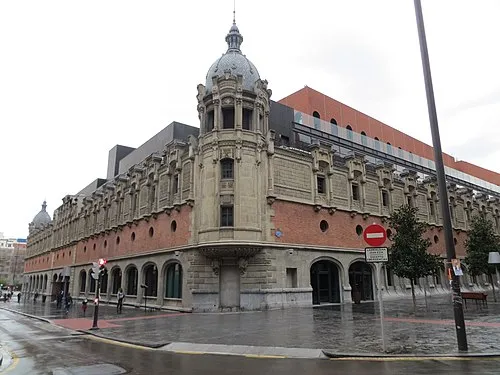
    Teatro Arriaga in Bilbao, stop 6 on the self-guided walking tour

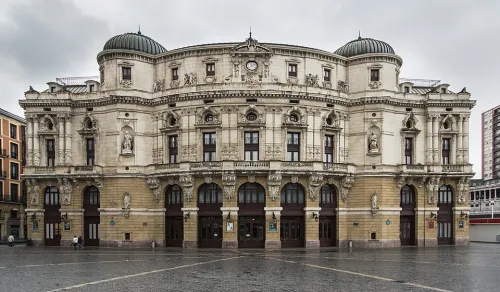
    The neo-Baroque opera house on the bank of the Nervión was designed by Joaquín Rucoba, the same architect who built Bilbao's city hall, and inaugurated on 31 May 1890 as the Nuevo Teatro de Bilbao after four years of construction. It replaced the Teatro de la Villa of 1834, which was too small for a city growing fast after the railway arrived and had been left in ruins by the Carlist Wars. The name Teatro Arriaga first appeared in newspaper announcements in 1902, honouring the Basque composer Juan Crisóstomo de Arriaga, known in his day as the “Spanish Mozart”.

    Few buildings in Bilbao have been knocked down and rebuilt as often. On the night of the Santo Tomás market in 1914 a fire destroyed it; architect Federico de Ugalde rebuilt it and it reopened on 5 June 1919. On 26 August 1983 floods caused by heavy rain raised the water up to five metres in the city and wrecked the theatre again. After a major restoration led by Francisco Hurtado de Saracho, it reopened on 5 December 1986.

    Look closely at the façades: between 1999 and 2000 they were restored because salts, pollution, moisture and biological growth had left the stone and sculptures flaking and discoloured.

    To see the interior you join a guided tour, with reduced or free places for some visitors, subject to space. Tours don't run all year round, so ask at the box office for times. From here you follow the river for 980 m, about 14 minutes, to the Zubizuri Bridge.

    Price
    Guided tours: EUR5 general; EUR3 for visitors with reduced mobility; free for accompanied under-18s (maximum two per adult) and students under 25, subject to capacity. No guided tours in July or August.
  7. 7

    Zubizuri Bridge

    Zubizuri Bridge in Bilbao, stop 7 on the self-guided walking tour

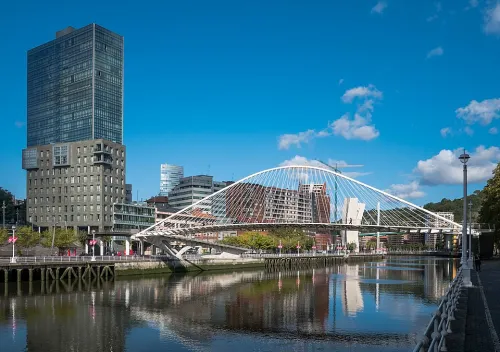
    Zubizuri is Basque for “white bridge”, and that is exactly what Santiago Calatrava delivered in 1997: a tied-arch footbridge whose curved walkway hangs from steel cables attached to a leaning white arch overhead. It links Campo Volantín on the right bank with Uribitarte on the left, and the deck is made of translucent glass bricks.

    Those glass bricks are what locals talk about. In Bilbao's wet climate they get slippery, so walk carefully when it has rained. Opinions on the design have always split: architecture professor Alexander Tzonis praised its curve as a message of hope for a declining city, while bridge engineer Matthew Wells found it strained, “like a sculptural toy”, touching the ground uncomfortably.

    The bridge has also been the subject of a long fight with its own creator. Calatrava's design landed on the Uribitarte dock rather than the higher Alameda Mazarredo street, so the city added a scaffolding walkway, then removed it after Calatrava protested. In 2006 the authorities let Arata Isozaki connect a new footway to the site of his Isozaki Atea towers, and a metal bar of the bridge was cut to do it. In 2007 Calatrava sued Bilbao over his moral rights to the integrity of his work.

    Cross it, stop in the middle and look along the river; this is the bridge many visitors use on their way to the Guggenheim, a symbol of the new Bilbao. Your final leg is 720 m, about 11 minutes.

    Hours
    Always open
    Price
    Free
  8. 8

    Guggenheim Museum Bilbao

    Guggenheim Museum Bilbao, stop 8 on the self-guided walking tour

    You end at the building that changed the city. Canadian architect Frank O. Gehry designed the Guggenheim Museum Bilbao, a museum of contemporary art run in partnership with the Solomon R. Guggenheim Foundation, and King Juan Carlos I opened it on 18 October 1997, the same year as the Zubizuri.

    It came together quickly. Basque public authorities and the foundation began talking in February 1991, signed at the end of that year and chose the architect and the site by mid-1992. This is the project that took the place of Oteiza's plans for the old Alhóndiga you saw at Azkuna Zentroa, and its success is what finally ended that dispute.

    Since opening, the museum has drawn more than a million visitors a year on average. The media coined the terms “Guggenheim effect” and “Bilbao effect” for what followed: an industrial city that reinvented itself through culture and tourism, revived public spaces and spread images of this building around the world, inspiring other cities to try the same with mixed results.

    Going in is worth it for anyone with even a passing interest in contemporary art or architecture; plan at least two hours. Queues get long in summer and on weekends, so buy your ticket in advance. When you are done, the GPS navigation can lead you back to the start.

    Hours
    Tue–Sun 10:00–19:00 (extended to 20:00 during high season 15 Jun-13 Sep). Mon closed, except select summer Mondays (mid-Jun to early Sep) and a few other special dates.
    Price
    EUR 15 adult
Walking tour route map of Bilbao Route loaded
Fine Arts Museum of BilbaoAzkuna ZentroaLa Ribera MarketSantiago Cathedral+4
All 8 stops are already on the map.
You just press start.
AI Tour Guide

You've read the route. Now walk it with a guide talking you through Bilbao.

Press start wherever you are, even hundreds of kilometres from Bilbao, and the guide begins telling its stories right away. In the city, pick any of the 8 stops to start from: it leads you there, then talks with you the whole route, asking, listening, remembering, and shaping the tour around your answers.

8stops 4.7km 1 h 6 minwalking 13languages
▶Start the tour free

Free to start · Runs in your browser · No app, no download

Shorter Ways to Walk Bilbao

Every stop works as a starting point, and the route splits neatly into pieces if you only have a morning or want to save the Guggenheim for another day.

Old Town core

Stops: 3, 4, 5, 6

For a short first look or a pintxo-focused morning: from La Ribera Market past Santiago Cathedral and Plaza Nueva to Teatro Arriaga. About 750 m and 11 minutes of walking. The only entry fee is the cathedral, and the old town bars are right there when you finish.

Riverfront architecture

Stops: 6, 7, 8

For architecture fans with an afternoon: Teatro Arriaga, the Zubizuri Bridge and the Guggenheim along the Nervión. About 1.7 km and 25 minutes of walking; budget the Guggenheim ticket and at least two hours inside.

From the Ensanche into the old town

Stops: 1, 2, 3, 4, 5

For a morning that ends in a pintxo bar: the park, Azkuna Zentroa, the market, the cathedral and Plaza Nueva. 39 minutes of walking; the cathedral is the only paid entry, and you finish in the square with the most bars on the route.

How Long This Bilbao Walk Takes, With and Without Museums

The pure walking time is 1 h 6 min, and the order follows the clock: the market stalls close in the early afternoon, so they come early, and the Guggenheim, which stays open into the evening, comes last. If you only look at everything from the outside, two hours are enough.

A realistic day with the good interiors: leave the Fine Arts Museum at 9:30, spend a quarter of an hour in Azkuna Zentroa and you reach La Ribera Market around 10:15. Give the market half an hour and the cathedral about 45 minutes, linger briefly at Plaza Nueva, Teatro Arriaga and the Zubizuri, and you stand at the Guggenheim around 12:45, ready for lunch and then two hours in the museum. That makes a little over five hours plus lunch. The Old Town variant takes about an hour and a half with the cathedral, the riverfront variant about three hours with the Guggenheim.

Before You Set Off in Bilbao

  • Start and finish: The recommended start is the Fine Arts Museum of Bilbao in Doña Casilda Iturrizar Park, the finish is the Guggenheim Museum Bilbao. You can join at any stop, and from the Guggenheim the GPS navigation in your browser leads you back to the start if you want.
  • Best day: Pick a day when the market stalls are trading and both the cathedral and the Guggenheim are open, as not every stop opens every day of the week.
  • Time of day: Start in the morning so you reach La Ribera Market while the stalls are trading; by mid-afternoon they are closed.
  • Costs: The route, the map and the GPS navigation cost nothing, and so do the market, Azkuna Zentroa, Plaza Nueva and the bridge. You pay for Santiago Cathedral, the Guggenheim and the optional Teatro Arriaga guided tour. The AI Tour Guide starts with 100 free credits; after that you choose this tour all-inclusive for €19.99 with no time limit, or €5 per hour.

Food and Breaks Along the Route: Pintxos, Market Counters, Butter Buns

This route runs straight through Bilbao's pintxo heartland: the market and the old town around Plaza Nueva in the middle, and a sit-down lunch at the Guggenheim at the end.

Market counters at La RiberaThe gastrobars keep serving after the stalls close. Look for carolinas and pantxineta, two traditional Basque sweets, and if you want jamón ibérico to take home, it is cheaper here than at the El Corte Inglés department store. (La Ribera Market)
Le ChocolatThe place for a bollo de mantequilla, the Basque butter bun filled with buttercream that Bilbao counts as its own creation. A good sweet stop before the cathedral. (Artekale 23, near La Ribera Market)
Gure TokiKnown for its award-winning Idiazabal cheese soup, plus excellent Gildas, a crispy mushroom pastry and a hot scallop pintxo. (Plaza Nueva 12)
SorginzuloCreative pintxos, a txistorra sausage roll and some of the best rabas in town, golden fried squid strips with lemon. Order kokotxas if you like fish cheeks, and ask to learn how to pour Basque cider. (Plaza Nueva 12)
La MugaAround for more than 40 years. Try the spinach and walnut croquetas; its terrace is one of the more affordable places to sit outside near the square. (Muñoz María street, near Plaza Nueva)
Bar GatzA local favourite in the Siete Calles for creative pintxos, a short detour from the cathedral. (Santa María 10, Casco Viejo)
Bistro Guggenheim BilbaoDesigned by Frank Gehry, with a daily three-course set menu including wine. It has its own entrance, so you don't need a museum ticket to eat here. (Guggenheim Museum Bilbao)
Nerua Guggenheim BilbaoChef Josean Alija's Michelin-starred restaurant, with seasonal menus built from local gardens and farms; the tasting menu is good value for its level. (Av. Abandoibarra 2, Guggenheim)
Lucky BasterCasual alternative near the museum: an oxtail bikini sandwich with truffle alioli, crisp croquetas, tortilla and a calamari bocadillo. (Barraincua Kalea 4, near the Guggenheim)

Tourist Traps to Avoid in Bilbao's Pintxo Bars and by the River

  • Chalked bills at Plaza Nueva: Some bars here chalk what you take on a slate and you pay at the end, and a few slip extra items onto it. Keep your own tally, watch what gets written and count your toothpicks before paying. (Plaza Nueva)
  • Pintxos that look free but aren't: Elaborate hot or specialty pintxos on the counter can be priced separately even when they look like part of the display. If it isn't on bread with a toothpick, ask whether it's included or extra before you eat.
  • Slick stone by the river: When the tide goes out, algae coats the polished stone along the riverside near the Zubizuri and it gets as slippery as ice. Stay on dry ground. (Near the Zubizuri Bridge)
  • Bracelet and rosemary trick: Near the sights, someone may start tying a bracelet on you or offer rosemary “for free”, then demand money. Pull your hand back, say “no, gracias” clearly and keep walking.
  • Pickpockets around the Guggenheim: The museum area in summer and tram B between San Mamés and Casco Viejo are where pickpockets work most. Be wary of anyone pointing out a stain on your shirt and offering to clean it. (Guggenheim Museum Bilbao)
Walking tour route map of Bilbao
AI Tour Guide

Your guide is ready when you are, from the park to the river.

Press start and a voice AI Tour Guide takes it from here: leading the route through Bilbao, telling the stories, and turning your walk into a real back-and-forth conversation. No app or download is needed; it runs in your browser.

8stops 4.7km 1 h 6 minwalking 13languages
▶Start the tour free

Free to start · Runs in your browser · No app, no download

What the AI Tour Guide Adds Between Market and Museum

On this route the AI Tour Guide ties together what you see in pieces: it can pick up the Oteiza dispute at Azkuna Zentroa and carry it all the way to Gehry's building at the end, or slow down at La Ribera Market if it notices you care more about food than façades. It greets you at the start, tells the stories of each place, asks what you'd like more of and remembers it, and you can interrupt whenever something catches your eye. Ask it what Juan Crisóstomo de Arriaga actually composed, or what the Basque names on the street signs mean.

A Real Conversation A voice AI Tour Guide greets you, leads the whole route, and tells the stories and facts as you walk, asking what you want to see and keeping a real conversation going. Not a recording you press play on.
Map Navigation Follow the route on the map and walk at your own pace. You choose where to start and when to move to the next stop.
Ask Anything Curious about a building you pass? Ask your AI Tour Guide on the spot and the conversation carries on.
13 Languages Switch language anytime. No separate tour needed.
Start free in your browser

Common Questions About Walking Bilbao

When do people eat dinner in Bilbao?

Late. Restaurants open for dinner around 8:30 or 9 PM, so a 6 PM table is a tourist pattern. Bridge the gap with a few pintxos in the old town.

What is a Gilda?

The original pintxo: an olive, an anchovy and a pickled guindilla pepper on a stick, named after Rita Hayworth's character in the film Gilda because it's green, salty and a little spicy. You'll find it in nearly every bar.

Where can I eat pintxos on a budget?

Bar Argia sells pintxos at very low prices, and Baster on Correo 22 is affordable for tortilla and a vermouth.

How do I recognise a licensed taxi in Bilbao?

Official taxis are white with a red stripe on the side and a licence number, and the meter must be running.

Can I combine Bilbao with San Sebastián?

Yes, San Sebastián is 76 km away and has its own walking route, so it makes a natural second day on the Basque coast.

Is the tour really free?

Yes. The whole tour is free: the route, the interactive map and the navigation cost you nothing. Only the voice AI Tour Guide is optional and paid: you test it with 100 free credits, then you pay either €5 per hour or €19.99 for this whole tour, with no time limit. Admission to 2 of the 8 stops is not included: Santiago Cathedral and Guggenheim Museum Bilbao charge their own entry fees.

Do I need to download an app?

No. Everything runs in your phone browser. Open the route and start walking, no download and no sign-up required.

Do I need to book the walking tour in advance?

No booking needed. This self-guided tour is available anytime. Open the route in your browser and start walking. The AI Tour Guide works instantly, no app, no reservation required.

What languages is the AI Tour Guide available in?

The AI Tour Guide speaks 13 languages, so you take the tour in your own language and can switch at any time.

Can I skip stops or change the route?

Yes. Skip any stop, spend extra time at places you like, or start the route from any point. It is your walk, you set the pace.
Image credits
▶ Start free in your browser Runs in your browser, no app, no download