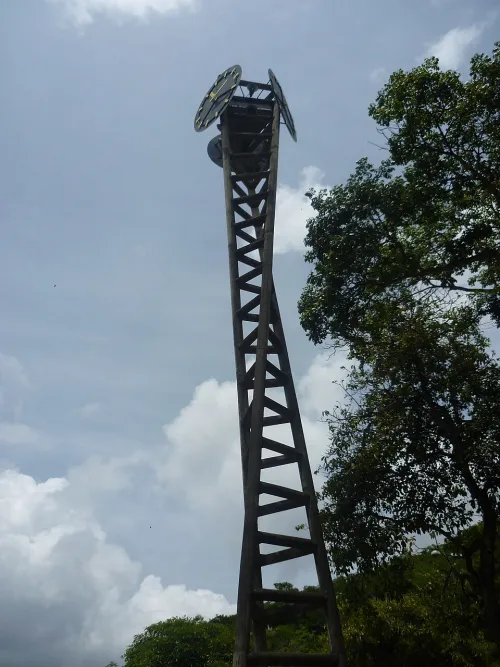
Free Walking Tour Caracas: From Bolívar to Villanueva

Walk from the square where Caracas rose against Spain in 1810 to Villanueva's UNESCO campus, then back past free museums to the crypt of Bolívar's family.

11 Stops 14.5 km ~3 h 31 min walking
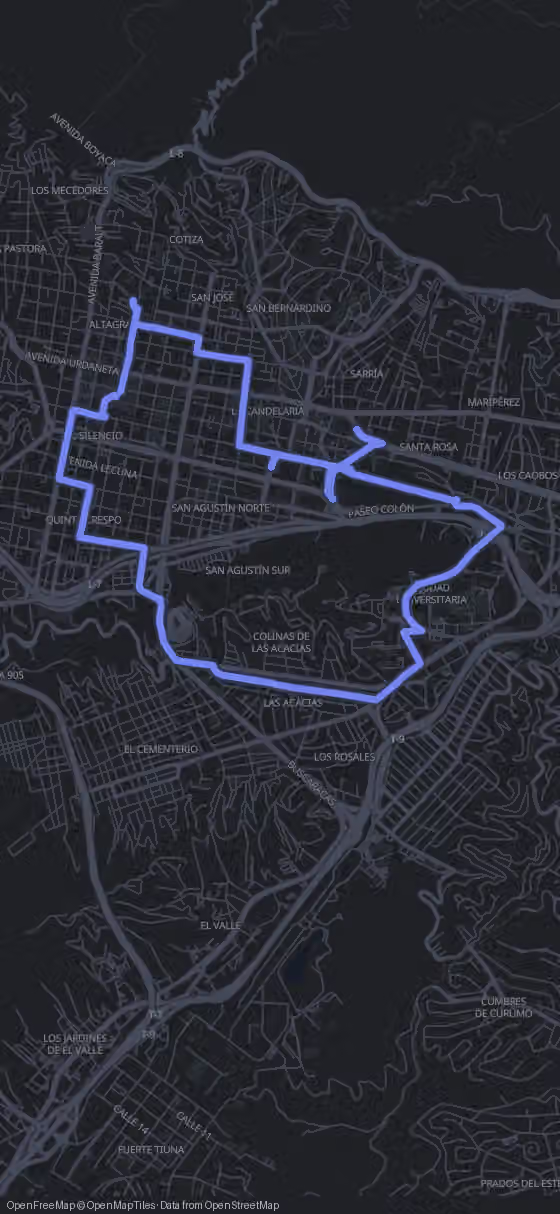
Route map for the Caracas walking tour
Stop 1 of 11
220 m·3 min
Plaza Bolívar
Head south-west toward Iglesia de San Francisco
Hola, welcome to Caracas. I'm Alex, and one campus here turned architecture and art into a single work.
Try this tour with Alex

Caracas on foot: what this walk covers

This free walking tour Caracas route links 11 stops over 14.5 km, from Plaza Bolívar out to the Ciudad Universitaria (UCV) and the museum quarter around Parque Los Caobos, then back to the Catedral Metropolitana de Santa Ana. Pure walking time is 3 h 31 min; with visits, plan about eight and a half hours.

Every stop is free to enter; only shows at the Teatro Teresa Carreño need a ticket. Route, map and GPS navigation from stop to stop are free in your browser, and the optional AI Tour Guide can lead the walk as a conversation.

Open free GPS & optional AI Tour Guide
This short shows highlights of the route. All 11 stops follow below.

The Route

Walking Map of Caracas: 11 Stops, 14.5 km

11 stops 14.5 km 3 h 31 min walking
Tap to load interactive map

The 11 stops along this route

  1. Plaza Bolívar in Caracas, stop 1 on the self-guided walking tour
    1Plaza Bolívar
  2. Iglesia de San Francisco in Caracas, stop 2 on the self-guided walking tour
    2Iglesia de San Francisco
  3. Casa Natal del Libertador in Caracas, stop 3 on the self-guided walking tour
    3Casa Natal del Libertador
  4. Ciudad Universitaria (UCV) in Caracas, stop 4 on the self-guided walking tour
    4Ciudad Universitaria (UCV)
  5. Parque Los Caobos in Caracas, stop 5 on the self-guided walking tour
    5Parque Los Caobos
  6. Museo de Bellas Artes in Caracas, stop 6 on the self-guided walking tour
    6Museo de Bellas Artes
  7. Teatro Teresa Carreño in Caracas, stop 7 on the self-guided walking tour
    7Teatro Teresa Carreño
  8. Mercado de Guaicaipuro in Caracas, stop 8 on the self-guided walking tour
    8Mercado de Guaicaipuro
  9. Galería de Arte Nacional in Caracas, stop 9 on the self-guided walking tour
    9Galería de Arte Nacional
  10. Panteón Nacional in Caracas, stop 10 on the self-guided walking tour
    10Panteón Nacional
  11. Catedral Metropolitana de Santa Ana in Caracas, stop 11 on the self-guided walking tour
    11Catedral Metropolitana de Santa Ana
  12. That's the full route.

    Walk it with an AI Tour Guide talking you through every one of these streets.

    Start free in your browser
    You made it

Caracas Walking Tour Stops: Colonial Core, Campus and Museums

  1. 1

    Plaza Bolívar

    Plaza Bolívar in Caracas, stop 1 on the self-guided walking tour

    Start where Caracas itself started. When the city was founded as Santiago de León de Caracas in 1567, this square sat at the centre of its first 25 blocks and was planned as the Plaza Mayor, the town's marketplace. Look around the edges and you can read the city's power map: the cathedral, the Sacred Museum, the Archbishop's Palace, City Hall, the Chapel of Santa Rosa de Lima, the Yellow House, the Main Theater and the seat of the Capital District government all face the square.

    Its history is not all gentle. Under Spanish rule this was where political enemies and conspirators were shot and executed; the case people remember is José María España, whose body was quartered here in 1799. Eleven years later, on 19 April 1810, a popular rebellion against the Spanish crown rose on this same ground, Venezuela's first move towards independence.

    The name came late. After independence it was the Plaza de Armas and the Plaza del Mercado; only when Bolívar's body arrived from Santa Marta was it formally named Plaza Bolívar in 1842, and the name did not really stick until 1874. In 1754 Governor Felipe Ricardos had wrapped the square in arcades. General Antonio Guzmán Blanco, who took the presidency in 1865, tore them down and moved the market vendors out, and he is also the man behind the equestrian statue of Bolívar in the middle. A detail locals like to correct: this is not the country's biggest Plaza Bolívar, that title goes to Maracay.

    The square is open around the clock and free, so give it fifteen minutes now; you come back to its edge at the very end, at the cathedral. The Iglesia de San Francisco is only 280 m away, about 3 minutes on foot.
    Hours
    24/7
    Price
    Free
  2. 2

    Iglesia de San Francisco

    Iglesia de San Francisco in Caracas, stop 2 on the self-guided walking tour

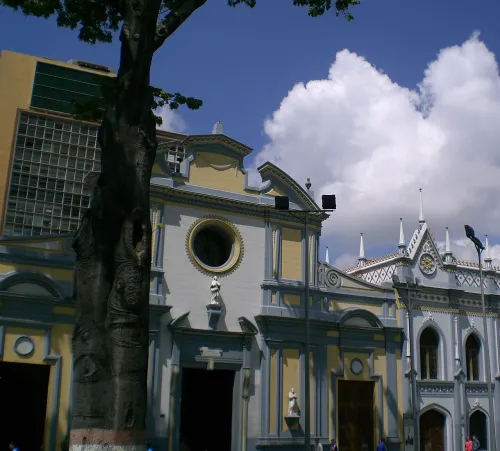
    The church everyone calls San Francisco is officially the Iglesia de la Inmaculada Concepción. It took its popular name from the Franciscan convent it served, and the name spread to the street corner too. Before you go in, look at the ceiba tree in front: it is around 150 years old and protected as part of the city's heritage.

    The Franciscans arrived in 1574, when Fray Alonso Vidal came with eight friars to found a convent. By 1578 there was a simple wattle-and-daub chapel; from 1587 a proper church went up to plans by the master builder Antonio Ruiz de Ullán, next to the convent that is now the Palacio de las Academias. An earthquake in 1641 badly damaged it, and in 1745 the main door was raised, a bell tower added and the three naves rebuilt. The façade you see dates from 1888, another Guzmán Blanco project, designed by the architect Juan Hurtado Manrique.

    Two Bolívar moments took place inside. Here, at the end of the Campaña Admirable on 6 August 1813, he was given the title of Libertador. And on 17 December 1842 his remains were received in this church before being carried on to the cathedral. In 1956 the building was declared a National Monument because its colonial-era works are so well preserved, and those works are the reason to step in.

    It is an active parish with no admission fee, so walk in quietly and keep it short if a mass is under way. From here it is 1540 m, about 20 minutes, to the house where Bolívar was born.

    Hours
    Open daily; masses Mon–Fri 06:00, 07:00, 12:00 and 18:00, Sat 06:30, 07:30, 12:00 and 18:00, Sun hourly 07:00–12:00 and 17:30
    Price
    Free (active Catholic parish; no admission fee)
  3. 3

    Casa Natal del Libertador

    Casa Natal del Libertador in Caracas, stop 3 on the self-guided walking tour

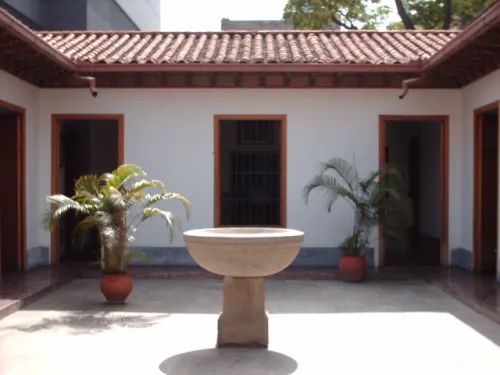
    This is the house where Simón Bolívar was born on 24 July 1783, in the bedroom, the fourth child of María de la Concepción Palacios y Blanco and Colonel Juan Vicente Bolívar y Ponte, an aristocratic Creole family whose ancestors had come from Spain two centuries earlier. Completed in the 1640s, it is one of only a few colonial-era houses left in central Caracas.

    What you walk through is not a frozen colonial home. The house was sold in 1806 to a relative named Madriz and stayed in his family until 1876, when Guzmán Blanco, a great admirer of Bolívar, bought it. Reconstruction was ordered in 1916, carried out from 1920 and inaugurated on 5 January 1921. The restorers wanted to enhance the house rather than keep it strictly authentic, so look closely at the street façade: it was refaced in stone, something colonial houses in Venezuela typically did not have.

    Inside, the single-storey house runs over a narrow plot 23 m wide and 60 m deep, with wide corridors, courtyards and patios. An adjoining building holds the Bolivarian museum, and together they show memorabilia of Bolívar and the War of Independence, plus weapons and furniture of the period. Entry is free. If you go inside only one historic building today, choose this one: it is the most personal stop on the route.

    Now comes the long leg: 4270 m, about 60 minutes on foot, out to the university city. It is the biggest stretch of the day, so pace yourself.

    Local name
    Casa Natal del Libertador Simón Bolívar
    Hours
    Tue–Fri 09:00–16:00, Sat–Sun and holidays 10:00–16:00, Mon closed
    Price
    Free
  4. 4

    Ciudad Universitaria (UCV)

    Ciudad Universitaria (UCV) in Caracas, stop 4 on the self-guided walking tour

    The Ciudad Universitaria is the main campus of the Central University of Venezuela, and it is one architect's life work. Carlos Raúl Villanueva designed it from the end of the Second World War and oversaw its construction for 20 years. UNESCO listed it as World Heritage in 2000; it remains the only 20th-century university campus designed by a single architect to receive that recognition.

    As you walk, notice how the faculties (Sciences, Architecture, Humanities, Medicine and others) each have their own zone, and how they all meet in the middle. There you find the Tierra de nadie, 'no man's land', a stretch of lawn and woodland that belongs to no discipline, and the Plaza Cubierta, a complex of shared buildings where modern art is part of the architecture. The northern half of the campus is a Botanical Garden, with sports grounds to the east, west and south.

    Not everything is pristine: parts of the campus suffer from age and from deliberate damage, which is why the World Monuments Fund put it on its lists in 2010 and 2014. Seeing the design up close still explains why it shaped Venezuelan architecture so strongly. Walking in costs nothing, and the visitor information office can give you guidance.

    Keep the name Villanueva in mind, you meet him again in the museum quarter. Parque Los Caobos is 2120 m away, about 30 minutes on foot.

    Hours
    Mon–Fri 08:00–12:00 and 13:30–16:00 (visitor info & COPRED administrative guidance)
    Price
    Free
    Website
    ucv.ve ↗
  5. 5

    Parque Los Caobos

    Parque Los Caobos in Caracas, stop 5 on the self-guided walking tour

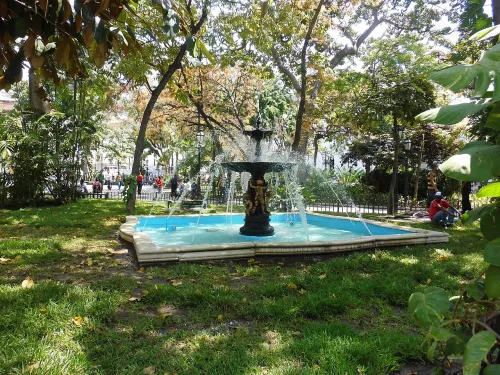
    Parque Los Caobos is one of the oldest parks in Caracas, 21.8 hectares of shade on the grounds of the former hacienda La Industrial, which belonged to José Antonio Mosquera. It opened on 9 December 1924, the centenary of the Battle of Ayacucho, and so it was first called Parque Sucre after Antonio José de Sucre, who led the winning army. In 1937 the city council renamed it for its mahogany trees, the caobos, which had grown here since colonial times. It still holds one of the city's important collections of century-old trees.

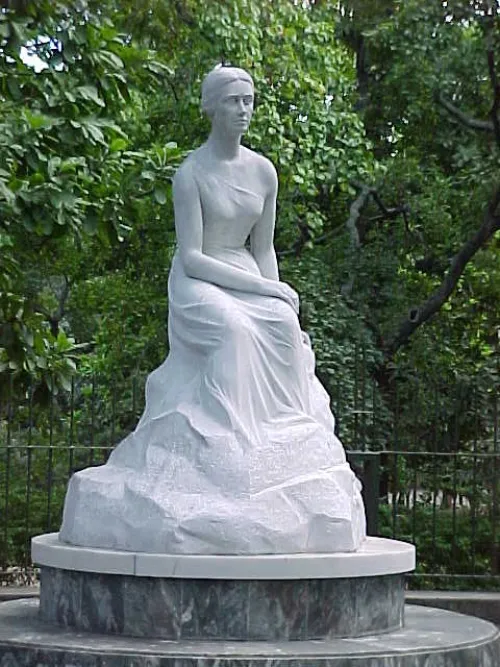
    At the entrance stands a statue of Teresa de la Parra by the sculptor Carmen Cecilia Caballero de Blanch. Walk into the middle to find the Fuente Venezuela by Ernest Maragall i Noble: human figures representing five regions of the country, Caracas, Los Llanos, the Caribbean, Guayana and the Andes. The fountain originally stood on Plaza Venezuela, was moved aside during remodelling works in 1962 and arrived here on 12 October 1967.

    The park is free to enter. One of its entrances is the Plaza de los Museos, and that is where you head next: the Museo de Bellas Artes is 440 m away, about 6 minutes.

    Hours
    Daily 08:30–18:00
    Price
    Free
  6. 6

    Museo de Bellas Artes

    Museo de Bellas Artes in Caracas, stop 6 on the self-guided walking tour

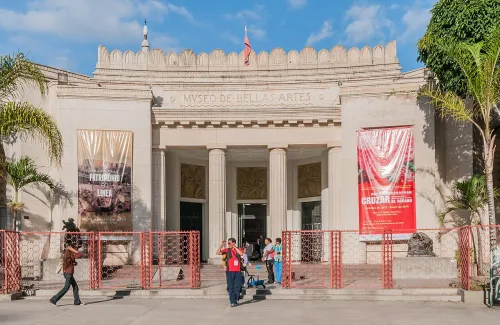
    Venezuela's oldest fine arts museum was created by decree in 1917 under acting president Victorino Márquez Bustillos and founded in 1918, at first in rooms of the National Academy of Fine Arts. On 20 February 1938 President Eleazar López Contreras opened its own neoclassical building beside Los Caobos, designed by Villanueva and enlarged towards the rear in 1953.

    In 1976, when the newly created Galería de Arte Nacional took over the neoclassical building, the museum moved into a brutalist structure behind it, again by Villanueva. So here you see the same architect in two very different moods side by side. Inside, notice how he arranged the galleries around a central patio, with corridors that give you room to rest between halls and let you move from one room to the next without losing the thread. The Cinemateca Nacional also has a screening room here.

    Entry is free. Allow 40 minutes or more if you enjoy architecture as much as the art on the walls.

    The Teatro Teresa Carreño is 400 m on, about 7 minutes, and on the way you pass the Ateneo de Caracas, today the National Experimental University of the Arts.

    Hours
    Tue–Fri 09:00–17:00, Sat–Sun and holidays 10:00–17:00, Mon closed
    Price
    Free
  7. 7

    Teatro Teresa Carreño

    Teatro Teresa Carreño in Caracas, stop 7 on the self-guided walking tour

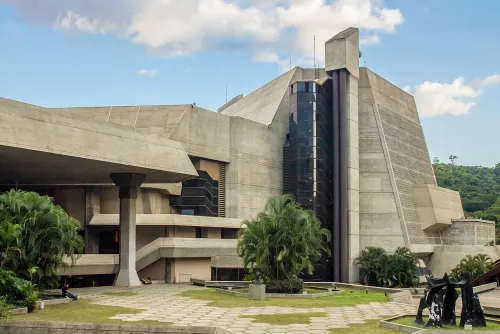
    The Teresa Carreño Cultural Complex is named after the Venezuelan pianist Teresa Carreño and is the country's main stage for symphonic and popular concerts, opera, ballet and plays. It ranks as the second largest theatre in South America after the Néstor Kirchner Cultural Centre in Buenos Aires. From outside, look at the enormous columns and the hexagonal roofs layered over each other, the signature of the architects Dietrich Kunckel, Tomás Lugo and Jesús Sandoval.

    The idea came in the 1970s from Pedro Antonio Ríos Reyna, who wanted a home for the Venezuela Symphony Orchestra; the Simón Bolívar Center widened it into a multi-use complex, and the money was granted in September 1970. It opened in two phases: the José Félix Ribas Hall in February 1976, then the Ríos Reyna Hall and the rest of the complex on 19 April 1983, the anniversary of the 1810 uprising on Plaza Bolívar.

    The site covers 22,586 m², with more than 80,000 m² built. Besides the two halls it holds exhibition rooms dedicated to Teresa Carreño and the composer Reynaldo Hahn, and it is home to the National Theater Company and a Monte Ávila Editores bookstore. There is no general admission, so the halls are for performance nights; on this walk, the building itself is the sight.

    From here it is 1020 m, about 16 minutes, to the Mercado de Guaicaipuro; keep an eye on the clock.

    Hours
    Mon–Fri: 09:00–17:00 | Sat–Sun: Closed
    Price
    No general admission, per-event tickets at the box office or MakeTicket.ve; some events free with limited capacity
  8. 8

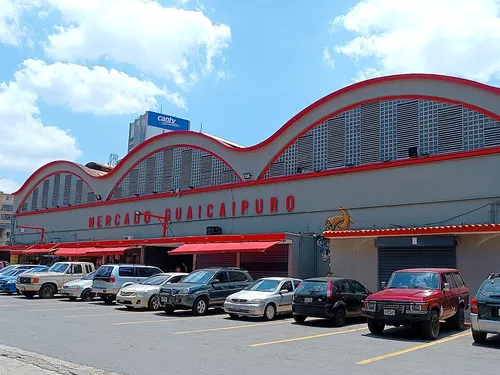
    Mercado de Guaicaipuro

    Mercado de Guaicaipuro in Caracas, stop 8 on the self-guided walking tour

    After the museums, a working market. The Mercado Municipal de Guaicaipuro opened in 1953 under General Marcos Pérez Jiménez and is one of the few municipal markets a Venezuelan head of state has visited; Vice Admiral Wolfgang Larrazábal came too, in 1953. Since 2009 it has been run by the Libertador municipality.

    Come for everyday Caracas: vegetables, meat, chicken, corn flour and much more, with clothing sold in some sections. The parking area hosts temporary fairs, such as a fish fair. Entry is free and you only pay for what you buy.

    The market does not stay open all day, so plan to be here well before mid-afternoon; this is the stop where timing decides whether you see anything at all. Then walk 1260 m, about 19 minutes, to the Galería de Arte Nacional.

    Hours
    Mon: Closed | Tue–Sun: 06:00–14:00
    Price
    Free (public municipal market; pay only for purchases)
  9. 9

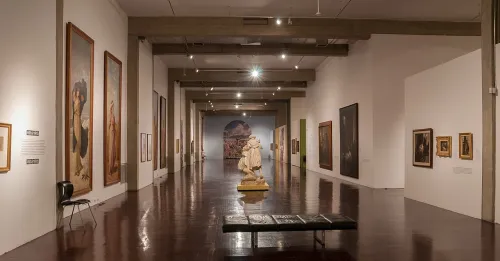
    Galería de Arte Nacional

    Galería de Arte Nacional in Caracas, stop 9 on the self-guided walking tour

    The Galería de Arte Nacional exists to show Venezuelan art in one place. Founded on 1 October 1974, it opened on 6 April 1976 in the 1938 Villanueva building you saw at the Museo de Bellas Artes. A plan for its own home came just a year later, was restarted in 1988 and stalled again, and was finally revived in 2005 with a design by the architect Carlos Gómez de Llarena.

    The current building faces the Parque Central complex between Avenida Bolívar and Avenida México, less than 600 m from the old seat. Its first phase opened in 2006, and President Hugo Chávez inaugurated it on 25 April 2009. Three volumes add up to 30,785 m², with double-height floors of 6.50 m.

    The collection holds around 9,000 works: painting, drawing, prints, photography, sculpture, installation, video installation, ceramics and textiles, from pre-Hispanic pieces and colonial paintings to modern Venezuelan art. Entry is free. If you pick only one museum today, this broad survey is the one; give it 45 minutes.

    The Panteón Nacional is 2420 m away, about 37 minutes, back towards the old town.

    Hours
    Tue–Fri 09:00–17:00; Sat–Sun 10:00–17:00; public holidays (Jan 1, Apr 19, May 1, Jun 24, Jul 5, Jul 24, Oct 12, Dec 24, 25 and 31) 10:00–17:00
    Price
    Free
  10. 10

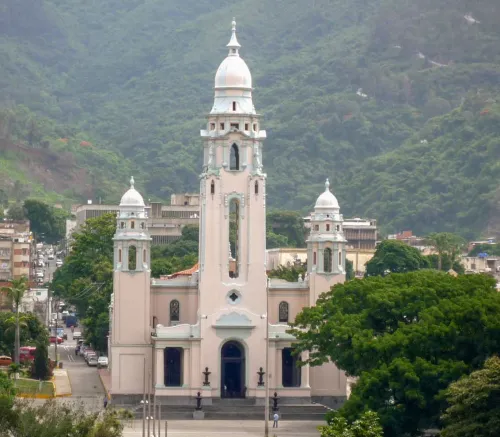
    Panteón Nacional

    Panteón Nacional in Caracas, stop 10 on the self-guided walking tour

    Venezuela's National Pantheon was created in the 1870s on the site of the ruined Santísima Trinidad church from 1744, at the northern edge of the old town. The whole central nave belongs to Simón Bolívar: where the altar would be stands his bronze sarcophagus, while other national figures rest in the aisles.

    Look up. The vault is covered with 1930s paintings of scenes from Bolívar's life, and the huge crystal chandelier was hung in 1883 for the centenary of his birth. The building reopened in 2013 after a three-year expansion and restoration.

    Then read the names along the aisles: generals and officers of the War of Independence, doctors, writers such as Cecilio Acosta and the historian Rafael María Baralt. Since 8 March 2017 they include the Indigenous rebel Apacuana and two women from Bolívar's childhood, his wet nurse Hipólita and Matea, the family's nurse.

    Entry is free. The Panteón takes a midday break, which matters if you arrive around lunchtime. The last leg is 770 m, about 11 minutes, to the cathedral.

    Local name
    Panteón Nacional de Venezuela
    Hours
    Tue–Sun 09:00–12:00 and 13:30–16:30, Mon closed
    Price
    Free
  11. 11

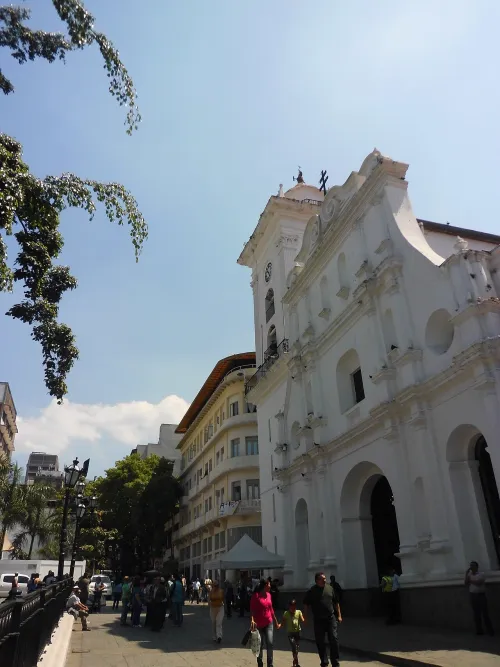
    Catedral Metropolitana de Santa Ana

    Catedral Metropolitana de Santa Ana in Caracas, stop 11 on the self-guided walking tour

    You finish on Plaza Bolívar, at the seat of the Archdiocese of Caracas. The first church here, a mud-walled chapel dedicated to Santiago in the mid-17th century, fell in the earthquake of 1641. Juan de Medina began the cathedral in 1666 and completed it in 1674, with a bell tower; the façade is from 1771, the work of Francisco Andrés de Meneses, and a frontispiece was added in 1866.

    The story told here is Holy Thursday, 26 March 1812. At 4 pm, with the church full of worshippers, an earthquake of magnitude 7.7 struck and the cathedral crumbled, killing a few people and injuring many. The priests called it divine punishment for Francisco de Miranda's rebellion; Bolívar told the crowd not to panic, it was merely an earthquake. One damaged tower was later shortened.

    Inside, find the chapel of the Holy Trinity, where Bolívar's parents and his young wife are buried. His own remains lay in this cathedral from 1842 until 1876, when they were moved to the Panteón you just left. The composer Juan Bautista Plaza served here as chapel master and organist until 1948.

    Entry is free from sunrise to sunset, a fitting place to close a day that began on the same square.

    Hours
    sunrise-sunset
    Price
    Free
Walking tour route map of Caracas Route loaded
Plaza BolívarIglesia de San FranciscoCasa Natal del LibertadorCiudad Universitaria (UCV)+7
All 11 stops are already on the map.
You just press start.
AI Tour Guide

You know the route. Now walk Caracas with a guide in your ear.

Press start wherever you are, even hundreds of kilometres from Caracas, and the guide begins telling its stories right away. In the city, pick any of the 11 stops to start from: it leads you there, then talks with you the whole route, asking, listening, remembering, and shaping the tour around your answers.

11stops 14.5km 3 h 31 minwalking 13languages
▶Start the tour free

Free to start · Runs in your browser · No app, no download

Shorter Ways to Walk Caracas

The full route is a long day. If you have less time or energy, these sections work well on their own, and every one of them costs nothing in admission.

Colonial core in a morning

Stops: 1, 2, 3

For a first visit or a short day: the founding square, the church where Bolívar became Libertador and the house where he was born. Just 280 m and 1540 m between them, 23 minutes of walking. All three are free.

Villanueva's Caracas

Stops: 4, 5, 6, 7, 8, 9

For architecture lovers: the UNESCO campus, the park, both museums, the theatre and the market. 1 h 18 min of walking. All free, though the theatre's halls are only open for performances. Start early enough to reach the market while it is still open.

Museums back to Plaza Bolívar

Stops: 5, 6, 7, 8, 9, 10, 11

Skips the long walk out to the university and still ends on the historic square. 1 h 36 min of walking from Parque Los Caobos to the cathedral. Every stop is free.

How Long the Caracas Tour Takes, Hour by Hour

Pure walking time is 3 h 31 min over 14.5 km. Two legs carry most of it: 60 minutes from the Casa Natal out to the university and 37 minutes from the Galería de Arte Nacional to the Panteón. The museum quarter around Los Caobos is compact, with legs of 6 and 7 minutes.

With realistic visits, plan about eight and a half hours. A weekday that works: start on Plaza Bolívar at 08:00, reach the Casa Natal at 08:53 and go in as soon as it has opened, leave at 09:40 and be at the university by 10:40. After 40 minutes on campus you arrive at Los Caobos at 11:50, the Museo de Bellas Artes at 12:11, the theatre at 12:58 and the market at 13:24. The Galería de Arte Nacional follows at 14:08, the Panteón at 15:30 and the cathedral at 16:11; you finish around 16:30.

With visits, the colonial core takes about an hour and a half, the Villanueva section about four and a quarter hours, and the stretch from the museums back to the cathedral about four hours and forty minutes.

Before You Start in Caracas

  • Start and finish: The recommended start is Plaza Bolívar, and the walk ends at the Catedral Metropolitana de Santa Ana on the same square. You can join at any stop and let the GPS navigation lead you on from there.
  • Best day: A weekday in the middle of the week works best, when the museums, the Panteón, the market, the theatre's offices and the university's visitor information are all open.
  • Time of day: Start early, around 08:00, so the market and all the visits still fit into the day.
  • Costs: Every stop is free to enter; the Teatro Teresa Carreño only sells tickets for performances. Route, map and GPS navigation cost nothing. The AI Tour Guide starts with 100 free credits, then €19.99 for this tour all-inclusive with no time limit, or €5 per hour.
Walking tour route map of Caracas
AI Tour Guide

Your Caracas guide starts when you do.

Press start and a voice AI Tour Guide takes it from here: leading the route through Caracas, telling the stories, and turning your walk into a real back-and-forth conversation. No app or download is needed; it runs in your browser.

11stops 14.5km 3 h 31 minwalking 13languages
▶Start the tour free

Free to start · Runs in your browser · No app, no download

What the AI Tour Guide adds on this route

On this walk Bolívar's life is scattered across the city: born in one house, named Libertador in a church, buried first in the cathedral and then in the Panteón. The AI Tour Guide ties those threads together as you go. It greets you on Plaza Bolívar, tells the stories of each place, asks what draws you in and steers the conversation that way. Curious about one of the lesser names in the Panteón's aisles, or about the art woven into Villanueva's Plaza Cubierta? Just cut in; the route stays exactly as it is.

A Real Conversation A voice AI Tour Guide greets you, leads the whole route, and tells the stories and facts as you walk, asking what you want to see and keeping a real conversation going. Not a recording you press play on.
Map Navigation Follow the route on the map and walk at your own pace. You choose where to start and when to move to the next stop.
Ask Anything Curious about a building you pass? Ask your AI Tour Guide on the spot and the conversation carries on.
13 Languages Switch language anytime. No separate tour needed.
Start free in your browser

Common Questions About Walking Caracas

Can I see inside the Teatro Teresa Carreño without going to a show?

There is no general admission. To get into the halls you need a ticket for a performance, sold at the box office or on MakeTicket.ve; some events are free with limited capacity.

When is the best time to look around the Iglesia de San Francisco?

Masses are held several times a day, every day of the week, so for looking around undisturbed go in between services.

Can I do the walk on a Venezuelan public holiday?

Yes. The Casa Natal and the Museo de Bellas Artes open on public holidays, and so does the Galería de Arte Nacional on the main national holidays and over Christmas. Plaza Bolívar and Parque Los Caobos are open as usual.

Where else in Venezuela can I walk a route like this?

Try the Mérida walking tour in the Andes, Ciudad Bolívar on the Orinoco side of the country or Maracaibo in the west. Across the border, Santa Marta, where Bolívar died, closes the circle.

Is the tour really free?

Yes. The whole tour is free: the route, the interactive map and the navigation cost you nothing. Only the voice AI Tour Guide is optional and paid: you test it with 100 free credits, then you pay either €5 per hour or €19.99 for this whole tour, with no time limit.

Do I need to download an app?

No. Everything runs in your phone browser. Open the route and start walking, no download and no sign-up required.

Do I need to book the walking tour in advance?

No booking needed. This self-guided tour is available anytime. Open the route in your browser and start walking. The AI Tour Guide works instantly, no app, no reservation required.

What languages is the AI Tour Guide available in?

The AI Tour Guide speaks 13 languages, so you take the tour in your own language and can switch at any time.

Can I skip stops or change the route?

Yes. Skip any stop, spend extra time at places you like, or start the route from any point. It is your walk, you set the pace.
Image credits
▶ Start free in your browser Runs in your browser, no app, no download