Free Walking Tour Cuenca, Ecuador: Cathedrals to Inca Ruins

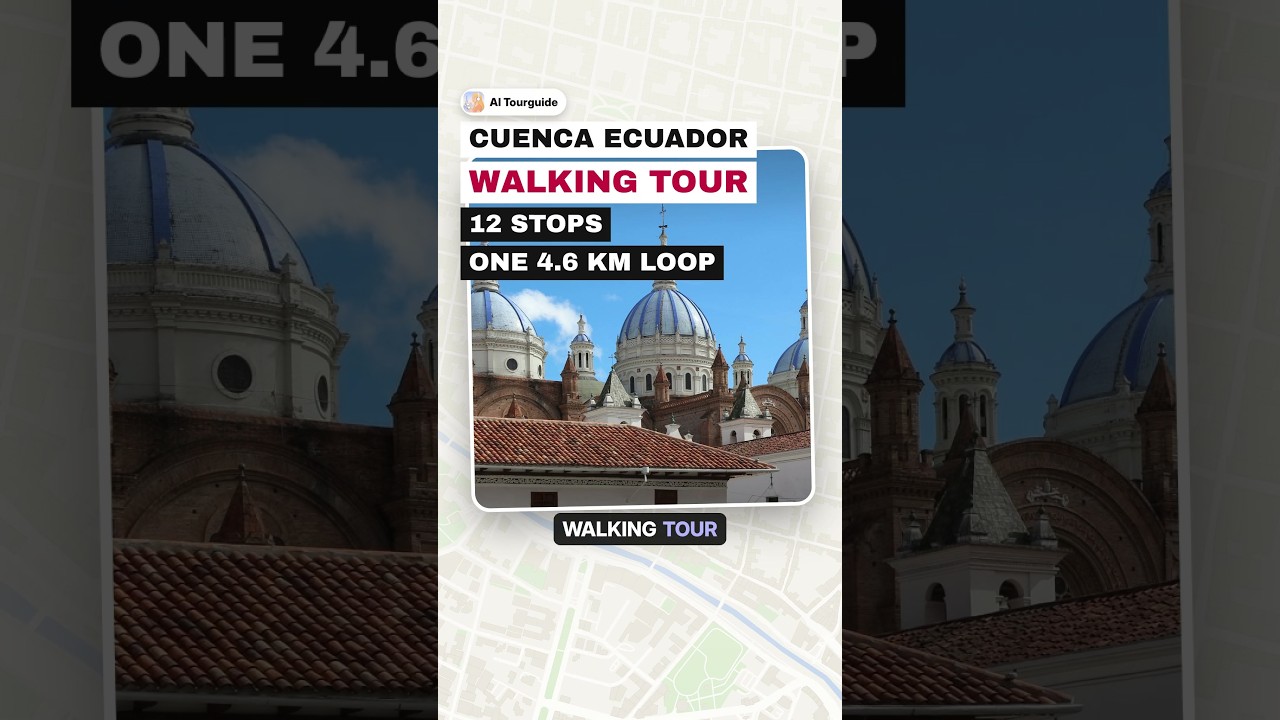
Colonial cloisters, a broken bridge over the Tomebamba and the Inca ruins of Pumapungo: 12 stops that walk you through Cuenca's whole story in 4.6 km.

12 Stops 4.6 km ~1 h 5 min walking
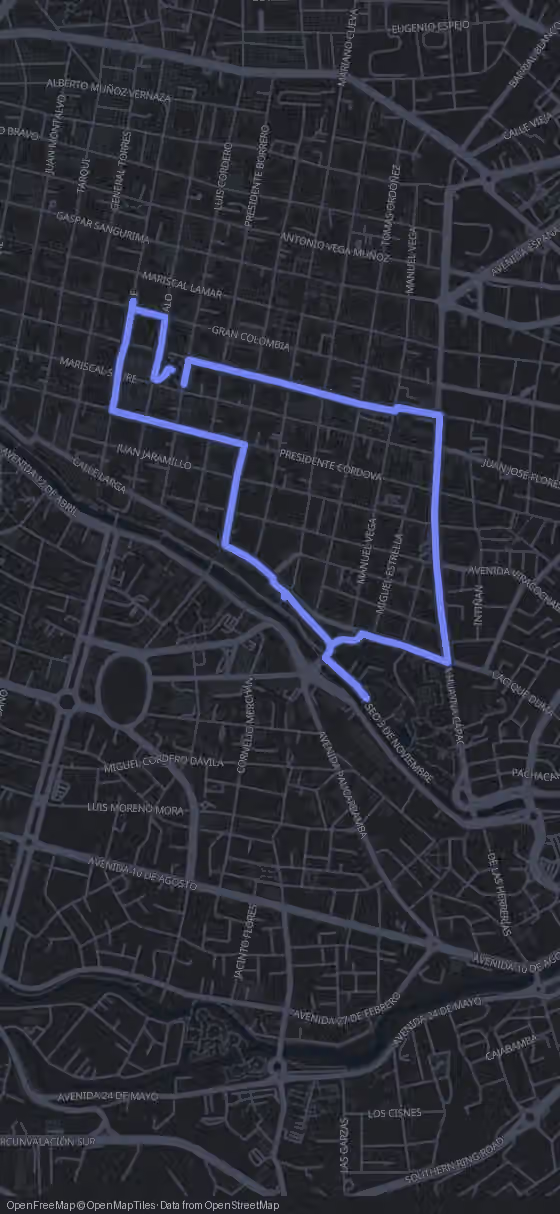
Route map for the Cuenca, Ecuador walking tour
Stop 1 of 12
70 m·1 min
Parque Calderón
Head west toward the Catedral de la Inmaculada Concepción
Hola, welcome to Cuenca. I'm Alex, and one broken crossing found a new life instead of being rebuilt.
Try this tour with Alex

What the Walk Covers, from Plaza to Pumapungo

Twelve stops lead from Parque Calderón past colonial churches and cloisters, down to Puente Roto on the river and the Inca ground of Parque Arqueológico Pumapungo, then back to Catedral Vieja (El Sagrario) on the starting square. 4.6 km, 1 h 5 min of pure walking; with interiors, most of a day.

The plaza, most churches, Puente Roto and both Pumapungo sites are free; tickets apply at Museo del Monasterio de las Conceptas, Museo de las Culturas Aborígenes, Iglesia de Todos Santos and the Old Cathedral. The GPS route is free in your browser, the AI Tour Guide optional.

Open free GPS & optional AI Tour Guide
This short shows highlights of the route. All 12 stops follow below.

The Route

Walking Map of Cuenca, Ecuador: Plaza, River and Inca Park

12 stops 4.6 km 1 h 5 min walking
Tap to load interactive map

The 12 stops along this route

  1. Parque Calderón in Cuenca, Ecuador, stop 1 on the self-guided walking tour
    1Parque Calderón
  2. Catedral de la Inmaculada Concepción in Cuenca, Ecuador, stop 2 on the self-guided walking tour
    2Catedral de la Inmaculada Concepción
  3. Iglesia de Santo Domingo in Cuenca, Ecuador, stop 3 on the self-guided walking tour
    3Iglesia de Santo Domingo
  4. Iglesia y Convento de San Francisco in Cuenca, Ecuador, stop 4 on the self-guided walking tour
    4Iglesia y Convento de San Francisco
  5. Museo del Monasterio de las Conceptas in Cuenca, Ecuador, stop 5 on the self-guided walking tour
    5Museo del Monasterio de las Conceptas
  6. Museo de las Culturas Aborígenes in Cuenca, Ecuador, stop 6 on the self-guided walking tour
    6Museo de las Culturas Aborígenes
  7. Iglesia de Todos Santos in Cuenca, Ecuador, stop 7 on the self-guided walking tour
    7Iglesia de Todos Santos
  8. Puente Roto in Cuenca, Ecuador, stop 8 on the self-guided walking tour
    8Puente Roto
  9. Parque Arqueológico Pumapungo in Cuenca, Ecuador, stop 9 on the self-guided walking tour
    9Parque Arqueológico Pumapungo
  10. Museo Pumapungo in Cuenca, Ecuador, stop 10 on the self-guided walking tour
    10Museo Pumapungo
  11. Iglesia y Parque de San Blas in Cuenca, Ecuador, stop 11 on the self-guided walking tour
    11Iglesia y Parque de San Blas
  12. Catedral Vieja (El Sagrario) in Cuenca, Ecuador, stop 12 on the self-guided walking tour
    12Catedral Vieja (El Sagrario)
  13. That's the full route.

    Walk it with an AI Tour Guide talking you through every one of these streets.

    Start free in your browser
    You made it

Your Cuenca, Ecuador Walking Tour Stop by Stop, from Cloisters to Inca Stones

  1. 1

    Parque Calderón

    Parque Calderón in Cuenca, Ecuador, stop 1 on the self-guided walking tour

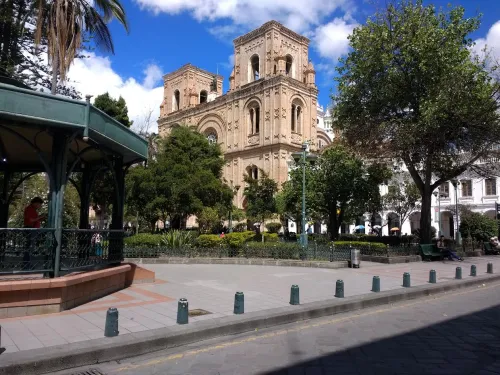
    Begin in the middle of Cuenca's main square. Its official name is Parque Mayor Abdón Calderón, and over time it has also gone by Plaza República and Plaza de Armas; it has carried Calderón's name since 1920. Turn slowly on the spot and you can read the whole city's order from here: the Catedral de la Inmaculada Concepción on one side, Catedral Vieja (El Sagrario) facing it, and around them the Gobernación, the Municipalidad, the old seminary and the Palace of the Provincial Court of Justice.

    In the centre stands the bronze monument to Abdón Calderón, set within four semicircles and unveiled on 24 May 1931. The city had contracted the European sculptor Carlos Mayer to cast it in September 1927. Nearby you will also find the park's gazebo.

    This is the square where Cuenca gathers for its big occasions, from Corpus Christi to the commemoration of the city's independence. It is free and open at any hour, which makes it an easy meeting point however early you start. Keep in mind that the walk loops out to the river and returns here: Catedral Vieja is your final stop, so leave it for the afternoon.

    The Catedral de la Inmaculada is just 90 m away, a minute on foot.
    Hours
    24/7
    Price
    Free (public plaza)
  2. 2

    Catedral de la Inmaculada Concepción

    Catedral de la Inmaculada Concepción in Cuenca, Ecuador, stop 2 on the self-guided walking tour

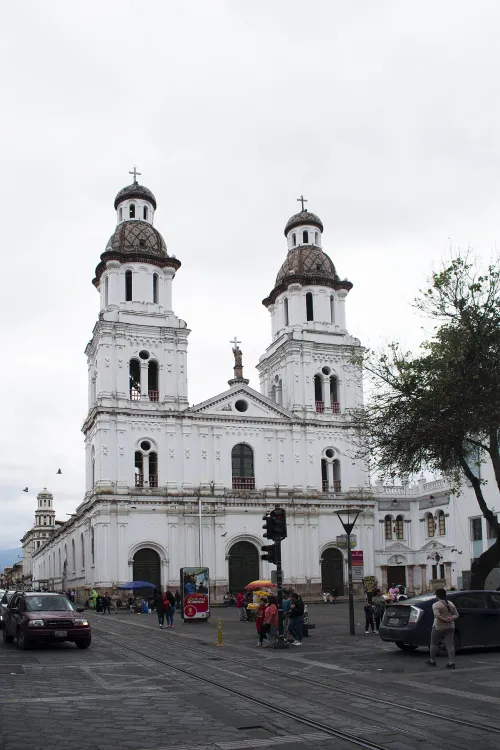
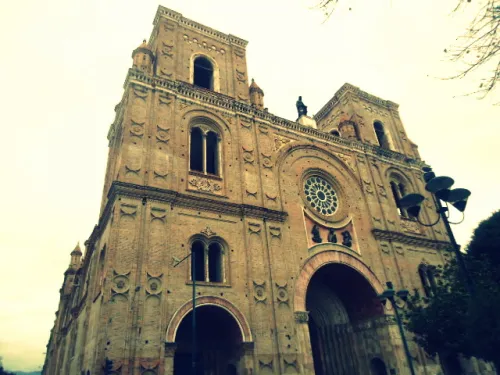
    Look up first. Three giant domes covered in blue and white glazed tile from Czechoslovakia crown the building, and that dome skyline has become the symbol of Cuenca. Then look at the towers: they stop short. The architect miscalculated, and had the towers been raised to their planned height, the foundation could not have carried the weight. The error stayed, and the city loves the result anyway.

    The plans came from Juan Bautista Stiehle, a German-born friar who arrived in Cuenca from Alsace in 1873, working on ideas from Bishop León Garrido. The city needed a bigger church because the old cathedral across the square had become too small. Work began in 1885 and went on for almost a century, which is why the building mixes several styles, with Romanesque Revival leading. Everyday Cuencanos still call it the New Cathedral.

    Inside, the scale is the point: when it was first built, 9,000 of Cuenca's 10,000 inhabitants could fit in. The facade is alabaster and local marble, the floor pink marble brought from Carrara in Italy, and the stained glass windows are by the Spanish artist Guillermo Larrazábal, a name you will meet again at Museo Pumapungo.

    Entry to the nave is free, so go in even if you are short on time. The paid dome and crypt tour is worth it if you want to see those tiles up close, and this early in the walk you are well placed for it.

    From here it is 320 m, about 5 minutes, to Santo Domingo.

    Hours
    Mon–Thu 06:30–15:45, Fri 06:30–12:45, Sat 06:30–02:00, Sun 06:30–13:45, 19:00–20:45 (church); daily 08:00–13:30, 14:00–16:00 (domes)
    Price
    Free entry to church nave; optional dome/crypt tour $2 USD
  3. 3

    Iglesia de Santo Domingo

    Iglesia de Santo Domingo in Cuenca, Ecuador, stop 3 on the self-guided walking tour

    Santo Domingo is the first church on the route that keeps strictly religious hours, so do not count on finding the doors open. Entry is free: fold it into your morning rather than building a plan around it.

    The Dominicans who built here shared one of the colonial era's central tasks with the Franciscans at the next stop: teaching the Catholic faith to the Indigenous people of the region, in places such as Paute, Gualaceo, Molleturo and Paccha. The two orders shaped Cuenca's religious life for centuries, and walking from one church to the other you follow that partnership.

    If you find the doors shut, keep moving. San Francisco holds more of the story and lies 370 m away, about 5 minutes on foot.

    Hours
    Mon–Wed: 7:30–11:00 | Thu: 07:30–19:00 | Fri–Sat: 7:30–11:00 | Sun: 07:30–12:00
    Price
    Free entry (church nave)
  4. 4

    Iglesia y Convento de San Francisco

    Iglesia y Convento de San Francisco in Cuenca, Ecuador, stop 4 on the self-guided walking tour

    San Francisco stands at the corner of Calle Padre Aguirre and Presidente Córdova. On 26 April 1557, just days after the city was founded, governor Gil Ramírez Dávalos granted the Franciscans almost a full block of four plots for their convent. By 1582 the church was under construction, and it stayed that way for a long time: it was only completed in 1789.

    After three centuries the Franciscans left convent and church in the 1860s. From 1920 the church became part of the parish of El Sagrario, and several major remodellings followed. What you see today is neoclassical on the outside, but the colonial walls are still there.

    Go in if the doors are open: entry is free. The interior has three naves, and the high altar is the reason to visit, dating from colonial times and covered in fine carving finished in gold leaf. The original pulpit survives too. Look for the sculpture of the Descent from the Cross by Álvaro y Figueroa, the large angels and many works telling the story of the Crucifixion.

    The building is hard to keep up: the parish priest has said the old structure needs more than the church can pay for, and the municipality has stepped in to help with maintenance and reconstruction.

    Next comes the Conceptas cloister, 520 m away, about 7 minutes.

    Hours
    Mon–Fri: 09:30–17:00 | Sat–Sun: Closed
    Price
    Free entry (church)
  5. 5

    Museo del Monasterio de las Conceptas

    Museo del Monasterio de las Conceptas in Cuenca, Ecuador, stop 5 on the self-guided walking tour

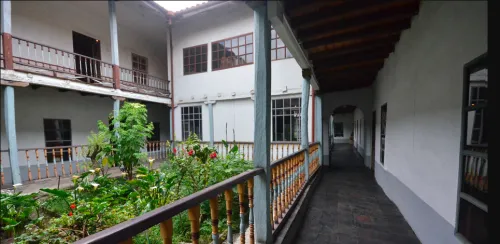
    This museum began in 1561 as a convent for women, and over the centuries it turned into what you visit today: rooms of paintings in every size, colour and material that pull you back into another era of the city.

    The story behind it is about money and families. Cuenca's colonial elite wanted a cloister where the daughters and descendants of the conquistadors could enter, but early funding came mostly from citizens' alms and one sizeable gift from an anonymous priest. Andrés Hurtado de Mendoza asked Viceroy Luis de Velasco for donations to complete the foundation. The decisive step came from Leonor Ordóñez, widow of Benito de Mendaña, treasurer of the town council: in her will she left several of her houses, valued at 4,250 pesos, on one condition, that her three daughters be accepted into the cloister.

    Leonor Ordóñez and her daughters Gerónima and Ángela de Amendaña were among the first women to take the habit in Cuenca, joined by nuns from Quito. The convent became popular with the city's leading families, many young women of high standing entered, and the monastery grew wealthy.

    It is worth the ticket if you care about colonial art or want to see how Cuenca's upper class lived its faith.

    The Museo de las Culturas Aborígenes is 320 m further, about 4 minutes.

    Hours
    Mon–Sat 10:00–17:00, Sun closed
    Price
    $4.00 USD adults, $2.00 USD students/children
  6. 6

    Museo de las Culturas Aborígenes

    Museo de las Culturas Aborígenes in Cuenca, Ecuador, stop 6 on the self-guided walking tour

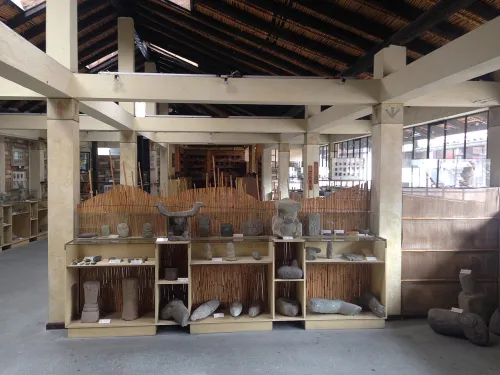
    The building itself has a past: it was once an inn for muleteers and their pack trains. Today it holds a collection of 5,000 archaeological pieces that run from the Palaeolithic and Neolithic to the Incas.

    Here the walk turns from Spanish Cuenca to everything that came before it. If you plan to give Pumapungo real time later, this museum is a good primer, because it lets you see what the people of this region made long before the first church went up on the main square.

    This museum charges entry, so if your time or budget only allows one paid museum on the route, choose by interest: Conceptas for colonial art, this one for the deeper past.

    Iglesia de Todos Santos is only 100 m away, about a minute.

    Hours
    Mon–Fri 09:00–18:00, Sat 09:00–14:00, Sun closed
    Price
    $4.00 USD adults, $2.00 USD students
  7. 7

    Iglesia de Todos Santos

    Iglesia de Todos Santos in Cuenca, Ecuador, stop 7 on the self-guided walking tour

    Long before this church, the site held a shrine known as Ushnu or Usno. After the Spanish founded the city, a chapel dedicated to San Marcos rose here, and it was in this place that the first Catholic Masses in Cuenca were celebrated.

    The present church dates from the mid-19th century, when the parish of Todos Santos was created and the church took its new name. In 1895 Bishop Miguel León gave the chapel and the surrounding land to the Oblate sisters. Led by Mother Virginia Urigüen, they redecorated the church and built their convent and a school, paid for largely with the inheritances of the Urigüen and Iñiguez sisters, with alms and with mingas, the collective work of the people living in the neighbourhood.

    On 25 March 1924 the work was inaugurated by placing the figure of the Sacred Heart at the top of the facade tower, with a Mass by Father Matovelle and a blessing from Bishop Daniel Hermida. The church looks much as it did then. Inside, murals cover columns, walls and the high altar, and the ceiling is pressed metal that Matovelle brought from France. On the altar stand the Heart of Jesus, the Heart of Mary and Saint Joseph.

    To go inside you book a paid guided visit, either the basic one or the full one.

    From here it is 100 m, 2 minutes, down to the river and Puente Roto.

    Hours
    Tue–Fri 08:00–16:30, Sat 09:00–16:30, Sun–Mon closed
    Price
    USD 2 (adult guided visit; seniors $1.50; children $0.50; full visit $4)
  8. 8

    Puente Roto

    Puente Roto in Cuenca, Ecuador, stop 8 on the self-guided walking tour

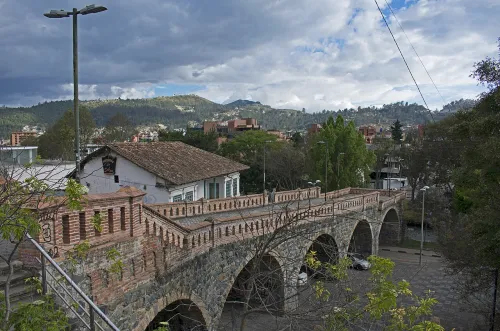
    Here the colonial city ends and the river begins. The Puente Roto is what remains of a 19th-century bridge across the Tomebamba: a surviving pier on the bank, never rebuilt, now a monument to a crossing that used to exist. It is free, open at any hour, and a few minutes of looking are enough.

    Treat it as the hinge of the walk. Everything behind you was Spanish Cuenca, its churches, cloisters and tickets. Ahead lies a history older than the colonial city: the Inca settlement that stood on this riverbank, and the museum that explains it.

    The Pumapungo ruins are 470 m away, about 6 minutes.

    Hours
    24/7
    Price
    Free
  9. 9

    Parque Arqueológico Pumapungo

    Parque Arqueológico Pumapungo in Cuenca, Ecuador, stop 9 on the self-guided walking tour

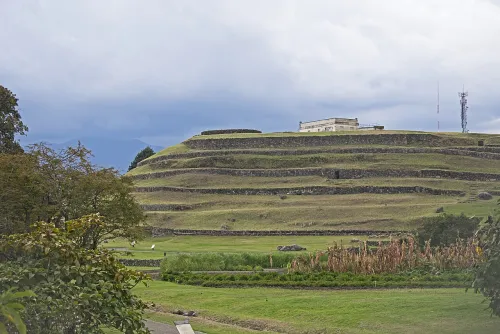
    These roughly 4 hectares are an Inca archaeological site, and the stones you see are mostly volcanic rock. Before the Incas, the Cañari people lived here. Then Túpac Yupanqui conquered the region, and under the Incas the site became a military fort, part of the city of Tomebamba.

    Its end came before the Spanish ever arrived: Pumapungo was destroyed during the Inca civil war. So when the conquerors founded Cuenca, they found ruins, and they used them. Both San Blas and Catedral Vieja, later on this walk, were built with stones taken from Tomebamba.

    Entry is free. Give it time if the Inca story is what brought you to Ecuador.

    Museo Pumapungo is 610 m from here, about 9 minutes.

    Hours
    Tue–Fri 08:00–17:00, Sat–Sun & holidays 10:00–16:00, Mon closed
    Price
    Free entry
  10. 10

    Museo Pumapungo

    Museo Pumapungo in Cuenca, Ecuador, stop 10 on the self-guided walking tour

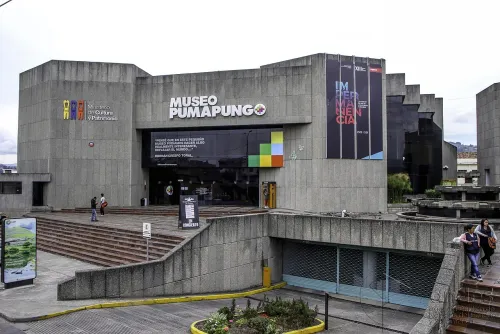
    Run by Ecuador's Ministry of Culture and Heritage, Museo Pumapungo covers anthropology, archaeology, ethnography and art, and access is free. It is the place that explains the ground you just walked.

    About a century ago the German scholar Max Uhle established that the Inca settlement of Tomebamba had stood here, in what is now the Pumapungo area of Cuenca. Túpac Yupanqui had raised it on the Cañari site of Guapondelig, and the archaeologist Jaime Idrovo later rediscovered it.

    Inside, the ethnography hall holds two permanent exhibitions: one on tsantsas, their myth, ritual and lost tradition, and one on spirituality and ritual through the worldview of the shaman. The archaeology hall, "Pumapunku: worlds of memory", ties back to the ruins. There is also a hall named after Guillermo Larrazábal, the artist of the cathedral's stained glass, two temporary exhibition halls, a theatre, the Víctor Manuel Albornoz library and archive, an ethnobotanical park, a bird rescue centre and a play library for children.

    With free entry and this much under one roof, it suits almost everyone; families have the children's spaces and the birds.

    The longest leg comes next: 960 m, about 14 minutes, to San Blas.

    Hours
    Tue–Fri 08:00–17:00, Sat–Sun & holidays 10:00–16:00, Mon closed
    Price
    Free entry
  11. 11

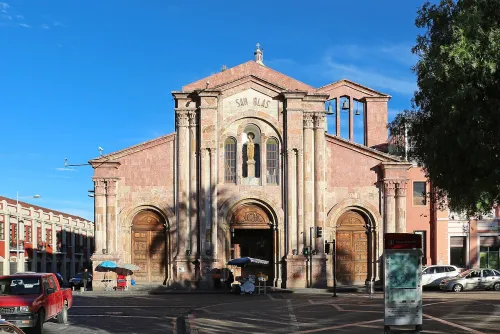
    Iglesia y Parque de San Blas

    Iglesia y Parque de San Blas in Cuenca, Ecuador, stop 11 on the self-guided walking tour

    For around 400 years San Blas marked the eastern edge of Cuenca, in the colonial district known as the Barrios de Abajo. Its origins go back to May 1557, a few days after the city was founded, and it was built with stones from the destroyed buildings of Tomebamba, the same ruins you just saw.

    Look at the base: it is made entirely of carved Inca stone, laid in the early colonial years. Above it rises a Romanesque facade clad in pink marble. The church you see dates from a 1935 rebuilding, funded jointly by the archdiocese and the municipality, which kept the original structure as its foundation. Inside, three main naves and two smaller ones form a perfect Latin cross, an arrangement found nowhere else in the city.

    The church opens mainly for Mass, so in the afternoon you may well find the doors closed; the Inca stones and the facade are outside anyway, and entry is free when it is open.

    Beside it lies the park, at the eastern end of Calle Simón Bolívar, with a monument to Manuel J. Calle, the Cuenca journalist and writer. From here it is 800 m, about 12 minutes, back to the main square and Catedral Vieja.

    Hours
    Church open daily for Mass (Mon–Fri 07:00, Sat 19:00, Sun 07:00/08:00/09:00); parish office Mon–Sat 08:00–12:00, 15:00–18:00
    Price
    Free
  12. 12

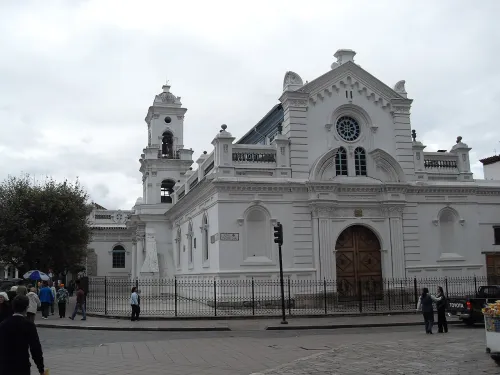
    Catedral Vieja (El Sagrario)

    Catedral Vieja (El Sagrario) in Cuenca, Ecuador, stop 12 on the self-guided walking tour

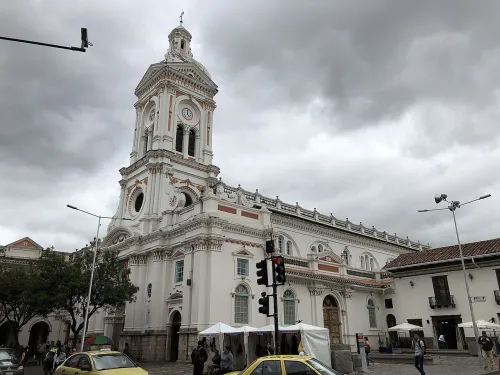
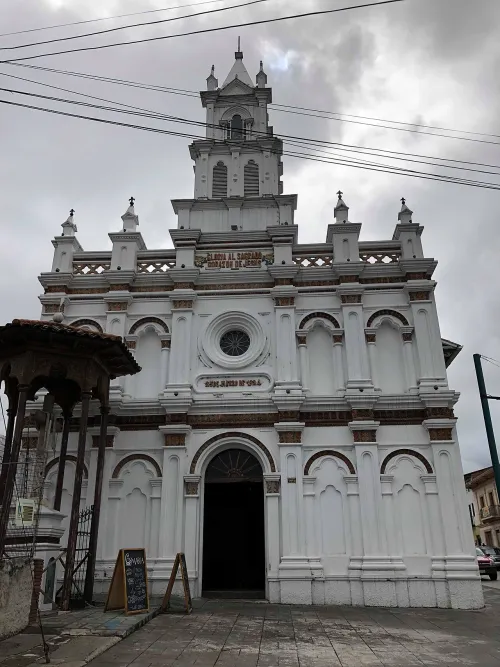
    You finish where you began, on Parque Calderón, at the church that came first. Planning started in 1557 and building ten years later, with foundations and walls of stone from the Tomebamba ruins. In colonial times this was the main church of the Parish of the Spaniards, reserved for people from Spain; Indigenous people had to stay outside or worship elsewhere.

    The tower carries a proud inscription. In 1736 the French Geodesic Mission used the old tower as a key reference point to measure the arc of the meridian, and the new tower of 1868 bears a plaque calling it a "tower more famous than the pyramids of Egypt". The clock was set in the tower in 1751; in 1787 Cuenca became a bishopric and this church a cathedral.

    Inside, look to the back of the building for the bellows organ, added in 1739 to accompany the choirs. It no longer works, but no other church in Cuenca has one. Once the Catedral de la Inmaculada was consecrated, regular services moved across the square. A restoration began in 1999, the year the Historic Center became a UNESCO World Heritage Site, and today the old cathedral is a Museum of Religious Art and a venue for concerts, with sculptures by Miguel Vélez and Gaspar Sangurima among its altars.

    The entry fee is small, so it is an easy yes. From the door you are back on the square where the walk started.

    Hours
    Mon–Fri 09:00–13:00, 14:00–16:00, Sat 09:00–13:00, Sun closed
    Price
    $1.00 USD per person
Walking tour route map of Cuenca, Ecuador Route loaded
Parque CalderónCatedral de la Inmaculada ConcepciónIglesia de Santo DomingoIglesia y Convento de San Francisco+8
All 12 stops are already on the map.
You just press start.
AI Tour Guide

You've read the route. Now walk Cuenca with a guide in your ear.

Press start wherever you are, even hundreds of kilometres from Cuenca, Ecuador, and the guide begins telling its stories right away. In the city, pick any of the 12 stops to start from: it leads you there, then talks with you the whole route, asking, listening, remembering, and shaping the tour around your answers.

12stops 4.6km 1 h 5 minwalking 13languages
▶Start the tour free

Free to start · Runs in your browser · No app, no download

Shorter Ways to Walk Cuenca

Not every day has room for twelve stops and four tickets. These three cuts follow the same order and use the same legs, so the GPS route still fits.

Colonial Cuenca in a morning

Stops: 1, 2, 3, 4, 5, 6, 7

For anyone who came for churches, cloisters and colonial art. From Parque Calderón to Iglesia de Todos Santos you walk 23 minutes in total. The Conceptas museum, the Museo de las Culturas Aborígenes and Todos Santos charge entry, and the dome tour at the Catedral de la Inmaculada is an optional extra. Start in the morning to catch Santo Domingo with its doors open.

River and Inca Cuenca, all free

Stops: 8, 9, 10, 11

For a budget afternoon or a second day. From Puente Roto through the Pumapungo ruins and museum to San Blas you walk 29 minutes, and nothing on this stretch charges entry.

One square, two cathedrals

Stops: 1, 2, 12

For a short stay or a rainy hour. Parque Calderón, the Catedral de la Inmaculada and Catedral Vieja all stand around the same square, so the walking is a matter of minutes. Catedral Vieja charges a small entry fee; the dome tour across the square is an optional extra.

How Long This Cuenca, Ecuador Tour Takes, With and Without Museums

The pure walking time is 1 h 5 min, and the longest leg is the 960 m between Museo Pumapungo and San Blas. Everything else is time spent looking: give the two Pumapungo sites and the Conceptas cloister the most, Puente Roto and San Blas the least.

With every interior worth seeing, plan about seven hours. A start at Parque Calderón at 08:30 puts you at Santo Domingo around 09:20, at the Conceptas museum around 10:00, at Todos Santos shortly before noon, at the Pumapungo ruins around 12:45 and back at Catedral Vieja around 15:10. Build any lunch break into that frame.

The colonial morning cut takes about three and a half hours with its museums; the free river and Inca section about two and a half; the single-square version about an hour, longer if you go up into the domes.

Before You Set Out in Cuenca

  • Start and finish: Parque Calderón is the recommended start, though you can join at any stop. The walk ends at Catedral Vieja (El Sagrario), on the same square where you began.
  • Best day: Midweek is best. Several museums and churches on the route keep reduced hours or close entirely on some days, so a weekday gives you the most open doors.
  • Time of day: Start in the early morning. Santo Domingo keeps short hours, so it is the stop you are most likely to miss later in the day.
  • Costs: Entry fees are in US dollars and modest; students and children pay less at the museums. The AI Tour Guide starts with 100 free credits, then you choose this tour all-inclusive for €19.99 with no time limit, or €5 per hour.
Walking tour route map of Cuenca, Ecuador
AI Tour Guide

Your Cuenca guide is ready when you are.

Press start and a voice AI Tour Guide takes it from here: leading the route through Cuenca, Ecuador, telling the stories, and turning your walk into a real back-and-forth conversation. No app or download is needed; it runs in your browser.

12stops 4.6km 1 h 5 minwalking 13languages
▶Start the tour free

Free to start · Runs in your browser · No app, no download

What the AI Tour Guide Adds Between Cathedral and Ruins

This route jumps between worlds: Cañari, Inca, Spanish, republican. The AI Tour Guide walks it with you as a conversation, greets you at Parque Calderón, tells the stories as you go and asks what pulls you in, then remembers it. Ask it what daily life behind the Conceptas walls looked like, or how a Cañari site became an Inca fort, and it picks up the thread, while you can interrupt at any time. The route itself stays the same; the free GPS navigation still takes you from stop to stop.

A Real Conversation A voice AI Tour Guide greets you, leads the whole route, and tells the stories and facts as you walk, asking what you want to see and keeping a real conversation going. Not a recording you press play on.
Map Navigation Follow the route on the map and walk at your own pace. You choose where to start and when to move to the next stop.
Ask Anything Curious about a building you pass? Ask your AI Tour Guide on the spot and the conversation carries on.
13 Languages Switch language anytime. No separate tour needed.
Start free in your browser

Common Questions About Cuenca on Foot

Can I go up into the domes of the Catedral de la Inmaculada?

Yes, on the optional paid dome and crypt tour. The nave itself is free to enter.

Which churches on the route are still active places of worship?

The Catedral de la Inmaculada, Santo Domingo and San Blas all hold services, so you may find a Mass under way when you step in. Catedral Vieja is now a Museum of Religious Art and a concert venue.

Is Museo Pumapungo really free?

Yes. Both the museum and the archaeological park are run by the Ministry of Culture and Heritage with free entry.

Which city walks pair well with Cuenca?

Within Ecuador, the walks in Quito and Guayaquil make good companions, and Baños adds a smaller town to the trip.

Is the tour really free?

Yes. The whole tour is free: the route, the interactive map and the navigation cost you nothing. Only the voice AI Tour Guide is optional and paid: you test it with 100 free credits, then you pay either €5 per hour or €19.99 for this whole tour, with no time limit. Admission to 4 of the 12 stops is not included: Museo del Monasterio de las Conceptas, Museo de las Culturas Aborígenes, Iglesia de Todos Santos and Catedral Vieja (El Sagrario) charge their own entry fees.

Do I need to download an app?

No. Everything runs in your phone browser. Open the route and start walking, no download and no sign-up required.

Do I need to book the walking tour in advance?

No booking needed. This self-guided tour is available anytime. Open the route in your browser and start walking. The AI Tour Guide works instantly, no app, no reservation required.

What languages is the AI Tour Guide available in?

The AI Tour Guide speaks 13 languages, so you take the tour in your own language and can switch at any time.

Can I skip stops or change the route?

Yes. Skip any stop, spend extra time at places you like, or start the route from any point. It is your walk, you set the pace.
Image credits
▶ Start free in your browser Runs in your browser, no app, no download