Free Walking Tour Quito: Basílica to El Panecillo

Thirteen stops through Quito's colonial heart, from a neo-Gothic basilica past gold-covered churches and La Ronda up to the Virgin on El Panecillo.

13 Stops 4.5 km ~1 h 16 min walking
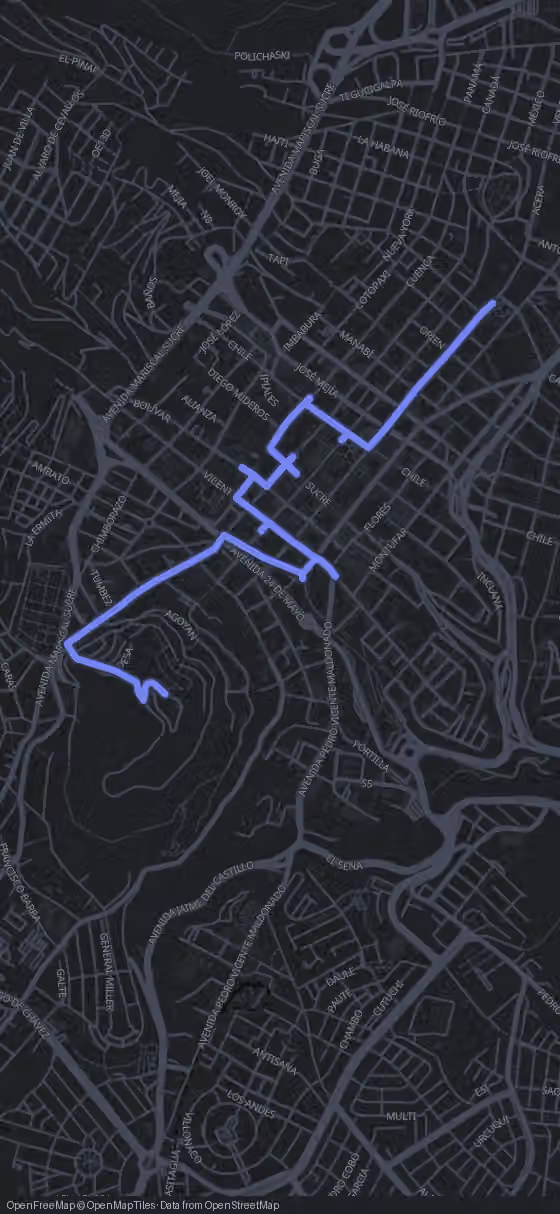
Route map for the Quito walking tour
Stop 1 of 13
770 m·10 min
Basílica del Voto Nacional
Head south-west toward Plaza de la Independencia
Welcome to Quito. I'm Alex, and one Gothic skyline here replaces Europe's monsters with creatures born much closer to home.
Try this tour with Alex

Quito's Old Town on Foot at a Glance

This route links 13 stops, from the Basílica del Voto Nacional on the edge of the historic centre to El Panecillo. It covers 4.5 km with 1 h 16 min of pure walking; with the interiors worth paying for, plan on most of a day.

The squares, Calle de La Ronda, the hill and several church naves are free; the Iglesia de la Compañía de Jesús, the Catedral Metropolitana de Quito, the Basílica, the Museo Casa del Alabado and the Museo de la Ciudad charge entry. Map and GPS navigation are free in your browser; the AI Tour Guide is optional.

Open free GPS & optional AI Tour Guide
View of Quito

The Route

Walking Map of Quito's Old Town Route

13 stops 4.5 km 1 h 16 min walking
Tap to load interactive map

The 13 stops along this route

  1. Basílica del Voto Nacional in Quito, stop 1 on the self-guided walking tour
    1Basílica del Voto Nacional
  2. Plaza de la Independencia in Quito, stop 2 on the self-guided walking tour
    2Plaza de la Independencia
  3. Palacio de Carondelet in Quito, stop 3 on the self-guided walking tour
    3Palacio de Carondelet
  4. Iglesia de La Merced in Quito, stop 4 on the self-guided walking tour
    4Iglesia de La Merced
  5. Plaza de San Francisco in Quito, stop 5 on the self-guided walking tour
    5Plaza de San Francisco
  6. Iglesia de la Compañía de Jesús in Quito, stop 6 on the self-guided walking tour
    6Iglesia de la Compañía de Jesús
  7. Catedral Metropolitana de Quito, stop 7 on the self-guided walking tour
    7Catedral Metropolitana de Quito
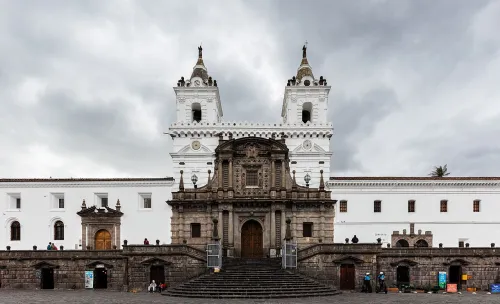
  8. Iglesia y Convento de San Francisco in Quito, stop 8 on the self-guided walking tour
    8Iglesia y Convento de San Francisco
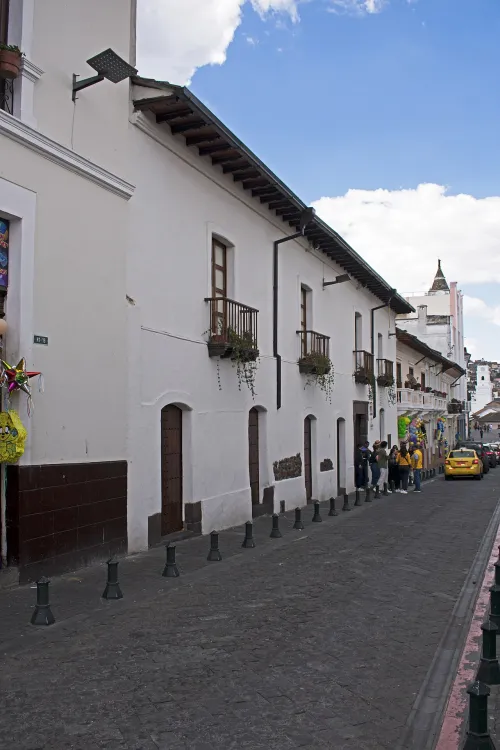
  9. Museo Casa del Alabado in Quito, stop 9 on the self-guided walking tour
    9Museo Casa del Alabado
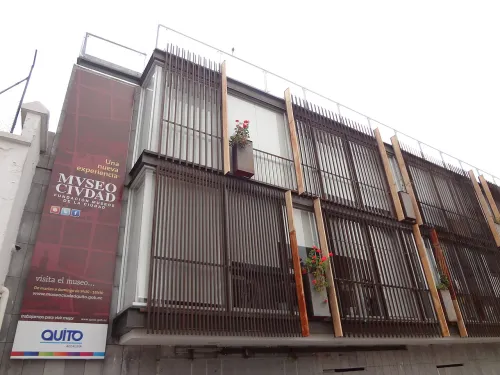
  10. Museo de la Ciudad in Quito, stop 10 on the self-guided walking tour
    10Museo de la Ciudad
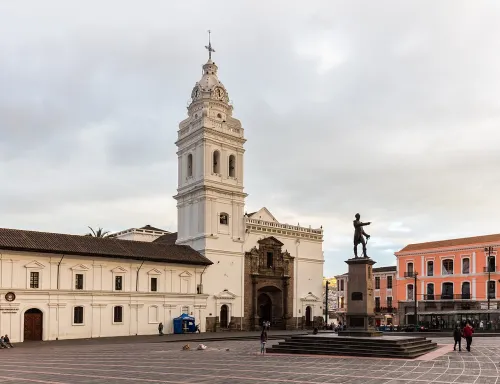
  11. Iglesia de Santo Domingo in Quito, stop 11 on the self-guided walking tour
    11Iglesia de Santo Domingo
  12. Calle de La Ronda in Quito, stop 12 on the self-guided walking tour
    12Calle de La Ronda
  13. El Panecillo in Quito, stop 13 on the self-guided walking tour
    13El Panecillo
  14. That's the full route.

    Walk it with an AI Tour Guide talking you through every one of these streets.

    Start free in your browser
    You made it

Quito Walking Tour Stop by Stop: Basílica, Plazas and La Ronda

  1. 1

    Basílica del Voto Nacional

    Basílica del Voto Nacional in Quito, stop 1 on the self-guided walking tour

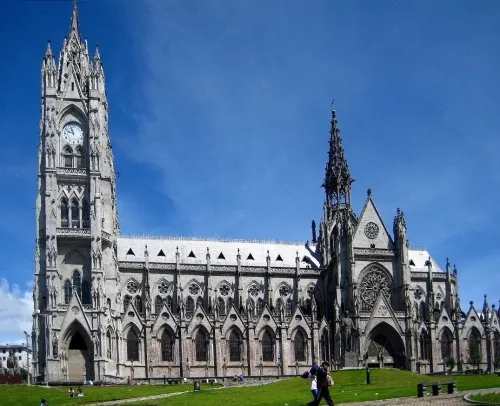
    You start on the edge of the historic centre, in front of the largest neo-Gothic basilica in the Americas. The Basílica del Voto Nacional, the Basilica of the National Vow, is dedicated to the Sacred Heart of Jesus, the patron of Ecuador. Its architect, Emilio Tarlier, took the cathedral of Bourges as his model, and it is considered the most important neo-Gothic building in the country. Step back far enough to take in the whole front before you go in.

    The idea came from Father Julio Matovelle in 1883: a monument to Ecuador's consecration to the Sacred Heart. President Luis Cordero signed the decree that same year, Congress set aside a yearly budget, and in 1895 the state even introduced a salt tax to keep the work going. The foundation stone was laid on 10 July 1892, and the basilica was essentially finished in 1924.

    Much of the money came from ordinary believers. People donated stones for the walls and had their names engraved in them in return, so look closely at the masonry as you walk around. Pope John Paul II blessed the church on 30 January 1985; it was consecrated in 1988 and raised to a minor basilica in 1991.

    Going inside is worth it if Gothic revival on a grand scale appeals to you. The church and the towers are separate tickets, so decide at the entrance whether you also want to go up. From here it's 770 m, about 11 minutes, to the Plaza de la Independencia, the political heart of the old town.
    Hours
    Daily 09:00–17:00
    Price
    $2 for the church, $4 to climb the towers
  2. 2

    Plaza de la Independencia

    Plaza de la Independencia in Quito, stop 2 on the self-guided walking tour

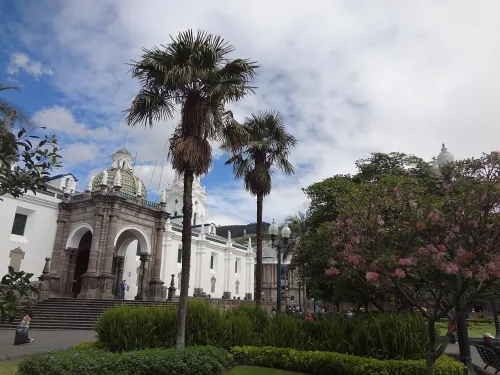
    Locals call it the Plaza Grande. It is the central square of Quito and a symbol of the country's executive power. In the middle stands the monument to the heroes of 10 August 1809, the day remembered as the first cry of independence of the Royal Audience of Quito against the Spanish crown.

    Turn slowly and you have the whole cast around you: the government palace, the cathedral, the Municipal Palace and the Hotel Plaza Grande. You'll come back to the cathedral later in the walk, so for now just note its long side wall facing the square.

    This wasn't the city's first square. The earliest colonial plaza was today's Plazoleta Benalcázar, but in 1612 the city's institutions moved here and called this one the Plaza Grande because it was the largest at the time. Back then it was packed earth with a water source for the neighbours. The Church took the north and south sides, and Captain Juan de Díaz Hidalgo, one of the city's founders, kept a corner lot for his own house. That house, later called Palacio Hidalgo, is the only private building from those days still standing on the square.

    Other founding families built on the west side until the earthquake of 1627 badly damaged their houses, and the government palace rose in their place. That palace is your next stop, just 80 m away, a one-minute walk; on the way you pass the Palacio Arzobispal, the archbishop's palace that also frames the square.

    Hours
    Open 24/7
    Price
    Free
  3. 3

    Palacio de Carondelet

    Palacio de Carondelet in Quito, stop 3 on the self-guided walking tour

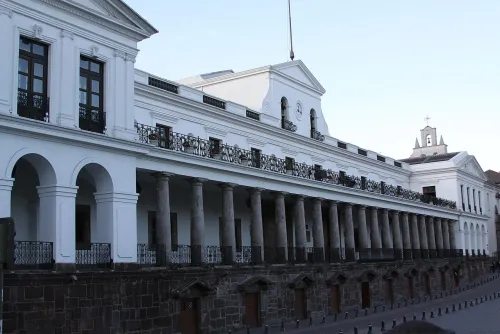
    The Palacio de Carondelet is the seat of government of Ecuador. Its story starts with a small palace: when Diego Suárez de Figueroa, secretary of the Royal Audience, died in 1611, the government took over his house on the square, and the Crown bought it to house the Spanish administration in Quito.

    It didn't stay small. Audience president Antonio de Morga told the king the royal houses were too old and proposed buying the neighbouring ones. The 1627 earthquake settled the matter: the government had to buy the adjacent buildings, and the complex was rebuilt in stone and brick. In 1799 Baron Francisco Luis Héctor de Carondelet became president of the Audience, and from 1801 Antonio García carried out rehabilitation work on the palace and the cathedral.

    After the Battle of Pichincha in 1822 ended Ecuador's struggle for independence, the building became the headquarters of the South Department of Gran Colombia, and Simón Bolívar stayed here at times. He admired how elegant and austere it was, credited the baron's taste, and named the palace after him.

    Entry is free, and the way inside is a guided tour that you book in advance by email (ucultural@presidencia.gob.ec). If you're curious about the halls where Ecuador is governed, plan it ahead; otherwise the facade from the square is enough. Then walk 260 m, about 4 minutes, to the Iglesia de La Merced, passing the Convento de la Inmaculada Concepción on the way.

    Hours
    Tue–Sun 09:00–16:00, Mon closed
    Price
    Free (guided tours free, book via ucultural@presidencia.gob.ec)
  4. 4

    Iglesia de La Merced

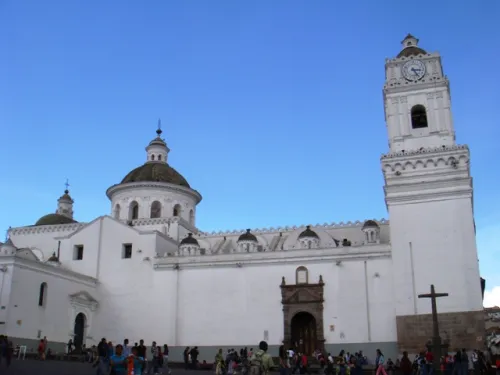
    Iglesia de La Merced in Quito, stop 4 on the self-guided walking tour

    The Iglesia de La Merced is easy to recognise by its white walls, five domes and square tower. It is the first church and main seat of the Mercedarian order in Ecuador, which is why it carries the title of basilica. Look at the decoration: it includes Inca and Arabic inscriptions, an unusual mix for a colonial church.

    Building began in 1701, the tower was finished in 1736 and the church was consecrated in 1747. Inside, the main altarpiece was carved by Bernardo de Legarda, one of the leading figures of the Quito School. Remember his name, because his work turns up again at the end of the walk. Paintings by Víctor Mideros hang in the church and in the sacristy.

    The convent also keeps one of the city's most important historic libraries, spread over two floors of the north wing, its walls lined with bookshelves. A conservation project between 1994 and 1997, funded by the Getty Conservation Institute, catalogued about 22,000 volumes.

    Church entry is free, so step in even if you're short on time; the Legarda altarpiece alone is worth a few minutes. A paid guided tour takes you up to the tower and cupola if you want more. The Plaza de San Francisco is 390 m away, about 5 minutes on foot.

    Local name
    Basílica de Nuestra Señora de la Merced
    Hours
    Mon–Sat: 07:00–18:00 | Sun: 08:00–18:00
    Price
    Free (church entry); tower/cupola guided tour $15 (run by La Chulla Historia, 10:00)
  5. 5

    Plaza de San Francisco

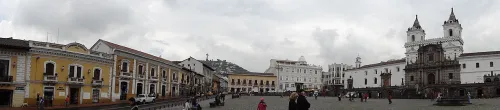
    Plaza de San Francisco in Quito, stop 5 on the self-guided walking tour

    The Plaza de San Francisco is the largest square in Quito's historic centre, ahead of the Plaza Grande and the Plaza de Santo Domingo: a rectangle of about 115 by 75 metres. The vast facade of the Franciscan church and convent dominates it. You'll go inside a little later in the walk, so for now take in the square itself.

    For centuries its central fountain supplied the neighbourhood with water. The plaza has served as a popular market, a stage for military and political rallies and simply a place to meet. Between square and church lies the atrium, which always felt more sacred than the open plaza. The concave-convex link between the two is famous in its own right: it inspired architectural solutions across the Americas, and its design is traced back to Bramante by some and to Bernini by others.

    Some historians believe the square was laid out on the Tianguez, the old indigenous market, with Inca buildings around it, including the quarters of the generals Quisquís and Calicuchima. But when the Quito Metro built a station beneath the plaza, the excavations found no pre-Hispanic structures at all, only 20th-century sewer channels. A nice reminder that city legends and the ground don't always agree.

    The square is free and always open, so linger as long as you like. Your next stop is only 110 m, about a minute, away: the Iglesia de la Compañía de Jesús.

    Hours
    Open 24/7
    Price
    Free
  6. 6

    Iglesia de la Compañía de Jesús

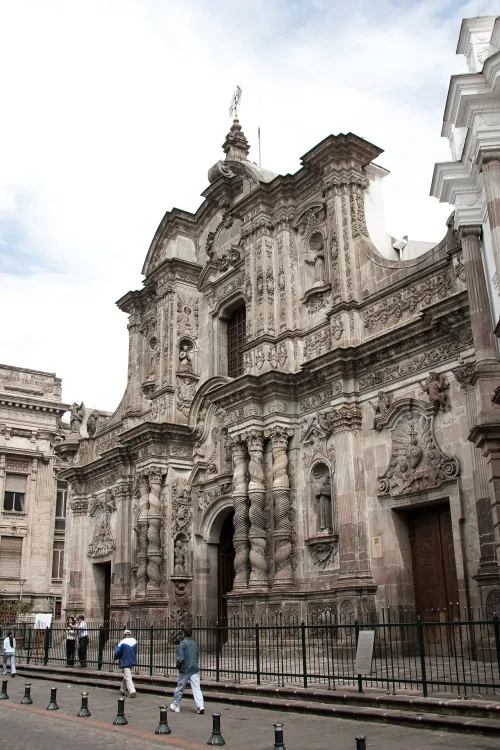
    Iglesia de la Compañía de Jesús in Quito, stop 6 on the self-guided walking tour

    La Compañía, as Quiteños simply call it, stands at the corner of García Moreno and Sucre streets. Before you go in, look at the portal: it is carved entirely from volcanic stone and counts among the most important examples of baroque architecture in the Americas.

    Inside, the ornamentation is covered completely in gold leaf, which is why the Jesuit traveller Father Bernardo Recio called the church an “ember of gold”. It has also been dubbed the Temple of Solomon of South America, and Ernesto La Orden, a Spanish ambassador to Ecuador, went as far as calling it “the finest Jesuit church in the world”.

    The church is part of a whole Jesuit block. In colonial times it housed the San Luis seminary, the Colegio Máximo, the University of San Gregorio Magno and the office of the Mainas missions; the Residencia San Ignacio is still the mother house of the Jesuits in Ecuador. Pope John Paul II said Mass here on 30 January 1985, the same day he blessed the Basílica del Voto Nacional, and Pope Francis prayed here before the image of the Dolorosa in 2015.

    The interior charges entry, and it is the reason to come: the golden church is one of Quito's major attractions. If your budget allows only one paid church today, this is a strong choice. The Catedral Metropolitana de Quito is only 90 m, about a minute, away.

    Hours
    Mon–Fri 09:30–18:00, Sat & holidays 10:00–16:00, Sun 12:00–16:00
    Price
    USD 6 adult; USD 6 senior; USD 0.50-3 student; USD 3 resident
  7. 7

    Catedral Metropolitana de Quito

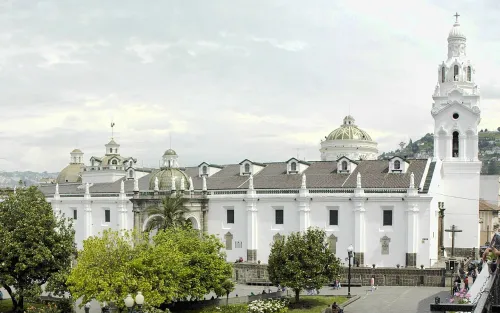
    Catedral Metropolitana de Quito, stop 7 on the self-guided walking tour

    The Catedral Metropolitana de Quito stands on the southwestern side of the Plaza Grande, and something looks odd: its long flank faces the square, not its main entrance. The reason was a deep ravine, the Quebrada de Sanguña, which made it impossible to extend the building backwards. The site next to the gorge had been picked for defence, and in the 17th century the Iglesia de El Sagrario was built over the ravine.

    Right after the city was founded in 1534, the whole south side of the future square went to the Church. Father Juan Rodríguez, the town's first pastor, put up a first church of adobe and wood with a thatched roof. Quito became a diocese in 1545, and between 1562 and 1565 a stone church rose on limestone foundations under Archdeacon Pedro Rodríguez de Aguayo, with Antonio García as architect. The builders used the minga, the local tradition of communal hauling, carving and masonry. Fray Pedro de la Peña, the second bishop of Quito, consecrated it in 1572.

    It was the seat of the diocese from 1545 and of the archdiocese from 1848, and in 1995 it became the Cathedral of Ecuador, the senior Catholic church in the country.

    You can buy the museum, the domes, or a full tour that combines both and includes the crypt. Take the full tour if you want all of it; the museum alone suits a shorter stop. From here, walk 270 m, about 4 minutes, back towards San Francisco for the church and convent.

    Hours
    Mon–Sat: 09:00–17:00 | Sun: 10:00–14:00
    Price
    $2 museum; $3 domes only; $4 full tour (museum + domes; crypt included in tour), per adult
  8. 8

    Iglesia y Convento de San Francisco

    Iglesia y Convento de San Francisco in Quito, stop 8 on the self-guided walking tour

    Now you cross the atrium into the Iglesia y Convento de San Francisco. People call it the Escorial of the New World, because it is the largest architectural complex in any historic centre in the Americas: about three and a half hectares with thirteen cloisters, six of them very large, three churches and the great atrium, some 40,000 square metres of building.

    Construction took more than 150 years, and you can see it in the mix of styles. Give the Mannerist-baroque facade of the main church a proper look; the curved approach from the square was designed to set it off. The complex is still very much in use: besides convent and church life, it houses health, education and communication services.

    Inside are more than 3,500 colonial works of art in many techniques. This is where the Quito School of art was born, so much of what you see in the city's other churches has its roots here. The Franciscan library was described in the 17th century as the best in the Viceroyalty of Peru.

    The church itself is free. The Museo Franciscano charges entry and is worth it if colonial painting and sculpture are your thing. Next, the Museo Casa del Alabado is just 100 m away, about 2 minutes.

    Hours
    Mon–Sat 09:00–17:00, Sun 09:00–13:00 (Museo Fray Pedro Gocial); Church: Mon–Sat 07:00–12:00, 15:00–17:30, Sun 07:00–12:00
    Price
    Free (church); Museo Franciscano $2 adults / $1 students / $0.50 children / free seniors
  9. 9

    Museo Casa del Alabado

    Museo Casa del Alabado in Quito, stop 9 on the self-guided walking tour

    Casa del Alabado is one of the oldest houses in Quito, dating from the 17th century. Look above the entrance: the lintel reads “ALABADO SEA EL SANTISIMO SACRAMENTO… 1671”, “Praised be the Most Holy Sacrament”, which gave the house its name. The facade is plain, with four overhanging balconies on the upper floor, three small shops beside the main door at street level and eaves resting on carved corbels.

    The Fundación La Tolita restored the house in 2006, and since 2010 it has been a museum of pre-Columbian art. It isn't a classic archaeology museum: it puts the beauty of the objects ahead of a strict timeline, and its theme is how people became divine through their contact with the forces of nature, the apus.

    There are 14 permanent galleries, one room for temporary shows, two patios and a café. Entry is paid, and it's worth it if you want to see what came before the churches you've just visited; after a morning of colonial gold it's a welcome change. Plan about an hour. Then walk 260 m, about 4 minutes, to the Museo de la Ciudad.

    Local name
    Museo de Arte Precolombino Casa del Alabado
    Hours
    Wed–Sun 09:00–17:00 (Mon–Tue by prior reservation via educacion@alabado.org)
    Price
    $10 adults, $5 students with ID / national seniors; free for children under 8, visitors with disabilities, and tour guides
  10. 10

    Museo de la Ciudad

    Museo de la Ciudad in Quito, stop 10 on the self-guided walking tour

    The Museo de la Ciudad sits on García Moreno street, between Morales and Rocafuerte, in the buildings of the former San Juan de Dios Hospital. The buildings were restored in 1995 with the same materials as the originals, and the museum opened in 1998. Look for the old Doric stone columns, the stone doorways and the stone-paved patios around four courtyards.

    The collections tell the story of Quito together with 400 years of the hospital. One permanent exhibition takes you through the customs, people and traditions of the city from the 16th to the 19th century; another covers the hospital itself, including objects from one of its former doctors; a third, “A new social order breaks through”, looks at 19th-century Quito.

    In July 2020, 69 artefacts returned to Ecuador to be shown here. A London diplomat with a passion for art and archaeology had taken them abroad in the 1960s; they include Catholic icons from the conquest era and pieces thought to be pre-Columbian.

    Entry is paid. If you have time for only one museum, choose this one for the city's own history and Casa del Alabado for pre-Columbian art. From here it's 370 m, about 5 minutes, to the Iglesia de Santo Domingo.

    Hours
    Tue–Thu & Sun 09:30–17:30 (last entry 16:30); Fri–Sat 09:30–19:00 (last entry 18:00); Mon closed
    Price
    $4 general adults, $8 foreign tourists from outside Latin America ($5 Latin America), $2 students / children 3-11; free for seniors 65+, disabled visitors, and infants under 3
  11. 11

    Iglesia de Santo Domingo

    Iglesia de Santo Domingo in Quito, stop 11 on the self-guided walking tour

    The Iglesia de Santo Domingo stands on Calle Flores, facing the Plaza de Santo Domingo, which takes its name from the church. The Dominicans received the plot in 1540. After a provisional chapel, the architect Francisco Becerra drew the plans for the present church in 1581, and Fray Juan Mantilla completed it in 1688.

    What you see inside isn't quite what the Dominicans built. In the 19th century President García Moreno brought in Italian friars to reform the local order, and they removed the baroque main altarpiece, the high choir and many baroque details. In their place came a low choir and the neo-Gothic altar that is still there today.

    Plenty survived: cedar carvings covered in gold leaf, many paintings and sculptures, and ten side chapels. The Chapel of the Virgen del Rosario is the best known, and another chapel keeps a mural of the Virgin painted by Father Pedro Bedón in the early 17th century. The cloister, built by brother Antonio Rodríguez to Becerra's design, has double arcades on octagonal pillars.

    The church is free; the Museo Fray Pedro Bedón is a separate paid visit for those who want more. Calle de La Ronda is 200 m, about 3 minutes, away.

    Hours
    Mon–Sat: 08:00–13:00, 14:00–17:00 | Sun: 08:00–13:00
    Price
    Free (church); Museo Fray Pedro Bedón paid separately
  12. 12

    Calle de La Ronda

    Calle de La Ronda in Quito, stop 12 on the self-guided walking tour

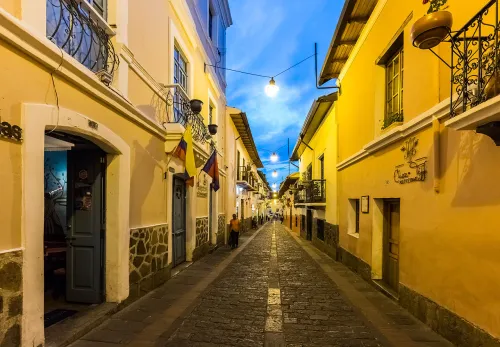
    Officially this is Calle Juan de Dios Morales, the same Morales you passed at the Museo de la Ciudad, but everyone calls it La Ronda. Colonial and republican houses line the street, with wooden balconies, inner patios and restored fronts in the traditional Quito style.

    Its origins go back to colonial times, and for centuries it was one of the busiest streets in the city. Artists, craftspeople and writers met here, and in the 20th century La Ronda became known for its nightlife and its musicians and poets. Later many houses fell into decay, until restoration began early in the 21st century, done with care to keep the historic character.

    Today many of the houses hold restaurants, cafés, craft workshops and galleries, and some cultural spaces put on music and performances. Traditional Quito food, craft demonstrations and evening walks are what draw people here. It's a free public street, so this is the natural place to slow down before the final leg.

    That last leg is the longest of the walk: 1,620 m, about 35 minutes, to El Panecillo.

    Hours
    Open 24/7
    Price
    Free (public street)
  13. 13

    El Panecillo

    El Panecillo in Quito, stop 13 on the self-guided walking tour

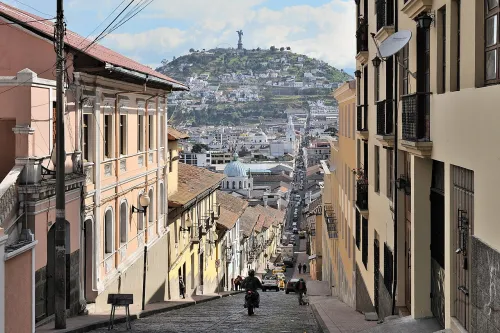
    El Panecillo is a natural hill at 3,000 metres, about 200 metres above the average level of Quito, right in the middle of the city. It is the most visited site in Quito and its main natural viewpoint: from here you can read the layout of the capital, from the historic centre you just walked out to the north and south.

    On top stands the giant aluminium Virgin of Quito by the Spanish artist Agustín de la Herrán Matorras. He based it on a work by Bernardo de Legarda, the same Quito School master whose altarpiece you saw in La Merced.

    The hill is far older than the statue. In Quichua it was called Shungoloma, heart-hill, and Yavirac, after a similar hill in Cuzco, the Inca capital. The Incas controlled Quito for less than a century. The historian Federico González Suárez wrote that before them the Cara people, worshippers of sun and moon, had a temple to the sun on this hill.

    The hill itself is free; the monument and the viewpoint inside it charge a small entry. Come in daylight, which is recommended here. Your walk ends on the hill.

    Hours
    Mon–Wed 09:00–17:00, Thu–Sun 09:00–21:00 (monument/interior); hill area accessible 24/7 (daylight recommended)
    Price
    $1 general admission, $0.50 special (monument/mirador interior); viewpoint hill is free
Walking tour route map of Quito Route loaded
Basílica del Voto NacionalPlaza de la IndependenciaPalacio de CarondeletIglesia de La Merced+9
All 13 stops are already on the map.
You just press start.
AI Tour Guide

You've read the route. Now walk Quito with a guide in your ear.

Press start wherever you are, even hundreds of kilometres from Quito, and the guide begins telling its stories right away. In the city, pick any of the 13 stops to start from: it leads you there, then talks with you the whole route, asking, listening, remembering, and shaping the tour around your answers.

13stops 4.5km 1 h 16 minwalking 13languages
▶Start the tour free

Free to start · Runs in your browser · No app, no download

Shorter Ways to Walk Quito's Historic Centre

Not everyone has a full day. These three cuts keep the order of the route and drop what you can live without.

Plazas and golden churches

Stops: 2, 3, 4, 5, 6, 7, 8

For a first half day in Quito: from the Plaza de la Independencia through La Merced and La Compañía to San Francisco. Only 16 minutes of walking. La Compañía and the cathedral charge entry; the squares and the naves of La Merced and San Francisco are free, and the palace tour is free with advance booking.

The whole old town, without the hill

Stops: 1, 2, 3, 4, 5, 6, 7, 8, 9, 10, 11, 12

For anyone who wants every church and museum but would rather skip the long final leg: from the Basílica to La Ronda in 41 minutes of walking. Paid entries are the Basílica, La Compañía, the cathedral, Casa del Alabado and the Museo de la Ciudad, plus the optional museums at San Francisco and Santo Domingo.

Museums, La Ronda and the view

Stops: 8, 9, 10, 11, 12, 13

For an afternoon or a second day: start at San Francisco, take in both museums and Santo Domingo, wander La Ronda and finish on El Panecillo. 49 minutes of walking. Casa del Alabado and the Museo de la Ciudad charge entry, as does the monument on the hill; the hill itself is free.

How Long Does This Quito Tour Take on Foot?

The pure walking time is 1 h 16 min, and almost half of it is the last leg up to El Panecillo. Everything before that is short hops through the old town, most of them under five minutes.

With the interiors that reward a paid visit (the Basílica, La Compañía, the cathedral, both museums) plus time on the squares and the hill, count on about seven and a half hours. Skip the two museums and you're done in roughly five and a half.

The plazas and golden churches cut takes just under three hours with La Compañía and the cathedral inside. The whole old town without the hill comes to about six and a half hours, and the museums, La Ronda and the view about four and a half.

Before You Set Off in Quito

  • Start and finish: Start at the Basílica del Voto Nacional and finish on El Panecillo. You can join at any stop, but this order is the recommended one.
  • Time of day: Set off in the morning so the interiors are open as you pass, and reach El Panecillo while it's still light; daylight is recommended for the hill.
  • What costs entry: The Basílica (church and towers are separate tickets), La Compañía, the cathedral museum and domes, Casa del Alabado, the Museo de la Ciudad, the monument on El Panecillo, and the optional museums at San Francisco and Santo Domingo. The prices are listed with each stop.
  • Book ahead: Inside the Palacio de Carondelet you go only with a free guided tour booked by email, so arrange it before your day if you want it.
Walking tour route map of Quito
AI Tour Guide

Your guide for Quito's old town is ready when you are.

Press start and a voice AI Tour Guide takes it from here: leading the route through Quito, telling the stories, and turning your walk into a real back-and-forth conversation. No app or download is needed; it runs in your browser.

13stops 4.5km 1 h 16 minwalking 13languages
▶Start the tour free

Free to start · Runs in your browser · No app, no download

What the AI Tour Guide Adds in Quito

On this route the AI Tour Guide turns thirteen stops into one conversation. It greets you at the Basílica, tells the stories as you go, picks up threads that run across the walk, like the Quito School from San Francisco to La Merced and the Virgin on El Panecillo, and notices what you linger over. Ask it what the walk leaves open, such as who the heroes of 1809 actually were or how the Mercedarians came to Quito, and interrupt whenever you like. You start with 100 free credits; after that you choose this tour all-inclusive for €19.99 with no time limit, or credits at €5 per hour.

A Real Conversation A voice AI Tour Guide greets you, leads the whole route, and tells the stories and facts as you walk, asking what you want to see and keeping a real conversation going. Not a recording you press play on.
Map Navigation Follow the route on the map and walk at your own pace. You choose where to start and when to move to the next stop.
Ask Anything Curious about a building you pass? Ask your AI Tour Guide on the spot and the conversation carries on.
13 Languages Switch language anytime. No separate tour needed.
Start free in your browser

Common Questions About Walking Quito's Old Town

Which paid interiors should I choose on a tight budget?

La Compañía is the one to pay for if you want gold and baroque. Then pick one museum by interest: Casa del Alabado for pre-Columbian art, the Museo de la Ciudad for Quito's own story. The naves of La Merced, San Francisco and Santo Domingo are free and already show a lot of colonial art.

Can I split the walk over two days?

Yes. Walk from the Basílica del Voto Nacional to the cathedral on day one, then start the second day at San Francisco and go on through the museums, Santo Domingo and La Ronda to El Panecillo.

Are there similar walks elsewhere in Ecuador?

Yes, the same free GPS route and optional AI Tour Guide exist for Otavalo, Baños, Cuenca and Guayaquil.

Is the tour really free?

Yes. The whole tour is free: the route, the interactive map and the navigation cost you nothing. Only the voice AI Tour Guide is optional and paid: you test it with 100 free credits, then you pay either €5 per hour or €19.99 for this whole tour, with no time limit. Admission to 5 of the 13 stops is not included: Basílica del Voto Nacional, Iglesia de la Compañía de Jesús, Catedral Metropolitana de Quito, Museo Casa del Alabado and Museo de la Ciudad charge their own entry fees.

Do I need to download an app?

No. Everything runs in your phone browser. Open the route and start walking, no download and no sign-up required.

Do I need to book the walking tour in advance?

No booking needed. This self-guided tour is available anytime. Open the route in your browser and start walking. The AI Tour Guide works instantly, no app, no reservation required.

What languages is the AI Tour Guide available in?

The AI Tour Guide speaks 13 languages, so you take the tour in your own language and can switch at any time.

Can I skip stops or change the route?

Yes. Skip any stop, spend extra time at places you like, or start the route from any point. It is your walk, you set the pace.
Image credits
▶ Start free in your browser Runs in your browser, no app, no download