Free Walking Tour Cuenca: Cathedral to Hanging Houses

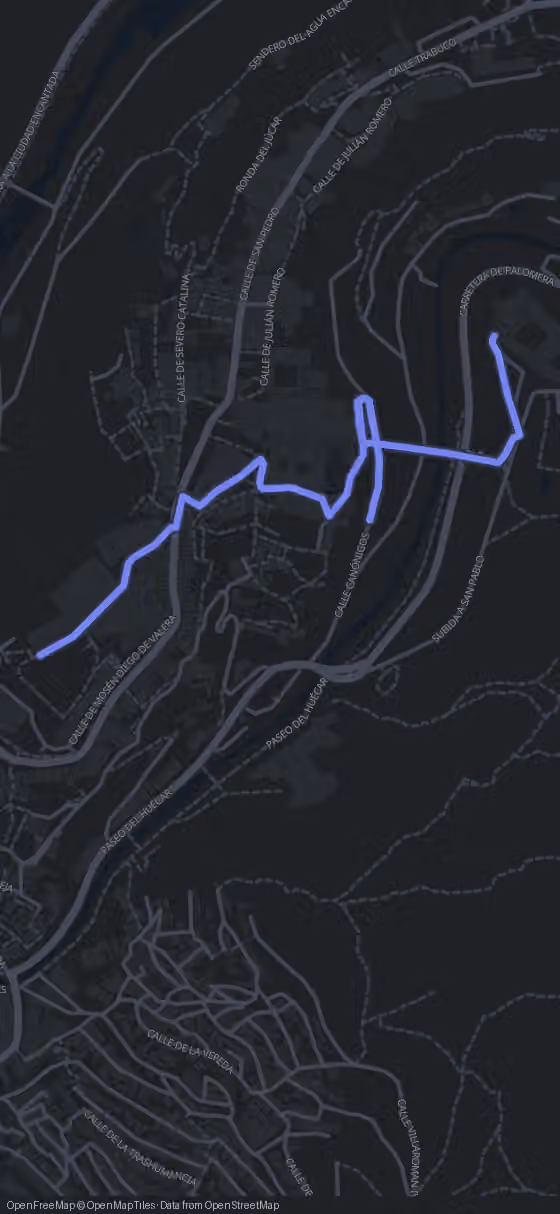
1.0 km from the Torre de Mangana past an early Gothic cathedral to the houses hanging over the Huécar gorge and the iron bridge that faces them.

5 Stops 1.0 km ~17 min walking
Route map for the Cuenca walking tour
Stop 1 of 5
290 m·4 min
Torre de Mangana
Head north-east toward the Cathedral of Cuenca.
Hola, welcome to Cuenca. I'm Alex, and this cliff-top city has never been afraid of impossible-looking architecture.
Try this tour with Alex

Cuenca's Old Town and Gorge in Five Stops

Five stops from the Torre de Mangana via the Cathedral of Cuenca and the Casas Colgadas to the Puente de San Pablo and the Convento de San Pablo: 1.0 km, 17 minutes of pure walking, about 2 hours 15 minutes with the cathedral and the museum inside.

Only the cathedral charges admission; everything else, including the abstract art museum in the hanging houses, is free. The GPS route in your browser is free, and the AI Tour Guide is optional.

Open free GPS & optional AI Tour Guide
This short shows highlights of the route. All 5 stops follow below.

The Route

Walking Map of Cuenca: From the Tower to the Convent

5 stops 1.0 km 17 min walking
Tap to load interactive map

The 5 stops along this route

  1. Torre de Mangana in Cuenca, stop 1 on the self-guided walking tour
    1Torre de Mangana
  2. Cathedral of Cuenca, stop 2 on the self-guided walking tour
    2Cathedral of Cuenca
  3. Casas Colgadas in Cuenca, stop 3 on the self-guided walking tour
    3Casas Colgadas
  4. Puente de San Pablo in Cuenca, stop 4 on the self-guided walking tour
    4Puente de San Pablo
  5. Convento de San Pablo in Cuenca, stop 5 on the self-guided walking tour
    5Convento de San Pablo
  6. That's the full route.

    Walk it with an AI Tour Guide talking you through every one of these streets.

    Start free in your browser
    You made it

Your Cuenca Walking Tour Stop by Stop, From Tower to Gorge

  1. 1

    Torre de Mangana

    Torre de Mangana in Cuenca, stop 1 on the self-guided walking tour

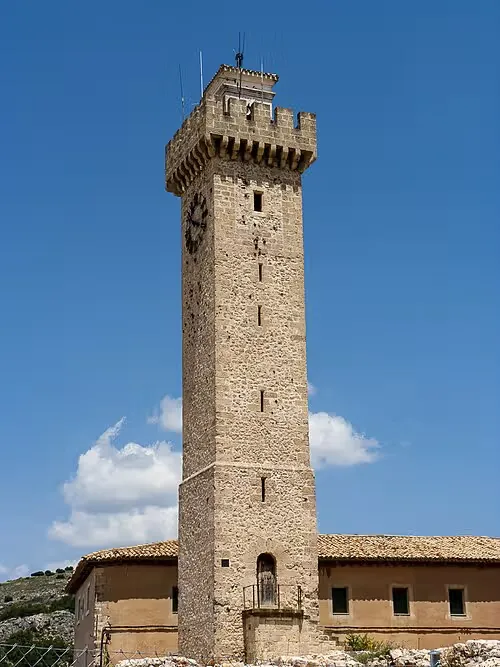
    Begin at the Torre de Mangana, a tower whose outline has been rebuilt again and again over five centuries. It has been protected as a monument of cultural interest since 2001, and it is free and open around the clock, so you can take your time here before the walk really starts.

    The first tower on this spot had a square plan, and you know what it looked like thanks to the painter Anton van den Wyngaerde, who drew it in 1565. Curiously, his drawing leaves out the iron cross and weathervane that the ironsmith Esteban Limosín had fixed in 1532 to the tin-covered spire. Works by the architect Juan Andrea Rodi at the end of the 16th century did not change the silhouette: an 18th-century view of the city by Juan Llanes y Massa shows the tower just as Wyngaerde had drawn it two hundred years earlier.

    Then came the blows. Lightning struck at the end of the 18th century, French troops arrived at the start of the 19th, and the architect Mateo López had to repair serious damage from both. Despite the restorations, the top of the tower was in a dreadful state by 1862, and the decision was taken to replace it.

    In 1926 the architect Fernando Alcántara gave the tower an exotic neo-Mudéjar makeover that had little to do with the original: he removed the spire, added a small square bell chamber under a little dome, covered the walls in colourful plaster ornament inspired by North African Islamic designs and crowned it with battlements modelled on the mosque of Córdoba. Even that was not the final version; the tower was remodelled once more in 1970.

    Keep that layered story in mind as you look up at it, then walk 290 m, about 4 minutes, to the Cathedral of Cuenca, a building with its own lightning scar.
    Hours
    Open 24/7
    Price
    Free
  2. 2

    Cathedral of Cuenca

    Cathedral of Cuenca, stop 2 on the self-guided walking tour

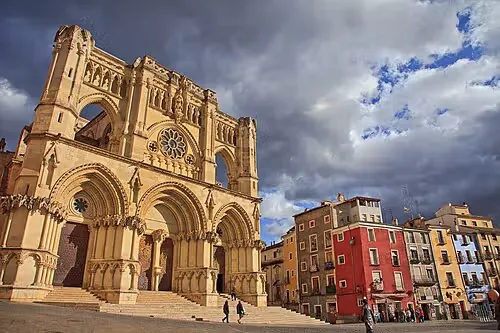
    The Cathedral of Cuenca, dedicated to Saint Mary and Saint Julian, is one of the earliest Gothic buildings in Spain, begun at a time when Romanesque still dominated the Iberian Peninsula. Its story starts with a siege: on 21 September 1177, Alfonso VIII of Castile, known as the Noble, took Cuenca from the Moors after nine months. The city became a diocese in 1183, and the cathedral rose on the foundations of the main mosque.

    Look for northern France in the stone. The design follows the Norman and Anglo-Norman Gothic of the 12th century, the family of Laon, Soissons and Notre-Dame de Paris. The usual explanation is Eleanor Plantagenet, Alfonso's English wife and daughter of Henry II of England and Eleanor of Aquitaine. French stonemasons began work between 1182 and 1189, and together with the cathedral of Ávila this counts among the first Gothic cathedrals of Castile. Saint Julian, second bishop of Cuenca and the city's patron saint, consecrated it in 1196, when only the chevet stood; most of the building was finished by 1257.

    The facade tells a much later story. In 1902 lightning hit the bell tower, the Giraldo, and it collapsed; the front was partly rebuilt in neo-Gothic style in 1910, and plans to complete it are still waiting for technical agreement. Over the centuries the chevet was rebuilt in the 15th century, the exterior largely reworked in the 16th, and the Sagrario chapel added in the 17th, when the facade and towers were also reformed.

    Is it worth going inside? If architecture interests you, yes: entry is paid, you can add the Triforio to your ticket, and around 45 minutes is a good amount of time. If you only have an hour for the whole walk, take in the facade and keep moving. From here it is 330 m, about 5 minutes, to the Casas Colgadas on the edge of the gorge.

    Hours
    Jul 1 – Nov 1: Mon–Sun 10:00–19:30; Nov 2 – Mar 31: Sun–Fri 10:00–17:30, Sat & holidays 10:00–19:30; Apr 1 – Jun 30: Sun–Fri 10:00–18:30, Sat & holidays 10:00–19:30 (ticket office closes 30 min before closing)
    Price
    5.50 EUR general, 4.50 EUR reduced (65+, students <25, disabled); Cathedral + Triforio: 7.00 EUR general, 6.00 EUR reduced; Combined (Cathedral + Triforio + Museo Tesoro + San Pedro & Torre): 10.50 EUR; Children <8 free
  3. 3

    Casas Colgadas

    Casas Colgadas in Cuenca, stop 3 on the self-guided walking tour

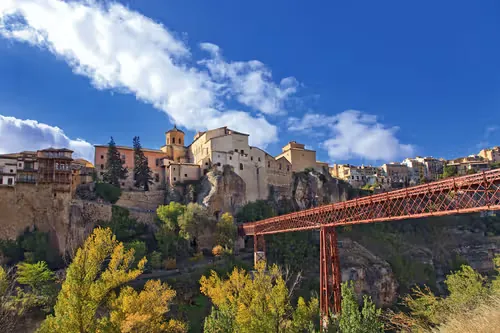
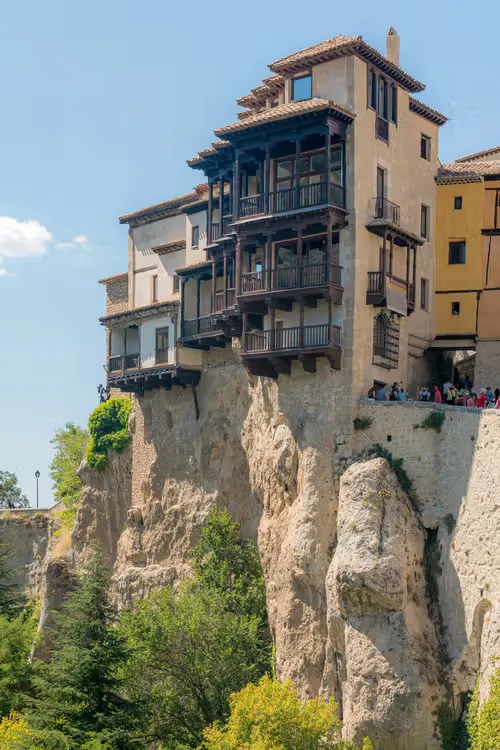
    The Casas Colgadas, the hanging houses, cling to the high rocky rim of the Huécar gorge, with parts of the buildings and their large wooden balconies projecting out over the drop. Only three survive: the Casa de la Sirena and the two Casas de los Reyes. Houses like these once lined the whole eastern edge of the old town facing the gorge; today only a small part of that is left.

    Their recorded history begins in 1565, when the Flemish painter Anton van den Wyngaerde included them, along with the whole San Martín cliff edge, in his panorama Cuenca from the East. The oldest photographs, from the last third of the 19th century, show the group almost untouched after several centuries. In the 1920s eight houses still stood and were restored; by 1966 the remaining ones were so decayed that another restoration followed. They reopened on 5 February 1966 in the presence of the minister Manuel Fraga and the bishop Inocencio Rodríguez.

    Over time the houses served as private homes and as the town hall. Since 25 October 2016 they have been a protected monument of cultural interest.

    Inside is the Museum of Spanish Abstract Art, and admission is free. It is your one chance on this walk to go inside the hanging houses themselves, so if modern art interests you even a little, plan around 45 minutes. If not, the exterior can be seen at any hour.

    Don't spend all your time on this side, though: the classic view of the houses comes from across the gorge. Walk 230 m, about 4 minutes, to the Puente de San Pablo.

    Hours
    Open 24 hours (exterior); Interior (Museo de Arte Abstracto Español): Tue–Fri & holidays 10:00–14:00 and 16:00–18:00, Sat 10:00–14:00 and 16:00–20:00, Sun 10:00–14:30, Mon closed
    Price
    Free (exterior); Museo de Arte Abstracto Español inside is also free
  4. 4

    Puente de San Pablo

    Puente de San Pablo in Cuenca, stop 4 on the self-guided walking tour

    The Puente de San Pablo crosses the Huécar gorge in iron and wood: 106 m long in two spans and up to 39 m high. It is free and open at all hours, and it is one of the best places to look back at the Casas Colgadas, so give yourself a few minutes in the middle.

    Before this bridge there was a stone one. The cathedral canon Juan del Pozo had it built between 1533 and 1589 to link the convent of San Pablo with the town across the gorge. That bridge collapsed. Look down at the piers: the present bridge still rests on the ashlar bases of its predecessor, with an iron prop in the centre.

    The current structure dates from 1902. It was designed by the Valencian civil engineer José María Fuster y Tomás and put up by George H. Bartle, whose Valencian foundry was well known at the time, and it opened on 19 April 1903.

    On the far side, 180 m and about 3 minutes away, stands the convent the bridge was built to reach.

    Hours
    Open 24 hours
    Price
    Free
  5. 5

    Convento de San Pablo

    Convento de San Pablo in Cuenca, stop 5 on the self-guided walking tour

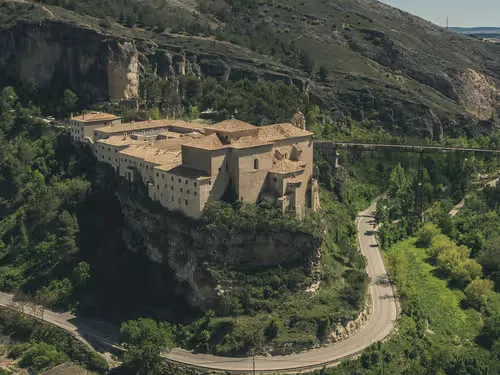
    The Convento de San Pablo stands outside the old town on a promontory high above the Huécar, directly opposite the Casas Colgadas. Locals call it los Paules. It was built for the Dominicans; today it houses the Parador de Cuenca with a hotel, restaurant and cafeteria, and its public areas are free to enter.

    Its founder was the same man behind the first bridge: the cathedral canon Juan del Pozo, who founded the convent in 1523. Construction had to wait until 1535, when a bull of Pope Paul III authorised it under Bishop Diego Ramírez de Fuenleal. When Juan del Pozo died, he was buried in the middle of the church's crossing, remembered by an effigy carved in low relief in white stone.

    The church was the work of the brothers Juan and Pedro de Alviz, and it shows the moment it was built: a Gothic structure with Renaissance decoration. Nothing is known of how Pedro de Alviz trained, but he probably learned within the Gothic tradition, which made it easier for him, as for other Cuenca artists of that century of transition, to dress medieval structures in the new Renaissance ornament.

    This is where the walk ends. If you want to sit down before heading back across the bridge, the Parador's cafeteria is right here.

    Hours
    Exterior visible 24 hours; interior operates as Parador de Cuenca hotel / restaurant / cafeteria
    Price
    Free (exterior / Parador public areas); no general admission ticket concept
Walking tour route map of Cuenca Route loaded
Torre de ManganaCathedral of CuencaCasas ColgadasPuente de San Pablo+1
All 5 stops are already on the map.
You just press start.
AI Tour Guide

You've read the route. Now walk it to the gorge with a guide in your ear.

Press start wherever you are, even hundreds of kilometres from Cuenca, and the guide begins telling its stories right away. In the city, pick any of the 5 stops to start from: it leads you there, then talks with you the whole route, asking, listening, remembering, and shaping the tour around your answers.

5stops 1.0km 17 minwalking 13languages
▶Start the tour free

Free to start · Runs in your browser · No app, no download

Shorter Ways Through Cuenca

Short on time, or only interested in one side of the walk? Each half works well on its own.

Old town and cathedral

Stops: 1, 2, 3

For architecture fans with about 1 hour 15 minutes. You walk 620 m, around 9 minutes, from the tower to the hanging houses. The cathedral is the only ticket on this section; the museum in the Casas Colgadas is free.

The gorge only

Stops: 3, 4, 5

For anyone who wants the classic view of the hanging houses without buying a ticket: 410 m and 7 minutes of walking, around 45 minutes in total, or about 1 hour 30 minutes with the museum. Everything on this section is free.

How Long Does This Cuenca Tour Take, With and Without Interiors?

The full route is 1.0 km with 17 minutes of pure walking, and no stage is longer than 330 m. Looking at every place from outside, with time to stop and take in each one, you need about 1 hour 15 minutes.

Add the cathedral interior (around 45 minutes) and the abstract art museum (another 45 minutes) and the walk grows to roughly 2 hours 15 minutes. The old-town half with the cathedral visit takes about 1 hour 15 minutes; the gorge half takes about 45 minutes, or 1 hour 30 minutes with the museum.

Before You Set Off in Cuenca

  • Start and finish: The recommended start is the Torre de Mangana; you finish at the Convento de San Pablo on the far side of the gorge. You can join at any stop, but this order saves the view of the hanging houses for the bridge.
  • Best day and time: Start in the morning if you want to see both the cathedral and the museum inside the Casas Colgadas without rushing.
  • Cathedral hours: The cathedral's hours vary with the season, so plan your visit for earlier in the day rather than late afternoon.
  • Costs: The tower, the bridge, the convent's public areas and the museum are free; the cathedral is the only ticket. The GPS route in your browser costs nothing. The AI Tour Guide starts with 100 free credits; after that you choose between €19.99 for this tour with no time limit or €5 per hour.
Walking tour route map of Cuenca
AI Tour Guide

Your guide is ready at the Torre de Mangana.

Press start and a voice AI Tour Guide takes it from here: leading the route through Cuenca, telling the stories, and turning your walk into a real back-and-forth conversation. No app or download is needed; it runs in your browser.

5stops 1.0km 17 minwalking 13languages
▶Start the tour free

Free to start · Runs in your browser · No app, no download

What the AI Tour Guide Adds Along the Huécar Gorge

On this short walk the same names keep coming back: Wyngaerde drew both the tower and the hanging houses, lightning struck both the tower and the cathedral, and Juan del Pozo built the first bridge and founded the convent. The AI Tour Guide ties those threads together as you walk, asks what you want more of and shapes the conversation around it. Ask it what daily life was like in a house hanging over a gorge, or what to look out for in the abstract art museum.

A Real Conversation A voice AI Tour Guide greets you, leads the whole route, and tells the stories and facts as you walk, asking what you want to see and keeping a real conversation going. Not a recording you press play on.
Map Navigation Follow the route on the map and walk at your own pace. You choose where to start and when to move to the next stop.
Ask Anything Curious about a building you pass? Ask your AI Tour Guide on the spot and the conversation carries on.
13 Languages Switch language anytime. No separate tour needed.
Start free in your browser

Common Questions About Walking Cuenca

What does the combined cathedral ticket include?

The combined ticket covers the cathedral, the Triforio, the Museo Tesoro and San Pedro with its tower. It pays off if you want to spend longer with Cuenca's church heritage; for this walk the regular cathedral ticket is enough.

Are there reduced tickets for the cathedral?

Yes, for older visitors, students and visitors with disabilities, with or without the Triforio. Young children go in free.

Why is Cuenca a World Heritage Site?

The walled city of Cuenca was listed in 1996, and the Casas Colgadas together with the Gothic cathedral played a major part in that decision.

Can I walk the route in reverse?

Yes. Start at the Convento de San Pablo, cross the bridge with the hanging houses ahead of you and finish at the Torre de Mangana. Check the museum's midday break before you set off.

Is the tour really free?

Yes. The whole tour is free: the route, the interactive map and the navigation cost you nothing. Only the voice AI Tour Guide is optional and paid: you test it with 100 free credits, then you pay either €5 per hour or €19.99 for this whole tour, with no time limit. Admission to one of the 5 stops is not included: Cathedral of Cuenca charges its own entry fee.

Do I need to download an app?

No. Everything runs in your phone browser. Open the route and start walking, no download and no sign-up required.

Do I need to book the walking tour in advance?

No booking needed. This self-guided tour is available anytime. Open the route in your browser and start walking. The AI Tour Guide works instantly, no app, no reservation required.

What languages is the AI Tour Guide available in?

The AI Tour Guide speaks 13 languages, so you take the tour in your own language and can switch at any time.

Can I skip stops or change the route?

Yes. Skip any stop, spend extra time at places you like, or start the route from any point. It is your walk, you set the pace.
Image credits
▶ Start free in your browser Runs in your browser, no app, no download