Free Walking Tour Toledo: Bridge to Bridge in a Day

Enter Toledo over a Roman bridge, pass a mosque from 999, the cathedral and two synagogues, and leave by a medieval bridge: 11 stops in one walk.

11 Stops 3.9 km ~1 h 1 min walking
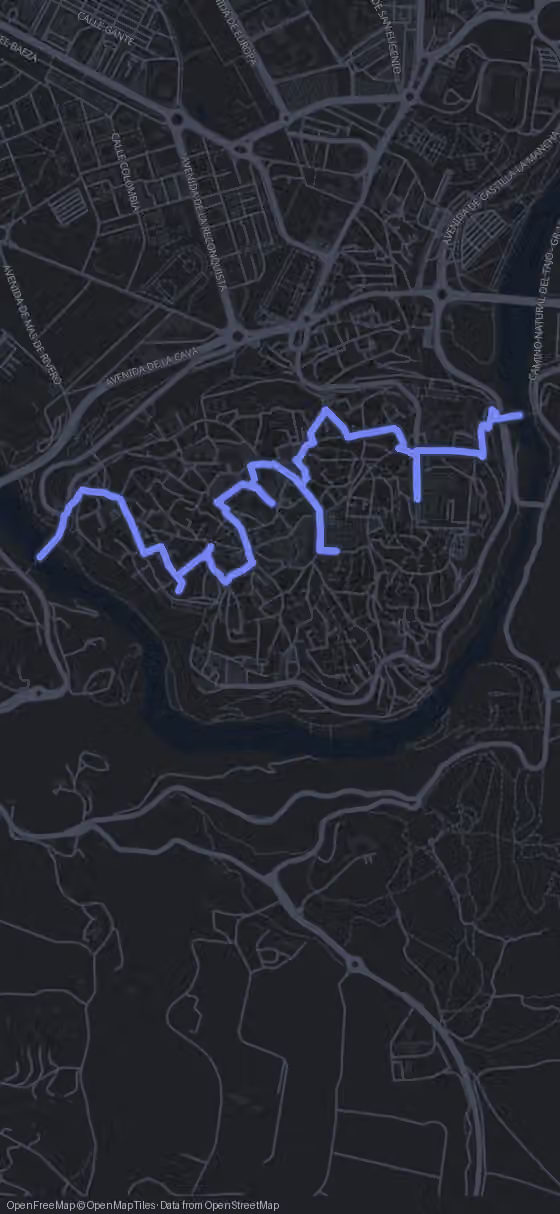
Route map for the Toledo walking tour
Stop 1 of 11
620 m·8 min
Puente de Alcántara
Head south-west and climb toward the Alcázar of Toledo
Hola, welcome to Toledo. I'm Alex, and here one small building lets two faiths meet along a line in the stone.
Try this tour with Alex

The Route at a Glance

This walk links 11 stops, from the Puente de Alcántara across the old town to the Puente de San Martín: 3.9 km and 1 h 1 min of pure walking. With the cathedral and the main interiors, plan on about five and a half hours, plus lunch.

The two bridges and the Plaza de Zocodover are free; the other eight stops charge admission. Route, map and GPS navigation from stop to stop are free in your browser, and the optional AI Tour Guide can tell the stories as you walk.

Open free GPS & optional AI Tour Guide
This short shows highlights of the route. All 11 stops follow below.

The Route

Walking Map of Toledo, from Bridge to Bridge

11 stops 3.9 km 1 h 1 min walking
Tap to load interactive map

The 11 stops along this route

  1. Puente de Alcántara in Toledo, stop 1 on the self-guided walking tour
    1Puente de Alcántara
  2. Alcázar of Toledo, stop 2 on the self-guided walking tour
    2Alcázar of Toledo
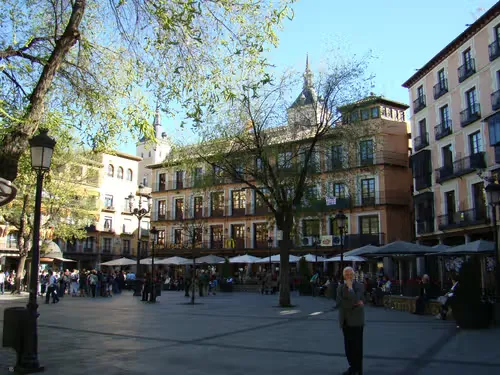
  3. Plaza de Zocodover in Toledo, stop 3 on the self-guided walking tour
    3Plaza de Zocodover
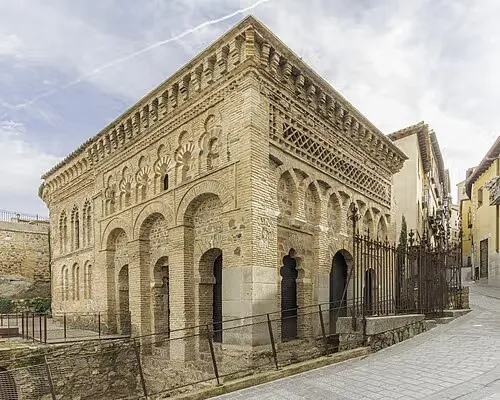
  4. Mezquita del Cristo de la Luz in Toledo, stop 4 on the self-guided walking tour
    4Mezquita del Cristo de la Luz
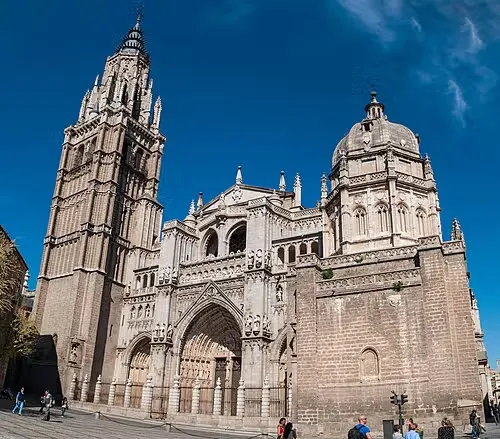
  5. Toledo Cathedral, stop 5 on the self-guided walking tour
    5Toledo Cathedral
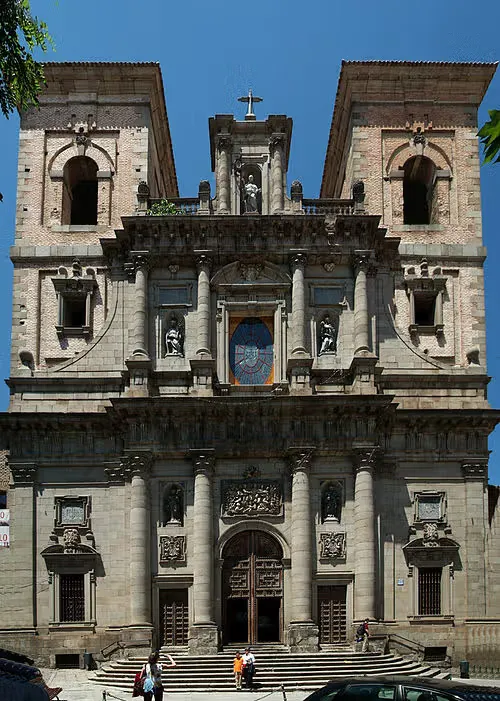
  6. Iglesia de San Ildefonso in Toledo, stop 6 on the self-guided walking tour
    6Iglesia de San Ildefonso
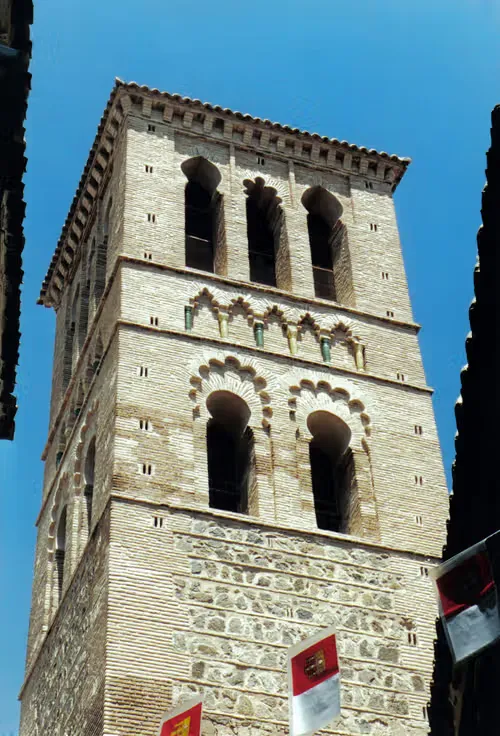
  7. Santo Tomé Church in Toledo, stop 7 on the self-guided walking tour
    7Santo Tomé Church
  8. Synagogue of El Tránsito in Toledo, stop 8 on the self-guided walking tour
    8Synagogue of El Tránsito
  9. Synagogue of Santa María la Blanca in Toledo, stop 9 on the self-guided walking tour
    9Synagogue of Santa María la Blanca
  10. Monastery of San Juan de los Reyes in Toledo, stop 10 on the self-guided walking tour
    10Monastery of San Juan de los Reyes
  11. Puente de San Martín in Toledo, stop 11 on the self-guided walking tour
    11Puente de San Martín
  12. That's the full route.

    Walk it with an AI Tour Guide talking you through every one of these streets.

    Start free in your browser
    You made it

Your Toledo Walking Tour, Stop by Stop: Mosque, Cathedral, Synagogues

  1. 1

    Puente de Alcántara

    Puente de Alcántara in Toledo, stop 1 on the self-guided walking tour

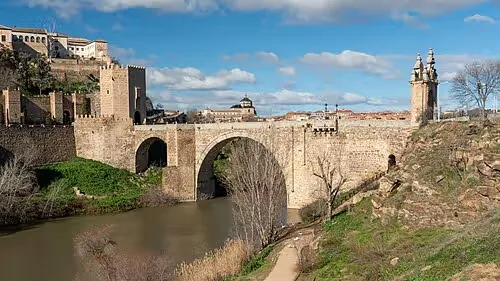
    Start where travellers have entered Toledo since Roman times: on the Puente de Alcántara, the arch bridge over the Tagus at the foot of the Castillo de San Servando. Its name comes from the Arabic al-qanṭarah, which simply means “the arch”, and today two arches carry you across.

    The Romans built it when they founded the city of Toletum. In the 10th century it was damaged and rebuilt, and a third arch disappeared, reduced to a gate with a horseshoe arch. For centuries this was one of the very few ways into Toledo, and in the Middle Ages every pilgrim had to come in here.

    Look at the two ends. The western tower dates from the rebuilding under Alfonso X of Castile, after floods had badly damaged the bridge, and the Catholic Monarchs later decorated it with their coat of arms. Search the arms for a pomegranate, the emblem of Granada: you won't find one, because when they went up the Reconquista was not yet over. The eastern tower had fallen into ruin by 1721 and was replaced by a Baroque triumphal arch.

    The bridge has been a national cultural monument since 1921 and costs nothing to cross. Don't confuse it with the Roman Alcántara Bridge in Extremadura, which spans the same river further downstream. From here the route climbs 620 m, about 12 minutes, to the Alcázar at the highest point of the city.
    Hours
    Open 24/7
    Price
    Free
  2. 2

    Alcázar of Toledo

    Alcázar of Toledo, stop 2 on the self-guided walking tour

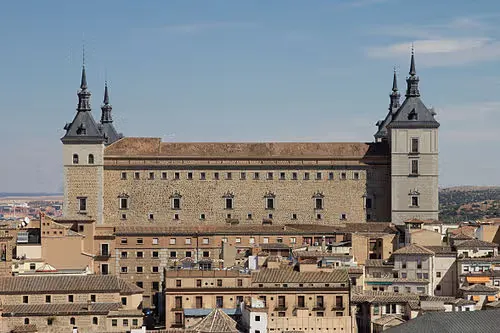
    The Alcázar is hard to miss: a stone square 60 m on each side, framed by four towers 60 m high, each topped with the pointed spire typical of Madrid. Its name is the Arabic al-qasr, “the castle”, which itself goes back to the Latin castrum.

    The site has been rebuilt by every power that held Toledo. It served as a Roman palace in the 3rd century, became a fortress in the 10th under the Córdoba caliph Abd ar-Rahman III, and was restored in the 1540s under Charles I, better known as Emperor Charles V, and his son Philip II. In 1521 Charles received Hernán Cortés here after the conquest of the Aztecs.

    Its most famous chapter is the Civil War siege. Colonel José Moscardó held the building against far larger Republican forces, who took his 24-year-old son Luis hostage and threatened to kill him unless the Alcázar surrendered. After a brief phone call with Luis, Moscardó told him to “commend your soul to God, shout ‘Viva España!’ and die like a hero”, and refused. Reports at the time said Luis was shot at once; other historians say he was killed a month later in reprisal for an air raid. The legend also hides a darker question: what became of the hostages, mostly Guardia Civil men, held inside the fortress during the siege, remains unclear.

    Most of what you see was rebuilt between 1939 and 1957. Going inside costs admission; if your day is short, the walls and the story are enough, but if the siege and the Civil War interest you, give it an extra hour. The Plaza de Zocodover is only 160 m away, 2 minutes on foot.

    Hours
    Tue–Sun 10:00–17:00 (last access 16:30, room evacuation from 16:45)
    Price
    5 EUR general admission
  3. 3

    Plaza de Zocodover

    Plaza de Zocodover in Toledo, stop 3 on the self-guided walking tour

    For most of Toledo's history, this was the city's main square and the heart of its social life. The name gives away its first job: it comes from the Arabic sūq ad-dawābb, “market of beasts of burden”, and in Muslim Toledo horses, donkeys, mules and foals changed hands right here. The city's main market was held on this spot for centuries; today it has moved to the area around the Paseo de Merchán.

    The square saw both festivals and terror. Bullfights and cucañas, the greasy-pole games of local celebrations, took place here, but so did the autos-da-fé of the Inquisition and public executions of prisoners.

    Fire destroyed the old square on 29 October 1589, and a new one was built, partly to designs by Juan de Herrera under Philip II. Plans to enlarge it came and went. In 1502 Isabella of Castile herself approved a scheme to join the square to the front of the Alcázar with a wall to the postern of San Miguel and Castilian arcades, but the slope up to the fortress façade, 23 m high, defeated the builders of the time. In 1854 Santiago Martín Ruiz drew up a plan to turn it into a rectangular arcaded square.

    The square itself is free and open. On the 360 m, 5 minute walk to the old mosque you pass the Mercado de San Agustín, a food market worth remembering for later.

    Hours
    Open 24/7
    Price
    Free
  4. 4

    Mezquita del Cristo de la Luz

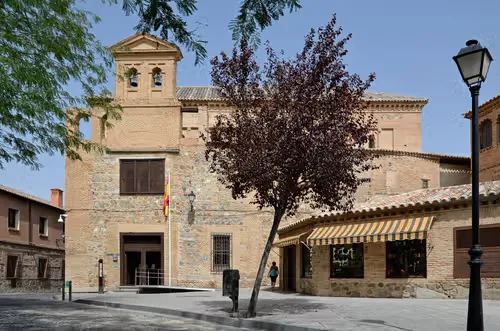
    Mezquita del Cristo de la Luz in Toledo, stop 4 on the self-guided walking tour

    This chapel was once one of the ten mosques of Muslim Toledo, and it still stands much as it was built. It was first called the Mezquita Bab al-Mardum, after the nearby city gate of that name, and it sits close to the Puerta del Sol in the district once known as the Medina, where wealthy Muslim families lived.

    Before you go in, look for the inscription in Kufic script, laid in brick on the southwest façade. It tells you, in effect, the building's birth certificate: Ahmad ibn Hadidi, from a leading Toledan family, paid for the mosque with his own money and asked Allah for a reward in paradise; Musa ibn Ali directed the work; and it was finished in the month of Muharram of the year 390, which is 999 AD, under the Umayyad Caliphate of Córdoba.

    After Alfonso VI took Toledo in 1085, the mosque became a church, and a Christian legend grew up to explain its new name. As the king rode in, his horse stumbled in front of the building; a shaft of light led him to a hidden figure of the crucified Christ, and a candle was said to have burned in a crack in the wall throughout the centuries of Muslim rule. Alfonso left his shield here with an inscription saying the first Mass was held in this chapel.

    Admission is charged. If you want to stand inside Toledo's Islamic past rather than read about it, this is where to do it, and 20 minutes is enough. The walk to Toledo Cathedral is 550 m, about 9 minutes.

    Hours
    1 Mar–15 Oct: daily 10:00–18:45; 16 Oct–28 Feb: daily 10:00–17:45
    Price
    4 EUR, reduced 2.50 EUR; free under 11 and for Toledo residents
  5. 5

    Toledo Cathedral

    Toledo Cathedral, stop 5 on the self-guided walking tour

    Toledo Cathedral is the seat of the Archdiocese of Toledo and, since 1088, the holder of the title Primatial, granted by Pope Urban II and placing it above the other sees of the Iberian Peninsula. It is one of Spain's three 13th-century High Gothic cathedrals, and some authorities consider it the masterpiece of Spanish Gothic. Locals have long called it Dives Toletana, “the rich one of Toledo”.

    Building began in 1226 under Ferdinand III, and the vaults of the central nave were only finished in 1493, under the Catholic Monarchs. The model was Bourges Cathedral, but Toledo has five naves for a reason of its own: the builders wanted the new church to cover the entire prayer space of the city's former great mosque, and the cloister to sit over its old courtyard. An unwritten tradition holds that an even older church, from the time of Archbishop Saint Eugene, stood here first.

    Inside, watch how the light is brought in and look up at the vaults of the ambulatory, both counted among its great achievements. The white limestone comes from the Olihuelas quarries near Toledo. Mudéjar touches appear mainly in the cloister, and the triforium has multifoiled arches. The Mozarabic Chapel still celebrates the old Hispano-Mozarabic rite and its music. Your ticket also covers the sacristy with its El Greco, the Transparente and the choir.

    Admission is charged, and if you pay for only one interior in Toledo, make it this one; allow about an hour and a half. From the cathedral it is 580 m, about 9 minutes, to the Jesuit church of San Ildefonso.

    Hours
    Mon–Sat 10:00–18:30, Sun 14:00–18:30 (access closes 30 min before closing)
    Price
    12 EUR general, 8 EUR reduced (65+, disability ≤64%, large families, youth card, students under 18), 6 EUR children 8-14 (with adult)
  6. 6

    Iglesia de San Ildefonso

    Iglesia de San Ildefonso in Toledo, stop 6 on the self-guided walking tour

    Toledo calls this the Jesuit church. It is dedicated to Saint Ildefonsus, archbishop and patron of the city, and the choice of site was deliberate: tradition says he was born in the houses that once stood here, which later belonged to Juan Hurtado de Mendoza, Count of Orgaz.

    The Jesuits bought the land in 1569, and two members of the high Castilian nobility, Pedro and Estefanía Manrique, paid for the church. Their founding document asks that it bear the saint's name and that his image stand at the centre of the high altar, out of their “great devotion” to him. The design followed the Gesù in Rome and the Jesuit churches of Palencia and Alcalá de Henares, and its plan is attributed to Juan Bautista Monegro, master of the cathedral at the time.

    It took more than a century to build. Work began in 1629 under the Jesuit brother Pedro Sánchez; after his death in 1633, Francisco Bautista designed the Baroque façade and altarpiece. In 1669 the Toledo architect Bartolomé Zumbigo took over and finished the towers and façade. The church was consecrated in 1718 with parts still missing, and José Hernández Sierra of Salamanca completed it only in 1765.

    Admission is charged; go in if Baroque is your period, otherwise the façade tells the story. The Orgaz name follows you to the next stop: Santo Tomé Church is 660 m away, about 9 minutes.

    Hours
    Daily 10:00–18:45 (summer) / 10:00–17:45 (winter)
    Price
    4 EUR general
  7. 7

    Santo Tomé Church

    Santo Tomé Church in Toledo, stop 7 on the self-guided walking tour

    Santo Tomé was founded after Alfonso VI took Toledo and is first mentioned in the 12th century, built on the site of an 11th-century mosque. When the city changed hands no buildings were destroyed, so its mosques simply became churches without major changes.

    Look up at the tower. By the early 14th century the church was in ruins, and Gonzalo Ruiz de Toledo, Lord of Orgaz and mayor of Toledo, rebuilt it completely, turning the old minaret into the Mudéjar bell tower you see. He also had the old east end pulled down for a new main chapel mixing Mudéjar and Gothic, with a central dome shaped like an eight-pointed star and painted ribs.

    Most visitors come for one painting: El Greco's The Burial of the Count of Orgaz, which you reach through the back of the church. Inside the church itself are three naves under a barrel vault, two Baroque altarpieces and a Plateresque one, a 16th-century font, a 12th-century image of the Virgin, and on the 19th-century main altarpiece Vicente López's painting The Unbelief of Saint Thomas. Gonzalo Ruiz, who died in 1323, lies in the Chapel of the Conception, as his will requested.

    Admission is charged; for the El Greco alone it is worth it, and 20 minutes covers it. This is also the natural moment for lunch. Afterwards it is just 190 m, 2 minutes, into the old Jewish quarter.

    Hours
    10:00–18:45 (summer, Mar 1-Oct 15) / 10:00–17:45 (winter, Oct 16-Feb 28)
    Price
    4 EUR general
  8. 8

    Synagogue of El Tránsito

    Synagogue of El Tránsito in Toledo, stop 8 on the self-guided walking tour

    The Synagogue of El Tránsito was built around 1357 as a private house of worship for Samuel HaLevi, treasurer and adviser to King Peter of Castile, and a gate once linked it to his palace. It also served as a yeshiva, a school of Jewish learning. The master mason Don Meir Abdeil designed it in the Mudéjar style, and it is one of three synagogues built by Jews under the Christian kings of Castile that survive.

    Samuel belonged to the Abulafia family, who had served the Castilian crown for generations and produced Kabbalists, Torah scholars and the poet Todros ben Judah Halevi Abulafia, one of the last to write in the Arab-influenced style of medieval Spain's Jewish poets. Some scholars think Peter allowed the synagogue as thanks for Samuel's service, perhaps also to make amends to Toledo's Jews for the persecution they suffered during the Black Death in 1348.

    After the expulsion of the Jews in 1492 the building became a Catholic church, and during the Napoleonic Wars it briefly served as army barracks. Since 1910 it has housed the Sephardic Museum. Inside, take your time with the rich stucco decoration and look for the women's gallery.

    Admission is charged, and for anyone curious about Jewish Spain it is one of the essential visits on this walk; allow about 40 minutes. The 180 m to the next synagogue, about 3 minutes, take you past the El Greco Museum.

    Local name
    Sinagoga del Tránsito
    Hours
    Tue–Sat 9:30–20:00, Sun/holidays 10:00–15:00, closed Monday
    Price
    3 EUR general, 1.50 EUR reduced
  9. 9

    Synagogue of Santa María la Blanca

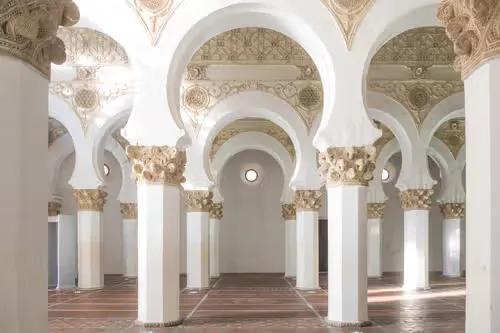
    Synagogue of Santa María la Blanca in Toledo, stop 9 on the self-guided walking tour

    Its Christian name means “Saint Mary the White”, but this building on Calle Reyes Católicos was built as a synagogue and is also known as the Ibn Shoshan Synagogue. Like El Tránsito, it is one of the three surviving synagogues built by Jews in the Mudéjar style under the Christian kingdom of Castile, and it has been a protected monument since 1930.

    Nobody knows exactly when it went up. Its style is close to 12th-century Almohad monuments such as the Kutubiyya mosque of 1147 and the Tinmal mosque of 1149, which points to the late 12th or early 13th century. One common view dates it to around 1205, when documents mention a “new” great synagogue in Toledo. A wooden tablet found nearby, though, says “its ruins were raised up in the year 4940”, which is 1180; if it refers to this building, the synagogue may be a rebuilding on an older site.

    Its layout raises more questions. One theory is that it was taken from a mosque that stood here before. A former synagogue in Segovia, destroyed by fire in 1899, had a very similar plan, so more buildings of this kind may once have existed in the region.

    Admission is charged; 15 minutes is enough for most visitors. San Juan de los Reyes is only 160 m further, 2 minutes on foot.

    Local name
    Sinagoga de Santa María la Blanca
    Hours
    10:00–18:45 (summer, Mar 1-Oct 15) / 10:00–17:45 (winter, Oct 16-Feb 28)
    Price
    4 EUR general
  10. 10

    Monastery of San Juan de los Reyes

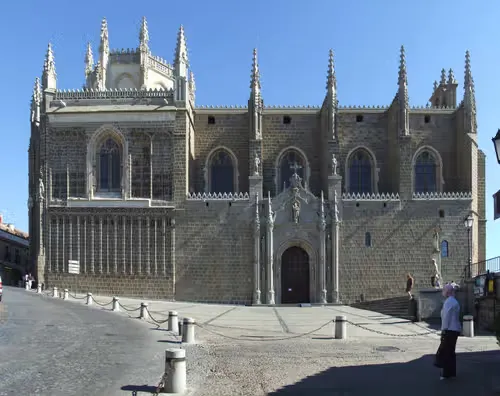
    Monastery of San Juan de los Reyes in Toledo, stop 10 on the self-guided walking tour

    Ferdinand II of Aragon and Isabella I of Castile founded this Franciscan monastery for two reasons: the birth of their son, Prince John, and their victory at the Battle of Toro in 1476 over the army of Afonso V of Portugal. Juan Guas drew the plans, and the building went up in the Isabelline style between 1477 and 1504, dedicated to Saint John the Evangelist.

    The victory was less clear than it sounds. Afonso's troops broke, but the Portuguese Prince John beat the Castilian right wing and held the field, and he celebrated his own victory with a procession every year. Politically, though, Toro was decisive: it secured the throne for the Catholic Monarchs and opened the way to the union of Castile and Aragon.

    They chose Toledo because it lay at the centre of the peninsula and had been the capital of the Visigothic kingdom, whose lost unity they saw themselves restoring. First named San Juan de la Reyna, the monastery was meant to be their tomb, but after taking Granada in 1492 they chose to be buried there instead.

    Admission is charged; give it about half an hour if you want to see the Catholic Monarchs' own statement in stone. The last leg runs 400 m, about 7 minutes, down to the Puente de San Martín.

    Local name
    Monasterio de San Juan de los Reyes
    Hours
    10:00–18:45 (summer, Mar 1-Oct 15) / 10:00–17:25 (winter, Oct 16-Feb 28)
    Price
    4 EUR general
  11. 11

    Puente de San Martín

    Puente de San Martín in Toledo, stop 11 on the self-guided walking tour

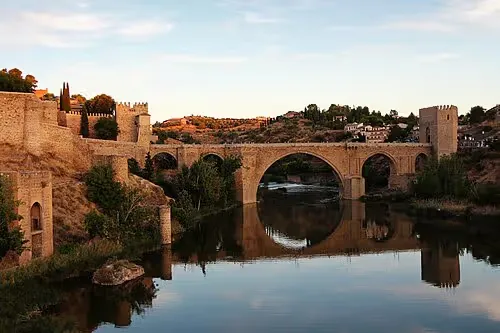
    You end on the city's second great bridge. Archbishop Pedro Tenorio built the Puente de San Martín in the late 14th century to give the old town an entrance from the west, the counterpart to the Puente de Alcántara where you started on the east.

    Its five arches are the reason to linger. The central one spans 40 m, and at the time it was built very few bridges in the world reached that length. Both ends were heavily fortified with towers; the younger of them date from the 16th century.

    The bridge's best story is a legend. The night before the opening, which Saint Ildefonsus himself had asked to attend, the architect realised he had miscalculated: once the supports came out, the bridge would collapse, with him on it. He went home and told his wife he would be disgraced. While he slept, she slipped out to the bridge and set it on fire. The burnt bridge spared him the shame, and it was rebuilt without the error.

    The bridge is free, and with it your walk across Toledo, from one river crossing to the other, is complete.

    Hours
    Open 24/7
    Price
    Free
Walking tour route map of Toledo Route loaded
Puente de AlcántaraAlcázar of ToledoPlaza de ZocodoverMezquita del Cristo de la Luz+7
All 11 stops are already on the map.
You just press start.
AI Tour Guide

You've read the route. Now walk Toledo with a guide in your ear.

Press start wherever you are, even hundreds of kilometres from Toledo, and the guide begins telling its stories right away. In the city, pick any of the 11 stops to start from: it leads you there, then talks with you the whole route, asking, listening, remembering, and shaping the tour around your answers.

11stops 3.9km 1 h 1 minwalking 13languages
▶Start the tour free

Free to start · Runs in your browser · No app, no download

Shorter Ways to Walk It

Not every day has room for eight interiors. These three versions keep the route's logic and cut it to fit your time.

Upper town: bridge, fortress, mosque and cathedral

Stops: 1, 2, 3, 4, 5

For a morning with the cathedral as its centrepiece. From the Puente de Alcántara up to Toledo Cathedral is 28 minutes of walking. The Alcázar, the Mezquita del Cristo de la Luz and the cathedral charge admission; the bridge and the Plaza de Zocodover are free.

Jewish quarter and the western bridge

Stops: 7, 8, 9, 10, 11

For an afternoon of El Greco, synagogues and the Catholic Monarchs' monastery. Only 14 minutes of walking from Santo Tomé Church to the Puente de San Martín, so nearly all your time goes into the buildings. Santo Tomé, both synagogues and San Juan de los Reyes charge admission; the bridge is free.

The full route from outside

Stops: 1, 2, 3, 4, 5, 6, 7, 8, 9, 10, 11

For a first look at the whole city without buying a single ticket. You walk all 1 h 1 min and stop briefly at each façade, which comes to about two hours, then return another day for the interiors that tempted you.

How Long Does This Toledo Tour Take with the Interiors?

The pure walking time is 1 h 1 min, and no leg is longer than 12 minutes. What fills the day is the time inside: about 90 minutes in the cathedral, 40 in the Synagogue of El Tránsito, half an hour in San Juan de los Reyes, around 20 minutes each in the Mezquita del Cristo de la Luz, San Ildefonso and Santo Tomé, and 15 in Santa María la Blanca.

A realistic day: start at 10:00 on the Puente de Alcántara, see the Alcázar from outside, and you are in the cathedral by 11:18. You reach Santo Tomé Church at about 13:26, just in time to sit down for lunch nearby. Back on the route at 14:40, you work through the Jewish quarter and arrive at the Puente de San Martín around 16:40. Add about an hour if you go inside the Alcázar.

The upper town version takes about three hours with its three interiors, the Jewish quarter version about two and a half, and the full route seen from outside about two.

Before You Start in Toledo

  • Start and finish: Start at the Puente de Alcántara and finish at the Puente de San Martín, on the far side of the old town. You can join at any stop; the recommended order runs from bridge to bridge.
  • Time of day: Set off around 10:00, so you see the cathedral before the lunch rush and eat in the Jewish quarter. Cathedral hours vary by day, so check them for your date before you fix the plan.
  • Tickets: Only the bridges and the square are free. Decide early which interiors you want, because each paid stop sells its own ticket at the door.

Food and Breaks Along the Route: Marzipan, Tapas and a Quiet Lunch

Toledo's sweet is marzipan, made by the city's nuns since the 13th century, and its best meals are found away from the cathedral and the Zocodover. Time lunch for the Jewish quarter and sit down before 13:30; many smaller bars take no reservations and simply write your name in a notebook and call you in order.

Marzipan at Santo ToméThis shop has competed with the nuns since 1856. Put together your own box, and look for the Don Quijote made of marzipan in the window. (Calle Santo Tomé 3)
Convent of San ClementeThe closed convent claims to be the original source, with marzipan and home-made pastries “since 1212”. Ring the bell and a nun appears behind a grilled hatch to sell you a box. (Calle San Clemente 1)
La OrzaFine dining away from the crush around the cathedral, and the natural lunch stop in the day's timing. (Jewish quarter, near Santo Tomé Church and the El Greco Museum)
El Trébol and Restaurante Santa FeBoth are busy with locals as well as visitors and serve genuine quality. At El Trébol, order the “bomba”; Restaurante Santa Fe has a quick menú del día. (Calle de Santa Fe)
El PeñónA tapas bar that fills with locals at lunchtime and is known for good value. (At the bottom of the hill, outside the old walls)
KumeraA local tip for a good-value weekday menu. (Calle Alfonso X El Sabio)

Tourist Traps to Avoid in Toledo's Old Town

  • Tourist menus around the Zocodover and the cathedral: Photo menus, flags and touts are the warning signs, and paella is not a Toledo dish. Order carcamusas, game or migas in a taberna instead.
  • The bracelet or rosemary “gift”: Near the Plaza de Zocodover, the cathedral and along the main walking lines, someone ties a bracelet on your wrist or presses rosemary into your hand, then demands money or reads your fortune and wants paying. You owe nothing. Pull your hand back, say “no, gracias” firmly and keep walking without stopping to be polite.
  • “You have something on your shirt”: Someone points out a stain, sometimes one their partner just splashed on you, and helps clean it while going through your pockets. Decline the help and walk on.
Walking tour route map of Toledo
AI Tour Guide

Your guide is ready when you are, from the first bridge on.

Press start and a voice AI Tour Guide takes it from here: leading the route through Toledo, telling the stories, and turning your walk into a real back-and-forth conversation. No app or download is needed; it runs in your browser.

11stops 3.9km 1 h 1 minwalking 13languages
▶Start the tour free

Free to start · Runs in your browser · No app, no download

What the AI Tour Guide Adds in Toledo

Between the two bridges you pass through Muslim, Jewish and Christian Toledo, and the AI Tour Guide holds that thread together as a conversation. It greets you at the first stop, tells each place's story, asks what draws you in and follows it: if you want to hear how the Mozarabic rite differs from an ordinary Mass, or who the figures in El Greco's painting are, it goes there with you, and you can interrupt it at any time. You start with 100 free credits; after that you choose this tour all-inclusive for €19.99 with no time limit, or €5 per hour.

A Real Conversation A voice AI Tour Guide greets you, leads the whole route, and tells the stories and facts as you walk, asking what you want to see and keeping a real conversation going. Not a recording you press play on.
Map Navigation Follow the route on the map and walk at your own pace. You choose where to start and when to move to the next stop.
Ask Anything Curious about a building you pass? Ask your AI Tour Guide on the spot and the conversation carries on.
13 Languages Switch language anytime. No separate tour needed.
Start free in your browser

Common Questions About Walking Toledo

Is the Toledo Monumental wristband worth it?

The wristband bundles seven monuments into one ticket and pays off from about four visits. The cathedral is never included, so ask at your first ticket desk which of this walk's churches and synagogues it covers.

Should I book a guided tour of the cathedral?

For a first visit, usually not. Resellers charge far more than the official ticket, which already takes you through the same rooms, including the sacristy with its El Greco, the Transparente and the choir. A guided tour adds most if you are deep into art history.

What should I wear?

Carry a shawl or a light cover-up, since several stops on this walk are churches.

Where can I go after Toledo?

Madrid is 68 km away and has its own walking route. If the old mosque caught your imagination, Cordoba was the seat of the caliphate under which it was built.

Is the tour really free?

Yes. The whole tour is free: the route, the interactive map and the navigation cost you nothing. Only the voice AI Tour Guide is optional and paid: you test it with 100 free credits, then you pay either €5 per hour or €19.99 for this whole tour, with no time limit. Admission to 8 of the 11 stops is not included: Alcázar of Toledo, Mezquita del Cristo de la Luz, Toledo Cathedral, Iglesia de San Ildefonso, Santo Tomé Church, Synagogue of El Tránsito, Synagogue of Santa María la Blanca and Monastery of San Juan de los Reyes charge their own entry fees.

Do I need to download an app?

No. Everything runs in your phone browser. Open the route and start walking, no download and no sign-up required.

Do I need to book the walking tour in advance?

No booking needed. This self-guided tour is available anytime. Open the route in your browser and start walking. The AI Tour Guide works instantly, no app, no reservation required.

What languages is the AI Tour Guide available in?

The AI Tour Guide speaks 13 languages, so you take the tour in your own language and can switch at any time.

Can I skip stops or change the route?

Yes. Skip any stop, spend extra time at places you like, or start the route from any point. It is your walk, you set the pace.
Image credits
▶ Start free in your browser Runs in your browser, no app, no download