Free Walking Tour Valencia: Gothic Gates to Calatrava

Start at a Gothic city gate from the 1390s, wander past the silk merchants' hall and the Central Market, then follow the old riverbed to Calatrava's City of Arts and Sciences.

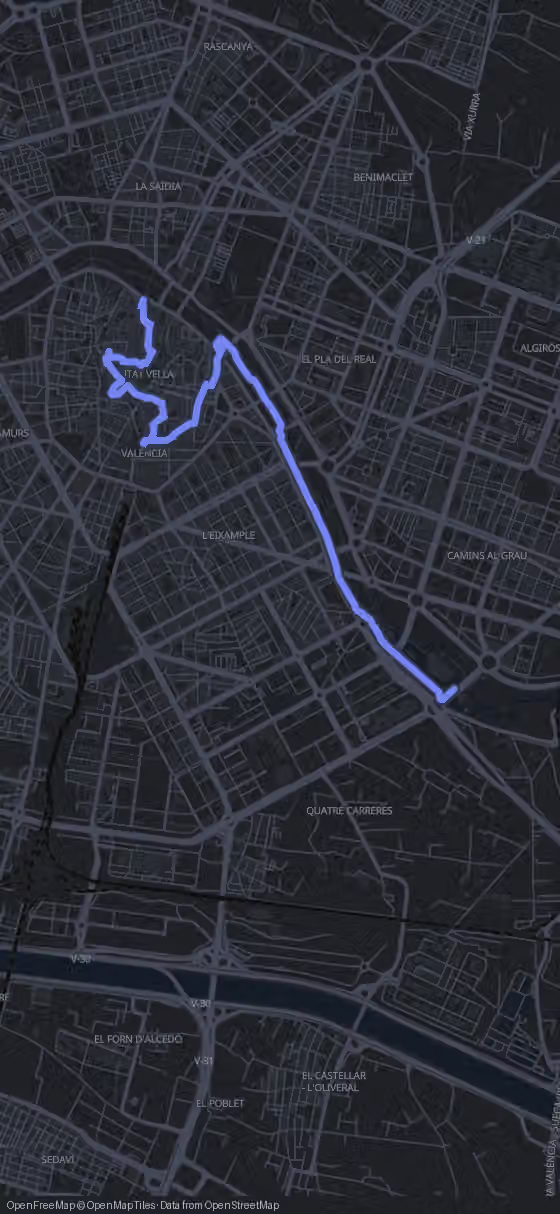
10 Stops 6.6 km ~1 h 29 min walking
Route map for the Valencia walking tour
Stop 1 of 10
470 m·6 min
Torres de Serranos
Head south toward Plaza de la Virgen
Welcome to Valencia. I'm Alex, and our first story begins with a church whose modest exterior hides nearly 2,000 square metres of frescoes.
Try this tour with Alex

Valencia on Foot: What This Route Covers

Ten stops lead from Torres de Serranos through Plaza de la Virgen, Valencia Cathedral, the Church of San Nicolás, the Silk Exchange, the Central Market, the National Museum of Ceramics and Plaza del Ayuntamiento into the Jardín del Turia, ending at the City of Arts and Sciences. That is 6.6 km and 1 h 29 min of pure walking; with the interiors worth seeing, plan a good six hours.

The squares, the market, the park and the grounds at the end are free; five buildings charge entry. Route, map and GPS navigation run free in your browser, and the optional AI Tour Guide tells the stories as you go.

Open free GPS & optional AI Tour Guide
This short shows highlights of the route. All 10 stops follow below.

The Route

Walking Map of Valencia: Ten Stops from Gate to Riverbed

10 stops 6.6 km 1 h 29 min walking
Tap to load interactive map

The 10 stops along this route

  1. Torres de Serranos in Valencia, stop 1 on the self-guided walking tour
    1Torres de Serranos
  2. Plaza de la Virgen in Valencia, stop 2 on the self-guided walking tour
    2Plaza de la Virgen
  3. Valencia Cathedral, stop 3 on the self-guided walking tour
    3Valencia Cathedral
  4. Church of San Nicolás in Valencia, stop 4 on the self-guided walking tour
    4Church of San Nicolás
  5. Silk Exchange in Valencia, stop 5 on the self-guided walking tour
    5Silk Exchange
  6. Central Market in Valencia, stop 6 on the self-guided walking tour
    6Central Market
  7. National Museum of Ceramics in Valencia, stop 7 on the self-guided walking tour
    7National Museum of Ceramics
  8. Plaza del Ayuntamiento in Valencia, stop 8 on the self-guided walking tour
    8Plaza del Ayuntamiento
  9. Jardín del Turia in Valencia, stop 9 on the self-guided walking tour
    9Jardín del Turia
  10. City of Arts and Sciences in Valencia, stop 10 on the self-guided walking tour
    10City of Arts and Sciences
  11. That's the full route.

    Walk it with an AI Tour Guide talking you through every one of these streets.

    Start free in your browser
    You made it

Your Valencia Walking Tour, Stop by Stop from Serranos to Calatrava

  1. 1

    Torres de Serranos

    Torres de Serranos in Valencia, stop 1 on the self-guided walking tour

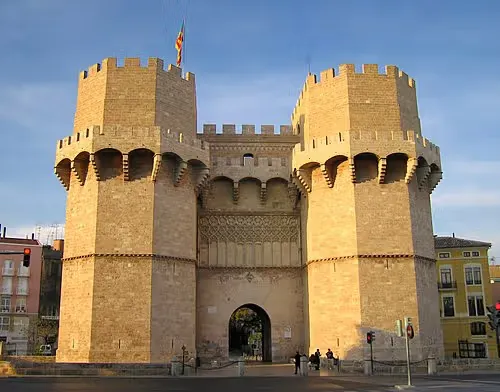
    Your walk begins at a gate built to impress as much as to defend. Torres de Serranos was one of the twelve gates in Valencia's Christian wall, raised in Valencian Gothic style between 1392 and 1398 on the site of an older gateway. Look at the two polygonal towers: the architect Pere Balaguer took his cue from Gothic gates such as the Porta de Sant Miquel in Morella and the Royal Gate of Poblet Monastery, and there is a Genoese touch in them too.

    The core is solid stone, because this was a fortification first. Yet the builders clad it in limestone, most of it from Alginet, a town near Valencia, so the gate would look refined to anyone arriving. That mattered. Besides defending the city in a siege, the gate was used for ceremonies, and ambassadors and kings were officially welcomed here. It counted as the main entrance to Valencia, and in spirit it still does.

    Its survival was luck. In 1865 the provincial governor ordered the old wall pulled down. Apart from these towers, only the 15th-century Quart Towers and a few remains, such as those of the Jewish Gate, made it through.

    Going inside costs entry. It is worth it if you want the view from the towers and a feel for how a medieval gate worked; if time is short, the outside tells the story well enough. From here it is 470 m, about 6 minutes, to Plaza de la Virgen, the heart of the old city.
    Hours
    Mon–Sat 10:00–19:00, Sun & public holidays 10:00–14:00. Closed Jan 1, Jan 6, May 1, Dec 25
    Price
    2.00 EUR general, 1.00 EUR reduced (groups, students with Jove card, pensioners, children 7-12)
  2. 2

    Plaza de la Virgen

    Plaza de la Virgen in Valencia, stop 2 on the self-guided walking tour

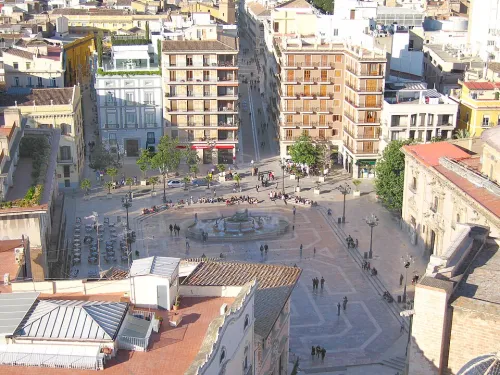
    This square lies where the forum of Roman Valentia once stood, and it still feels like the city's living room. Three of Valencia's landmark buildings frame it: Valencia Cathedral, the Basilica of the Virgen de los Desamparados and the Palau de la Generalitat with its gardens. The square is fully pedestrian and irregular in shape, so turn around slowly and take it all in.

    In the northern half stands the Turia Fountain, a bronze allegory of the river surrounded by eight nude female figures wearing the headdress of Valencian farm women. Each stands for one of the eight main irrigation channels that water the Vega, the fertile plain around the city. The sculptor Manuel Silvestre Montesinos, known as Silvestre de Edeta, made it, and it was unveiled in 1976.

    Those channels lead straight to one of the city's oldest institutions. The Water Tribunal holds its sessions in front of the cathedral's Apostles' Door, and its members meet before and after in the Casa Vestuario on the south side of the square. On that building's front, a plaque recalls Pope John Paul II's visit to the square on 8 December 1982. To the north, Calle de Navellos passes the Palacio de Benicarló, seat of the Valencian parliament, and runs down to the old riverbed you will reach later.

    The square is free and always open, so linger as long as you like. The cathedral is right beside you: 20 m, a minute's walk.

    Hours
    Always open
    Price
    Free
  3. 3

    Valencia Cathedral

    Valencia Cathedral, stop 3 on the self-guided walking tour

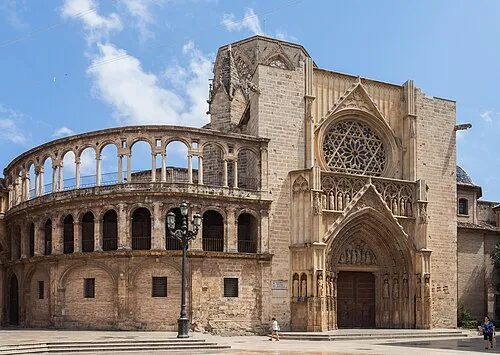
    Under this cathedral lie several cities. It stands on the site of the Visigothic cathedral, which the Moors turned into a mosque. After the Christian conquest in 1238, the first bishop, Pere d'Albalat, consecrated it, and James I the Conqueror had it dedicated to Saint Mary. For decades the old mosque simply kept serving as a cathedral, Koranic inscriptions still on its walls, until 22 June 1262, when bishop Andreu d'Albalat had it torn down and a new church begun to plans by the architect Arnau Vidal.

    Look closely at the doors. One theory holds that the mosque matches today's transept, that the Apostles' Door was the mosque's entrance and that the Almoina Door sat where the mihrab was. Most of the building went up between the 13th and 15th centuries, mainly in Valencian Gothic, but work went on for centuries, so you will also spot Romanesque, French Gothic, Renaissance, Baroque and Neoclassical parts.

    Inside, the treasures are the 15th-century paintings, some by local artists such as Jacomart, others by the Italian Renaissance painters Francesco Pagano and Paolo da San Leocadio. Both were commissioned by the Valencian Pope Alexander VI, who as a cardinal had asked for Valencia to become a metropolitan see; Pope Innocent VIII granted it in 1492. In one of the chapels you will find a chalice that many believe is the true Holy Grail.

    Entry is charged, and for art lovers and anyone curious about the Grail it is the one interior not to miss; give it about an hour. The Miguelete bell tower is a separate ticket. If archaeology is your thing, note that excavations at the Almoina Archaeological Centre have uncovered the remains of that first Visigothic cathedral. Next comes a hidden church: 420 m, about 6 minutes, to San Nicolás.

    Local name
    Catedral de Santa María de Valencia
    Hours
    Cathedral (Jan–Jun & Oct–Dec): Mon–Fri 10:30–18:30, Sat 10:30–17:30, Sun 14:00–17:30. Cathedral (Jul–Sep, summer): Mon–Sat 10:30–18:30, Sun 14:00–18:30, last entry 17:30. Miguelete Tower (Mar 1-Nov 30): daily 10:00–18:45
    Price
    12.00 EUR general, 6.00 EUR reduced (seniors, disabled, students, ages 8-17), 22.00 EUR family pack (2 adults + up to 3 children), free under 8. Miguelete Tower is a SEPARATE ticket: 3.00 EUR general, 2.00 EUR reduced
  4. 4

    Church of San Nicolás

    Church of San Nicolás in Valencia, stop 4 on the self-guided walking tour

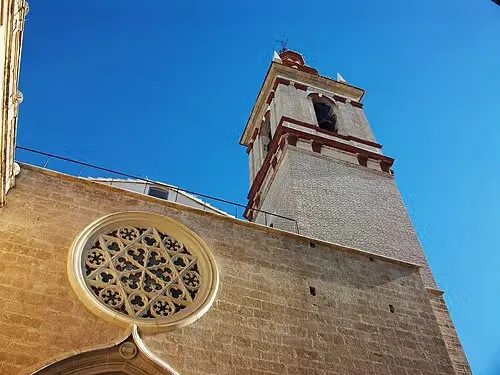
    Keep your eyes open: this church is wedged in among other buildings in the El Carmen quarter, and only its south side on the Plaça de Sant Nicolau and part of the west front with the entrance portal are free. Plenty of people walk straight past. Inside waits the reason Valencians call it the ‘Sistine Chapel of Valencia’.

    The site has layers. Traces of a Roman temple were found here; an early Christian church stood on the spot, then a mosque under al-Andalus. After James I took the city in 1238 it was consecrated as a parish church, one of the very first in Christian Valencia. The Dominicans received it as a gift and dedicated it to Saint Nicholas, adding Saint Peter Martyr, their first martyr, a few years later.

    The Gothic shell dates largely from the 15th century. Then, at the end of the 17th century, the interior was transformed into Baroque: between 1690 and 1693 the architect Juan Bautista Pérez Castiel covered it in sgraffito, stucco and reliefs, and the ceiling frescoes, designed by Antonio Palomino, were painted by his pupil Dionís Vidal between 1697 and 1700. The bell tower followed in the 18th century and a neo-Gothic remodelling in 1864. In the Spanish Civil War the church was damaged, used as a warehouse and its chapels destroyed and looted.

    Entry is charged, and there is also a guided cultural visit. Go in if painted ceilings move you at all; this is the whole point of the stop, and half an hour inside is well spent. The Silk Exchange is only 210 m away, about 3 minutes.

    Local name
    Iglesia de San Nicolás y San Pedro
    Hours
    October to June: Tue–Fri 10:30–19:00, Sat 10:00–19:00, Sun 13:00–20:00; July to September: Tue–Fri 10:30–20:00, Sat 10:00–19:30, Sun 11:00–20:00; Mondays worship only (no tourist visits); last ticket one hour before closing
    Price
    20 EUR guided cultural visit (Tue–Sat 12:30, 1 hour); other visit ticket types priced separately
  5. 5

    Silk Exchange

    Silk Exchange in Valencia, stop 5 on the self-guided walking tour

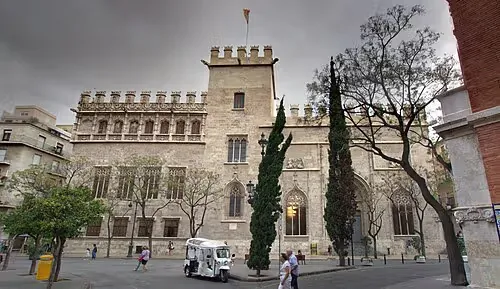
    The Lonja de la Seda, also called the merchants' exchange, is the masterpiece of Valencian civil Gothic. It became a National Monument in 1931 and a UNESCO World Heritage Site in 1996. It faces the church of the Santos Juanes and the Central Market across the square, so commerce and faith look each other in the eye.

    Francesc Baldomar drew up the original design between 1470 and 1471. He died in 1476, and in 1481 his pupils Joan Ivarra and Pere Compte were commissioned to finish it from the plans he had drawn in his last years. The contract is a gem: neither master was to be subordinate to the other, and the building was to follow the well-drawn plan ‘or otherwise, whichever is better’.

    The model was the exchange in Palma de Mallorca, and the result became the emblem of Valencia's 15th-century golden age, of the commercial boom of the late Middle Ages and of a merchant class that had grown rich and proud.

    Entry is charged, and it is worth it for the column hall alone, the image most people carry home from Valencia. Half an hour is enough. The Central Market is just across: 180 m, about 3 minutes.

    Local name
    Lonja de la Seda
    Hours
    Mon–Sat: 10:00–19:00 | Sun: 10:00–14:00
    Price
    7 EUR adults, 5 EUR reduced (seniors/students), Free under 12
  6. 6

    Central Market

    Central Market in Valencia, stop 6 on the self-guided walking tour

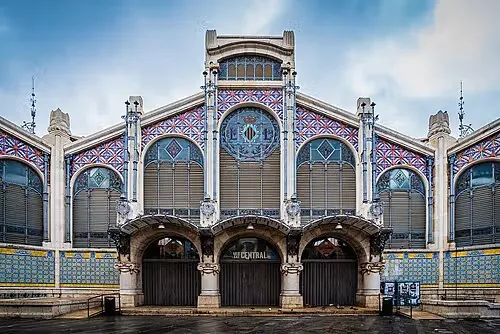
    After the Gothic merchants' hall comes the shopping hall of the 20th century, built in Valencian Art Nouveau. A market hall opened on this spot in 1839, but by the end of the century it was too small for the growing city. In 1910 a design by Alejandro Soler March and Francisco Guardia Vial was accepted; construction started in November 1914 and was finished in January 1928 by Enrique Viedma and Ángel Romaní.

    From outside, look low on the walls: the brick core is faced with white stone, and richly decorated tiles run along the lower facade. Inside there are two halls covering 8,000 m². The larger one is laid out like a church, its two broad main aisles forming a Latin cross, 107 m and 51 m long, with a dome 14 m wide and 27 m high over the crossing.

    Off the shorter aisle lies the smaller octagonal hall with its own dome. It holds the fish market, said to be the largest in Europe, and it is worth a slow lap even if you are not buying.

    Entry is free. Come early, before the crowds pack the aisles, and give yourself half an hour to look and taste. From here it is 410 m, about 5 minutes, to the National Museum of Ceramics.

    Hours
    Mon–Sat: 07:30–15:00 | Sun: Closed
    Price
    Free
  7. 7

    National Museum of Ceramics

    National Museum of Ceramics in Valencia, stop 7 on the self-guided walking tour

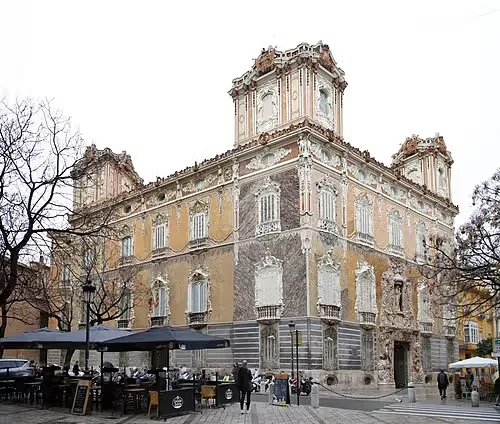
    Stop in front of the portal first, because the facade is the show. The Palace of the Marqués de Dos Aguas began as a Gothic building and was entirely reshaped in Baroque style in the mid-18th century. Hipólito Rovira designed the facade and the Valencian sculptor Ignacio Vergara carved it. Later remodellings left a mix of mainly Rococo, Neoclassical and Oriental style.

    The palace was declared a historic-artistic monument in 1941. The museum was founded on 7 February 1947 from the ceramics collection that Manuel González Martí donated, the state bought the palace in 1949, and the doors opened to the public on 18 June 1954. The last restoration, by the architect Ginés Sánchez Hevia, ran between 1990 and 1998.

    Inside, the ground floor holds temporary exhibitions and the remarkable carriage patio, once the carriage house and stables. The first floor is the real treat: the Marquis's private rooms with 19th-century stucco, wall and ceiling paintings by artists such as Plácido Francés y Pascual, José Felipe Parra and José Brel Guiralt, and marble floors in different colours bearing the initials ‘MD’. Look for the Ballroom, the Red Room and the Porcelain Sitting Room, partly with their original furniture.

    Entry is charged and the visit is good value even if ceramics leave you cold, because the Rococo rooms and the carriages are what stay with you; plan about 45 minutes. Then it is 390 m, about 5 minutes, to Plaza del Ayuntamiento, passing the Mercado de Tapineria on the way.

    Local name
    Museo Nacional de Cerámica
    Hours
    Mon: Closed | Tue–Sat: 10:00–14:00, 16:00–20:00 | Sun: 10:00–14:00
    Price
    3 EUR adults, 1.50 EUR reduced (students/seniors), Free under 18
  8. 8

    Plaza del Ayuntamiento

    Plaza del Ayuntamiento in Valencia, stop 8 on the self-guided walking tour

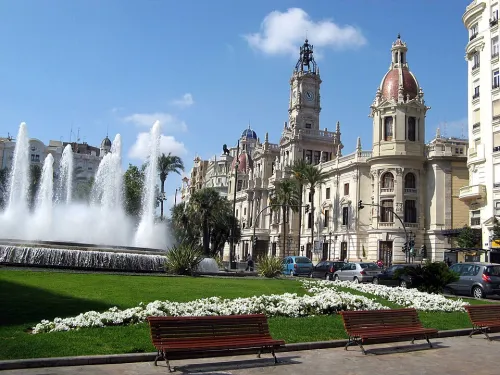
    The big civic square in front of City Hall was once called Plaza de Emilio Castelar, and before that the area was the old ‘Bajada de San Francisco’. The municipal architect Francisco Javier Goerlich Lleó, son of the Austro-Hungarian consul, designed its modernisation from 1927, with the main works between 1931 and 1933. The expropriations caused the unrest you might expect among residents.

    Goerlich wanted a new civic centre to rival Plaza de la Reina and Plaza de la Virgen. He set a high, triangular platform in the middle, with fountains at the corners standing for the three provinces, and locals promptly nicknamed it ‘la tortada’, the cake. Beneath it he placed an underground Flower Market, but the florists opposed it from the start: the space was narrow and dark, and they saw it as their commercial ruin.

    That design did not last. His nephew, the art historian Daniel Benito Goerlich, put it plainly: the reform belonged to a very specific social context and was destroyed a few years later in a completely different one, the repressive postwar years. The same architect also signed the headquarters of the Bank of Valencia and widened several of the city's streets and avenues.

    The square is free and open, a short pause rather than a long visit. Now the walk changes character: 1200 m, about 16 minutes, takes you to the Jardín del Turia.

    Hours
    Always open
    Price
    Free
  9. 9

    Jardín del Turia

    Jardín del Turia in Valencia, stop 9 on the self-guided walking tour

    You are now walking in a river without a river. After the catastrophic flood of 1957, the Turia was drained and rerouted around the city. In the 1960s the city and the Spanish government planned to fill the empty bed with a major traffic corridor, motorways linking the port and the airport.

    Valencians pushed back. Under the slogan ‘El llit del Túria és nostre i el volem verd’, the riverbed is ours and we want it green, a citizens' movement turned the plan around. In 1976 ownership of the old bed passed to the city, in 1979 it was approved as a green zone, and in 1986 the park opened.

    Today it covers about 136 hectares, runs for nearly 8.5 km with an average width of about 160 m, and stretches from the Bioparc zoo to the Oceanogràfic. It is one of the largest purely urban gardens in Spain, and because so many people live along its length, it may well be the most visited park in the country. One of its central stretches runs beside the Jardines del Real, which locals call ‘Viveros’.

    The park is free and always open. Your stretch is the longest leg of the tour, 3250 m and about 44 minutes inside the garden itself, so think of it less as a transfer and more as a stop you walk through, all the way to the City of Arts and Sciences.

    Hours
    Open 24/7
    Price
    Free
  10. 10

    City of Arts and Sciences

    City of Arts and Sciences in Valencia, stop 10 on the self-guided walking tour

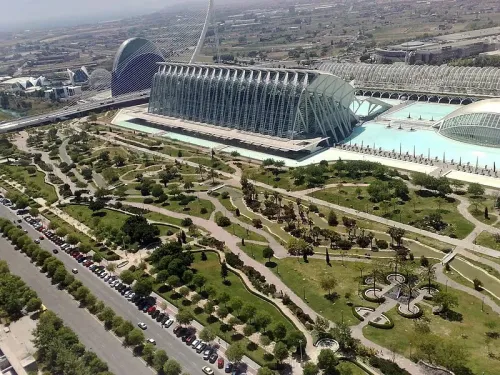
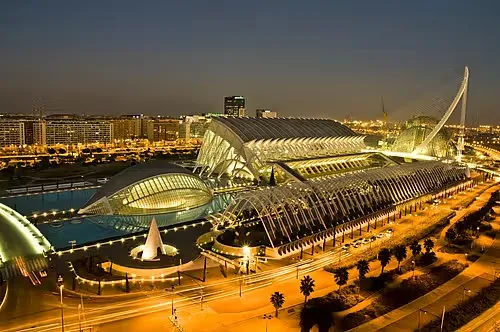
    At the far end of the old riverbed the white buildings rise out of the park. The City of Arts and Sciences was designed by Santiago Calatrava and Félix Candela; construction began in July 1996 and the complex opened on 16 April 1998 with L'Hemisfèric. The Palau de les Arts Reina Sofía followed on 9 October 2005, Valencian Community Day, and L'Àgora in 2009. Budgeted in 1991 for three structures, it kept growing, and the final cost ended up around three times the original estimate.

    Start with L'Hemisfèric, the centrepiece, built to resemble a giant eye, 110 m long and 55.5 m wide. Its shutter of elongated aluminium awnings folds upward like an eyelid, opening along the curved axis to reveal the dome, the iris, which houses the planetarium and IMAX cinema. The pool around it has a glass bottom, so the reflection completes the illusion of a whole eye.

    Walking around the complex is free, and half an hour among the buildings is the natural finale of the tour. The Oceanogràfic, the Hemisfèric and the Science Museum each charge separately, so decide in advance whether you want to go in, perhaps on another day with a combined ticket. Either way, you have walked from a 14th-century gate to a building that opened in this century, along the course of the river that once shaped the city.

    Local name
    Ciudad de las Artes y las Ciencias
    Price
    Free to walk around the complex; the individual attractions (Oceanogràfic, Hemisfèric, Science Museum) charge separately
    Website
    cac.es ↗
Walking tour route map of Valencia Route loaded
Torres de SerranosPlaza de la VirgenValencia CathedralChurch of San Nicolás+6
All 10 stops are already on the map.
You just press start.
AI Tour Guide

You know the route now. Walk it with a guide in your ear.

Press start wherever you are, even hundreds of kilometres from Valencia, and the guide begins telling its stories right away. In the city, pick any of the 10 stops to start from: it leads you there, then talks with you the whole route, asking, listening, remembering, and shaping the tour around your answers.

10stops 6.6km 1 h 29 minwalking 13languages
▶Start the tour free

Free to start · Runs in your browser · No app, no download

Shorter Ways to Walk Valencia

Not everyone has a full day. These three cuts follow the same order and simply stop earlier or start later.

Morning in the old town

Stops: 1, 2, 3, 4, 5, 6

For a half day with lunch at the end: from Torres de Serranos to the Central Market is 1.3 km and 19 minutes of walking. Entry is charged at the towers, the cathedral, San Nicolás and the Silk Exchange; the square and the market are free. With visits, count on about three and a half hours.

The whole historic centre

Stops: 1, 2, 3, 4, 5, 6, 7, 8

For history and architecture lovers who want to skip the long park walk: 2.1 km and 29 minutes of walking from the gate to Plaza del Ayuntamiento. The National Museum of Ceramics adds a fifth paid interior. Plan about four and a half hours.

Modern Valencia and the riverbed

Stops: 8, 9, 10

For a second day or anyone who has seen the old town: from Plaza del Ayuntamiento through the Jardín del Turia to the City of Arts and Sciences is 4.45 km and 60 minutes of walking. Walking is free; only the attractions at the end charge entry. About two hours without going inside.

How Long This Valencia Tour Takes, With and Without Interiors

The pure walking time is 1 h 29 min over 6.6 km, but most of it sits at the end: the old town stops lie close together, while the stretch to the Jardín del Turia takes 16 minutes and the park walk to the City of Arts and Sciences another 44.

If you go inside where it pays off, allow about an hour for the cathedral, 45 minutes for the ceramics palace and around half an hour each for the towers, San Nicolás, the Silk Exchange, the market and the grounds of the City of Arts and Sciences. Add short pauses at the squares and you land at a good six hours, closer to seven with a sit-down lunch. The morning cut takes about three and a half hours, the full old town about four and a half, the riverbed walk about two.

Before You Set Off from Torres de Serranos

  • Start: Torres de Serranos is the recommended start and the order runs best from there, but you can join at any stop.
  • Finish: The City of Arts and Sciences, at the far end of the old riverbed from the historic centre.
  • Time of day: Set off in the morning. The Central Market is at its best early, before the crowds, and an early start leaves room for the interiors and a proper lunch.
  • Entry: Torres de Serranos, Valencia Cathedral, the Church of San Nicolás, the Silk Exchange and the National Museum of Ceramics charge entry; the cathedral's Miguelete bell tower needs its own ticket. At the City of Arts and Sciences the grounds are free and the Oceanogràfic, Hemisfèric and Science Museum charge separately, with a combined ticket if you plan more than one.

Food and Breaks Between the Market and El Carmen

Valencia eats well if you know where to sit. Here are the places worth a pause along the old town part of the walk, plus what to drink and when to order rice.

Horchatería Santa CatalinaA rite of passage in Valencia: traditional tiled walls, quick and friendly service, and a creamy, refreshing horchata that some find a little sweet. Ideal for a short stop between sights. (Next to Valencia Cathedral)
Horchata and fartonsThe local pairing: cold horchata with fartons, the soft sweet pastries made for dunking. Far better than the smoothies inside the market, which are not freshly made and which no local buys. (Stand outside the main entrance of the Central Market)
Escalones de la LonjaReliable and good value, a sensible choice for tapas right after the market and the Silk Exchange. (By the Central Market and the Silk Exchange)
La PilaretaOpen for over a century, with its tiled modernist interior unchanged. The speciality is clonchinas, small mussels from the waters around Valencia, in season from May through August; the shells still go into crates in front of the bar. The montaditos on toasted rolls are good all year. (El Carmen)
ForasteraAn intimate husband and wife restaurant with a set lunch that changes daily: starter, rice, main and dessert, built on seasonal produce with nods to the Basque Country and North Africa. There is also a seven-course option. (El Carmen)
Tasca AngelA traditional standing-only tapas bar known for sardines, mushrooms and padrón peppers. (El Carmen)
Coffee in an old man barLocals skip the queue at Camarena's bar inside the market and the terraces on Plaza del Ayuntamiento. The plain corner bars nearby serve decent coffee at about half the price. (Around the Central Market)

Tourist Traps to Avoid in Valencia's Old Town

  • Paella in ‘paella city’: Boards without prices, hawkers and weak paella. Valencians eat paella at lunch, not dinner, so a place serving it in the evening is a warning sign, and real paella has socarrat, the crisp rice at the bottom. Walk one street further and look for a menú del día where Spanish families eat at midday; no good restaurant here sends out hawkers. (Around the Silk Exchange and the Central Market)
  • Rosemary sprigs and friendship bracelets: Someone hands you a ‘lucky’ sprig of rosemary or ties a band round your wrist, then demands money. Touch nothing, say no and keep walking. If the band is already on, say clearly ‘I did not ask for this’: you owe nothing. (Valencia Cathedral, Plaza de la Reina and the Central Market)
  • Fake plainclothes police: Two people flash a badge, talk about counterfeit money or drug cash and ask to inspect your wallet. Real undercover police in Spain do not check tourists' wallets in the street. Keep your wallet put away and walk on. (Plaza del Ayuntamiento, El Carmen and the Central Market)
Walking tour route map of Valencia
AI Tour Guide

Your guide is ready when you reach the first gate.

Press start and a voice AI Tour Guide takes it from here: leading the route through Valencia, telling the stories, and turning your walk into a real back-and-forth conversation. No app or download is needed; it runs in your browser.

10stops 6.6km 1 h 29 minwalking 13languages
▶Start the tour free

Free to start · Runs in your browser · No app, no download

What the AI Tour Guide Adds Between Gate and Garden

On this route the AI Tour Guide turns the walk into a conversation: it greets you at Torres de Serranos, tells the stories of each place, asks what you care about and remembers it, so the Silk Exchange sounds different for a history fan than for a food lover. You can interrupt any time, for instance to ask how the Water Tribunal actually settles a dispute, or what Calatrava wanted the rest of the complex to look like. The GPS navigation still leads you from stop to stop and the route stays the same. You start with 100 free credits; after that, choose this tour all-inclusive for €19.99 with no time limit, or credits at €5 per hour.

A Real Conversation A voice AI Tour Guide greets you, leads the whole route, and tells the stories and facts as you walk, asking what you want to see and keeping a real conversation going. Not a recording you press play on.
Map Navigation Follow the route on the map and walk at your own pace. You choose where to start and when to move to the next stop.
Ask Anything Curious about a building you pass? Ask your AI Tour Guide on the spot and the conversation carries on.
13 Languages Switch language anytime. No separate tour needed.
Start free in your browser

Common Questions About Walking Valencia

How do I get back to the old town from the City of Arts and Sciences?

On request, the GPS navigation in your browser guides you on foot from the City of Arts and Sciences back to Torres de Serranos.

If I only go inside two buildings, which should they be?

Valencia Cathedral for the Holy Chalice and its 15th-century paintings, plus either the Silk Exchange for its column hall or the Church of San Nicolás for its painted ceiling. Pick the National Museum of Ceramics instead if palace rooms tempt you more than churches.

I don't like horchata. What else do locals drink on a break?

Order tinto de verano or a sangria; even at Horchatería Santa Catalina that is a perfectly normal choice.

Where can I walk next after Valencia?

Cuenca is the nearest tour city at 164 km. Madrid and Barcelona are both 303 km away, and Zaragoza is 246 km.

Is the tour really free?

Yes. The whole tour is free: the route, the interactive map and the navigation cost you nothing. Only the voice AI Tour Guide is optional and paid: you test it with 100 free credits, then you pay either €5 per hour or €19.99 for this whole tour, with no time limit. Admission to 4 of the 10 stops is not included: Torres de Serranos, Valencia Cathedral, Silk Exchange and National Museum of Ceramics charge their own entry fees.

Do I need to download an app?

No. Everything runs in your phone browser. Open the route and start walking, no download and no sign-up required.

Do I need to book the walking tour in advance?

No booking needed. This self-guided tour is available anytime. Open the route in your browser and start walking. The AI Tour Guide works instantly, no app, no reservation required.

What languages is the AI Tour Guide available in?

The AI Tour Guide speaks 13 languages, so you take the tour in your own language and can switch at any time.

Can I skip stops or change the route?

Yes. Skip any stop, spend extra time at places you like, or start the route from any point. It is your walk, you set the pace.
Image credits
▶ Start free in your browser Runs in your browser, no app, no download