Free Walking Tour Delft: Churches, Gate and Vermeer

From Delft's huge market square past a leaning church tower, the prince's last home and the town's only surviving gate, then into Vermeer's world.

9 Stops 4.5 km ~1 h 2 min walking
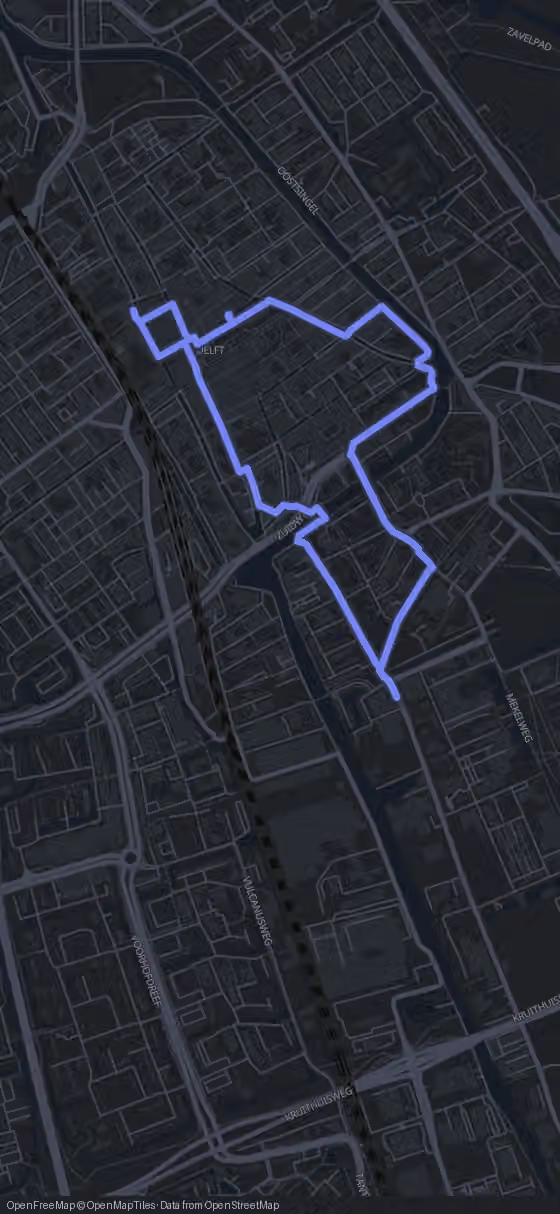
Route map for the Delft walking tour
Stop 1 of 9
240 m·3 min
Markt
Head north-west off the Markt toward the Old Church
Welkom in Delft. I'm Alex, and one quiet staircase here still bears the marks of a killing that changed Dutch history.
Try this tour with Alex

Your Delft loop at a glance

Nine stops in a loop that starts and ends on the Markt: 4.5 km with 1 h 2 min of pure walking. With the church interiors, Royal Delft and the Vermeer Centrum Delft inside, plan close to six hours.

The Markt, the Eastern Gate and the Klaeuwshofje cost nothing, and one ticket covers both the Old Church and the New Church. Route, map and GPS navigation are free in your browser; the optional AI Tour Guide can lead the walk as a conversation.

Open free GPS & optional AI Tour Guide
This short shows highlights of the route. All 9 stops follow below.

The Route

Walking map of Delft: the old town loop

9 stops 4.5 km 1 h 2 min walking
Tap to load interactive map

The 9 stops along this route

  1. Markt in Delft, stop 1 on the self-guided walking tour
    1Markt
  2. Old Church in Delft, stop 2 on the self-guided walking tour
    2Old Church
  3. Museum Prinsenhof Delft, stop 3 on the self-guided walking tour
    3Museum Prinsenhof Delft
  4. Paul Tétar van Elven Museum in Delft, stop 4 on the self-guided walking tour
    4Paul Tétar van Elven Museum
  5. 5Royal Delft
  6. Eastern Gate in Delft, stop 6 on the self-guided walking tour
    6Eastern Gate
  7. Klaeuwshofje in Delft, stop 7 on the self-guided walking tour
    7Klaeuwshofje
  8. New Church in Delft, stop 8 on the self-guided walking tour
    8New Church
  9. Vermeer Centrum Delft, stop 9 on the self-guided walking tour
    9Vermeer Centrum Delft
  10. That's the full loop.

    Walk it with an AI Tour Guide talking you through every one of these streets.

    Start free in your browser
    You made it

Delft walking tour stop by stop, from the Markt to Vermeer

  1. 1

    Markt

    Markt in Delft, stop 1 on the self-guided walking tour

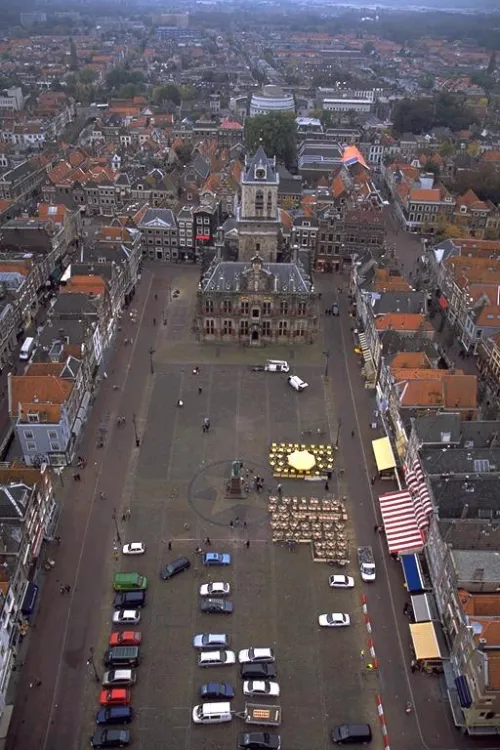
    You start on one of the largest historic market squares in Europe: 120 by 50 metres, almost a perfect rectangle. Stand in the middle and look at the two short sides. At one end rises the New Church, at the other the City Hall, and the side streets that link them also count as part of the Markt. The square sits on an old silted creek ridge, which makes it one of the highest points in the old town, and it was last redesigned in 2004.

    Delft grew up in the twelfth century around a count's manor, and the open ground next to it became the market field. The Thursday market has been held here ever since. In earlier centuries two big annual fairs filled the square too, one around the town's yearly procession on 12 June and one on the feast of St Eligius on 1 December.

    The square also has a grimmer past. Public executions mostly took place here, and before the New Church was built the eastern part of the field served as the gallows ground. The field was raised by more than a metre, then shortened by about 34 metres in 1396 to make room for the church and by another 17 metres in 1421 for a churchyard. In 1436 Count Philip the Good gave his manor and the rest of the field to the city, and his manor buildings became the City Hall.

    The statue of Hugo Grotius on the square comes up again when you reach the New Church. For now, head 300 m, about 4 minutes, to the tower that does not stand straight.
    Hours
    Open 24/7
    Price
    Free
  2. 2

    Old Church

    Old Church in Delft, stop 2 on the self-guided walking tour

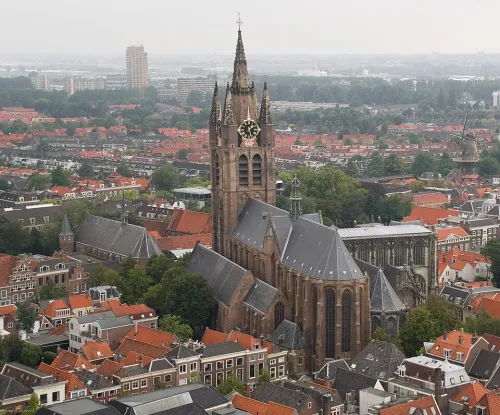
    Look up before you go in. The brick tower of the Old Church is 75 metres high and leans about two metres out of the vertical, which earned the church its nicknames Oude Jan, Old John, and Scheve Jan, Skewed John. The foundations could not carry the weight, and as the builders went up they tried to correct the lean layer by layer. Only the four corner turrets at the very top are truly vertical. One theory says the canal next to it had to be shifted to make room, leaving the ground unstable.

    The church was founded in 1246 as St Bartholomew's, on a site where churches had stood for up to two centuries before. The tower with its spire and four turrets was added in the first half of the fourteenth century and ruled the skyline for about 150 years, until the New Church overtook it. Later the church was rededicated to St Hippolytus.

    Inside you read the building's troubled history in its walls. An ambitious extension by the Keldermans family of master builders stopped short after the town fire of 1536 and the Reformation; the flat-roofed stone north transept from that phase looks quite different from the older parts. The Delft Thunderclap, a gunpowder explosion, shattered most of the stained glass, and many windows were refitted with plain glass or bricked up.

    Is it worth going in? If you plan to see the New Church too, yes: one ticket covers both, so buy it here. Then walk 100 m, a single minute, to the former convent where William of Orange lived.

    Local name
    Oude Kerk
    Hours
    Feb–Oct: Mon–Sat 10:00–17:00, Sun closed (services only); Nov–Jan: Mon–Fri 11:00–16:00, Sat 10:00–17:00, Sun closed (services only)
    Price
    10.00 EUR regular (admission ticket valid for both Old Church and New Church), 8.00 EUR students/scholars (up to 25), 4.75 EUR children (6-11), free for children up to 5
  3. 3

    Museum Prinsenhof Delft

    Museum Prinsenhof Delft, stop 3 on the self-guided walking tour

    The Museum Prinsenhof Delft is currently closed, so this is a stop for the facade and the story. And the story is a big one: this former convent was the home of William of Orange, leader of the Dutch revolt against Spain, from 1572 until he was murdered here in 1584.

    It began around 1380 with a group of women who gathered around the priest Jacob Jan to devote their lives to God. They lived in deep poverty until a wealthy widow, Alijd Buser, joined them and became their first prioress. The sisters supported themselves by spinning and weaving, and in 1404 the community became the St Agatha Convent. More and more women from good families joined and handed over their property, so the convent grew rich enough to host the city's distinguished guests.

    In 1572 the States of Holland confiscated the convent and gave it to William, who needed a safe home for his family. The remaining nuns were allowed to stay in the south wing; the last of them died in 1640. Because William had inherited the Principality of Orange, the new residence was called the Prinsenhof, the Prince's Court. His living rooms were on the first floor at the corner facing the Oude Delft canal, with a view of the Old Church you just left. Two of his children were born here, the last being Frederick Henry, later stadtholder.

    From here it is 500 m, about 7 minutes, to a canal house with five centuries of owners.

    Status
    Currently closed
  4. 4

    Paul Tétar van Elven Museum

    Paul Tétar van Elven Museum in Delft, stop 4 on the self-guided walking tour

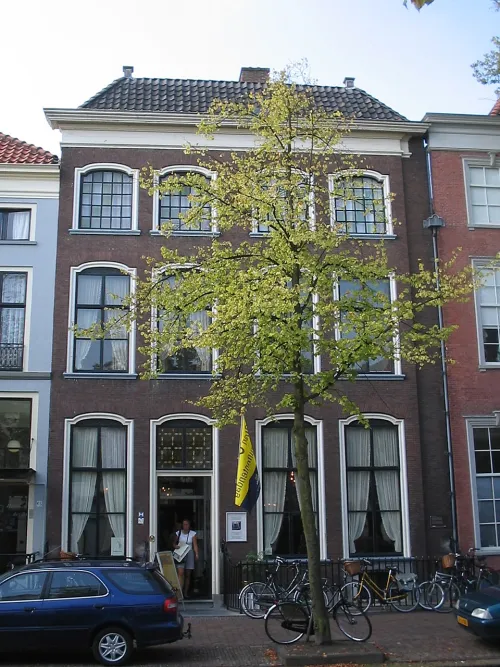
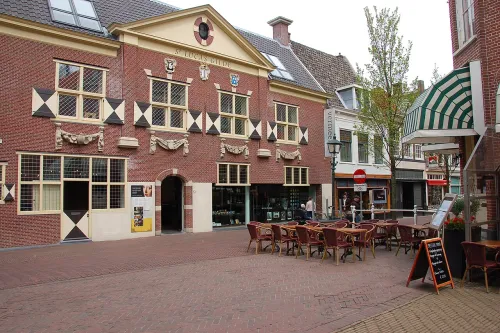
    This canal house museum is built around one man: the painter and collector Paul Tétar van Elven, who lived here from 1864 to 1894. His own work and his collection of fine and applied art fill the rooms, so you see a nineteenth-century artist's home rather than a gallery.

    The house is much older than its famous resident. It was rebuilt after the town fire of 1536, and the barrel-vaulted cellar dates from around 1400. In the sixteenth century it belonged to the brewery Het Dubbelde Cruys and was home to Machtelt van Adrichem, daughter of the brewer Adriaen van Adrichem, who served several times as mayor. Her sister became the grandmother of Hugo de Groot, better known as Grotius, whose tomb you will see in the New Church. Later Delft regent families held the house for generations, and the Van der Dussen family reworked it thoroughly between 1709 and 1720, adding a dining room to the salon and a corridor through to the garden.

    The museum charges admission, though Museumkaart holders go free. Worth it if you like house museums and the feel of lived-in rooms.

    Now comes the long walk, and the only real commitment this route asks for: 1300 m, about 18 minutes, to Royal Delft. Together with the next leg it makes up more than half of the walking on the loop.

    Hours
    Tue–Sun 13:00–17:00, Mon closed
    Price
    12 EUR regular adults, 6 EUR CJP/discount cards, free for children (0-18), Museumkaart, Delftpas/Rotterdampas, and TU Delft students
  5. 5

    Royal Delft

    If Delft Blue is part of why you came, this is the place. Royal Delft, founded in 1653, is the last of the seventeenth-century Delft Blue pottery factories still standing and still producing. A visit combines the working factory with a museum, and admission includes an audio tour.

    Tickets are cheaper for students and teenagers, and the Museumkaart gets you in free. Give this stop the earlier part of your day, so you have time for the audio tour without rushing.

    A small curiosity: the company counts among the smallest stocks traded on the stock exchange.

    If pottery leaves you cold, there is no need to go in; the walk out here still pays off at the next stop. From the factory it is 1350 m, about 19 minutes, to the Eastern Gate.

    Hours
    Daily 09:30–17:00 (1 April – 15 May: daily 09:00–17:00)
    Price
    17.50 EUR adults, 10.00 EUR youth (13-18), 7.50 EUR children (7-12; free until 30 August under summer promotion), free for children up to 6, 11.50 EUR students, free with Museumkaart, Rotterdampas, Ooievaarspas or ICOM
  6. 6

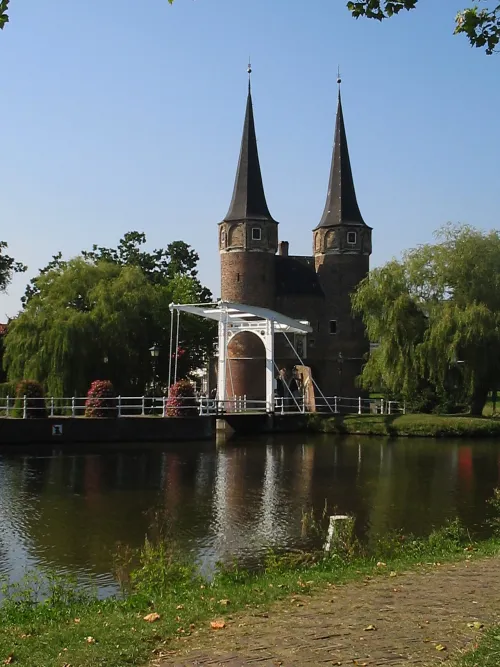
    Eastern Gate

    Eastern Gate in Delft, stop 6 on the self-guided walking tour

    Two pointed towers, a water gate and a drawbridge: the Eastern Gate is the only one of Delft's eight original city gates still standing. It consists of a land gate and a water gate joined by remains of the city wall, all fully restored in 1964. Look for the small piece of wall on the north side and the statue of a guard above the gate, reminders that this structure once defended the town.

    Its history is a run of punishments and lucky escapes. In 1359 Delft lost a war against Duke Albrecht of Bavaria and had to tear down its gates as a penalty; the Eastern Gate was rebuilt straight away. It was raised in 1519, and when William of Orange moved to Delft in 1572 the whole fortification was strengthened. Around 1840 all the other gates were demolished. This one survived only because it stood in a corner of the town and was in nobody's way.

    The bridge beside it dates from 1514 and is a national monument like the gate. Far away in Japan, the Huis ten Bosch theme park has a replica of the gate and its drawbridge.

    You view it from outside only; the building serves as a photographer's workspace. Then walk just 150 m, 2 minutes, to a quiet almshouse courtyard.

    Local name
    Oostpoort
    Hours
    Exterior view accessible 24/7 (no interior public access)
    Price
    Free admission
  7. 7

    Klaeuwshofje

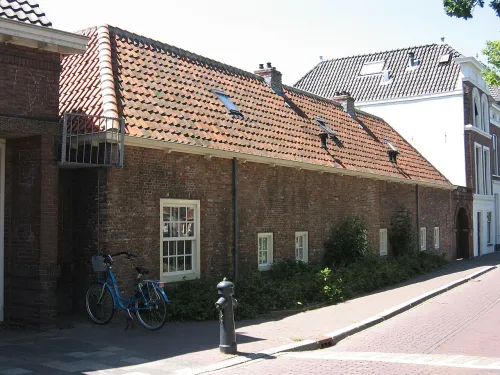
    Klaeuwshofje in Delft, stop 7 on the self-guided walking tour

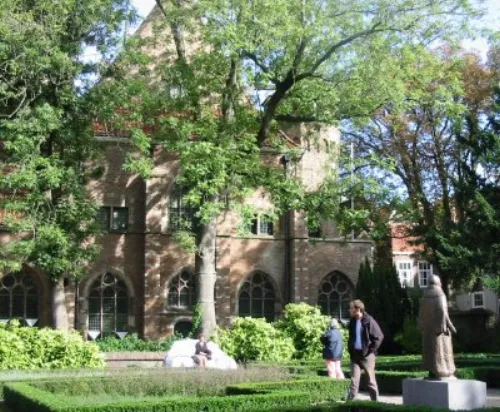
    Step into the Klaeuwshofje and the town goes quiet. This almshouse courtyard was founded in 1605 by Dirck Uytenhage and Elizabeth van Adrichem, owners of the De Klaeuw brewery, as homes for elderly Catholic women. The Van Adrichem name you met at the canal house turns up here again, once more in a brewing family.

    Today the courtyard has 12 houses. During a renovation in the 1960s every two small houses were joined into one, but the front doors that were no longer needed were kept. Count the doors against the homes and you can still read the old layout in the facades.

    The courtyard costs nothing to visit. People live here, so keep your voice down. From here it is 620 m, about 9 minutes, back to the Markt side of town and the New Church.

    Hours
    Daily: 09:00–21:00
    Price
    Free
  8. 8

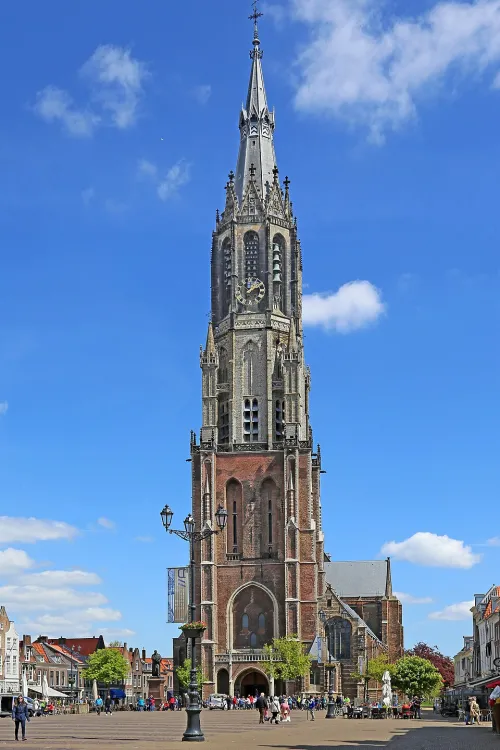
    New Church

    New Church in Delft, stop 8 on the self-guided walking tour

    The New Church closes off the Markt opposite the City Hall, and its slender tower is the second highest in the Netherlands, after the Domtoren in Utrecht. Both were built by the same man: Jacob van der Borch worked on this tower, built between 1396 and 1496, and later on the Domtoren. The spire you see today is a recreation designed by Pierre Cuypers and completed in 1872. The tower's clock has 18 bells cast by Francois Hemony from 1659.

    Inside, the church is about the House of Orange. William the Silent was entombed here in 1584, in a mausoleum by Hendrick and Pieter de Keyser finished around 1621, and since then members of the royal family have been buried in the crypt below; the latest were Queen Juliana and Prince Bernhard in 2004.

    Look also for the tomb of Hugo Grotius, born in Delft in 1583. His wife Maria van Reigersberch helped him escape from imprisonment at Loevestein Castle in 1621 by hiding him in a book chest, and she lies here beside him. His monument inside dates from 1781, the statue on the Markt from 1886.

    The Delft Thunderclap blew off the roof and destroyed the stained glass, so much of what you see is the result of repairs. Your Old Church ticket gets you in. Then it is only 120 m, 2 minutes, to the Vermeer Centrum Delft.

    Local name
    Nieuwe Kerk
    Hours
    Feb–Oct: Mon–Sat 10:00–17:00, Sun closed (services only); Nov–Jan: Mon–Fri 11:00–16:00, Sat 10:00–17:00, Sun closed (services only)
    Price
    10.00 EUR regular (admission ticket valid for both New Church and Old Church), 8.00 EUR students/scholars (up to 25), 4.75 EUR children (6-11), free for children up to 5; Tower climb only: 7.50 EUR adults, 5.75 EUR students, 4.25 EUR children; Combined church + tower: 15.00 EUR adults, 12.00 EUR students, 6.50 EUR children
  9. 9

    Vermeer Centrum Delft

    Vermeer Centrum Delft, stop 9 on the self-guided walking tour

    Johannes Vermeer was born in Delft in 1632 and lived and worked here all his life. The Vermeer Centrum Delft owns no original Vermeer, but it is the only place in the world where you can see all 37 of his paintings as life-size reproductions together. The years he painted them are marked on the floor, so you can follow his development step by step through the room.

    The building has its own story. It stands on the site of the old St Luke's Guild: in 1661 the mayor G. Meerman had the former chapel of the Oude Manhuys converted into a guild house for glaziers, painters, printers and potters. The garlands on the facade are copies; Pierre Cuypers set the originals into the rear facade of the Rijksmuseum in Amsterdam when the building was demolished in 1886.

    Inside, an exhibition explains Vermeer's time, his studio and his handling of colour, light and perspective. You can experiment with a camera obscura, watch a film about Vermeer and Delft on a 12 metre wide screen, and on the second floor learn to read the hidden love messages in his paintings. The centre opened in 2007 and is run entirely by volunteers.

    The centre charges admission, and there is also a combi ticket with both churches. Worth it for anyone who wants to understand the painter rather than just see one canvas. From the door it is 90 m, a single minute, back to the Markt, where your loop ends.

    Hours
    Daily 10:00–17:00
    Price
    15.00 EUR adults, 7.50 EUR youth (13-18), 2.00 EUR children (7-12), free for children (0-6); Combi-ticket with Old & New Church: 18.50 EUR ; Students / Museumkaart: 11.00 EUR
Walking tour route map of Delft Route loaded
MarktOld ChurchMuseum Prinsenhof DelftPaul Tétar van Elven Museum+5
All 9 stops are already on the map.
You just press start.
AI Tour Guide

You know the route now. Walk Delft with a guide in your ear.

Press start wherever you are, even hundreds of kilometres from Delft, and the guide begins telling its stories right away. In the city, pick any of the 9 stops to start from: it leads you there, then talks with you the whole route, asking, listening, remembering, and shaping the tour around your answers.

9stops 4.5km 1 h 2 minwalking 13languages
▶Start the tour free

Free to start · Runs in your browser · No app, no download

Three ways to walk the Delft loop

The long legs to Royal Delft and on to the Eastern Gate decide most of your day, so the choices start there.

The full loop with Delft Blue

Stops: 1, 2, 3, 4, 5, 6, 7, 8, 9

For anyone who came for Delft Blue as much as for the churches. All 1 h 2 min of walking. Admissions: the shared church ticket, Royal Delft, the Vermeer Centrum (also available as a combi ticket with both churches) and, if your timing allows, the Paul Tétar van Elven Museum.

The old centre without the long legs

Stops: 1, 2, 3, 4, 8, 9

For a half day focused on churches, Orange history and Vermeer. From the Markt via the Old Church and the Prinsenhof to the canal house is 12 minutes on foot; New Church, Vermeer and back to the Markt add 3 more, plus the short way from the canal house to the New Church. You leave out the 37 minutes out to Royal Delft and the Eastern Gate. Admissions: one combi ticket covers both churches and Vermeer.

Outside only, no admissions

Stops: 1, 2, 3, 4, 5, 6, 7, 8, 9

For a slow walk on a tight budget or a Sunday. You follow the whole loop, 1 h 2 min of walking, look at every building from the outside and spend nothing. Allow about two hours with pauses on the Markt and in the Klaeuwshofje.

How long does this Delft tour take with Royal Delft and Vermeer?

The loop takes 1 h 2 min of pure walking. Most of that sits in two legs: 18 minutes out to Royal Delft and 19 minutes on to the Eastern Gate. Everything else is a few minutes apart.

A realistic full day from 10:00: Markt until 10:15, Old Church 10:19 to 10:59, the Prinsenhof facade until 11:10, the Paul Tétar van Elven Museum at 11:17 (on this timing it is a facade stop), Royal Delft 11:40 to 13:10, Eastern Gate 13:29, Klaeuwshofje 13:41, New Church 14:00 to 14:45, Vermeer Centrum 14:47 to 15:47, back on the Markt at 15:48. That is close to six hours, and an hour for lunch still fits before Vermeer closes.

The old centre variant fits comfortably into three hours with all three interiors; the outside-only walk takes about two.

Before you start walking Delft

  • Start and finish: The Markt is the recommended start and also where the loop ends. You can join at any stop; the order here is the one we recommend.
  • Best day: Pick a day when both churches and the Paul Tétar van Elven Museum are open to visitors. The weekly market fills the Markt on Thursdays.
  • Time of day: Start in the morning so Royal Delft gets the early part of your day and Vermeer still fits in before it closes.
  • Costs: The walk itself is free. Inside visits are optional: one ticket covers both churches, a combi ticket adds the Vermeer Centrum, and Royal Delft and the Paul Tétar van Elven Museum charge their own admission. The Museumkaart gets you into Royal Delft and the canal house free.
Walking tour route map of Delft
AI Tour Guide

Your guide is ready when you reach the Markt

Press start and a voice AI Tour Guide takes it from here: leading the route through Delft, telling the stories, and turning your walk into a real back-and-forth conversation. No app or download is needed; it runs in your browser.

9stops 4.5km 1 h 2 minwalking 13languages
▶Start the tour free

Free to start · Runs in your browser · No app, no download

Walk Delft with a guide who talks with you

On this loop the AI Tour Guide earns its keep on the two long legs out to Royal Delft and the Eastern Gate: 37 minutes in which it greets you, keeps telling the story of Delft, asks what you care about and builds on your answers. Curious what happened to Hugo Grotius after the book chest, or why William of Orange chose a convent to live in? Just ask, and the guide picks up the thread. The GPS route stays free; the guide is optional, with 100 free credits to start and then this tour all-inclusive for €19.99 with no time limit, or €5 per hour.

A Real Conversation A voice AI Tour Guide greets you, leads the whole route, and tells the stories and facts as you walk, asking what you want to see and keeping a real conversation going. Not a recording you press play on.
Map Navigation Follow the route on the map and walk at your own pace. You choose where to start and when to move to the next stop.
Ask Anything Curious about a building you pass? Ask your AI Tour Guide on the spot and the conversation carries on.
13 Languages Switch language anytime. No separate tour needed.
Start free in your browser

Common questions about walking Delft

Can I see the royal crypt in the New Church?

No. The crypt of the House of Orange-Nassau is private and not open to the public. You can see William the Silent's mausoleum and the Grotius monument in the church itself.

Can I climb the New Church tower?

Yes. You can buy a ticket for the tower alone or a combined ticket for church and tower.

Is the Museumkaart worth bringing to Delft?

It covers Royal Delft and the Paul Tétar van Elven Museum in full and gets you a reduced ticket at the Vermeer Centrum. For the churches, plan on the regular ticket.

Are the inside visits cheaper for children?

Yes. Both churches, the Vermeer Centrum and Royal Delft offer reduced tickets for children, and the youngest go free everywhere on the loop. The Paul Tétar van Elven Museum is free for children and teenagers.

Can I combine Delft with another city on the same day?

Yes, The Hague is only 9 km away and Rotterdam 13 km. If you do, walk the old centre variant here and continue with the walking tour of The Hague or the Rotterdam walking tour.

Is the tour really free?

Yes. The whole tour is free: the route, the interactive map and the navigation cost you nothing. Only the voice AI Tour Guide is optional and paid: you test it with 100 free credits, then you pay either €5 per hour or €19.99 for this whole tour, with no time limit. Admission to 5 of the 9 stops is not included: Old Church, Paul Tétar van Elven Museum, Royal Delft, New Church and Vermeer Centrum Delft charge their own entry fees.

Do I need to download an app?

No. Everything runs in your phone browser. Open the route and start walking, no download and no sign-up required.

Do I need to book the walking tour in advance?

No booking needed. This self-guided tour is available anytime. Open the route in your browser and start walking. The AI Tour Guide works instantly, no app, no reservation required.

What languages is the AI Tour Guide available in?

The AI Tour Guide speaks 13 languages, so you take the tour in your own language and can switch at any time.

Can I skip stops or change the route?

Yes. Skip any stop, spend extra time at places you like, or start the route from any point. It is your walk, you set the pace.
Image credits
▶ Start free in your browser Runs in your browser, no app, no download