Free Walking Tour Gouda: Cheese, Glass and Gothic

A compact loop from the cheese weigh house to the longest church in the Netherlands, with a pilgrim's chapel and a Gothic town hall on the way.

7 Stops 1.2 km ~16 min walking
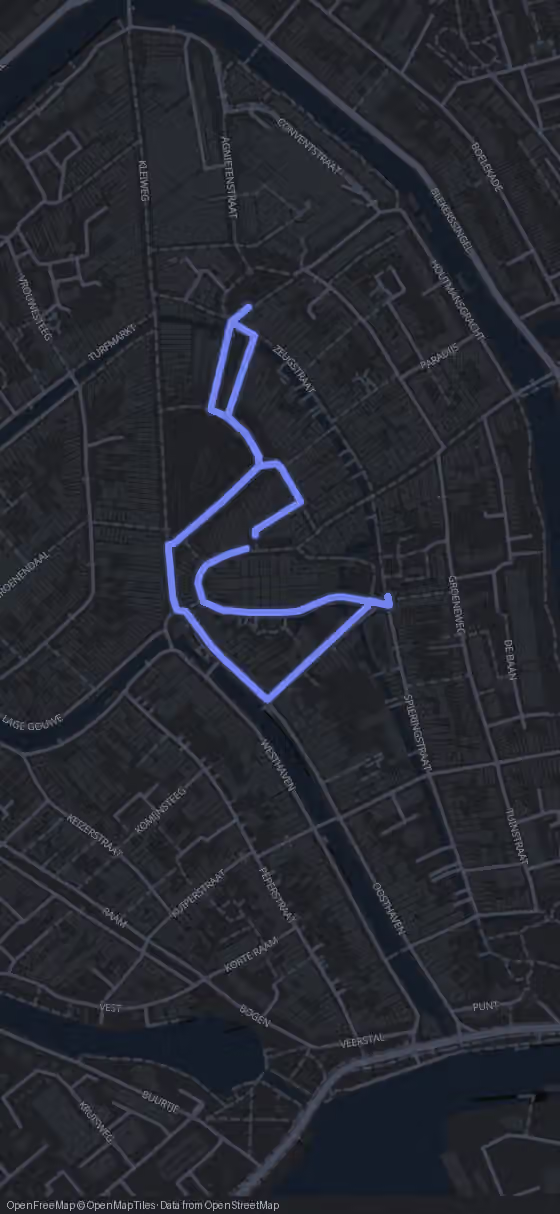
Route map for the Gouda walking tour
Stop 1 of 7
210 m·3 min
Markt
Head north off the Markt toward the Agnietenkapel
Welcome to Gouda. I'm Alex, and some of the city's finest history survived in colored glass.
Try this tour with Alex

Gouda's Old Centre in One Short Loop

This free walking tour of Gouda is a 1.2 km loop with 7 stops that starts and ends on the Markt, taking in the Agnietenkapel, Goudse Waag, Stadhuis Gouda, Museum Gouda, Jeruzalemkapel and St. John's Church. Pure walking time is 16 minutes; with the main interiors, plan about four and a quarter hours.

The square, the façades and both chapels are free. The Goudse Waag, Museum Gouda and St. John's Church charge admission. The GPS route in your browser costs nothing; the AI Tour Guide is optional.

Open free GPS & optional AI Tour Guide
This short shows highlights of the route. All 7 stops follow below.

The Route

Walking Map of Gouda's Old Centre Loop

7 stops 1.2 km 16 min walking
Tap to load interactive map

The 7 stops along this route

  1. Markt in Gouda, stop 1 on the self-guided walking tour
    1Markt
  2. Agnietenkapel in Gouda, stop 2 on the self-guided walking tour
    2Agnietenkapel
  3. Goudse Waag in Gouda, stop 3 on the self-guided walking tour
    3Goudse Waag
  4. Stadhuis Gouda, stop 4 on the self-guided walking tour
    4Stadhuis Gouda
  5. Museum Gouda, stop 5 on the self-guided walking tour
    5Museum Gouda
  6. Jeruzalemkapel in Gouda, stop 6 on the self-guided walking tour
    6Jeruzalemkapel
  7. St. John's Church in Gouda, stop 7 on the self-guided walking tour
    7St. John's Church
  8. That's the full loop.

    Walk it with an AI Tour Guide talking you through every one of these streets.

    Start free in your browser
    You made it

Your Gouda Walking Tour: Seven Stops Around the Markt

  1. 1

    Markt

    Markt in Gouda, stop 1 on the self-guided walking tour

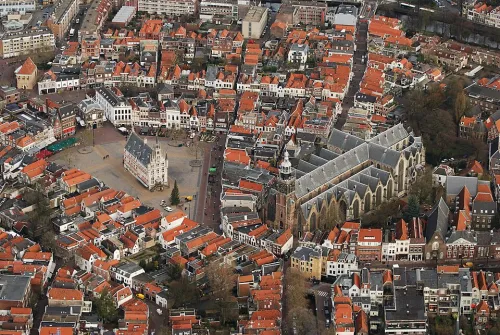
    You start on the Markt, Gouda's central square, built around the town hall that stands free in the middle. Look at its shape: roughly triangular, with the north side bending in a curve rather than running straight. In the 14th century each side had its own name. The curved edge was the Regenboog, the rainbow, probably because of that shape; the west side was the Koestraat, where the cow market was held; the southeast side was the Botermarkt. People kept using these names well into the 20th century, though officially the whole square is simply the Markt.

    The town bought this marshy ground from the lords Van der Goude to build a new town hall, but work only began in 1448. Ever since, the square has been a trading floor for cows, horses, meat, butter and cheese. The great annual fair was the Sint-Jacobsmarkt at the end of July, the origin of today's funfair, and the Thursday and Saturday markets are what remains of the old weekly markets. In season the cheese market fills the square on Thursday mornings; if your dates fit, time your start for it.

    Before you move on, find two buildings. Next to the Waag stands De Zalm, an inn rebuilt in 1670. The city ruled that its cornice had to sit at least six ells lower than the Waag's, and the gable stone under the carved salmon still says so: Niet te hooch niet te laech van passe, not too high, not too low, just right. Then look for Arti Legi, built in 1855 to a design by Willem Cornelis van Goor. Its name records its first two tenants, the city drawing school (Arti) and the cantonal court (Legi). Today it is used for exhibitions and other events.

    From here it is 280 m, about 4 minutes, to the Agnietenkapel on the Nieuwe Markt.
    Hours
    Always open; cheese market Thu 10:00–12:30 (Apr–Aug)
    Price
    Free
  2. 2

    Agnietenkapel

    Agnietenkapel in Gouda, stop 2 on the self-guided walking tour

    This modest Gothic chapel is all that is left of the Agnietenconvent, a women's convent founded at the end of the 14th century and dedicated to Saint Agnes. The sisters lived by the Rule of Augustine, and the chapel probably went up in the middle of the 15th century. Around a courtyard stood the convent itself, a sacristy, a brewery, service buildings and stables. Right next door was a second women's convent, the Magdalenaconvent; both stood on ground that is now the Nieuwe Markt.

    It was never a wealthy house. In 1515 the convent's own priest described it as 'this poor and miserable, shabby convent'. After the Reformation the chapel became a workshop for the town's tapestry weavers, and in 1653 the lombard, the municipal pawn bank, moved in. Until 1924 people from Gouda came here to borrow money against a pledge, so for nearly three centuries this was where the town went when cash ran short.

    After that the building changed roles again and again: labour exchange, food distribution point, emergency post office, arts centre. One by one the other convent buildings were pulled down. In the 1960s and 1970s the chapel stood empty for years and was itself marked for demolition, until a restoration from 1972 to 1975 saved it. Today it hosts exhibitions and receptions. If the door is open, step in, entry is free; if not, the exterior and its story are reason enough to pass by.

    The Goudse Waag is only 110 m away, about a minute's walk back to the Markt.

    Price
    Free (Church/heritage chapel)
  3. 3

    Goudse Waag

    Goudse Waag in Gouda, stop 3 on the self-guided walking tour

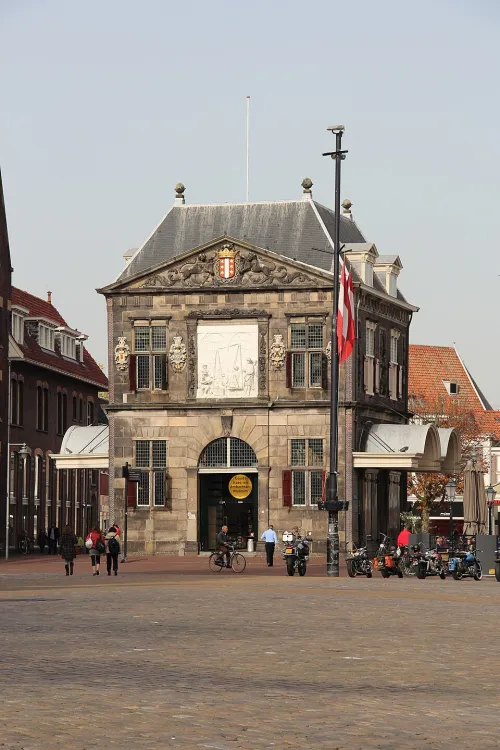
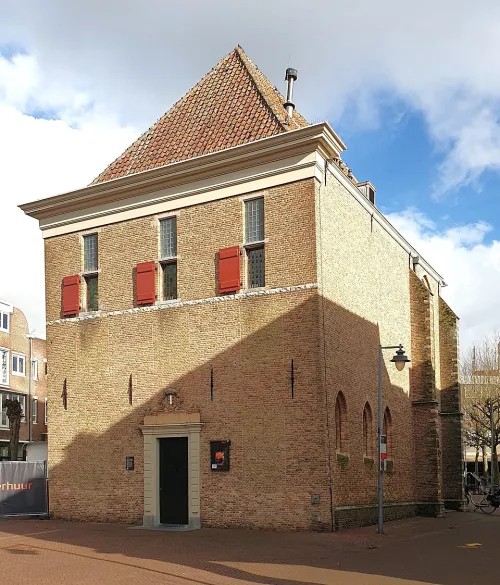
    The Goudse Waag is the town's public weigh house, a major work by architect Pieter Post, completed in 1670. As a building made for a single purpose, weighing goods, it is regarded as the high point in the development of its type. Before it existed, the public scales were most likely kept in the town hall, and the layout of the square still shows that bond: the two buildings stand on one axis and are exactly the same width. Both are faced in natural stone and rise above the houses around them, and the Waag keeps a little distance from its neighbours, which sets it apart as a civic monument.

    Now look at the front. The ground floor is plain, clad in stone worked to look like squared blocks. In the middle of the upper floor, a relief by sculptor Bartholomeus Eggers shows a weighing scene, including the large round cheeses typical of Gouda. Post left out a canopy at the front, useful as it would have been, so as not to spoil the building's tower-like look. The sides do have barrel-shaped canopies: they sheltered the sliding beam scales when these were pushed halfway out to be loaded. There are six weighing places in all, although the one at the back on the gate axis never received a scale.

    For his design Post first drew on his own weigh house for Leiden, so if you have seen that one, the family resemblance is no accident. Going inside is worth it if you want the weighing trade in more depth; the ticket includes an audio tour, and about 45 minutes is enough. Without a ticket you can still walk into the ground floor museum shop.

    The Stadhuis Gouda is 120 m away, a 2 minute walk across the square.

    Hours
    Daily 10:00–17:00 (1 Apr – 1 Nov); Daily 10:00–16:00 (1 Nov – 1 Apr); closed King's Day, 25 Dec, 1 Jan
    Price
    8.50 EUR adult (incl. audio tour); 3.50 EUR children 6-14; free under 6, Rotterdampas; free ground floor museum shop
  4. 4

    Stadhuis Gouda

    Stadhuis Gouda, stop 4 on the self-guided walking tour

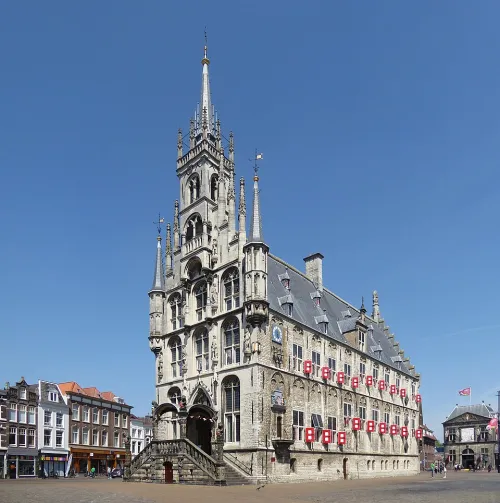
    The Stadhuis Gouda in the middle of the Markt is one of the oldest Gothic town halls in the Netherlands. It is currently closed, so this is a stop for the outside, which rewards a slow walk around it. The council bought the market field from the lords Van der Goude for a town hall, yet construction only started in 1448; city historian Ignatius Walvis put the long delay down to the town's poor finances. The building was in use by 1450 and complete in 1459, when its small tower was finished.

    Among the stonemasons was Jan III Keldermans, from a Brabant family of architects based in Mechelen, and his son Andries also worked on it. The walls are Belgian limestone. Instead of driving piles into the soft ground, the builders set the town hall on rafts of heavy oak beams. It was spruced up in 1497 for the visit of Philip the Handsome and rebuilt in 1517 and 1518.

    According to Walvis, water surrounded the town hall until 1603, and you reached it by a drawbridge. That year city sculptor Gregorius Cool made the Renaissance perron at the front. Walk round to the back for the scaffold, added during a major rebuild between 1692 and 1697; an earlier one is first mentioned in 1525. Until 1897 prisoners were brought up to it from outside, because they were not allowed to pass through the town hall. That same year, on 24 April 1897, Queen Wilhelmina visited Gouda.

    From here, Museum Gouda is 210 m away, about 3 minutes on foot.

    Status
    Currently closed
  5. 5

    Museum Gouda

    Museum Gouda, stop 5 on the self-guided walking tour

    Museum Gouda was founded in 1874 as the town museum, prompted by Gouda's 600th anniversary. City draughtsman J.J. Bertelman and minister J.N. Scheltema were among the founders, and they asked residents to hand over objects linked to the town's history. The collection first lived in Arti Legi on the Markt, then moved in 1947 into the Catharina Gasthuis, the former hospital you are standing at now.

    The building's own past is part of the visit. You can see the surgeons' guild room, where Gouda's surgeons met from 1699, and a complete apothecary interior on the original site of the town pharmacy. In the cellar of the hospital chapel lies a collection of instruments of punishment and torture once used at the town hall you just passed, and a cell where psychiatric patients were locked up in the past.

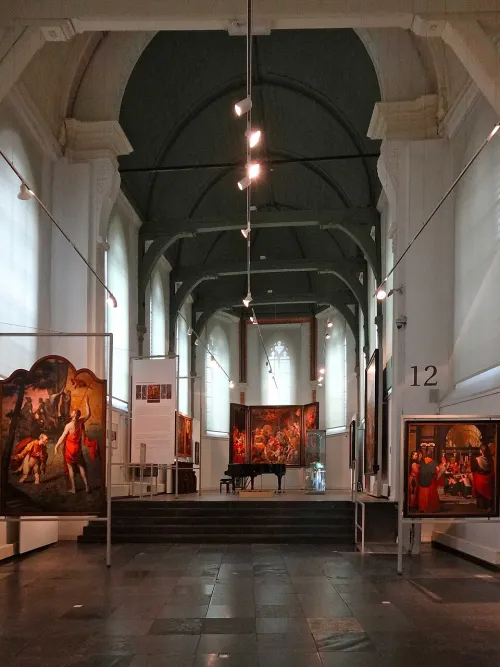
    Art lovers find 16th century altarpieces, 19th century paintings from the Artzenius collection of the Hague School and the Barbizon School, and works by Isaac Israëls, Willem Tholen, Pieter Pourbus, Odilon Redon and Charles-François Daubigny. Then there is plateel, decorated earthenware that looks like porcelain. The Plateelbakkerij Zuid-Holland was founded in Gouda in 1898, and when demand for clay pipes fell in the early 20th century, the pipe makers followed its lead and switched to decorative and household pottery with success. Hand-painted pieces with floral decoration from before 1930 are the most sought after.

    Go in if you have the time: this is the longest visit on the loop, plan about 90 minutes, and the museum café is there if you want a break. Then walk 190 m, about 2 minutes, to the Jeruzalemkapel.

    Hours
    Tue–Sun 11:00–17:00, Mon closed; Museumcafé Tue–Sat 10:00–17:00, Sun 11:00–17:00; closed 25 Dec, 1 Jan
    Price
    16.00 EUR adult (18+); 8.00 EUR CJP/student; free under 18 and pass holders (Museumkaart, Rotterdampas, etc.)
  6. 6

    Jeruzalemkapel

    Jeruzalemkapel in Gouda, stop 6 on the self-guided walking tour

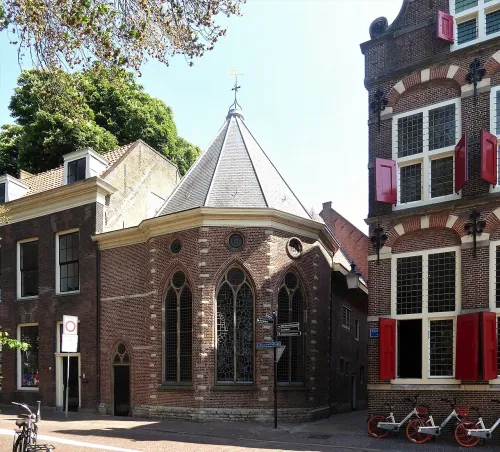
    This small twelve-sided chapel on the Jeruzalemstraat, near the former orphanage and the Jewish cemetery, exists because of one man's journey. Gijsbert Raet, priest and vicar of St. John's Church, made a pilgrimage to Jerusalem sometime between 1478 and 1487. Back in Gouda, he had this chapel built around 1500, modelled on the Church of the Holy Sepulchre. It is the best preserved chapel of this type in the Netherlands, and it was consecrated in 1504.

    Raet furnished it with an altar bearing a painted triptych, a golden chasuble and a monument to the Holy Sepulchre. Already in 1497 he had agreed with the Collatiebroeders that they would maintain the altar and say twelve masses a week. He died on 28 May 1511 and was buried here, as he had wished, after which the chapel passed to the brothers.

    In 1572 the city took it over. From the late 16th century the almoners, who cared for the poor who did not hold citizenship, met here. They later turned the site opposite into an orphanage and kept the chapel as their office until 1812. Around 1860 it was restored in neo-Gothic style, and in the 20th century it served as a glass painter's studio and as exhibition space for Kunstcentrum Burgvliet. Entry is free.

    St. John's Church, where Raet served, is just 110 m on, a one minute walk.

    Hours
    Mon – Sat 09:00–17:00 | Sun closed (Sint-Jan complex)
    Price
    Free (Church)
  7. 7

    St. John's Church

    St. John's Church in Gouda, stop 7 on the self-guided walking tour

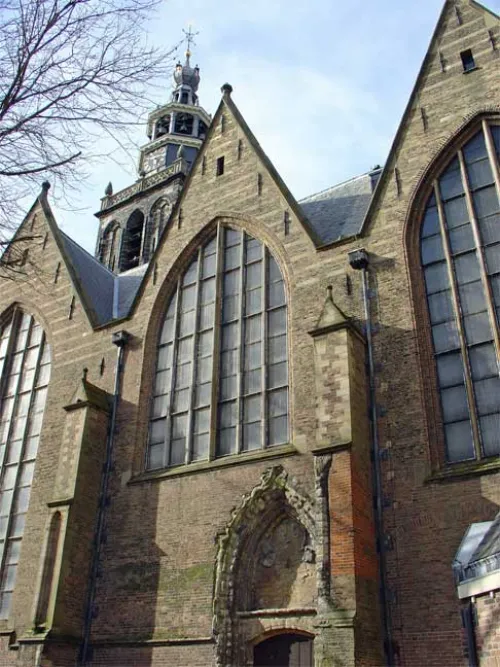
    St. John's Church, the Sint-Janskerk, is a large Gothic church dedicated to John the Baptist, Gouda's patron saint. It was built during the 15th and 16th centuries, and when the foundations for the present choir were laid in 1485, it became the longest church in the Netherlands: 123 metres. Of the tower built around 1350, only the lower part survives. A fire in 1552 destroyed much of the church along with its archives, which is why so much of its early history comes from the diaries of Ignatius Walvis.

    The windows are what you come for; they earned the church its place among the top 100 Dutch monuments. The brothers Dirk and Wouter Crabeth I made and installed most of them between 1555 and 1571, and after a pause for the Reformation, other artists added more until 1603. The earlier, Catholic windows show scenes from the Bible and the Apocrypha: the Queen of Sheba visiting Solomon, Judith and Holofernes, the punishment of Heliodorus, the birth of John the Baptist, the birth and baptism of Jesus. In the choir, two windows show Jesus on the Mount.

    That the glass survived at all is a story in itself. During the Reformation the city fathers sided with King Philip II of Spain rather than William the Silent, and the church was spared. In 1572 Gouda went over to Orange, and three weeks later an angry mob stormed the church and plundered it, yet left the windows intact. In 1573 the council banned Catholic worship, and that summer the church reopened for the Dutch Reformed faith, which still uses it today.

    If you pay for only one interior on this walk, make it this one, and allow about an hour; it is free for under 18s. From the church it is 150 m, 2 minutes, back to the Markt, where the loop closes.

    Local name
    Sint-Janskerk
    Hours
    Mon–Sat 09:00–17:00 (2 Mar – 2 Nov 2026); Mon–Sat 10:00–16:00 (3 Nov 2026 – 1 Mar 2027); Sun church services only (10:00 & 17:00); closed 25-26 Dec, 1 Jan
    Price
    11.00 EUR adult; 6.50 EUR student / CJP; free under 18, Museumkaart, Rotterdampas, Vriendenloterij VIP; 10.00 EUR groups (15+)
Walking tour route map of Gouda Route loaded
MarktAgnietenkapelGoudse WaagStadhuis Gouda+3
All 7 stops are already on the map.
You just press start.
AI Tour Guide

You've read the Gouda loop. Now walk it with a guide in your ear.

Press start wherever you are, even hundreds of kilometres from Gouda, and the guide begins telling its stories right away. In the city, pick any of the 7 stops to start from: it leads you there, then talks with you the whole route, asking, listening, remembering, and shaping the tour around your answers.

7stops 1.2km 16 minwalking 13languages
▶Start the tour free

Free to start · Runs in your browser · No app, no download

Three Ways to Walk Gouda

The loop is short enough to bend to your day. Pick the version that fits your time and how many tickets you want to buy.

Outside only, in about an hour

Stops: 1, 2, 3, 4, 5, 6, 7

For a first look or a short stopover. You walk the full loop, 16 minutes on foot, and read the buildings from outside. No tickets needed; step into the Agnietenkapel and the Jeruzalemkapel if they are open, both are free.

Markt morning

Stops: 1, 2, 3, 4

For anyone who wants the trading story of Gouda, ideally on a Thursday cheese market morning in season. Markt, Agnietenkapel, Goudse Waag and Stadhuis Gouda take only 7 minutes of walking; the Waag is the one ticket. Plan around an hour and a half.

Art and stained glass

Stops: 5, 6, 7, 1

For art lovers with an afternoon. Start at Museum Gouda, then the Jeruzalemkapel and St. John's Church, and finish on the Markt: 5 minutes of walking in total. Tickets for the museum and the church; allow about three hours.

How Long Does This Gouda Tour Take, With and Without Interiors?

The legs between stops are all short, so the walking itself adds up to just 16 minutes. Your time goes into the interiors: roughly 45 minutes for the Goudse Waag, 90 for Museum Gouda and an hour for St. John's Church, plus ten or fifteen minutes at each of the other stops.

A realistic day looks like this: Markt at 10:00, Agnietenkapel at 10:19, Goudse Waag at 10:30, Stadhuis Gouda at 11:17, Museum Gouda at 11:30, Jeruzalemkapel at 13:02, St. John's Church at 13:13 and back on the Markt at 14:15. That is about four and a quarter hours. Skip the interiors and you are done in about an hour.

Before You Set Off in Gouda

  • Start and finish: Start on the Markt and you end there again after 1.2 km. You can join at any stop, but the recommended order runs from the Markt to St. John's Church and back.
  • Best day and time: Pick a day when all the interiors are open, and start in the morning once the Waag has opened; on a Thursday in cheese market season you also catch the cheese market on the Markt.
  • Winter hours: In winter some interiors close earlier, so do not leave the Waag and St. John's Church for late in the day.
  • Holidays: On public holidays not every interior on the route is open, so plan around them.
  • Costs: The Goudse Waag (with an audio tour), Museum Gouda and St. John's Church charge entry, with reductions for children, students and CJP holders.
Walking tour route map of Gouda
AI Tour Guide

Your Gouda guide is ready when you are.

Press start and a voice AI Tour Guide takes it from here: leading the route through Gouda, telling the stories, and turning your walk into a real back-and-forth conversation. No app or download is needed; it runs in your browser.

7stops 1.2km 16 minwalking 13languages
▶Start the tour free

Free to start · Runs in your browser · No app, no download

What the AI Tour Guide Adds in Gouda

On a loop this compact, the AI Tour Guide is about the conversation. It greets you on the Markt, tells the stories of each place, asks what catches your interest, Post's architecture, the Crabeth windows or the people who pawned their goods in a convent chapel, and steers the talk that way. Ask it how stained glass on this scale was made and fitted in the 16th century, or what a sister's day looked like in a convent its own priest called miserable. Route, map and GPS navigation stay free. The guide starts with 100 free credits; after that you choose this tour all-inclusive for €19.99 with no time limit, or €5 per hour.

A Real Conversation A voice AI Tour Guide greets you, leads the whole route, and tells the stories and facts as you walk, asking what you want to see and keeping a real conversation going. Not a recording you press play on.
Map Navigation Follow the route on the map and walk at your own pace. You choose where to start and when to move to the next stop.
Ask Anything Curious about a building you pass? Ask your AI Tour Guide on the spot and the conversation carries on.
13 Languages Switch language anytime. No separate tour needed.
Start free in your browser

Common Questions About Visiting Gouda

Do museum passes work on this route?

Yes. The Museumkaart gets you into Museum Gouda and St. John's Church for free. The Rotterdampas covers the Goudse Waag, Museum Gouda and St. John's Church, and the Vriendenloterij VIP card also works at the church.

Can I visit St. John's Church on a Sunday?

Only for the church services. To see the windows as a visitor, come on another day.

Can I go into the Goudse Waag without a ticket?

Yes, the museum shop on the ground floor is free to enter.

Is there a group rate at St. John's Church?

Yes, groups of 15 or more pay a reduced group rate per person.

Which cities pair well with Gouda on the same trip?

Rotterdam is 19 km away, Delft 24 km and Utrecht 29 km, so any of them makes an easy second walk.

Is the tour really free?

Yes. The whole tour is free: the route, the interactive map and the navigation cost you nothing. Only the voice AI Tour Guide is optional and paid: you test it with 100 free credits, then you pay either €5 per hour or €19.99 for this whole tour, with no time limit. Admission to 3 of the 7 stops is not included: Goudse Waag, Museum Gouda and St. John's Church charge their own entry fees.

Do I need to download an app?

No. Everything runs in your phone browser. Open the route and start walking, no download and no sign-up required.

Do I need to book the walking tour in advance?

No booking needed. This self-guided tour is available anytime. Open the route in your browser and start walking. The AI Tour Guide works instantly, no app, no reservation required.

What languages is the AI Tour Guide available in?

The AI Tour Guide speaks 13 languages, so you take the tour in your own language and can switch at any time.

Can I skip stops or change the route?

Yes. Skip any stop, spend extra time at places you like, or start the route from any point. It is your walk, you set the pace.
Image credits
▶ Start free in your browser Runs in your browser, no app, no download