Free Walking Tour Haarlem: Mill, Museums and St. Bavo

A 4.0 km loop from the Grote Markt to a windmill on the Spaarne, the last city gate and two famous museums, past a family's wartime hiding place.

13 Stops 4.0 km ~54 min walking
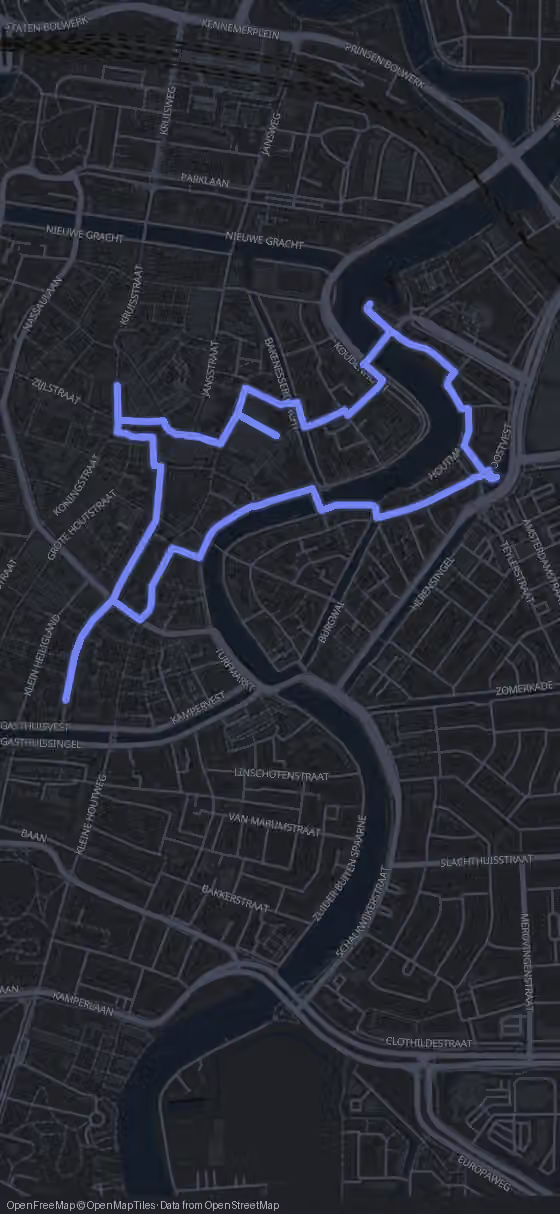
Route map for the Haarlem walking tour
Stop 1 of 13
150 m·2 min
Grote Markt
Head north-west up Barteljorisstraat toward the Corrie ten Boom House
Welcome to Haarlem. I'm Alex, and one narrow watchmaker's house here holds an extraordinary story of courage.
Try this tour with Alex

Haarlem Walking Route at a Glance

The loop has 13 stops and starts and ends on the Grote Markt: 4.0 km and 54 minutes of pure walking, about five hours with a few visits inside. Most stops cost nothing, and the Corrie ten Boom House runs free guided tours if you book.

Entry fees apply at the Grote Kerk (St. Bavo Church), Molen De Adriaan, Teylers Museum and Frans Hals Museum. The GPS route in your browser is free; the AI Tour Guide is optional.

Open free GPS & optional AI Tour Guide
This short shows highlights of the route. All 13 stops follow below.

The Route

Walking Map of Haarlem's Old Centre and the Spaarne

13 stops 4.0 km 54 min walking
Tap to load interactive map

The 13 stops along this route

  1. Grote Markt in Haarlem, stop 1 on the self-guided walking tour
    1Grote Markt
  2. Corrie ten Boom House in Haarlem, stop 2 on the self-guided walking tour
    2Corrie ten Boom House
  3. Hoofdwacht in Haarlem, stop 3 on the self-guided walking tour
    3Hoofdwacht
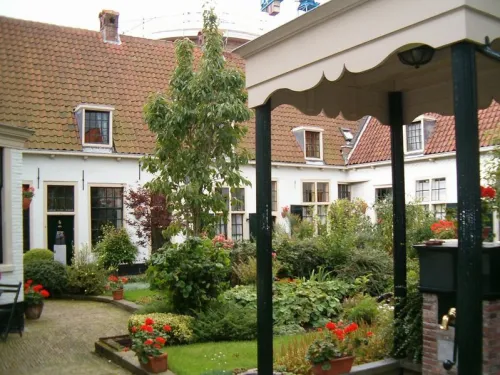
  4. Hofje van Bakenes in Haarlem, stop 4 on the self-guided walking tour
    4Hofje van Bakenes
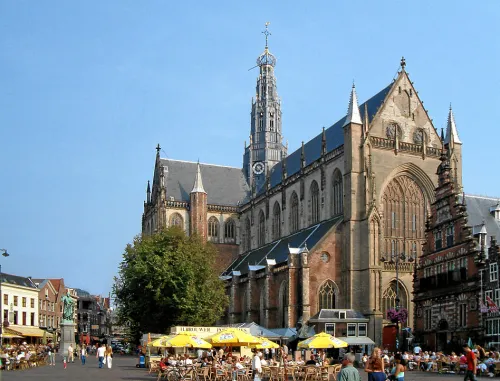
  5. Grote Kerk (St. Bavo Church) in Haarlem, stop 5 on the self-guided walking tour
    5Grote Kerk (St. Bavo Church)
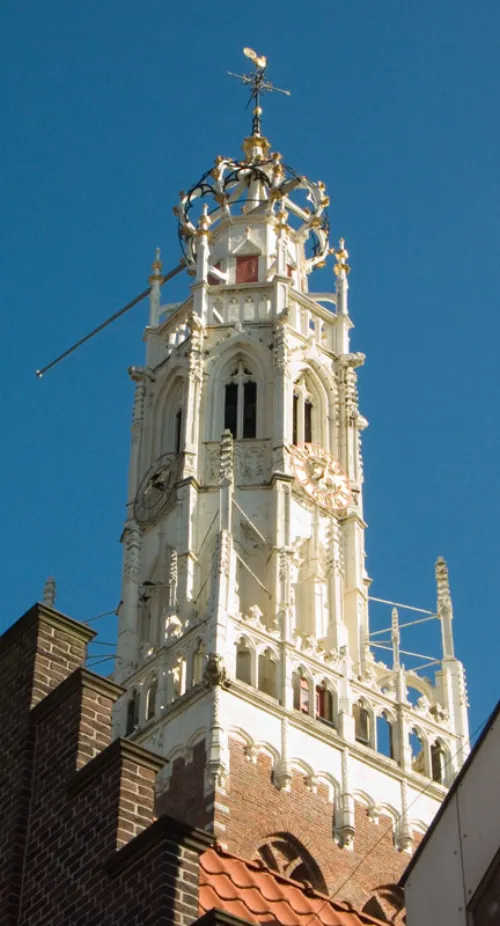
  6. Bakenesserkerk in Haarlem, stop 6 on the self-guided walking tour
    6Bakenesserkerk
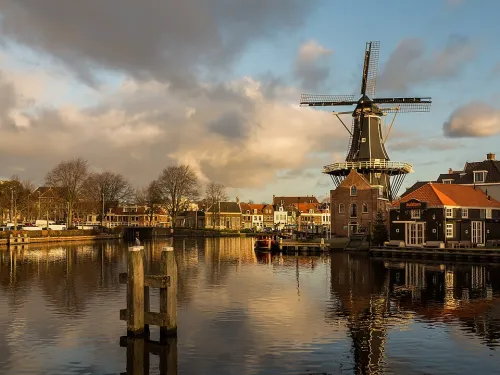
  7. Molen De Adriaan in Haarlem, stop 7 on the self-guided walking tour
    7Molen De Adriaan
  8. Amsterdamse Poort in Haarlem, stop 8 on the self-guided walking tour
    8Amsterdamse Poort
  9. Gravestenenbrug in Haarlem, stop 9 on the self-guided walking tour
    9Gravestenenbrug
  10. Teylers Museum in Haarlem, stop 10 on the self-guided walking tour
    10Teylers Museum
  11. Waag Haarlem, stop 11 on the self-guided walking tour
    11Waag Haarlem
  12. Frans Hals Museum in Haarlem, stop 12 on the self-guided walking tour
    12Frans Hals Museum
  13. Frans Hals Museum Hal in Haarlem, stop 13 on the self-guided walking tour
    13Frans Hals Museum Hal
  14. That's the full loop.

    Walk it with an AI Tour Guide talking you through every one of these streets.

    Start free in your browser
    You made it

Your Haarlem Walking Tour from the Market Square to the Mill and Back

  1. 1

    Grote Markt

    Grote Markt in Haarlem, stop 1 on the self-guided walking tour

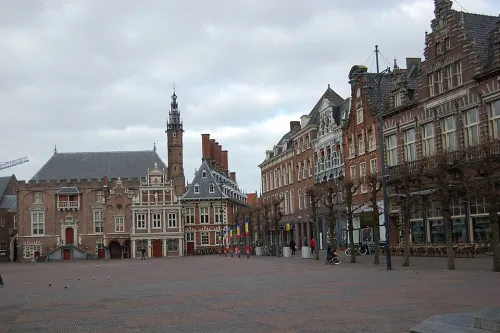
    You start on Haarlem's big market square, the stage the city has gathered around for centuries. Look up first: the Grote Kerk rises more than 80 metres above the square, and opposite it stands the city hall. The old name of the square was 't Sant, the sand, from the days when it was still unpaved.

    In the middle stands Loutje, as locals call the statue of Laurens Janszoon Coster. Coster was a pioneer of printing, and for a long time the Dutch often credited him with inventing it; he is said to have lived at Grote Markt 23. Look out too for the Zonnevechter, a sculpture by Arthur Spronken.

    On the north side, grand café Brinkmann has been here since 1881. By the 1930s it had grown into a whole entertainment complex with a cinema, which made way in the late 1970s for the Brinkmannpassage, now being turned into homes. The square is still the city's living room: a weekly market, a summer fair and, in the third week of August, the Haarlem Jazz & More weekend.

    From here it is just 150 m, about two minutes, to a narrow street where an ordinary watch shop once hid one of Haarlem's bravest stories.
    Hours
    24/7
    Price
    Free
  2. 2

    Corrie ten Boom House

    Corrie ten Boom House in Haarlem, stop 2 on the self-guided walking tour

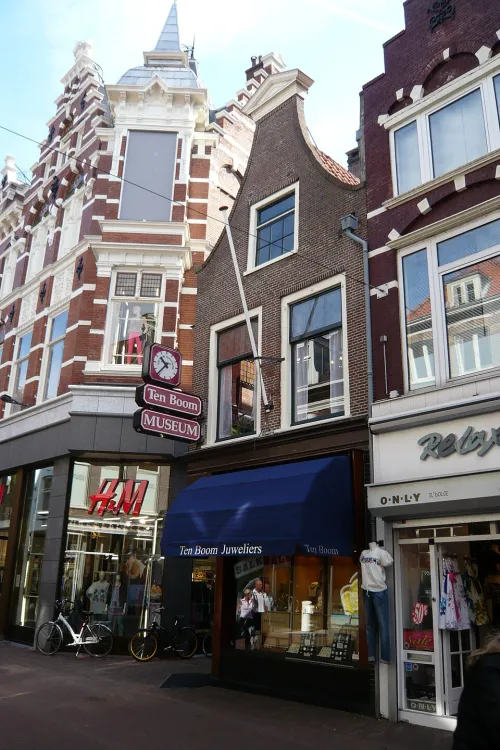
    At Barteljorisstraat 19 the ten Boom family ran a watch shop from 1837 until 1944, living in the house above it. Casper ten Boom was a watchmaker known well beyond Haarlem; his unmarried daughters Betsie and Corrie lived with him. The family called the house Béjé, after the street name.

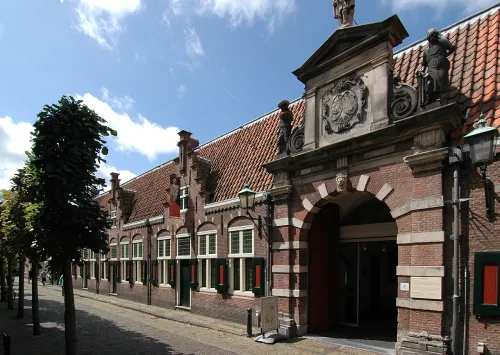
    During the war the house became a refuge for Jews, resistance fighters and others in hiding. Because the building was made from two neighbouring houses, floors sit at different heights and rooms vary in size, so a false wall and a secret room could be built without an empty space being noticed. A small triangular advertising sign in the shop window signalled that it was safe to come in.

    On 28 February 1944 the Gestapo raided the house. Six people were in the hiding place and were never found, but Casper, Betsie and Corrie were arrested. Using the sign, the Nazis then trapped more people. Casper died in Scheveningen prison on 9 March 1944, aged 84; Betsie died in Ravensbrück on 16 December 1944. Corrie survived, later sold the house and travelled the world as a missionary.

    Going inside is worth it for anyone, and especially for families with older children: the guided tour is free, but runs at fixed times and must be booked. Afterwards walk 150 m back towards the square to the building said to be the oldest in town.

    Local name
    Corrie ten Boomhuis
    Hours
    Tue–Sat guided tours at fixed times (Dutch and English, e.g. English tours start at 10:00, 12:00, 14:00; booking required); Sun–Mon closed
    Price
    Free admission (guided tours free; voluntary donations welcome)
  3. 3

    Hoofdwacht

    Hoofdwacht in Haarlem, stop 3 on the self-guided walking tour

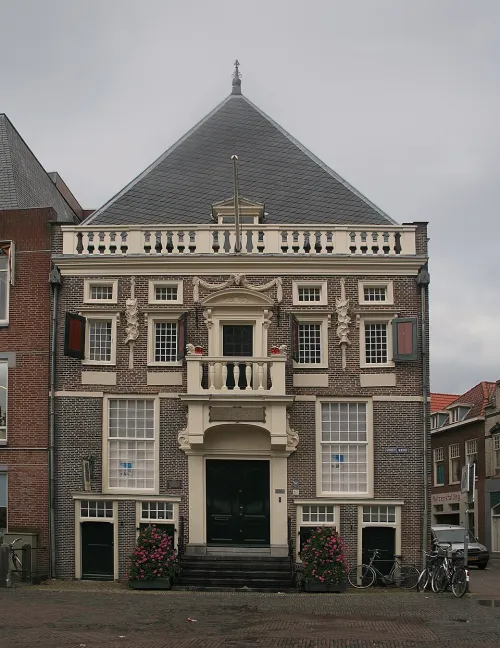
    The Hoofdwacht faces St. Bavo across the Grote Markt and is considered the oldest building in Haarlem, dating from the 13th century. From 1250 until around 1350 it served as the town's first city hall. The baroque facade you see is much younger, from around 1650.

    Read the plaque above the door. Its old Dutch verse says that whenever the Count of Holland held court in the Count's hall across the square, this building served as the council house. Below ground, the humanist Dirck Volckertszoon Coornhert ran a printshop in the 16th century; other parts held a general store and beer.

    In 1755 the city bought it as headquarters for the civic guard, which gave it its name: the militia living here unlocked the city gates each morning and evening. Until the Koepelgevangenis opened in 1899 there were jail cells on the upper floor. Before 1755, prisoners sat in the damp cellar of the city hall opposite, where they could still talk to townsfolk in the alley.

    The interior is free, but it only opens on certain days in the warmer months. Then head 300 m, about four minutes, to a quiet courtyard.

    Hours
    Fri–Sun 13:00–17:00 (during season late April to late September); Mon–Thu closed
    Price
    Free admission
  4. 4

    Hofje van Bakenes

    Hofje van Bakenes in Haarlem, stop 4 on the self-guided walking tour

    Hidden between the Bakenessergracht and the Wijde Appelaarsteeg lies the Hofje van Bakenes, also called the Bakenesserkamer. A hofje is a group of small almshouses around a courtyard, and this is the kind of place you would walk straight past without knowing it was there.

    The name explains the homes themselves: in the Middle Ages kamer, room, simply meant house, and most houses in a hofje really were a single room. Stand in the courtyard and picture a whole life fitting into one of them.

    Entry is free. It takes only a few minutes and is a calm contrast to the square. From here it is 230 m, three minutes, to the great church.

    Hours
    Mon–Sat 10:00–17:00, Sun closed
    Price
    Free admission
  5. 5

    Grote Kerk (St. Bavo Church)

    Grote Kerk (St. Bavo Church) in Haarlem, stop 5 on the self-guided walking tour

    The Grote Kerk, or St. Bavokerk, has dominated Haarlem's skyline for centuries. A church stood on this spot as early as 1307, but that wooden building burned in the 14th century. Haarlem had a parish church here even earlier, from the 9th century, a daughter church of Velsen.

    The Gothic church you see grew in the 15th century until it outranked the Janskerk as the city's main church. Its architects included Godevaert de Bosscher and Steven van Afflighem for the nave and Evert van Antwerpen for the transept. It became a chapter church in 1479 and a cathedral only in 1559, in the middle of the Reformation, which is why the name never really stuck.

    Just 19 years later, in 1578, the church was taken over and became Protestant, as it remains today. The Catholic Cathedral of St. Bavo elsewhere in town now serves the diocese, and it keeps a curious painting of Saint Bavo saving Haarlem, made a century after Catholics lost this church.

    Going inside is the clear choice if you have time for only one interior on the square, and the entry fee is modest. Next, 420 m, five minutes, to a white tower that will look familiar.

    Hours
    Mon–Sat 10:00–17:00, Sun & religious holidays closed for tourist visits
    Price
    4 EUR adult, 2 EUR youth (13-16), free children 0-12 in family context
  6. 6

    Bakenesserkerk

    Bakenesserkerk in Haarlem, stop 6 on the self-guided walking tour

    Look at the white tower of the Bakenesserkerk and then think back to St. Bavo: the two are almost identical. This richly decorated tower was added around 1530. The church began as a burial chapel dedicated to Mary, probably from the 13th century, while the church itself likely dates from the 15th.

    Before the Reformation it was the Onze Lieve Vrouwekapel op Bakenesse; in 1577 it passed to the Reformed church. In the 17th century a second nave was added on the north side and the main entrance moved to the Vrouwestraat. The east side borders 't Krom, named after the swordsmiths who once lived there.

    From 1779 it served as a children's church, where the Reformed deacons taught religion, often to orphans. Children who skipped the services had their pocket money cut, and these services continued into the 1950s. The painter Johannes Bosboom painted its interior several times in the 19th century.

    The interior is closed to regular visits, so enjoy it from outside, which costs nothing and takes a few minutes. Then walk 350 m, five minutes, towards the river and the mill.

    Hours
    24/7 (exterior viewing; interior closed to regular tourist visits)
    Price
    Free
  7. 7

    Molen De Adriaan

    Molen De Adriaan in Haarlem, stop 7 on the self-guided walking tour

    Molen De Adriaan rises above the Spaarne on the foundations of the Goevrouwetoren, once the northern support of the Catrijnenpoort, a gate over the river. When the gate became redundant, Amsterdam industrialist Adriaan de Booys bought the tower in 1778, reinforced the foundations with wooden poles and built his mill 34 metres above the river. It opened on 19 May 1779.

    De Booys hoped to get rich with a 25 year monopoly on cement, alongside paint and tanbark. It never paid: a competitor dodged the rule by importing cement from Dordrecht. In 1802 he sold the mill for 1650 guilders to Cornelis Kraan, who turned it into a snuff tobacco mill. A steam engine installed in 1865 was no success either.

    In 1925 the windmill society De Hollandsche Molen bought it to save it from demolition. A storm damaged it in 1930, and on the evening of 23 April 1932 it burned down completely; the cause was never found. What you see today is the 2002 rebuild.

    Going inside is worth it for families and anyone curious how mills work; entry is charged. Then follow the water 500 m, seven minutes, to the old city gate.

    Hours
    1 Mar – 1 Nov: Mon–Sun 10:30–17:00 (first 3 weeks of March closed Tue–Thu); 1 Nov – 1 Mar: Mon–Fri 13:00–16:30, Sat–Sun 10:30–16:30
    Price
    7.50 EUR adult and children from 12 years, 3.50 EUR children 5-11
  8. 8

    Amsterdamse Poort

    Amsterdamse Poort in Haarlem, stop 8 on the self-guided walking tour

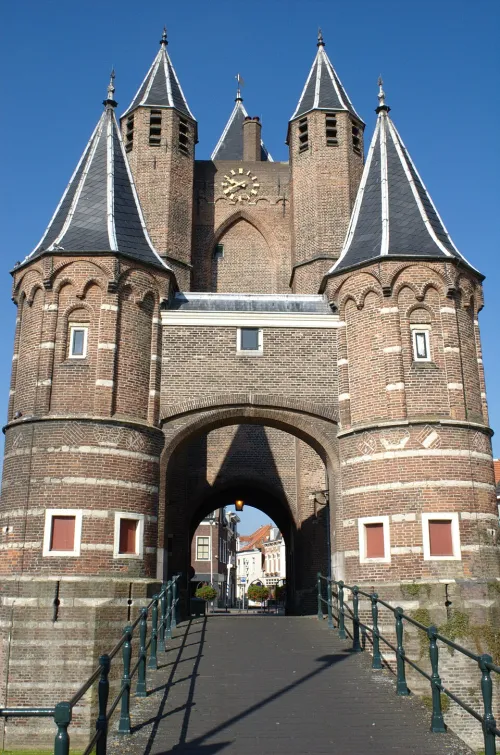
    The Amsterdamse Poort, built in 1355, is the only gate left of Haarlem's original twelve. For centuries it was simply the land gate towards Spaarnwoude, called the Spaarnwouderpoort, on the old road now known as the Oude weg.

    Its name changed with a canal. In 1631 the Haarlemmertrekvaart was dug, shortening the trip to Amsterdam so much that you could go there and back in a day, and travellers began to know this as the Amsterdam gate. Today Amsterdam is still an easy day trip away.

    The gate nearly vanished: in 1865 the city wanted it gone because it was in poor shape and blocking a new bridge. There was no money for the bridge, so the gate got a quick repair instead. After the Papentoren was demolished in 1867, the gate even stored munitions until most were moved out in 1874. It became a national monument in the 1960s and was fully restored in 1985.

    It is free and always accessible, so walk through and look at both sides. Then head 430 m, six minutes, back towards the centre and a white and red drawbridge.

    Hours
    24/7
    Price
    Free
  9. 9

    Gravestenenbrug

    Gravestenenbrug in Haarlem, stop 9 on the self-guided walking tour

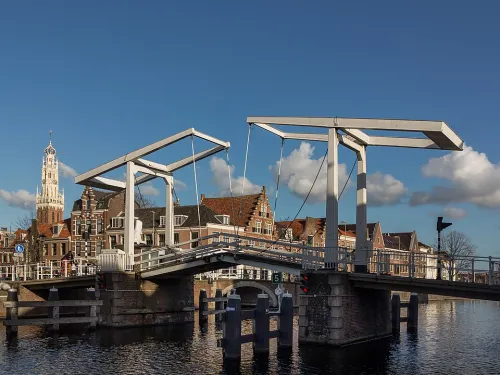
    The Gravestenenbrug is a pedestrian drawbridge over the Spaarne, linking the Korte Spaarne bank with the Bakenessergracht. The current bridge dates from 1950, designed by J.J. Fuijkschot, head of the city's public works, but a bridge has stood here for some 600 and perhaps 800 years.

    It takes its name from the Gravensteen, a castle the Counts of Holland built before Haarlem received city rights in 1245, used to collect toll from ships and defend the settlement. Restoration started at the end of 2023, bringing back the original white and red colours.

    Look at the little bridge keeper's house from 1954. Artist Ramon Spiering once filled it with what he called the smallest museum in the Netherlands, a wink at its neighbour Teylers, the oldest museum in the country, and placed the statue now known as De Voet van Mercurius on top. The museum is gone; the hut became a shower for boaters.

    Teylers Museum is just 70 m away, one minute on foot.

    Hours
    24/7
    Price
    Free
  10. 10

    Teylers Museum

    Teylers Museum in Haarlem, stop 10 on the self-guided walking tour

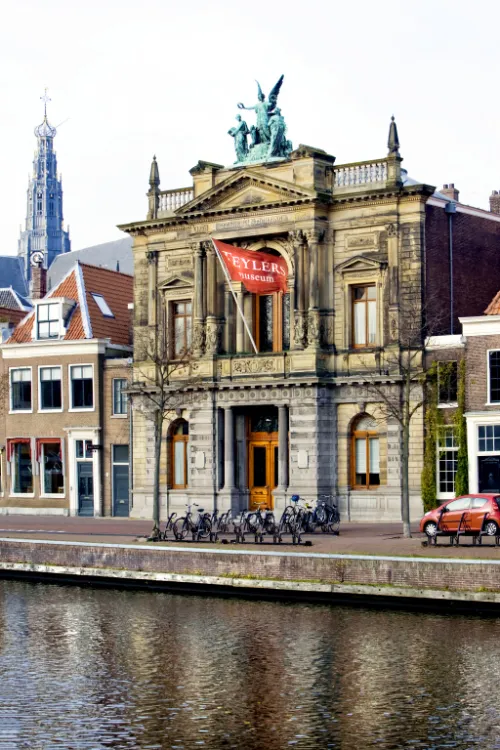
    Teylers Museum, founded in 1778, is a museum of art, natural history and science that grew out of one man's will. Pieter Teyler van der Hulst was a wealthy cloth merchant and banker of Scottish descent, a Mennonite drawn to the Enlightenment, who left his fortune to advance religion, art and science.

    His executors created a centre for study under one roof, full of books, scientific instruments, drawings, fossils and minerals, guided by a bold idea: that people could explore the world for themselves, free from church or state. Their model was the ancient Mouseion, a temple for the muses that doubled as a meeting place for scholars.

    The heart of it is the neoclassical Oval Room of 1784, built behind Teyler's house, the Fundatiehuis, to a design by Leendert Viervant. Experiments, public demonstrations and viewings of prints and drawings took place here.

    Go in if you enjoy history of science or want to see a museum that still feels like the 18th century. Entry is charged, with reduced prices for young visitors, and it is free with a Museumkaart. The Waag is just 40 m along the water.

    Hours
    Tue–Sun 10:00–17:00, Mon closed
    Price
    18.50 EUR adult, 9.25 EUR youth 18-24 / CJP, 2.50 EUR youth 6-17, free children 0-5 and Museumkaart
  11. 11

    Waag Haarlem

    Waag Haarlem, stop 11 on the self-guided walking tour

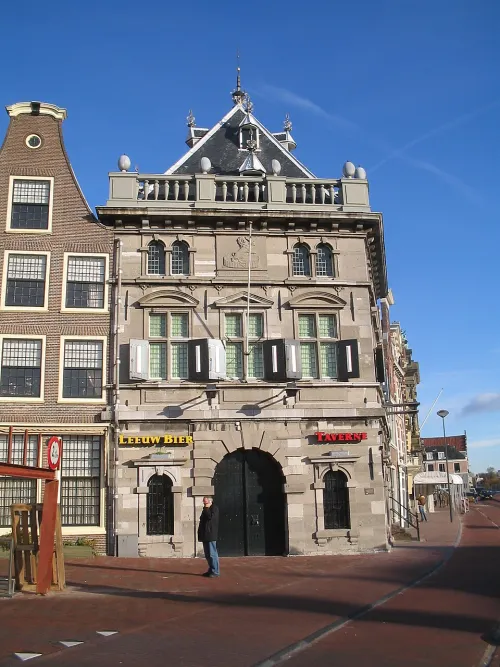
    On the corner of the Spaarne and the Damstraat stands the Waag, the weigh house, built in Renaissance style by city architect Lieven de Key and finished in 1598. It is the oldest building in Holland made solely to be a weigh house, and its spot by the river made it easy to load and unload goods.

    Notice that both street facades are identical, built of costly bluestone from Namur and richly decorated. With three storeys and a steep hipped roof, it was meant to stand out as a landmark more than to look like a workplace. Across from it, right at the quay, a crane once lifted goods from the boats, and beam scales hung in both gateways. A drawing by Romeyn de Hooghe and a painting by Gerrit Berckheyde show the scene.

    Today the Waag is a place to eat. From here it is the longest leg of the loop, 700 m and ten minutes, to the Frans Hals Museum.

    Hours
    Wed–Sun 15:00–22:00, Mon–Tue closed
    Price
    Dishes approx. 19.50 EUR (daily specials)
  12. 12

    Frans Hals Museum

    Frans Hals Museum in Haarlem, stop 12 on the self-guided walking tour

    The Frans Hals Museum, founded in 1862, holds Haarlem's own art collection, built up since the 16th century, including more than a dozen paintings by Frans Hals. It is housed in the Oudemannenhuis, an almshouse for old men founded in 1609.

    Thirty small houses around a courtyard each held two men, who had to be at least 60, honest Haarlem citizens and single. They brought their own bed, a chair with a cushion, a tin chamber pot, three blankets, six good shirts and six nightcaps, and were locked in at eight in summer and seven in winter. In the entrance hall, look for the statue of a man with a poor box: residents had to collect alms every week.

    The five regents who ran the home were painted by Hals in 1664, and their portraits hang here. Only the main hall survives largely intact; the city orphanage used the complex from 1810 until 1908 and changed it beyond recognition.

    For anyone who cares about Dutch painting this is the visit of the day. Entry is charged but free with a Museumkaart, and there is a museum café. Then walk 610 m, eight minutes, back to the Grote Markt.

    Hours
    Tue–Sun 11:00–17:00, Mon closed
    Price
    18.50 EUR adult, 9.00 EUR youth 19-24 / CJP, free 0-18 and Museumkaart
  13. 13

    Frans Hals Museum Hal

    Frans Hals Museum Hal in Haarlem, stop 13 on the self-guided walking tour

    Back on the Grote Markt, the Frans Hals Museum Hal is permanently closed, so this is a stop to admire from outside. It was made up of three buildings: the Vleeshal on the east side, the Verweyhal on the west and a small entrance building between them.

    The Vleeshal is the one to study. Lieven de Key built it between 1602 and 1605 as a meat hall where butchers sold their goods, and the heads of bulls and rams on the facades still say so. It is Dutch Renaissance decoration on a Gothic structure: pilasters, rustication, scrollwork over the cellar entrances and obelisks, inspired by prints of Hans Vredeman de Vries.

    It stayed a meat hall into the 19th century, then served as a garrison storehouse, a records office and a library depot, and from 1950 as an exhibition hall. On the square you also pass the Verwey Museum Haarlem and the Archeologisch Museum Haarlem, and from here you are back where the loop began.

    Status
    Permanently closed
Walking tour route map of Haarlem Route loaded
Grote MarktCorrie ten Boom HouseHoofdwachtHofje van Bakenes+9
All 13 stops are already on the map.
You just press start.
AI Tour Guide

Read the Route? Now Walk It with a Guide in Your Ear

Press start wherever you are, even hundreds of kilometres from Haarlem, and the guide begins telling its stories right away. In the city, pick any of the 13 stops to start from: it leads you there, then talks with you the whole route, asking, listening, remembering, and shaping the tour around your answers.

13stops 4.0km 54 minwalking 13languages
▶Start the tour free

Free to start · Runs in your browser · No app, no download

Shorter Haarlem Loops for Half a Day

If you have only a morning or want to spend most of your time in one museum, these sections of the loop work well on their own.

Market square and medieval core

Stops: 1, 2, 3, 4, 5

For first timers with an hour or two. Around 11 minutes of walking from the Grote Markt to the Corrie ten Boom House, the Hoofdwacht and the Hofje van Bakenes, ending at the Grote Kerk back on the square. Only the church charges entry; the Corrie ten Boom tour is free but needs booking.

Along the Spaarne: church tower, mill and city gate

Stops: 6, 7, 8, 9, 10, 11

For those who like water, old defences and engineering. About 20 minutes of walking from the Bakenesserkerk to the windmill, the Amsterdamse Poort, the Gravestenenbrug and on to Teylers Museum and the Waag. Entry costs only at Molen De Adriaan and Teylers Museum.

Museum afternoon

Stops: 10, 11, 12, 13, 1

For art and science lovers. About 20 minutes of walking from Teylers Museum past the Waag to the Frans Hals Museum and back to the Grote Markt. Both museums charge entry and are free with a Museumkaart; together they easily fill an afternoon.

How Long This Haarlem Tour Takes with Museum Visits

The full loop is 4.0 km with 54 minutes of pure walking, and no single leg takes longer than 10 minutes. The longest stretches run from Molen De Adriaan to the Amsterdamse Poort and from the Waag to the Frans Hals Museum.

Realistically, plan about five hours: roughly 45 minutes inside St. Bavo, 45 minutes at the windmill, a booked tour at the Corrie ten Boom House and around 90 minutes in one of the two big museums. If you want both Teylers Museum and the Frans Hals Museum, it becomes a full day. The shorter variants need 11 or about 20 minutes of walking, plus whatever time you spend inside.

Before You Set Off from the Grote Markt

  • Start and finish: The recommended start is the Grote Markt, and the loop brings you back there. You can join at any stop; the order shown is simply the one that flows best.
  • Best day: Not every stop opens every day: the Corrie ten Boom House, Teylers Museum, the Frans Hals Museum and St. Bavo each have days when they are closed to visitors, so check before you pick your day. The Hoofdwacht interior only opens on some days in the warmer months.
  • Booking: Reserve your slot at the Corrie ten Boom House ahead of time; tours run in Dutch and English at fixed times, and you can plan the rest of the morning around it.
  • Costs: Walking the route is free. St. Bavo, Molen De Adriaan, Teylers Museum and the Frans Hals Museum charge entry. With a Museumkaart both museums are free.
Walking tour route map of Haarlem
AI Tour Guide

Your Guide Is Ready for Haarlem Whenever You Are

Press start and a voice AI Tour Guide takes it from here: leading the route through Haarlem, telling the stories, and turning your walk into a real back-and-forth conversation. No app or download is needed; it runs in your browser.

13stops 4.0km 54 minwalking 13languages
▶Start the tour free

Free to start · Runs in your browser · No app, no download

What the AI Tour Guide Adds Along the Spaarne

On this loop the AI Tour Guide talks with you as you go: it greets you on the Grote Markt, tells the stories of the gates, mills and almshouses, asks what caught your eye and follows that thread. Curious how Haarlem's painters lived, or what life on the Spaarne looked like when the city still had twelve gates? Ask, and interrupt whenever you like. Start with 100 free credits; after that, unlock this tour for €19.99 with no time limit or pay €5 per hour.

A Real Conversation A voice AI Tour Guide greets you, leads the whole route, and tells the stories and facts as you walk, asking what you want to see and keeping a real conversation going. Not a recording you press play on.
Map Navigation Follow the route on the map and walk at your own pace. You choose where to start and when to move to the next stop.
Ask Anything Curious about a building you pass? Ask your AI Tour Guide on the spot and the conversation carries on.
13 Languages Switch language anytime. No separate tour needed.
Start free in your browser

Common Questions About Walking Haarlem

Can I just walk into the Corrie ten Boom House?

No. Visits are by guided tour at fixed times, Tuesday to Saturday, and you need to book. The tour is free; donations are welcome.

Is Molen De Adriaan open in winter?

Yes, but with shorter hours than in summer, so check the times before you go.

Teylers Museum or Frans Hals Museum, if I only have time for one?

Choose Teylers if you like fossils, instruments and the feel of an 18th century study room; choose the Frans Hals Museum for Golden Age portraits. Under 19s get into the Frans Hals Museum free, which makes it the easier pick for families.

Can I eat at the Waag?

Yes, the Waag now serves food, with daily specials.

Can I combine Haarlem with another city in one day?

Amsterdam is only 17 km away, and its own Amsterdam walking tour pairs well with a morning here. Leiden is another easy combination.

Is the tour really free?

Yes. The whole tour is free: the route, the interactive map and the navigation cost you nothing. Only the voice AI Tour Guide is optional and paid: you test it with 100 free credits, then you pay either €5 per hour or €19.99 for this whole tour, with no time limit. Admission to 4 of the 13 stops is not included: Grote Kerk (St. Bavo Church), Molen De Adriaan, Teylers Museum and Frans Hals Museum charge their own entry fees.

Do I need to download an app?

No. Everything runs in your phone browser. Open the route and start walking, no download and no sign-up required.

Do I need to book the walking tour in advance?

No booking needed. This self-guided tour is available anytime. Open the route in your browser and start walking. The AI Tour Guide works instantly, no app, no reservation required.

What languages is the AI Tour Guide available in?

The AI Tour Guide speaks 13 languages, so you take the tour in your own language and can switch at any time.

Can I skip stops or change the route?

Yes. Skip any stop, spend extra time at places you like, or start the route from any point. It is your walk, you set the pace.
Image credits
▶ Start free in your browser Runs in your browser, no app, no download