Free Walking Tour The Hague: Peace, Power and Painters

Start at the court built to end war, pass the King's workplace and the parliament complex, then pick your museums: Vermeer, Escher or Mesdag's Barbizon painters.

10 Stops 5.2 km ~1 h 10 min walking
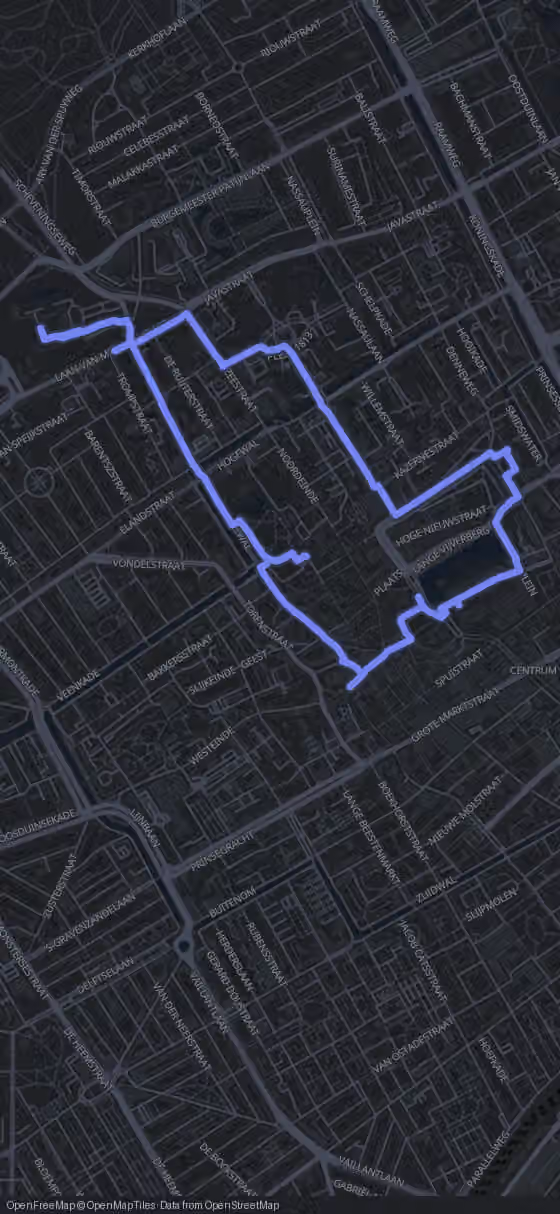
Route map for the The Hague walking tour
Stop 1 of 10
1,280 m·16 min
Peace Palace
Head south-east from the Peace Palace gates toward Noordeinde Palace.
Welcome to The Hague. I'm Alex, and beside the city's halls of power hides a small room that changed museum history.
Try this tour with Alex

The Loop at a Glance

Ten stops on a 5.2 km loop that begins and ends at the Peace Palace, with 1 h 10 min of pure walking. Allow about two and a half hours if you only look from outside, or around five hours with two museum visits.

Free: the Visitors Centre, Noordeinde Palace gardens, the Binnenhof viewing tower and the Kloosterkerk. Entry fees apply at the Grote of Sint-Jacobskerk, Galerij Prins Willem V, Mauritshuis, Escher in Het Paleis and De Mesdag Collectie; the Haags Historisch Museum is currently closed. The GPS route is free, the AI Tour Guide optional.

Open free GPS & optional AI Tour Guide
View of The Hague

The Route

Walking Map of The Hague: One Loop, Ten Stops

10 stops 5.2 km 1 h 10 min walking
Tap to load interactive map

The 10 stops along this route

  1. Peace Palace in The Hague, stop 1 on the self-guided walking tour
    1Peace Palace
  2. Noordeinde Palace in The Hague, stop 2 on the self-guided walking tour
    2Noordeinde Palace
  3. Grote of Sint-Jacobskerk in The Hague, stop 3 on the self-guided walking tour
    3Grote of Sint-Jacobskerk
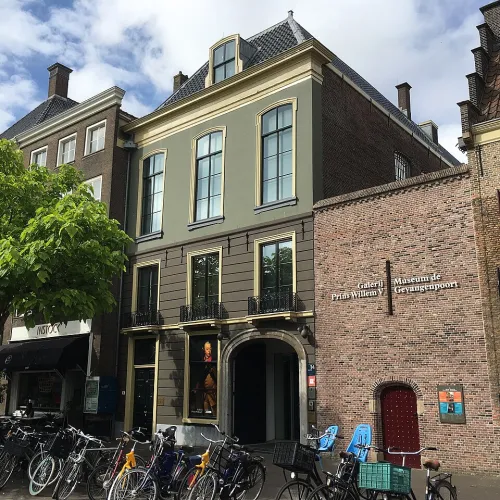
  4. Galerij Prins Willem V in The Hague, stop 4 on the self-guided walking tour
    4Galerij Prins Willem V
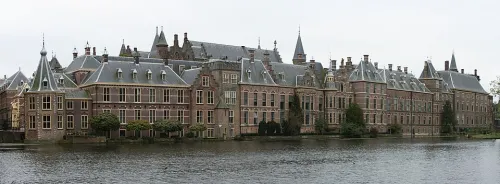
  5. Binnenhof in The Hague, stop 5 on the self-guided walking tour
    5Binnenhof
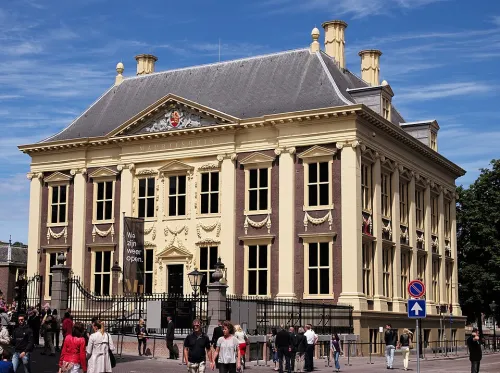
  6. Mauritshuis in The Hague, stop 6 on the self-guided walking tour
    6Mauritshuis
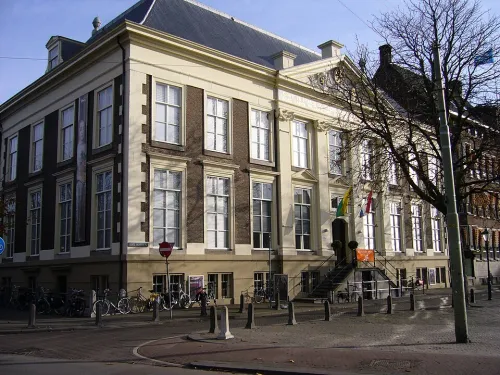
  7. Haags Historisch Museum in The Hague, stop 7 on the self-guided walking tour
    7Haags Historisch Museum
  8. Escher in Het Paleis in The Hague, stop 8 on the self-guided walking tour
    8Escher in Het Paleis
  9. Kloosterkerk in The Hague, stop 9 on the self-guided walking tour
    9Kloosterkerk
  10. De Mesdag Collectie in The Hague, stop 10 on the self-guided walking tour
    10De Mesdag Collectie
  11. That's the full loop.

    Walk it with an AI Tour Guide talking you through every one of these streets.

    Start free in your browser
    You made it

The Hague Walking Tour Stop by Stop: Courts, Palaces and Painters

  1. 1

    Peace Palace

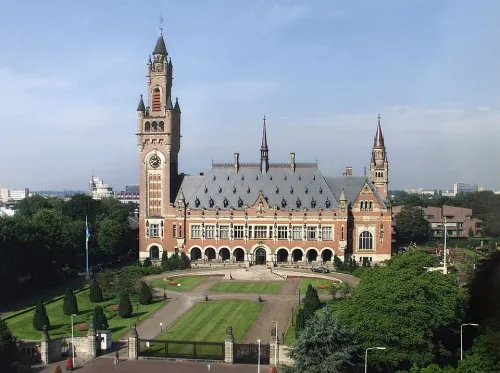
    Peace Palace in The Hague, stop 1 on the self-guided walking tour

    You start at the Peace Palace, the Vredespaleis, an international courthouse that still does daily work. It houses the International Court of Justice, the principal judicial body of the United Nations, and the Permanent Court of Arbitration. The palace opened on 28 August 1913 and continues to host dozens of hearings every year, so the building in front of you is a working court, not a monument to a past idea.

    The idea itself began with an arms race. In the late 1800s states were pouring money into their militaries, and the risk of a large war was growing. Russia's Czar Nicholas II proposed a conference to find peaceful ways of settling disputes. In 1899 delegates from 26 states, from Europe and the Ottoman Empire to the United States, Mexico, China, Japan, Siam and Persia, met at Huis Ten Bosch in The Hague for what became the First Hague Peace Conference.

    Its main result was a convention that called arbitration “the most effective, and at the same time the most equitable means” of settling disputes where diplomacy had failed. It created the Permanent Court of Arbitration, meant to be “accessible to all” and “accessible at all times”, the first permanent intergovernmental body for resolving international disputes peacefully. The founding states then decided the court needed a dedicated home that would encourage nations to come and use it: this palace.

    The Visitors Centre is free and the easiest way to understand what happens here. The palace and its gardens can only be entered on a paid guided tour on selected days, which is worth planning around if international law or grand interiors are your thing. From here it is 1250 m, about 17 minutes, to Noordeinde Palace, from the court of nations to the workplace of the Dutch King.
    Local name
    Vredespaleis
    Hours
    Visitors Centre: Wed–Sun 12:00–17:00, Mon–Tue closed; Palace and gardens accessible only via guided tour (select weekends/days May–Oct)
    Price
    Free (Visitors Centre); guided palace tour 17.50 EUR, outside/garden tour 13.50 EUR, children under 8 free
  2. 2

    Noordeinde Palace

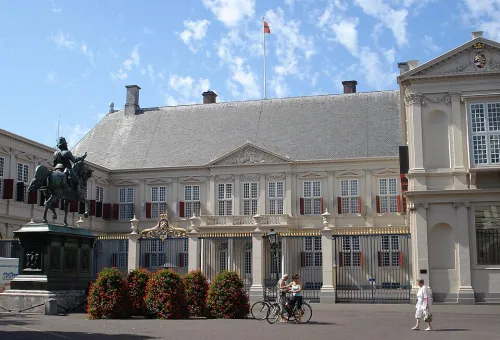
    Noordeinde Palace in The Hague, stop 2 on the self-guided walking tour

    Noordeinde Palace is one of the three official palaces of the Dutch royal family and, since 2013, the workplace of King Willem-Alexander and Queen Máxima. The building and its grounds belong to the Dutch State. Besides the palace itself, the grounds hold the Royal Stables, the Palace Gardens, the Royal Archives and the Dome of Fagel.

    Its beginnings are humble. In 1533 a farmhouse stood here at the edge of The Hague, on a street called Int Nortende, “in the North End”, today's Noordeinde. Willem van de Goudt, steward of the States of Holland and West Friesland, turned it into a spacious residence, and the cellars of that farmhouse still survive in the palace basement. The town has long since grown around it, which is why a former edge-of-town farm now sits in the city centre.

    In 1595 the States of Holland bought the house for Louise de Coligny, widow of William the Silent, and her son Frederick Henry. In 1609 they gave it to the family in recognition of William's service. Frederick Henry bought the surrounding plots and enlarged the house, then called the Oude Hof. The architects Pieter Post and Jacob van Campen were among those behind the alterations of 1640, which lengthened the main building and added wings on both sides. Look for that H shape: it is the outline you still see today. After Frederick Henry died in 1647, his widow Amalia of Solms-Braunfels spent much of her time here.

    The Palace Gardens are open to the public; the buildings only open on a few announced days in summer, and those visits are free. Remember the names Post and Van Campen, they return at the Mauritshuis. Next comes a walk of 660 m, about 9 minutes, to the Grote of Sint-Jacobskerk, the church where this royal family is baptised and married.

    Local name
    Paleis Noordeinde
    Hours
    Public interior visits are limited to announced summer openings; in 2026, 22 Jul–9 Aug, Wed–Sun 09:30–17:00.
    Price
    Free
  3. 3

    Grote of Sint-Jacobskerk

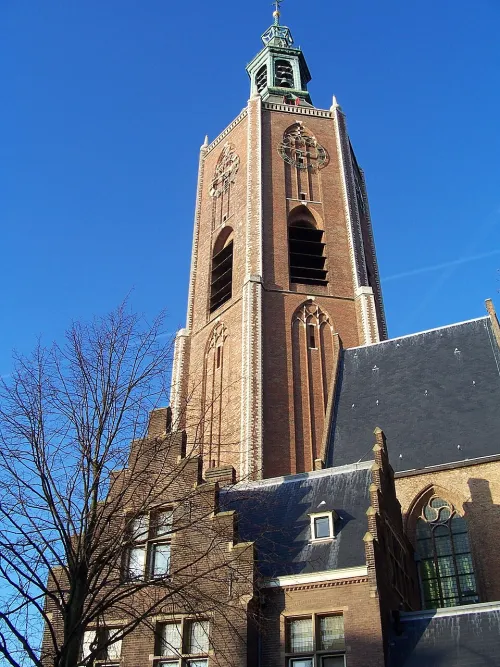
    Grote of Sint-Jacobskerk in The Hague, stop 3 on the self-guided walking tour

    The Grote of Sint-Jacobskerk, the Great Church or St James's Church, stands on the Torenstraat, a street named after its high tower. Together with the Binnenhof it ranks among the oldest buildings in The Hague. Members of the House of Orange-Nassau have been baptised and married here, most recently King Willem-Alexander and his daughter Catharina-Amalia, Princess of Orange.

    The church was founded in the late 13th century, probably in wood. By 1337 sources speak of the “grote kercke”, a name that usually points to brick. Excavations in 2009 confirmed it: some basement walls use bricks from the first half of the 14th century, and records of maintenance work from 1399 show the church was brick by then.

    Check the facade beside the tower. You can still make out the roof line of 1424, which shows a cross-shaped church with a nave and two lower aisles. Between 1434 and 1455 those aisles were widened and raised to the height of the nave, and the cross shape disappeared. The result was the first “Hague hall church” in the Low Countries, a type that later spread across the County of Holland.

    Inside, the church charges a modest admission, free for children under 12, and it is worth it if you like medieval interiors. You find a fine vaulted space, old stained glass, a carved wooden pulpit from 1550, a large organ, tomb monuments and 34 coats of arms of the knights of the Order of the Golden Fleece, hung after their chapter met here in 1456. The church opens on limited days, so plan ahead if you want to go in.

    From here it is 400 m, about 5 minutes, to Galerij Prins Willem V, where a prince who wanted to rival Europe's kings put his paintings on show.

    Hours
    Fri–Sun 12:00–16:00 (Apr–Sep); Sat–Sun 12:00–16:00 (Oct–Mar); closed during private rental events
    Price
    3.00 EUR adults, free for children under 12
  4. 4

    Galerij Prins Willem V

    Galerij Prins Willem V in The Hague, stop 4 on the self-guided walking tour

    Galerij Prins Willem V sits on the Buitenhof and shares its entrance with the Gevangenpoort museum. It recreates the gallery that William V, Prince of Orange, opened on this spot in 1774. The paintings belong to the Mauritshuis collection and include works by Peter Paul Rubens, Jan Steen, Paulus Potter and Gerard van Honthorst.

    William V inherited the family collection at the age of four, when his father died, and the paintings were then spread over several residences. He developed a real passion for them and made his first purchase at fifteen. Sometimes he bought whole collections, such as that of Govert van Slingelandt in 1768. His court painter Tethart Haag drew up an inventory in 1763, looked after the paintings and advised him on purchases. The prince wanted to be seen as an equal of Europe's great monarchs, and a great art collection was part of that image, so he brought it together in one place to show his guests.

    The gallery had a bumpy life. About twenty years after it opened, the French carried the collection off, and most important works only returned in 1815. William kept collecting in the meantime and opened another gallery at Huis ten Bosch. In 1822 the collection moved to the Mauritshuis, and this room served as an archive until it reopened as a gallery in 1977.

    Admission is charged, but visitors under 19 go free and a Mauritshuis ticket or the combined ticket covers it too, so combine both if you love Dutch painting. Then it is just 200 m, about 3 minutes, to the Binnenhof, the political heart that William's ancestors served.

    Hours
    Tue–Sun 12:00–17:00, Mon closed
    Price
    8.50 EUR adults, free for visitors under 19 (included with Mauritshuis ticket or combi ticket 24.00 EUR)
  5. 5

    Binnenhof

    Binnenhof in The Hague, stop 5 on the self-guided walking tour

    The Binnenhof, historically the Hof van Holland, has been the centre of Holland's and then Dutch politics for centuries. The complex covers almost 90,000 square metres with four thousand rooms. Both chambers of parliament meet here, the Prime Minister has an office in the small tower known as the Torentje, and the advisory division of the Council of State works here too. In Dutch, “Binnenhof” is often simply shorthand for parliament.

    It began as a castle of the Counts of Holland, who lived here from the 13th century. Stadtholders, the States of Holland and West Friesland and the States General followed, and since 1815 the States General of the Kingdom of the Netherlands. It is the oldest parliament complex in Europe still used as such, and the meeting hall of the Senate, built around 1655 for the States of Holland and West Friesland, counts as the oldest parliamentary chamber still in use. The city itself owes its existence to this court, which drew officials and workers who settled nearby.

    What you see is the result of many rebuildings, the last completed in 1992. The neighbouring square, the Buitenhof, was once also called the Nederhof. Since 2021 a major renovation has been under way, and the complex is closed until summer 2031. You can still view it from the Buitenhof and across the Hofvijver pond, and a free viewing tower is open.

    Walk on 250 m, about 3 minutes, to the Mauritshuis; on the way you pass the Ridderzaal.

    Hours
    Temporarily closed for comprehensive multi-year renovation until summer 2031 (perimeter viewing from Buitenhof/Hofvijver; free viewing tower open daily 09:00–17:00)
    Price
    Free
  6. 6

    Mauritshuis

    Mauritshuis in The Hague, stop 6 on the self-guided walking tour

    The Mauritshuis holds the Royal Cabinet of Paintings, 854 objects, most of them Dutch Golden Age paintings. Johannes Vermeer, Rembrandt van Rijn, Jan Steen, Paulus Potter, Frans Hals, Jacob van Ruisdael and Hans Holbein the Younger are all represented. The building is state property and listed among the top 100 Dutch heritage sites.

    It started as a private house. In 1631 John Maurice of Nassau-Siegen, a cousin of Stadtholder Frederick Henry, bought a plot bordering the Binnenhof and the Hofvijver, right in the political centre of the Dutch Republic. Between 1636 and 1641, while he was governor of Dutch Brazil, the house was built in the Dutch Classicist style by Jacob van Campen and Pieter Post, the same pair you met at Noordeinde Palace. Notice the strict symmetry of the two-storey facade. Inside there were originally four apartments, each with an antechamber, chamber, cabinet and cloakroom, plus a great hall.

    After John Maurice died in 1679, the Maes family owned the house and leased it to the government. A fire in 1704 destroyed most of the interior and the cupola, and restoration took until 1718. In 1820 the state bought the building to house the Royal Cabinet of Paintings, and in 1822 it opened to the public together with the Royal Cabinet of Rarities. From 1875 the whole museum was given over to paintings.

    If you go into one museum on this walk and you care about the Golden Age, make it this one. Admission is charged, visitors under 19 go free. Afterwards the Haags Historisch Museum is only 100 m away, about a minute's walk.

    Hours
    Mon 13:00–18:00, Tue–Sun 10:00–18:00
    Price
    21.00 EUR adults, free for youth under 19 (combi with Galerij Prins Willem V 24.00 EUR)
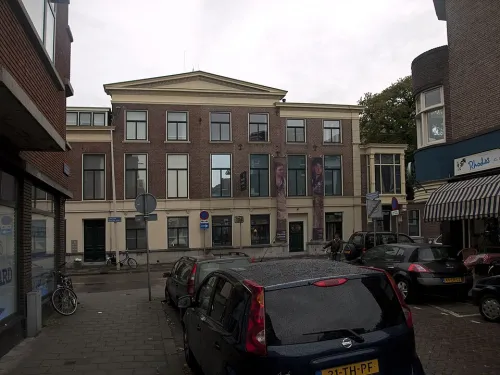
  7. 7

    Haags Historisch Museum

    Haags Historisch Museum in The Hague, stop 7 on the self-guided walking tour

    The Haags Historisch Museum, the city's history museum on the Korte Vijverberg, is currently closed for a major refurbishment, with reopening planned for spring 2027. So this is an outside stop for now. The building is the former guild house of Saint Sebastian, home in the 17th century of the civic militia of that name, whose members appear in paintings in the collection. DP6 architects are redesigning it with a new entrance foyer and larger galleries.

    The collection behind those walls is worth knowing about for a return visit. Around 7,500 objects tell the city's story, among them silver guild vases, a panorama of The Hague almost five metres wide by Jan van Goyen, the dolls' houses of Lita de Ranitz and paintings by Jan van Ravesteyn, Paulus Constantijn la Fargue and Jan Steen. The strangest pieces are the finger of Cornelis de Witt and the tongue of his brother Johan.

    The permanent display “Power, 800 years of the Binnenhof” links straight back to the complex you just saw, with objects from the 16th century to today. Other rooms cover the city after 1945, and a replica 19th-century salon lets children experience life in old The Hague during weekends and school holidays.

    From here it is 300 m, about 4 minutes, to Escher in Het Paleis, a former queen's winter palace.

    Status
    Currently closed
  8. 8

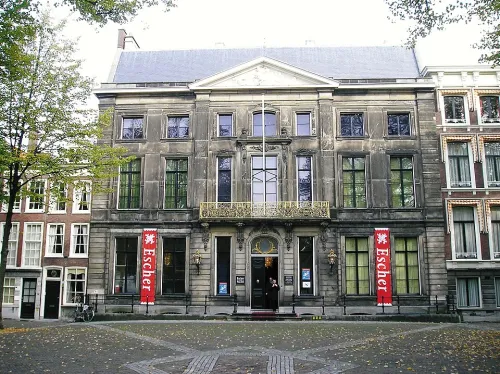
    Escher in Het Paleis

    Escher in Het Paleis in The Hague, stop 8 on the self-guided walking tour

    Escher in Het Paleis shows the work of the graphic artist M. C. Escher inside the Lange Voorhout Palace, an 18th-century royal residence. Queen Emma bought the house in 1896 and used it as her winter palace from 1901 until her death in 1934. Four later queens kept their offices here, until Queen Beatrix moved hers to Noordeinde Palace. The museum moved in in November 2002, and the first and second floors still tell the story of the royal years, especially Queen Emma's.

    The permanent display holds a large number of Escher's woodcuts and lithographs, including Sky and Water, where birds turn into fish, Belvedere, Waterfall, where water seems to flow uphill, and Drawing Hands, two hands drawing each other. You also see his early Italian landscapes, mirror prints and tessellation drawings, and all three versions of Metamorphosis; the third, seven metres long, is shown in a circle so it never ends.

    The third floor is devoted to optical illusion. In the Escher Room adults suddenly look smaller than their children, and interactive displays play tricks on your eyes. Look up too: fifteen chandeliers by the Rotterdam artist Hans van Bentem hang in the rooms, among them a shark, a skull, spiders and a sea horse, while in the ballroom a star chandelier is reflected endlessly between two mirrors. The parquet floor was designed in 1991 and 1992 by the American minimal artist Donald Judd.

    Admission is charged, with reduced rates for students, teenagers and children and free entry for the youngest, which makes this the best family stop on the route. Next you walk 420 m, about 6 minutes, to the Kloosterkerk, which also stands on the Lange Voorhout.

    Hours
    Tue–Sun 11:00–17:00, Mon closed (ticket desk closes 16:30)
    Price
    14.50 EUR adults, 13.50 EUR students, 11.00 EUR youth (13-17), 8.00 EUR children (7-12), free for children 6 and under
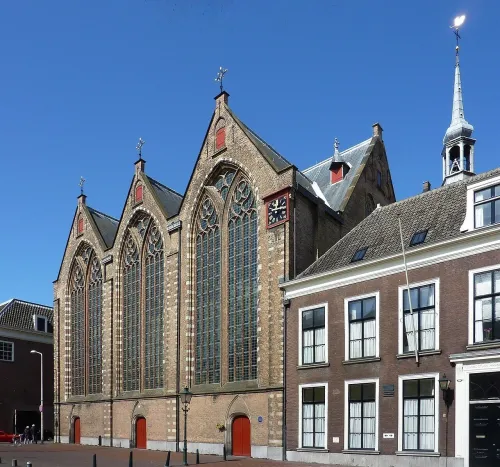
  9. 9

    Kloosterkerk

    Kloosterkerk in The Hague, stop 9 on the self-guided walking tour

    The Kloosterkerk, the Cloister Church on the Lange Voorhout, goes back to 1397, when a church and monastery were built here for the Dominicans. Today it is known as the church where Princess Beatrix occasionally attended services.

    It was founded in a lively moment. The court of Albrecht of Bavaria and his second wife Margaret of Cleves had made The Hague a new centre of the arts; the illuminated Hours of Margaret of Cleves date from these years. From December 1399 Dirc van Delf served the duke as court chaplain while also lecturing at universities in Cologne and Erfurt.

    A fire swept through the monastery in 1420. In the early 16th century a southern transept was added, and around 1540 the church gained a larger aisle and side chapels. The barrel-vaulted central aisle is 20 metres high and 11.5 metres wide. It became a pilgrimage church where people could pass through while services went on in the nave, and it was dedicated to St Vincent, the Valencian Dominican canonised in 1455.

    Then the tide turned. The iconoclasm of 1566 stripped out the Catholic decoration, the last friars left in 1574, and most of the monastery was demolished in 1583. The empty church decayed for twelve years and some wanted it gone, until in 1588 a cavalry company moved in for shelter.

    Entry is free when the church is open, which is on certain days and for services. Then comes the second long leg: 1170 m, about 16 minutes, back west to De Mesdag Collectie.

    Hours
    Wed–Sun 12:00–16:00 (seasonal church opening; outside these hours by appointment or for church services; closed to public on 18-19 & 30 Sep, 1 & 10 Oct 2026)
    Price
    Free
  10. 10

    De Mesdag Collectie

    De Mesdag Collectie in The Hague, stop 10 on the self-guided walking tour

    De Mesdag Collectie on the Laan van Meerdervoort is the former home of the painter Hendrik Willem Mesdag and his wife Sientje van Houten, together with the museum he built right next to it. Mesdag opened it to art lovers in 1887, gave museum and collection to the Dutch State in 1903 and stayed on as director until 1911. Since 1991 it has been part of the Van Gogh Museum, and after a long restoration it reopened under its current name on 14 May 2011.

    Mesdag was a leading sea painter of the Hague School, and Sientje painted too, mainly landscapes and still lifes. They were also passionate collectors, funded by the inherited fortune of two Groningen business families, Mesdag and Van Houten.

    The heart of the collection is French: paintings of the Barbizon school, the largest and most important group of its kind outside France, with masterpieces by Camille Corot, Charles-François Daubigny and Théodore Rousseau, alongside works of the Hague School. The walls are richly decorated with original motifs, and large windows look onto the museum garden and the tower of the Peace Palace, which gives the rooms their 19th-century atmosphere.

    Admission is charged and visitors under 18 go free. It is a quiet, rewarding stop for anyone who likes painting beyond the Golden Age. From here it is 420 m, about 6 minutes, back to the Peace Palace, the tower you just saw from the windows, and the loop is complete.

    Hours
    Wed–Sun 10:00–17:00, Mon–Tue closed (1 Sep – 31 Dec; Fri–Sun 10:00–17:00 in summer 8 Jun – 31 Aug)
    Price
    15.00 EUR adults, free for visitors under 18
Walking tour route map of The Hague Route loaded
Peace PalaceNoordeinde PalaceGrote of Sint-JacobskerkGalerij Prins Willem V+6
All 10 stops are already on the map.
You just press start.
AI Tour Guide

You know the route now. Walk it with a guide in your ear.

Press start wherever you are, even hundreds of kilometres from The Hague, and the guide begins telling its stories right away. In the city, pick any of the 10 stops to start from: it leads you there, then talks with you the whole route, asking, listening, remembering, and shaping the tour around your answers.

10stops 5.2km 1 h 10 minwalking 13languages
▶Start the tour free

Free to start · Runs in your browser · No app, no download

Shorter Ways Through The Hague

Not every day has room for the full loop. These three cuts keep the order of the route and simply start or stop at a different place.

Government quarter in an afternoon

Stops: 3, 4, 5, 6, 7, 8, 9

For a first visit with limited time: from the Grote of Sint-Jacobskerk past the Binnenhof and the Mauritshuis to the Kloosterkerk. Only 22 minutes of walking, so most of your time goes into looking. Entry fees at the Grote of Sint-Jacobskerk, Galerij Prins Willem V, Mauritshuis and Escher in Het Paleis; pick the one or two that interest you.

West side: peace, kings and Mesdag

Stops: 10, 1, 2

For anyone staying near the Peace Palace or keen on the city's international and royal side: De Mesdag Collectie, the Peace Palace and Noordeinde Palace, 23 minutes on foot. The Visitors Centre and the Noordeinde gardens are free; De Mesdag Collectie charges admission.

Art lover's line

Stops: 4, 6, 8, 10

For a museum day: Galerij Prins Willem V, Mauritshuis, Escher in Het Paleis and De Mesdag Collectie. Following the loop from the gallery to Mesdag's house takes 33 minutes of walking and passes the Binnenhof, the Haags Historisch Museum and the Kloosterkerk on the way. All four charge admission.

How Long This The Hague Tour Takes, With and Without Museums

The pure walking time is 1 h 10 min. The long legs sit at the edges: 17 minutes from the Peace Palace to Noordeinde Palace and 16 minutes from the Kloosterkerk out to De Mesdag Collectie. In between, the centre is compact, with seven stops separated by one to nine minutes on foot.

With a short look at every stop you need about two and a half hours. Add the Mauritshuis and Escher in Het Paleis and you are closer to five hours; a full art day with all paid interiors fills the whole day. The government quarter cut fits into a long afternoon with one museum, the west side cut into about two hours with a visit to De Mesdag Collectie, and the art lover's line into a full day.

Before You Set Off from the Peace Palace

  • Start and finish: The recommended start is the Peace Palace, and the loop ends back there after De Mesdag Collectie. You can join at any stop and follow the same order from there.
  • Tickets: You pay at each museum and at the Grote of Sint-Jacobskerk. The Mauritshuis and Galerij Prins Willem V are linked: a Mauritshuis ticket or the combined ticket also gets you into the gallery.
  • Timing: Pick a day when the museums you care about are open, and check the church opening days before you go: both churches open only on certain days, and the Grote of Sint-Jacobskerk also closes for private events.
  • Closed right now: The Binnenhof is under renovation and the Haags Historisch Museum is shut while its building is refurbished. Both still make sense as outside stops.
Walking tour route map of The Hague
AI Tour Guide

Your guide is waiting at the Peace Palace.

Press start and a voice AI Tour Guide takes it from here: leading the route through The Hague, telling the stories, and turning your walk into a real back-and-forth conversation. No app or download is needed; it runs in your browser.

10stops 5.2km 1 h 10 minwalking 13languages
▶Start the tour free

Free to start · Runs in your browser · No app, no download

What the AI Tour Guide Adds Between Palace and Parliament

This route is packed with princes, stadtholders and queens who all show up in more than one building. The AI Tour Guide walks it with you as a conversation: it greets you, tells each place's story, asks what you want more of and remembers it, so the House of Orange keeps coming back if that is your thread. Wonder how the de Witt brothers ended up as relics in a museum, or who the knights of the Golden Fleece were? Just interrupt and ask. You start with 100 free credits; after that it is €19.99 for this tour all-inclusive with no time limit, or €5 per hour.

A Real Conversation A voice AI Tour Guide greets you, leads the whole route, and tells the stories and facts as you walk, asking what you want to see and keeping a real conversation going. Not a recording you press play on.
Map Navigation Follow the route on the map and walk at your own pace. You choose where to start and when to move to the next stop.
Ask Anything Curious about a building you pass? Ask your AI Tour Guide on the spot and the conversation carries on.
13 Languages Switch language anytime. No separate tour needed.
Start free in your browser

Questions Before You Walk The Hague

Do children and teenagers pay at the museums on this route?

Often not. Visitors under 19 go free at the Mauritshuis and Galerij Prins Willem V, under 18 at De Mesdag Collectie, and children under 12 at the Grote of Sint-Jacobskerk. Escher in Het Paleis has reduced rates for students, teenagers and children and is free for children aged six and under.

Is De Mesdag Collectie the place with the big panorama?

No. Mesdag's famous panorama of Scheveningen hangs in a separate museum, Panorama Mesdag on the Zeestraat, about half a kilometre from De Mesdag Collectie. The collection on this route is his home and private museum.

Can I go inside the Peace Palace itself?

Only on a paid guided tour, which runs on selected days. The Visitors Centre is free and open without a tour.

Which city makes a good next walk after The Hague?

Delft is the closest, about 9 km away, and Leiden is 15 km. For a bigger city, Rotterdam is 22 km away.

Is the tour really free?

Yes. The whole tour is free: the route, the interactive map and the navigation cost you nothing. Only the voice AI Tour Guide is optional and paid: you test it with 100 free credits, then you pay either €5 per hour or €19.99 for this whole tour, with no time limit. Admission to 5 of the 10 stops is not included: Grote of Sint-Jacobskerk, Galerij Prins Willem V, Mauritshuis, Escher in Het Paleis and De Mesdag Collectie charge their own entry fees.

Do I need to download an app?

No. Everything runs in your phone browser. Open the route and start walking, no download and no sign-up required.

Do I need to book the walking tour in advance?

No booking needed. This self-guided tour is available anytime. Open the route in your browser and start walking. The AI Tour Guide works instantly, no app, no reservation required.

What languages is the AI Tour Guide available in?

The AI Tour Guide speaks 13 languages, so you take the tour in your own language and can switch at any time.

Can I skip stops or change the route?

Yes. Skip any stop, spend extra time at places you like, or start the route from any point. It is your walk, you set the pace.
Image credits
▶ Start free in your browser Runs in your browser, no app, no download