Free Walking Tour Fez: Madrasas, Tannery, Coppersmiths

From carved madrasa courtyards to the coppersmiths of Place Seffarine and the dye vats of Chouara: a free self-guided walk through Fes el Bali, led by GPS in your browser.

7 Stops 3.4 km ~50 min walking
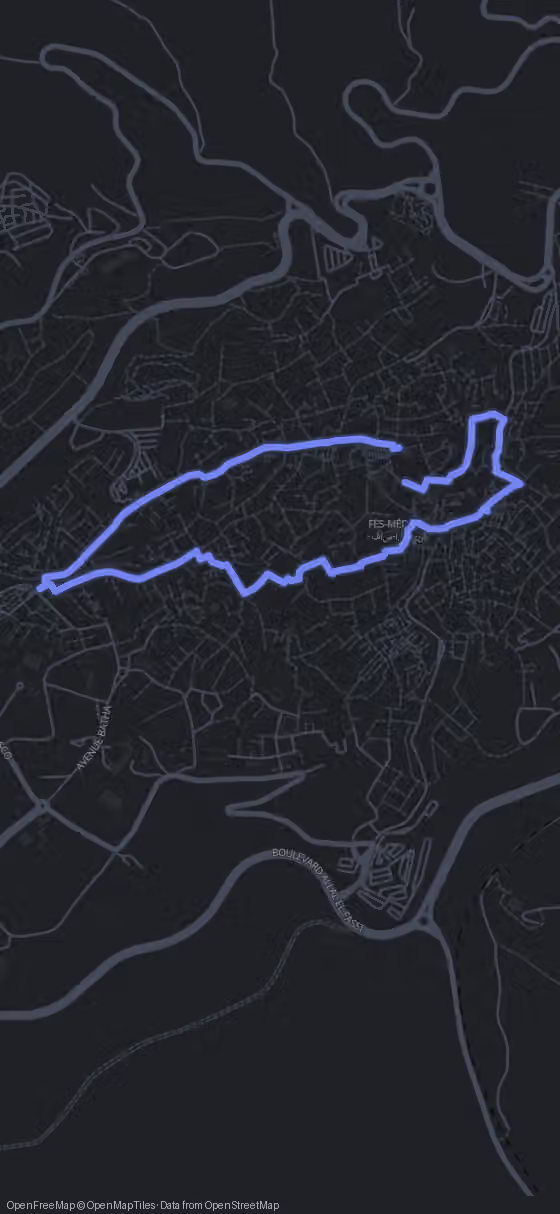
Route map for the Fez walking tour
Stop 1 of 7
980 m·12 min
Al Attarine Madrasa
Head west along Talaa Kebira toward the Bou Inania Madrasa
Welcome to Fes. I'm Alex, and one of the medina's greatest institutions began with a woman in the ninth century.
Try this tour with Alex

Your Fez Route at a Glance

Seven stops, 3.4 km and 50 minutes of pure walking through Fes el Bali: from Al Attarine Madrasa via Bou Inania Madrasa, Boujloud Gate, Place Nejjarine, Place Seffarine and Chouara Tannery to the University of Karaouine. With both madrasas visited inside, plan about three hours.

The squares, the gate, the tannery from the street and the Karaouine from outside cost nothing; only the two madrasas charge an entry fee. Route, map and GPS navigation are free in your browser, and the optional AI Tour Guide can lead the walk as a conversation.

Open free GPS & optional AI Tour Guide
This short shows highlights of the route. All 7 stops follow below.

The Route

Walking Map of Fez: Seven Stops Through Fes el Bali

7 stops 3.4 km 50 min walking
Tap to load interactive map

The 7 stops along this route

  1. Al Attarine Madrasa in Fez, stop 1 on the self-guided walking tour
    1Al Attarine Madrasa
  2. Bou Inania Madrasa in Fez, stop 2 on the self-guided walking tour
    2Bou Inania Madrasa
  3. Boujloud Gate in Fez, stop 3 on the self-guided walking tour
    3Boujloud Gate
  4. Place Nejjarine in Fez, stop 4 on the self-guided walking tour
    4Place Nejjarine
  5. Place Seffarine in Fez, stop 5 on the self-guided walking tour
    5Place Seffarine
  6. Chouara Tannery in Fez, stop 6 on the self-guided walking tour
    6Chouara Tannery
  7. University of Karaouine in Fez, stop 7 on the self-guided walking tour
    7University of Karaouine
  8. That's the full route.

    Walk it with an AI Tour Guide talking you through every one of these streets.

    Start free in your browser
    You made it

Your Fez Walking Tour Stop by Stop, From Attarine to the Karaouine

  1. 1

    Al Attarine Madrasa

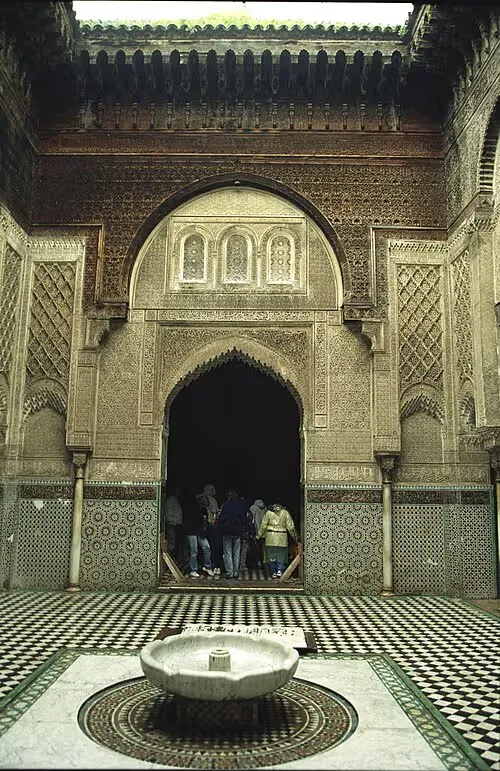
    Al Attarine Madrasa in Fez, stop 1 on the self-guided walking tour

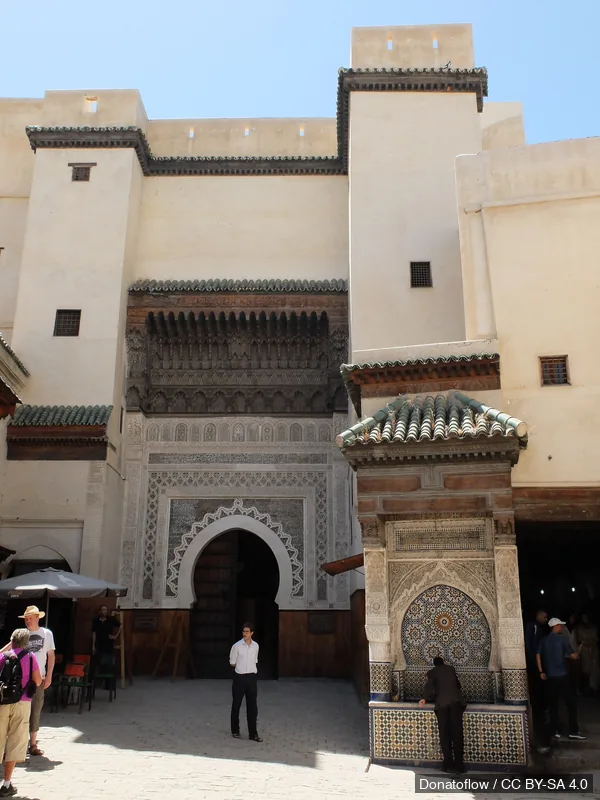
    You start right in the old heart of Fez, near the Al-Qarawiyyin Mosque, at a madrasa whose name smells of its neighbourhood: Attarine means the perfumers, after the Souk al-Attarine, the spice and perfume market it was named for. Behind the entrance opens an ornate internal courtyard, and around it everything a student needed: a small prayer hall, an ablutions facility and sleeping quarters.

    The Marinid sultan Uthman II Abu Said had it built between 1323 and 1325. The Marinids were prolific madrasa builders, and not only out of piety. The madrasa, an institution born in northeastern Iran by the early 11th century, trained scholars in Islamic law, and it had struggled in Morocco under the Almohads, whose doctrine it opposed. Their Marinid successors used these schools to court the influential but fiercely independent religious elite of Fez, to present themselves as protectors of orthodox Sunni Islam and to train the men who ran their bureaucracy.

    Al Attarine belongs to a cluster of madrasas, with the Saffarin and the Mesbahiyya, built close to the Qarawiyyin, the main centre of learning in Fez. They played a supporting role: the mosque taught, the madrasas housed students, especially those who came from outside the city.

    Look at how much fits into so little ground. The madrasa counts among the high points of Marinid architecture precisely because its decoration is rich and harmonious while the space is used so efficiently. Entry is charged, and if carved surfaces and courtyards move you, give it half an hour.

    From here it is 980 m, about 17 minutes, to Bou Inania Madrasa, the longest walking leg of the route and a good chance to compare a compact Marinid madrasa with a far grander one.
    Local name
    Médersa Al-Attarine
    Hours
    Daily 10:00–17:00
    Price
    20 MAD
  2. 2

    Bou Inania Madrasa

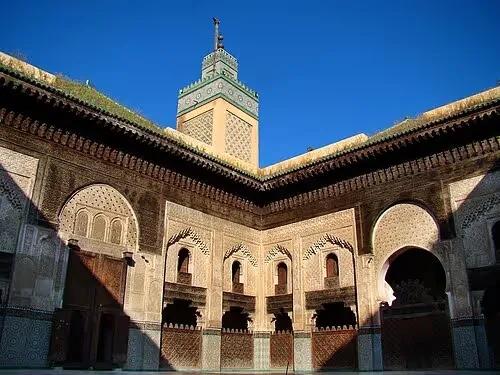
    Bou Inania Madrasa in Fez, stop 2 on the self-guided walking tour

    Bou Inania stands on the south side of Tala'a Kebira, the main souk street of the medina, and it is the only madrasa in Morocco that also functioned as a congregational mosque. That double role explains what you notice first: a prominent minaret, which almost no other Moroccan madrasa has. Inside, a courtyard is framed by galleries with student rooms built above them, flanked by two classroom chambers and leading to a wide prayer hall.

    Take your time with the surfaces. Much of the building is covered with high-quality carved stucco, zellij mosaic tilework and carved wood, and it is widely regarded as a high point of Marinid and of historic Moroccan architecture generally. Then turn around: across the street stand the ablutions facility and the Dar al-Magana, whose street façade carries an elaborate water clock.

    The man behind it was Abu Inan Faris, who built the madrasa between 1350 and 1355. His father Abu al-Hasan had pushed the Marinid empire as far east as Tunis. Abu Inan rebelled against him and declared himself sultan in 1348; he could not hold the new eastern lands, but Morocco prospered under him. On 10 January 1358 his own vizier assassinated him, aged 31, and his death marked the start of the dynasty's definitive decline. He had named the school the Madrasa al-Mutawakkiliya, yet the name that stuck comes from his own: Bou Inania.

    Entry is charged, and for anyone interested in Moroccan craftsmanship this is the interior on the route most worth paying for.

    Boujloud Gate is only 150 m further along Tala'a Kebira, a two minute walk.

    Local name
    Médersa Bou Inania
    Hours
    Sat–Thu 09:00–17:00, Fri closed to non-Muslim visitors (or restricted during prayer times)
    Price
    20 MAD
  3. 3

    Boujloud Gate

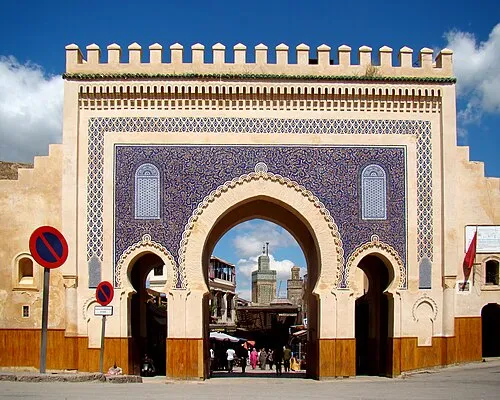
    Boujloud Gate in Fez, stop 3 on the self-guided walking tour

    Boujloud Gate looks like the ancient front door of Fes el Bali, yet the monumental gate you see is younger than many of the houses behind it. After the French Protectorate was established in 1912, the colonial administration wanted a grander entrance to the old city. Captain Mellier, chief of municipal services, drew up plans in December 1912, and the new gate was finished in 1913.

    Look to the left of the big arch when you face it from outside: there is the old Bab Bou Jeloud, a simple and modest gate that may date essentially from the 12th century, closed off today. Its passage ran sideways, parallel to the city wall, so you entered Tala'a Kebira from the side rather than head on. Many old Moroccan gates were built this way because a bent entrance was easier to defend and to control. Once gunpowder and heavy artillery arrived, such walls lost their serious military value, though they still kept out poorly armed rural tribes, and gates became mostly decorative.

    The name is far older than either gate. By one account Bou Jeloud is a vernacular corruption of Abu al-Junud, father of the troops, pointing to the parade ground now called Place Bou Jeloud or Place el-Baghdadi. Nearby stood one of the main citadels of Fes el Bali, the Kasbah Bou Jeloud, and the Kasbah en-Nouar.

    The gate is free and always accessible, so a few minutes here cost nothing. Next comes the second long leg: 1210 m, about 15 minutes, back into the medina to Place Nejjarine, passing Rcif Square on the way.

    Local name
    Bab Bou Jeloud
    Hours
    Always accessible (open 24/7)
    Price
    Free
  4. 4

    Place Nejjarine

    Place Nejjarine in Fez, stop 4 on the self-guided walking tour

    Place Nejjarine is a small square built around an 18th-century fountain, and the fountain is the reason to stop. Its zellij mosaic work counts among the finest examples in Fes, and a carved cedar wood canopy shelters the basin. Step close and follow the geometry of the tiles, then look up at the carving above them.

    Right beside the fountain stands the Fondouk Nejjarine, a caravanserai from 1711 that has been restored and now houses the Museum of Wooden Arts and Crafts, spread over three floors of traditional Moroccan woodworking. If the carved wood in the madrasas caught your attention, this is where you can see the craft up close; you pay the entry fee at the door. If you are mainly here for the walk, the fountain and the square are free at any hour.

    Place Seffarine is 300 m away, about 4 minutes on foot.

    Hours
    Always accessible (open 24/7)
    Price
    Free
  5. 5

    Place Seffarine

    Place Seffarine in Fez, stop 5 on the self-guided walking tour

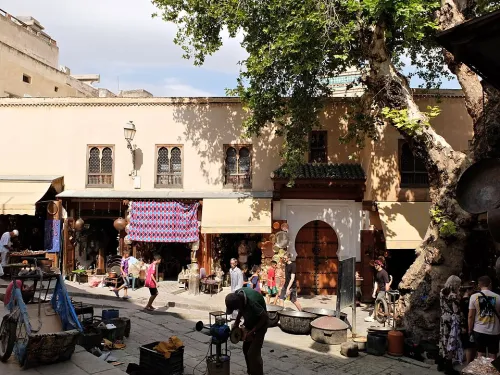
    You will probably hear Place Seffarine before you see it. The small square is named after the coppersmiths, the seffarin, who have kept their workshops here for centuries; Leo Africanus already noted them in the 16th century, and they are still at work today.

    Around you stand three institutions that tell the story of Fez as a city of learning. To the east is the entrance of the Saffarin Madrasa, built in 1271 by the Marinid sultan Abu Yusuf Ya'qub. It is the oldest purpose-built madrasa in Morocco, still in use and most recently renovated in the late 2010s, so you are looking at the model for Al Attarine and Bou Inania. To the northwest lies the library of the Qarawiyyin, first built on this spot in the late 16th century by Sultan Ahmad al-Mansur. To the southwest is the Saffarin Hammam, a bathhouse from the 14th century.

    The square dates back to the Middle Ages, but much of what you see today comes from renovations in the 1930s and 1940s, during the French protectorate, requested by the manager of the Qarawiyyin's endowments and backed by King Mohammed V. In that programme the Qarawiyyin library was greatly expanded and reopened in 1949 in its present form, and the Madrasa Mohammadia, an 18th-century annex of the Saffarin Madrasa, was enlarged as well.

    Stay a quarter of an hour, watch the metal take shape and then head 390 m, about 5 minutes, to Chouara Tannery, which lies near the Saffarin Madrasa along the river.

    Hours
    Square always accessible 24/7; artisan coppersmith workshops typically active Mon–Sat 08:30–19:00
    Price
    Free
  6. 6

    Chouara Tannery

    Chouara Tannery in Fez, stop 6 on the self-guided walking tour

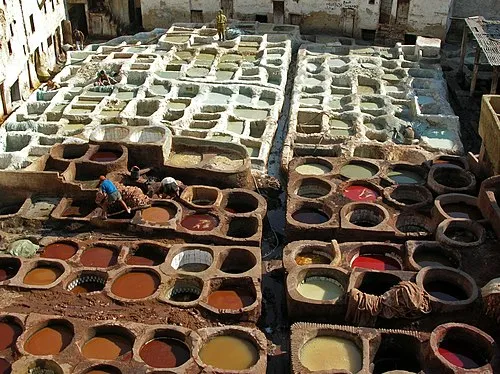
    Chouara is the largest of the three tanneries of Fez and one of the oldest, set in Fes el Bali along the Oued Fes, also called the Oued Bou Khrareb. What you look down on is a field of round stone vessels, some filled with dye, others with white liquids that soften the hides. The tanning here has continued in much the same fashion as in the city's early centuries, and the leather made in these vats is exported around the world.

    Local tradition says Chouara, like the Sidi Moussa Tannery, goes back to the city's foundation by Idris II at the beginning of the 9th century, though its early history is not firmly established. What is clear is the scale of the trade: Fez leather was prestigious enough to reach Baghdad, the Almohads reportedly counted 86 tanning workshops in the city, and a later source speaks of around a hundred under the Marinids. Tanneries clustered near the river then for the same reason they do now: they need water.

    Viewing from the street is free. For the classic view you go onto one of the rooftop terraces, which usually expect a small tip per person. The workshops are busiest in the mornings, with limited activity on Friday afternoons, so if the tannery is your priority, come early or reach it before lunch.

    The last leg is 380 m, about 6 minutes, to the University of Karaouine.

    Local name
    Tannerie Chouara
    Hours
    Daily 08:30–18:30 (workshop activity highest mornings; limited activity Friday afternoons)
    Price
    Free viewing from street; rooftop terrace access typically 10-20 MAD tip/gratuity per person
  7. 7

    University of Karaouine

    University of Karaouine in Fez, stop 7 on the self-guided walking tour

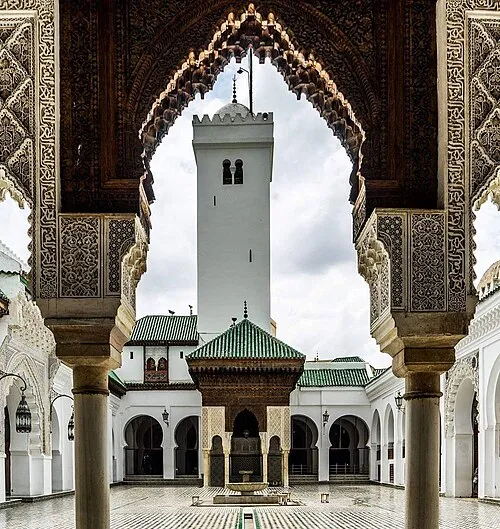
    The walk ends where learning in Fez began. In 859 Fatima bint Muhammad al-Fihri founded the Qarawiyyin Mosque, which became one of the leading spiritual and educational centres of the Islamic golden age. Lessons began in study circles right after the mosque was built, although some historians think it only became a university under the Almoravids or the Marinids. UNESCO and Guinness World Records list it as the oldest existing institution of higher education still teaching without interruption.

    Teaching here still follows the old pattern. Students sit in a semicircle, the halaqa, around a sheikh who has them read passages from a text, questions them on grammar, law or interpretation and explains the difficult points. The focus is on Maliki jurisprudence and the grammar of classical Arabic, with some lessons in French and English. Most students are between 13 and 30 and come from all over Morocco and Muslim West Africa, a few from as far as Central Asia. In 1963 the Karaouine was integrated into Morocco's modern state university system.

    Non-Muslim visitors cannot enter, so this stop is about the exterior and the glimpses the open doors allow, at no cost. Think back to the madrasas you saw this morning: they existed to house the students who came to study here, and Al Attarine Madrasa, where you started, stands close by. The GPS navigation in your browser can lead you back there if you want to close the loop.

    Local name
    Université Al Quaraouiyine
    Hours
    Exterior view accessible daily 08:30–19:00 (exterior viewing during open door hours; non-Muslim tourists cannot enter the interior)
    Price
    Free (exterior only; non-Muslims cannot enter)
    Website
    uaq.ma ↗
Walking tour route map of Fez Route loaded
Al Attarine MadrasaBou Inania MadrasaBoujloud GatePlace Nejjarine+3
All 7 stops are already on the map.
You just press start.
AI Tour Guide

You've read the route through the medina. Now walk it with a guide in your ear.

Press start wherever you are, even hundreds of kilometres from Fez, and the guide begins telling its stories right away. In the city, pick any of the 7 stops to start from: it leads you there, then talks with you the whole route, asking, listening, remembering, and shaping the tour around your answers.

7stops 3.4km 50 minwalking 13languages
▶Start the tour free

Free to start · Runs in your browser · No app, no download

Shorter Ways to Walk the Fez Medina

Not every visitor wants the full loop of gate, madrasas and workshops. These cuts keep the route order and use the same walking legs.

Crafts and the Karaouine

Stops: 4, 5, 6, 7

For anyone short on time who cares more about living crafts than monuments: the zellij fountain of Place Nejjarine, the coppersmiths of Place Seffarine, Chouara Tannery and the Karaouine from outside. 15 minutes of walking, no entry fees; only the tannery terraces expect a small tip.

The Marinid madrasas

Stops: 1, 2, 3

For architecture lovers: Al Attarine Madrasa and Bou Inania Madrasa, then the short hop to Boujloud Gate. 19 minutes of walking and two tickets.

The free route

Stops: 3, 4, 5, 6, 7

For a tight budget: start at Boujloud Gate and follow the route to the Karaouine without any ticketed interior. 30 minutes of walking; everything is free from the street, and the tannery terrace tip is up to you.

How Long This Fez Tour Takes, With and Without the Madrasas

The pure walking time is 50 minutes over 3.4 km. The longest legs are the 980 m from Al Attarine Madrasa to Bou Inania Madrasa and the 1210 m from Boujloud Gate back into the medina to Place Nejjarine; everything after that comes in short hops of 300 to 390 m.

Half an hour inside each madrasa, a few minutes at the gate, a quarter of an hour each at Place Nejjarine and Place Seffarine, 20 minutes at the tannery and a short look at the Karaouine add up to about three hours. Start at 10:00 and you reach Bou Inania around 10:45, the tannery around 12:20 and the Karaouine just before 13:00. The variants need far less: 15 minutes of walking for the crafts cut, 19 for the madrasas, 30 for the free route, plus whatever time you spend at each place.

Before You Set Off in Fez

  • Start and finish: The recommended start is Al Attarine Madrasa, the finish is the University of Karaouine, but you can join at any stop. From the last stop the GPS navigation in your browser can lead you back to the start if you wish.
  • Best day: Pick your day with care: Bou Inania Madrasa does not admit non-Muslim visitors every day, the tannery is quieter on Friday afternoons, and the coppersmith workshops on Place Seffarine do not work every day.
  • Time of day: Start in the morning, once Al Attarine Madrasa has opened, so you have room for long looks inside both madrasas.
  • Costs: Each madrasa charges an entry fee; add a small tip if you climb onto a tannery terrace, and the ticket for the wood museum on Place Nejjarine if you go in. The AI Tour Guide starts with 100 free credits; after that you choose between this tour all-inclusive for €19.99 with no time limit or credits at €5 per hour.
Walking tour route map of Fez
AI Tour Guide

Your guide for Fez is ready when you are.

Press start and a voice AI Tour Guide takes it from here: leading the route through Fez, telling the stories, and turning your walk into a real back-and-forth conversation. No app or download is needed; it runs in your browser.

7stops 3.4km 50 minwalking 13languages
▶Start the tour free

Free to start · Runs in your browser · No app, no download

What the AI Tour Guide Adds in the Medina

In Fez the AI Tour Guide walks you from madrasa to tannery as one long conversation: it greets you at Al Attarine, tells the stories of sultans, scholars and craftsmen, asks whether Marinid court intrigue or the work of the dyers pulls you in more, and remembers your answer at the next stop. Wonder what the calligraphy bands in a madrasa courtyard actually say, or how a coppersmith learns the trade? Cut in at any moment and the conversation follows you, while the route itself stays the same.

A Real Conversation A voice AI Tour Guide greets you, leads the whole route, and tells the stories and facts as you walk, asking what you want to see and keeping a real conversation going. Not a recording you press play on.
Map Navigation Follow the route on the map and walk at your own pace. You choose where to start and when to move to the next stop.
Ask Anything Curious about a building you pass? Ask your AI Tour Guide on the spot and the conversation carries on.
13 Languages Switch language anytime. No separate tour needed.
Start free in your browser

Common Questions About Walking Fez

If I only have time for one madrasa, which should it be?

Bou Inania Madrasa is the larger complex, the only madrasa in Morocco that also served as a congregational mosque, with a minaret and the water clock across the street. Al Attarine Madrasa is smaller but admired for packing rich decoration into a tight space. For the bigger story pick Bou Inania, for the jewel box pick Al Attarine; on a Friday Al Attarine is the only option.

Why does the route go out to Boujloud Gate and then back into the medina?

Bou Inania Madrasa stands on Tala'a Kebira, the main souk street that runs from Boujloud Gate to the Qarawiyyin, so the gate is only a two minute walk on. From there the route heads back into the heart of the medina and ends at the Karaouine, close to Al Attarine Madrasa where you began.

Can I combine Fez with another city on the same trip?

Yes. Marrakech, 391 km away, has its own free walking route, and if you cross to Spain, Granada and Cordoba continue the story of Andalusian scholarship that still shapes teaching at the Karaouine.

Is the tour really free?

Yes. The whole tour is free: the route, the interactive map and the navigation cost you nothing. Only the voice AI Tour Guide is optional and paid: you test it with 100 free credits, then you pay either €5 per hour or €19.99 for this whole tour, with no time limit. Admission to 2 of the 7 stops is not included: Al Attarine Madrasa and Bou Inania Madrasa charge their own entry fees.

Do I need to download an app?

No. Everything runs in your phone browser. Open the route and start walking, no download and no sign-up required.

Do I need to book the walking tour in advance?

No booking needed. This self-guided tour is available anytime. Open the route in your browser and start walking. The AI Tour Guide works instantly, no app, no reservation required.

What languages is the AI Tour Guide available in?

The AI Tour Guide speaks 13 languages, so you take the tour in your own language and can switch at any time.

Can I skip stops or change the route?

Yes. Skip any stop, spend extra time at places you like, or start the route from any point. It is your walk, you set the pace.
Image credits
▶ Start free in your browser Runs in your browser, no app, no download