Free Walking Tour Granada: Alhambra to Albaicín

Begin in the sultans' gardens above the Alhambra, walk down through the old bazaar to the royal tombs, and finish facing the palace from the Albaicín.

10 Stops 5.5 km ~1 h 22 min walking
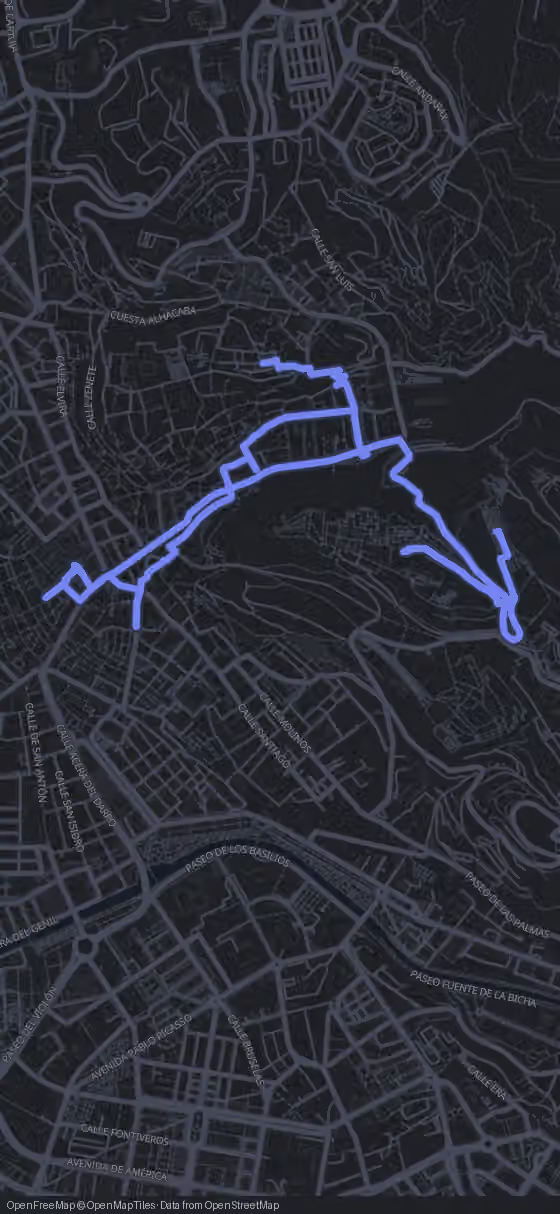
Route map for the Granada walking tour
Stop 1 of 10
610 m·8 min
Generalife Gardens
Head west along the cypress path toward the Alhambra
Hola, welcome to Granada. I'm Alex, and in this city water can be both decoration and architecture.
Try this tour with Alex

Granada on Foot at a Glance

Ten stops on a one-way route of 5.5 km: from the Generalife Gardens and the Alhambra down to Plaza Bib-Rambla and the old centre, then along the Darro to the Mirador de San Nicolás. Pure walking time is 1 h 22 min; with the palace, the interiors and a tapas lunch, plan around eight hours.

The squares, the Alcaicería, the Paseo de los Tristes and the viewpoint are free. You pay for the Alhambra, Granada Cathedral, the Royal Chapel and one shared ticket for Corral del Carbón and El Bañuelo. Route, map and GPS navigation are free; the AI Tour Guide is optional.

Open free GPS & optional AI Tour Guide
This short shows highlights of the route. All 10 stops follow below.

The Route

Walking Map of Granada: From the Generalife to San Nicolás

10 stops 5.5 km 1 h 22 min walking
Tap to load interactive map

The 10 stops along this route

  1. Generalife Gardens in Granada, stop 1 on the self-guided walking tour
    1Generalife Gardens
  2. Alhambra in Granada, stop 2 on the self-guided walking tour
    2Alhambra
  3. Plaza Bib-Rambla in Granada, stop 3 on the self-guided walking tour
    3Plaza Bib-Rambla
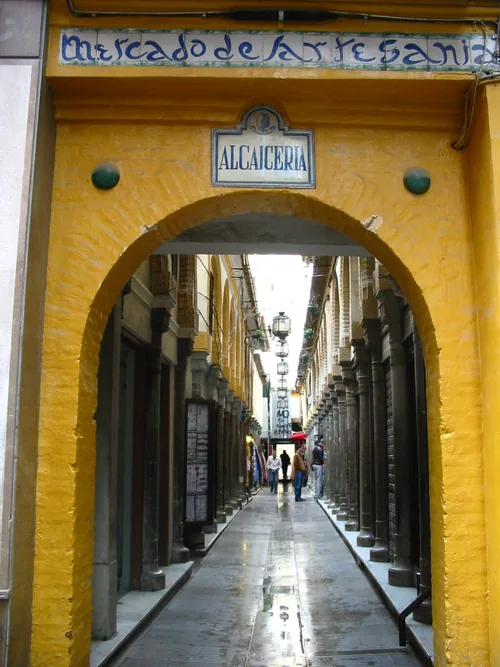
  4. Alcaicería in Granada, stop 4 on the self-guided walking tour
    4Alcaicería
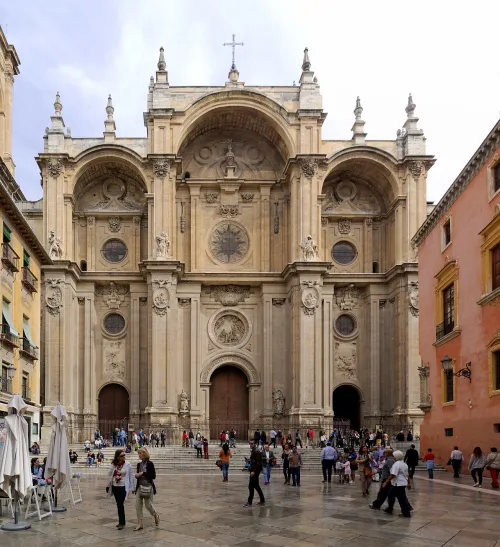
  5. Granada Cathedral, stop 5 on the self-guided walking tour
    5Granada Cathedral
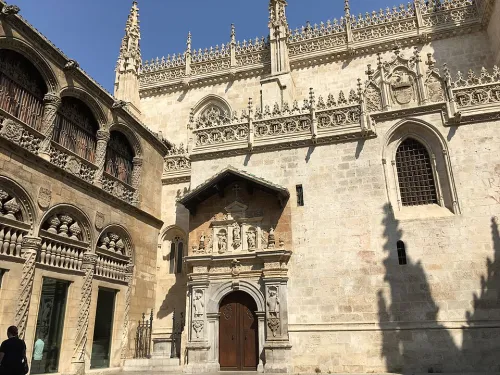
  6. Royal Chapel in Granada, stop 6 on the self-guided walking tour
    6Royal Chapel
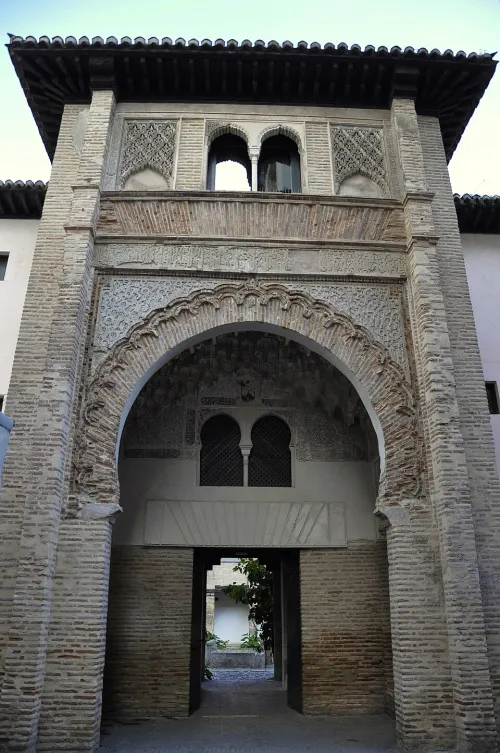
  7. Corral del Carbón in Granada, stop 7 on the self-guided walking tour
    7Corral del Carbón
  8. El Bañuelo in Granada, stop 8 on the self-guided walking tour
    8El Bañuelo
  9. Paseo de los Tristes in Granada, stop 9 on the self-guided walking tour
    9Paseo de los Tristes
  10. Mirador de San Nicolás in Granada, stop 10 on the self-guided walking tour
    10Mirador de San Nicolás
  11. That's the full route.

    Walk it with an AI Tour Guide talking you through every one of these streets.

    Start free in your browser
    You made it

Your Granada Walking Tour, Garden by Bazaar by Bathhouse

  1. 1

    Generalife Gardens

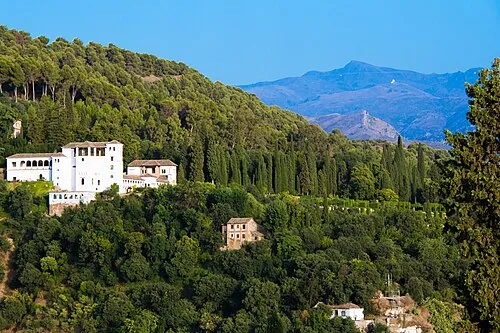
    Generalife Gardens in Granada, stop 1 on the self-guided walking tour

    You start where the Nasrid sultans came to rest. The Generalife was their country villa on the slope of the Cerro del Sol, just outside the Alhambra walls, conceived as a place where ornamental gardens, orchards and buildings blend into one another. It was a retreat and a working farm at the same time: in the Middle Ages the estate had at least four orchards, and the vizier Ibn al-Yayyab called the residence the Royal House of Happiness.

    Look for the heart of the complex: two pavilions, one to the north and one to the south, joined by a courtyard with a channel of water running its length. Both pavilions have been heavily reworked, so read them as a building that grew over centuries rather than a frozen medieval scene. Its oldest decoration points to the late 13th century and Muhammad II, the second Nasrid sultan, who reigned until 1302; later sultans kept adding and changing.

    When it was built, the Generalife lay outside Muslim Granada and had no direct connection to the Alhambra. Its main approach was a path up a ravine from the Darro river, today's Cuesta de los Chinos. Since 1984 it has been a UNESCO World Heritage Site together with the palace.

    Come first thing in the morning, as soon as the gates open. The Alhambra General ticket includes the gardens; if you only want the Generalife, there is a separate garden ticket. From here it is 610 m, about 8 minutes, to the Alhambra itself.
    Hours
    16 Oct-31 March: daily 08:30–18:00 | 1 Apr-14 Oct: daily 08:30–20:00
    Price
    12,73 EUR (Generalife-Garden-Ticket)
  2. 2

    Alhambra

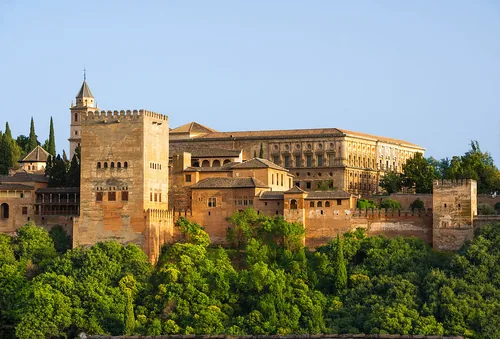
    Alhambra in Granada, stop 2 on the self-guided walking tour

    The Alhambra is a palace and a fortress at once, and in Nasrid times it was a self-contained city above the rest of Granada. It stands on the Sabika hill, an outcrop of the Sierra Nevada that had carried earlier fortresses and the 11th-century palace of Samuel ibn Naghrillah. Muhammad I Ibn al-Ahmar, the first Nasrid emir and founder of the Emirate of Granada, the last Muslim state of al-Andalus, began building in 1238. The royal palaces got much of their character in the 14th century under Yusuf I and Muhammad V.

    It is the only well-preserved palace from the medieval Islamic world, and it carries a second chapter right next to it. After 1492 the Alhambra became the royal court of Ferdinand and Isabella; here Christopher Columbus received royal backing for his voyage. In 1526 Charles V commissioned a Renaissance palace placed directly beside the Nasrid palaces, so two worlds face each other on the same hill.

    Then came decline: squatters moved into the buildings, and Napoleon's troops blew up parts of the complex in 1812. Romantic travellers rediscovered it, above all Washington Irving, whose Tales of the Alhambra of 1832 made the place famous worldwide. It was one of the first Islamic monuments studied scientifically and has been restored again and again since the 19th century.

    The Alhambra General ticket covers the Nasrid Palaces, the Alcazaba and the Generalife; the Nasrid Palaces are entered at the time printed on your ticket. Book on the official site one or two months ahead. Night visits exist too, for the Nasrid Palaces or for the gardens. If Islamic architecture is why you came to Granada, this visit is the centre of your day.

    From the palace it is 2430 m, about 33 minutes, down to Plaza Bib-Rambla. On the way you pass the Archaeological Museum of Granada and walk along the Carrera del Darro.

    Hours
    Oct 15-Mar 31: Daily 08:30–18:00 and 18:00–20:00, Fri–Sat 20:00–21:30 | Apr 1-Oct 14: Daily 08:30–20:00 and 20:00–22:00, Tue–Sat 22:00–23:30; closed Dec 25, Jan 1
    Price
    22.27 EUR total ticket (Conjunto Monumental) | Nasrid palaces night visit 12.73 EUR | gardens night visit 8.48 EUR
  3. 3

    Plaza Bib-Rambla

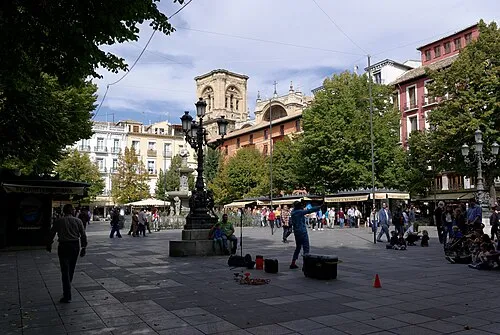
    Plaza Bib-Rambla in Granada, stop 3 on the self-guided walking tour

    Plaza Bib-Rambla goes back to Nasrid times, when it lay right beside the city's commercial core, the tangle of small streets around the Alcaicería and the Zacatín. In the Muslim era it was a place of trade; later it hosted jousts, bullfights and festivals. A remodelling in the late 16th century gave it roughly its present size, and in the mid-20th century Calle Príncipe was cut through to connect it with Calle Reyes Católicos, which runs over the vaulted-over Darro, and with Plaza del Carmen and the City Hall.

    Today the square is a rectangle presided over by the Fountain of the Giants, with pagan motifs and pastoral details that suit a market square. At its ends stand late 19th-century Fernandine iron lamps cast in a Seville foundry, and the trees overhead are lindens. Watch the flower stalls around the fountain: at Christmas they sell firs, pines and poinsettias, on Valentine's Day and Mother's Day bouquets.

    The square once held the seat of the city council and the main façade of the Archbishop's Palace. Cafés line it on all sides; enjoy the setting, but keep lunch for a tapa bar. Calle Arco de las Cucharas leads to Calle Mesones, and Calle Libreros to the Sagrario of the Cathedral. The Alcaicería is only 150 m away, about 2 minutes.

    Hours
    Open 24/7
    Price
    Free
  4. 4

    Alcaicería

    Alcaicería in Granada, stop 4 on the self-guided walking tour

    The name comes from the Arabic al-qaysariyya, the main bazaar, and that is exactly what stood here. Be aware of what you are looking at, though: the Nasrid bazaar burned down in 1843 and was rebuilt in its present form, so the narrow lanes keep the old layout while the shopfronts are 19th century.

    This part of town rose in the 11th century under the Zirids, when the city's Great Mosque was built here; the Cathedral stands on its site today. At first the area was a semi-rural estate of the ruling family, and the mosque may have been meant to pull the city in this direction. The first major markets grew up around it.

    The Nasrid emir Yusuf I raised the district's profile in the 14th century: he remodelled the Alcaicería, founded a madrasa and built a caravanserai nearby, the one you will see later as the Corral del Carbón. Perfumers and notaries worked on the square by the mosque. The most important market, al-Saqqāṭīn, literally the second-hand clothes sellers, actually housed silversmiths, shoemakers and haberdashers, while food was sold closer to the river, each trade grouped together.

    Walking through is free and buying anything is up to you. The Cathedral is just 40 m away, about a minute.

    Hours
    Open 24/7
    Price
    Free (market passage; purchases optional)
  5. 5

    Granada Cathedral

    Granada Cathedral, stop 5 on the self-guided walking tour

    Like many Andalusian cathedrals, this one stands on the site of the city's main mosque, in the centre of the old Muslim medina. Unusually for Spain, work only began in 1518, after the conquest of 1492. Enrique Egas laid the foundations with Gothic plans, but by 1529 Diego de Siloé had taken over, and he shaped the building from the ground to the cornice for nearly four decades.

    Siloé is the reason to go inside. He planned five naves instead of the usual three, combined a Renaissance dome with a Gothic floor plan and, most unusually, built a circular main chapel instead of a semicircular apse, perhaps inspired by Italian ideas of the circular “perfect building”. Stand in the middle and look up at that round chapel; it is the moment the building makes sense.

    After Siloé came Juan de Maena, Juan de Orea and Ambrosio de Vico. In 1667 Alonso Cano, working with Gaspar de la Peña, changed the main façade and brought in Baroque elements; it is framed like a triumphal arch. Construction took 181 years, and two 81-metre towers in the plans were never built, partly for lack of money.

    The Cathedral charges admission, and the KERYGMA special exhibition is on at the moment. Worth it if architecture interests you even a little. The Royal Chapel is 40 m further, about a minute, passing the José Guerrero Centre.

    Hours
    Mon–Sat: 10:00–18:15 | Sun: 15:00–18:15
    Price
    10 EUR adults (currently, during KERYGMA special exhibition 08.05.-28.11.2026) | reduced 8 EUR | students of Granada province 3 EUR | Granada residents 5 EUR | under 12 free
  6. 6

    Royal Chapel

    Royal Chapel in Granada, stop 6 on the self-guided walking tour

    This is where the story of 1492 ends. Queen Isabella I and King Ferdinand, the Catholic Monarchs who took Granada from the last Nasrid rulers, are buried here. On 13 September 1504 they declared that their remains should rest in Granada, and a royal charter issued at Medina del Campo ordered an “honest chapel” in the Cathedral of the city, to be called the Chapel of the Kings and dedicated to Saint John the Baptist and Saint John the Evangelist.

    It was built between 1505 and 1517 in Isabelline Gothic under the direction of Enrique Egas, with Juan Gil de Hontañón, Juan de Badajoz the Elder and Lorenzo Vázquez de Segovia also involved. Originally part of the Cathedral complex, it was finished in Ferdinand's lifetime and flourished under Charles V, who had it decorated. It remained the mausoleum of the Spanish royal family until Philip II founded El Escorial.

    Besides the tombs, the chapel holds a gallery of artworks and objects associated with Queen Isabella, and a recent restoration has freshened it up. There is an entry fee, and there are no visits during services. If you care about Spanish history, put this interior ahead of the Cathedral.

    The Corral del Carbón is 380 m away, about 5 minutes.

    Local name
    Capilla Real de Granada
    Hours
    Mon–Sat 10:00–18:30, Sun 11:30–18:30 (doors close 19:00); no visits during services
    Price
    7 EUR adults | 5 EUR students (under 25) and people with disabilities | under 12 free
  7. 7

    Corral del Carbón

    Corral del Carbón in Granada, stop 7 on the self-guided walking tour

    Behind this portal stands the only Nasrid funduq preserved anywhere on the Iberian Peninsula. Its original name was al-Funduq al-Jadida, the New Inn. It dates from the early 14th century; documents mention it in 1336. Like other urban caravanserais, it stored grain and gave merchants from outside the city a place to sleep and keep their goods.

    Most funduqs in al-Andalus were modest and have vanished. This one reportedly belonged to the wives of the Nasrid sultans, which explains its more monumental look. It sat next to the main bazaar, the Alcaicería you just walked through, and a small bridge over the Darro, known until 1501 as the new bridge, linked the two.

    After the fall of Granada, the Catholic Monarchs gave the building in 1494 to their lieutenant Juan de Arana. When he died in 1531 it was auctioned off and became a theatre courtyard, a corral de comedias, until at least 1593; the interior was altered to make room for audiences.

    Entry is with the shared ticket for the Andalusian monuments, which also covers El Bañuelo, the Casa Morisca Horno de Oro, the Palacio de Dar al-Horra and the Maristán. A quarter of an hour inside is enough. El Bañuelo is 710 m away, about 11 minutes.

    Hours
    16 Sep-30 Apr: daily 10:00–17:00 | 1 May-14 Sep: daily 09:00–14:30 and 17:00–20:30
    Price
    8.48 EUR combined ticket for the Andalusian monuments (Corral del Carbón, Bañuelo, Casa Morisca Horno de Oro, Palacio de Dar al-Horra, Maristán)
  8. 8

    El Bañuelo

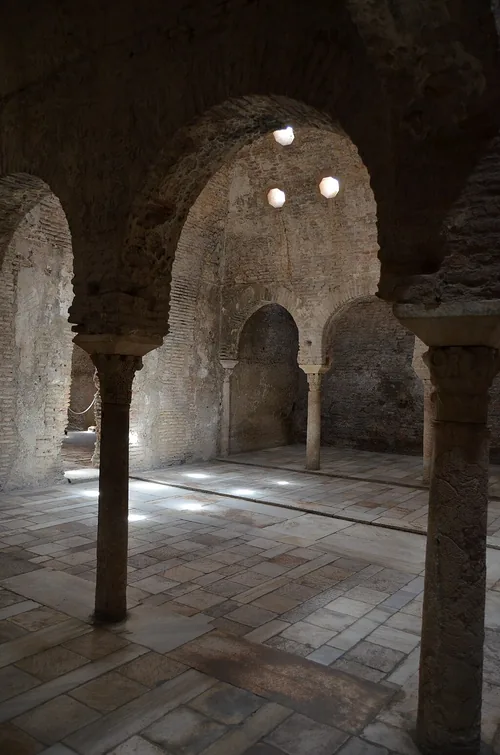
    El Bañuelo in Granada, stop 8 on the self-guided walking tour

    El Bañuelo, the little bath, also goes by Bath of the Walnut, Hammam al-Yawza in Arabic. It sits in the Albaicín on the bank of the Darro and dates from the 11th or 12th century. It worked as a bathhouse until the 16th century, then fell out of use and served other purposes until restorations in the 20th century opened it to visitors.

    A hammam like this was part of every Muslim city. It served the ritual washing of the whole body that certain occasions required, everyday hygiene and simply meeting people. Its layout follows the Roman baths that had been part of life in the region for generations.

    About a dozen remains of Islamic baths have been found in Granada, most of them modest, the exception being the lavish 14th-century Comares Baths in the Alhambra. El Bañuelo is the only hammam outside the Alhambra that has been restored and opened to the public. Its date is debated: the scholar Leopoldo Torres Balbás placed it in the Zirid 11th century, while later researchers argue for the 12th century or later because of its layout and masonry. Either way it stood inside the Old Alcazaba, the royal citadel above what became the Albaicín, before the Alhambra took over as the seat of power. After 1492 it was still repaired and used by the city's morisco population.

    Entry is included in the Andalusian monuments ticket and in the Dobla de Oro ticket. If you only go inside one of the two Nasrid buildings by the river, make it this one. The Paseo de los Tristes is 560 m on, about 9 minutes.

    Hours
    Sep 15-Apr 30: Daily 10:00–17:00 | May 1-Sep 14: Daily 09:00–14:30 and 17:00–20:30
    Price
    Included in the 'Monumentos Andalusíes' ticket 8.48 EUR (also in the Dobla de Oro ticket)
  9. 9

    Paseo de los Tristes

    Paseo de los Tristes in Granada, stop 9 on the self-guided walking tour

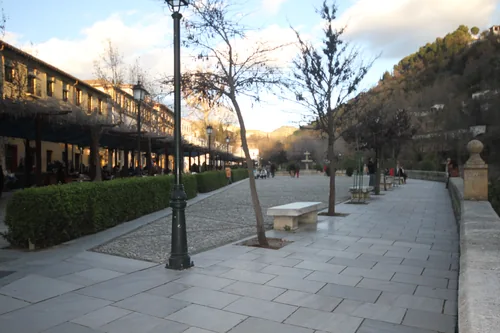
    The Paseo de los Tristes is the flat promenade at the bottom of the Darro valley, with the Alhambra above you and the Albaicín rising behind. After a long day, flat ground is exactly what you need, and this is the best place on the route to sit down.

    It is free and open around the clock. Order a drink, rest your legs and look up at the palace where you started this morning. Then decide whether to go up now or wait for softer light. The final 600 m, about 12 minutes, climb into the Albaicín to the Mirador de San Nicolás.

    Hours
    Open 24/7
    Price
    Free
  10. 10

    Mirador de San Nicolás

    Mirador de San Nicolás in Granada, stop 10 on the self-guided walking tour

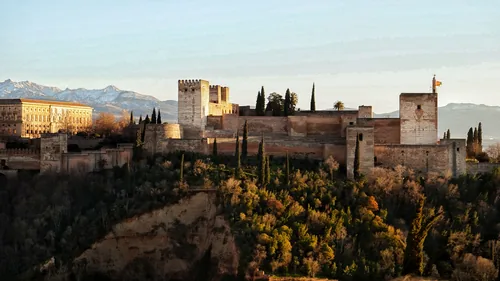
    The route ends with the whole day in one frame: the Alhambra on its hill, the Sierra Nevada behind it, the city in between. You began in the Generalife above the palace, looking down; you finish in the Albaicín, looking up at it, not far from the old bathhouse you visited a little earlier.

    The terrace is free and open at all hours, and the postcard view of Granada costs nothing. For the evening light, come at least half an hour before sunset, when it fills up. There is no shade at all, so in high summer treat this as an early-morning or evening stop.

    If you want the same panorama with fewer people, the Mirador de San Miguel Alto is a calmer free alternative. Otherwise, stay a while: this is where the Nasrid story you followed from garden to bazaar to bathhouse comes together.

    Hours
    Open 24/7
    Price
    Free
Walking tour route map of Granada Route loaded
Generalife GardensAlhambraPlaza Bib-RamblaAlcaicería+6
All 10 stops are already on the map.
You just press start.
AI Tour Guide

You've read the route. Now walk it with a guide in your ear.

Press start wherever you are, even hundreds of kilometres from Granada, and the guide begins telling its stories right away. In the city, pick any of the 10 stops to start from: it leads you there, then talks with you the whole route, asking, listening, remembering, and shaping the tour around your answers.

10stops 5.5km 1 h 22 minwalking 13languages
▶Start the tour free

Free to start · Runs in your browser · No app, no download

Shorter Ways to Walk the Route

Not every day has room for the full walk. These three cuts follow the same order and the same legs, so the GPS route still works.

The Alhambra hill only

Stops: 1, 2

For a morning given entirely to the Nasrid world. Between the gardens and the palace you walk just 610 m, about 8 minutes, and the Alhambra General ticket covers both.

Old town and Albaicín without the Alhambra

Stops: 3, 4, 5, 6, 7, 8, 9, 10

For anyone who has already seen the palace or couldn't get a ticket. Walking time is 41 minutes; you pay for the Cathedral, the Royal Chapel and the shared ticket for Corral del Carbón and El Bañuelo, while the squares, the bazaar, the promenade and the viewpoint cost nothing.

Late afternoon along the Darro

Stops: 7, 8, 9, 10

For a short outing that ends with the view. Walking time is 32 minutes and one shared ticket covers the Corral del Carbón and El Bañuelo. Visit the Corral early in the afternoon so you still get inside both.

How Long This Granada Tour Takes, Palace Included

The walking itself takes 1 h 22 min. What stretches the day is what you go inside: allow about three hours for the Generalife and the Alhambra together, around 45 minutes for the Cathedral, 40 for the Royal Chapel, a quarter of an hour at the Corral del Carbón and 20 minutes in El Bañuelo, plus an hour for lunch and a proper rest on the Paseo de los Tristes.

Start in the morning as soon as the Generalife opens and you reach Plaza Bib-Rambla shortly after 12:00. After lunch the centre stops follow each other within a few minutes, you leave the Corral del Carbón around 15:20, stand in El Bañuelo around 15:30 and reach the Mirador de San Nicolás around 16:45, about eight and a quarter hours after you set off. In summer the Corral and El Bañuelo take a long afternoon break, so take a longer pause after the Royal Chapel; the later finish puts you on the viewpoint in the evening.

The Alhambra hill on its own fills a morning of about three hours. The old town and Albaicín without the palace takes nearly four hours with all interiors, and the late afternoon along the Darro about an hour and a half before you settle in at the viewpoint.

Before You Set Off in Granada

  • Start: The Generalife Gardens, ideally first thing in the morning when the gates open. You can join the route at any stop; the order here is the recommended one, from the hill down into town and up again into the Albaicín.
  • Finish: The Mirador de San Nicolás in the Albaicín. The C32 minibus links the Albaicín and the Alhambra roughly every 10 minutes.
  • Getting to the start: Bus C30 runs from Isabel la Católica up to the Alhambra about every 12 minutes, and a Credibus card makes the fare even cheaper. It runs more often than the tourist train, which costs more and only passes the monuments from outside.
  • Best day: Monday to Saturday works best, since the Cathedral and the Royal Chapel keep shorter hours on Sundays.
  • Costs: With every interior you pay for the Alhambra General ticket, the Cathedral, the Royal Chapel and the shared ticket for the Andalusian monuments. Plaza Bib-Rambla, the Alcaicería, the Paseo de los Tristes and the Mirador de San Nicolás are free.

Tapas and Breaks Along the Route

Granada feeds you almost for free if you eat the local way: order a drink in a bar and a tapa comes with it. Lunch after the descent from the Alhambra and a drink on the promenade before the final climb fit this route well.

Free tapas in Realejo, on Calle Elvira and in the lower AlbaicínA cheap drink comes with a real plate of food, and three drinks with three tapas make a lunch. Names worth knowing: Bar Aliatar, La Taberna de Kafka in Realejo, Los Diamantes, Casa Enrique and Bodegas Castañeda. Calle Navas is half local, half tourist, and fine.
Tapa rules that save moneyCola often doesn't earn a free tapa, while tinto de verano and alcohol-free beer do. Have one or two drinks per bar and move on. After midnight most bars stop serving tapas, and between 18:00 and 20:00 some kitchens are closed.

Tourist Traps to Avoid in Granada, from Tickets to Rosemary

  • Terraces with multilingual menus: On Plaza Bib-Rambla, Plaza Nueva and at the bars by the Alhambra entrance, tapas shrink to olives or crisps, or you pay extra for a tapa voucher. A menu with paella photos in five languages is the signal to keep walking. (Plaza Bib-Rambla)
  • Alhambra resellers and “tours with ticket”: A fast-track ticket from a reseller costs noticeably more for the same entry, and guided packages with a ticket cost more again. Some third-party “tours” don't even include the Nasrid Palaces. Book on the official Alhambra ticket site, one or two months ahead.
  • The Granada Card for just the Alhambra: The 48-hour card isn't cheap, and the 24-hour version only includes the Alhambra at night. It pays off only if you visit six or seven of the included monuments. Its real use: card quotas are often still free when regular Alhambra tickets are sold out.
  • The rosemary offer: Women press a sprig of rosemary into your hand as a “gift”, read your palm and then ask for money. Don't take the sprig, just keep walking. (Granada Cathedral and Royal Chapel)
  • Taxi numbers starting with 910: These are brokers with high fees. Call the official radio taxis instead, Tele Radio Taxi on 958 28 00 00 or Radio Taxi Genil on 958 13 23 23, and insist on the meter.
Walking tour route map of Granada
AI Tour Guide

Your guide is ready when you are, right at the Generalife gate.

Press start and a voice AI Tour Guide takes it from here: leading the route through Granada, telling the stories, and turning your walk into a real back-and-forth conversation. No app or download is needed; it runs in your browser.

10stops 5.5km 1 h 22 minwalking 13languages
▶Start the tour free

Free to start · Runs in your browser · No app, no download

What the AI Tour Guide Adds on This Route

This route crosses eight centuries in a single day, from the Nasrid sultans to Charles V and Washington Irving. The AI Tour Guide walks it with you as a conversation: it greets you at the Generalife, tells the stories of each place, asks what interests you and remembers it, so the Royal Chapel sounds different for a history buff than for someone who came for the architecture. Ask who Samuel ibn Naghrillah was, or what Irving actually wrote about the palace, and you can interrupt at any moment. You start with 100 free credits; after that you choose between this tour all-inclusive for €19.99 with no time limit, or €5 per hour.

A Real Conversation A voice AI Tour Guide greets you, leads the whole route, and tells the stories and facts as you walk, asking what you want to see and keeping a real conversation going. Not a recording you press play on.
Map Navigation Follow the route on the map and walk at your own pace. You choose where to start and when to move to the next stop.
Ask Anything Curious about a building you pass? Ask your AI Tour Guide on the spot and the conversation carries on.
13 Languages Switch language anytime. No separate tour needed.
Start free in your browser

Common Questions about Granada on Foot

Can I see any of the Alhambra without a ticket?

Yes. The Palace of Charles V, the Puerta de la Justicia, the Plaza de los Aljibes, the woods, the Torres Bermejas, the Silla del Moro and the Carmen de los Mártires are free. They complement the visit, but they don't replace the Nasrid Palaces.

What can I do if Alhambra tickets are sold out?

Remaining tickets are released in the evening of the day before, and the ticket office sells them on the day until two hours before the Nasrid Palaces slot, both at the normal price. A night visit to the Nasrid Palaces costs less but leaves out the Alcazaba and the Generalife. Skip the last-minute premium tours, which charge far more.

Can I visit the Cathedral and the Royal Chapel for free?

Yes, both offer a limited number of free visits that you reserve online. In busy months these slots go quickly.

Is there a quieter alternative to the Mirador de San Nicolás?

The Mirador de San Miguel Alto offers the Alhambra panorama as well, is calmer and is also free.

Where can I go after Granada?

Córdoba continues the story of al-Andalus with its own great mosque, and Malaga on the coast is the closest city with its own walking tour.

Is the tour really free?

Yes. The whole tour is free: the route, the interactive map and the navigation cost you nothing. Only the voice AI Tour Guide is optional and paid: you test it with 100 free credits, then you pay either €5 per hour or €19.99 for this whole tour, with no time limit. Admission to 6 of the 10 stops is not included: Generalife Gardens, Alhambra, Granada Cathedral, Royal Chapel, Corral del Carbón and El Bañuelo charge their own entry fees.

Do I need to download an app?

No. Everything runs in your phone browser. Open the route and start walking, no download and no sign-up required.

Do I need to book the walking tour in advance?

No booking needed. This self-guided tour is available anytime. Open the route in your browser and start walking. The AI Tour Guide works instantly, no app, no reservation required.

What languages is the AI Tour Guide available in?

The AI Tour Guide speaks 13 languages, so you take the tour in your own language and can switch at any time.

Can I skip stops or change the route?

Yes. Skip any stop, spend extra time at places you like, or start the route from any point. It is your walk, you set the pace.
Image credits
▶ Start free in your browser Runs in your browser, no app, no download