Free Walking Tour Cordoba: Mosque, Synagogue, Bridge

Start at the fortress guarding the Roman bridge, wind through the Jewish quarter to the Mosque-Cathedral and finish on the bridge itself, all in 2.5 km.

8 Stops 2.5 km ~34 min walking
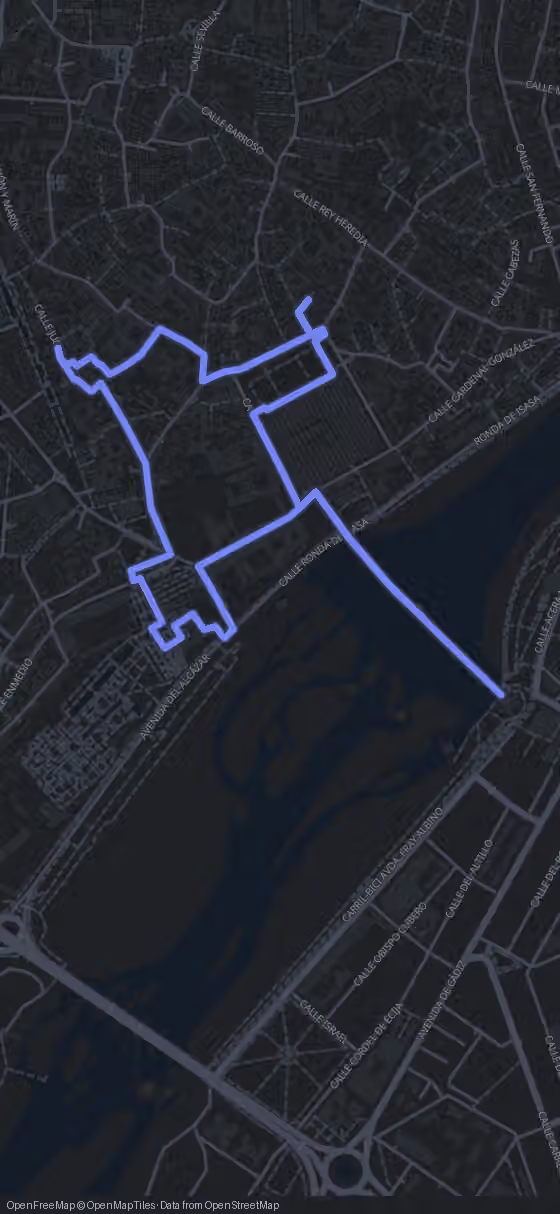
Route map for the Cordoba walking tour
Stop 1 of 8
730 m·9 min
Calahorra Tower
Cross the Roman Bridge and head west toward the Alcázar de los Reyes Cristianos
Hola, welcome to Cordoba. I'm Alex, and before one famous voyage began, its proposal was made inside a fortress here.
Try this tour with Alex

What this Cordoba route covers

Eight stops over 2.5 km: from the Calahorra Tower to the Alcázar de los Reyes Cristianos, the Synagogue of Córdoba, the Capilla Mudéjar de San Bartolomé, Calle de las Flores and the Mosque-Cathedral of Córdoba, then through the Puerta del Puente onto the Roman Bridge.

Pure walking time is 34 min; with the paid interiors, plan a little over four hours. The synagogue, the flower lane and the bridge are free. The GPS route runs free in your browser, and the AI Tour Guide is optional.

Open free GPS & optional AI Tour Guide
This short shows highlights of the route. All 8 stops follow below.

The Route

Walking Map of Cordoba: Eight Stops from Tower to Bridge

8 stops 2.5 km 34 min walking
Tap to load interactive map

The 8 stops along this route

  1. Calahorra Tower in Cordoba, stop 1 on the self-guided walking tour
    1Calahorra Tower
  2. Alcázar de los Reyes Cristianos in Cordoba, stop 2 on the self-guided walking tour
    2Alcázar de los Reyes Cristianos
  3. Synagogue of Córdoba in Cordoba, stop 3 on the self-guided walking tour
    3Synagogue of Córdoba
  4. Capilla Mudéjar de San Bartolomé in Cordoba, stop 4 on the self-guided walking tour
    4Capilla Mudéjar de San Bartolomé
  5. Calle de las Flores in Cordoba, stop 5 on the self-guided walking tour
    5Calle de las Flores
  6. Mosque-Cathedral of Córdoba in Cordoba, stop 6 on the self-guided walking tour
    6Mosque-Cathedral of Córdoba
  7. Puerta del Puente in Cordoba, stop 7 on the self-guided walking tour
    7Puerta del Puente
  8. Roman Bridge in Cordoba, stop 8 on the self-guided walking tour
    8Roman Bridge
  9. That's the full route.

    Walk it with an AI Tour Guide talking you through every one of these streets.

    Start free in your browser
    You made it

Your Cordoba Walking Tour, from the Calahorra to the Old Bridge

  1. 1

    Calahorra Tower

    Calahorra Tower in Cordoba, stop 1 on the self-guided walking tour

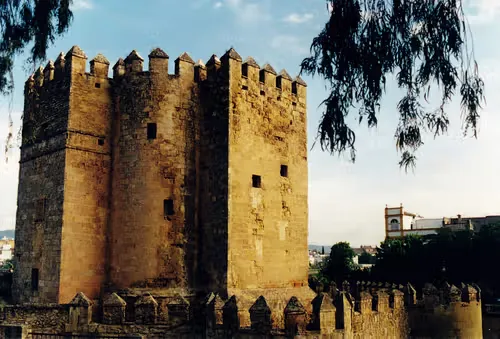
    You start at the fortress that was built to guard the Roman bridge from the southern bank of the Guadalquivir. Its origins are Islamic, but what you see today is the work of many centuries. Look at the outer walls for the coat of arms of Castile and León: it dates from the 14th century, when the tower played a part in the civil war between the brothers Pedro I and Enrique II over the Castilian throne. Enrique won, and he gave the fortress a moat and a second tower, linked to the first by a drawbridge.

    The tower first appears in the records in 1236, when Fernando III conquered Córdoba and the fortress stood in the way of his advance. Later a third tower was added and the three were joined by cylinders of the same height. Once gunpowder arrived, gun ports were cut into the walls, and in 1514 Queen Juana I ordered the barbican around the compound that gives it its present shape.

    Its later life was colourful: a prison for nobles, a girls' school from 1863, a Guardia Civil barracks. In 1952 mayor Antonio Cruz-Conde secured the building for the city, and after restoration it reopened on 29 April 1953 with an exhibition marking 500 years since the birth of the Gran Capitán; Francisco Franco attended the opening.

    Inside is the Living Museum of al-Andalus, opened in 1987. It charges entry and is worth it if you want the background of Muslim Córdoba before you walk into the old town; if you are short on time, the exterior and the view along the bridge are enough. From here it is 730 m, about 10 min, to the Alcázar de los Reyes Cristianos.
    Hours
    Oct and Mar–May: daily 10:00–19:00; Nov–Feb: daily 10:00–18:00; Jun–Sep: daily 10:00–14:00 and 16:30–20:30
    Price
    4.50 EUR, reduced 3 EUR, Córdoba residents 2 EUR
  2. 2

    Alcázar de los Reyes Cristianos

    Alcázar de los Reyes Cristianos in Cordoba, stop 2 on the self-guided walking tour

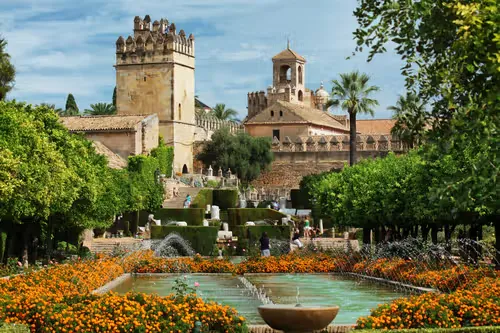
    The name means Castle of the Christian Monarchs, and the building lives up to its military purpose: sober, solid walls outside. King Alfonso XI of Castile ordered its construction in 1328, on ground that had already served as the residence of the Roman governor, a customs post and a Visigothic fortress. Later it became one of the main residences of Isabella I of Castile and Ferdinand II of Aragon.

    The deeper story lies underneath. When the Umayyads lost power in Damascus to the Abbasids, the surviving prince Abd ar-Rahman I fled to Córdoba and founded his own emirate here. He and his successors, who went on to proclaim the independent Caliphate of Córdoba, built the earlier Umayyad Alcázar on this site: the seat of power of al-Andalus, with baths, gardens and the largest library in the West. Watermills on the nearby Guadalquivir lifted water to irrigate the gardens.

    That garden tradition is the main reason to go inside. Behind the plain exterior the courtyards and gardens keep a Mudéjar spirit, and they reward a slow hour. Entry is paid; you'll find the current price at the ticket desk. If you only have time for one paid interior on this route, save it for the Mosque-Cathedral; with two, the Alcázar gardens are a fine second.

    From the Alcázar it is 600 m, around 9 min, to the synagogue. On the way you pass the Baños del Alcázar Califal and the Casa de Sefarad, two quieter places worth a glance if you are curious.

  3. 3

    Synagogue of Córdoba

    Synagogue of Córdoba in Cordoba, stop 3 on the self-guided walking tour

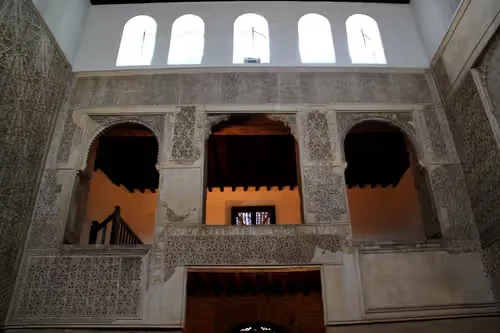
    At 20 Calle de los Judíos, in the heart of the Jewish quarter, stands a small building with a long memory. The synagogue was completed in 1315, and its Mudéjar design is attributed to Isaac Makheb. Pay attention to its size: it is so modest that it may have been the private synagogue of a wealthy family, a place of study, or even a guild workroom or a home before it became a house of prayer.

    It served as a synagogue until 1492. After the expulsion of the Jews it was seized and turned into the Hospital of Santa Quiteria for people suffering from rabies. In 1588 the shoemakers' guild bought it as a meeting place and small Christian chapel, dedicated to Saints Crispin and Crispinian, patrons of shoemakers. It was declared a National Monument in 1885 and restored in several phases.

    Two dates tie it to Maimonides, the philosopher born in Córdoba and buried in Tiberias. In 1935, for his 800th birthday, the square outside was renamed Tiberias Square, and the synagogue hosted the first openly held Jewish prayer service in 443 years. A later restoration, begun in 1977, reopened the building in 1985 for his 850th anniversary.

    It is the only synagogue in Córdoba that survived the years of persecution, and entry is free, so go in even if you only spend ten minutes. Then it is only 120 m, about 2 min, to San Bartolomé, passing the Zoco Municipal de Artesanía.

    Local name
    Sinagoga de Córdoba
    Hours
    Tue–Sun 09:00–15:00; Mon closed (except holidays/pre-holidays, then 09:00–15:00); closed 1+6 Jan, 1 May, 24/25/31 Dec
    Price
    Free
  4. 4

    Capilla Mudéjar de San Bartolomé

    Capilla Mudéjar de San Bartolomé in Cordoba, stop 4 on the self-guided walking tour

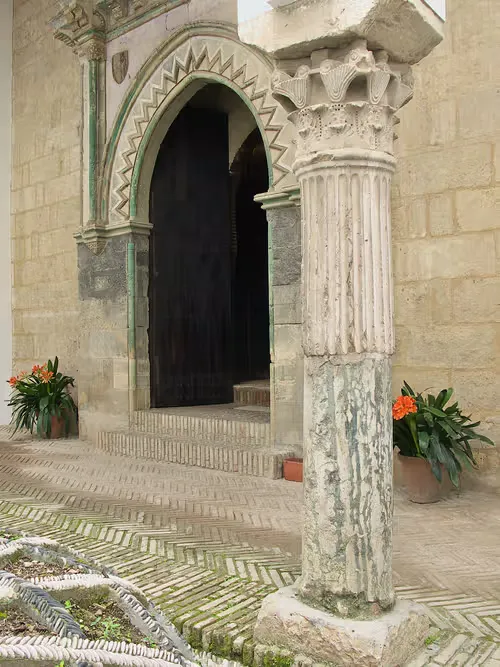
    This chapel is a lesser-known gem of Mudéjar art in Córdoba, mentioned in the same breath as the synagogue and the Royal Chapel inside the Mosque-Cathedral. It dates from between 1399 and 1410 and was built after the anti-Jewish riot of 1391, when the area was resettled and needed a parish of its own.

    Before you reach the chapel you pass through the church that was never finished, probably for lack of money: it has no roof, and only one of its two side aisles was built. Look at the capitals and column shafts, many of them reused Roman and Islamic pieces. Today this unfinished nave works as the anteroom to the chapel itself. In 1724 the complex was attached to Cardinal Salazar's hospital, now the university's Faculty of Philosophy and Letters.

    The founder may have been a converso named Diego Fernández Abencaçin, a city councillor and envoy of the future Fernando I of Aragon, whose missions to Nasrid Granada could explain the chapel's style. An Arabic inscription recorded in 1766 even claimed a mosque built by Almanzor and his wife Fátima in 976 had stood here.

    The chapel reopened in 2010 after restoration and charges only a small entry fee, which makes it an easy yes for anyone who likes decorative detail. Calle de las Flores is 380 m, about 5 min, away.

    Local name
    Capilla de San Bartolomé
    Hours
    Mon–Sat: 10:30–13:30, 15:30–18:30 | Sun: 10:30–13:30
    Price
    Individual visit 1.50 EUR Mon–Fri, 2 EUR Sat/Sun/holidays; groups 1 EUR Mon–Fri or 1.50 EUR weekends/holidays; free under 8 and University of Córdoba students
  5. 5

    Calle de las Flores

    Calle de las Flores in Cordoba, stop 5 on the self-guided walking tour

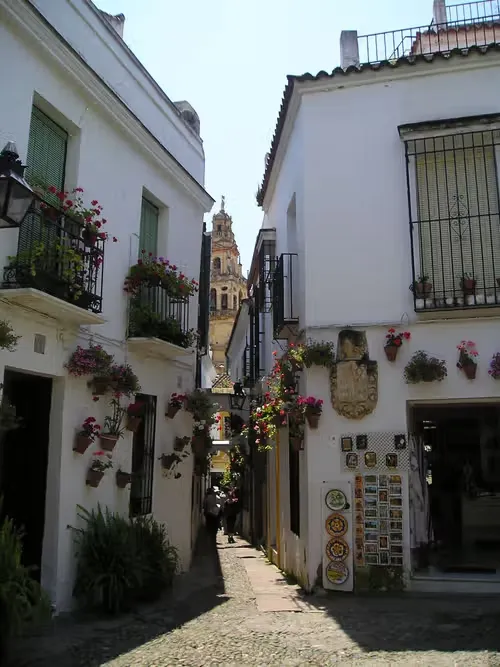
    Calleja de las Flores, as locals call it, is a narrow, pedestrian dead end that branches off Calle Velázquez Bosco and opens into a small square. It is one of Córdoba's most visited corners: a Spanish travel magazine named it the most beautiful street in Spain in 2018, and Condé Nast Traveler counted it among the world's prettiest in 2024.

    The little square was originally a typical Córdoba neighbours' courtyard that over the years turned into a street. The flowerpots began with one woman. In September 1939 Felisa, mother of Rafaela Tena, moved from La Carlota into number 2 of what was then Calle de los Jazmines, bringing hundreds of pots. Her terrace was too small, so she put the rest out in the street. Her neighbour Rafael Bernier Soldevilla, a surveyor for the city, liked it and followed her example.

    The lane's present look goes back to mayor Alfonso Cruz-Conde, who wanted to beautify certain spots in the city; it was his brother Antonio, the same man who saved the Calahorra Tower, who carried it out when he became mayor in turn.

    The lane is free and open at all hours, so a short stop is enough. Mosque-Cathedral of Córdoba is just 180 m, about 2 min, away.

    Local name
    Calleja de las Flores
    Hours
    Open 24/7
    Price
    Free
  6. 6

    Mosque-Cathedral of Córdoba

    Mosque-Cathedral of Córdoba in Cordoba, stop 6 on the self-guided walking tour

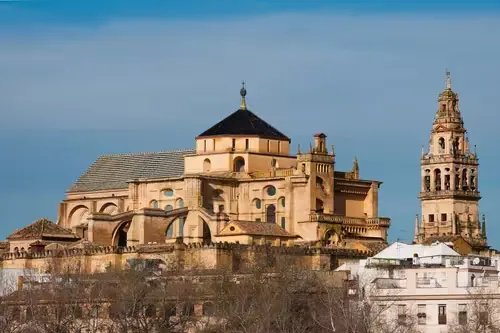
    This is Córdoba's most important monument and the reason many people come to the city. Before the Muslim conquest a Christian site stood here, which Islamic sources call the basilica of San Vicente and excavations show as a 5th-century episcopal complex. Abd ar-Rahman I, the founder of the emirate, built the great mosque at the end of his life, in 786.

    It grew under the emirs and above all under the caliphs. Abd ar-Rahman III added a new minaret in 958, and his son al-Hakam II created the most lavish part, the new mihrab and maqsura, in 971. At its height the mosque covered 23,400 square metres, second only to the mosque of Mecca in area. One detail to remember: the qibla wall does not face Mecca but points 51 degrees to the south, a common practice in al-Andalus.

    After Fernando III took the city in 1236, the building was consecrated as a church, and two years later it became the cathedral under its first bishop, Lope de Fitero. The big architectural change came only with the cruciform main chapel, built between 1523 and 1607 under the architects Hernán Ruiz I, Hernán Ruiz II and Juan de Ochoa. That mix of caliphal arches and Renaissance chapel is what you walk into.

    This is the one interior worth paying for on the whole route; give it at least an hour. Afterwards it is 330 m, about 4 min, to the Puerta del Puente.

    Price
    15 EUR; over 65, students aged 15–26 and Youth Card holders 12 EUR; children aged 10–14 8 EUR; children under 10 free
  7. 7

    Puerta del Puente

    Puerta del Puente in Cordoba, stop 7 on the self-guided walking tour

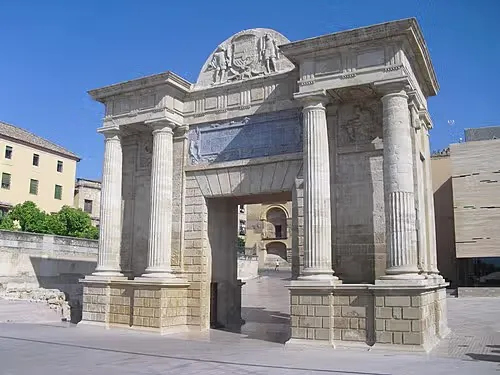
    The gate is currently closed, so you see it from the outside, which is how it works best anyway: as a monumental frame between the city and the bridge. It is one of only three historic city gates that survive in Córdoba, together with the Puerta de Almodóvar and the Puerta de Sevilla.

    The present gate is Renaissance, built in the 16th century to mark the Cortes held by Philip II in Córdoba in 1570. The city wanted a grander entrance because the old gate was in poor shape and this was one of the busiest ways into town for people and supplies.

    The spot itself is far older. Between the reigns of the emperors Tiberius and Claudius, in the middle of the 1st century, the Romans built a three-arched gate here, where the Via Augusta crossed the river on the bridge. In Islamic times it protected the mosque and the Alcázar and carried several names, among them Bab al-Wadi, the River Gate, and Bab al-Qantara, the Bridge Gate. The last stop is only 150 m, about 2 min, ahead.

    Status
    Currently closed
  8. 8

    Roman Bridge

    Roman Bridge in Cordoba, stop 8 on the self-guided walking tour

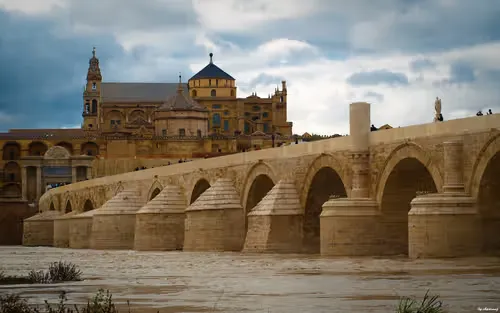
    You finish where Córdoba began to connect with the world. For two thousand years this was the city's only bridge over the Guadalquivir, until the San Rafael Bridge was built in the mid-20th century, which is why locals still call it the Old Bridge. The Via Augusta, the road linking Rome with Cádiz, most likely ran across it.

    Most of what you walk on is not Roman. Early in Muslim rule, the Umayyad governor Al-Samh ibn Malik al-Khawlani had a bridge built on the ruins of the Roman one, and it was repaired many times, notably in the 10th century. Today it has 16 arches, one fewer than originally, measures 247 metres in length and about 9 metres in width. Only the 14th and 15th arches, counted from the Puerta del Puente, are original.

    Halfway across, look for the statue of Saint Raphael, placed here in the 17th century and made by Bernabé Gómez del Río. Since 1 May 2004 the bridge has been pedestrian only, so you can take your time.

    The bridge is free and open around the clock. At its far end the Calahorra Tower closes the circle: you are back where you started.

    Hours
    Open 24/7
    Price
    Free
Walking tour route map of Cordoba Route loaded
Calahorra TowerAlcázar de los Reyes CristianosSynagogue of CórdobaCapilla Mudéjar de San Bartolomé+4
All 8 stops are already on the map.
You just press start.
AI Tour Guide

You've read the route along the Guadalquivir. Now walk it with a guide in your ear.

Press start wherever you are, even hundreds of kilometres from Cordoba, and the guide begins telling its stories right away. In the city, pick any of the 8 stops to start from: it leads you there, then talks with you the whole route, asking, listening, remembering, and shaping the tour around your answers.

8stops 2.5km 34 minwalking 13languages
▶Start the tour free

Free to start · Runs in your browser · No app, no download

Three ways to walk Cordoba

The full route works best with a morning to spare, but it splits easily depending on your time and budget.

The full route with interiors

Stops: 1, 2, 3, 4, 5, 6, 7, 8

For first-time visitors who want the whole story of Córdoba. You walk 34 min in total and go inside the Calahorra Tower, the Alcázar, the synagogue, the chapel and the Mosque-Cathedral. Count on a little over four hours, plus entry fees everywhere except the synagogue.

The free-entry walk

Stops: 1, 2, 3, 4, 5, 6, 7, 8

For tight budgets or a first look before deciding what to enter. Same 34 min of walking, but you only go inside the synagogue, which is free, and enjoy the rest from the outside, the flower lane and the bridge included. About an hour and a half.

Jewish quarter and Mosque-Cathedral

Stops: 3, 4, 5, 6

For anyone with a short window who wants the heart of the old town. Only 9 min of walking from the synagogue via San Bartolomé and Calle de las Flores to the Mosque-Cathedral. The chapel and the Mosque-Cathedral charge entry; plan about two hours.

How Long Does This Cordoba Tour Take, with and without Interiors?

The legs between stops add up to 34 min of walking, and most of them are short: from the synagogue onwards no leg takes longer than 5 min. The real time goes into the interiors, above all the Alcázar gardens and the Mosque-Cathedral, where an hour each is a sensible plan.

A sample day: start at 10:00 at the Calahorra Tower and spend 40 min in the museum, reach the Alcázar at 10:50 and leave around 11:50, arrive at the synagogue at 11:59 and at San Bartolomé at 12:16, so you see both before lunch. After Calle de las Flores you are at the Mosque-Cathedral at 12:48; leave it around 13:48 and you stand on the Roman Bridge at about 14:00, with a quarter of an hour there bringing the total to roughly 4 hours 15 minutes.

The free-entry walk takes around an hour and a half, the Jewish quarter and Mosque-Cathedral loop about two hours.

Before you set off in Cordoba

  • Start and finish: The recommended start is the Calahorra Tower, and the route ends on the Roman Bridge, right back at the tower. You can join at any stop; the GPS navigation in your browser guides you from stop to stop and, if you like, from the last stop back to the start.
  • Best day: Any day suits the bridge, Calle de las Flores and the views from outside. For the interiors, especially the synagogue and the Capilla Mudéjar de San Bartolomé, check before you go that they are open on your day.
  • Time of day: Start in the morning at the Calahorra Tower, when it is open. The morning is also the best slot for the Jewish quarter.
  • Costs: The Calahorra Tower, San Bartolomé, the Alcázar and the Mosque-Cathedral charge entry. The synagogue, Calle de las Flores and the Roman Bridge are free.
Walking tour route map of Cordoba
AI Tour Guide

Your guide is waiting at the Calahorra Tower whenever you are.

Press start and a voice AI Tour Guide takes it from here: leading the route through Cordoba, telling the stories, and turning your walk into a real back-and-forth conversation. No app or download is needed; it runs in your browser.

8stops 2.5km 34 minwalking 13languages
▶Start the tour free

Free to start · Runs in your browser · No app, no download

What the AI Tour Guide adds on the Córdoba route

On this route the stories of Romans, Umayyads, Castilian kings and Jewish Córdoba overlap at every corner, and the AI Tour Guide leads you through them as a conversation. It greets you at the river, tells the history of each place as you arrive, asks what grabs you and remembers it: if the shoemakers' guild in the synagogue made you curious, it picks up that thread again later, and if you'd rather hear about daily life under the caliphs than about building dates, it shifts the conversation. You can interrupt whenever you like. The route and map stay free; the first 100 credits are on the house, and after that you choose between this tour all-inclusive for €19.99 with no time limit or €5 per hour.

A Real Conversation A voice AI Tour Guide greets you, leads the whole route, and tells the stories and facts as you walk, asking what you want to see and keeping a real conversation going. Not a recording you press play on.
Map Navigation Follow the route on the map and walk at your own pace. You choose where to start and when to move to the next stop.
Ask Anything Curious about a building you pass? Ask your AI Tour Guide on the spot and the conversation carries on.
13 Languages Switch language anytime. No separate tour needed.
Start free in your browser

Common Questions about Walking Córdoba

When is the best time of day to visit the Calahorra Tower?

In the morning, at the start of the walk. That way the museum gives you the background of Muslim Córdoba before you head into the old town.

Is the Synagogue of Córdoba still used for worship?

No. It no longer functions as a house of worship and is open to the public as a historic site, free of charge.

Are there reduced tickets for the Mosque-Cathedral?

Yes. Young children go free, and older children, seniors, students and Youth Card holders pay a reduced price.

Can I combine Córdoba with other Andalusian cities?

Easily as part of a longer trip: Seville lies about 120 km away and Granada about 130 km. After the Mosque-Cathedral, the Alhambra city makes a natural next chapter of al-Andalus.

Is the tour really free?

Yes. The whole tour is free: the route, the interactive map and the navigation cost you nothing. Only the voice AI Tour Guide is optional and paid: you test it with 100 free credits, then you pay either €5 per hour or €19.99 for this whole tour, with no time limit. Admission to 4 of the 8 stops is not included: Calahorra Tower, Alcázar de los Reyes Cristianos, Capilla Mudéjar de San Bartolomé and Mosque-Cathedral of Córdoba charge their own entry fees.

Do I need to download an app?

No. Everything runs in your phone browser. Open the route and start walking, no download and no sign-up required.

Do I need to book the walking tour in advance?

No booking needed. This self-guided tour is available anytime. Open the route in your browser and start walking. The AI Tour Guide works instantly, no app, no reservation required.

What languages is the AI Tour Guide available in?

The AI Tour Guide speaks 13 languages, so you take the tour in your own language and can switch at any time.

Can I skip stops or change the route?

Yes. Skip any stop, spend extra time at places you like, or start the route from any point. It is your walk, you set the pace.
Image credits
▶ Start free in your browser Runs in your browser, no app, no download