Free Walking Tour Malaga: Alcazaba to Gibralfaro

Start inside Moorish walls, cross the old town past Picasso's birthplace and finish high on Gibralfaro with the whole city below you.

11 Stops 4.0 km ~1 h 1 min walking
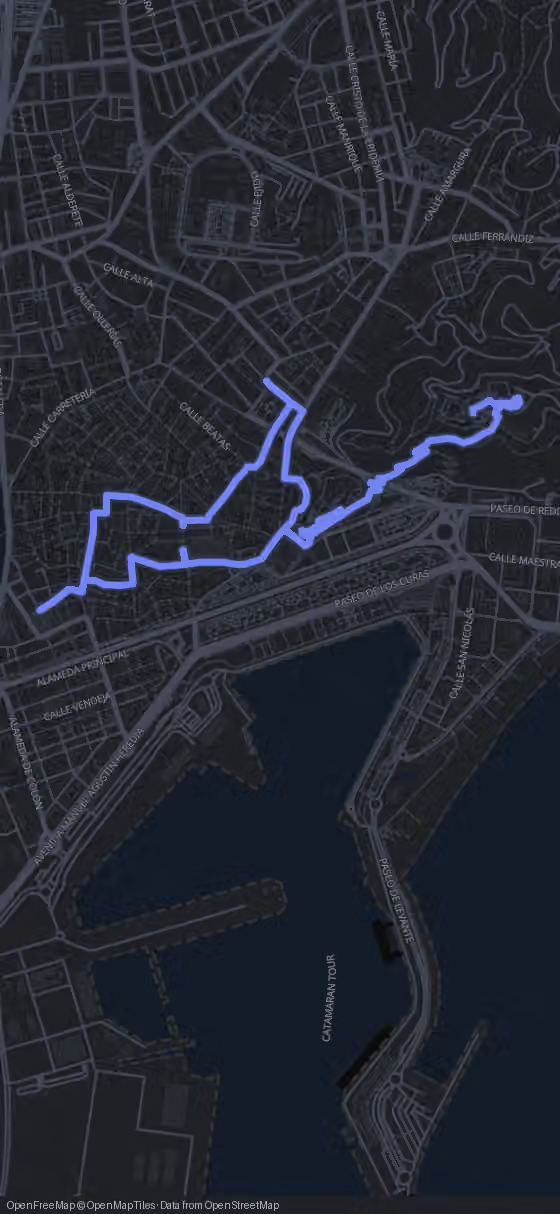
Route map for the Malaga walking tour
Stop 1 of 11
630 m·8 min
Alcazaba
Head south-west toward the Customs Palace.
Hola, welcome to Málaga. I'm Alex, and this city lets you see how one civilization literally built on another.
Try this tour with Alex

This Route at a Glance

Eleven stops lead from the Alcazaba through the old town to Gibralfaro Castle: 4.0 km with 1 h 1 min of pure walking. With the main interiors and a fish lunch at Atarazanas Market, plan about eight hours.

Larios Street, Constitution Square, the market and the Roman Theatre are free; the fortresses, Malaga Cathedral and Picasso Museum Málaga charge entry. The GPS route in your browser is free and leads you from stop to stop; the AI Tour Guide is optional.

Open free GPS & optional AI Tour Guide
This short shows highlights of the route. All 11 stops follow below.

The Route

Walking Map of Malaga from Fortress to Castle Hill

11 stops 4.0 km 1 h 1 min walking
Tap to load interactive map

The 11 stops along this route

  1. Alcazaba in Malaga, stop 1 on the self-guided walking tour
    1Alcazaba
  2. Customs Palace in Malaga, stop 2 on the self-guided walking tour
    2Customs Palace
  3. Malaga Cathedral, stop 3 on the self-guided walking tour
    3Malaga Cathedral
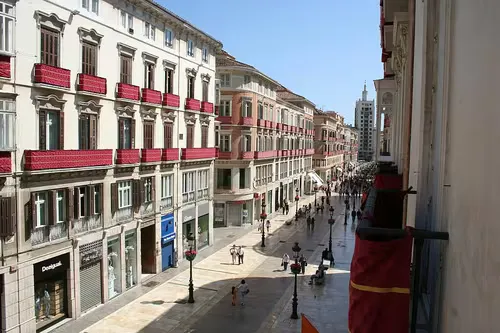
  4. Larios Street in Malaga, stop 4 on the self-guided walking tour
    4Larios Street
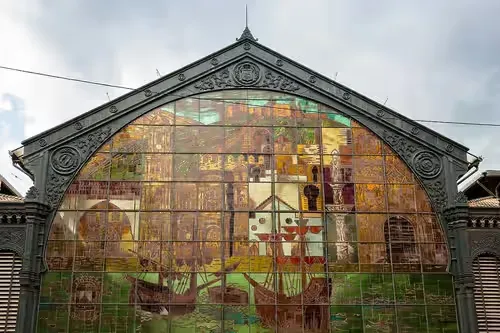
  5. Atarazanas Market in Malaga, stop 5 on the self-guided walking tour
    5Atarazanas Market
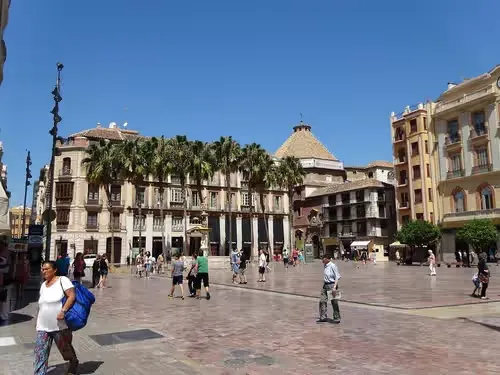
  6. Constitution Square in Malaga, stop 6 on the self-guided walking tour
    6Constitution Square
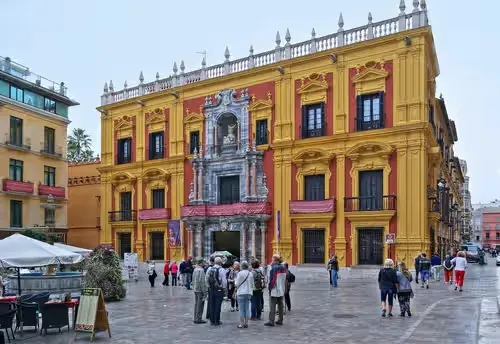
  7. Episcopal Palace in Malaga, stop 7 on the self-guided walking tour
    7Episcopal Palace
  8. Picasso Museum Málaga in Malaga, stop 8 on the self-guided walking tour
    8Picasso Museum Málaga
  9. Picasso Birthplace Museum in Malaga, stop 9 on the self-guided walking tour
    9Picasso Birthplace Museum
  10. Roman Theatre in Malaga, stop 10 on the self-guided walking tour
    10Roman Theatre
  11. Gibralfaro Castle in Malaga, stop 11 on the self-guided walking tour
    11Gibralfaro Castle
  12. That's the full route.

    Walk it with an AI Tour Guide talking you through every one of these streets.

    Start free in your browser
    You made it

Your Malaga Walking Tour, Eleven Stops in Order

  1. 1

    Alcazaba

    Alcazaba in Malaga, stop 1 on the self-guided walking tour

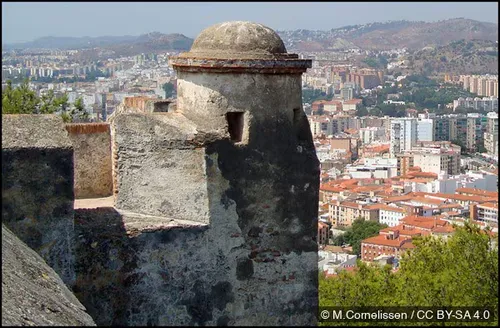
    The name comes from the Arabic al-qasbah, the citadel, and that is exactly what rises in front of you at the foot of Gibralfaro hill: a palace fortress from the Islamic period, raised on top of an even older Phoenician and Punic stronghold. It once formed the eastern end of the walls that enclosed the old medina of Mālaqa, so the town pressed right up against it.

    Read the walls as layers of defence. Leopoldo Torres Balbás, the architect who restored it, called the Alcazaba the prototype of 11th-century taifa military architecture, with its double ring of walls and many fortifications, and the only parallel he saw was the Krak des Chevaliers, the Crusader castle in Syria. Today the complex covers 15,000 square metres, which old plans show is less than half of what it covered at its height.

    A walled corridor called La Coracha ties the fortress to Gibralfaro Castle on the summit, where this walk ends. Down here at the gate you stand beside the Roman Theatre and opposite the Customs Palace: Roman, Andalusí and Renaissance Malaga within a few metres of each other.

    Going in is worth an hour for anyone curious about Moorish Spain. Entry is paid, and if you plan to climb Gibralfaro later, the combined ticket covers both. From the gate it is 300 m, 4 minutes, to the Customs Palace.
    Hours
    1 Apr–31 Oct: daily 09:00–20:00; 1 Nov–31 Mar: daily 09:00–18:00; last entry 1 hour before closing
    Price
    7 EUR, reduced 3 EUR; combined ticket with Gibralfaro Castle 10 EUR
  2. 2

    Customs Palace

    Customs Palace in Malaga, stop 2 on the self-guided walking tour

    The Palacio de la Aduana was planned as the customs house of Malaga's port. Manuel Martín Rodríguez proposed it in 1787, Charles III approved it, and work began in 1791 under the architects Miguel del Castillo and Ildefonso Valcárcel, who drew the main façade. In 1810, still unfinished, it was sacked by French troops during the Peninsular War. Pedro Nolasco Ventura reworked the plans after the war, and the building was finally completed in 1829.

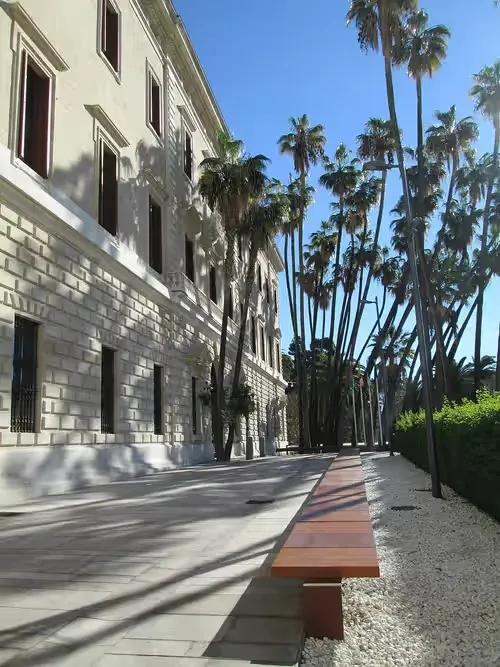
    Its model was the Italian Renaissance palace: rusticated stone outside, tall palms flanking the main façade, and inside a central patio with arcades on the lower two floors. On the top floor the gallery is set back behind an openwork balustrade, with Roman busts placed between its sections.

    The building changed roles again and again: Royal Tobacco Factory in the later 19th century, seat of the city government, then the office of the Spanish government in the province from the Franco era, also used by the National Police. Fire marked it twice. The original roof burned in the tobacco factory years, and on 25 and 26 April 1922 a far worse blaze reached the top floor, where 70 government officials lived. 28 people died, and years of archives were lost.

    Today it houses the Museo de Málaga, whose fine arts collection ended up here after the Picasso Museum took over its former home in the Buenavista Palace. Entry is free for EU citizens with ID, while everyone else pays a small fee. Twenty minutes are enough to see the patio and the galleries around it. Then it is 290 m, 4 minutes, to the cathedral.

    Local name
    Palacio de la Aduana
    Hours
    Tue–Sat 09:00–21:00; Sundays and public holidays 09:00–15:00; closed Mondays (Mondays before a holiday open with holiday hours); closed 1 and 6 January, 1 May and 24, 25 and 31 December
    Price
    EU citizens free (with ID); other nationalities 1.50 EUR
  3. 3

    Malaga Cathedral

    Malaga Cathedral, stop 3 on the self-guided walking tour

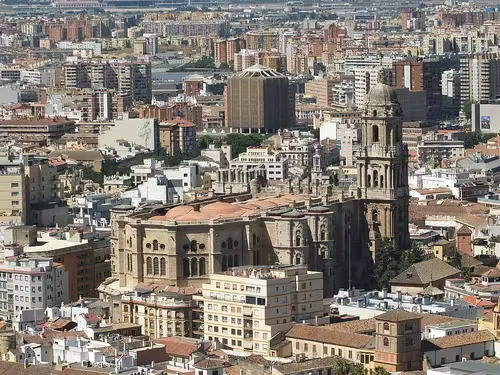
    Malaga's cathedral took more than 250 years: building began in 1528 to plans by Diego de Siloe and stopped in 1782. Inside and out it follows the Renaissance tradition, except for the Baroque façade in front of you. Its lower level has three arches with portals separated by marble columns. Look at the stone medallions above the doors: the side ones show Malaga's patron saints, Cyriacus and Paula, and the central one the Annunciation, which gives the church its full name, Catedral de la Encarnación.

    Then look up. The north tower reaches 84 metres, which makes this the second-highest cathedral in Andalusia after the Giralda in Seville. The south tower was never finished because the money ran out.

    Where that money went is the best story here. To pay for the work, the Crown taxed every ship calling at Malaga by the weight of the goods it loaded, and once trade with America opened up from 1776, construction moved fast. At the end of the century, though, funds assigned by Charles III were passed through the canon Tomás de Unzaga to his brother Luis de Unzaga, governor of Louisiana, as aid for the Americans rising against England. Part of the missing tower, in other words, went to American independence.

    Inside, the nave is wider than the two aisles but rises to the same height, which makes the space feel unusually open. The ticket includes an audio guide that covers the church well; the guided tour adds little. The upgrade that is worth it is the roof tour, with a view onto the Alcazaba and the bells; ask for it at the ticket desk. Larios Street is 190 m away, 2 minutes.

    Local name
    Catedral de la Encarnación de Málaga
    Hours
    Mon–Fri 10:30–18:30, Sat 10:30–18:00, Sun 14:00–18:00 (last entry 45 min before closing, seasonally varying)
    Price
    10 EUR standard (incl. audio guide), 15 EUR with guided tour
  4. 4

    Larios Street

    Larios Street in Malaga, stop 4 on the self-guided walking tour

    Calle Marqués de Larios is considered one of the most elegant 19th-century streets in Spain, and it is expensive too: in 2018 it ranked as the third most expensive street in the country for shop rents. Walk it slowly and look at the uniform façades rather than the shop windows.

    What stood here before tells you why it exists. The street replaced a maze of narrow lanes from the Muslim town plan, many of them unhealthy and cramped, with names like Siete Revueltas, the street of seven twists, the Callejón del Perro and the Callejón del Gato. In their place came a wide, straight, modern street linking the heart of the city with the Alameda Principal and the Parque, part of a wider push from the late 19th century to modernise the centre.

    It is named after its main promoter, Manuel Domingo Larios y Larios, second Marquis of Larios, whose family came from Laguna de Cameros in La Rioja to make their fortune in Malaga. He still presides over the street in a sculpture group by Mariano Benlliure at the junction with the Alameda Principal. During the Second Republic it was briefly renamed Calle 14 de Abril. On 14 December 2002 it became pedestrian, the start of the big regeneration of the historic centre.

    The street is free and always open; enjoy it on foot, but eat elsewhere. From here it is 350 m, 5 minutes, to Atarazanas Market.

    Local name
    Calle Marqués de Larios
    Hours
    Always open
    Price
    Free
  5. 5

    Atarazanas Market

    Atarazanas Market in Malaga, stop 5 on the self-guided walking tour

    The Mercado Central de Atarazanas was built between 1876 and 1879 by the architect Joaquín de Rucoba on the site of a Nasrid shipyard, an atarazana, which gave the market its name. Of the shipyard only a marble gateway survives, and the old Muslim building shaped the new one: the market is neo-Arab in style, with Nasrid and Caliphal details.

    Before the market, the shipyard served as barracks and military hospital and was close to collapse. From 1822 people petitioned to pull down its towers because they blocked the way, and in 1840 the provincial council ruled in favour of demolition. In 1868 the Revolutionary Junta ordered the remains of the walls torn down, partly to give work to the poor, and decided on a covered market, because all of the city's markets were in the open air and unhygienic. Officially it was named after Alfonso XII.

    Look first at the main façade, which once faced the sea: the Nasrid gateway was reassembled here 25 metres forward of its original spot. The building has three naves on a slightly trapezoid plan, carried by an iron skeleton largely cast at the San Antonio foundry in Seville, the same works that built the Triana bridge there. At the back, a triangular iron pediment frames a large glazed arch.

    Entry is free. Come hungry, because the bars inside fry fish all morning. Then walk 420 m, 6 minutes, to Constitution Square.

    Hours
    Mon–Sat 09:00–14:00, Sun closed
    Price
    Free (entry)
  6. 6

    Constitution Square

    Constitution Square in Malaga, stop 6 on the self-guided walking tour

    This was Malaga's Plaza Mayor, and since the 15th century it has been the city's main public and political space. Even under the Nasrids it was a principal square, known as the Plaza de las Cuatro Calles. A plan from 1571 shows its final shape, lined with the town hall (here until 1869), the houses of the corregidor and the cathedral chapter, the prison, the court and the butchers' stalls.

    Its name follows Spain's history. It became Plaza de la Constitución in 1812, when the constitution known as La Pepa was proclaimed, then changed again and again: Plaza de la Libertad, de la República Federal, de José Antonio Primo de Rivera, until democracy brought back the original name. Look down at the paving: steel plates laid in 2004 reproduce newspaper front pages from the days after the 1978 Constitution was approved.

    The 19th century took buildings away, among them the chapel of Santa Lucía and the public prison, where the companions of General Torrijos were locked up in December 1831. It also added Spain's first shopping arcade, the Pasaje Heredia, built in 1837 by Manuel Agustín Heredia after the arcades of Paris and London and remodelled in 2011. From the same years comes the Pasaje Chinitas, named after the café-theatre where much of Malaga's bohemian life gathered.

    The square is free and always open, and most of the city's cultural events have some link to it. The 220 m, 3 minutes to the Episcopal Palace lead through the lanes of the historic centre.

    Local name
    Plaza de la Constitución
    Hours
    Always open
    Price
    Free
  7. 7

    Episcopal Palace

    Episcopal Palace in Malaga, stop 7 on the self-guided walking tour

    The bishops' palace stands on Plaza del Obispo, right by the cathedral. Archbishop José Francisco Lasso de Castilla paid for it from 1762, and the plans came from Antonio Ramos, the architect who took over the cathedral works after José de Bada died in 1756. The palace became Ramos's most important building and one of the finest examples of civil architecture in Malaga.

    Stand back to take in the façade: three floors with paired pilasters, balconies above and large windows below, crowned by straight and curved pediments in a restrained Baroque. In the centre sits a portal shaped like an altarpiece, three tiers of grey and pink marble in which the number of columns shrinks from floor to floor. Note the sweeping balcony over the door, the coats of arms and, at the top, a deep niche with the Virgen de las Angustias by Fernando Ortiz.

    Inside, Ramos arranged everything around two patios: the first, with low arcades, held the public rooms, while the second, open with balconies, framed the private quarters of the prelate. Today the Centro Fundación Unicaja shows exhibitions here. Entry is paid, and the fee is posted at the door; go in if the current show interests you, otherwise the façade is the main event.

    The Picasso Museum is 230 m away, 3 minutes.

    Hours
    Centro Fundación Unicaja (exhibitions in the palace): Mon–Sat 10:00–14:00 and 16:00–19:00; Sundays and public holidays 10:00–14:00
  8. 8

    Picasso Museum Málaga

    Picasso Museum Málaga in Malaga, stop 8 on the self-guided walking tour

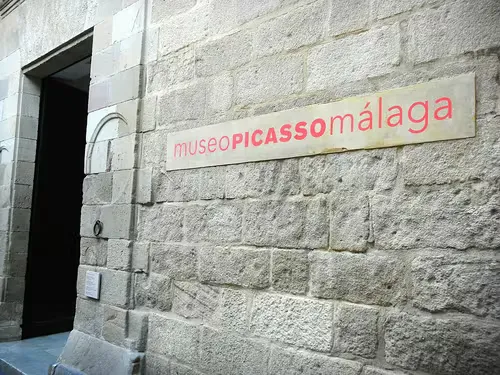
    Pablo Ruiz Picasso was born in Malaga, and since 17 October 2003 his city has had a museum worthy of him, in the Buenavista Palace. The king and queen of Spain came to the opening.

    The idea is much older. In 1953, under Franco, Picasso was in touch with Juan Temboury Álvarez, Malaga's provincial delegate for fine arts, and this very building was discussed as a site, but nothing came of it. Decades later Christine Ruiz-Picasso, widow of the artist's eldest son Paulo, worked with the city on the exhibitions Picasso Clásico in 1992 and Picasso, primera mirada in 1994, and by 1996 the plan for a major museum was alive again.

    Christine donated 133 works: 14 paintings, 9 sculptures, 44 drawings, a sketchbook with 36 more, 58 engravings and 7 ceramics. Her son Bernard, Picasso's grandson, added 22 more, for 155 in total, and many further pieces are on long-term loan. The collection runs from his early academic studies through cubism to his late reworkings of the Old Masters, so you see the whole arc of the career in one visit. A library with more than 800 titles on Picasso sits alongside.

    If you pay for one museum on this walk and you care about modern art, make it this one; allow about 90 minutes. From here it is 330 m, 5 minutes, to Plaza de la Merced and the house where he was born.

    Hours
    Mar–Jun: Daily 10:00–19:00 | Jul–Aug: Daily 10:00–20:00 | Sep–Oct: Daily 10:00–19:00 | Nov–Feb: Daily 10:00–18:00; closed Dec 25, Jan 1, Jan 6; last entry 30 min before closing
    Price
    Single entry 13 EUR / reduced 11 EUR
  9. 9

    Picasso Birthplace Museum

    Picasso Birthplace Museum in Malaga, stop 9 on the self-guided walking tour

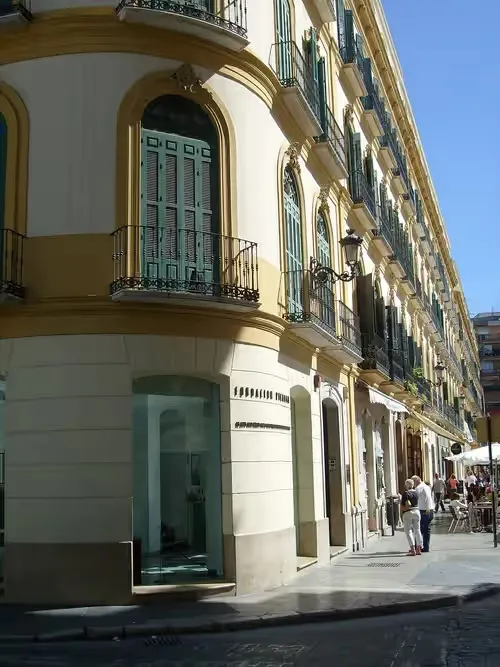
    Picasso was born in this house on Plaza de la Merced. Today it is the Museo Casa Natal, declared a Historical-Artistic Monument of National Interest, and the headquarters of the Fundación Picasso, which the city government created in 1988. In 2005 the foundation added a second exhibition space at number 13 of the same square.

    Don't mix it up with the museum you have just seen: that one belongs to a separate foundation built on the Ruiz-Picasso family's gifts. The birthplace is smaller and more personal, with a documentation centre on Picasso, its own collection of his works and a strong focus on engravings by many artists. It also holds work by the philosopher, inventor and kinetic sculptor Frank Rebaxes and a collection of sketches by Luis Molledo.

    Entry is paid, but half an hour is enough, and for Picasso fans it is the natural pair to the big museum. Then walk 440 m, 6 minutes, back towards the hill to the Roman Theatre.

    Local name
    Casa natal de Pablo Ruiz Picasso
    Hours
    Daily: 09:30–20:00
    Price
    3 EUR
  10. 10

    Roman Theatre

    Roman Theatre in Malaga, stop 10 on the self-guided walking tour

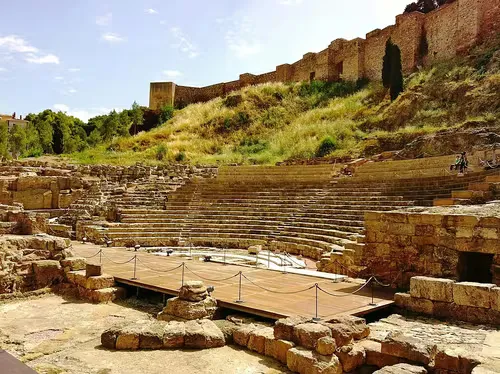
    These are the remains of the theatre of ancient Malaka and the main surviving trace of Roman Malaga, built in the early years of the Empire at the foot of the Alcazaba hill. Its builders mixed two methods: where the slope allowed, they set the seating into the hillside as the Greeks did, and where there was no rock, they built it up.

    For centuries nobody knew it was here. It turned up in 1951 during work on a garden, and the first finds were taken for a gate in the city wall until they were recognised as the aditus maximus, the main entrance of a Roman theatre. The rest lay under the Casa de la Cultura, a modern building for archives, libraries and museums. After years of study and debate it was demolished in the 1990s, and the whole site was excavated, restored and opened.

    Much of the cavea, the seating, survives, along with the orchestra paved in large marble slabs and the stage, where a wooden floor now reproduces the original. The back of the stage would have closed with a decorated façade of openings, columns and statues, several of which were recovered. You visit through an interpretation centre next to the theatre and on wooden walkways across the site.

    Entry is free. The last leg is the longest: 1210 m, 23 minutes, climbing steeply to Gibralfaro Castle.

    Local name
    Teatro romano
    Hours
    Tue–Sat 10:00–18:00, Sun/public holidays 10:00–16:00, Mon closed. Closed 1/6 Jan, 1 May, 24/25/31 Dec. Last entry 30 min before closing.
    Price
    Free
  11. 11

    Gibralfaro Castle

    Gibralfaro Castle in Malaga, stop 11 on the self-guided walking tour

    The hill takes its name from a lighthouse: the old Phoenician enclosure up here held one, hence Jbel-Faro, the mount of the lighthouse. Abd al-Rahman III turned the ruins into a fortress, and in 1340 the Nasrid king Yusuf I enlarged it into a castle palace. It was built to house troops and protect the Alcazaba below, because artillery had made the summit the key to the city.

    It was counted among the most impregnable fortresses of the peninsula, and the Catholic Monarchs needed the whole summer of 1487 to besiege it. After the siege Ferdinand took up residence in the castle, while Isabella chose to live down in the city.

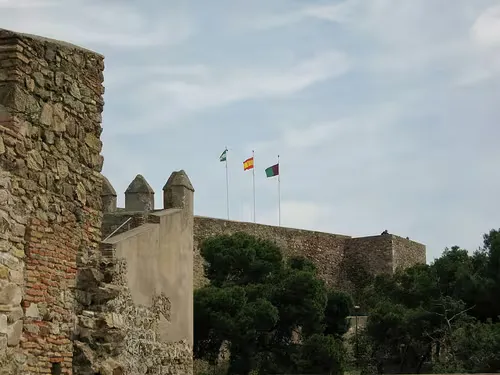
    Two lines of walls and eight towers make up the castle. The outer wall joins the coracha, the zigzag walls that tie Gibralfaro to the Alcazaba, and the inner wall carries a walkway around the entire perimeter. In the upper part, the main courtyard, you find the interpretation centre, the 17-metre Torre Mayor, the Phoenician well and the baths; the Airón well is cut 40 metres into solid rock. The lower parade ground held the barracks and stables, and the Torre Blanca still has its cistern and storerooms.

    From the walls the whole city spreads out below, and on clear days you can make out mountains of the Rif in Africa and the Strait of Gibraltar. Entry is paid; if you bought the combined ticket at the Alcazaba, you are already covered. This is the end of the walk; on request the GPS navigation leads you back down to the start.

    Hours
    1 Apr–31 Oct: daily 09:00–20:00; 1 Nov–31 Mar: daily 09:00–18:00; last entry 1 hour before closing
    Price
    Paid entry; combined ticket with the Alcazaba 10 EUR, reduced 5 EUR
Walking tour route map of Malaga Route loaded
AlcazabaCustoms PalaceMalaga CathedralLarios Street+7
All 11 stops are already on the map.
You just press start.
AI Tour Guide

Now walk from the Alcazaba to Gibralfaro with a guide in your ear

Press start wherever you are, even hundreds of kilometres from Malaga, and the guide begins telling its stories right away. In the city, pick any of the 11 stops to start from: it leads you there, then talks with you the whole route, asking, listening, remembering, and shaping the tour around your answers.

11stops 4.0km 1 h 1 minwalking 13languages
▶Start the tour free

Free to start · Runs in your browser · No app, no download

Shorter Ways to Walk Malaga's Old Town

Not everyone has a full day. These three cuts follow the same order and leave out what you can spare.

Old town and market morning

Stops: 1, 2, 3, 4, 5, 6, 7

For a first morning in Malaga: the Alcazaba, the cathedral, Larios Street and the market, ending at the Episcopal Palace. 24 minutes of walking, about four hours with visits. The Alcazaba and the cathedral are paid, and the Customs Palace is free for EU citizens. Start early so you reach the market while it is still open.

Picasso, Romans and the castle

Stops: 8, 9, 10, 11

For an afternoon with art and a view: both Picasso museums, the Roman Theatre and the climb to Gibralfaro. 34 minutes of walking, just under four hours with visits. Both Picasso museums and Gibralfaro are paid, the Roman Theatre is free, and the combined ticket for Gibralfaro also covers the Alcazaba.

Everything except the climb

Stops: 1, 2, 3, 4, 5, 6, 7, 8, 9, 10

For anyone who would rather not tackle the hill: the whole old town, finishing at the Roman Theatre right below the Alcazaba. 38 minutes of walking, about 6 h 40 min with the same visits as the full day. You save the 23-minute climb and the Gibralfaro ticket.

How Long This Malaga Tour Takes, Hill Climb Included

The pure walking time is 1 h 1 min over 4.0 km. Ten of the eleven legs in the old town take between 2 and 6 minutes each; the one real effort is the last leg, 1210 m and 23 minutes up to Gibralfaro Castle.

With the interiors that are worth it, a Tuesday to Saturday plan looks like this: Alcazaba at 09:00 for an hour, 25 minutes at the Customs Palace, the cathedral at 10:33 for an hour, a fish lunch at the market from 11:50, the Picasso Museum at 13:07 for 90 minutes, the birthplace at 14:42, the Roman Theatre at 15:18 and Gibralfaro Castle at 16:01. After an hour on the castle walls you finish around 17:00, about eight hours in total.

The old town morning takes about four hours, the Picasso and castle afternoon just under four, and the route without the climb about 6 h 40 min.

Before You Set Off in Malaga

  • Start and finish: The recommended start is the Alcazaba gate, but you can join at any stop. The route ends at Gibralfaro Castle; on request the GPS navigation leads you from there back down to the start.
  • Best day and time: Tuesday to Saturday works best, starting in the morning at the Alcazaba.
  • Costs: The main tickets are the combined Alcazaba and Gibralfaro ticket, the cathedral with audio guide, the Picasso Museum and the birthplace. Non-EU visitors also pay at the Customs Palace, and the Episcopal Palace exhibitions charge a fee at the door.

Food and Breaks Between the Market and the Old Town

The best meal on this route is at the market itself; for tapas, leave the main streets for the side streets where locals eat.

Fried fish at the market barsThe bars inside the market serve fresh fried fish to a mostly local crowd at fair prices. Arrive before noon so you are there well before the market closes. (Atarazanas Market)
Tapas in the side streetsBarrio de la Victoria, Calle Beatas and the lanes off Calle Granada are full of small tapas bars where a single tapa costs little more than a euro. Rincón de Mata and Bar Logueno are two names to look for.
El Pimpi, Bodeguita El Gallo and Taberna QuitapenasEl Pimpi is popular with locals and moderately priced; Bodeguita El Gallo and Taberna Quitapenas are known as friendly, authentic places.
La Terraza de la AduanaThe terrace restaurant of the Museo de Málaga can be reached without visiting the exhibition and looks straight across at the Alcazaba. You pay with a drink instead of a rooftop entry fee. (Customs Palace)

Tourist Traps to Avoid in Malaga's Centre

  • Terraces on the main streets: Skip the tourist terraces on Calle Larios, Plaza de la Constitución and Plaza de la Merced. The side streets are as good or better, because that is where Malaga eats.
  • Bar Aduana Vieja: Near the Museo de Málaga, its prices look too good to be true, and the portions turn out to be extremely small.
  • Horse carriages without a posted price: Only climb in once you have agreed on the total price; otherwise walk on.
  • Resold fortress tickets and paid theatre tours: Skip-the-line resellers add a surcharge to the official Alcazaba tickets, so buy from the official sale. Combined tours sold as Alcazaba and Roman Theatre come at a premium, yet the theatre and its interpretation centre are free.
Walking tour route map of Malaga
AI Tour Guide

Your guide is ready at whichever stop you start

Press start and a voice AI Tour Guide takes it from here: leading the route through Malaga, telling the stories, and turning your walk into a real back-and-forth conversation. No app or download is needed; it runs in your browser.

11stops 4.0km 1 h 1 minwalking 13languages
▶Start the tour free

Free to start · Runs in your browser · No app, no download

What the AI Tour Guide Adds in Malaga

This route jumps from Phoenician foundations to Picasso in a single day, and the AI Tour Guide keeps those threads together as a conversation. It greets you at the Alcazaba, tells the stories of each place, asks what draws you in, Moorish defences, port trade or modern art, and leans into it from then on. Ask it what the stops leave open, such as what work in the Nasrid shipyard looked like or how the young Picasso grew up on Plaza de la Merced, and interrupt it whenever you want. Route, map and GPS navigation stay free; the guide starts with 100 free credits, after which you choose this tour all-inclusive for €19.99 with no time limit, or €5 per hour.

A Real Conversation A voice AI Tour Guide greets you, leads the whole route, and tells the stories and facts as you walk, asking what you want to see and keeping a real conversation going. Not a recording you press play on.
Map Navigation Follow the route on the map and walk at your own pace. You choose where to start and when to move to the next stop.
Ask Anything Curious about a building you pass? Ask your AI Tour Guide on the spot and the conversation carries on.
13 Languages Switch language anytime. No separate tour needed.
Start free in your browser

Common Questions About Walking Malaga

Do the Alcazaba, Gibralfaro and the Picasso Museum charge entry?

Yes, all three are paid, and a combined ticket covers both the Alcazaba and Gibralfaro. Each of them also offers free entry at certain times, and the Picasso Museum is free for younger visitors.

Can I take a bus up to Gibralfaro instead of walking?

City bus 35 goes up to the castle on every day except Sunday. On Sundays you walk, and the path is steep.

How do I get from the airport to the old town?

Take the C-1 suburban train: it is cheap and reaches Centro-Alameda in about 12 minutes. A taxi costs a lot more and is only worth it for four people with heavy luggage.

Which day trips combine well with Malaga?

Ronda is 67 km away and Granada 89 km, both close enough for a day. With more time, Cordoba and Seville continue the Andalusian story.

Is the tour really free?

Yes. The whole tour is free: the route, the interactive map and the navigation cost you nothing. Only the voice AI Tour Guide is optional and paid: you test it with 100 free credits, then you pay either €5 per hour or €19.99 for this whole tour, with no time limit. Admission to 7 of the 11 stops is not included: Alcazaba, Customs Palace, Malaga Cathedral, Episcopal Palace, Picasso Museum Málaga, Picasso Birthplace Museum and Gibralfaro Castle charge their own entry fees.

Do I need to download an app?

No. Everything runs in your phone browser. Open the route and start walking, no download and no sign-up required.

Do I need to book the walking tour in advance?

No booking needed. This self-guided tour is available anytime. Open the route in your browser and start walking. The AI Tour Guide works instantly, no app, no reservation required.

What languages is the AI Tour Guide available in?

The AI Tour Guide speaks 13 languages, so you take the tour in your own language and can switch at any time.

Can I skip stops or change the route?

Yes. Skip any stop, spend extra time at places you like, or start the route from any point. It is your walk, you set the pace.
Image credits
▶ Start free in your browser Runs in your browser, no app, no download