Free Walking Tour Seville: Setas to the Royal Alcázar

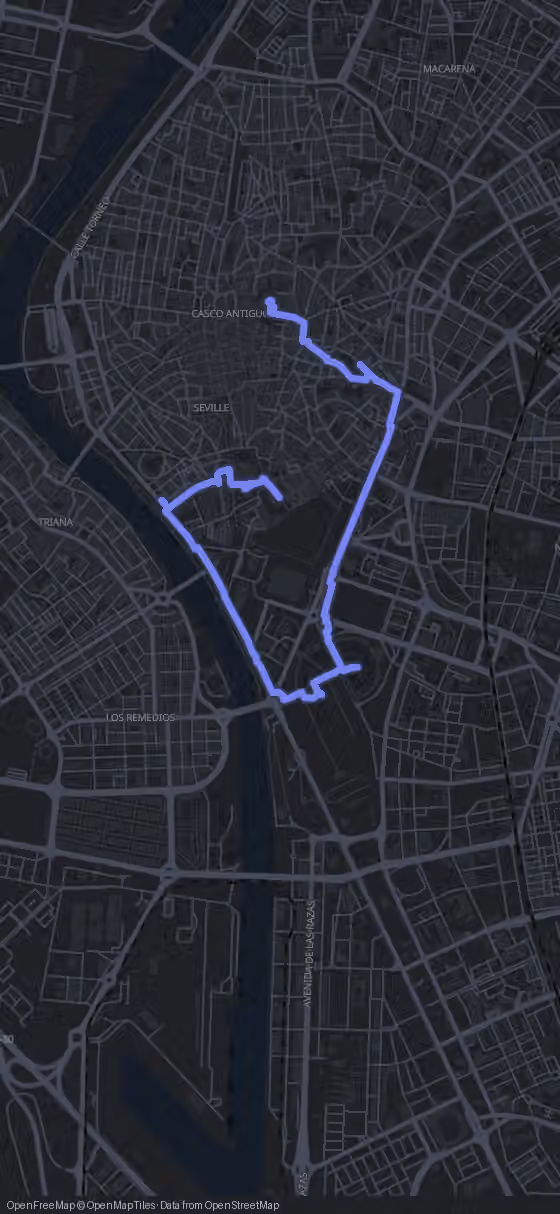
Ten stops, 5.4 km: from the wooden Setas past tiled palaces, a riverside tower and the cathedral to the Alcázar, with a free GPS route in your browser.

10 Stops 5.4 km ~1 h 14 min walking
Route map for the Seville walking tour
Stop 1 of 10
890 m·11 min
Metropol Parasol
Head south-east toward Casa de Pilatos
Hola, welcome to Seville. I'm Alex, and one quiet building here preserves the paperwork that redrew the world.
Try this tour with Alex

Seville on Foot: The Route at a Glance

Ten stops over 5.4 km, starting at Metropol Parasol and running via Casa de Pilatos, Plaza de España, Parque de María Luisa, Torre del Oro, Real Maestranza Bullring, Plaza del Cabildo, Seville Cathedral & La Giralda and Archive of the Indies to the Royal Alcázar. Pure walking time is 1 h 14 min; allow about three hours with quick looks, a full day with the interiors.

The squares, the park, Torre del Oro and the archive are free; the Setas, Casa de Pilatos, the bullring, the cathedral and the Alcázar charge entry. Route, map and GPS navigation run free in your browser; the AI Tour Guide is optional.

Open free GPS & optional AI Tour Guide
This short shows highlights of the route. All 10 stops follow below.

The Route

Walking Map of Seville, Setas to Alcázar

10 stops 5.4 km 1 h 14 min walking
Tap to load interactive map

The 10 stops along this route

  1. Metropol Parasol in Seville, stop 1 on the self-guided walking tour
    1Metropol Parasol
  2. Casa de Pilatos in Seville, stop 2 on the self-guided walking tour
    2Casa de Pilatos
  3. Plaza de España in Seville, stop 3 on the self-guided walking tour
    3Plaza de España
  4. Parque de María Luisa in Seville, stop 4 on the self-guided walking tour
    4Parque de María Luisa
  5. Torre del Oro in Seville, stop 5 on the self-guided walking tour
    5Torre del Oro
  6. Real Maestranza Bullring in Seville, stop 6 on the self-guided walking tour
    6Real Maestranza Bullring
  7. Plaza del Cabildo in Seville, stop 7 on the self-guided walking tour
    7Plaza del Cabildo
  8. Seville Cathedral & La Giralda, stop 8 on the self-guided walking tour
    8Seville Cathedral & La Giralda
  9. Archive of the Indies in Seville, stop 9 on the self-guided walking tour
    9Archive of the Indies
  10. Royal Alcázar in Seville, stop 10 on the self-guided walking tour
    10Royal Alcázar
  11. That's the full route.

    Walk it with an AI Tour Guide talking you through every one of these streets.

    Start free in your browser
    You made it

Your Seville Walking Tour, Ten Stops in Order

  1. 1

    Metropol Parasol

    Metropol Parasol in Seville, stop 1 on the self-guided walking tour

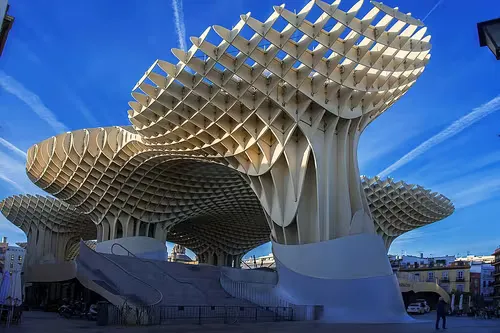
    Begin under the Setas, as everyone in Seville calls the Metropol Parasol: a huge canopy of laminated wood and concrete resting on six pillars above Plaza de la Encarnación. It is 150 metres long, 70 wide and about 26 high, and every rib of the grid has its own curve, so the whole roof seems to ripple as you walk beneath it. The Berlin architect Jürgen Mayer took his cue from the vaults of Seville Cathedral; the locals saw mushrooms instead, and the nickname stuck.

    The structure grew out of an open competition the city held to rehabilitate the square. In January 2003 the design was already one of five finalists, out of 335 entries, for the European Mies van der Rohe Prize for contemporary architecture, and work began on 26 June 2005. Today it has become an icon of the historic centre, and it works on several levels: a traditional market and places to eat at street level, a space for shows, and the Antiquarium, an archaeological museum, in the base.

    Up top are a terrace and a walkway with a panoramic view over the old town, and that walkway is the real reason to buy a ticket. The full ticket also covers the museum, which many visitors find rather empty, so go for the view rather than the exhibits. Ask at the desk whether your ticket allows two entries within 48 hours: if so, come back in the evening for sunset and for the Aurora light show that runs after dark.

    From the Setas it is 890 m, about 12 minutes, to Casa de Pilatos, a palace begun more than five centuries before this canopy.
    Hours
    Daily 09:30–01:00 (last admission 00:15)
    Price
    16 EUR general (from price)
  2. 2

    Casa de Pilatos

    Casa de Pilatos in Seville, stop 2 on the self-guided walking tour

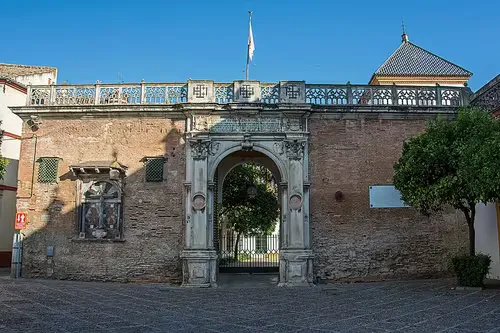
    Casa de Pilatos is considered the prototype of the Andalusian palace: Italian Renaissance architecture mixed with Mudéjar elements and decoration, set around tiled rooms and well-kept gardens. It is still the permanent residence of the Dukes of Medinaceli. Look closely at the walls: around 150 different azulejo designs, made in the 1530s by the brothers Diego and Juan Pulido, make this one of the largest early-modern tile collections in the world.

    Pedro Enríquez de Quiñones, Adelantado Mayor of Andalusia, and his wife Catalina de Rivera began building in 1483; their son Fadrique Enríquez de Rivera, first Marquis of Tarifa, finished it. Fadrique made a pilgrimage to Jerusalem in 1519 and came back on 20 October 1520 after travelling through Europe and the Holy Land. During Lent in 1521 he launched the Way of the Cross in Seville: it started at the Chapel of the Flagellations in his own palace and ended at a pillar near the Cruz del Campo, outside the city walls, 1,321 paces away, the distance believed to separate Pilate's praetorium from Calvary.

    At the time the house was called the Palacio de San Andrés and was still partly a building site. The procession gave it its later name, and popular imagination went further, taking the palace for a copy of Pilate's own house. That is why rooms carry names like the Hall of the Praetorian. The oldest written record of the name Casa de Pilatos dates from 1754, and the palace became a National Monument in 1931.

    Going in is worth it if tiles and palace architecture are your thing. The ground floor and the upper floor are sold as separate tickets, so you can keep the visit short. Then comes the longest leg of the route: 1840 m, about 26 minutes, to Plaza de España.

    Hours
    Daily 09:00–18:00
    Price
    12 EUR ground floor, 6 EUR upper floor (separate tickets)
  3. 3

    Plaza de España

    Plaza de España in Seville, stop 3 on the self-guided walking tour

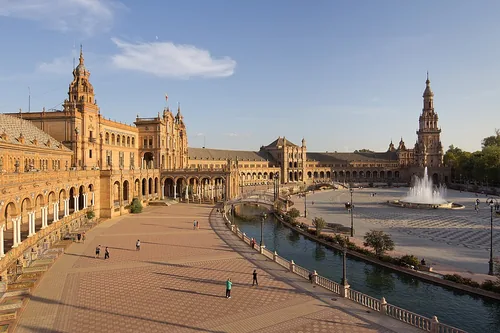
    Plaza de España is a huge half-circle of brick and tile, built in 1928 for the Ibero-American Exposition of 1929. Its architect, Aníbal González, set it on the edge of Parque de María Luisa to showcase Spain's industry and technology, and mixed 1920s Art Deco with Renaissance Revival, Baroque Revival and Neo-Mudéjar styles. The result is a landmark of Regionalism architecture.

    Four bridges cross the moat to the buildings, each standing for one of the ancient kingdoms of Spain, and the Vicente Traver fountain sits in the centre. Walk along the curve and you pass tiled alcoves, one for each Spanish province. Spaniards like to have their photo taken in front of their home province, so you will often see small family shoots here.

    Look at the covered bookshelves on either side of each alcove. Visitors use them as a little free library: many hold books about their province, and people leave their favourite novels for others to read. Film crews have used these buildings too, including for Lawrence of Arabia in 1962. Today the buildings have been carefully adapted and house offices of government agencies.

    The square is free and open at all times. From here it is only 320 m, about 4 minutes, into Parque de María Luisa, the gardens the square was built for.

    Hours
    Freely accessible, no fixed opening hours
    Price
    Free
  4. 4

    Parque de María Luisa

    Parque de María Luisa in Seville, stop 4 on the self-guided walking tour

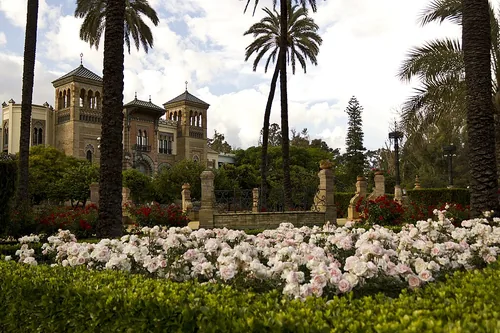
    Parque de María Luisa stretches along the Guadalquivir and is Seville's principal green area. Most of its grounds were once the gardens of the Palace of San Telmo, until the Infanta Luisa Fernanda, Duchess of Montpensier, gave them to the city in 1893 as a public park. From 1911 the French designer Jean-Claude Nicolas Forestier reshaped them into what you see today, and from 1914 Aníbal González built here for the 1929 exposition.

    The style is often called Moorish paradise: half a mile of tiled fountains, pavilions, walls, ponds, benches and exedras, with palms, orange trees, Mediterranean pines, formal flower beds and bowers hidden under vines. The park also serves as a botanical garden, with native and exotic species and information panels along the paths.

    Listen and look up: doves are everywhere, so many that part of Plaza de América is called the Parque de las Palomas, the Dove Park. Parakeets live in the centre of the park, and ducks and swans float in the ponds. Among the many monuments, look for the Fountain of Lions and the Water-lily Pool. In the north of the park, on Avenida de Gustavo Adolfo Bécquer, stands the monument to the poet Bécquer, made in 1911 by Lorenzo Coullaut-Valera with the architect Juan Talavera Heredia and the Catalan sculptor Federico Bechini.

    The park is free, and you can wander as long as you like. When you are ready, it is 1160 m, about 16 minutes, to the river and Torre del Oro.

    Hours
    Freely accessible, no fixed opening hours
    Price
    Free
  5. 5

    Torre del Oro

    Torre del Oro in Seville, stop 5 on the self-guided walking tour

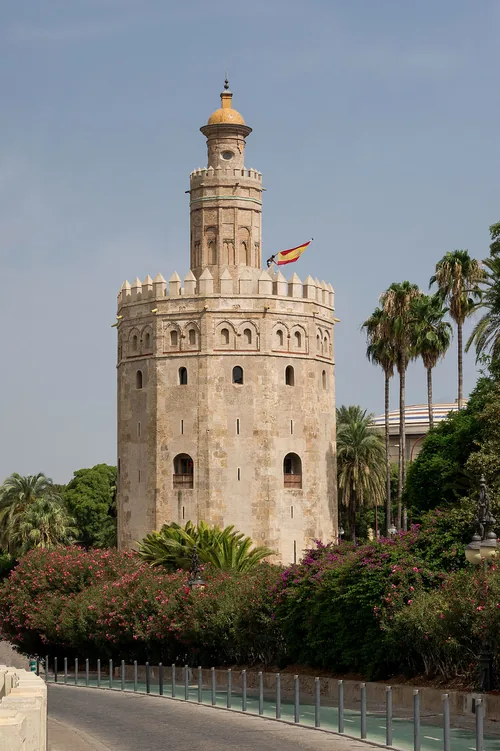
    Torre del Oro, the Tower of Gold, is a twelve-sided watchtower that the Almohads built to control access to Seville along the Guadalquivir. Its name comes from the golden shine it once cast on the water, thanks to its building material, a mix of mortar, lime and pressed hay. In the Middle Ages it also served as a prison.

    Read the tower from bottom to top and you read its history. The lower, twelve-sided level was built in 1220 and 1221 on the orders of the Almohad governor Abu l-Ulà. The second level, also twelve-sided and only 8 metres high, was added by Peter of Castile in the 14th century, as archaeologists have confirmed. The round top came last: after the Lisbon earthquake of 1755 damaged the old upper level, the Brussels military engineer Sebastian Van der Borcht rebuilt it in 1760.

    The tower was one anchor of a great chain that could close the river; the other anchor has disappeared, possibly in the same earthquake. In 1248 the Castilian fleet under Ramón de Bonifaz broke through these river defences and cut Seville off from Triana. A wall once linked the tower to the octagonal Torre de la Plata nearby, part of the walls protecting the Alcázar. After 1755 the Marquis of Monte Real wanted to demolish the damaged tower to make way for coaches heading to the Triana bridge, but the people of Seville protested to the king, who stepped in and saved it.

    Entry is free, so it is worth a quick look inside. The bullring is just 260 m away, about 4 minutes on foot.

    Hours
    Mon–Fri 09:30–19:00 (last entry 18:30); Sat–Sun 10:30–19:00, closed at midday 14:00–15:00 (last entry 18:30)
    Price
    Free
  6. 6

    Real Maestranza Bullring

    Real Maestranza Bullring in Seville, stop 6 on the self-guided walking tour

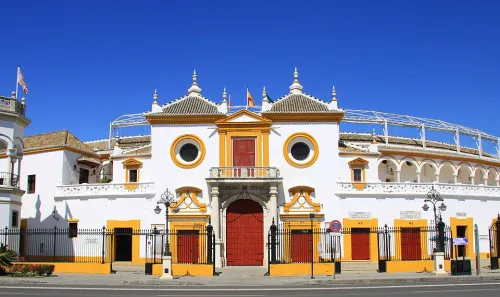
    The Real Maestranza Bullring, in Spanish the Plaza de toros de la Real Maestranza, holds 12,000 people and belongs to the Real Maestranza de Caballería de Sevilla, a noble guild founded for cavalry training. During the annual Seville Fair it hosts one of the best-known bullfighting festivals in the world, and its audience is considered one of the most unforgiving anywhere, which makes it one of the toughest stages a bullfighter can face.

    Building began in 1749 on Baratillo Hill, where a rectangular ring had stood before. From 1761 the ring grew in ochavas, sections of four arches each. The Prince's Box, finished in 1765, is the piece to look for: below is the gate through which successful bullfighters leave, above is the box reserved for the Spanish royal family. Four arches carry a half-orange vault topped with white and blue tiles, crowned by sculptures by the Portuguese artist Cayetano de Acosta. It was built for the Infante Felipe de Borbón, son of Philip V and Isabel de Farnesio.

    Opposite, above the gate where the bulls come in, sits the old Palco de la Diputación, once the Herdsmen's Box, from the same period. Work on the sculptures stopped in 1786 when Carlos III banned bullfighting, at a time when only a third of the ring had been completed.

    The visit costs entry and is worth it for the architecture and history even if bullfighting itself is not for you. From here it is 400 m, about 5 minutes, into the Arenal to Plaza del Cabildo.

    Local name
    Plaza de toros de la Real Maestranza
    Hours
    Daily 09:30–21:30 (Jul/Aug until 21:00); on corrida days only 09:30–15:00
    Price
    12 EUR; seniors 65+, students 17–25 and ages 12–16 7 EUR; children 7–11 4 EUR; family 29 EUR
  7. 7

    Plaza del Cabildo

    Plaza del Cabildo in Seville, stop 7 on the self-guided walking tour

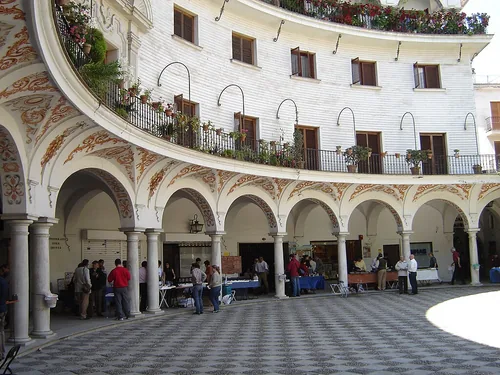
    Plaza del Cabildo is a hidden half-moon in the Arenal district, right beside the cathedral yet surprisingly quiet. You reach it through one of three passages, from Avenida de la Constitución, Calle Almirantazgo or Calle Arfe. It stands on the site of the Colegio de San Miguel, which belonged to the cathedral chapter, the Cabildo, until it was torn down in the middle of the 20th century.

    The architect Joaquín Barquín y Barón laid the square out as a semicircle of arcades on marble columns, with up to three floors built above. Look up at the arches: they are painted in fresco by the Sevillian painter José Palomar. Inside the curve you'll find a fountain, a few shops and a section of Seville's old city wall about 50 metres long.

    On Sunday mornings the calm gives way to a collectors' market for coins and stamps, where people trade banknotes, medals, minerals and military insignia. The square is free, and a few minutes are enough unless the market is on.

    Seville Cathedral & La Giralda is only 210 m away, about 3 minutes.

    Hours
    Freely accessible, no fixed opening hours
    Price
    Free
  8. 8

    Seville Cathedral & La Giralda

    Seville Cathedral & La Giralda, stop 8 on the self-guided walking tour

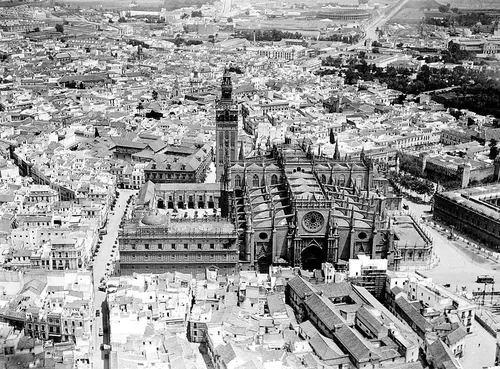
    Seville Cathedral, the Catedral de Sevilla, is the seat of the archdiocese: a Gothic church with Renaissance additions, listed by UNESCO in 1987 together with the Alcázar and the Archive of the Indies. In 1988 Guinness World Records certified it as the largest cathedral in the world by surface area. In 2017 it drew 1,934,373 visitors, the fifth most visited monument in Spain, and in 2023 it passed two million.

    It stands on the site of Seville's great mosque, which had served for more than 150 years as a Christian cathedral and was in poor shape by then. Two parts survived: the minaret, which became La Giralda, and the courtyard, the Patio de los Naranjos. Tradition says work began in 1401, though documents only confirm it from 1433. One of the first master builders was Maestre Carlín, Charles Galter from Normandy, who had worked on other great Gothic cathedrals and is believed to have come to Spain fleeing the Hundred Years' War.

    On 10 October 1506 the last stone was set at the top of the crossing dome, and the cathedral was symbolically complete, though work went on for centuries. Diego de Riaño, Martín de Gainza and Asensio de Maeda all left their mark, and Hernán Ruiz built the top section of the Giralda. The Lisbon earthquake of 1755 caused only minor damage here.

    Inside you find the tomb of Columbus and the high altar, and the visit is worth it for almost anyone. The cathedral charges entry, but there is a limited number of free places that you must reserve online on the official site, and they go fast. The Archive of the Indies is just 60 m away, about 1 minute.

    Local name
    Catedral de Sevilla
    Hours
    Mon–Sat 11:00–18:00 (Giralda until 17:00); Sun 14:30–19:00 (Giralda until 17:00); Jul/Aug special hours: Mon–Sat 09:30–18:00, Sun 12:30–18:00
    Price
    13 EUR online / 14 EUR Ticket desk general; 7 EUR online / 8 EUR Ticket desk reduced
  9. 9

    Archive of the Indies

    Archive of the Indies in Seville, stop 9 on the self-guided walking tour

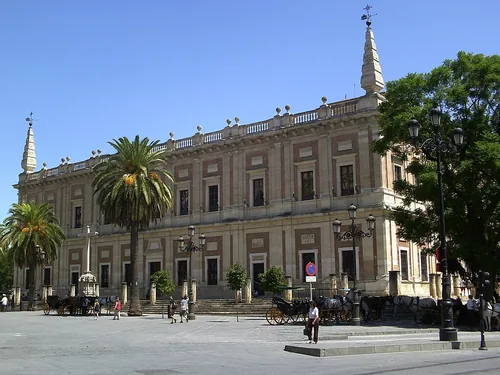
    The Archive of the Indies, the Archivo General de Indias, holds the documents of the Spanish Empire in the Americas and Asia. Charles III created it, and it opened in 1785 in a building that had been the merchants' exchange of Seville, the Lonja. Along with the cathedral and the Alcázar, building and contents became a UNESCO World Heritage Site in 1987.

    The exchange exists because of a habit Philip II wanted to end: Seville's merchants used to retreat into the cool recesses of the cathedral to do business. In 1572 he commissioned a design from Juan de Herrera, the architect of the Escorial, and Juan de Mijares began building in 1584. An inscription over the central door of the north façade records that the northern rooms of the ground floor were done in 1598; the rest followed a year later. Money ran out in 1601, work resumed in 1609 under Miguel de Zumárraga, and after his death in 1630 Pedro Sánchez Falconete finished it in 1646.

    Take a moment on the façade: it is an Italianate piece of Spanish Renaissance architecture, with windows set in slightly sunken panels between flat pilasters, plain square tablets floating above each window, and a balustrade with rusticated obelisks at the corners. Inside, two storeys of galleries surround a large central patio.

    Entry is free, so step inside if the doors are open as you pass. The Royal Alcázar is 240 m away, about 3 minutes.

    Local name
    Archivo General de Indias
    Price
    Free
  10. 10

    Royal Alcázar

    Royal Alcázar in Seville, stop 10 on the self-guided walking tour

    The Royal Alcázar is still a royal palace: its upper floors are used by the Spanish royal family when they visit Seville and are managed by Patrimonio Nacional. The name comes from the Arabic al-qasr, a large stone building from which power is projected, which in turn goes back to the Latin castrum, fort.

    The story starts after the Umayyad conquest of Seville in 712. In 913 and 914, after a revolt against Córdoba, Abd al-Rahman III built a fortress here in place of a Visigothic Christian basilica: a roughly square enclosure about 100 metres a side, with walls and rectangular towers tied into the city wall. In the 11th century the Abbadid ruler al-Mu'tamid extended it to the south and east with a new enclosure of about 70 by 80 metres, a palace called al-Mubarak, the Blessed, plus stables and warehouses. The Almohads kept building in the 12th and early 13th centuries.

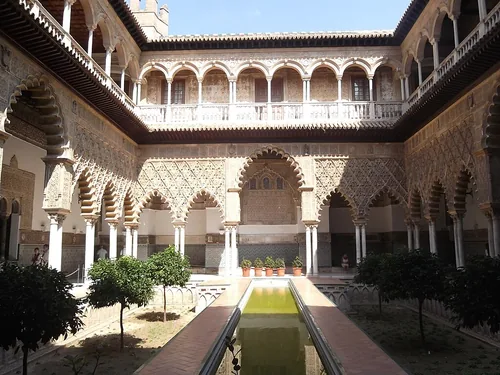
    After the Castilian conquest of 1248, new palaces and gardens gradually replaced the old ones. The most important is the richly decorated palace Pedro I built in the 1360s, a leading example of Mudéjar style in the Iberian Peninsula, with Gothic and Renaissance sections added later. If you have seen the caliphate's legacy in Córdoba, this is where the story continues.

    The Alcázar charges entry with timed tickets, and the Upper Royal Quarters cost a separate supplement. Give yourself about two hours for palace and gardens; it is the right finale for anyone with time left in the day. The route ends here, and the GPS navigation can lead you back to the Setas if you want.

    Local name
    Reales Alcázares
    Hours
    Oct–Mar 09:30–17:00; Apr–Sep 09:30–19:00
    Price
    15.50 EUR, reduced 8 EUR (65+, students 14–30); Upper Royal Quarters +5.50 EUR
Walking tour route map of Seville Route loaded
Metropol ParasolCasa de PilatosPlaza de EspañaParque de María Luisa+6
All 10 stops are already on the map.
You just press start.
AI Tour Guide

You know the route now. Walk it with a guide in your ear.

Press start wherever you are, even hundreds of kilometres from Seville, and the guide begins telling its stories right away. In the city, pick any of the 10 stops to start from: it leads you there, then talks with you the whole route, asking, listening, remembering, and shaping the tour around your answers.

10stops 5.4km 1 h 14 minwalking 13languages
▶Start the tour free

Free to start · Runs in your browser · No app, no download

Shorter and Slower Ways to Walk Seville

The full route is a lot for one day if you go inside everywhere. These versions keep the order and cut or split it.

Monument core only

Stops: 7, 8, 9, 10

For a short visit focused on the three UNESCO sites. From Plaza del Cabildo to the Royal Alcázar you walk just 510 m, about 7 minutes in total. The plaza and the Archive of the Indies are free; the cathedral and the Alcázar charge entry, so this is mostly time spent indoors.

Free open-air half day

Stops: 3, 4, 5, 6, 7, 8, 9

For a tight budget or a first look. From Plaza de España through the park, along the river and into the Arenal to the Archive of the Indies is 2.4 km and 33 minutes of walking. Torre del Oro and the archive are free to enter; the bullring and the cathedral you see from outside.

The whole route over two days

Stops: 1, 2, 3, 4, 5, 6, 7, 8, 9, 10

For anyone who wants every interior without rushing. Day one runs from Metropol Parasol to Parque de María Luisa with 42 minutes of walking and entry at the Setas and Casa de Pilatos. Day two starts at Torre del Oro and ends at the Royal Alcázar after only 16 minutes on foot, with tickets for the bullring, the cathedral and the Alcázar.

How Long Does This Seville Tour Take on Foot?

The pure walking time is 1 h 14 min over 5.4 km. The longest leg is the 26 minutes from Casa de Pilatos to Plaza de España; from Torre del Oro onward the stops sit close together, and the last five legs add up to only 16 minutes. If you look at most places from outside and only wander the square and the park, about three hours is realistic.

With the interiors it becomes a full day: roughly 45 minutes on the Setas, an hour in Casa de Pilatos, half an hour each in the park and on Plaza de España, around 45 minutes in the bullring, about an hour and a half in the cathedral and two hours in the Alcázar, so eight to nine hours in total. The monument core takes half a day with both big interiors, the free open-air version about two hours.

Before You Set Off in Seville

  • Start and finish: The recommended start is Metropol Parasol, the end is the Royal Alcázar. You can join at any stop; the GPS navigation in your browser leads you from the last stop back to the start if you like.
  • Tickets: Metropol Parasol, Casa de Pilatos, the bullring, the cathedral and the Alcázar charge entry; everything else on the route is free. The cathedral and the Alcázar use timed tickets that do sell out, sometimes more than a week ahead in high season, and spring weekends go fastest. Book both on their official websites three to four weeks before your trip.
  • Timing: Fix your cathedral and Alcázar slots first and plan the walk around them. If you want the view from the Setas at sunset, go up in the evening rather than at the start.

Tapas, Food and Breaks Along the Way

Seville eats in tapas, and the good bars are rarely the ones facing a monument. Order at the bar, try several small dishes instead of one big plate, and ask “¿Tienen tapas?”, because some places serve tapas only at the counter.

Bodeguita RomeroA classic tapas bar at Calle Harinas 10, known for its pringá sandwich, espinacas con garbanzos and Iberian pork. Locals send visitors here for solomillo al whisky and cola de toro.
Bar AlfalfaA small triangle-shaped bar on a shady square in the Alfalfa quarter, serving tostas with an Italian owner's touch. Ask locals for their favourite bar and this name comes up a lot.
En La Espero Te EsquinaA corner bar on Calle Corral del Rey in Santa Cruz, a Holy Week hangout. Order the mantecaíto: solomillo al whisky with fries in bread.
Calle Mateos Gago and Calle Rodrigo CaroThe place for a tapas break near the cathedral, away from the photo menus. Las Columnas (Bodega Santa Cruz) is a reliable stand-up option for a quick bite at the bar. (Two blocks from Seville Cathedral & La Giralda)
Calle Dos de MayoA good stop between the river and the cathedral; Bodega Dos de Mayo is one of the addresses locals use. (In the Arenal, with more bars in the streets behind the Real Maestranza Bullring)

Tourist Traps to Avoid in Seville's Monument Quarter

  • Restaurants right at the monuments: Places facing the big sights charge well above the local average for reheated food. Warning signs are photo menus in five or more languages and staff calling you in from the door. Walk two or three streets away and look for a menú del día instead.
  • The rosemary sprig: Near the cathedral entrance, at the Alcázar entrance and on Plaza de España, women offer you a sprig of rosemary “for luck”, then read your palm and ask for money. Don't take it; say “No, gracias” and keep walking.
  • Friendship bracelets: Mainly on Plaza de España, someone ties a bracelet round your wrist unasked and then demands payment. Pull your hand back; you owe nothing.
  • Skip-the-line tickets from resellers: For the cathedral and the Alcázar, resellers charge noticeably more for exactly the same timed ticket. Any online ticket skips the ticket queue, and everyone goes through the same security check, so buy on the official sites.
  • Souvenir shops outside the Alcázar and Cathedral: The shops directly outside sell the same items for two to three times what you pay two streets away.
Walking tour route map of Seville
AI Tour Guide

Your guide is ready under the Setas when you are.

Press start and a voice AI Tour Guide takes it from here: leading the route through Seville, telling the stories, and turning your walk into a real back-and-forth conversation. No app or download is needed; it runs in your browser.

10stops 5.4km 1 h 14 minwalking 13languages
▶Start the tour free

Free to start · Runs in your browser · No app, no download

What the AI Tour Guide Adds on This Route

This route crosses eight centuries, from Almohad walls to a 1920s world's fair, and the AI Tour Guide ties them together as a conversation while you walk. It greets you under the Setas, tells the story of each place as you arrive, asks what caught your eye and remembers it, so a tile lover hears more about the Pulido brothers and a history fan more about the siege of 1248. You can interrupt at any point, for instance to ask what life was like for the merchants who once traded inside the cathedral. It starts with 100 free credits; after that you choose between this tour all-inclusive for €19.99 with no time limit or credits at €5 per hour.

A Real Conversation A voice AI Tour Guide greets you, leads the whole route, and tells the stories and facts as you walk, asking what you want to see and keeping a real conversation going. Not a recording you press play on.
Map Navigation Follow the route on the map and walk at your own pace. You choose where to start and when to move to the next stop.
Ask Anything Curious about a building you pass? Ask your AI Tour Guide on the spot and the conversation carries on.
13 Languages Switch language anytime. No separate tour needed.
Start free in your browser

Common Questions About Walking Seville

What does the Seville Cathedral ticket include?

The standard cathedral ticket also covers La Giralda and the Iglesia del Salvador. Whether the Giralda is included in the free visits is not clear, so check when you reserve.

Is the free evening slot at the Alcázar worth it?

The Alcázar offers a free evening slot where you pay only the online booking fee. You get the same palace and gardens, but only about an hour, which suits quick visitors more than garden strollers. The slots are released well in advance and are often gone quickly.

What should I order in Seville instead of paella?

Paella isn't a Sevillian dish, and a “paella sevillana” on a board outside is a warning sign. Look for espinacas con garbanzos, carrillada and solomillo al whisky, which local bars cook fresh.

Are there similar walking tours near Seville?

Yes: Córdoba is 120 km away and continues the story of the caliphate you meet at the Alcázar, Ronda is 103 km away, and Granada 213 km.

Is the tour really free?

Yes. The whole tour is free: the route, the interactive map and the navigation cost you nothing. Only the voice AI Tour Guide is optional and paid: you test it with 100 free credits, then you pay either €5 per hour or €19.99 for this whole tour, with no time limit. Admission to 5 of the 10 stops is not included: Metropol Parasol, Casa de Pilatos, Real Maestranza Bullring, Seville Cathedral & La Giralda and Royal Alcázar charge their own entry fees.

Do I need to download an app?

No. Everything runs in your phone browser. Open the route and start walking, no download and no sign-up required.

Do I need to book the walking tour in advance?

No booking needed. This self-guided tour is available anytime. Open the route in your browser and start walking. The AI Tour Guide works instantly, no app, no reservation required.

What languages is the AI Tour Guide available in?

The AI Tour Guide speaks 13 languages, so you take the tour in your own language and can switch at any time.

Can I skip stops or change the route?

Yes. Skip any stop, spend extra time at places you like, or start the route from any point. It is your walk, you set the pace.
Image credits
▶ Start free in your browser Runs in your browser, no app, no download