Free Walking Tour Cáceres: Walled Old Town in 0.8 km

Eight stops in 0.8 km: from the arcades of Plaza Mayor through noble palaces and old parish churches to the Almohad Bujaco Tower.

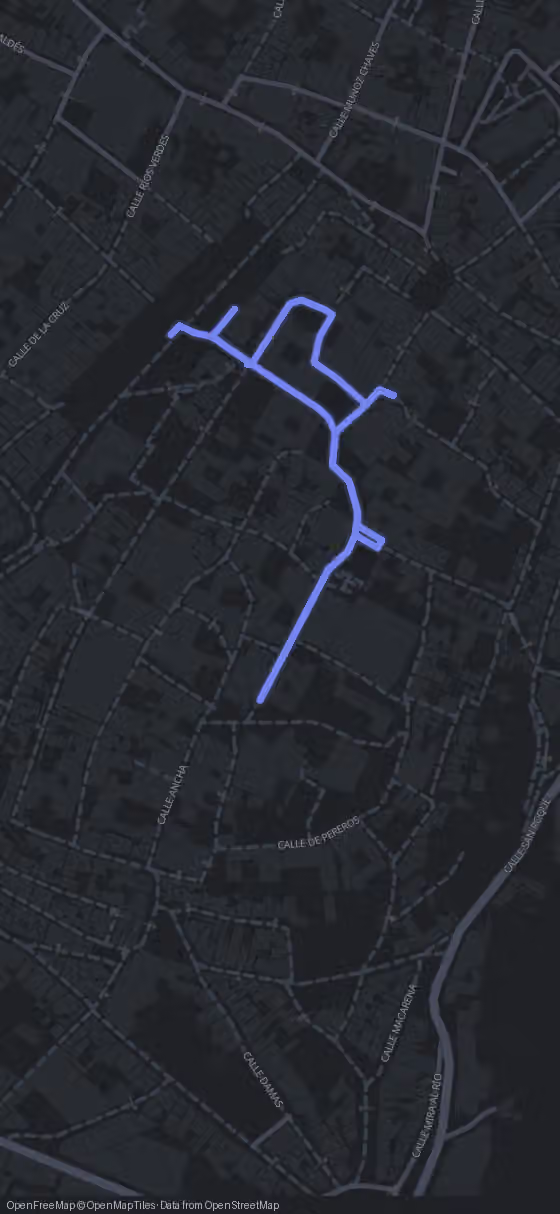
8 Stops 0.8 km ~13 min walking
Route map for the Cáceres walking tour
Stop 1 of 8
120 m·2 min
Plaza Mayor
Head east toward the Toledo-Moctezuma Palace
Hola, welcome to Cáceres. I'm Alex, and one palace here carries a remarkable link between Spain and the Aztec Empire.
Try this tour with Alex

What the Cáceres Route Covers

Eight stops in and around the walled old town: from Plaza Mayor via Toledo-Moctezuma Palace, Cáceres Cathedral, Palace of the Golfines de Abajo, Church of San Francisco Javier and Church of San Mateo to Arch of the Star and Bujaco Tower. 0.8 km, 13 min of pure walking, about three hours with the interiors.

Squares, façades and the arch are free; the cathedral, the Golfines palace, both churches and the tower charge entry. The GPS route runs free in your browser; the AI Tour Guide is optional.

Open free GPS & optional AI Tour Guide
This short shows highlights of the route. All 8 stops follow below.

The Route

Walking Map of Cáceres' Walled Old Town

8 stops 0.8 km 13 min walking
Tap to load interactive map

The 8 stops along this route

  1. Plaza Mayor in Cáceres, stop 1 on the self-guided walking tour
    1Plaza Mayor
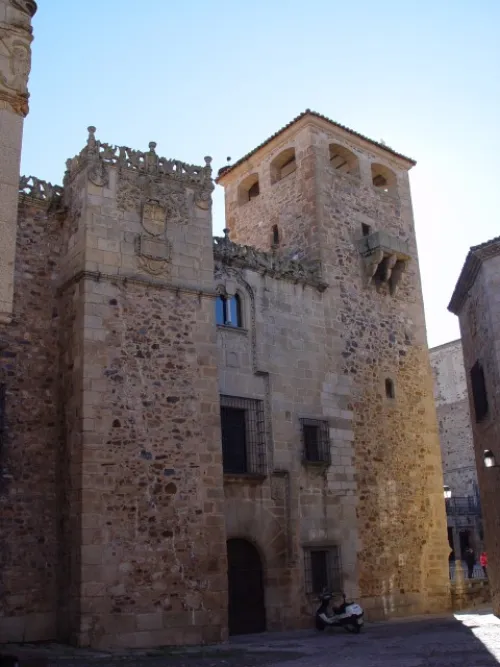
  2. Toledo-Moctezuma Palace in Cáceres, stop 2 on the self-guided walking tour
    2Toledo-Moctezuma Palace
  3. Cáceres Cathedral, stop 3 on the self-guided walking tour
    3Cáceres Cathedral
  4. Palace of the Golfines de Abajo in Cáceres, stop 4 on the self-guided walking tour
    4Palace of the Golfines de Abajo
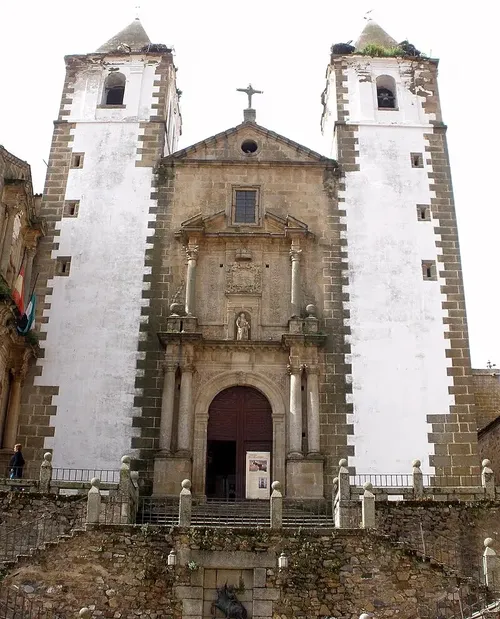
  5. Church of San Francisco Javier in Cáceres, stop 5 on the self-guided walking tour
    5Church of San Francisco Javier
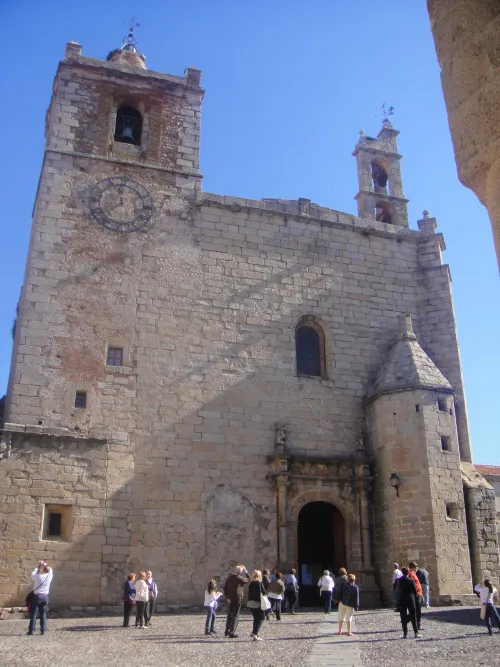
  6. Church of San Mateo in Cáceres, stop 6 on the self-guided walking tour
    6Church of San Mateo
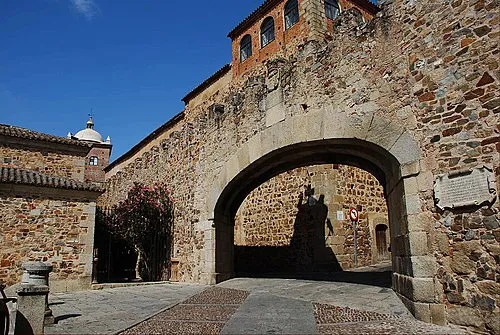
  7. Arch of the Star in Cáceres, stop 7 on the self-guided walking tour
    7Arch of the Star
  8. Bujaco Tower in Cáceres, stop 8 on the self-guided walking tour
    8Bujaco Tower
  9. That's the full route.

    Walk it with an AI Tour Guide talking you through every one of these streets.

    Start free in your browser
    You made it

Cáceres Walking Tour: Eight Stops In and Around the Walls

  1. 1

    Plaza Mayor

    Plaza Mayor in Cáceres, stop 1 on the self-guided walking tour

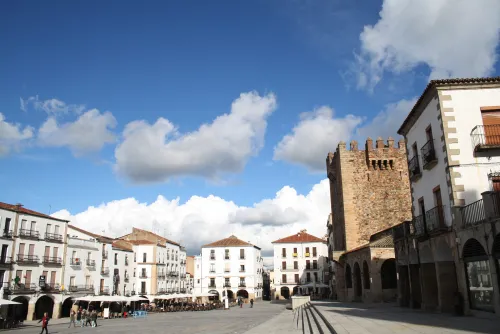
    You start on the square that has been the meeting point of Cáceres for centuries and is still the main way into the monumental town. Look across to one side and you see the best-known stretch of the old wall: Bujaco Tower, the Arch of the Star and the Torre de los Púlpitos. You come back to them at the end of the walk, so for now just take in the whole picture.

    Turn around and read the other sides. The west side is lined with arcades full of bars, restaurants and shops; some of those arcades date from the 16th century, low arches on sturdy stone pillars built to keep people out of the sun and rain. On the south side stand the town hall and the Foro de los Balbos, and that is also where Calle Pintores begins, the busiest shopping street in town. The promenade through the middle was laid out in 2001, and the whole square was redesigned in 2011.

    The square exists because of a compromise. In the 14th century, Cáceres had two main settlements outside the walls, one around the church of Santiago and one around the Coria gate, and this slightly sloping rectangle lay halfway between them. It was the ideal ground for fairs, markets and festivities, and over time the heart of town moved here from the open space beside Santa María.

    Most buildings have three floors and are homes, with the Ermita de la Paz, the town hall and hotels mixed in. The white façades are a fairly recent fashion; earlier, an earthy render painted to look like ashlar stone was common. From the square it is 120 m, about two minutes, to the first palace inside the old town.
    Hours
    Open 24/7
    Price
    Free
  2. 2

    Toledo-Moctezuma Palace

    Toledo-Moctezuma Palace in Cáceres, stop 2 on the self-guided walking tour

    This palace connects a Cáceres noble family with the Aztec emperors. Built in the 15th century, it got its present look in restorations at the end of the 16th and start of the 17th century. Look at the main façade for the coats of arms: the Toledo family owned it, and the Carvajal and Ulloa families, who held the house before them, left their shields here too.

    The story behind the top floor is the reason to stop. At the end of the 16th century, Mariana de Carvajal y Toledo married Juan de Toledo Moctezuma, a descendant of Juan Cano de Saavedra and of Isabel de Moctezuma, daughter of the Aztec emperor Moctezuma II. After the wedding, the upper part of the house was rebuilt with the open brick gallery that gives it its character, and the arms of the Toledo and Carvajal families went up again, now joined by those of the Moctezumas.

    After works by the Ministry of Culture at the end of the 20th century, the building houses the Provincial Historical Archive of Cáceres, so access inside is limited. The façade is what you came for, and you can see it at any time for free; five minutes is enough. The cathedral is just 100 m on, about a minute's walk.

    Hours
    Exterior visible anytime (interior houses Provincial Historic Archive, limited access)
    Price
    Free
  3. 3

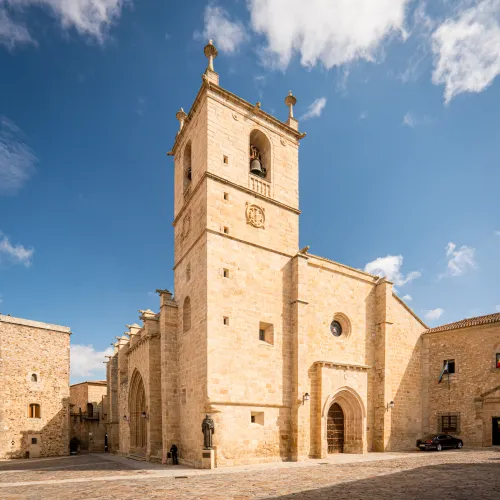
    Cáceres Cathedral

    Cáceres Cathedral, stop 3 on the self-guided walking tour

    The Concatedral de Santa María is the most important church in Cáceres. It began as one of the four parish churches of the medieval town, and since 1957 it has been a co-cathedral, sharing the seat of the diocese of Coria-Cáceres with the cathedral in Coria. It has been a protected monument since 1931, and the old town around it has been a UNESCO World Heritage Site since 1986.

    What you see dates mostly from the 15th and 16th centuries and is late Gothic. Keep an eye out for older and younger traces: some Romanesque parts survive from an earlier church built after the town was taken in the 13th century, and there are Renaissance additions too.

    Take a moment on the Plaza de Santa María itself. Facing the cathedral across the square stand the Ovando palace, the Episcopal palace, the Mayoralgo palace and the palace of the Duquesa de Valencia; to the north, Calle Amargura separates the church from the Carvajal palace. The block the cathedral stands on covers about three quarters of a hectare, yet holds only two other buildings: the provincial council palace and the Golfines de Abajo palace, your next stop.

    If you only go inside one building on this walk, make it this one. Entry is paid, with reduced rates for seniors, young people, students, pilgrims and visitors with a disability.

    From here it is 130 m, two minutes, to the Golfines palace. On the way you pass the Palace of Carvajal and the Arab House Museum Yusuf Al-Burch.

    Local name
    Concatedral de Santa María de Cáceres
    Hours
    May–Sep: Mon–Sat 10:00–21:00, Sun 10:00–12:30 & 14:00–19:00; Oct–Apr: Mon–Sat 10:00–20:00, Sun 10:00–12:30 & 14:00–18:30
    Price
    7 EUR full, 6 EUR reduced (+65, disability <60%), 5 EUR youth/students (12-25) & pilgrims
  4. 4

    Palace of the Golfines de Abajo

    Palace of the Golfines de Abajo in Cáceres, stop 4 on the self-guided walking tour

    The Golfín family settled in Cáceres right after the town was taken from the Moors, and this house shows how they rose. Alonso Golfín backed Enrique IV and got the Catholic Monarchs to grant him a licence to found an entailed estate for his son, Sancho Paredes. Over time this grew into a vast inheritance of rents and lands, and this house was its family seat. Building began around 1510 or 1511 on the site of the family home, with a second phase later.

    Read the façade from the top down. A central body of ashlar stone sits between two towers, and the towers don't match. Under the Gothic upper window, two naked cherubs leaning backwards hold the Golfín coat of arms. Beneath them, inside a carved wreath of flowers, is the inscription “Fer de Fer”, which refers to Ferdinand the Catholic and his beloved grandson Ferdinand. The shield with two fleurs-de-lis and two castles is the Golfín one.

    You can see two eras side by side. The 15th-century fortress house shows in the tower with its two machicolations and the low arches. The 16th-century taste for humanist decoration shows in the plateresque cresting of fantastic animals running along the top of the façade, the granite mouldings around doors and windows, and the shields of the Golfín and Álvarez families.

    Going in is worth it if you want to see how a noble family lived and wanted to be remembered: the highlight is the Salón de los Linajes, a rectangular hall with painted coffered ceilings and a complete family tree. Visits start at set times, and tickets are paid, with reductions for seniors, students and visitors with a disability. Then it is just 70 m, one minute, to San Francisco Javier.

    Hours
    Oct–Apr: Tue–Sat 10:00, 11:00, 12:00, 13:00, 16:30, 17:30, 18:30, Sun 10:00, 11:00, 12:00, 13:00; May–Sep: Tue–Sat 10:00, 11:00, 12:00, 13:00, 17:00, 18:00, 19:00, Sun 10:00, 11:00, 12:00, 13:00; Mon closed
    Price
    3 EUR full, 2 EUR reduced (+65, groups >15), 1 EUR students (<26) & disabled
  5. 5

    Church of San Francisco Javier

    Church of San Francisco Javier in Cáceres, stop 5 on the self-guided walking tour

    This Jesuit church, also called the Iglesia de la Preciosa Sangre, is the baroque note on a walk full of medieval stone. It was paid for, together with the convent beside it, with the fortune of a Jesuit from the Figueroa family, the last heir of an entailed estate that was dying out. Work started in 1698 and finished in 1755, under the architect Pedro Sánchez Lobato.

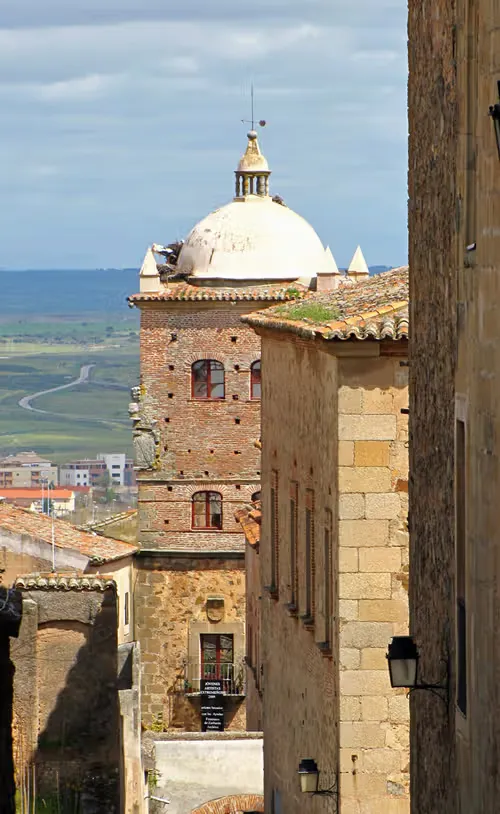
    Stand back and notice how the sloping square makes the whole thing look even grander. Two square towers of rubble and ashlar rise on either side, each topped with a pyramid spire. Between them, a round arch framed by paired columns forms the door; above it a niche holds a statue of Saint Francis Xavier and the arms of Castile and León, crowned by a broken pediment. This front was remodelled in 1992.

    Inside, the church has a Latin cross plan with linked side chapels and a dome with a lantern over the crossing. The main altarpiece holds an 18th-century painting of Saint Francis Xavier. Since 1899 the church has been in the care of the Missionaries of the Precious Blood, hence its second name, but no services are held here now. In the crypt you find the Holy Week Interpretation Centre.

    Entry is cheap, and locals with ID pay even less, so it is an easy look at a baroque interior and the Holy Week centre. This is also where you can buy the diocesan pass for San Mateo. The next church is 60 m away, a one-minute walk, passing the Casa de los Cáceres Ovando.

    Price
    1.50 EUR general (Cacereños with ID 1 EUR )
  6. 6

    Church of San Mateo

    Church of San Mateo in Cáceres, stop 6 on the self-guided walking tour

    San Mateo stands on the highest point of the walled town, at the western end of a long flat space formed by three small squares in a row. Officially they are the plazas of San Mateo, San Pablo and Las Veletas, but everyone simply calls the whole area San Mateo.

    The church you see was built over the 16th century, replacing a medieval church bit by bit. Some believe the original building may have been the mosque of the Moorish fortified town out of which Cáceres grew in the 13th century, although no documents prove it. For centuries it was one of the town's four historic parishes.

    Its story today is one of a quieter old town. Because so few people still live inside the walls, most parish life moved in 2006 to a parish centre in the nearby Santa Clara district. The old church is now used only for some weekend masses and special occasions: Saturday at 20:00 and Sunday at 12:00 and 20:00.

    To go inside, buy the diocesan tourist pass at the Ermita de la Paz or at San Francisco Javier; visits with the pass are only possible on certain days. If your day doesn't fit, the squares around it are reason enough to come up here. Then comes the longest leg of the walk, 250 m and about four minutes, crossing the Plaza de San Jorge on the way back to the wall.

    Hours
    Thu–Sun (guided visits arranged upon pass purchase at Ermita de la Paz or San Francisco Javier); Mass: Sat 20:00, Sun 12:00 & 20:00
    Price
    5 EUR (Diocesan tourist pass)
  7. 7

    Arch of the Star

    Arch of the Star in Cáceres, stop 7 on the self-guided walking tour

    You are back at the wall, now from the inside. The Arch of the Star is the main western entrance to the walled quarter and one of the symbols of the old town. Behind you, Calle de la Estrella runs to the cathedral between the Episcopal and Mayoralgo palaces; in front of you opens Plaza Mayor. Officially the arch counts as one building together with the Bujaco, Púlpitos and Hierba towers that once defended it.

    Surprisingly, it is not one of the original gates. In the Middle Ages the wall had only four: the Coria gate to the north, the Cristo gate to the east, the Mérida gate to the south, all of Roman origin, and the Santa Ana postern on this west side, added later. In the 15th century, when the wall mattered far less for defence, the town built a “Puerta Nueva” here to make it easier to reach the main square.

    Kings swore oaths at this gate: Queen Isabella the Catholic swore to respect the town's charters here in 1477, and her husband Ferdinand did the same in 1479. Beside the gate stood a chapel to the Virgen de la Estrella, with a painting by the local artist Lucas Holguín dated to 1547; it was modelled on the Virgen de la Antigua in Seville cathedral and was badly damaged a century and a half later.

    The old gate was too narrow for carriages coming from the square, and residents inside the walls complained. What you see today is the rebuilding of 1726 by the architect Manuel de Lara Churriguera. Walk through, it is free and always open, and Bujaco Tower is only 50 m on, one minute away.

    Local name
    Arco de la Estrella
    Hours
    Open 24/7
    Price
    Free
  8. 8

    Bujaco Tower

    Bujaco Tower in Cáceres, stop 8 on the self-guided walking tour

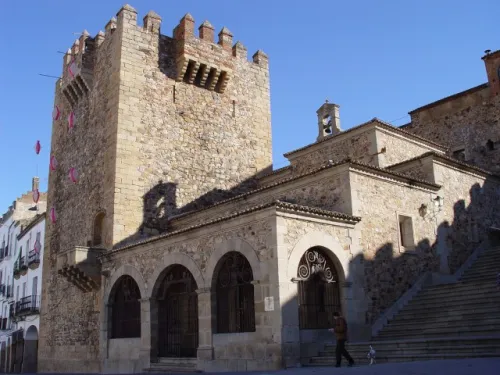
    The emblem of Cáceres and the most eye-catching building on Plaza Mayor, Bujaco Tower guards the northwest corner of the walled town. It is a genuinely Arab tower on a square plan, built in the 12th century when the Almohads rebuilt the town, and it stands on reused Roman stone blocks. It measures about 10 m a side and 25 m high, mostly rubble masonry with ashlar corners.

    Look at how it connects to the wall: it is an albarrana tower, standing forward and linked to the wall by a massive arch, typical of Almohad military building. At the top are battlements, two side machicolations and a front one added much later. On the side facing the square you see the small Balcón de los Fueros, from the 16th century, with scrolled brackets and a coat of arms.

    Its darkest moment came in the 12th century. Christian troops took Cáceres in 1169, but the Almohads won it back in the spring of 1173. The tower was the last stronghold of the Christian knights after a six-month siege, and the Almohad caliph had forty of the Cáceres Fratres who defended it put to death. He then rebuilt the tower.

    The name is modern. It may come from the caliph Abu Ya'qub, or from “buhaco”, a local straw-and-rag doll, the nickname for the statue of the Androgynous Genius that stood on top from 1820 to 1962. Between 1672 and 1791 it also held the town clock, so it was known as the clock tower too.

    Going up costs a small entry fee and is worth it if you want the wall from the inside and the square from above. When you come out, you are standing on Plaza Mayor again, right where you began.

    Hours
    Wed–Mon 10:00–14:00, 16:30–19:30 (Winter) / 17:30–20:30 (Summer), Tue closed
    Price
    2.50 EUR full
Walking tour route map of Cáceres Route loaded
Plaza MayorToledo-Moctezuma PalaceCáceres CathedralPalace of the Golfines de Abajo+4
All 8 stops are already on the map.
You just press start.
AI Tour Guide

You know the route now. Walk it with a guide talking you through every palace.

Press start wherever you are, even hundreds of kilometres from Cáceres, and the guide begins telling its stories right away. In the city, pick any of the 8 stops to start from: it leads you there, then talks with you the whole route, asking, listening, remembering, and shaping the tour around your answers.

8stops 0.8km 13 minwalking 13languages
▶Start the tour free

Free to start · Runs in your browser · No app, no download

Shorter Ways Through Cáceres Old Town

The walk is short enough to do in one go, but the entry tickets and opening days shape the day. Three ways to cut it to what you care about:

Free outside loop

Stops: 1, 2, 3, 4, 5, 6, 7, 8

For a first look or a tight budget: all eight stops from the outside, 13 min of walking and no tickets at all. At an easy pace with time for the façades and coats of arms, plan about an hour, and you finish back on Plaza Mayor.

Cathedral and noble houses

Stops: 1, 2, 3, 4

For a morning with two good interiors: Plaza Mayor, the Moctezuma façade, the cathedral and the Golfines palace, 5 min of walking in total. You pay entry at the cathedral and for the Golfines visit.

Churches and the wall

Stops: 5, 6, 7, 8

For church interiors and the fortifications: from San Francisco Javier up to San Mateo and down to the Arch of the Star and Bujaco Tower, 6 min of walking. You pay entry at San Francisco Javier, buy the diocesan pass for San Mateo and a ticket for the tower. Pick a day when San Mateo can be visited and the tower is open.

How Long the Cáceres Tour Takes, With and Without Interiors

The legs are tiny: the longest one, from San Mateo to the Arch of the Star, is 250 m and four minutes, most of the others take a minute or two. That is why the 13 minutes of walking hardly count; the time goes into the buildings.

With all the paid interiors, the full route fills about three hours: roughly half an hour each in the cathedral and Bujaco Tower, a fixed-time visit at the Golfines palace, and shorter stops in the two churches. The cathedral and palace variant fits into a morning, the churches and wall variant into a long afternoon, and the outside loop into an hour.

Before You Set Off in Cáceres

  • Start and finish: The recommended start is Plaza Mayor, and the walk ends at Bujaco Tower, which stands on the same square. You can join at any stop and pick up the order from there.
  • Best days: Check before you go which interiors are open on your day: the Golfines palace, Bujaco Tower and San Mateo are not open every day, so pick a day when all three can be visited.
  • A timing that works: Start on Plaza Mayor at 10:00, spend a quarter of an hour on the square, walk 2 minutes to the Moctezuma palace for five minutes, then 1 minute to the cathedral, arriving at 10:23. Half an hour inside and a 2-minute walk put you at the Golfines palace at 10:55, just in time for the next visit.
  • Costs: The squares, façades and the Arch of the Star are free. Each interior charges its own entry; reductions for seniors, students and young visitors apply at the cathedral and the Golfines palace.
  • San Mateo pass: Buy the diocesan pass at the Ermita de la Paz on Plaza Mayor before you set off, or at San Francisco Javier, one stop before San Mateo.
Walking tour route map of Cáceres
AI Tour Guide

Your guide is ready whenever you reach the old town.

Press start and a voice AI Tour Guide takes it from here: leading the route through Cáceres, telling the stories, and turning your walk into a real back-and-forth conversation. No app or download is needed; it runs in your browser.

8stops 0.8km 13 minwalking 13languages
▶Start the tour free

Free to start · Runs in your browser · No app, no download

What the AI Tour Guide Adds Inside the Walls

Cáceres packs dozens of palaces into a few lanes, and this route can only stop at a handful. The AI Tour Guide leads the walk as a conversation: it greets you, tells the stories of each place, asks what draws you in and remembers it, so a heraldry fan hears more about the coats of arms and someone curious about the Moorish town hears more about the towers. Ask it about the Ovando or Mayoralgo palaces facing the cathedral, or what the Holy Week centre in the crypt of San Francisco Javier shows, and it takes the conversation there while the free GPS route keeps leading you from stop to stop.

A Real Conversation A voice AI Tour Guide greets you, leads the whole route, and tells the stories and facts as you walk, asking what you want to see and keeping a real conversation going. Not a recording you press play on.
Map Navigation Follow the route on the map and walk at your own pace. You choose where to start and when to move to the next stop.
Ask Anything Curious about a building you pass? Ask your AI Tour Guide on the spot and the conversation carries on.
13 Languages Switch language anytime. No separate tour needed.
Start free in your browser

Common Questions About Cáceres

Is Plaza Mayor inside the old town walls?

No. Plaza Mayor is the main way into the monumental town, and the wall runs along one side of it. The Arch of the Star is the gate that takes you from the square into the walled quarter.

Can I do this walk in the late afternoon?

Yes, as long as you plan the interiors. The cathedral stays open into the evening, Bujaco Tower reopens after its midday break, and the Golfines palace also runs afternoon visits. The façades and squares are always open.

Which cities pair well with a visit to Cáceres?

If you are touring the region, Salamanca is 176 km away and has its own walking route, Seville lies 235 km off, and across the border Lisbon is 253 km away.

Is the tour really free?

Yes. The whole tour is free: the route, the interactive map and the navigation cost you nothing. Only the voice AI Tour Guide is optional and paid: you test it with 100 free credits, then you pay either €5 per hour or €19.99 for this whole tour, with no time limit. Admission to 5 of the 8 stops is not included: Cáceres Cathedral, Palace of the Golfines de Abajo, Church of San Francisco Javier, Church of San Mateo and Bujaco Tower charge their own entry fees.

Do I need to download an app?

No. Everything runs in your phone browser. Open the route and start walking, no download and no sign-up required.

Do I need to book the walking tour in advance?

No booking needed. This self-guided tour is available anytime. Open the route in your browser and start walking. The AI Tour Guide works instantly, no app, no reservation required.

What languages is the AI Tour Guide available in?

The AI Tour Guide speaks 13 languages, so you take the tour in your own language and can switch at any time.

Can I skip stops or change the route?

Yes. Skip any stop, spend extra time at places you like, or start the route from any point. It is your walk, you set the pace.
Image credits
▶ Start free in your browser Runs in your browser, no app, no download