Free Walking Tour Hamburg: Brick, Harbour and Michel

From the copper-roofed city hall through UNESCO brick and warehouse quarters to the harbour piers, the Michel and the Alster: ten stops through a merchant city.

10 Stops 7.1 km ~1 h 40 min walking
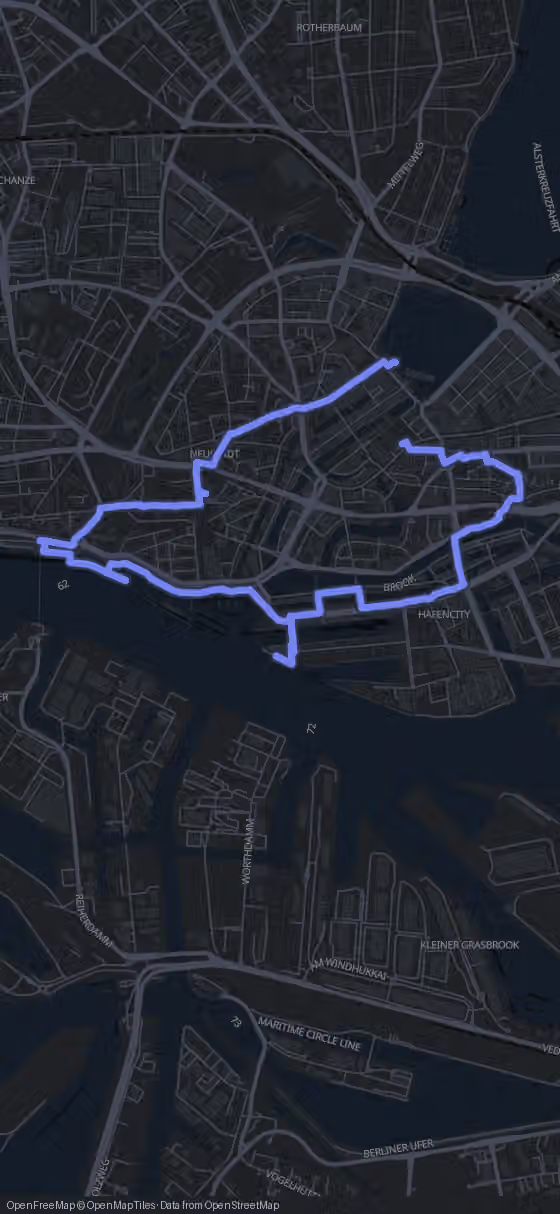
Route map for the Hamburg walking tour
Stop 1 of 10
950 m·12 min
Hamburger Rathaus
Head south-east toward the Kontorhausviertel
Moin, welcome to Hamburg. I'm Alex, and this city keeps finding new lives for its warehouses and waterfront.
Try this tour with Alex

What This Hamburg Walk Covers

Ten stops lead from the Hamburger Rathaus through brick office blocks, warehouses and the harbour to the Binnenalster, close to where you started. The route covers 7.1 km with 1 h 40 min of pure walking; plan about four hours with short visits, or most of a day with the big interiors.

Most stops are free to see. Miniatur Wunderland, the Elbphilharmonie and Rickmer Rickmers charge admission. The GPS route with map runs free in your browser and leads you from stop to stop; the AI Tour Guide is optional.

Open free GPS & optional AI Tour Guide
This short shows highlights of the route. All 10 stops follow below.

The Route

Walking Map of Hamburg: City Hall, Warehouses, Harbour, Alster

10 stops 7.1 km 1 h 40 min walking
Tap to load interactive map

The 10 stops along this route

  1. Hamburger Rathaus, stop 1 on the self-guided walking tour
    1Hamburger Rathaus
  2. Kontorhausviertel in Hamburg, stop 2 on the self-guided walking tour
    2Kontorhausviertel
  3. Chilehaus in Hamburg, stop 3 on the self-guided walking tour
    3Chilehaus
  4. Speicherstadt in Hamburg, stop 4 on the self-guided walking tour
    4Speicherstadt
  5. Miniatur Wunderland in Hamburg, stop 5 on the self-guided walking tour
    5Miniatur Wunderland
  6. Elbphilharmonie in Hamburg, stop 6 on the self-guided walking tour
    6Elbphilharmonie
  7. Rickmer Rickmers in Hamburg, stop 7 on the self-guided walking tour
    7Rickmer Rickmers
  8. Landungsbrücken in Hamburg, stop 8 on the self-guided walking tour
    8Landungsbrücken
  9. St. Michaelis (Michel) in Hamburg, stop 9 on the self-guided walking tour
    9St. Michaelis (Michel)
  10. Binnenalster in Hamburg, stop 10 on the self-guided walking tour
    10Binnenalster
  11. That's the full route.

    Walk it with an AI Tour Guide talking you through every one of these streets.

    Start free in your browser
    You made it

Your Hamburg Walking Tour, from City Hall to the Lake

  1. 1

    Hamburger Rathaus

    Hamburger Rathaus, stop 1 on the self-guided walking tour

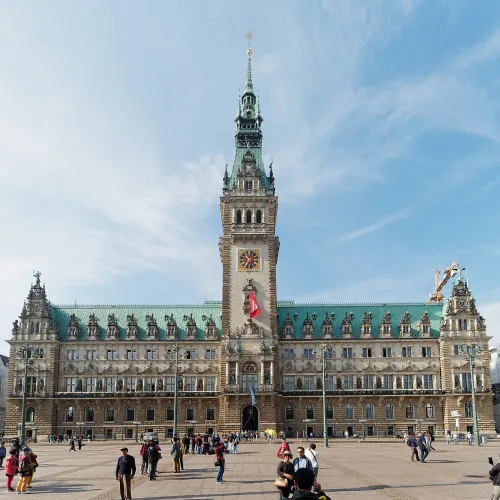
    Start on the Rathausmarkt and look up. The Hamburger Rathaus is still a working building: the First Mayor has an office here, and both the Parliament and the Senate, the city's executive, meet inside. Because Hamburg is a city and a federal state at once, this is also the seat of one of Germany's 16 state parliaments. The green roof is copper that has reacted with air and rain over the decades, a quiet sign of the building's age.

    The previous city hall burned in the great fire of 1842, and it took almost 44 years before work on a new one began. Seven architects led by Martin Haller designed it; construction started in 1886, and on 26 October 1897 First Mayor Johannes Versmann received the key. The bill came to 11 million gold marks, roughly 80 million euros today. Outside you see Neo-Renaissance; inside, the architects mixed several historical styles, and the house is one of the few completely preserved buildings of historicism in Hamburg.

    Officially it has 647 rooms, but nobody is entirely sure. In 1971 a room in the tower turned up by accident, during a search for a document that had slipped behind a filing cabinet. The square in front has seen state visits by Emperor Haile Selassie, the Shah of Iran in 1955 and Queen Elizabeth II in 1965, a moving service of remembrance for the victims of the North Sea flood of 1962, and the title celebrations of Hamburger SV, the last in 1983.

    Admission is free, but you can only see the interior on a guided tour, except during official events. If council chambers and grand halls are your thing, ask at the entrance about the next tour and build it into your morning; otherwise the facade and the square tell the story well. From here it is 710 m, about 10 minutes, to the brick office blocks of the Kontorhausviertel.
    Hours
    Mon–Sun 09:00–19:00 (interior by guided tour only, except at official events)
    Price
    Free
  2. 2

    Kontorhausviertel

    Kontorhausviertel in Hamburg, stop 2 on the self-guided walking tour

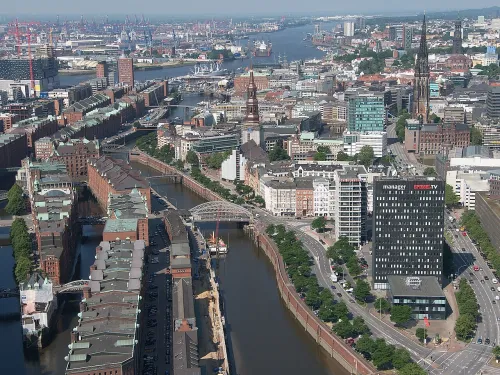
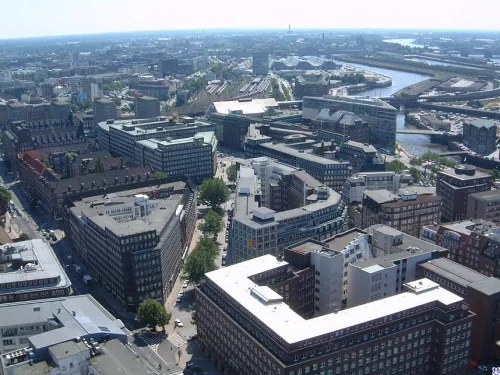
    Here the city changes colour. The Kontorhausviertel is a district of large office buildings in dark clinker brick from the early 20th century, a style known as Brick Expressionism. Look for the copper roofs, the upper floors set back from the street line so the narrow streets get more sky, and the ceramic ornaments and sculptures on the facades, many of them linked to Hamburg's trade and crafts. Since 5 July 2015 parts of the quarter have been a UNESCO World Heritage Site, together with the neighbouring Speicherstadt.

    It looked very different before. From the 17th century the area was a densely built Gängeviertel, a 'corridor quarter' of narrow alleys, and after the fire of 1842 even more people squeezed in because housing was short. When cholera broke out in 1892, the poor hygiene let the disease spread dramatically, and the city decided to clear and rebuild the area. Many residents were resettled elsewhere.

    The new quarter carries the mark of Fritz Schumacher, the city's Director of Construction from 1909. Hamburg's merchants needed office space, so large Kontorhäuser rose on reinforced concrete skeletons, each one designed individually; at first some housing was planned in them as well. Burchardplatz forms the centre of his layout and deserves a slow look around. The Chilehaus is only 100 m away, about a minute's walk.

    Hours
    Freely accessible, no opening hours
    Price
    Free
  3. 3

    Chilehaus

    Chilehaus in Hamburg, stop 3 on the self-guided walking tour

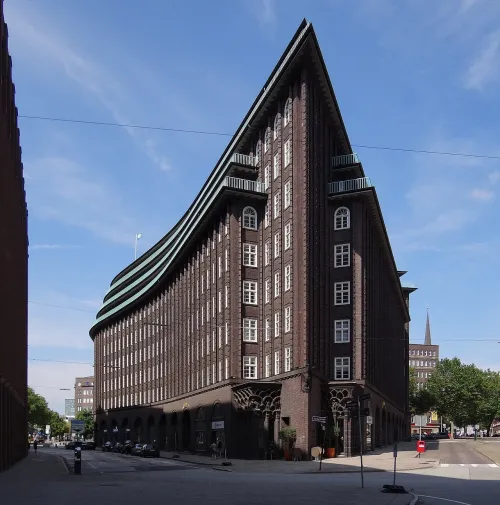
    You will recognise the Chilehaus by its tip, which looks like the prow of a ship, where the facades meet at a very sharp angle at the corner of Pumpenstraße and Niedernstraße. If you can, walk round to the east side: that is where the building shows itself best. Despite ten storeys on a plot of about 6,000 m², it feels surprisingly light, thanks to its strong vertical lines, recessed upper floors and the curved facade along Pumpenstraße.

    Architect Fritz Höger built it between 1922 and 1924 for the shipowner Henry B. Sloman, who made his fortune trading saltpetre from Chile, hence the name. Because it went up during the hyperinflation of the early 1920s, the exact cost is hard to pin down; estimates say more than 10 million Reichsmark. Some 4.8 million dark Oldenburg bricks went into it, and the building spans Fischertwiete street.

    Much of the cleverness is hidden. The ground was so difficult that the house stands on reinforced concrete piles 16 metres deep, and the closeness to the Elbe called for a specially sealed cellar. The heating plant sits in a caisson that can float inside the building, so a flood would not damage it. Sculptor Richard Kuöhl created the sculptural details, and until a modernisation in 1991 two sets of paternoster lifts carried office workers up and down.

    The Chilehaus is an office building, so you enjoy it from outside, free of charge. Next comes the Speicherstadt, 1060 m or about 15 minutes away.

    Hours
    Freely accessible (exterior view only), no opening hours
    Price
    Free
  4. 4

    Speicherstadt

    Speicherstadt in Hamburg, stop 4 on the self-guided walking tour

    Red brick warehouses on oak piles, cut through by loading canals called Fleete: the Speicherstadt is the largest warehouse district in the world whose buildings stand on timber-pile foundations. It stretches for 1.5 km and was built in stages between 1883 and 1927. Notice the mix of Neo-Gothic detail and later modernist blocks; UNESCO listed the district on 5 July 2015 for exactly this architecture and for what it tells about the growth of international sea trade.

    The whole district exists because of a customs dispute. Hamburg belonged to the German Confederation from 1815 but stayed outside the German Customs Union. Article 34 of the North German constitution allowed Hamburg and the other Hanseatic cities to remain free ports until they asked to join, and the clause passed into the imperial constitution of 1871. When Berlin sharply raised its external tariffs in 1879, the pressure on Hamburg grew.

    In 1881 an agreement was signed in Berlin; among Hamburg's negotiators were Senators Versmann and O'Swald, the same Versmann who later received the key of the new city hall. The outcome was a free zone where goods could be moved and stored without paying customs, and these warehouses were built for it.

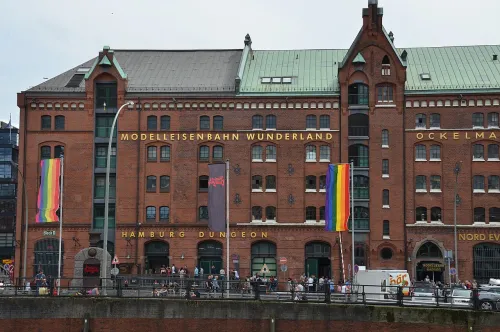
    The port has since changed, and the area around the warehouses has been redeveloped for years, yet walking the bridges and canal edges still gives you a strong feel for the old harbour trade. Miniatur Wunderland is inside this district, just 290 m and about 4 minutes on.

    Hours
    Mon–Fri 10:00–17:00, Sat/Sun and holidays 10:00–18:00 (Nov–Feb daily 10:00–17:00)
    Price
    Free
  5. 5

    Miniatur Wunderland

    Miniatur Wunderland in Hamburg, stop 5 on the self-guided walking tour

    Behind a warehouse facade in the Speicherstadt lies what Guinness World Records lists as the largest model railway system in the world. Around 1,230 digitally controlled trains pull more than 12,000 wagons past some 5,280 houses and bridges, 52 aircraft and around 290,000 figures, while almost 500,000 LEDs run a recurring cycle of day and night. As of May 2025 the track measured 16,491 m in H0 scale, with 3,600 switches and 1,400 signals.

    The layout is divided into twelve sections: the Harz mountains, the invented town of Knuffingen, the Alps and Austria, Hamburg itself, America, Scandinavia, Switzerland, a replica of Hamburg Airport, Italy, Rio de Janeiro, Patagonia and Monaco/Provence. Sections for Central America and the Caribbean are being planned.

    The idea struck Frederik Braun in the summer of 2000, on holiday in a model train shop in Zurich. Back in Hamburg he ran an online survey about the city's sights, real and fictional, and male respondents ranked the not yet existing Wunderland third. He and his twin brother Gerrit say the first business plan fitted on two pages; Hamburger Sparkasse backed it, building began in December 2000, and the first three sections opened on 16 August 2001.

    Is it worth going in? If you love detail, trains or are travelling with children, yes. You need a ticket, and the opening hours vary, so check them before you plan your walk around it. Short on time? Keep going: the Elbphilharmonie is 690 m, about 10 minutes, away.

    Hours
    Open 365 days a year; opening hours vary by day (daily calendar)
    Price
    22 EUR
  6. 6

    Elbphilharmonie

    Elbphilharmonie in Hamburg, stop 6 on the self-guided walking tour

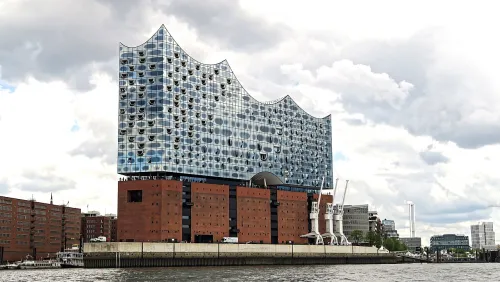
    The glass crown on top of an old brick block is the Elbphilharmonie, Hamburg's concert hall since January 2017, nicknamed Elphi. Its base is the shell of Kaispeicher A, a warehouse from 1963; on top sits a new structure with a glass facade meant to recall sails, waves, icebergs or a quartz crystal. At 110 metres it is the highest inhabited building in Hamburg. Its site at the Kaiserhöft, at the tip of the Großer Grasbrook, is shaped by old harbour industry and by the Neo-Gothic brick of the Speicherstadt you just walked through.

    The concept goes back to an idea by Hamburg project developer Alexander Gérard in 2001, and the city parliament decided to build it in 2007 under Mayor Ole von Beust. The Basel architects Herzog & de Meuron designed it, Hochtief built it, and the city, as main financier, paid with tax money. The aim was a new landmark and a 'cultural monument for everyone'.

    Then came the delays. Completion was planned for 2010, but the date slipped again and again, including an eighteen-month halt on construction, until the architects, client and builder reorganised the project shortly after Olaf Scholz became mayor. In the end the building cost around 866 million euros, more than eleven times the 77 million first budgeted, which made it famous across Germany long before it opened.

    To go inside you need a paid time-slot ticket, and you can also come back after dark. If you only want the outline against the river, the outside view is enough. From here the longest leg begins: 1440 m, about 20 minutes, to the sailing ship Rickmer Rickmers.

    Hours
    Daily 10:00–24:00 (last admission 23:30)
    Price
    Currently free (time-slot ticket required); from 05.10.2026 5 EUR per ticket
  7. 7

    Rickmer Rickmers

    Rickmer Rickmers in Hamburg, stop 7 on the self-guided walking tour

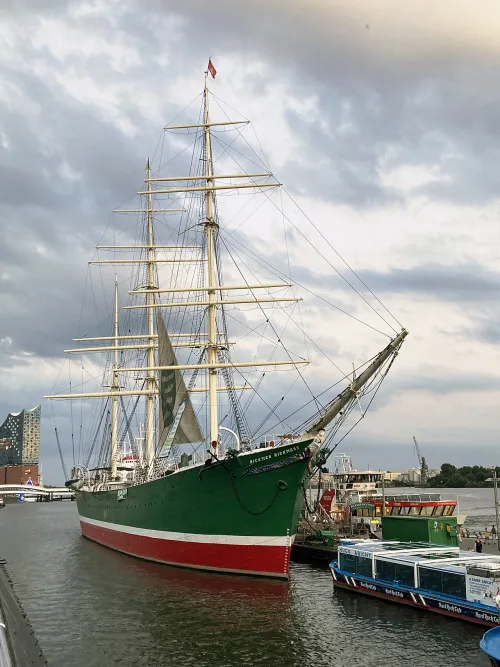
    A three-masted steel cargo sailing ship lies at the St. Pauli piers: Rickmer Rickmers, today a museum and monument ship. It was launched in August 1896 at the Bremerhaven yard of the Rickmers shipping company and named after the owner's grandson, also called Rickmer Rickmers. Its first voyage went to Hong Kong and brought rice and bamboo back to Germany, under Captain Hermann Hinrich Ahlers and a crew of 21.

    Few ships have changed name so often. In 1904 a hurricane in the Indian Ocean tore away its mizzen mast; the crew still brought it into Cape Town, where it was re-rigged as a barque to save money. In 1912 a Hamburg shipping firm bought it and renamed it Max, carrying coal from Wales to Chile and saltpetre from Chile to Europe, the same trade that paid for the Chilehaus.

    In 1914, after the First World War broke out, the ship anchored off the neutral Azores, and on 23 February 1916 Portuguese forces seized it. As Flores it carried war supplies for Britain; from 1924 it served the Portuguese navy as the training ship Sagres, received two diesel engines in 1930 and won the Tall Ships' Races in 1958. After 1962 it lay near Lisbon as a depot ship named Santo André.

    Going on board costs admission, and it is worth it if you want to see a sailing cargo ship of this era up close; if not, the hull and rigging from the pier already say a lot. The Landungsbrücken are 530 m on, about 7 minutes.

    Hours
    Daily: 10:00–18:00
    Price
    7.00 EUR adults
  8. 8

    Landungsbrücken

    Landungsbrücken in Hamburg, stop 8 on the self-guided walking tour

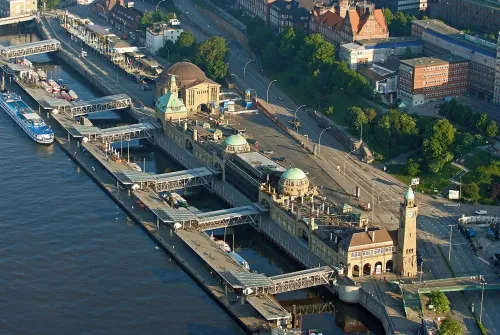
    The St.-Pauli-Landungsbrücken are the largest landing site in the Port of Hamburg and a busy hub where S-Bahn, U-Bahn and ferries meet, with plenty of restaurants and boats waiting for passengers. The landing stage runs for 688 metres along the Elbe. At its eastern end stands the Pegelturm, the water level tower: halfway up, a gauge built into the wall shows the current state of the tide. At the western end is an entrance to the Old Elbe Tunnel.

    The first pier was built here in 1839, at what was then the edge of the harbour. It served steamships that took on coal, and since coal was a fire risk, the city wanted it at a safe distance. The present piers date from 1907: floating pontoons reached by ten movable bridges, built for the passenger steamers of the overseas lines, among them the great Hapag-Lloyd liners.

    The old pontoons were destroyed in the Second World War and rebuilt between 1953 and 1955; the last gap, between bridges 2 and 3, was closed only in 1976. Roofs and lighting were renewed in a modernisation that began in 1999. Today HADAG ferries, harbour tour boats, launches, ships to the lower Elbe and catamarans to Stade and Helgoland leave from here, and boats cross daily to the musical theatre showing The Lion King.

    The piers are free and always open, a good spot to sit for a while and watch the river traffic. Then turn inland: the Michel is 970 m, about 14 minutes, away.

    Local name
    St.-Pauli-Landungsbrücken
    Hours
    Freely accessible, no opening hours
    Price
    Free
  9. 9

    St. Michaelis (Michel)

    St. Michaelis (Michel) in Hamburg, stop 9 on the self-guided walking tour

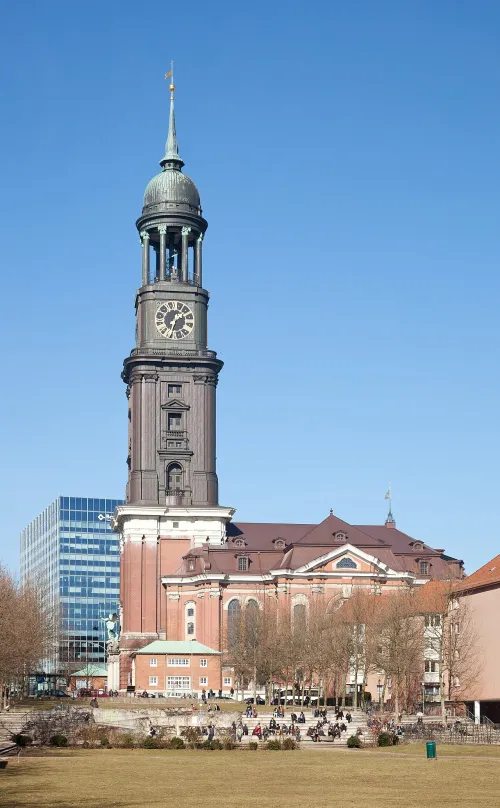
    The Michel's copper-clad Baroque spire rises 132 metres and has long served ships sailing up the Elbe as a landmark. St. Michaelis is one of Hamburg's five Lutheran main churches and is considered one of the most important Protestant Baroque churches in northern Germany. Above the main portal, a large bronze statue shows the Archangel Michael overcoming the devil.

    Unlike many Hamburg churches, which were Catholic before the Reformation, the Michel was built as a Protestant church from the start. Its story begins around 1600 with a small cemetery chapel outside the city walls, so cramped that in good weather people stood in the churchyard and followed the sermon through the open windows. The first proper church was built for the growing new town, the Neustadt, consecrated in 1661 before it even had a tower, and became the fifth main church in 1685.

    On 10 March 1750 lightning struck. The fire went unnoticed for about two hours, and planning for a new church started the very next day. The second church, designed by Johann Leonhard Prey and Ernst Georg Sonnin, survived a three-year halt over disputes about the roof and was inaugurated in 1762 with an oratorio by Georg Philipp Telemann, then in charge of music at the city's five main churches. Today's building is the third on this site.

    Entry is free, and even a few minutes inside are worth it if Baroque church interiors interest you. The last leg is 1370 m, about 19 minutes, to the Binnenalster.

    Hours
    Daily: 09:00–20:00
    Price
    Free
  10. 10

    Binnenalster

    Binnenalster in Hamburg, stop 10 on the self-guided walking tour

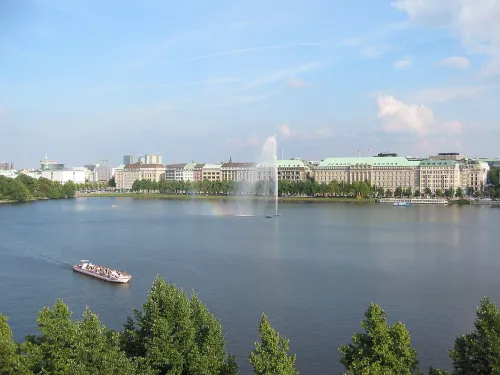
    The walk ends on the water. The Binnenalster is the smaller of two artificial lakes formed by the Alster river, covering 0.2 km². 'Binnen' means inner: this part of the lake lay inside Hamburg's old city walls. It was originally dammed as a reservoir for a mill.

    During the Second World War the lake was covered with a mostly wooden camouflage so that it looked like part of the city from the air, to confuse bomber crews; a fake Lombardsbrücke and an anti-aircraft unit were set up on the Außenalster as a decoy. The walls are long gone, and today the Lombardsbrücke and the Kennedybrücke span the water instead.

    Embankment streets line three sides, and a park borders the north. Opposite the park, Jungfernstieg is the busy boulevard at the heart of the lake front, while Ballindamm and Neuer Jungfernstieg are home to company headquarters and first-class hotels. On the first weekend of September the Alstervergnügen street fair fills the shores with food, drink, stalls and rock bands. The Hamburger Rathaus, where you began, is close by.

    Hours
    Freely accessible, no opening hours
    Price
    Free
Walking tour route map of Hamburg Route loaded
Hamburger RathausKontorhausviertelChilehausSpeicherstadt+6
All 10 stops are already on the map.
You just press start.
AI Tour Guide

You've read the route. Now walk it from the Rathaus with a guide in your ear.

Press start wherever you are, even hundreds of kilometres from Hamburg, and the guide begins telling its stories right away. In the city, pick any of the 10 stops to start from: it leads you there, then talks with you the whole route, asking, listening, remembering, and shaping the tour around your answers.

10stops 7.1km 1 h 40 minwalking 13languages
▶Start the tour free

Free to start · Runs in your browser · No app, no download

Shorter Ways to Walk Hamburg

Not every day has room for all ten stops. These three cuts keep the route's logic and simply start or end somewhere else.

City hall to concert hall

Stops: 1, 2, 3, 4, 5, 6

For a first morning in Hamburg: politics, brick architecture and the free port, ending at the Elbphilharmonie. About 40 minutes of walking. You only pay for the Elbphilharmonie ticket, plus Miniatur Wunderland if you go in.

Warehouses and water

Stops: 4, 5, 6, 7, 8

For harbour lovers and families: canals, model trains, the concert hall and an old sailing ship, ending at the Landungsbrücken with S-Bahn, U-Bahn and ferries at hand. About 41 minutes of walking. Paid entries: Miniatur Wunderland, the Elbphilharmonie and Rickmer Rickmers.

Harbour to the Alster

Stops: 6, 7, 8, 9, 10

For an afternoon: from the Elbphilharmonie along the river, up to the Michel and back to the lake near the city hall. About 60 minutes of walking. Paid entries: the Elbphilharmonie and Rickmer Rickmers; the Michel is free.

How Long Does This Hamburg Tour Take, with or without Wunderland?

The order tells the city's story in sequence: a city hall rebuilt after the fire of 1842, brick offices that replaced a cholera-stricken slum, the warehouses of the free port, the new concert hall, then the old harbour and the Michel, before you finish at the lake near your starting point.

Pure walking takes 1 h 40 min. With short looks at each stop and a time-slot visit to the Elbphilharmonie, count on about four hours. Add around two hours if you go into Miniatur Wunderland and about 45 minutes on board Rickmer Rickmers; with both, the walk fills most of a day. Split in half, the city hall to Elbphilharmonie part needs 40 minutes of walking, the Elbphilharmonie to Binnenalster part 60 minutes.

Before You Set Off from the Rathaus

  • Start and finish: The recommended start is the Hamburger Rathaus, near the central station; you can join at any stop. You finish at the Binnenalster, close to the city hall again.
  • Best day and time: Start in the morning so you reach Rickmer Rickmers well before it closes; the Elbphilharmonie is also open in the evening if you want to return.
  • Costs: Walking the route costs nothing. Entry is charged at Miniatur Wunderland, the Elbphilharmonie and Rickmer Rickmers.
  • Shortcut: The Landungsbrücken have S-Bahn, U-Bahn and ferry stations, handy if you want to end the walk there.
  • AI Tour Guide: You get 100 free credits to start. After that, choose freely: this tour all-inclusive for €19.99 with no time limit, or €5 per hour.
Walking tour route map of Hamburg
AI Tour Guide

Your guide is ready when you reach the Rathaus.

Press start and a voice AI Tour Guide takes it from here: leading the route through Hamburg, telling the stories, and turning your walk into a real back-and-forth conversation. No app or download is needed; it runs in your browser.

10stops 7.1km 1 h 40 minwalking 13languages
▶Start the tour free

Free to start · Runs in your browser · No app, no download

What the AI Tour Guide Adds Between Brick and Harbour

The AI Tour Guide walks this route with you as a conversation. It greets you at the Rathaus, tells the stories of each place as you arrive, asks what caught your attention and remembers it, so the talk drifts towards what you care about: the ceramic ornaments of the Kontorhaus blocks, perhaps, or how Rickmer Rickmers found its way from a Lisbon naval harbour back to the Elbe. Interrupt it whenever you like. The GPS keeps leading you from stop to stop; the guide never changes the route.

A Real Conversation A voice AI Tour Guide greets you, leads the whole route, and tells the stories and facts as you walk, asking what you want to see and keeping a real conversation going. Not a recording you press play on.
Map Navigation Follow the route on the map and walk at your own pace. You choose where to start and when to move to the next stop.
Ask Anything Curious about a building you pass? Ask your AI Tour Guide on the spot and the conversation carries on.
13 Languages Switch language anytime. No separate tour needed.
Start free in your browser

Common Questions About Walking Hamburg

What can I do on this route if it rains?

Several stops work indoors: Miniatur Wunderland, the Elbphilharmonie, the Michel and the decks and cabins of Rickmer Rickmers. Plan longer visits there and keep the open squares, canals and piers short.

Can I walk the route in the evening?

Partly. The outdoor stops are open at any hour, and the Michel and the Elbphilharmonie can be visited into the evening. Miniatur Wunderland's hours vary, while Rickmer Rickmers and the city hall close earlier.

Can I add a boat trip?

Yes. Harbour tour boats and HADAG ferries leave from the Landungsbrücken, right in the middle of the route. Take a trip there and pick up the walk afterwards towards the Michel.

Which day trips fit well with Hamburg?

For more brick Gothic and Hanseatic history, Lübeck and Lüneburg are close. Stade is also linked by catamaran from the Landungsbrücken, and Bremen makes a fine Hanseatic comparison.

Is the tour really free?

Yes. The whole tour is free: the route, the interactive map and the navigation cost you nothing. Only the voice AI Tour Guide is optional and paid: you test it with 100 free credits, then you pay either €5 per hour or €19.99 for this whole tour, with no time limit. Admission to 3 of the 10 stops is not included: Miniatur Wunderland, Elbphilharmonie and Rickmer Rickmers charge their own entry fees.

Do I need to download an app?

No. Everything runs in your phone browser. Open the route and start walking, no download and no sign-up required.

Do I need to book the walking tour in advance?

No booking needed. This self-guided tour is available anytime. Open the route in your browser and start walking. The AI Tour Guide works instantly, no app, no reservation required.

What languages is the AI Tour Guide available in?

The AI Tour Guide speaks 13 languages, so you take the tour in your own language and can switch at any time.

Can I skip stops or change the route?

Yes. Skip any stop, spend extra time at places you like, or start the route from any point. It is your walk, you set the pace.
Image credits
▶ Start free in your browser Runs in your browser, no app, no download