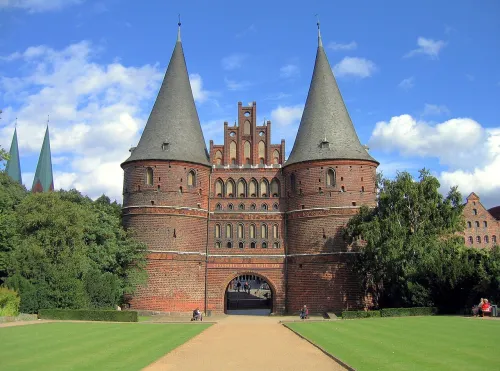
Free Walking Tour Lübeck: Gate, Hanse and Marzipan

From the twin towers of the Holstentor to the tower of St. Petri, with almshouses, Brick Gothic churches and marzipan in between: 4.1 km through Lübeck's old town.

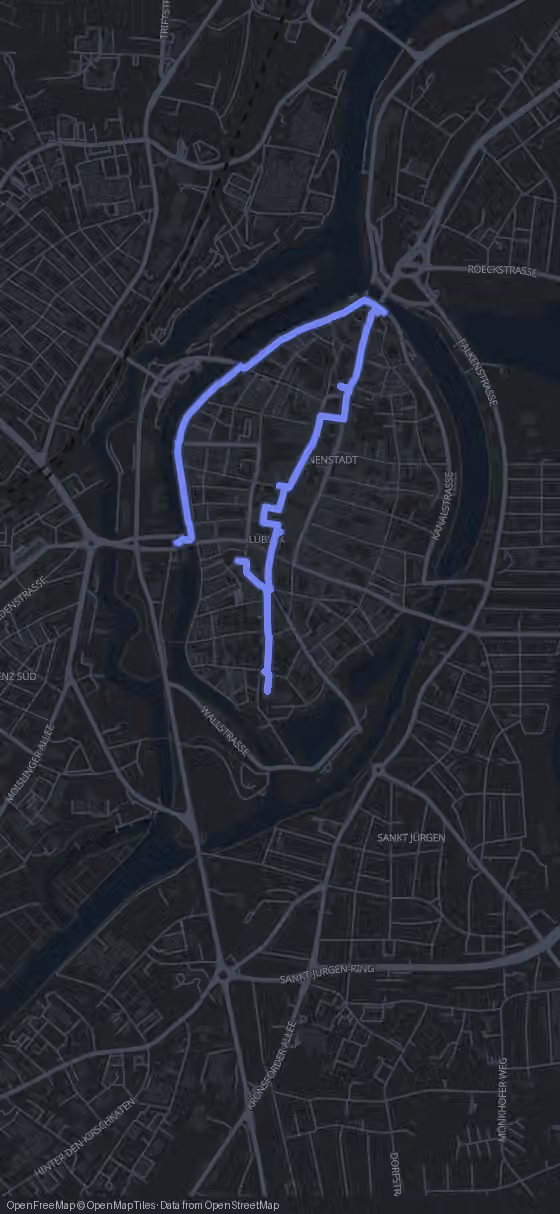
10 Stops 4.1 km ~56 min walking
Route map for the Lübeck walking tour
Stop 1 of 10
1.3 km·16 min
Holstentor
Head north-east toward the Europäisches Hansemuseum
Moin, welcome to Lübeck. I'm Alex, and this city keeps one wartime scar exactly where it fell.
Try this tour with Alex

Lübeck's Old Town on Foot at a Glance

Ten stops lead from the Holstentor to St. Petri: 4.1 km and 56 minutes of pure walking. With lunch and the interiors that reward you, plan most of a day.

Most stops are free. Entry costs at the Holstentor, the Europäisches Hansemuseum, the Marienkirche and the St. Petri tower; the Buddenbrookhaus is currently closed. The GPS route in your browser is free, and the AI Tour Guide is optional.

Open free GPS & optional AI Tour Guide
View of Lübeck

The Route

Walking Map of Lübeck's Old Town Route

10 stops 4.1 km 56 min walking
Tap to load interactive map

The 10 stops along this route

  1. Holstentor in Lübeck, stop 1 on the self-guided walking tour
    1Holstentor
  2. Europäisches Hansemuseum in Lübeck, stop 2 on the self-guided walking tour
    2Europäisches Hansemuseum
  3. Füchtingshof in Lübeck, stop 3 on the self-guided walking tour
    3Füchtingshof
  4. Heiligen-Geist-Hospital in Lübeck, stop 4 on the self-guided walking tour
    4Heiligen-Geist-Hospital
  5. Buddenbrookhaus in Lübeck, stop 5 on the self-guided walking tour
    5Buddenbrookhaus
  6. Marienkirche in Lübeck, stop 6 on the self-guided walking tour
    6Marienkirche
  7. Rathaus Lübeck, stop 7 on the self-guided walking tour
    7Rathaus Lübeck
  8. Café Niederegger in Lübeck, stop 8 on the self-guided walking tour
    8Café Niederegger
  9. Lübecker Dom, stop 9 on the self-guided walking tour
    9Lübecker Dom
  10. St. Petri in Lübeck, stop 10 on the self-guided walking tour
    10St. Petri
  11. That's the full route.

    Walk it with an AI Tour Guide talking you through every one of these streets.

    Start free in your browser
    You made it

Your Lübeck Walk, Stop by Stop: Holstentor to St. Petri

  1. 1

    Holstentor

    Holstentor in Lübeck, stop 1 on the self-guided walking tour

    Start on the city side of the Holstentor and the gate looks like a single block: two round towers and a central building fused into one brick face. Walk through the passage to the field side, the side that faced away from the city, and the three parts come apart. Here the towers bulge out as half-circles, reaching 3.5 metres beyond the central block, under conical roofs with a pediment between them. This Brick Gothic gate is one of the last pieces of Lübeck's medieval fortifications and one of only two city gates still standing; the other is the Burgtor. Together with the old town it has been a UNESCO World Heritage Site since 1987.

    Look up over the passage. On the city side the letters SPQL sit between the years 1477 and 1871. They copy Rome's SPQR and stand for Senatus populusque Lubecensis, the Senate and People of Lübeck, yet they were only added in 1871, the year of the gate's restoration and of the founding of the German Reich. The 1477 was long taken for the year of construction; the correct date is now known to be 1478.

    The portcullis in the passage dates from 1934 and has nothing to do with the original defences. In its place hung a so-called pipe organ: separate bars that could be lowered one at a time. Defenders could drop all but one or two and leave a narrow gap for their own men to slip through later.

    Going inside costs an entrance fee. The two faces and the passage are the heart of the visit; go in if you want to see the four floors from within. Then head into the old town along Petersilienstraße to the Europäisches Hansemuseum, 1290 m and about 18 minutes, the longest leg of the route.
    Hours
    Mon–Sun 10:00–18:00 (closed 24.12, 25.12, 31.12, 01.01)
    Price
    9 EUR regular, under 18 as well as pupils/students/trainees free, groups of 12+ 8 EUR
  2. 2

    Europäisches Hansemuseum

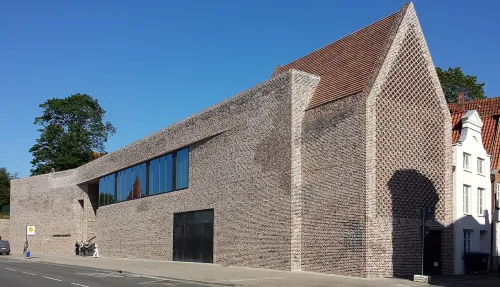
    Europäisches Hansemuseum in Lübeck, stop 2 on the self-guided walking tour

    The Europäisches Hansemuseum tells the story that paid for nearly everything you see in Lübeck: the Hanseatic League, from its formation to its dissolution. With 7,405 square metres in total, it is the largest museum in the world devoted to the subject. Planning began in 2004, and the opening was postponed several times because the archaeological excavations on the site took far longer than expected. Chancellor Angela Merkel opened it on 27 May 2015, and the first visitors came in on 30 May.

    Inside, original objects sit alongside interactive stations and staged scenes from the Hanse's trading posts in Novgorod, Bruges, Bergen and London, as well as Lübeck itself. Look out for the gold and silver coins of the Lübeck Hoard, and for the documents and paintings that explain the trade networks and the everyday life of the people involved.

    The museum is part of the Burgkloster, a Dominican friary from the 13th century in the northern part of the old town, partly joined to the nearby Castle Hill. The site has been described as one of the most important medieval monuments in northern Germany. Your ticket also opens the friary and the excavated ground the museum stands on, so you can follow how Lübeck's streets and society grew while the exhibition tells the League's story.

    The permanent exhibition including the Burgkloster is a paid entry. It is worth it if the Hanse genuinely interests you and you can give it a couple of hours; if not, take in the setting from outside and come back another day. From here it is 600 m, about 9 minutes, to the Füchtingshof, passing the Glandorpshof on the way.

    Hours
    Daily 10:00–18:00 (closed 24.12)
    Price
    Permanent exhibition (incl. castle monastery): 16 EUR adults, 10 EUR reduced, under 18 free | castle monastery only: 8 EUR adults, 5 EUR reduced
  3. 3

    Füchtingshof

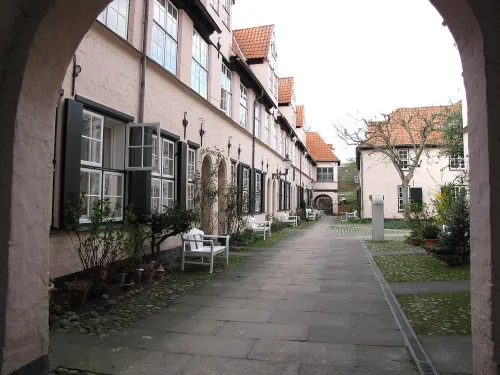
    Füchtingshof in Lübeck, stop 3 on the self-guided walking tour

    Around the corner from the Koberg, on Glockengießerstraße, a gateway dated 1639 opens onto one of Lübeck's almshouse courtyards. It was built as housing for the old and the poor, and it is still social housing today.

    That shapes the whole visit. People live behind these doors, and the request for quiet posted at the entrance is there for a reason. Walk in softly and keep your voice low; in return you get to stand in a working piece of the 17th century rather than a museum set.

    The courtyard is a public right of way and costs nothing, but the gate does not stand open all day. Guided groups tend to pass through around midday, so the late afternoon is the calmer time; in the morning, come well before midday.

    The Heiligen-Geist-Hospital is only 60 m away, a minute's walk, and it belongs right after this courtyard: the same tradition of caring for the poor, only far older and on a grand scale.

    Hours
    Usually 10:00–12:00 and 15:00–18:00 (when the gate is open)
    Price
    0 EUR
  4. 4

    Heiligen-Geist-Hospital

    Heiligen-Geist-Hospital in Lübeck, stop 4 on the self-guided walking tour

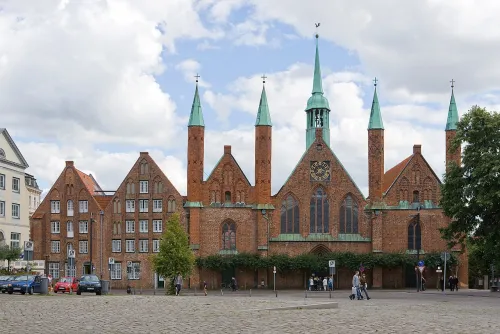
    On the Koberg stands the Heiligen-Geist-Hospital, completed in 1286 and one of the oldest existing social institutions in the world. It was founded as a charitable foundation in 1227 and is regarded as the most important foundation of medieval welfare in northern Europe.

    Study the facade before you go in. The slender turrets cannot be climbed and have no practical use; they are there for artistic reasons and, together with the zigzag of the gables, act as a signature of the Gothic style. You will meet the same motif again on the Rathaus. The small roof turret on the middle gable was added later, and it has long been seen as a disturbance of the composition.

    The hospital was a merchants' project. Bertram Morneweg, who is said to have traded in Riga before returning to Lübeck, was one of its co-founders and its first head. Its income came from land: villages in Mecklenburg, part of the island of Poel and villages in Holstein fed and cared for the poor and the sick. In 1935, ahead of an expected redrawing of borders, the foundation swapped its estates inside the city for others outside, and it still owns land today.

    Entry is free, and it is worth a look inside. From here it is 520 m, about 7 minutes, to the Buddenbrookhaus on Mengstraße.

    Hours
    Tue–Sun 10:00–17:00, Mon closed
    Price
    0 EUR
  5. 5

    Buddenbrookhaus

    Buddenbrookhaus in Lübeck, stop 5 on the self-guided walking tour

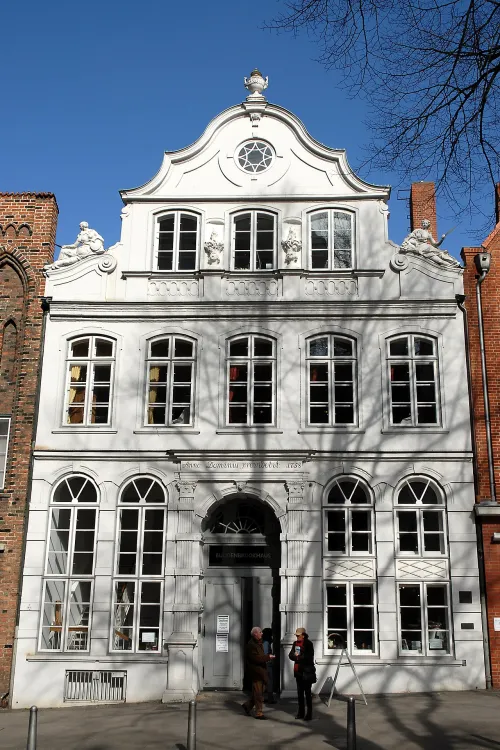
    At Mengstraße 4 the Buddenbrookhaus turns its main facade directly towards the Marienkirche. As the Heinrich and Thomas Mann Centre it has been a memorial since 1993, devoted to the novel Buddenbrooks and to the Mann family of writers. The house is currently closed for extension and rebuilding, so this is a stop for the outside.

    Look above the portal: the date 1758 and the inscription Dominus providebit, The Lord will provide. Both mark the house built by Johann Michael Croll, a merchant trading with Novgorod, who bought the property in 1758. His plot was a strip 12 metres wide running about 50 metres back into the block, with a main building around 29 metres deep, a side wing, a garden house and a warehouse.

    The site's history reaches much further back. In 1289 the city's records name one Arnoldus Calvus as owner of a house here. Until 1537 a good dozen owners followed, mostly long-distance traders and without exception councillors, mayors or relatives of the council. Then Hermann von Dorne bought it, and his family, which put a councillor into every generation, kept the house for about 220 years until 1750.

    From the portal you can already see your next goal: the Marienkirche is 160 m away, about 2 minutes on foot through the heart of the Lübecker Altstadt.

    Status
    Currently closed
  6. 6

    Marienkirche

    Marienkirche in Lübeck, stop 6 on the self-guided walking tour

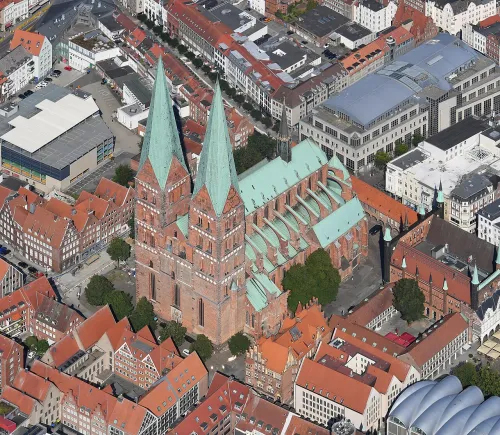
    The Marienkirche is the church the old town organises itself around: the third-largest church in Germany and the masterpiece of Brick Gothic, the building tradition you have followed since the Holstentor. If the Hanse paid for Lübeck, this is what its money bought at its peak.

    Tourist visits run on the MarienTaler, a contribution to the building's upkeep rather than a classic ticket. Services and private prayer stay free. When the doors are open, pay it without hesitation.

    Two caveats. The church's instrument, the world's largest mechanical organ, is going through phases of restoration, so organ lovers should ask about its current state before counting on it. More important: a full closure for renovation has been announced from 1 November 2026 into May 2027. If you walk the route in that period, admire the brick from outside and check at the door before promising anyone the interior.

    The Rathaus is only 100 m away, about a minute, past the Wochenmarkt on the Marktplatz.

    Hours
    Mon–Sat from 10:00, Sun from 11:00 (Apr–Oct) / Sun from 12:00 (Jan–March). Closing: Apr-03 Oct 18:00, 04 Oct–Oct 17:00, Nov–March 16:00 (renovation closure announced from 01.11.2026 to May 2027)
    Price
    Tourist visit: 5 EUR standard, 3 EUR reduced. Prayer and services are free.
  7. 7

    Rathaus Lübeck

    Rathaus Lübeck, stop 7 on the self-guided walking tour

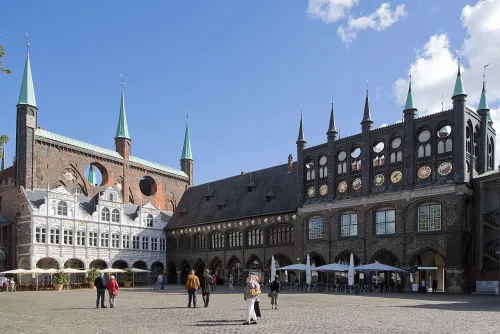
    The Rathaus Lübeck is one of the best-known buildings of Brick Gothic and one of the largest medieval town halls in Germany. Its story starts small: the oldest town hall, mentioned in the earliest codex of Lübeck law, stood at the northwest corner of the market, measured just 8 by 10 metres and was handed over to the tanners as early as 1250.

    The present building began around 1240 as a late Romanesque group of three gabled houses. After the city fire of 1251 damaged it, it was rebuilt on a grand scale, and its south and north gables were combined into monumental shield walls. Look for the large blind windows with tracery after French and Flemish models; today they are largely hidden by the arcaded front and interrupted by the central turret. The northern shield wall you see is a reconstruction.

    Inside, the functions shifted after the fire: the council moved into the former cloth hall, and the cloth trade went down into the cellar vaults. Those vaults of the original group building survive and now belong to the Ratskeller. The slender turrets that give the facade its rhythm are the same motif you saw at the Heiligen-Geist-Hospital.

    The outside is accessible at any time and costs nothing. Café Niederegger is just 50 m away, a minute's walk.

    Hours
    Administration hours: Mon 10:00–16:00, Tue–Wed 09:00–16:00, Thu 09:00–18:00, Fri 09:00–16:00, Sat–Sun closed; outdoor area continuously accessible
    Price
    Free
  8. 8

    Café Niederegger

    Café Niederegger in Lübeck, stop 8 on the self-guided walking tour

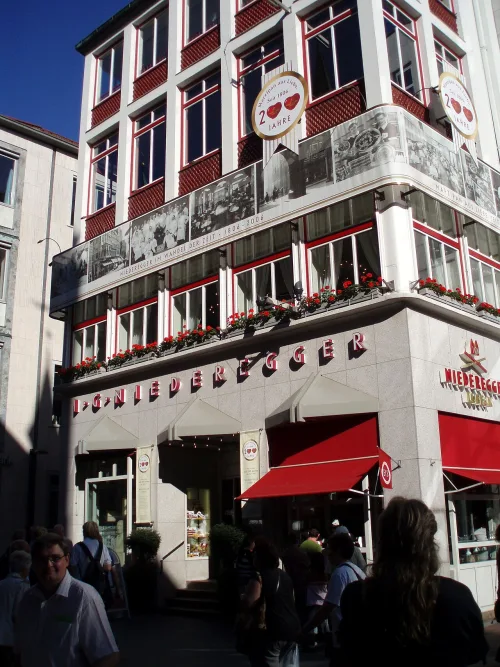
    Niederegger is one of the best-known makers of Lübeck marzipan. Its founder, Johann Georg Niederegger, was born in Ulm in 1777, trained as a confectioner in Langenau and moved to Lübeck in 1800, where he worked in the Maret confectionery on the market, founded in 1786 by the Heidelberg sugar baker Johann Gerhard Maret.

    The craft is simpler than you might think and harder than it looks. Almonds are blanched and skinned, the last bits of skin picked off by hand, then ground with sugar, two thirds almonds to one third sugar, between granite rollers. The mass is caramelised in small batches over an open gas flame, cooled with dry ice, portioned into 15 kilogram blocks and left to rest for between a week and a month before flavourings are worked in. Today the company makes up to 30 tonnes of marzipan a day and around 300 specialities, shipped to more than 40 countries; more than half of its sales come at Christmas.

    The café is on the first floor of the main house on Breite Straße, opposite the Rathaus. It serves 21 cakes, among them the Niederegger nut cake, as well as small lunch dishes, which makes it a natural lunch stop on this route, and walking in costs nothing.

    Afterwards it is 680 m, about 9 minutes, to the Lübecker Dom.

    Hours
    Mon–Fri: 09:00–19:00 | Sat: 09:00–18:00 | Sun: 10:00–18:00
    Price
    0 EUR
  9. 9

    Lübecker Dom

    Lübecker Dom, stop 9 on the self-guided walking tour

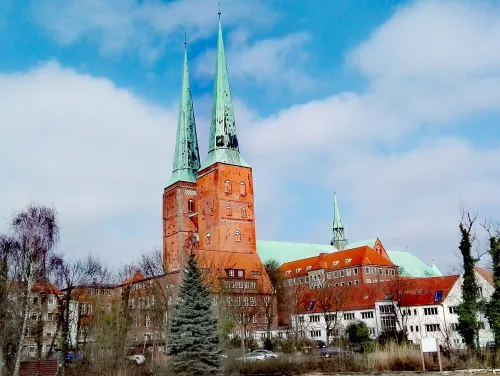
    Henry the Lion founded the Lübecker Dom in 1173 for the bishops of Lübeck, after the bishop's seat had moved here from Oldenburg in Holstein in 1160. The Romanesque cathedral was finished around 1230, and between 1266 and 1335 it was converted into a Gothic church whose side aisles were raised to the height of the main aisle, around 20 metres.

    On the night of Palm Sunday 1942, a Royal Air Force raid destroyed a fifth of the town centre. Bombs brought down the eastern vault of the choir and destroyed the altar of 1696; fire spread from the neighbouring cathedral museum into the roof, and around noon the towers collapsed. The Arp Schnitger organ was lost in the flames. In 1946 the gable of the north transept fell as well. Because the Marienkirche was rebuilt first, the work here dragged on for decades and was only finished in 1982.

    Much of the interior was saved, including the cross and almost all of the medieval altarpieces. Look for the works of Bernt Notke and Thomas Quellinus, which survived the raid. Outside, in the churchyard, grows an offshoot of the Luther beech from Steinbach in Thuringia, planted in 1873 for the cathedral's 700th anniversary.

    Entry is free, and it is worth going in. St. Petri is 580 m away, about 8 minutes.

    Hours
    1 May to 30 September: Mon–Sat 10:00–18:00, Sun 11:30–16:00 (July/Aug Sundays until 15:00); 1 October to 30 April: daily 10:00–16:00
    Price
    0 EUR
  10. 10

    St. Petri

    St. Petri in Lübeck, stop 10 on the self-guided walking tour

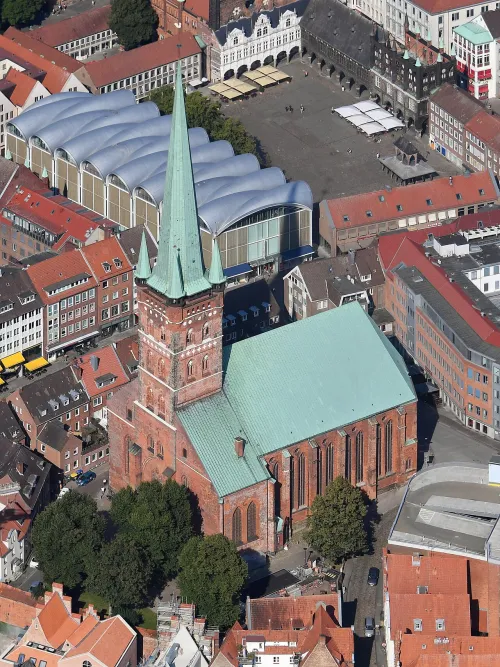
    St. Petri was first mentioned in 1170, together with the Marienkirche, and was rebuilt several times until it reached its present form in the 15th century: a Gothic hall church of brick with five aisles, which makes it one of the few five-aisled churches anywhere. It was the imperial church of Lübeck and, alongside the Marienkirche, the city's second market church. It became Protestant when the Reformation reached Lübeck in 1529 and 1530.

    In the Palm Sunday raid of 1942 the church burned out completely: roof, spire and rich furnishings, including the organ front carved by Tönnies Evers the Younger. The baroque font donated by councillor Johann Philipp Lefèvre survived. Restoration was only completed in 1987, and since the furnishings could not be restored, St. Petri has no congregation and serves as a space for culture, art exhibitions and special services.

    Step inside to feel how the bare five-aisled hall works on you. Modern pieces set the tone: the altar cross by the Austrian artist Arnulf Rainer and the illuminated neon cross by Hanna Jäger. The church interior is free.

    Then go up the tower to the viewing platform for a view over the old town you have just walked; the climb costs a small fee. This is where the route ends, and the GPS navigation can lead you back to the Holstentor.

    Local name
    Petrikirche
    Hours
    Tower: 1 March to 21 December daily 10:00–19:00, 22 December to 28 February daily 11:00–17:00 (24.12 closed); church interior: daily 11:00–16:00; café: daily 12:00–17:00
    Price
    Tower/viewing platform: 5 EUR adults, 4 EUR groups of 10+, 3 EUR students (up to 27 yrs), 1 EUR pupils (6-17 yrs), children up to 5 free | church interior: 0 EUR free
Walking tour route map of Lübeck Route loaded
HolstentorEuropäisches HansemuseumFüchtingshofHeiligen-Geist-Hospital+6
All 10 stops are already on the map.
You just press start.
AI Tour Guide

You've read the Lübeck route. Now walk it with a guide in your ear.

Press start wherever you are, even hundreds of kilometres from Lübeck, and the guide begins telling its stories right away. In the city, pick any of the 10 stops to start from: it leads you there, then talks with you the whole route, asking, listening, remembering, and shaping the tour around your answers.

10stops 4.1km 56 minwalking 13languages
▶Start the tour free

Free to start · Runs in your browser · No app, no download

Three Ways to Walk Lübeck

The full route fills a day. If you have less time or a clear interest, split it by theme: the Hanse and its gate, or the churches and the market heart of the old town.

The full route

Stops: 1, 2, 3, 4, 5, 6, 7, 8, 9, 10

For a first visit with a whole day to spare. All ten stops, 56 minutes of pure walking. Paid entries: Holstentor, Europäisches Hansemuseum, Marienkirche and the St. Petri tower; everything else is free.

Gate and Hanse

Stops: 1, 2, 3, 4

For history lovers who want the merchants' story in depth. Holstentor, Europäisches Hansemuseum, Füchtingshof and Heiligen-Geist-Hospital: 28 minutes of walking. You pay at the Holstentor and the Hansemuseum; the two charitable foundations are free.

Old town core

Stops: 3, 4, 5, 6, 7, 8, 9, 10

For an afternoon or a second half-day. From the Füchtingshof through the Marienkirche, Rathaus and Niederegger to the Dom and St. Petri: 29 minutes of walking. Only the Marienkirche and the St. Petri tower charge entry.

How Long the Lübeck Tour Takes, With and Without Museums

The pure walking time is 56 minutes; the stops make the day. A compact plan that works all year: start at the Holstentor at 10:00 and spend 40 minutes there, see the Europäisches Hansemuseum from outside at about 11:00, and you reach the Füchtingshof at 11:12, well before midday. The Heiligen-Geist-Hospital follows at 11:28, the Buddenbrookhaus facade at 11:55, the Marienkirche at about 12:00 for 40 minutes, the Rathaus at 12:43, and lunch at Café Niederegger from 12:54. After 45 minutes you walk on to the Dom, arriving at 13:48, and reach St. Petri at 14:26, with time for the church and the tower. That is about five hours.

With the Hansemuseum inside, the day grows to about seven hours. Start at the Holstentor at 11:30, give the museum two and a half hours, and you reach the Füchtingshof shortly after 15:00, in the quieter afternoon. You then arrive at the Dom around 17:20 and at the St. Petri tower just before 18:00, so this version only works on days when both are still open that late. The church interior of St. Petri will be closed by then.

Gate and Hanse takes about three and three-quarter hours with both museums. The old town core takes about three hours, closer to four with lunch at Niederegger.

Before You Set Off in Lübeck

  • Start and finish: The Holstentor is the recommended start, but you can join at any stop. The route ends at St. Petri; if you want to get back to the gate, the GPS navigation guides you there.
  • Best days: A weekday works best, as some interiors on the route are not open every day. Also keep in mind that the Marienkirche is due to close for renovation.
  • Time of day: Start in the morning, once the Holstentor has opened. The Füchtingshof gate does not stand open all day, so plan around it.
  • Costs: Four entries on the route cost money: the Holstentor, the Hansemuseum, the Marienkirche and the St. Petri tower. Everything else on the route is free.
Walking tour route map of Lübeck
AI Tour Guide

Your guide for Lübeck is ready when you are.

Press start and a voice AI Tour Guide takes it from here: leading the route through Lübeck, telling the stories, and turning your walk into a real back-and-forth conversation. No app or download is needed; it runs in your browser.

10stops 4.1km 56 minwalking 13languages
▶Start the tour free

Free to start · Runs in your browser · No app, no download

What the AI Tour Guide Adds in Lübeck

The AI Tour Guide walks this route with you as a conversation. It greets you at the Holstentor, tells the stories of each place as you arrive, asks what caught your interest and remembers it: if the Hanse grabs you at the museum, merchants and their money come back at the Buddenbrookhaus and the Rathaus. You can interrupt at any moment, for example to hear how the Dominicans lived in the Burgkloster or what life in the Hanse's trading post at Bergen was like. You start with 100 free credits; after that you choose this tour all-inclusive for €19.99 with no time limit, or €5 per hour.

A Real Conversation A voice AI Tour Guide greets you, leads the whole route, and tells the stories and facts as you walk, asking what you want to see and keeping a real conversation going. Not a recording you press play on.
Map Navigation Follow the route on the map and walk at your own pace. You choose where to start and when to move to the next stop.
Ask Anything Curious about a building you pass? Ask your AI Tour Guide on the spot and the conversation carries on.
13 Languages Switch language anytime. No separate tour needed.
Start free in your browser

Common Questions About Walking Lübeck

Can I see anything of the Buddenbrookhaus exhibition while the house is closed?

Yes. Parts of the exhibition are on show at the Museum Behnhaus-Drägerhaus in Lübeck.

Where is the Memling altar from the Lübecker Dom?

The famous altar by Hans Memling is no longer in the Dom. It is kept in Lübeck's St. Annen Museum.

Can I visit only the Burgkloster without the Hansemuseum exhibition?

Yes. The Burgkloster has its own ticket, which costs less than the one including the exhibition.

Which other Hanseatic towns nearby can I explore on foot?

Good day trips are Wismar, Rostock, Lüneburg and Stade. For a big-city contrast, try Hamburg.

Is the tour really free?

Yes. The whole tour is free: the route, the interactive map and the navigation cost you nothing. Only the voice AI Tour Guide is optional and paid: you test it with 100 free credits, then you pay either €5 per hour or €19.99 for this whole tour, with no time limit. Admission to 3 of the 10 stops is not included: Holstentor, Europäisches Hansemuseum and Marienkirche charge their own entry fees.

Do I need to download an app?

No. Everything runs in your phone browser. Open the route and start walking, no download and no sign-up required.

Do I need to book the walking tour in advance?

No booking needed. This self-guided tour is available anytime. Open the route in your browser and start walking. The AI Tour Guide works instantly, no app, no reservation required.

What languages is the AI Tour Guide available in?

The AI Tour Guide speaks 13 languages, so you take the tour in your own language and can switch at any time.

Can I skip stops or change the route?

Yes. Skip any stop, spend extra time at places you like, or start the route from any point. It is your walk, you set the pace.
Image credits
▶ Start free in your browser Runs in your browser, no app, no download