

Schwerin Castle
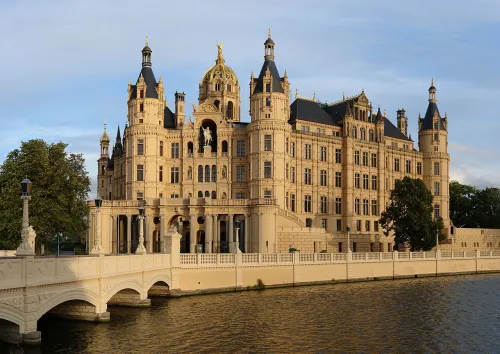
You start at the picture you have probably seen on every postcard: a castle of towers, gilded domes and turrets rising straight out of the water on an island in Lake Schwerin. Locals and guidebooks call it the “Neuschwanstein of the North”, and it is regarded as one of the most important works of Romantic historicism in Europe. In 2024 it was added to the UNESCO World Heritage List.
What you see is largely a 19th-century creation. Between 1845 and 1857 four leading architects of the age, Gottfried Semper, Friedrich August Stüler, Georg Adolf Demmler and Ernst Friedrich Zwirner, worked together on it, and only a few parts of the older castle survived the rebuilding. For centuries before that, this island was the seat of the dukes and later grand dukes of Mecklenburg.
The story of the island is much older. The first record dates from 973, when the Obotrites, a Slavic tribe, held a fort here. In 1160 Henry the Lion pushed east with his noblemen; the Obotrite leader Niklot destroyed his own fort and withdrew. The newcomers saw the value of the island and built a new fort, and in the same year the town of Schwerin was founded. In 1167 Henry gave the County of Schwerin to his vassal Gunzelin von Hagen and returned the surrounding land to Niklot's son Pribislav, whose descendants ruled as dukes until 1918.
Today the castle is a working building: the state parliament of Mecklenburg-Vorpommern sits in one part, while the palace museum, a restaurant and cultural events such as open-air theatre in the courtyard fill the rest. The museum charges admission, and it is worth it if you enjoy palace interiors and want to see how a 19th-century grand duke wished to be seen. Allow a good hour and a half.
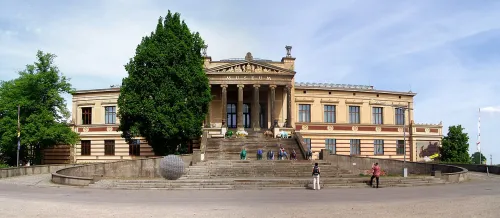
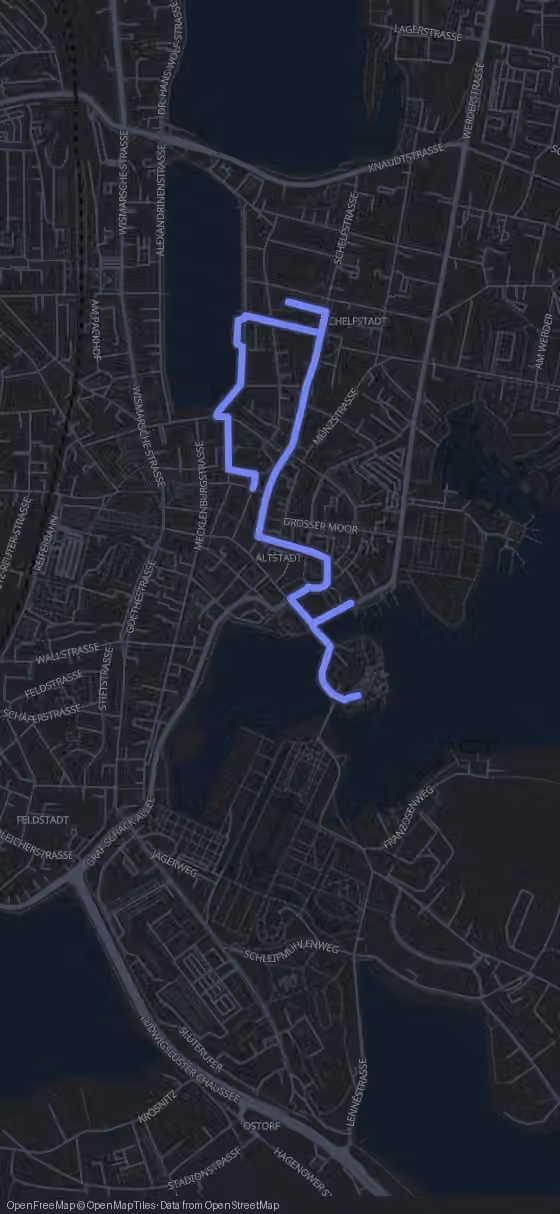
From the island it is 420 m, about 6 minutes, across to the State Museum Schwerin on the mainland.