Free Walking Tour Freiburg: Münster, Schlossberg & Gates

From Rathausplatz past the Münster and the Bächle, up the Schlossberg and through both medieval gates, ending among Freiburg's museums.

11 Stops 4.2 km ~1 h 4 min walking
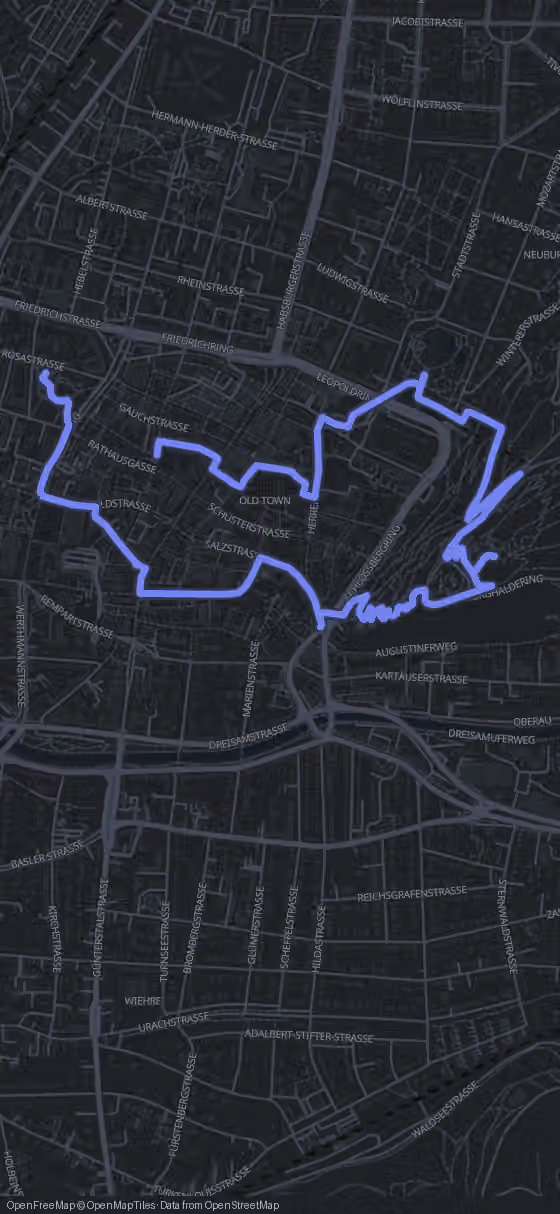
Route map for the Freiburg walking tour
Stop 1 of 11
290 m·4 min
Rathausplatz
Head east toward the Freiburger Münster
Welcome to Freiburg. I'm Alex, and the city's medieval history still runs beside your feet.
Try this tour with Alex

Freiburg's Old Town Route at a Glance

This route links 11 stops on a one-way line from Rathausplatz to the Archäologisches Museum Colombischlössle: 4.2 km and 1 h 4 min of pure walking. Looking around outside takes about two and a half hours; with interiors, plan on about six.

The squares, the Historische Bächle, the Schlossberg and both gates are free, as is the nave of the Freiburger Münster. Tickets apply for the Münster tower and choir, the Augustinermuseum and the archaeology museum. The GPS route is free; the AI Tour Guide is optional.

Open free GPS & optional AI Tour Guide
This short shows highlights of the route. All 11 stops follow below.

The Route

Freiburg Walking Map from Rathausplatz to the Colombischlössle

11 stops 4.2 km 1 h 4 min walking
Tap to load interactive map

The 11 stops along this route

  1. Rathausplatz in Freiburg, stop 1 on the self-guided walking tour
    1Rathausplatz
  2. Freiburger Münster, stop 2 on the self-guided walking tour
    2Freiburger Münster
  3. Münstermarkt in Freiburg, stop 3 on the self-guided walking tour
    3Münstermarkt
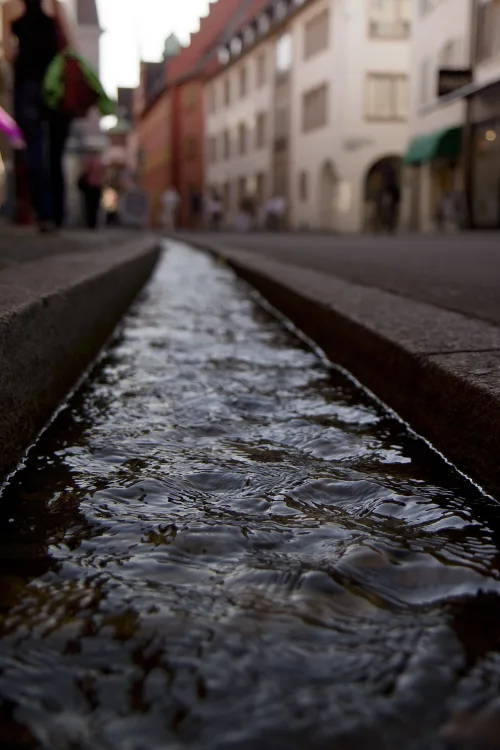
  4. Historische Bächle in Freiburg, stop 4 on the self-guided walking tour
    4Historische Bächle
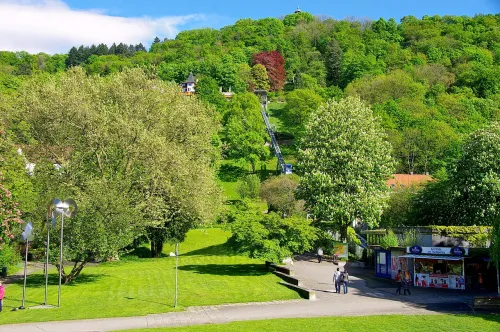
  5. Stadtgarten in Freiburg, stop 5 on the self-guided walking tour
    5Stadtgarten
  6. Schlossberg in Freiburg, stop 6 on the self-guided walking tour
    6Schlossberg
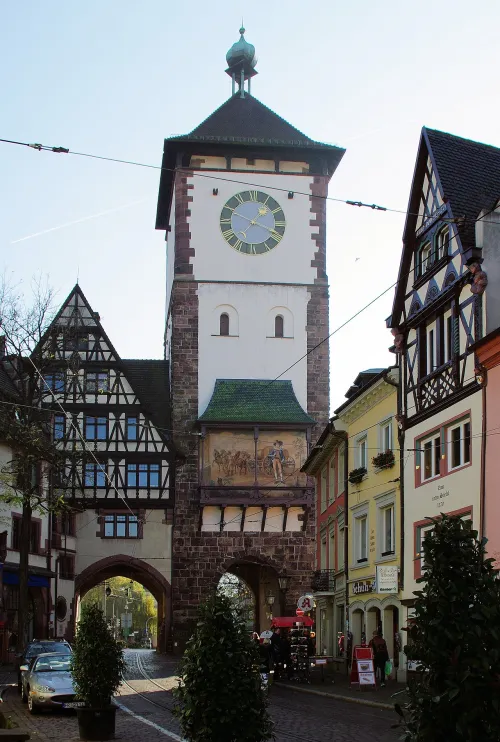
  7. Schwabentor in Freiburg, stop 7 on the self-guided walking tour
    7Schwabentor
  8. Augustinermuseum in Freiburg, stop 8 on the self-guided walking tour
    8Augustinermuseum
  9. Augustinerplatz in Freiburg, stop 9 on the self-guided walking tour
    9Augustinerplatz
  10. Martinstor in Freiburg, stop 10 on the self-guided walking tour
    10Martinstor
  11. Archäologisches Museum Colombischlössle in Freiburg, stop 11 on the self-guided walking tour
    11Archäologisches Museum Colombischlössle
  12. That's the full route.

    Walk it with an AI Tour Guide talking you through every one of these streets.

    Start free in your browser
    You made it

Freiburg Walking Tour Stop by Stop: Minster, Hill, Gates and Museums

  1. 1

    Rathausplatz

    Rathausplatz in Freiburg, stop 1 on the self-guided walking tour

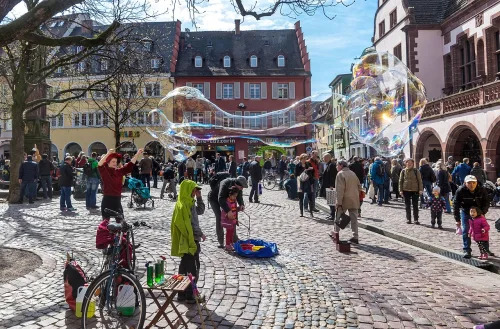
    Start where Freiburg runs its own affairs. Rathausplatz is open at all hours and costs nothing, so it works as a starting point whenever you arrive. Nothing here needs a ticket or a time slot; your first real decisions wait at the Münster.

    Give the square a minute anyway, because it keeps its own calendar. In February, on Schmutzige Dunschdig, the carnival guilds storm the town hall at half past one in the afternoon, and before Christmas the market sets up its wooden chalets right here. On an ordinary day it is simply the civic counterpart to the church square you are about to enter.

    The walk sets its rhythm from the first leg: short hops through the old town, one long climb in the middle up the Schlossberg, and two museums to finish. From here it is 280 metres, about four minutes, to the Freiburger Münster.

    Hours
    24/7
    Price
    Free
  2. 2

    Freiburger Münster

    Freiburger Münster, stop 2 on the self-guided walking tour

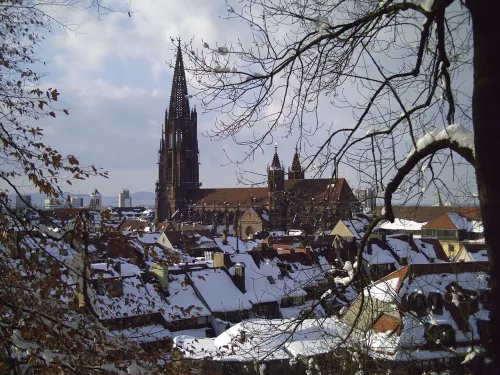
    Look up first. The tower rises 116 metres: nearly square at the base, then the twelve-sided star gallery, then an octagonal, tapering section and finally the spire. The Swiss historian Jacob Burckhardt said it would forever remain the most beautiful spire on earth. Whatever you think of that, it holds a real distinction: it is the only Gothic church tower within Germany's present borders that was completed in the Middle Ages, in 1330.

    Building began around 1200 under the last duke of Zähringen, in Romanesque style, partly on the foundations of a church that had stood here since the town was founded in 1120. From 1230 the builders continued in Gothic. It only became a cathedral in 1827, as the seat of the newly created Catholic Archdiocese of Freiburg, long after it was finished.

    The church came through the air raid of November 1944, which destroyed every house on the west and north sides of the market. The tower shook violently, and its survival is credited to the lead anchors that tie the sections of the spire together. Church staff led by Monsignor Max Fauler had already taken the windows out of the spire, so they survived too.

    Listen as well as look. The tower holds 16 bells, the oldest being the Hosanna of 1258, which weighs 3,290 kilograms. It rings on Thursday evenings after the Angelus, on Saturday evenings, every 27 November in memory of the raid, and on Fridays at 11:00, an hour locals call the Spätzleglocke.

    The nave is free and worth a look for anyone. The art lies a little deeper: the high altar by Hans Baldung, an altar by Hans Holbein the Younger in a side chapel, and sculptures of the Ten Virgins on the inner portal. The separate ticket for the choir and chapels is for art lovers who want those altars up close; the tower ticket is for anyone who wants to go up the spire Burckhardt praised. The market begins 40 metres away, wrapped around the church itself.

    Hours
    Building/prayer: Mon–Sat 06:30–19:00, Sun & holidays 07:30–20:30; Touristic visits: Mon–Tue, Thu–Fri 09:00–11:45 & 12:30–16:45, Wed 09:00–11:45 & 13:00–16:45, Sat 09:00–11:00 & 12:15–18:00, Sun & holidays 13:30–19:30 (no visits during mass); Tower: Mon–Sat 11:00–16:00, Sun & holidays 13:00–17:00; Choir: Mon–Tue, Thu–Fri 10:00–11:30 & 12:30–16:00, Wed 10:00–11:30 & 13:00–16:00, Sat 10:00–11:00 & 12:30–15:30, Sun & holidays 13:30–17:00
    Price
    Free admission to nave; tower: 5 EUR adults, 3 EUR children (8-17), children under 7 free; choir & chapels: 2 EUR adults, 1.50 EUR students, children under 14 free

  3. 3

    Münstermarkt

    Münstermarkt in Freiburg, stop 3 on the self-guided walking tour

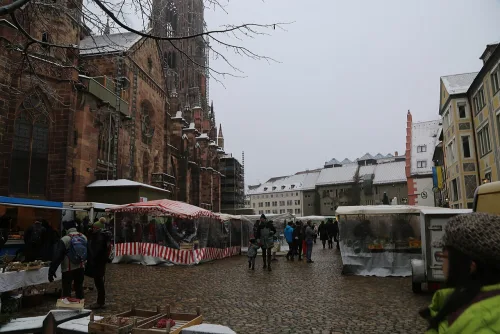
    The paved square runs all the way around the Münster, with Bächle along its sides. Around it stand the city library, the Historical Merchants' Hall, the Wentzinger House and the Korn House. Notice which buildings look old: the 1944 raid destroyed nearly everything here, and only the southeast side with the Merchants' Hall, the Wentzinger House and the Old Guard survived, along with the Münster.

    For centuries this was a churchyard, not a market, enclosed by a wall about 1.60 metres high that only came down in 1785. The north side served as the town cemetery. Look down: the outline of the cemetery chapel of St. Andreas, pulled down in 1752 together with the bone house in its basement, is set into the cobblestones. In 1514, at the urging of Emperor Maximilian I, the cemetery was moved out to the suburb of Neuburg for reasons of hygiene, and the market moved in from Kaiser-Joseph-Straße. Until the pedestrian zone arrived in the 1970s, the square became a car park every afternoon.

    Today up to 180 stalls spread over roughly 10,000 square metres, selling groceries, crafts and souvenirs. The north side is the farmers' market, reserved for local farms and their own produce, so that is where to look for regional food. It is a morning market that packs up in the early afternoon, which is why it sits right after the Münster on this route.

    Before you leave, find the three plague columns in front of the main portal, beneath the tower. They are crowned by Mary and the two patron saints, Lambert of Liège and Alexander. Then follow the water: 190 metres, about three minutes, to the Historische Bächle.

    Hours
    Mon–Fri 07:30–13:30, Sat 07:30–14:00, Sun & holidays closed
    Price
    Free
  4. 4

    Historische Bächle

    Historische Bächle in Freiburg, stop 4 on the self-guided walking tour

    You have been walking beside them already: the narrow water channels running along the streets and alleys of the old town. They are fed by the Dreisam, and the name is simply Alemannic for little brook, Bach with the local diminutive ending -le, where standard German would say Bächlein.

    The first written mention dates from 1220, when Count Egon I of Freiburg allowed the Tennenbacherhof monastery to use a field watered by a Bächle. In 1238 the Dominicans built a monastery by the town wall “inter duas ripas”, between two banks. Excavations lead archaeologists to believe the channels are about a hundred years older, already there when Freiburg was founded in 1120. The town sat on a natural slope at the foot of the Schlossberg, which made it easy to run artificial watercourses; around 1180 some streets were even raised by up to three metres with layers of gravel.

    The Bächle supplied water and helped fight fires. In the 19th century they were considered obsolete, and most were covered with iron plates. They originally ran down the middle of the road, and because they were seen as a traffic hazard, they were moved to the edges in 1852, where you see them now.

    Watch your feet: local superstition says that if you step into a Bächle by accident, you will marry someone from Freiburg. From here the route leaves the dense old town behind, 470 metres and about seven minutes to the Stadtgarten.

    Local name
    Freiburger Bächle
    Hours
    24/7
    Price
    Free
  5. 5

    Stadtgarten

    Stadtgarten in Freiburg, stop 5 on the self-guided walking tour

    A green breather before the climb. The Stadtgarten covers 2.6 hectares in the Neuburg district, with an old grove of trees, a large rose garden, two ponds and a children's playground. The Karlssteg, a footbridge of prestressed concrete, links it with Karlsplatz.

    The park grew out of an exhibition. In 1887 the Upper Rhine Industrial Exhibition took place on Karlsplatz, the former drill ground, and the city gardener Schmöger was commissioned to create something similar. The park opened in 1888 and charged admission until 1911. Its first features included an aquarium, a music pavilion, a fountain, a playground and an enclosure with a rhesus monkey named Anne.

    Care lapsed during the First World War, and the grounds were redesigned in the early 1920s. The 1944 air raid destroyed the park and its concert hall, and it was restored after the war. The music pavilion is still used for summer concerts and as an open stage, and the Theatresports open-air festival has played here since 1997.

    This is also where the Schlossbergbahn starts, an inclined lift that replaced the 1968 cable car in 2008, if you would rather ride up. The route itself walks: 1,120 metres, about 21 minutes, the longest leg of the day, up to the Schlossberg.

    Hours
    24/7
    Price
    Free
  6. 6

    Schlossberg

    Schlossberg in Freiburg, stop 6 on the self-guided walking tour

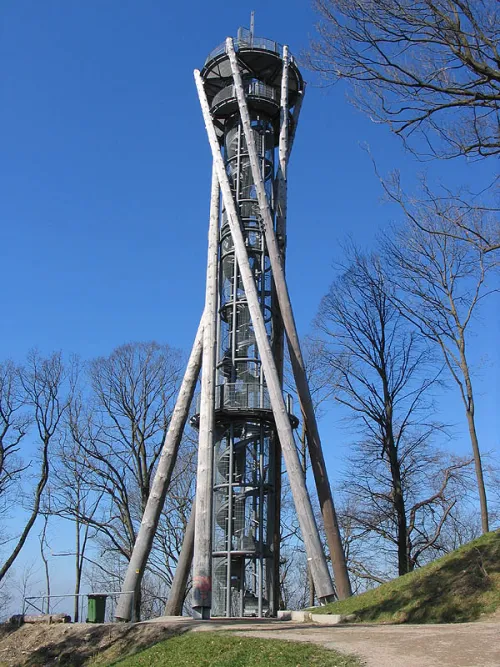
    The wooded hill, 456 metres high, rises directly east of the old town and already belongs to the Black Forest; the main geological fault runs along its western edge, where the Upper Rhine Graben begins. Everything up here is free: the hill, the park and the Schlossbergturm lookout tower.

    This is where Freiburg's story begins. As early as 1091, Berthold II, Duke of Zähringen, built the Romanesque castle Castrum de Friburch, mentioned in many documents and praised in the songs of the medieval poet Hartmann von Aue. Fortifications stood on the hill from the 11th century on, and a board of trustees is carefully uncovering the overgrown remains so that visitors can see them again.

    For the view, you have choices. The Schlossbergturm, built in 2002 as a project of that same board of trustees, gives a panorama over the whole town and its surroundings. The Burghaldering, a ring around the hill at half height, partly hiking trail and partly forest road closed to cars, offers good views too, especially from the Kanonenplatz right above the historic centre. On a rock over the Burghaldering stands the Bismarck tower of red sandstone, designed by Fritz Geiges and inaugurated in 1900.

    The hill also hides things inside: a water tower built in the 1870s to supply the city, and next to the tank a large bomb shelter from the 20th century. Allow at least half an hour up here, more if you go all the way to the Schlossbergturm. The way down to the Schwabentor is 820 metres, about 13 minutes.

    Hours
    24/7
    Price
    Free (hill, park and Schlossbergturm lookout tower)
  7. 7

    Schwabentor

    Schwabentor in Freiburg, stop 7 on the self-guided walking tour

    The Schwabentor, called Obertor in the Middle Ages, is the younger of Freiburg's two surviving town gates. The tower went up around 1250 and was originally open on the side facing the town; only in 1547 was that side closed with a stone wall.

    Look at the inner wall. In 1572 Matthias Schwäri painted a merchant with a cart there, and in the 19th century the picture inspired a legend: a Swabian came to Freiburg with two barrels of gold to buy the town and was laughed at when the barrels turned out to hold sand and pebbles. Before he set off, his wife had secretly swapped the gold for worthless filling. Under the inner arch, the keystone shows a Romanesque “Boy with Thorn”, an ancient figure read here in a Christian way: everyone passing through carries the thorn of original sin and should be reminded of it.

    Much of what you see is not medieval. From 1900 the gate was almost doubled in height to a design by Carl Schäfer, with a crow-stepped gable modelled on north German town towers. In 1903 Fritz Geiges, whose name you met at the Bismarck tower, painted the city's patron Saint George as a dragon slayer on the outside, and historicist annexes followed until 1913. In 1954 the conversion was partly undone: the gate received a simpler tented roof close to the original and a bell turret with an onion dome.

    Close by is a square unofficially called the Square of the Last Barricade of 1848. On Easter Monday 1848, volunteers from Baden were defeated here by the superior government troops of the Grand Duke of Baden. From the gate it is 250 metres, about three minutes, to the Augustinermuseum.

    Hours
    24/7
    Price
    Free (exterior, public monument)
  8. 8

    Augustinermuseum

    Augustinermuseum in Freiburg, stop 8 on the self-guided walking tour

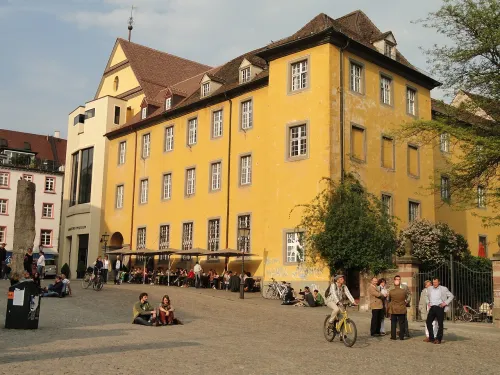
    Behind these walls lived the Augustinian hermits; their monastery, with its Gothic cloister, now houses one of the major museums of the Upper Rhine. The collection covers art from the Middle Ages to the Baroque and painting of the 19th century. It also shows the holdings of the archdiocese's diocesan museum, which has worked with the city's collections since the 1920s without a building of its own, and important lenders include the Münsterfabrikfonds and the Adelhausen foundation.

    The building has been rebuilt in three phases since 2006. The former monastery church reopened on 23 March 2010, the House of the Graphic Collection followed in 2016, and the old convent building opened with a ceremony in the Münster on 27 February 2026. Since the following day, the whole museum is open to the public again.

    One new part ties the walk together: the city history department in the west wing. Its objects used to be on show in the Wentzinger House on the Münster square, which closed at the end of 2024, and moved here in 2025. The Documentation Centre on National Socialism, opened in 2025 in the former tourist office on Rotteckring, also belongs to the museum.

    Is it worth going in? If art of the Upper Rhine interests you, yes: in importance it compares with the Unterlinden Museum in Colmar and the Historical Museum in Basel. Allow about an hour and a half. Augustinerplatz is right next door, 20 metres away.

    Hours
    Tue–Sun 10:00–17:00, Fri 10:00–19:00, Mon closed
    Price
    12 EUR full, 8 EUR reduced, free under 27 years
  9. 9

    Augustinerplatz

    Augustinerplatz in Freiburg, stop 9 on the self-guided walking tour

    Twenty metres from the museum, the shortest hop of the route. Augustinerplatz is the square beside the former monastery, and it plays whatever role you need: the pause before going in, fresh air after coming out, or the fallback on a Monday when the museum doors are shut. No ticket, no timetable.

    From here it is 290 metres, about four minutes, to the Martinstor. On the way you pass the Museum Natur und Mensch, where Anne, the rhesus monkey from the Stadtgarten's old enclosure, is now on display.

    Hours
    24/7
    Price
    Free
  10. 10

    Martinstor

    Martinstor in Freiburg, stop 10 on the self-guided walking tour

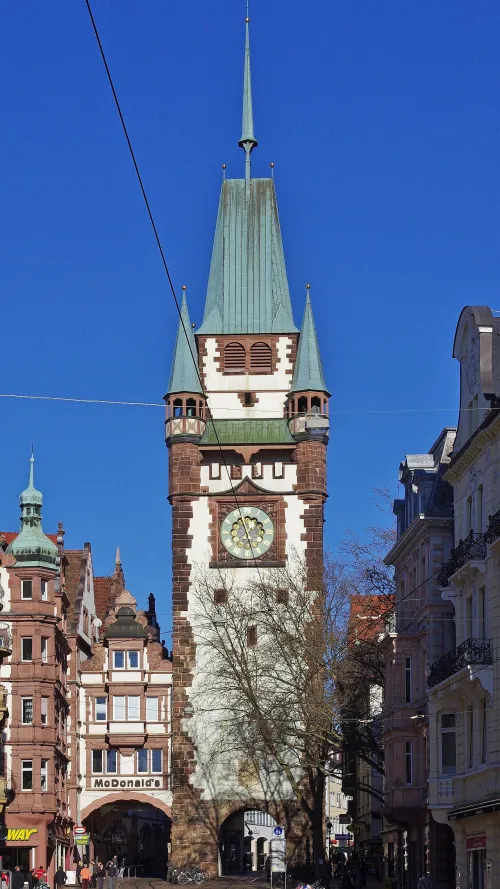
    The Martinstor on Kaiser-Joseph-Straße is the older of Freiburg's two surviving gates. Tree-ring dating puts its wooden beams at 1202, documents first name it in 1238 as “Porta Sancti Martini”, and in the Middle Ages it was also known as Norsinger Tor. For a while it served as a prison, and people said of the inmates that they had put on “the cloak of Martin”.

    Look at the side facing the town. From the 17th century it carried a picture of Martin of Tours. In the same period, Vauban's construction work and the levelling of the suburbs cut the gate off from the city, and Salzstraße became the main road in from the Höllental. The picture was restored many times, last in 1851 by Wilhelm Dürr, and removed in 1968/69. The council has never agreed on a new one, so a blank spot remains, said to honour the conflicts between Freiburg's civil defence and the French Revolutionary forces.

    The tall tower you see dates from 1901. By then the surrounding buildings rose above the old gate, and its passage was too narrow for the growing city and the new trams. The council briefly considered demolition, then chose to rebuild: under Carl Schäfer the tower grew from 22 to 60 metres and got a roof in 15th-century style, and a second, wider gateway in matching style was added beside the old one. An imperial eagle painted on the outer façade above the arms of Freiburg and Baden was removed in 1951.

    The Martinstor is a sight from the street; the tower itself is not open to visitors. The final leg runs 680 metres, about nine minutes, to the Archäologisches Museum Colombischlössle.

    Hours
    24/7
    Price
    Free (exterior, public monument; tower interior not open to the public)
  11. 11

    Archäologisches Museum Colombischlössle

    Archäologisches Museum Colombischlössle in Freiburg, stop 11 on the self-guided walking tour

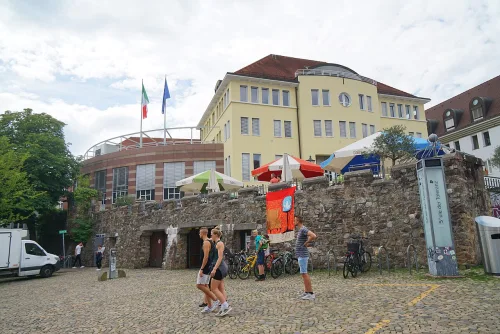
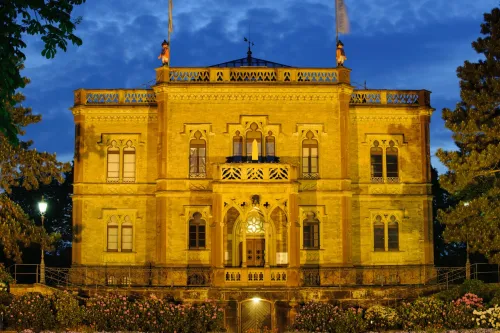
    The route ends at a neo-Gothic villa on Rotteckring, the Colombischlössle, home of the city's archaeological museum. The permanent exhibition runs from the Old Stone Age to the Middle Ages, and many of the finds are long-term loans from the state of Baden-Württemberg.

    The collection took a long road to get here. It goes back to Alexander Ecker, Heinrich Fischer and Wilhelm Deecke, head of the university's Geological Institute, who expanded the collection of the Museum for Prehistory and Ethnography, founded in 1867, and housed it in his institute from 1926. Deecke brought the prehistorian Georg Kraft to Freiburg, and in June 1938 a new Museum for Prehistory opened in rooms of the Adelhausen monastery. Kraft led it until he was killed in the bombing of Freiburg in 1944.

    After the war there was no space to show the finds, and from 1961 they went into storage while the monastery became home to what is now the nature museum. In 1978 the council decided to revive the museum in the Colombischlössle, and Lothar Späth reopened it in 1983.

    Go in if prehistory and early history interest you; it is the most affordable of the paid visits on this walk. When you are done, the GPS navigation can lead you back to Rathausplatz.

    Hours
    Tue–Sun 10:00–17:00, Wed 10:00–19:00, Mon closed
    Price
    5 EUR full, 3 EUR reduced, free under 27 years
Walking tour route map of Freiburg Route loaded
RathausplatzFreiburger MünsterMünstermarktHistorische Bächle+7
All 11 stops are already on the map.
You just press start.
AI Tour Guide

You've read the Freiburg route. Now walk it with a guide in your ear.

Press start wherever you are, even hundreds of kilometres from Freiburg, and the guide begins telling its stories right away. In the city, pick any of the 11 stops to start from: it leads you there, then talks with you the whole route, asking, listening, remembering, and shaping the tour around your answers.

11stops 4.2km 1 h 4 minwalking 13languages
▶Start the tour free

Free to start · Runs in your browser · No app, no download

Shorter Ways to Walk Freiburg

The full line works best in one go, but it splits cleanly into an old town core, a first half with the hill, and a museum finish.

Münster and old town core

Stops: 1, 2, 3, 4

For a short visit or a first hour in town: Rathausplatz, the Münster, the market and the Bächle, 710 metres and about 8 minutes of walking. Only the Münster tower and choir cost anything; with the nave and tower included, about an hour and a half is enough.

From town hall to the Schlossberg and down

Stops: 1, 2, 3, 4, 5, 6, 7

For walkers who want the view and the history without museums: through the old town, the Stadtgarten and up the Schlossberg, then down to the Schwabentor. That is 2.9 km and about 49 minutes of walking; apart from the Münster tower and choir, everything is free. Allow around three hours.

Gates and museums

Stops: 7, 8, 9, 10, 11

For art and archaeology fans who have already seen the centre: from the Schwabentor to the Augustinermuseum, past the Martinstor and on to the Colombischlössle, 1.2 km and about 17 minutes of walking. Both museums charge admission; with time inside each, count on about three hours.

How Long Does the Freiburg Tour Take, Museums Included?

The pure walking time is 1 h 4 min over 4.2 km, and about a third of it goes on the single climb from the Stadtgarten to the Schlossberg. Everything before that is a string of short hops, the last of them just 40 metres from the Münster to its market.

If you only look around outside, plan about two and a half hours. Add roughly an hour for the Münster nave and tower, an hour and a half for the Augustinermuseum and 45 minutes for the archaeology museum, and a full day of about six hours is realistic. The old town core takes about an hour and a half, the walk to the Schlossberg and down about three hours, and the museum finish about three hours.

Before You Set Off in Freiburg

  • Start and finish: The recommended start is Rathausplatz and the route ends at the Archäologisches Museum Colombischlössle; you can join at any stop. It is a one-way line, and the GPS navigation in your browser can lead you from the last stop back to the start.
  • Best day and time: Pick a day when the Münstermarkt is on and both museums are open. Starting around 10:30 works well, because the market is still up when you reach it and you have the afternoon for the museums.
  • Costs: Walking the route is free, including the Schlossbergturm lookout tower. You pay for the Münster tower, the choir and chapels, the Augustinermuseum and the Archäologisches Museum Colombischlössle.
Walking tour route map of Freiburg
AI Tour Guide

Your Freiburg guide is ready when you are

Press start and a voice AI Tour Guide takes it from here: leading the route through Freiburg, telling the stories, and turning your walk into a real back-and-forth conversation. No app or download is needed; it runs in your browser.

11stops 4.2km 1 h 4 minwalking 13languages
▶Start the tour free

Free to start · Runs in your browser · No app, no download

What the AI Tour Guide Adds in Freiburg

On this route the AI Tour Guide leads the walk as a conversation: it greets you at Rathausplatz, tells the stories as you go, and on the long climb to the Schlossberg it keeps talking about the Zähringen castle or the town below, depending on what you said grabbed you. If the Swabian legend at the Schwabentor made you laugh, it remembers and picks up that thread at the Martinstor. Ask it what this walk leaves open, such as what Hans Baldung painted on the high altar or what Hartmann von Aue sang about the castle, and interrupt it whenever you like. Route, map and GPS navigation stay free; for the guide you get 100 free credits, then choose this tour all-inclusive for €19.99 with no time limit, or €5 per hour.

A Real Conversation A voice AI Tour Guide greets you, leads the whole route, and tells the stories and facts as you walk, asking what you want to see and keeping a real conversation going. Not a recording you press play on.
Map Navigation Follow the route on the map and walk at your own pace. You choose where to start and when to move to the next stop.
Ask Anything Curious about a building you pass? Ask your AI Tour Guide on the spot and the conversation carries on.
13 Languages Switch language anytime. No separate tour needed.
Start free in your browser

Common Questions about Walking Freiburg

Can I visit the inside of the Freiburger Münster at any time?

Not at any time. Tourist visits pause during mass and there is a midday break, so plan your visit around the services.

Are the museums free for young visitors?

Yes. Both the Augustinermuseum and the Archäologisches Museum Colombischlössle let everyone under 27 in for free.

Is the Münstermarkt held every day?

No, not every day, so check the market days before you plan your walk around it.

Which nearby cities make a good next walk?

Colmar is 38 km away, Basel 53 km and Strasbourg 66 km, each with its own walking route. Further into the Black Forest region, Baden-Baden is 90 km away.

Is the tour really free?

Yes. The whole tour is free: the route, the interactive map and the navigation cost you nothing. Only the voice AI Tour Guide is optional and paid: you test it with 100 free credits, then you pay either €5 per hour or €19.99 for this whole tour, with no time limit. Admission to 2 of the 11 stops is not included: Augustinermuseum and Archäologisches Museum Colombischlössle charge their own entry fees.

Do I need to download an app?

No. Everything runs in your phone browser. Open the route and start walking, no download and no sign-up required.

Do I need to book the walking tour in advance?

No booking needed. This self-guided tour is available anytime. Open the route in your browser and start walking. The AI Tour Guide works instantly, no app, no reservation required.

What languages is the AI Tour Guide available in?

The AI Tour Guide speaks 13 languages, so you take the tour in your own language and can switch at any time.

Can I skip stops or change the route?

Yes. Skip any stop, spend extra time at places you like, or start the route from any point. It is your walk, you set the pace.
Image credits
▶ Start free in your browser Runs in your browser, no app, no download