Free Walking Tour Strasbourg: From Vauban to Gutenberg

Start on a 17th-century floodgate, cross the old prison towers of the covered bridges and finish under Gutenberg's statue, with the cathedral's reddish sandstone in between.

9 Stops 4.0 km ~54 min walking
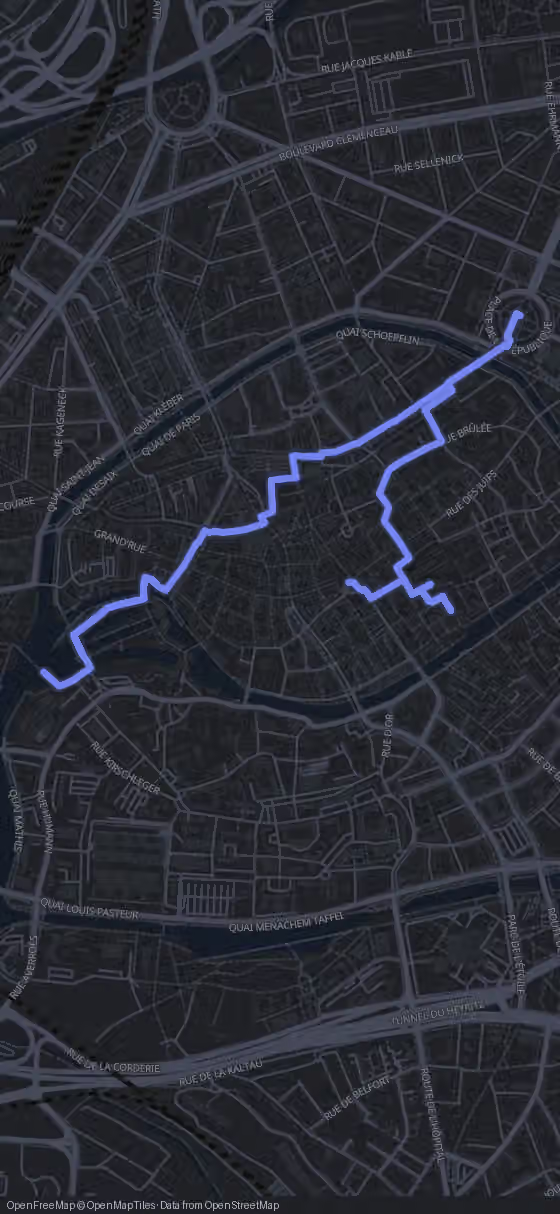
Route map for the Strasbourg walking tour
Stop 1 of 9
140 m·2 min
Barrage Vauban
Head east toward the Maison des Tanneurs
Bonjour, welcome to Strasbourg. I'm Alex, and this peaceful riverfront once hid a ruthless defensive machine.
Try this tour with Alex

What This Strasbourg Walk Covers

Nine stops over 4.0 km: from the Barrage Vauban past the Maison des Tanneurs and the Ponts Couverts, across Place Kléber and Place de la République, then the Maison Kammerzell, Strasbourg Cathedral and Palais Rohan to Place Gutenberg. Pure walking time is 54 min; with a cathedral visit, plan a little over three hours.

Squares, bridges and the cathedral itself cost nothing; the astronomical clock and the Palais Rohan museums charge entry. The route with map and GPS navigation runs free in your browser, and the AI Tour Guide is optional.

Open free GPS & optional AI Tour Guide
This short shows highlights of the route. All 9 stops follow below.

The Route

Walking Map of Strasbourg: Floodgate to Gutenberg

9 stops 4.0 km 54 min walking
Tap to load interactive map

The 9 stops along this route

  1. Barrage Vauban in Strasbourg, stop 1 on the self-guided walking tour
    1Barrage Vauban
  2. Maison des Tanneurs in Strasbourg, stop 2 on the self-guided walking tour
    2Maison des Tanneurs
  3. Ponts Couverts in Strasbourg, stop 3 on the self-guided walking tour
    3Ponts Couverts
  4. Place Kléber in Strasbourg, stop 4 on the self-guided walking tour
    4Place Kléber
  5. Place de la République in Strasbourg, stop 5 on the self-guided walking tour
    5Place de la République
  6. Maison Kammerzell in Strasbourg, stop 6 on the self-guided walking tour
    6Maison Kammerzell
  7. Strasbourg Cathedral, stop 7 on the self-guided walking tour
    7Strasbourg Cathedral
  8. Palais Rohan in Strasbourg, stop 8 on the self-guided walking tour
    8Palais Rohan
  9. Place Gutenberg in Strasbourg, stop 9 on the self-guided walking tour
    9Place Gutenberg
  10. That's the full route.

    Walk it with an AI Tour Guide talking you through every one of these streets.

    Start free in your browser
    You made it

Strasbourg Walking Tour Stop by Stop: Nine Places and Their Stories

  1. 1

    Barrage Vauban

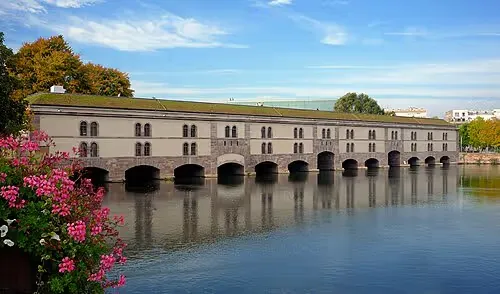
    Barrage Vauban in Strasbourg, stop 1 on the self-guided walking tour

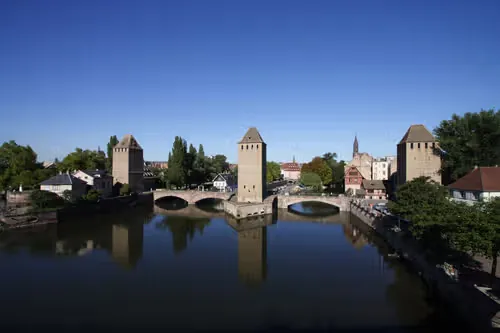
    You begin on top of a fortification that looks, at first glance, like a long stone bridge with a lawn on its back. The Barrage Vauban stretches across the Ill on thirteen arches, and from the panoramic terrace on its roof you look straight at the towers of the Ponts Couverts, the half-timbered houses behind them and the cathedral rising in the background.

    The plans came from Vauban, who judged the spot where the Ill flows into the historic centre to be a weak point in Strasbourg's defences. Artillery had outgrown the medieval covered bridges, so between 1681 and 1688 the engineer Tarade built this new barrier about a hundred metres upstream of them. Over time it collected names: the Great Lock, the flour lock, the casemate bridge.

    The trick was water, not walls. In an attack, iron panels would seal all thirteen arches, the Ill would back up, and the fields and orchards south of the city would turn into a swamp where enemy troops were meant to get stuck. It was actually used during the siege of 1870, flooding the districts upstream. Afterwards the German authorities added a storey and covered the whole structure in earth and turf, which is why it looks so green today.

    In 1966 the city opened the roof terrace, and the barrage has been a listed historic monument since 1971. Give it a few minutes: if you want the postcard view of the covered bridges, this is where you get it. It's a different view from the cathedral platform, which looks out over the rooftops towards the Black Forest and the Vosges.

    From here it's 510 m, about 7 minutes, into Petite France, the half-timbered district on the river, where the Maison des Tanneurs waits.
    Hours
    Panoramic terrace: 1 March – 30 April 08:00–19:00; 1 May – 31 August 07:15–21:00; 1 September – 31 October 08:00–19:00; 1 November – end of February 08:30–16:00
  2. 2

    Maison des Tanneurs

    Maison des Tanneurs in Strasbourg, stop 2 on the self-guided walking tour

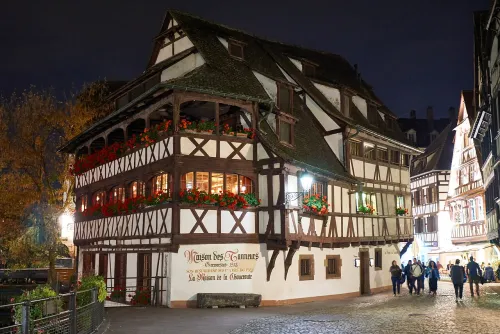
    The Maison des Tanneurs is the tanners' old guildhall, built in 1572 and easy to recognise by the open wooden galleries on its upper floors. Look up at them: this is where the tanners hung animal hides to dry in the open air.

    Today the restored building is one of the most photographed in the quarter, so stand back far enough to take in the whole façade with its timber framing and those galleries.

    There's no ticket to go in, because inside is an acclaimed Alsatian restaurant, so you come in to eat. Many restaurants around here lean touristy, and this is one of the few that people who know the city call genuinely good. If you're planning a sit-down Alsatian meal in this part of town, keep it in mind.

    The Ponts Couverts are only 330 m away, about 5 minutes on foot.

    Hours
    Restaurant: Tue–Sat 12:00–14:00 and 19:00–22:00
    Price
    Free (entry)
  3. 3

    Ponts Couverts

    Ponts Couverts in Strasbourg, stop 3 on the self-guided walking tour

    The Ponts Couverts are three bridges over the arms of the Ill, guarded by four square, battlemented towers. The name means covered bridges, yet there's no roof in sight: you're walking on stone bridges from 1865, paved with Rhine pebbles since 1976, when traffic moved to the new Pont des Frères Matthis and these became pedestrian.

    The story starts between 1230 and 1250, when the citizens of Strasbourg built four bridges here to close the river to attackers. In 1332 the wooden piers were replaced with masonry, and from the 14th century the bridges carried tiled roofs over a row of galleries: open towards the town, closed on the outside by a timber wall pierced with loopholes for guns. In the 16th century Daniel Specklin improved the defences, and around 1570 iron portcullises were added to seal off the river.

    There were five towers at first. One of them, the Almosenturm or Malzenturm, burned in 1863 and was demolished in 1869. The other four survived for a less heroic reason: they served as prisons until the new jail in the Rue du Fil was finished in 1823. They have been listed historic monuments since 1928.

    The roofs came off in 1784, long after the Barrage Vauban upstream had taken over the job of defending the river. Crossing is free at any hour, so take your time and look back at the barrage you just stood on.

    Then head 790 m, about 11 minutes, towards Place Kléber; on the way you can follow the Rue du Bain-aux-Plantes.

    Hours
    Open 24/7
    Price
    Free
  4. 4

    Place Kléber

    Place Kléber in Strasbourg, stop 4 on the self-guided walking tour

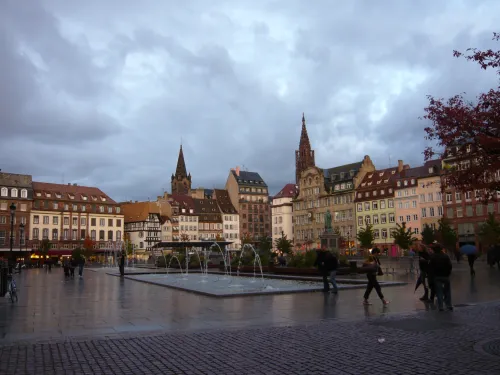
    Place Kléber is the largest square in the centre of Strasbourg and the heart of its shopping district. In the middle stands the statue of Jean-Baptiste Kléber, the revolutionary general born here in 1753, and beneath it lies a vault with his remains.

    Getting him there took a while. Kléber was assassinated in Cairo in 1800 and his body was brought back to France, but Napoleon feared his tomb would become a symbol for Republicans and kept it at the Château d'If, on an island near Marseille. It stayed there for 18 years until Louis XVIII granted him a burial place in his home town.

    The square has worn many names: Barfüsserplatz after a Franciscan monastery that stood here, Waffenplatz in the 17th century, Place des Recollets and Place des Cordeliers, and finally Kléber from 24 June 1840. During the German occupation in the 1940s it was renamed after Karl Roos, a local ethnically German politician executed by the French authorities in 1940 for espionage.

    On the north side is the Aubette, built between 1765 and 1772 by Jacques François Blondel, architect to Louis XV. In the 1920s Hans Arp, Theo van Doesburg and Sophie Taeuber-Arp decorated its interior; it was destroyed in the 1930s and, after a long restoration, opened to the public again in 2006. It has been called the Sistine Chapel of abstract art, so if modern art is your thing, ask at the building about visiting.

    Next comes the longest leg: 870 m, about 12 minutes, across the Ill to Place de la République.

    Hours
    Open 24/7
    Price
    Free
  5. 5

    Place de la République

    Place de la République in Strasbourg, stop 5 on the self-guided walking tour

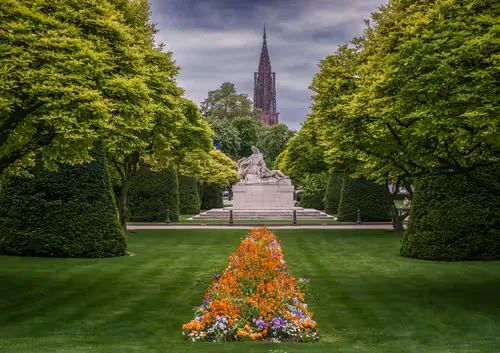
    Place de la République feels like a different city, and that was the point. After the Franco-Prussian War the city walls here were torn down, and from 1880 the architect Jean-Geoffroy Conrath laid out a grand square as the showpiece entrance to the Neustadt, built during the Reichsland period opposite the old Grande Île on the other side of the Ill. Back then it was the Kaiserplatz, the Imperial Square.

    Five buildings frame three sides, none of them residential: the Palais du Rhin, the National and University Library, the Théâtre national de Strasbourg, the Préfecture and the tax office. All are listed monuments. The fourth side stays open towards the Faux-Rempart canal.

    The round garden in the middle holds ginkgo trees that Emperor Meiji of Japan gave to the German emperor in the 1880s, and they still stand. Two beeches planted in the same decade were less lucky and fell in a storm in June 2019.

    At the centre is Léon-Ernest Drivier's war memorial from 1936: a mother holding two dead sons, an allusion to Strasbourg's history between Germany and France. It replaced an equestrian statue of Emperor Wilhelm I, which stood here for only seven years before its removal in 1918. There's a darker layer too: an old Jewish cemetery lay on ground near the river, and it is assumed to be where the Jews of Strasbourg were burned at the stake in 1349.

    From here you walk 860 m, about 12 minutes, back into the old town to the Maison Kammerzell on the cathedral square.

    Hours
    Open 24/7
    Price
    Free
  6. 6

    Maison Kammerzell

    Maison Kammerzell in Strasbourg, stop 6 on the self-guided walking tour

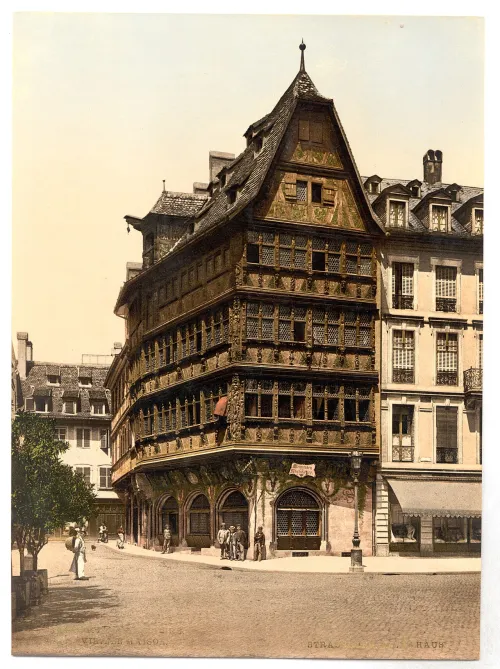
    Look up at the Maison Kammerzell and you'll see some of the most richly decorated timber framing in Strasbourg. It stands at number 16 on the cathedral square, facing the cathedral, and takes its name from Philippe-François Kammerzell, its last private owner, who sold it in 1879 to the Œuvre Notre-Dame foundation.

    The stone ground floor dates from 1427 and is all that remains of the original house. In 1571 the well-known cheese merchant Martin Braun bought it and added the wooden upper floors in a very particular Renaissance style; the house reached its final look in 1589. A restoration in 1892 changed parts of the façade and added the colourful paintwork in the 16th-century Rhenish manner.

    Take time with the carvings around the bottle-glass windows: sacred and secular scenes, medieval legends, the five senses, the four ages of life, faith, hope and charity, and the signs of the zodiac. Look for Caesar, Charlemagne, Hector and Godfrey of Bouillon among the figures, and on the gable you can still see the pulley once used to haul supplies into the attic.

    Inside is a restaurant with no entry ticket, decorated with a 1910 painting by Léo Schnugg that shows, among other things, a Strasbourg culinary anecdote from 1576. Go in if you want to see the room over a meal; for the classic dishes themselves, locals often point you to a winstub nearby.

    The cathedral is just 160 m away, about 2 minutes.

    Hours
    Daily: 08:00–22:00
    Price
    Free (entry)
  7. 7

    Strasbourg Cathedral

    Strasbourg Cathedral, stop 7 on the self-guided walking tour

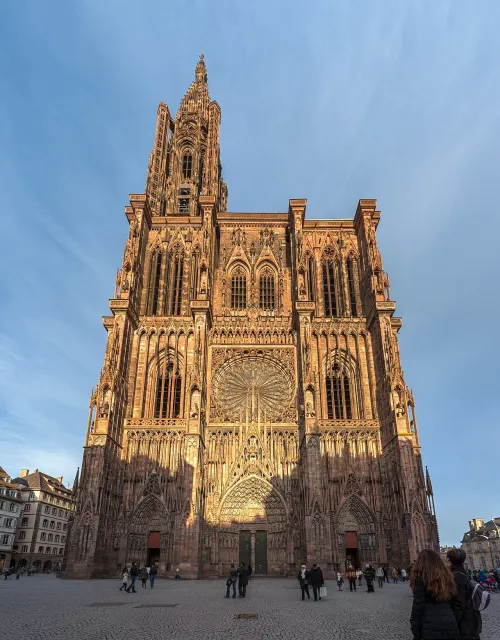
    Strasbourg Cathedral fills your view the moment you reach the square, and its colour strikes you first: reddish-brown sandstone from the Vosges mountains. At 142 metres it was the tallest building in the world for 227 years, until St. Nikolai's Church in Hamburg overtook it in 1874. Today it is the sixth-tallest church in the world and the tallest structure still standing that was built entirely in the Middle Ages.

    Notice the lopsided west façade with its single spire on the north side. Erwin von Steinbach shaped the building from 1277 until his death in 1318, followed by his son Johannes and his grandson Gerlach, and their plan foresaw two spires. Their successors went another way: Ulrich Ensingen and then Johannes Hültz built the single octagonal tower with its tall octagonal crown. Work had begun in 1015, was relaunched in 1190 and finished in 1439, which is why considerable parts are still Romanesque beneath all the Rayonnant Gothic.

    Victor Hugo called it a gigantic and delicate marvel, Goethe a sublimely towering, wide-spreading tree of God. Since at least 1224 the Fondation de l'Œuvre Notre-Dame has supervised its construction and upkeep.

    Going in is free and worth it for everyone. The astronomical clock and its apostles' procession need a ticket, sold only for the day of your visit, so decide on the spot. The viewing platform, 66 metres up, is a separate ticket sold on site with no reservations; it's the choice for the sea of roofs and the views towards the Black Forest and the Vosges.

    On the 140 m, about 2 minutes, to the Palais Rohan you pass the Musée de l'Œuvre Notre-Dame with original sculptures and building plans of the cathedral, and a platform ticket gets you in there at a reduced rate.

    Local name
    Cathédrale Notre-Dame de Strasbourg
    Hours
    Mon–Sat 8:30–11:15 + 12:45–17:45, Sun/holidays 14:00–17:15 (during Christmas market: Mon–Sat continuous 8:30–17:45)
    Price
    Church entry: free. Astronomical clock (show): 4 EUR adults, 3 EUR groups of 12+/students up to 25, 2 EUR children 6-17, free under 6.
  8. 8

    Palais Rohan

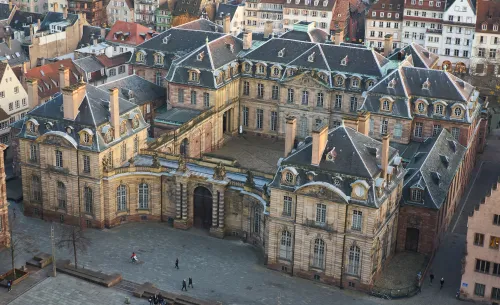
    Palais Rohan in Strasbourg, stop 8 on the self-guided walking tour

    The Palais Rohan was the residence of the prince-bishops and cardinals of the House of Rohan, an old noble family from Brittany. Robert de Cotte designed it, it went up next to the cathedral in the 1730s and was completed in 1742, and it counts as a masterpiece of French Baroque.

    Its message was as much religious as architectural. For two centuries Strasbourg had been dominated by Protestantism, and the palace was meant to announce the return of Catholicism: the prelate's apartments face the cathedral, and many of the statues, reliefs and paintings reflect Catholic doctrine.

    Royal guests came often: Louis XV, Marie Antoinette, Napoleon and Joséphine, Charles X. Ownership passed from the nobility to the city, the monarchy, the state, the university and back to the city, a small mirror of Strasbourg's own history. It has been a listed monument since 1920.

    Since the late 19th century it has housed three museums: archaeology in the basement, decorative arts on the ground floor and fine arts on the first and second floors, plus the Galerie Robert Heitz for temporary exhibitions. Each museum has its own entry fee. Short on time, admire the exterior and move on; if you love art or history, one museum is a good way to spend an extra hour and a half.

    Place Gutenberg is 350 m away, about 5 minutes on foot.

    Hours
    Museums in the Palais Rohan (Beaux-Arts, Arts décoratifs, Archéologique): Mon and Wed–Fri 10:00–13:00 and 14:00–18:00; Sat–Sun 10:00–18:00; closed Tuesdays
    Price
    9 EUR per museum (Musée Archéologique, Musée des Arts décoratifs, Musée des Beaux-Arts); reduced 5 EUR
  9. 9

    Place Gutenberg

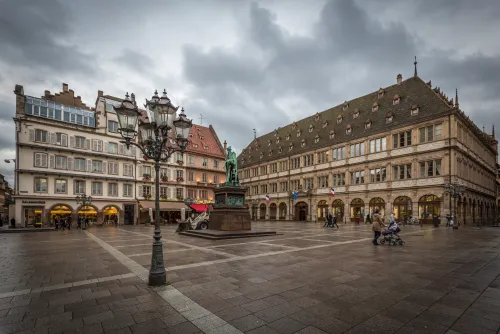
    Place Gutenberg in Strasbourg, stop 9 on the self-guided walking tour

    You finish on Place Gutenberg, laid out around 1100 and once the herb market, before it took the printer's name some time before 1863.

    The bronze statue by David d'Angers was unveiled on 24 June 1840, the very day Place Kléber received its name. Gutenberg holds a printed sheet with the Bible verse “And there was light”, and the four bronze reliefs on the pedestal show what printing brought to the other continents. Born in Mainz, he did at least his first printing work here in Strasbourg, including work on the Bible.

    The main building on the square is the Neue Bau, the former town hall and today the Chamber of Commerce. At numbers 1 and 2 stood the Schwowelade, the Swabian shop, as Strasbourgers called a hardware store whose roots went back to 1779, after its owner Paul Siebler-Ferry from Lenzkirch in the Black Forest; to locals, Schwowe meant more or less anyone from across the Rhine. Renamed Quincaillerie Centrale, it was destroyed in the bombing of 11 August 1944, which killed Arno Siebler-Ferry, and closed for good in 1957 when the rebuilt building was finished.

    A carousel stands on the square, a cheerful end point if you have children with you. If you need to get back to the Barrage Vauban, the GPS navigation in your browser leads you there.

    Hours
    Open 24/7
    Price
    Free
Walking tour route map of Strasbourg Route loaded
Barrage VaubanMaison des TanneursPonts CouvertsPlace Kléber+5
All 9 stops are already on the map.
You just press start.
AI Tour Guide

Nine stops read. Now walk them with a guide in your ear.

Press start wherever you are, even hundreds of kilometres from Strasbourg, and the guide begins telling its stories right away. In the city, pick any of the 9 stops to start from: it leads you there, then talks with you the whole route, asking, listening, remembering, and shaping the tour around your answers.

9stops 4.0km 54 minwalking 13languages
▶Start the tour free

Free to start · Runs in your browser · No app, no download

Shorter Ways to Walk Strasbourg

Short on time or only after one part of the city? These cuts follow the same order as the full walk.

The river quarter in under an hour

Stops: 1, 2, 3

For a short visit or anyone who came for the classic views of the half-timbered houses and the bridge towers. 12 minutes of walking (7 plus 5), and nothing on this stretch needs a ticket.

Cathedral quarter only

Stops: 6, 7, 8, 9

For a compact visit around the cathedral square: carved timber, Gothic sandstone, Baroque palace and Gutenberg. Just 9 minutes of walking (2, 2 and 5). The church is free; the astronomical clock and each Palais Rohan museum cost entry.

Squares, Neustadt and cathedral

Stops: 4, 5, 6, 7, 8, 9

For those staying near the centre who want the contrast between the old Grande Île and the German-era Neustadt. 33 minutes of walking (12, 12, 2, 2 and 5); the same tickets apply as in the cathedral quarter.

How Long the Strasbourg Tour Takes, Museums or Not

Walking alone takes 54 min over the 4.0 km. Add short pauses at the bridges, squares and façades, about three quarters of an hour inside the cathedral, and you end up at a little over three hours. One museum in the Palais Rohan adds roughly an hour and a half.

The river quarter cut takes under an hour including the views from the barrage. The cathedral quarter fills about an hour and a half with a cathedral visit, more with a museum. The squares, Neustadt and cathedral version comes to around two and a quarter hours.

Before You Start in Strasbourg

  • Start: The Barrage Vauban is the recommended start, so the walk runs from the river into the old centre. You can join at any stop.
  • Finish: Place Gutenberg. If you need to return to the Barrage Vauban, the GPS navigation in your browser leads you back.
  • Timing: Plan your start so you reach the cathedral while it's open to visitors. Finishing around lunchtime pairs well with a lunch menu.
  • Tickets: Bridges, squares and the cathedral are free. The astronomical clock show has its own ticket, sold only for the day of your visit, the cathedral platform is a separate ticket sold on site, and each Palais Rohan museum charges entry.

Food and Breaks Along the Route: Winstubs, Flammekueche, Crêpes

Eat your main meal at midday: many Strasbourg restaurants offer a formule midi, two courses for roughly half of what the same kitchen charges à la carte. For choucroute and flammekueche, the traditional winstubs are where locals go.

La Corde à LingeLooks like a tourist trap but isn't entirely one. Locals come for the terrace and the spaetzle, and admit the food is correct rather than extraordinary. (Petite France)
Le GurtlerhoftA 14th-century wine cellar that stands out despite the tourist location, with a choucroute some rate very highly. (Cathedral area)
Le Tire-BouchonA genuine winstub, discreet among the tourist traps around it. (Cathedral area)
Aux Armes de StrasbourgClassic brasserie right where the walk ends, with a summer terrace for people-watching. (Place Gutenberg)
BinchstubThe most recommended address for flammekueche, with farm ingredients and three locations. The base is properly crunchy, not soggy.
Crêpe kioskA massive crêpe for little money; one resident calls it the best crêpe in the city. (Place Broglie)
Ma Boulangerie au Feu du BoisWorth the walk for bread and pastry; the queue out the door says enough. (36 Rue de Lazaret)

Tourist Traps to Avoid in Strasbourg's Old Town

  • Choucroute on the cathedral square: The square's restaurants charge a lot for the setting, and service can feel robotic. The same dish costs noticeably less in a winstub a lane away, often tasting better. (Place de la Cathédrale)
  • Flammekueche at Flam's: Heavy, rather bland bases. Don't judge the dish by it.
  • Cathedral entry tickets from resellers: The church is free. Only the clock and the platform cost money, so don't buy a third-party ticket for simply going in. (Strasbourg Cathedral)
  • The little tourist train: It covers the same streets you walk anyway, and on foot you get into the lanes the train only passes. (Place de la Cathédrale)
Walking tour route map of Strasbourg
AI Tour Guide

Your guide is ready at whichever stop you start.

Press start and a voice AI Tour Guide takes it from here: leading the route through Strasbourg, telling the stories, and turning your walk into a real back-and-forth conversation. No app or download is needed; it runs in your browser.

9stops 4.0km 54 minwalking 13languages
▶Start the tour free

Free to start · Runs in your browser · No app, no download

What the AI Tour Guide Adds Between Vauban and Gutenberg

The AI Tour Guide turns this walk into a conversation: it greets you on the barrage, tells the stories of each place as you arrive, asks what caught your interest and remembers whether you lean towards the fortifications or the Neustadt's grand architecture, then follows that thread to the cathedral. Ask what daily life was like for prisoners in the bridge towers, or what the Aubette's abstract interior looked like, and it carries on from there; you can interrupt whenever you like. You start with 100 free credits; after that you choose this tour all-inclusive for €19.99 with no time limit, or €5 per hour.

A Real Conversation A voice AI Tour Guide greets you, leads the whole route, and tells the stories and facts as you walk, asking what you want to see and keeping a real conversation going. Not a recording you press play on.
Map Navigation Follow the route on the map and walk at your own pace. You choose where to start and when to move to the next stop.
Ask Anything Curious about a building you pass? Ask your AI Tour Guide on the spot and the conversation carries on.
13 Languages Switch language anytime. No separate tour needed.
Start free in your browser

Common Questions About Walking Strasbourg

Do I need a ticket for the astronomical clock show?

Yes, the clock show has its own ticket, sold only for the day of your visit. It gets full, so sort it out on site before you plan the rest of your day around it.

Is the Palais Rohan day pass worth buying?

Only if you plan all three museums; for two, single tickets work out cheaper. The pass includes the Galerie Robert Heitz, is sold only at the counter, and visitors under 18 get in free anyway.

Where can I go for a day trip from Strasbourg?

Colmar, 63 km away, is the natural next step for more of Alsace. Across the Rhine, Baden-Baden at 41 km and Freiburg at 66 km each have their own walking route.

Is the tour really free?

Yes. The whole tour is free: the route, the interactive map and the navigation cost you nothing. Only the voice AI Tour Guide is optional and paid: you test it with 100 free credits, then you pay either €5 per hour or €19.99 for this whole tour, with no time limit.

Do I need to download an app?

No. Everything runs in your phone browser. Open the route and start walking, no download and no sign-up required.

Do I need to book the walking tour in advance?

No booking needed. This self-guided tour is available anytime. Open the route in your browser and start walking. The AI Tour Guide works instantly, no app, no reservation required.

What languages is the AI Tour Guide available in?

The AI Tour Guide speaks 13 languages, so you take the tour in your own language and can switch at any time.

Can I skip stops or change the route?

Yes. Skip any stop, spend extra time at places you like, or start the route from any point. It is your walk, you set the pace.
Image credits
▶ Start free in your browser Runs in your browser, no app, no download