Free Walking Tour Colmar: Unterlinden to Petite Venise

Grünewald's altarpiece, Schongauer's Madonna, a façade full of grotesque masks and painted timber houses, ending on the canals of the Lauch.

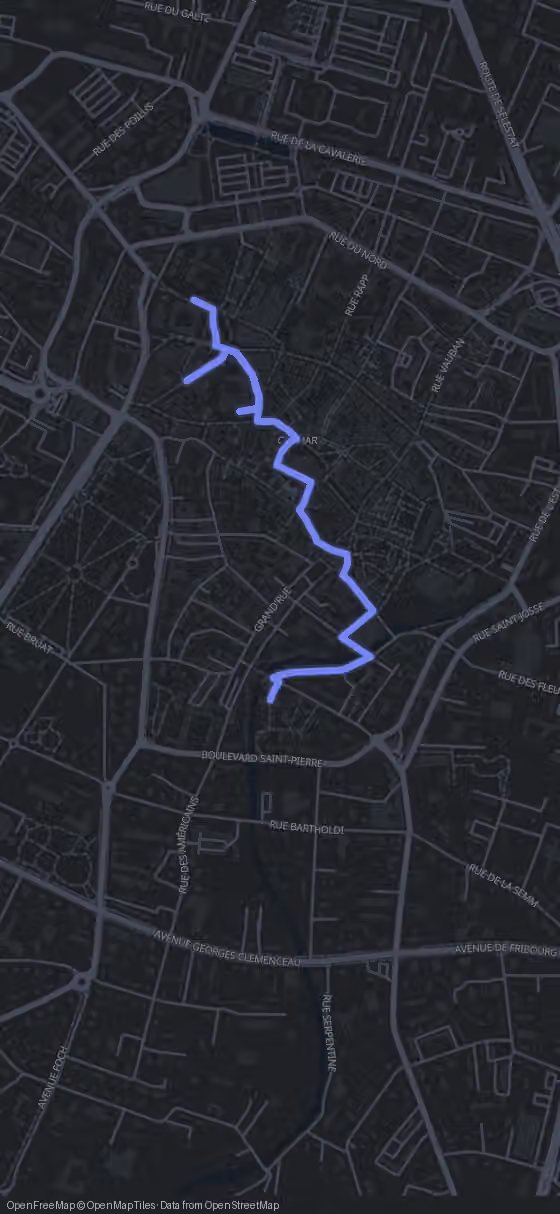
8 Stops 1.7 km ~22 min walking
Route map for the Colmar walking tour
Stop 1 of 8
290 m·4 min
Musée Unterlinden
Head south-east toward the Dominican Church
Bonjour, welcome to Colmar. I'm Alex, and one masterpiece here was created for people facing terrible pain.
Try this tour with Alex

This Colmar Route at a Glance

Eight stops, 1.7 km and 22 minutes of pure walking: from the Musée Unterlinden past the Dominican Church, Maison des Têtes, Cathédrale Saint-Martin, Maison Pfister, Koïfhus and Marché Couvert to La Petite Venise. Plan about two hours, or four and a half with the museum and lunch.

Only the museum charges entry; the rest is free. Route, map and GPS navigation from stop to stop run free in your browser, and the AI Tour Guide is optional.

Open free GPS & optional AI Tour Guide
This short shows highlights of the route. All 8 stops follow below.

The Route

Colmar Walking Map: From the Convent Museum to the Canals

8 stops 1.7 km 22 min walking
Tap to load interactive map

The 8 stops along this route

  1. Musée Unterlinden in Colmar, stop 1 on the self-guided walking tour
    1Musée Unterlinden
  2. Dominican Church in Colmar, stop 2 on the self-guided walking tour
    2Dominican Church
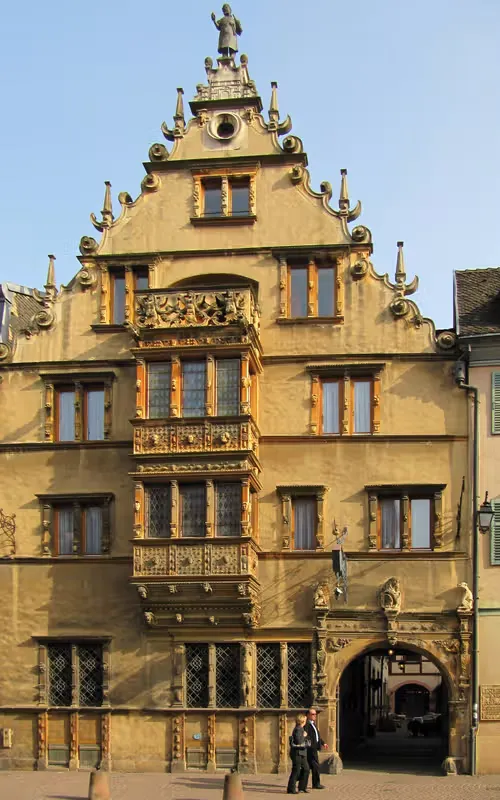
  3. Maison des Têtes in Colmar, stop 3 on the self-guided walking tour
    3Maison des Têtes
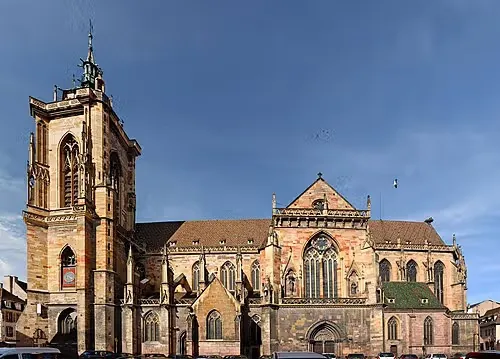
  4. Cathédrale Saint-Martin in Colmar, stop 4 on the self-guided walking tour
    4Cathédrale Saint-Martin
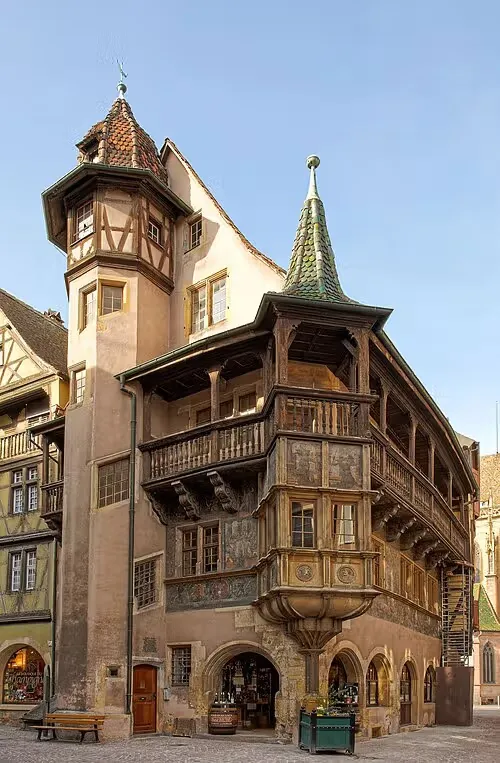
  5. Maison Pfister in Colmar, stop 5 on the self-guided walking tour
    5Maison Pfister
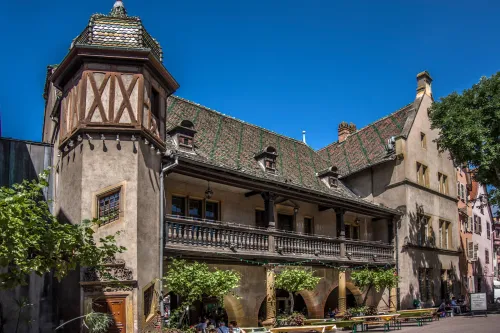
  6. Koïfhus in Colmar, stop 6 on the self-guided walking tour
    6Koïfhus
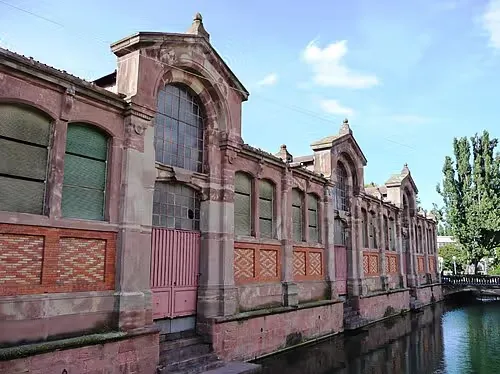
  7. Marché Couvert in Colmar, stop 7 on the self-guided walking tour
    7Marché Couvert
  8. La Petite Venise in Colmar, stop 8 on the self-guided walking tour
    8La Petite Venise
  9. That's the full route.

    Walk it with an AI Tour Guide talking you through every one of these streets.

    Start free in your browser
    You made it

The Colmar Walking Tour Stops, From Grünewald to the Lauch

  1. 1

    Musée Unterlinden

    Musée Unterlinden in Colmar, stop 1 on the self-guided walking tour

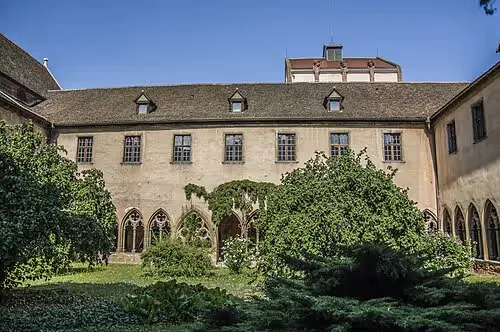
    You start in front of two buildings that tell two different stories. One is a 13th-century convent of Dominican nuns, with its cloister and chapel; the other is a Neo-Baroque public baths building from 1906. Between 2009 and 2015 the city turned the old baths into an annex and linked the two with a series of underground exhibition rooms, so today you walk from medieval vaults into a modern museum without going outside.

    After the French Revolution the convent stood empty. It was saved by the Société Schongauer, a society founded in 1847 by Louis Hugot and named after Colmar's great painter, and the town handed the buildings over to it. The museum was established in 1849. At first its pride was a Roman mosaic found in Bergheim, still on display, and plaster casts of antique sculptures lent by the Louvre.

    Everything changed in 1852, when the Isenheim Altarpiece by Matthias Grünewald arrived, together with most of the large painted and carved altarpieces from Colmar's churches and from abbeys and monasteries of the Upper Rhine. A year later, in 1853, the doors opened to the public. With around 200,000 visitors a year it is the most visited museum in Alsace.

    Is it worth going in? If you care about art even a little, yes: the altarpiece alone justifies the ticket, and the collection runs from prehistory to contemporary works. Give it two hours and come at opening time. If you only have a morning for the town itself, admire the convent from outside and come back another day.

    From here it is 290 m, about 4 minutes, to the Dominican Church. On the way you pass Bartholdi's statue of Martin Schongauer, a fitting introduction to the painting that waits at the next stop.
    Hours
    Wed–Mon 09:00–18:00 (last entry 17:30), Tue closed; Dec 24 and Dec 31 09:00–16:00; closed Jan 1, May 1, Nov 1 and Dec 25
    Price
    14 EUR (17 EUR with audio guide), reduced 12 EUR, ages 12–17 and students under 30 9 EUR
  2. 2

    Dominican Church

    Dominican Church in Colmar, stop 2 on the self-guided walking tour

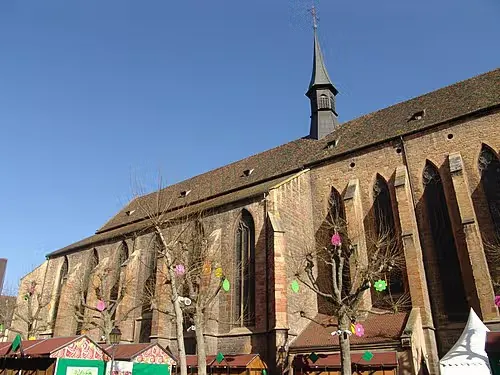
    From outside, the Dominican Church looks plain, apart from the Neo-Gothic portal that Théophile Klem added during a restoration at the end of the 19th century. Inside, it is one of the great Gothic spaces of Colmar and the town's second largest church after Saint Martin's. The monastery was founded in 1277, and the church was built between 1289 and 1346.

    The nave is 35 metres long, with a flat ceiling carried by tall, slender columns that divide it into three. It rises about 28 metres today, although the floor now sits some 80 centimetres above the original level. The choir is 30 metres long, narrower and a little lower, with a ribbed vault.

    At the entrance to the choir hangs the reason most people come: the Madonna of the Rose Bower by Martin Schongauer, a masterpiece of German painting. It used to stand in Saint Martin's, until it was stolen in 1972. Once recovered, it was installed here in 1973, in a richly decorated frame from Klem's workshop, with saints by Martin von Feuerstein on the side wings.

    Take time for the ten choir windows from the 14th century, telling the legends of saints. They are the most important collection of medieval stained glass in Colmar. Look also at the Rococo choir altars by Gabriel Ignaz Ritter, brought from Marbach Abbey after 1790, and at the choir stalls, partly from the former Alspach convent near Kaysersberg. The splendid Silbermann organ of 1726 that once played here now stands in the parish church of Niedermorschwihr.

    Entry is free and donations are welcome; even a short look is worth it. The Maison des Têtes is 260 m away, about 3 minutes on foot.

    Local name
    Église des Dominicains de Colmar
    Hours
    Mon: Closed | Tue: 10:00–13:00, 15:00–18:00 | Wed: 15:00–18:00 | Thu: 10:00–13:00, 15:00–18:00 | Fri–Sat: 10:00–18:00 | Sun: 10:00–13:00, 15:00–18:00
    Price
    Free (donations accepted)
  3. 3

    Maison des Têtes

    Maison des Têtes in Colmar, stop 3 on the self-guided walking tour

    Stop at number 19, rue des Têtes and look up. The façade is crowded with little figures and, above all, with 106 grotesque masks, the faces that gave the house its name. Count a few and you notice that no two pull the same expression.

    The house was built in 1609 for Anton Burger, a merchant who joined the merchants' guild in 1602, sat on the town council from 1612 and became Stettmeister, one of Colmar's leading magistrates, from 1626 to 1628. He had his father's house torn down and rebuilt on the same plot. Burger put his coat of arms, a castle, on the façade twice: on the volute gable and above the doorway. The second one also carries the arms of his wife, Anne Ortlieb from Riquewihr.

    After his heirs sold the house in 1698 for 1,500 thalers, it passed from owner to owner, among them a war treasurer and an infantry captain, until Colmar's wine exchange acquired it. That chapter left its mark at the top of the curved gable: a bronze cooper from 1902, made by Auguste Bartholdi, one of the town's most famous citizens.

    The house has been a restaurant and a meeting place since 1898, the same year it was listed as a historic monument. You see it all from the street for free. Then follow the route 440 m, about 6 minutes, to the Cathédrale Saint-Martin, the longest stage of the walk.

    Price
    Free (exterior visible, restaurant inside)
  4. 4

    Cathédrale Saint-Martin

    Cathédrale Saint-Martin in Colmar, stop 4 on the self-guided walking tour

    Everyone in Colmar calls it a cathedral, yet the town has never been the seat of a bishop. The name comes from its size; officially it is a collegiate church, built between 1234 and 1365 for a college of canons devoted to Saint Martin of Tours. Excavations in 1972 uncovered the remains of an earlier church in Carolingian style from around the year 1000 and the foundations of a Romanesque one on the same spot.

    Walk around the outside first. The coloured tile roof catches the eye, and the bell tower wears a Renaissance helmet added in 1572 after a fire. The portals are small for such a large building, some are bricked up, and the biggest have richly carved tympana. Massive pillars hold up the façade, an architectural rarity that makes the front look heavy next to the airy windows of the apse.

    Look closely and you will also find two “Judensäue”, one as a gargoyle and one carved on the corner of a portal. These insulting images of Jews are a stone reminder of the troubled history of the Jewish community in Alsace.

    Inside, the furnishings suffered badly during the French Revolution, but the space is generous. The Baroque organ case of 1755 is exuberant; the instrument inside, first built by Johann Andreas Silbermann, was completely replaced in 1979. The ambulatory around the choir is unique among Alsatian churches, and its chapels hold medieval altars and statues. In the nave, look for a 13th-century stained glass head of a beardless Christ. Entry is free and the doors open every day, so step in for twenty minutes.

    Maison Pfister is just 60 m away, a one-minute walk past the Musée des Vins d'Alsace.

    Local name
    Collégiale Saint-Martin de Colmar
    Hours
    Mon–Sat: 08:00–18:45 | Sun: 10:00–19:00
    Price
    Free
  5. 5

    Maison Pfister

    Maison Pfister in Colmar, stop 5 on the self-guided walking tour

    This is probably the best-known house in Colmar, and you see why at once: a corner building in yellow Rouffach sandstone and wood, with a two-storey corner oriel and an octagonal stair turret crowned by an onion dome. The lower part of the oriel is stone with curving Gothic ribs, the upper part a wooden gallery with a balustrade. Above the arcaded ground floor come two storeys of mullioned windows and two levels of attic.

    It was built in 1537 for a hatter from Besançon, Ludwig Scherer, on the site of an older house called “at the red cockerel”. The date is inscribed on a window of the stair turret, so look for it there. The painted frescoes followed in 1577.

    The name comes from later owners: the merchant François Jean Pfister bought it in 1841, and François Joseph Pfister owned it from 1860. Since 1892 the house has belonged to the Judlin family, wholesale merchants, who had it carefully restored in 1909. It was listed as a historic monument in 1927 and restored again in 1971, and in 2012 the façade and roof were brought back to their original state.

    The house is for looking at from the street at 11, rue des Marchands; there is nothing you need to pay for. From here it is 120 m, about 2 minutes, to the Koïfhus, past the Musée Bartholdi.

    Hours
    Daily: 10:00–19:00
    Price
    Free (exterior visible, restaurant inside)
  6. 6

    Koïfhus

    Koïfhus in Colmar, stop 6 on the self-guided walking tour

    The Koïfhus, Alsatian German for “big store”, is the oldest public building in Colmar. It stands at 29 Grand-Rue and is really three buildings. The large rectangular block to the south, first built in 1480 and altered in the 16th and 18th centuries, was the customs house proper. Above its two main doors, with their ogee arches framed by the town's arms, you see the double-headed eagle of the Empire.

    This was the town's administrative and economic centre at a time when Colmar minted its own coins. On the ground floor, goods coming in and going out were stored and taxed. Upstairs, the hall served in turn as a court, as the council chamber of the town and as the meeting place of the Decapolis, the league of ten imperial towns of Alsace that existed from 1354 until 1679. Its windows still carry the arms of the ten towns.

    The middle building, called zum Grisen after a family that ran a bathhouse there, was bought by the town in 1482 and used as a slaughterhouse until 1840. The northern one, the Ankenhaus from the 16th century, was acquired in 1594 for the trade in tallow and candles. General Jean Rapp, one of Napoleon's generals, was born here in 1771. Do not miss the glazed tile roof.

    The interior is not open to the public, so this is a stop for the façades. The Marché Couvert is 250 m away, about 3 minutes, through the Tanners' Quarter.

    Hours
    Exterior visible 24/7 (interior closed to public)
    Price
    Free (view from outside)
  7. 7

    Marché Couvert

    Marché Couvert in Colmar, stop 7 on the self-guided walking tour

    Colmar's covered market was built in 1865 by the architect Louis-Michel Boltz, in brick and dressed stone, with a metal roof structure on cast-iron columns. It stands right on the Lauch, and that was the point: the market gardeners could tie up their boats at the foot of the building and unload straight into the hall.

    For a while the hall also served as a car park, shared with the Thursday market. Work that began in September 2010 gave it back its original purpose, and today around twenty traders sell here from Tuesday to Saturday. Look for the niche in the south-west corner: it holds Bartholdi's statue of the little winegrower, a cousin of the bronze cooper you saw on the Maison des Têtes.

    This is the most useful stop for a break. You can put together a picnic or eat at the terrace facing the river, usually for less than in the restaurants along the canals. Keep an eye on the clock, because the hall closes fairly early.

    La Petite Venise begins right here; follow the Quai de la Poissonnerie for 250 m, about 3 minutes, to the heart of the quarter.

    Hours
    Mon closed, Tue–Thu 08:00–18:00, Fri 08:00–19:00, Sat 08:00–17:00, Sun 10:00–14:00
    Price
    Free
  8. 8

    La Petite Venise

    La Petite Venise in Colmar, stop 8 on the self-guided walking tour

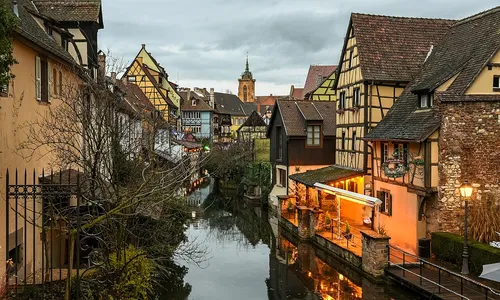
    The walk ends where Colmar is at its most photogenic: half-timbered houses painted in Alsatian colours, lined up along the canals of the Lauch. Most of them were built between the 14th and 18th centuries. The quarter is named after Venice because life here was organised around the water, and it counts among the most picturesque corners not only of Colmar but of all Alsace.

    La Petite Venise is part of the Krutenau quarter, whose name refers to vegetable gardens on the edge of a town. In the Middle Ages the old marshland at the southern gates was turned into market gardens, irrigated by the Lauch. The gardeners, who were also boatmen, carried their vegetables in flat-bottomed boats straight to the quay of the covered market via the Quai de la Poissonnerie.

    The quarter stretches from the market along that quay to around the bridge on the boulevard Saint-Pierre. Today it is full of small hotels, restaurants, winstubs, pastry shops and boutiques, but it has kept its old shape. If you want to see it from the water, traditional boats still make trips on the Lauch between the covered market and the old market gardens, now a green residential area.

    Take your time here; there is no next stage to hurry for. When you are ready, the GPS navigation in your browser can lead you back to the Musée Unterlinden.

    Hours
    Open 24/7
    Price
    Free
Walking tour route map of Colmar Route loaded
Musée UnterlindenDominican ChurchMaison des TêtesCathédrale Saint-Martin+4
All 8 stops are already on the map.
You just press start.
AI Tour Guide

You've read the Colmar route. Now walk it with a guide in your ear.

Press start wherever you are, even hundreds of kilometres from Colmar, and the guide begins telling its stories right away. In the city, pick any of the 8 stops to start from: it leads you there, then talks with you the whole route, asking, listening, remembering, and shaping the tour around your answers.

8stops 1.7km 22 minwalking 13languages
▶Start the tour free

Free to start · Runs in your browser · No app, no download

Shorter Ways to Walk Colmar

The route splits neatly at the Cathédrale Saint-Martin: the first half is about art, the second about merchants' houses and water. Each half works on its own.

The art half: Grünewald and Schongauer

Stops: 1, 2, 3, 4

For anyone who came for the paintings. From the Musée Unterlinden to the cathedral it is 990 m and 13 minutes of walking. The museum is the only paid entry; the Dominican Church and the cathedral are free. Allow around three hours with a proper museum visit.

The old town half: houses, market and canals

Stops: 4, 5, 6, 7, 8

For a short first look or a late afternoon. From the cathedral to La Petite Venise it is 680 m and 9 minutes on foot, all of it free. Around an hour is enough, longer if you sit down at the market or by the water.

How Long the Colmar Tour Takes, With and Without the Museum

The walking itself is short: 22 minutes for 1.7 km, with no stage longer than 440 m. What takes time is going inside. Done as a walk with a look into the two churches and the market hall, the route fills about two hours. With two hours in the Musée Unterlinden and a lunch break, count on four and a half.

A day that works: be at the museum in the morning when it opens and leave around 11:00. You reach the Dominican Church at 11:04, the Maison des Têtes around 11:27 and the cathedral at about 11:43. After twenty minutes inside, Maison Pfister and the Koïfhus are only one and two minutes apart, and you arrive at the Marché Couvert around 12:29, comfortably in time for lunch. You reach La Petite Venise at about 13:15.

The art half takes around three hours with the museum; the old town half about an hour.

Before You Set Off in Colmar

  • Start and finish: Start at the Musée Unterlinden and finish at La Petite Venise. You can join the route at any stop; the order here is the one we recommend. From the last stop, the GPS navigation in your browser takes you back to the start if you want.
  • Best days: Pick a day when the museum, the Dominican Church and the Marché Couvert are all open: each has a weekly closing day, and the church and the market hall keep shorter hours on some days.
  • Time of day: Mornings suit the full route, starting at the museum when it opens. On some days the Dominican Church closes over lunch.
  • Costs: The Musée Unterlinden charges entry, with an audio guide on offer and reduced tickets for some visitors. The Dominican Church welcomes donations; everything else on the route is free.
  • Holidays: On some public holidays the museum is closed or shuts early, so plan around them if you visit then.

Food and Breaks Between the Museum and the Canals

Colmar eats early and precisely: most local kitchens take orders between 12:00 and 13:30 and stop serving lunch at 14:00 sharp. The route passes good addresses at every stage, from set lunches near the museum to terraces on the water.

Le ComptoirA lunch formula that includes a glass of Alsatian wine, bought directly from small producers in villages off the tourist wine route. (Rue des Clefs, near the Musée Unterlinden)
La Table du BrocanteurA lunch menu that changes weekly. The owner collects old Alsatian cookbooks and sometimes cooks historical recipes as the dish of the day. (Rue des Augustins, near the Musée Unterlinden)
Au Croissant DoréA small café behind a baby pink façade with ten kinds of coffee at fair prices. Fine for two or three, not for a big group. (Near the Cathédrale Saint-Martin)
Chez HenrietteIt looks like a grandmother's dining room. The lunch menu follows what was bought at the market that morning, and the choucroute uses sauerkraut fermented in wooden barrels in the basement. (Rue de la Herse, Tanners' Quarter)
Le Quai 21A gingerbread house with refined cooking and Mediterranean touches. At lunch you choose between two and three courses. (Opposite the Marché Couvert)
La Fleur de SelA tiny room with a lovely terrace on the quay in summer and good value for money. Book ahead, the tables go fast. (La Petite Venise)
Wistub BrennerThe reliable classic in the heart of Little Venice: cosy, traditional, with a terrace in summer. (La Petite Venise)
Jadis et GourmandeWarm, wooden and full of teddy bears, with Alsatian dishes beyond choucroute such as meat pie, fleischnakas and lawerknepfla, plus generous desserts. Reserve, it fills up even in low season.

Tourist Traps in Colmar: Late Lunches, Pricey Sausages, Early Closing

  • Sitting down for lunch at 13:45: Arriving that late usually means a reduced menu and rushed service. Plan your lunch stop before 13:30.
  • The canal-side sausage sandwich: Canal-side cafés charge a lot for a saucisse de Strasbourg sandwich with inferior sausage. At the Saturday market, the charcuterie stand near the fountain sells the real thing for much less.
  • Counting on the market for a late picnic: The Marché Couvert closes fairly early, so do your shopping in good time. The Casino grocery on Grand Rue, across from Hotel St. Martin, stays open into the evening.
  • Walking in at Wistub de la Petite Venise: It is extremely popular and hard to get into without a booking made well in advance.
Walking tour route map of Colmar
AI Tour Guide

Your Colmar guide is ready when you are.

Press start and a voice AI Tour Guide takes it from here: leading the route through Colmar, telling the stories, and turning your walk into a real back-and-forth conversation. No app or download is needed; it runs in your browser.

8stops 1.7km 22 minwalking 13languages
▶Start the tour free

Free to start · Runs in your browser · No app, no download

What the AI Tour Guide Adds in Colmar

Colmar's stories connect across the route: the Schongauer society that saved the convent, the Madonna stolen from the cathedral, Bartholdi's figures on a gable and a market hall. The AI Tour Guide leads you through them as a conversation. It greets you, tells the stories, asks what caught your eye and remembers it, so if you linger over the altarpieces it spends more time on art, and if the merchants' houses grab you it follows that thread. You can interrupt it anytime. It starts with 100 free credits; after that you choose this tour all-inclusive for €19.99 with no time limit, or €5 per hour.

A Real Conversation A voice AI Tour Guide greets you, leads the whole route, and tells the stories and facts as you walk, asking what you want to see and keeping a real conversation going. Not a recording you press play on.
Map Navigation Follow the route on the map and walk at your own pace. You choose where to start and when to move to the next stop.
Ask Anything Curious about a building you pass? Ask your AI Tour Guide on the spot and the conversation carries on.
13 Languages Switch language anytime. No separate tour needed.
Start free in your browser

Common Questions About Walking Colmar

Can I take a boat on the canals in La Petite Venise?

Yes. Traditional flat-bottomed boats run trips on the Lauch between the Marché Couvert and the old market gardens. Departure times and fares are posted at the landing.

Where can I buy picnic food in Colmar?

The Marché Couvert is the best place for picnic food; go in good time, as it closes fairly early. The Casino grocery on Grand Rue is an alternative later in the day.

Where should I try tarte flambée in Colmar?

La Soi is the name locals mention most, but you will need a reservation. Les Bateliers and Le Comptoir de Georges are good alternatives.

Which nearby cities can I walk the same way?

Freiburg is 38 km away, Basel 60 km and Strasbourg 63 km, and each has its own free self-guided route.

Is the tour really free?

Yes. The whole tour is free: the route, the interactive map and the navigation cost you nothing. Only the voice AI Tour Guide is optional and paid: you test it with 100 free credits, then you pay either €5 per hour or €19.99 for this whole tour, with no time limit. Admission to one of the 8 stops is not included: Musée Unterlinden charges its own entry fee.

Do I need to download an app?

No. Everything runs in your phone browser. Open the route and start walking, no download and no sign-up required.

Do I need to book the walking tour in advance?

No booking needed. This self-guided tour is available anytime. Open the route in your browser and start walking. The AI Tour Guide works instantly, no app, no reservation required.

What languages is the AI Tour Guide available in?

The AI Tour Guide speaks 13 languages, so you take the tour in your own language and can switch at any time.

Can I skip stops or change the route?

Yes. Skip any stop, spend extra time at places you like, or start the route from any point. It is your walk, you set the pace.
Image credits
▶ Start free in your browser Runs in your browser, no app, no download