Free Walking Tour Füssen: Castle, Abbey and Lechfall

From the bishops' castle on its hill, down a Roman road and out to the roaring weir on the Lech: six stops, 3.1 km, and the route costs you nothing.

6 Stops 3.1 km ~42 min walking
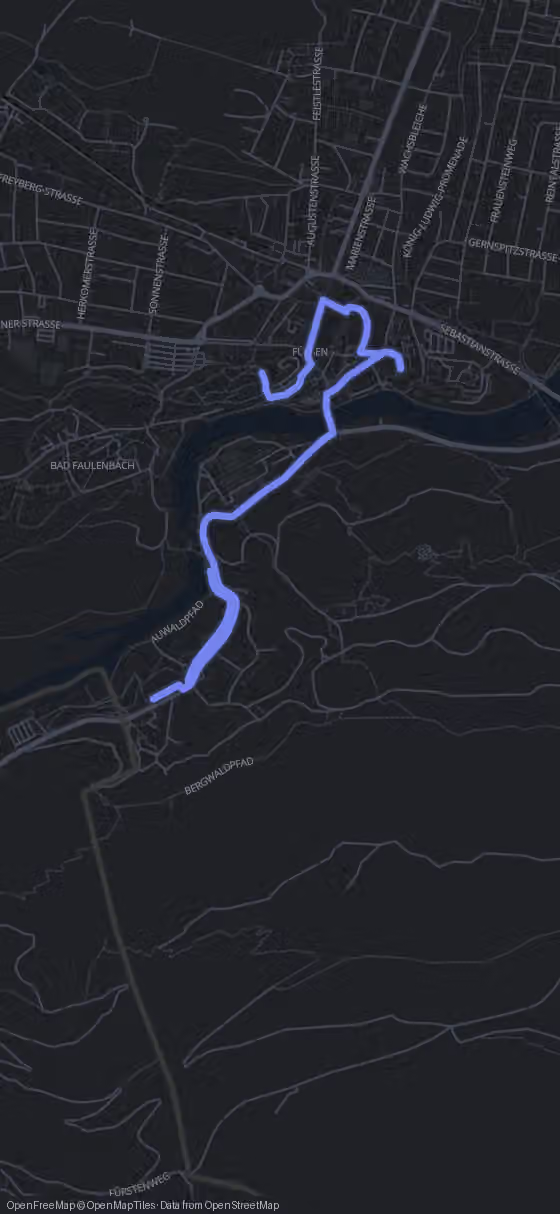
Route map for the Füssen walking tour
Stop 1 of 6
190 m·2 min
Hohes Schloss
Head south-east toward Kloster St. Mang
Grüß Gott, welcome to Füssen. I'm Alex, and the castle above town plays a convincing trick on your eyes.
Try this tour with Alex

Füssen on Foot at a Glance

Six stops lead from the Hohes Schloss past Kloster St. Mang, along the Reichenstrasse and the Franziskanerkloster out to the Baumkronenpfad Ziegelwies and the Lechfall: 3.1 km, 42 minutes of pure walking, about four hours if you go inside everywhere it is worth it.

The street, both churches and the waterfall are free; the castle, the abbey museum and the treetop path charge admission. The GPS route in your browser is free, and the optional AI Tour Guide tells the stories as you walk.

Open free GPS & optional AI Tour Guide
This short shows highlights of the route. All 6 stops follow below.

The Route

Walking Map of Füssen from Castle Hill to the Lech

6 stops 3.1 km 42 min walking
Tap to load interactive map

The 6 stops along this route

  1. Hohes Schloss in Füssen, stop 1 on the self-guided walking tour
    1Hohes Schloss
  2. Kloster St. Mang in Füssen, stop 2 on the self-guided walking tour
    2Kloster St. Mang
  3. Reichenstrasse in Füssen, stop 3 on the self-guided walking tour
    3Reichenstrasse
  4. Franziskanerkloster in Füssen, stop 4 on the self-guided walking tour
    4Franziskanerkloster
  5. Baumkronenpfad Ziegelwies in Füssen, stop 5 on the self-guided walking tour
    5Baumkronenpfad Ziegelwies
  6. Lechfall in Füssen, stop 6 on the self-guided walking tour
    6Lechfall
  7. That's the full route.

    Walk it with an AI Tour Guide talking you through every one of these streets.

    Start free in your browser
    You made it

Your Füssen Walking Tour from Hilltop Castle to River Gorge

  1. 1

    Hohes Schloss

    Hohes Schloss in Füssen, stop 1 on the self-guided walking tour

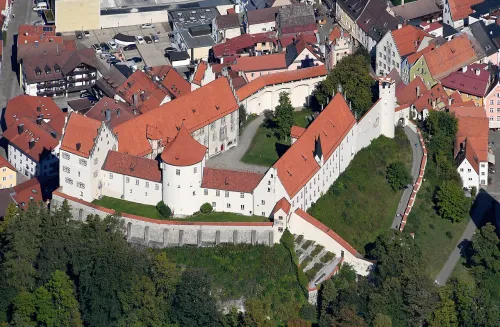
    Start at the top. The late Gothic Hohes Schloss, the castle of the prince-bishops of Augsburg, sits on its hill above the old town and is considered one of the best-preserved medieval castle complexes in Bavaria. Most of what you see today goes back to Bishop Friedrich II of Zollern, who had the old administrative castle rebuilt and enlarged from 1486 onwards.

    The hill was busy long before any bishop. In the late Roman Empire a fort called Foetibus stood here, home to a supply unit of the Third Italian Legion, and around AD 47 the Via Claudia probably already had a rest station on ground that is now the town. When the bishops later founded the abbey below, the ruined fort most likely served as a welcome quarry.

    The castle itself began as a broken promise. In 1183 the bishops gave this hill to the abbey on one condition: no secular building would ever stand on it, and it would never pass to a secular lord. Then Konradin, the last of the Hohenstaufen, unlawfully pledged the protectorate over the bishopric to his uncle, Duke Ludwig II of Bavaria, in 1266 and 1267. The duke built a castle above the monastery to secure his claim, and only after fierce disputes did he give it up in a settlement of 1292. In 1322 the bishopric acquired the hill by exchange and made the fortress the seat of its local administration; by 1363 it was part of the town walls.

    Going inside is worth it if you have the morning and enjoy castles: the rooms were refitted around 1680 under Prince-Bishop Johann Christoph von Freyberg, and the visit costs an adult ticket, free under 18. On your way out you pass the Staatsgalerie im Hohen Schloss Füssen, and from there it is only 190 m, about 3 minutes, down to the abbey.
    Hours
    Tue–Sun 10:00–17:00 (until Nov 8), Fri–Sun 10:00–12:30 (from Nov 13); Mon closed
    Price
    6 EUR adults, 5 EUR reduced, free under 18
  2. 2

    Kloster St. Mang

    Kloster St. Mang in Füssen, stop 2 on the self-guided walking tour

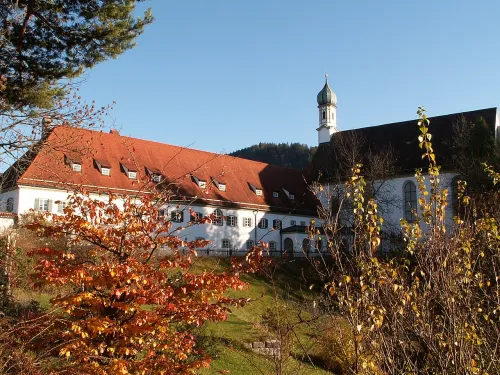
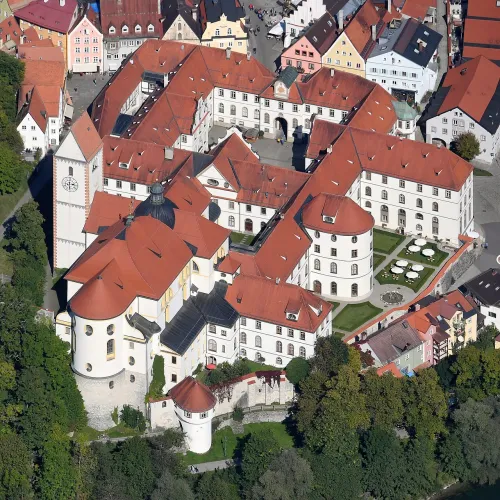
    Right below the castle spreads the huge Baroque complex of Kloster St. Mang. It was built between 1696 and 1726, commissioned by Abbot Gerhard Oberleitner in the confident spirit of the Counter-Reformation, and together with the Hohes Schloss it still defines the look of Füssen.

    The abbey traces itself to a hermit. Magnus, remembered here as Saint Mang, came from the Abbey of St. Gall with his Benedictine brother Theodor. The two built a cell and an oratory on this spot, and Magnus died here on 6 September, though nobody recorded the year. His body was later found uncorrupted, amid reports of miracles, and the veneration of Saint Mang became the spiritual foundation of the Benedictine abbey that the prince-bishops of Augsburg set up as their own house.

    Faith was not the only motive. The abbey sat on the important medieval road from Augsburg across the Alps to Upper Italy, right at the Füssen Gap, where the Lech breaks out of the mountains. That made it valuable to bishops and emperors alike. Through the Middle Ages the monks kept returning to reform movements to live closer to the Rule of Saint Benedict, and each reform tended to bring more monks, more money, more building and more art. The abbey was dissolved in the secularisation of Bavaria after the Napoleonic era.

    The church is free and open daily during the day, so look in even if you are short of time. The abbey museum charges admission and suits travellers who like religious art and want the inside story of the house. From the abbey it is 220 m, about 3 minutes, to the Reichenstrasse.

    Hours
    Church: open daily during daytime; Museum: Tue–Sun 10:00–17:00 (until Nov 8), Fri–Sun 13:30–16:00 (from Nov 13); Mon closed
    Price
    Church free; Museum 6 EUR adults (5 EUR reduced, free under 18)
  3. 3

    Reichenstrasse

    Reichenstrasse in Füssen, stop 3 on the self-guided walking tour

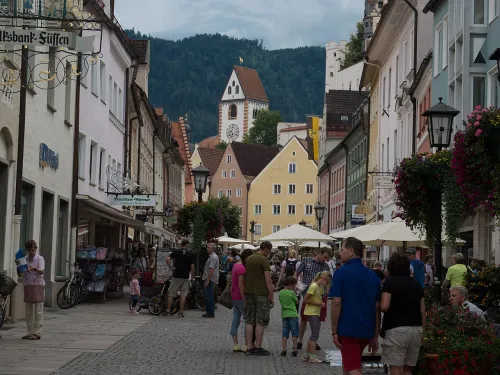
    Now you walk on Roman ground. The Reichenstrasse, the historic main street of the old town and today a pedestrian zone, runs dead straight for about 245 m on the line of the Via Claudia Augusta. Notice that it is the only straight street in the old town: the Romans built straight, while the other lanes bend, which breaks the wind.

    Watch the name as well. In the 14th century people called it the street of the Empire, because it was part of an imperial road. By the 17th century at the latest it had become the rich lane, perhaps because its tall, handsome houses suggested a new meaning. As the main road over the Fernpass, it carried the trade that fed the town.

    Some of its landmarks have vanished. At the start of the street, jutting into today's square opposite the town fountain, the late Gothic old town hall stood until the years 1837 to 1839. At the corner of Schrannengasse, where number 30 stands now, the salt office with its salt barn survived until the end of the 19th century. The northern end was closed from the 14th century by the Augsburger Tor, also called the Kuglertor, part of the town fortifications, until it was torn down in 1864.

    Stroll the whole length; it costs nothing and takes only a few minutes. Then head on 490 m, about 7 minutes, to the Franziskanerkloster, passing the Markthalle Füssen on the way.

    Hours
    Open 24/7
    Price
    Free
  4. 4

    Franziskanerkloster

    Franziskanerkloster in Füssen, stop 4 on the self-guided walking tour

    On a rise at the eastern edge of town stands the Franziskanerkloster with its church of St. Stephan. This church is older than it looks: it served as the parish church of Füssen until 1206, when the parish rights passed to St. Mang. The building you see today was rebuilt between 1763 and 1767.

    The friars arrived in 1628. Prince-Bishop Heinrich von Knoeringen and Abbot Martin of St. Mang invited them after the Jesuits had left Füssen for Kaufbeuren, and the first Franciscans came over from Reutte in Tyrol. They built their convent in 1629, only to see it damaged in 1632 when Swedish troops marched through. They also preached at the parish mass in St. Mang until 1802, and townspeople loved the masses here at St. Stephan, partly because the friars already sang in German.

    The friars were practical too: they added a brewhouse in 1662, a distillery in 1695 and a second wing from 1712. After 1803 the convent passed first to the Teutonic Order and in 1805 to the state, which turned it into a house meant to die out, forbidden to take new members or to beg for food. It survived, and the convent is still active today.

    The church is free and open daily during the day; the convent itself is not open to visitors, so enjoy it from outside. Then comes the longest leg of the walk: 1640 m, about 22 minutes, out to the Baumkronenpfad Ziegelwies.

    Hours
    Church: open daily during daytime; Convent interior: not open to general public (exterior only)
    Price
    Free (church open for prayer/visiting; convent active)
  5. 5

    Baumkronenpfad Ziegelwies

    Baumkronenpfad Ziegelwies in Füssen, stop 5 on the self-guided walking tour

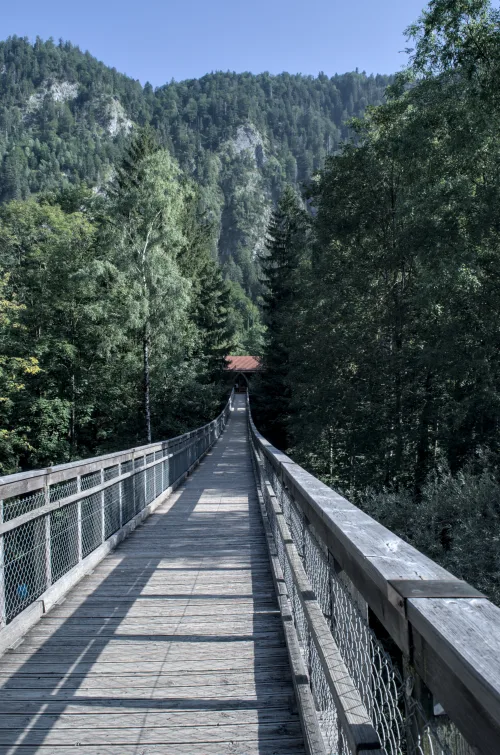
    The long walk pays off here. At the forest experience centre of Ziegelwies, the Baumkronenpfad lifts you into the forest canopy on a purpose-built walkway, a complete change of scene after castle, abbey and friary. It has the cheapest adult ticket on the whole walk, which makes it an easy yes for families.

    Weather decides this stop more than any other: the walkway closes in heavy rain, gales, storms or lightning, so check the sky before you set out from the old town, and make sure it is open before walking out this far.

    From the treetops it is 550 m, about 8 minutes, to the last stop, the Lechfall.

    Hours
    May 1 – Oct 15: daily 09:00–19:30; Oct 16 – Nov 25: daily 10:00–16:30; March: daily 10:00–16:00; Easter holidays: daily 09:00–18:00; April: daily 10:00–16:30; Winter: on request
    Price
    5.00 EUR adults (from 16 years), 4.00 EUR group (10+), free under 16 / disabled
  6. 6

    Lechfall

    Lechfall in Füssen, stop 6 on the self-guided walking tour

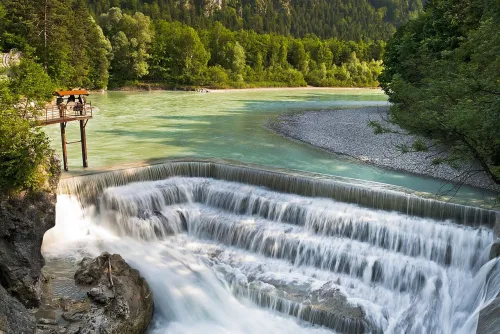
    Here the Lech leaves the Northern Limestone Alps and drops over the full width of a weir almost 8 m high into a short gorge. What you see is technically a dam: it was built between 1784 and 1787 together with a diversion tunnel to harness water power, and even then it was advertised as a new waterfall, more impressive than the natural cataract it replaced. Today minimum water volumes are fixed so the fall never runs dry, and in both flow and height it clearly beats the Alzfall near Altenmarkt, the natural waterfall with the most water in Germany.

    Look down into the gorge itself. It is about 150 m long and well over 20 m deep, cut through a rock barrier of massive reef limestone. It began forming at the end of the last ice age, about 12,000 years ago, when meltwater from the Lech glacier formed a large lake reaching as far as today's Pfronten, and the Lech, draining it, gradually sawed its way through the rock. The site is a designated geotope and listed among the 100 most beautiful geotopes in Bavaria.

    Cross the König-Max-Steg, the footbridge over the fall built in 1895, and look for the bust of King Maximilian II in a niche above the gorge. On the eastern side, find the Magnustritt: legend says Saint Mang leapt across the Lech here while fleeing his pagan pursuers, and folk belief read a mark in the rock as his footprint. Some even think the town takes its name from this gorge, from the Latin fauces, meaning throat or narrow passage, though that is disputed.

    The waterfall is free and always open, so it makes an unhurried finale. When you are ready, the GPS navigation can lead you back to the castle where you began, closing the story of saint, abbey and town where it started.

    Hours
    Open 24/7
    Price
    Free
Walking tour route map of Füssen Route loaded
Hohes SchlossKloster St. MangReichenstrasseFranziskanerkloster+2
All 6 stops are already on the map.
You just press start.
AI Tour Guide

You just read the route. Now walk it from the castle gate with a guide in your ear.

Press start wherever you are, even hundreds of kilometres from Füssen, and the guide begins telling its stories right away. In the city, pick any of the 6 stops to start from: it leads you there, then talks with you the whole route, asking, listening, remembering, and shaping the tour around your answers.

6stops 3.1km 42 minwalking 13languages
▶Start the tour free

Free to start · Runs in your browser · No app, no download

Shorter Ways to Walk Füssen

The route splits naturally into a compact old town core and a river section reached by one long walk. Pick the part that fits your time and interests.

Old town core

Stops: 1, 2, 3, 4

For a morning in the old town: castle, abbey, the Roman street and the friary church. Just 900 m and 13 minutes of walking. Admission only if you go into the castle and the abbey museum; around two and a half hours with both, under an hour from the outside.

Treetops and the gorge

Stops: 5, 6

For nature lovers who have already seen the old town: begin at the canopy walkway and finish at the waterfall. 550 m, 8 minutes of walking, about an hour and a quarter in total. Only the treetop path charges admission.

The whole walk without tickets

Stops: 1, 2, 3, 4, 5, 6

For a tight budget: all six stops, 42 minutes of walking, about two and a half hours. You see the castle and the treetop path from outside, step into the abbey church and the friary church for free, and the Lechfall costs nothing.

How Long Does This Füssen Tour Take with Castle, Abbey and Treetops?

The order follows the town's history downhill: first the castle that ruled Füssen, then the abbey beneath it, then the trade street that made both rich, and finally the river that gave the place its strategic value. The first three legs are short; the one long stretch, 22 minutes, carries you out of the old town toward the Lech.

Pure walking takes 42 minutes. With the castle, the abbey museum and the treetop path inside, plan on about four hours; walking the whole route and only entering the free churches takes about two and a half.

Before You Set Off in Füssen

  • Start and finish: Begin at the Hohes Schloss for the recommended order, though you can join at any stop. The walk ends at the Lechfall, and the GPS navigation in your browser can lead you back to the castle if you like.
  • Best day and time: Pick a day when both the castle and the abbey museum are open, since neither opens every day and both keep shorter hours in late autumn and winter. A morning start with the castle first works well.
  • Costs: The route itself is free. The Hohes Schloss, the abbey museum and the Baumkronenpfad charge admission, and the castle and the museum offer reduced tickets. The abbey church, the friary church, the Reichenstrasse and the Lechfall are free.
Walking tour route map of Füssen
AI Tour Guide

Your guide is ready at the castle whenever you are.

Press start and a voice AI Tour Guide takes it from here: leading the route through Füssen, telling the stories, and turning your walk into a real back-and-forth conversation. No app or download is needed; it runs in your browser.

6stops 3.1km 42 minwalking 13languages
▶Start the tour free

Free to start · Runs in your browser · No app, no download

What the AI Tour Guide Adds Between Castle and Gorge

On this walk the AI Tour Guide greets you at the castle and talks you through bishops, monks and river as you go, asks what you care about and leans the conversation that way, whether that is Roman roads, Baroque art or the geology of the gorge. You can interrupt at any time, for instance to ask what life inside a working friary looks like today or how the Via Claudia continued into the Alps. You start with 100 free credits; after that you choose between this tour all-inclusive for €19.99 with no time limit, or €5 per hour.

A Real Conversation A voice AI Tour Guide greets you, leads the whole route, and tells the stories and facts as you walk, asking what you want to see and keeping a real conversation going. Not a recording you press play on.
Map Navigation Follow the route on the map and walk at your own pace. You choose where to start and when to move to the next stop.
Ask Anything Curious about a building you pass? Ask your AI Tour Guide on the spot and the conversation carries on.
13 Languages Switch language anytime. No separate tour needed.
Start free in your browser

Common Questions about Walking Füssen

If I only have time for one paid visit in Füssen, which should it be?

For history, the Hohes Schloss: it is the building the whole town grew around, and the visit fits a morning. If you are travelling with children or want a break from old walls, the Baumkronenpfad is the cheaper and more playful choice.

Do children pay admission on this walk?

Children and teenagers go free at the Hohes Schloss, the abbey museum and the Baumkronenpfad, and groups pay a reduced rate on the treetop path.

How do I get back from the Lechfall to the old town?

The walk ends at the waterfall, and the GPS navigation in your browser leads you back to the starting point at the castle on request.

Which towns make a good second day from Füssen?

Innsbruck is 62 km away across the border. Augsburg, 90 km away, was the seat of the bishops who built the castle and founded the abbey, and Munich is 91 km away.

Is the tour really free?

Yes. The whole tour is free: the route, the interactive map and the navigation cost you nothing. Only the voice AI Tour Guide is optional and paid: you test it with 100 free credits, then you pay either €5 per hour or €19.99 for this whole tour, with no time limit. Admission to 2 of the 6 stops is not included: Hohes Schloss and Baumkronenpfad Ziegelwies charge their own entry fees.

Do I need to download an app?

No. Everything runs in your phone browser. Open the route and start walking, no download and no sign-up required.

Do I need to book the walking tour in advance?

No booking needed. This self-guided tour is available anytime. Open the route in your browser and start walking. The AI Tour Guide works instantly, no app, no reservation required.

What languages is the AI Tour Guide available in?

The AI Tour Guide speaks 13 languages, so you take the tour in your own language and can switch at any time.

Can I skip stops or change the route?

Yes. Skip any stop, spend extra time at places you like, or start the route from any point. It is your walk, you set the pace.
Image credits
▶ Start free in your browser Runs in your browser, no app, no download