Free Walking Tour Augsburg: 13 Stops via the Fuggerei

In the Fuggerei, founded in 1521, 150 people still pay 0.88 euros rent a year. The 4.7 km walk adds a thousand-year-old cathedral, Renaissance fountains and a marionette theatre.

13 Stops 4.7 km ~1 h 4 min walking
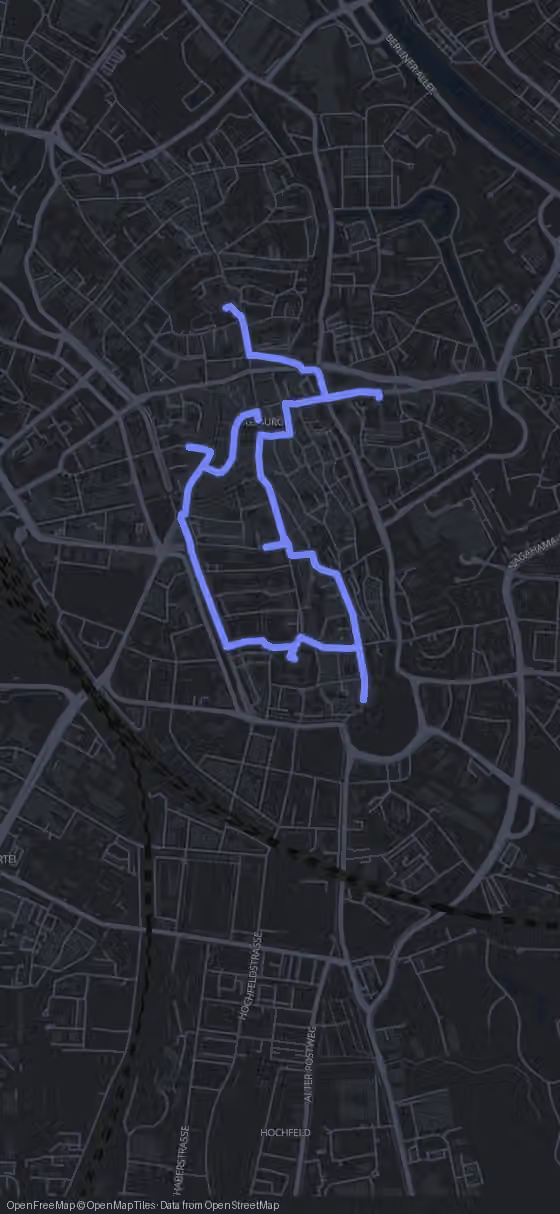
Route map for the Augsburg walking tour
Stop 1 of 13
760 m·10 min
Augsburger Dom
Head south-east toward the Fuggerei
Grüß Gott, welcome to Augsburg. I'm Alex, and here a promise made five centuries ago still sets the rent.
Try this tour with Alex

13 Stops from the Cathedral to the Perlachturm

The route links 13 stops from the Augsburger Dom via the Fuggerei and the Maximilianstraße to the Perlachturm. It is 4.7 km with 1 h 4 min of pure walking; with interiors and lunch plan most of a day, without the museums about three hours.

The Augsburger Dom, St. Ulrich und Afra, the St. Anna-Kirche, the Stadtmarkt and the two fountains are free. The Fuggerei, the Golden Hall in the Augsburger Rathaus, the Augsburger Puppenkiste and two museums charge entry; the Perlachturm is closed. The route, map and GPS navigation are free; the AI Tour Guide is an optional extra.

Open free GPS & optional AI Tour Guide
This short shows highlights of the route. All 13 stops follow below.

The Route

Walking Map of Augsburg: Cathedral, Fuggerei and Rathausplatz

13 stops 4.7 km 1 h 4 min walking
Tap to load interactive map

The 13 stops along this route

  1. Augsburger Dom, stop 1 on the self-guided walking tour
    1Augsburger Dom
  2. Fuggerei in Augsburg, stop 2 on the self-guided walking tour
    2Fuggerei
  3. Augsburger Rathaus, stop 3 on the self-guided walking tour
    3Augsburger Rathaus
  4. Schaezlerpalais in Augsburg, stop 4 on the self-guided walking tour
    4Schaezlerpalais
  5. Maximilianstraße in Augsburg, stop 5 on the self-guided walking tour
    5Maximilianstraße
  6. Herkulesbrunnen in Augsburg, stop 6 on the self-guided walking tour
    6Herkulesbrunnen
  7. Augsburger Puppenkiste, stop 7 on the self-guided walking tour
    7Augsburger Puppenkiste
  8. St. Ulrich und Afra in Augsburg, stop 8 on the self-guided walking tour
    8St. Ulrich und Afra
  9. Stadtmarkt in Augsburg, stop 9 on the self-guided walking tour
    9Stadtmarkt
  10. St. Anna-Kirche in Augsburg, stop 10 on the self-guided walking tour
    10St. Anna-Kirche
  11. Maximilianmuseum in Augsburg, stop 11 on the self-guided walking tour
    11Maximilianmuseum
  12. Augustusbrunnen in Augsburg, stop 12 on the self-guided walking tour
    12Augustusbrunnen
  13. Perlachturm in Augsburg, stop 13 on the self-guided walking tour
    13Perlachturm
  14. That's the full route.

    Walk it with an AI Tour Guide talking you through every one of these streets.

    Start free in your browser
    You made it

The Augsburg Walking Tour, Stop by Stop

  1. 1

    Augsburger Dom

    Augsburger Dom, stop 1 on the self-guided walking tour

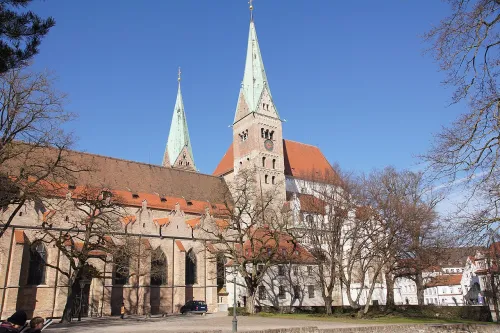
    The cathedral is where Augsburg's story begins. Its origins go back to the 8th century, and the church you see today was built from 995 onwards, which makes it the only surviving Ottonian bishop's church in Germany and one of the oldest cathedrals north of the Alps. Look at how the building changes along its length: the Romanesque nave got a Gothic high choir in the 14th century, so two eras meet under one roof.

    In 1690 the cathedral served as a coronation church, when Joseph I was crowned Roman-German king and Eleonore Magdalene empress. Going inside is free and well worth 20 minutes, though you should keep quiet and stay back during services.

    From here it is 760 m and about 10 minutes to the Fuggerei.
    Hours
    Daily 07:00–18:00 (outside church services)
    Price
    Free
  2. 2

    Fuggerei

    Fuggerei in Augsburg, stop 2 on the self-guided walking tour

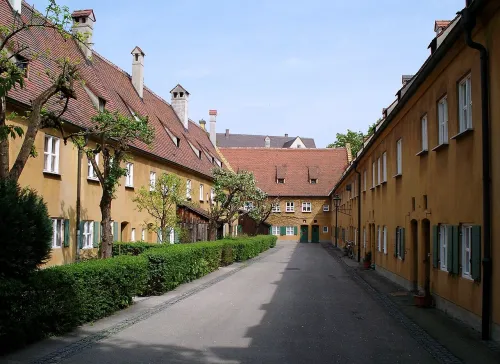
    Behind the gate lies one of the oldest social housing estates in the world that is still in use. Jakob Fugger, known as "the Rich", founded it in 1521, and today 150 Catholic Augsburg residents in need live in its 140 apartments spread over 67 houses. Their annual rent, before utilities, is 0.88 euros. In return they say three prayers a day for the founder and his family: an Our Father, a Creed and a Hail Mary.

    The settlement is still funded from Jakob Fugger's foundation, overseen by the Fugger family. That is what makes a visit so striking: you are not walking through a museum but a neighbourhood people actually live in, so keep your voice down by the front doors.

    This is the paid stop that most deserves your money, and there is a family ticket if you come with children. Allow 45 minutes, then walk 520 m, about 8 minutes, to the town hall.

    Hours
    Daily 09:00–20:00 (April–September), Daily 09:00–18:00 (October–March)
    Price
    8 EUR full, 7 EUR reduced, 4 EUR children 8-17, under 8 free, 18 EUR family
  3. 3

    Augsburger Rathaus

    Augsburger Rathaus, stop 3 on the self-guided walking tour

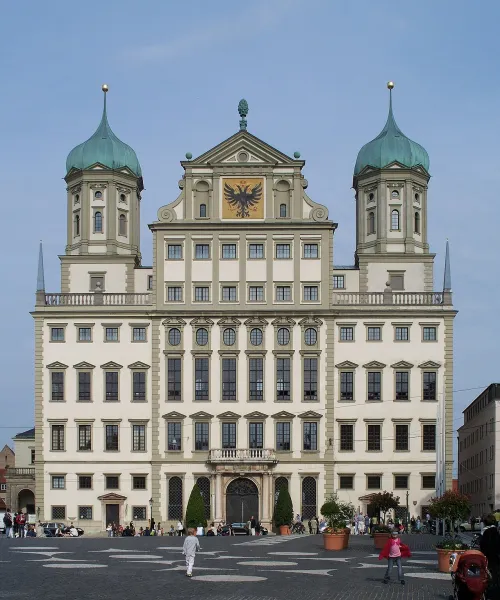
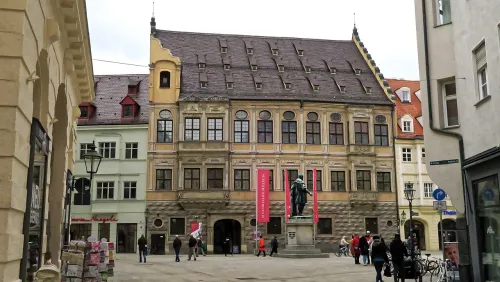
    The town hall fills the east side of the Rathausplatz. It was built between 1615 and 1624, rises 57 metres and counts as one of the most important secular Renaissance buildings north of the Alps. Together with the Perlachturm beside it, it is the symbol of the city, and its historic importance places it under the protection of the Hague Convention for cultural property in armed conflict.

    Inside, the Golden Hall and the Prince's Chamber cost very little, with reductions for pupils and students, which makes this the easiest yes on the route. The Augustusbrunnen on the same square is part of the finale, so save it for the end.

    Walk 480 m, about 7 minutes, to the Schaezlerpalais. On the way you pass the Merkurbrunnen, the third of Augsburg's three grand fountains.

    Hours
    Daily 10:00–18:00 (ticket desk closes 17:30)
    Price
    2.50 EUR (Golden Hall and Prince's Chamber); pupils from age 10 and students 1 EUR
  4. 4

    Schaezlerpalais

    Schaezlerpalais in Augsburg, stop 4 on the self-guided walking tour

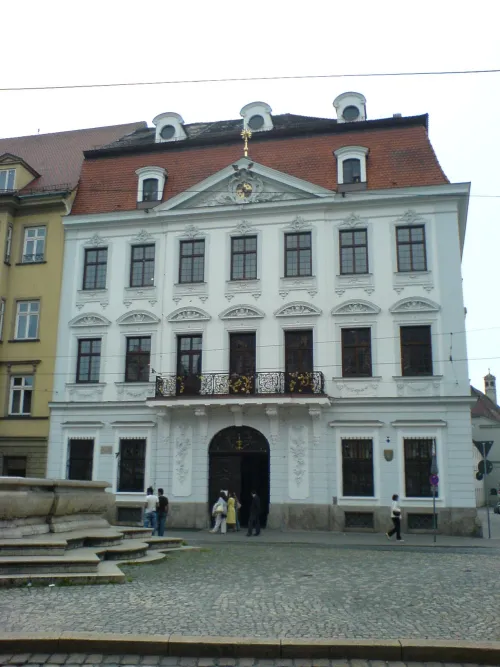
    From the street the palace looks modest: its front on the Maximilianstraße is only 19 metres wide. Walk along the Katharinengasse side, though, and the façade runs on for 107 metres. It was the town palace of the banker Benedikt Adam Freiherr von Liebert, and today it houses the city's and the state's art collections.

    It charges entry, but if you enjoy paintings and grand interiors and have an hour to give it, come in.

    The Maximilianstraße is just 80 m away, a minute's walk.

    Hours
    Tue–Sun 10:00–17:00, Mon closed
    Price
    7 EUR full, 5.50 EUR reduced (under 27 free, free admission on Sundays)
  5. 5

    Maximilianstraße

    Maximilianstraße in Augsburg, stop 5 on the self-guided walking tour

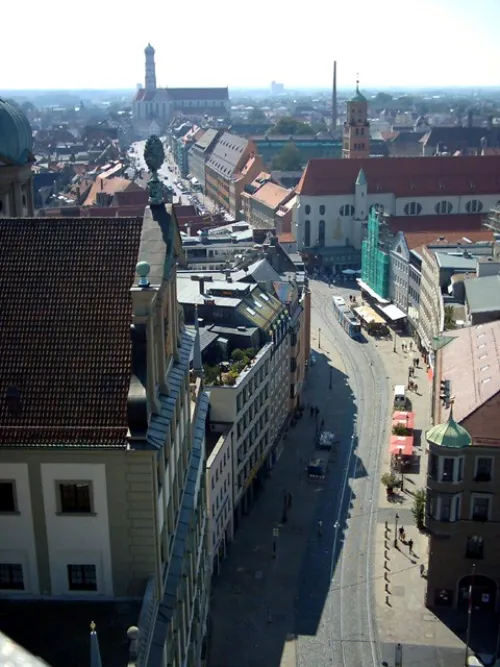
    Locals often just call it the Maxstraße, and it used to be the Weinmarkt, the wine market. It is one of the most important streets in Germany for architectural history, with Gothic, Renaissance, Rococo, Neoclassical and postwar buildings side by side.

    Its unusual width is no accident: the street was created in 1809 by demolishing buildings to make room for a broad, representative avenue. Walk it slowly and look up at the façades, then continue 50 m to the fountain.

    Hours
    Open 24 hours
    Price
    Free
  6. 6

    Herkulesbrunnen

    Herkulesbrunnen in Augsburg, stop 6 on the self-guided walking tour

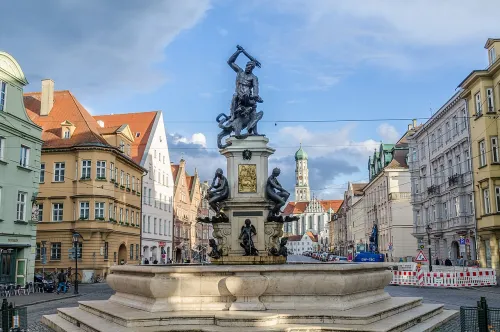
    Hercules, the Greek demigod, stands at the top of this Renaissance fountain, created by Adriaen de Vries between 1596 and 1600. It is one of Augsburg's three grand fountains, together with the Augustusbrunnen and the Merkurbrunnen you passed earlier.

    On 6 July 2019 the fountain was added to the UNESCO World Heritage List as part of the Augsburg Water Management System. Take a few minutes to walk around it, then head 680 m, about 9 minutes, to the Puppenkiste.

    Hours
    Open 24 hours
    Price
    Free
  7. 7

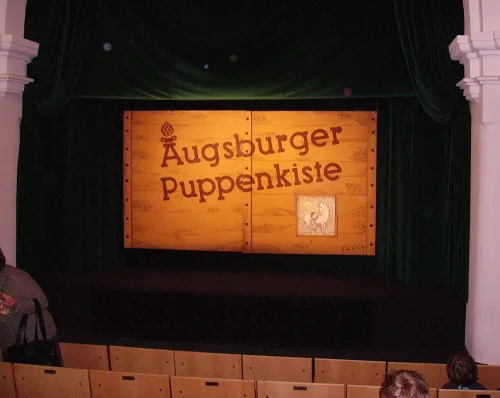
    Augsburger Puppenkiste

    Augsburger Puppenkiste, stop 7 on the self-guided walking tour

    This marionette theatre is housed in the historic Heilig-Geist-Spital and has been staging fairy tales and serious plays since 1948. Its television productions, including the stories of Jim Knopf and Urmel, made it known across Germany from 1953 onwards, and it is one of the best-known stages in the country.

    It is a must with children and a treat for anyone who grew up with German television. Tickets are paid, with family tickets and reductions available.

    From here it is 500 m, about 7 minutes, to St. Ulrich und Afra.

    Hours
    Wed–Sun 12:00–18:00, Mon–Tue closed
    Price
    6 EUR adults, 3.80 EUR children 4-14, 14.80 EUR family, 5 EUR students (Wed-Thu) and disabled
  8. 8

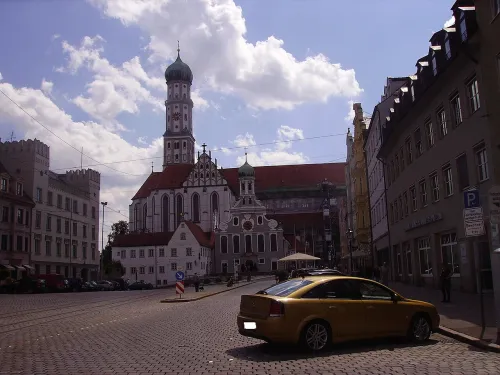
    St. Ulrich und Afra

    St. Ulrich und Afra in Augsburg, stop 8 on the self-guided walking tour

    The onion-domed tower of this basilica dominates the south of the city, and it served as the model for many Baroque church towers across Bavaria. The church grew from the Roman tomb of Saint Afra, martyred in 304, and the building is a fine example of German Gothic. Inside are three enormous Renaissance altars, each regarded as a masterpiece of German sculpture of its time.

    The history is crowded: it became an imperial abbey in 1577, Mozart gave an organ concert here on 18 October 1777, Pope Pius VI celebrated Mass on 4 May 1782, and Pope John Paul II visited on 4 May 1987. After secularisation in 1802 it passed to the Bavarian state, became a parish church in 1810 and a minor basilica in 1937.

    Entry is free, so 20 minutes inside for the altars is time well spent. The next leg is the longest of the walk: 1,120 m, about 15 minutes, north to the Stadtmarkt.

    Hours
    Daily 07:30–18:30
    Price
    Free
  9. 9

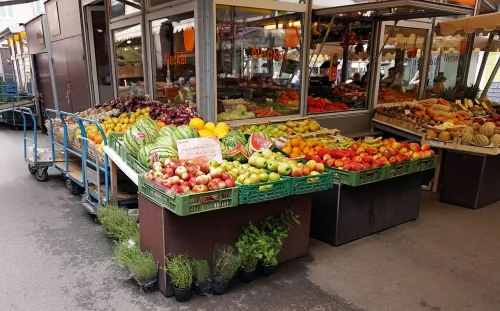
    Stadtmarkt

    Stadtmarkt in Augsburg, stop 9 on the self-guided walking tour

    After the longest walk you arrive at the right place: Augsburg's food market, which is a sight in its own right. It covers more than 10,000 square metres with two large market halls, fixed stalls in the eastern part and a farmers' market in the west, where producers from the surrounding area sell from mobile stands.

    There are 104 businesses in total. Some traders run their stall as a branch of a shop elsewhere, so not every stall is open on every market day. This is the natural lunch break of the route.

    St. Anna borders the market to the south, just 130 m and 2 minutes away.

    Hours
    Mon–Fri 07:00–18:00; Sat 07:00–17:00; Sun/public holidays closed (2026 pilot hours)
    Price
    Free
  10. 10

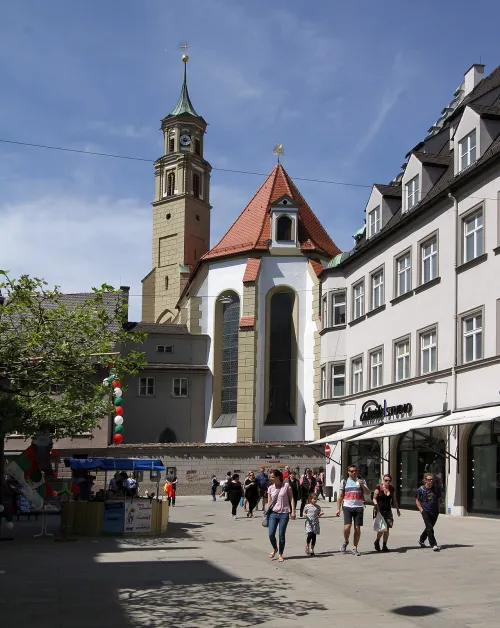
    St. Anna-Kirche

    St. Anna-Kirche in Augsburg, stop 10 on the self-guided walking tour

    Carmelite monks built this church in 1321, and its architecture spans everything from Gothic to Neoclassical. The part not to miss is the west choir: the Fugger chapel, added in the early 16th century, one of the earliest Renaissance buildings north of the Alps and home to the church's main organ.

    Here the Fugger story from the Fuggerei comes full circle. When the church became Protestant in 1548, the Fugger chapel stayed Catholic, and the grille once planned to separate the two was never built. Entry is free.

    The Maximilianmuseum is only 120 m away, about 2 minutes.

    Hours
    Mon 12:00–18:00, Tue–Sat 10:00–18:00, Sun 10:00–12:30 and 15:00–17:00
    Price
    Free
  11. 11

    Maximilianmuseum

    Maximilianmuseum in Augsburg, stop 11 on the self-guided walking tour

    Augsburg's oldest museum sits in a 15th-century patrician house at Fuggerplatz 1 and opened in 1854. Its art collection and its exhibits on the history of the Free Imperial City, from the Middle Ages to its absorption into Bavaria in 1805, earned it the Bavarian Museum Prize in 2007. Until the Second World War it was the only municipal museum in Augsburg.

    If you want to understand how this city became so rich and powerful, this is the museum to choose; it charges entry, and you should give it an hour.

    Walk 250 m, about 3 minutes, back to the town hall square.

    Hours
    Tue–Sun 10:00–17:00, Mon closed
    Price
    7 EUR full, 5.50 EUR reduced (under 27 free, free admission on Sundays)
  12. 12

    Augustusbrunnen

    Augustusbrunnen in Augsburg, stop 12 on the self-guided walking tour

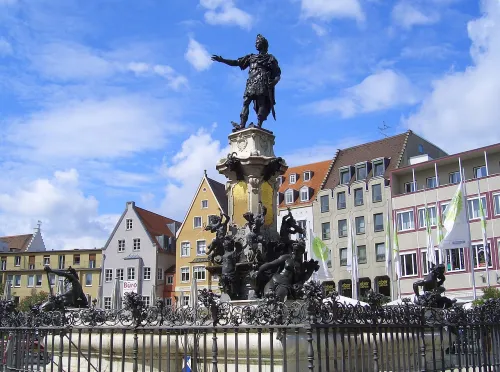
    Back on the Rathausplatz, the Roman emperor Augustus stands above the third of the grand fountains on this walk, honoured here as the founder of the city. Hubert Gerhard created it in the Renaissance style between 1589 and 1594, and like the Herkulesbrunnen it is part of the UNESCO-listed water management system.

    With the town hall facing you, this is a good spot to look back over the day. The Perlachturm is just 20 m away.

    Hours
    Open 24 hours
    Price
    Free
  13. 13

    Perlachturm

    Perlachturm in Augsburg, stop 13 on the self-guided walking tour

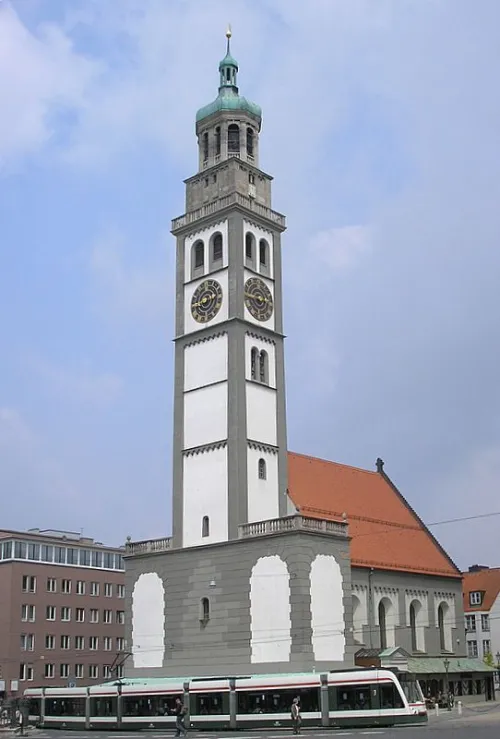
    The 70-metre tower beside the town hall began as a watchtower in the 10th century. Together with the Rathaus it forms the city's best-known landmark, and it normally serves as a viewing tower.

    The tower is currently closed, so enjoy it from the square, where you see it side by side with the town hall façade. This is where the walk ends; if you want to return to the cathedral, the GPS navigation in your browser leads you back.

    Status
    Currently closed
Walking tour route map of Augsburg Route loaded
Augsburger DomFuggereiAugsburger RathausSchaezlerpalais+9
All 13 stops are already on the map.
You just press start.
AI Tour Guide

You know the route now. Walk Augsburg with a guide in your ear.

Press start wherever you are, even hundreds of kilometres from Augsburg, and the guide begins telling its stories right away. In the city, pick any of the 13 stops to start from: it leads you there, then talks with you the whole route, asking, listening, remembering, and shaping the tour around your answers.

13stops 4.7km 1 h 4 minwalking 13languages
▶Start the tour free

Free to start · Runs in your browser · No app, no download

Shorter Ways to Walk the Augsburg Route

Short on time? Each of these sections works on its own and keeps the walking short.

Cathedral, Fuggerei and town hall

Stops: 1, 2, 3

For first-timers with a morning to spare: the oldest church, the famous social settlement and the Renaissance town hall. 18 minutes of walking; entry for the Fuggerei and for the Golden Hall, the cathedral is free.

Maximilianstraße to St. Ulrich

Stops: 4, 5, 6, 7, 8

For art lovers and families: a palace full of paintings, the grand street with its fountain, the marionette theatre and the basilica at its southern end. 18 minutes of walking; entry for the Schaezlerpalais and the Puppenkiste, the rest is free.

Market, Fugger chapel and finale

Stops: 9, 10, 11, 12, 13

For a relaxed afternoon: lunch at the Stadtmarkt, the Fugger chapel in St. Anna, city history in the Maximilianmuseum and the town hall square. Only 8 minutes of walking; just the museum charges entry.

How Long This Augsburg Tour Takes, With and Without Museums

The pure walking time is 1 h 4 min over 4.7 km, and no leg is longer than the 15 minutes from St. Ulrich und Afra to the Stadtmarkt. What fills the day is the interiors. Start at the cathedral at 10:00, give it 20 minutes, the Fuggerei 45, the Golden Hall 25 and the Schaezlerpalais a full hour, and you reach the Puppenkiste a little after 13:00, when it is already open. With half an hour there and 20 minutes in the basilica, you sit down for lunch at the Stadtmarkt around 14:20. Allow 45 minutes to eat, a quarter of an hour in St. Anna and an hour in the Maximilianmuseum, and you stand under the Perlachturm around 16:30, about six and a half hours after you set off.

If you skip both museums and the Puppenkiste but keep the Fuggerei and the Golden Hall, the whole loop takes about three hours. The three shorter sections need 18, 18 and 8 minutes of walking, so each fits into a morning or an afternoon with time to go inside.

Before You Set Off in Augsburg

  • Start and finish: The recommended start is the Augsburger Dom, but you can join at any stop. The walk ends at the Perlachturm on the town hall square, and the GPS navigation in your browser can lead you back to the cathedral if you want.
  • Best day: Not every stop is open every day, so check the Schaezlerpalais, the Maximilianmuseum, the Puppenkiste and the Stadtmarkt before you settle on a date.
  • Costs: Going inside everywhere that charges entry adds up, so pick the interiors that interest you most. The Schaezlerpalais and the Maximilianmuseum are free at certain times, which makes the day noticeably cheaper.
Walking tour route map of Augsburg
AI Tour Guide

Your Augsburg guide is ready when you are

Press start and a voice AI Tour Guide takes it from here: leading the route through Augsburg, telling the stories, and turning your walk into a real back-and-forth conversation. No app or download is needed; it runs in your browser.

13stops 4.7km 1 h 4 minwalking 13languages
▶Start the tour free

Free to start · Runs in your browser · No app, no download

Walking Augsburg With the AI Tour Guide

Augsburg is a city of one family's money: the Fuggerei, the Fugger chapel in St. Anna and the merchant houses on the Maximilianstraße all tell parts of the same story. The AI Tour Guide leads you through it as a conversation, greets you at the cathedral, tells the stories of each place, asks what you care about and remembers it, so that if banking caught your interest at the Fuggerei, it picks that thread up again in St. Anna. Ask it how Jakob Fugger actually made his fortune, or interrupt whenever something catches your eye. It starts with 100 free credits; after that you choose between this tour all-inclusive for €19.99 with no time limit, or €5 per hour.

A Real Conversation A voice AI Tour Guide greets you, leads the whole route, and tells the stories and facts as you walk, asking what you want to see and keeping a real conversation going. Not a recording you press play on.
Map Navigation Follow the route on the map and walk at your own pace. You choose where to start and when to move to the next stop.
Ask Anything Curious about a building you pass? Ask your AI Tour Guide on the spot and the conversation carries on.
13 Languages Switch language anytime. No separate tour needed.
Start free in your browser

Common Questions About Walking Augsburg

Is Augsburg a good day trip from Munich?

Yes. Augsburg is 56 km from Munich, so the full route with lunch fits comfortably into a day. If you are travelling on, Nördlingen and Ulm are both within 70 km and have their own walking routes.

What can I do on this route if it rains?

Plenty of the walk is indoors: the cathedral, St. Ulrich und Afra and St. Anna, the two market halls of the Stadtmarkt, the Golden Hall, the Puppenkiste and the two museums. On a wet day, give the Schaezlerpalais and the Maximilianmuseum more time and keep the street and fountain stops short.

Is the route good for children?

Yes. The Puppenkiste is the highlight for kids, with marionettes from the Jim Knopf and Urmel productions, and both the Puppenkiste and the Fuggerei have family tickets. The Stadtmarkt is a good place for a snack break halfway.

If I can only go inside one place, which should it be?

The Fuggerei. It is still lived in, it explains why the Fugger name runs through the whole city, and nothing else on the route shows you everyday life behind the grand facades in the same way.

Is the tour really free?

Yes. The whole tour is free: the route, the interactive map and the navigation cost you nothing. Only the voice AI Tour Guide is optional and paid: you test it with 100 free credits, then you pay either €5 per hour or €19.99 for this whole tour, with no time limit. Admission to 4 of the 13 stops is not included: Fuggerei, Schaezlerpalais, Augsburger Puppenkiste and Maximilianmuseum charge their own entry fees.

Do I need to download an app?

No. Everything runs in your phone browser. Open the route and start walking, no download and no sign-up required.

Do I need to book the walking tour in advance?

No booking needed. This self-guided tour is available anytime. Open the route in your browser and start walking. The AI Tour Guide works instantly, no app, no reservation required.

What languages is the AI Tour Guide available in?

The AI Tour Guide speaks 13 languages, so you take the tour in your own language and can switch at any time.

Can I skip stops or change the route?

Yes. Skip any stop, spend extra time at places you like, or start the route from any point. It is your walk, you set the pace.
Image credits
▶ Start free in your browser Runs in your browser, no app, no download