Free Walking Tour Munich: Stachus to Sendlinger Tor

Twelve stops on 5.1 km: palace courtyards, river surfers, the Glockenspiel and a market lunch, all on one free route through Munich's old town.

12 Stops 5.1 km ~1 h 10 min walking
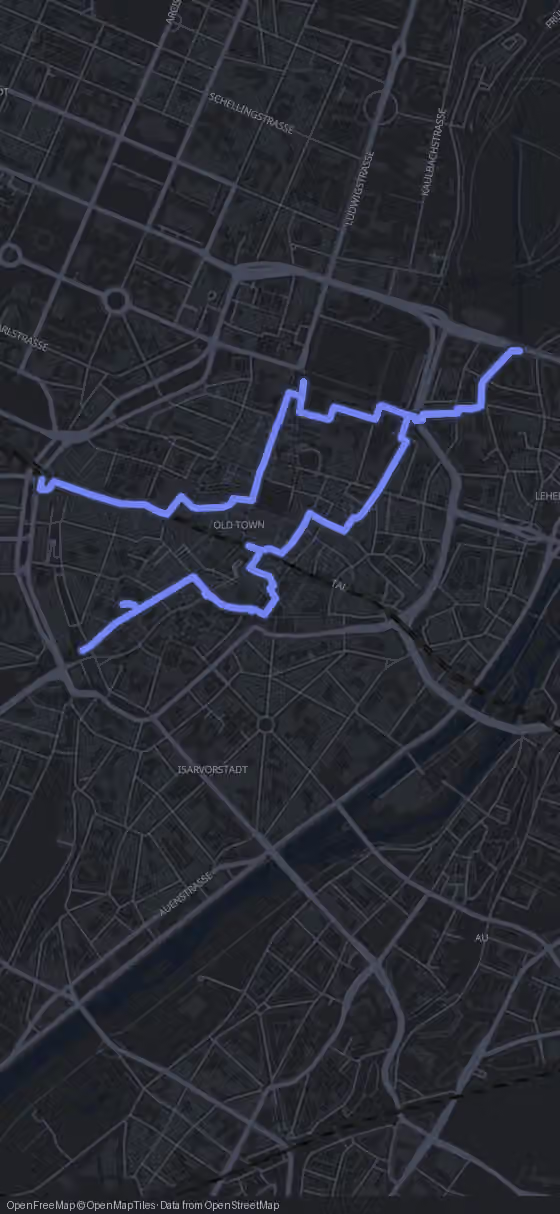
Route map for the Munich walking tour
Stop 1 of 12
700 m·9 min
Karlsplatz/Stachus
Head east toward the Frauenkirche
Grüß Gott, welcome to Munich. I'm Alex, and this city takes its traditions seriously, even when they get a little unusual.
Try this tour with Alex

What This Free Walk Through Munich Covers

Twelve stops lead you from Karlsplatz/Stachus to Sendlinger Tor: 5.1 km with 1 h 10 min of pure walking. With a church tower, the Glockenspiel and a market lunch, plan about five hours.

The squares, the Asamkirche and the nave of the Frauenkirche are free; you pay for the towers of the Frauenkirche and St. Peter's Church and for the museum of the Munich Residenz. The GPS route in your browser costs nothing, the AI Tour Guide is optional.

Open free GPS & optional AI Tour Guide
This short shows highlights of the route. All 12 stops follow below.

The Route

Walking Map of Munich from Stachus to Sendlinger Tor

12 stops 5.1 km 1 h 10 min walking
Tap to load interactive map

The 12 stops along this route

  1. Karlsplatz/Stachus in Munich, stop 1 on the self-guided walking tour
    1Karlsplatz/Stachus
  2. Frauenkirche in Munich, stop 2 on the self-guided walking tour
    2Frauenkirche
  3. Odeonsplatz in Munich, stop 3 on the self-guided walking tour
    3Odeonsplatz
  4. Munich Residenz, stop 4 on the self-guided walking tour
    4Munich Residenz
  5. Eisbachwelle in Munich, stop 5 on the self-guided walking tour
    5Eisbachwelle
  6. Hofbräuhaus in Munich, stop 6 on the self-guided walking tour
    6Hofbräuhaus
  7. Alter Hof in Munich, stop 7 on the self-guided walking tour
    7Alter Hof
  8. Marienplatz in Munich, stop 8 on the self-guided walking tour
    8Marienplatz
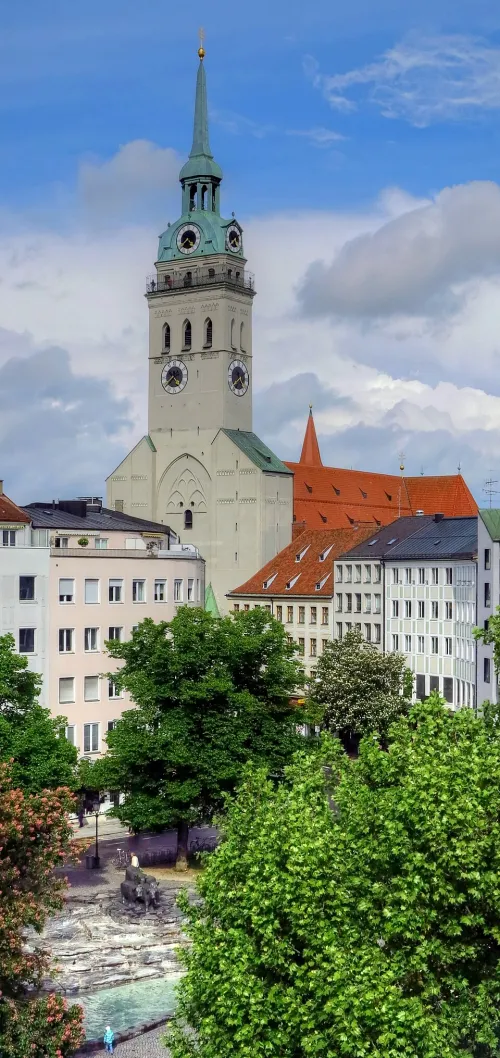
  9. St. Peter's Church in Munich, stop 9 on the self-guided walking tour
    9St. Peter's Church
  10. Viktualienmarkt in Munich, stop 10 on the self-guided walking tour
    10Viktualienmarkt
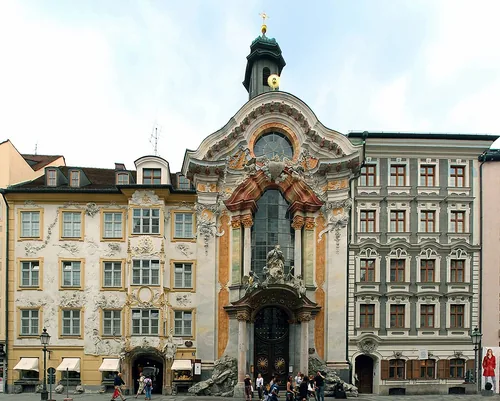
  11. Asamkirche in Munich, stop 11 on the self-guided walking tour
    11Asamkirche
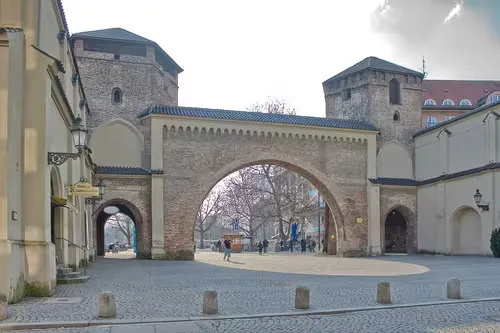
  12. Sendlinger Tor in Munich, stop 12 on the self-guided walking tour
    12Sendlinger Tor
  13. That's the full route.

    Walk it with an AI Tour Guide talking you through every one of these streets.

    Start free in your browser
    You made it

Your Munich Walking Tour Through Twelve Stops

  1. 1

    Karlsplatz/Stachus

    Karlsplatz/Stachus in Munich, stop 1 on the self-guided walking tour

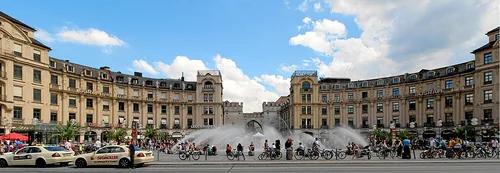
    You start on a square with two names. Officially it is Karlsplatz, but in Munich nearly everyone says Stachus, and the nickname is the older one. In the 18th century a house stood on the corner of Sonnenstraße and Bayerstraße, where the Kaufhof department store is today, and from 1710 the Föderl family poured beer there and in its garden. From 1728 the landlord was Mathias Eustachius Föderl, known as Eustach. His inn became the Stachus, the name outlived the family, and eventually it passed to the whole square.

    Look at the gate with its two flanking towers that closes the square. It is the 15th-century outer gate of the Neuhauser Tor, first recorded in 1302 when Munich built its second wall. The road through it was the medieval salt road, which Duke Henry the Lion had diverted from Föhring to Munich. The city owed its very existence and its wealth to that salt.

    The neo-Baroque crescent of buildings around you is the Stachus-Rondell, begun in 1899 to plans by Gabriel von Seidl and finished in 1901. When the lower levels were dug for the S-Bahn trunk line, workers found the foundations of a 15th-century round outwork in front of the gate. In 1791 Elector Karl Theodor gave Benjamin Thompson the authority to raze the later bastion here, and that was the beginning of Munich losing its walls. The square never got quiet again: in 2022 some 41,000 vehicles crossed it every day, so use the crossings.

    Walk through the gate into the old town; after 720 m, about 9 minutes, you stand in front of the Frauenkirche.
    Hours
    Open 24/7
    Price
    Free
  2. 2

    Frauenkirche

    Frauenkirche in Munich, stop 2 on the self-guided walking tour

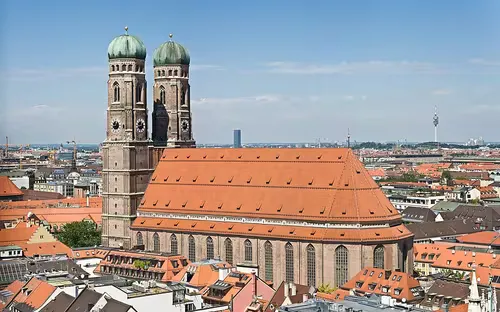
    The two towers with their rounded caps are Munich's emblem. Officially this is the Cathedral of Our Lady, seat of the Archbishop of Munich and Freising since 1821. Jörg von Halspach began the brick church in 1468, and it was consecrated in 1494: 109 m long, 40 m wide, with nave walls about 37 m high. It ranks among the two largest hall churches anywhere and the three largest brick churches north of the Alps.

    A popular story claims the towers differ by exactly one metre. They don't: the north tower measures 98.57 m, the south tower 98.45 m. Since nothing in the centre may rise above 100 m, they still stand out across the city.

    Go in; the nave is free. Pause first by the main portal: from there the rows of pillars look like walls filled with light, carrying the star vaults above. In a square floor slab near the entrance you'll find the Teufelstritt, the devil's footprint, tied to a legend about exactly this effect of the space. Further in stands the tomb of Emperor Louis the Bavarian by Hans Krumpper, one of the survivors of an interior that was once far richer.

    You can pay to climb the south tower for the view from up here, but most visitors will do better with the cheaper Alter Peter later on. Then walk 640 m, about 8 minutes, to Odeonsplatz; just before you reach it you pass the Feldherrnhalle.

    Hours
    Church daily 8:00–20:00; tower Mon–Sat 10:00–17:00, Sun/holiday 11:30–17:00 (last admission 16:30)
    Price
    Nave free; south tower 7.50 EUR (reduced/youth 7-16 years 5.50 EUR, under 6 free, family card 2+2 21 EUR)
  3. 3

    Odeonsplatz

    Odeonsplatz in Munich, stop 3 on the self-guided walking tour

    Here Munich turns grand. Leo von Klenze laid out the square in the early 19th century together with Ludwigstraße, which begins at its northern edge. The ideas go back to 1790, when the city walls came down: the Schwabinger Tor was to give way to a square that made a worthy start for the princes' road to Nymphenburg Palace, today's Brienner Straße.

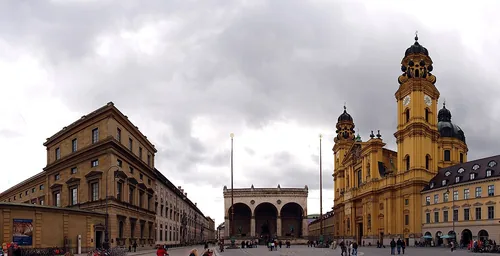
    The name comes from the Odeon, a former concert hall built in 1826, now the Bavarian Ministry of the Interior. Next to it stands its twin, the Palais Leuchtenberg, now the Ministry of Finance; both were modelled on the Palazzo Farnese in Rome. Opposite is Klenze's Bazaar Building with Café Tambosi, and a short street between the two palaces leads to the Palais Ludwig Ferdinand, Siemens' headquarters.

    The Feldherrnhalle, closing the forecourt of the Residenz in front of the Theatine Church, is a copy of the Loggia dei Lanzi in Florence. In 1923 Hitler's Beer Hall Putsch ended here: the march on the Feldherrnhalle was stopped in a deadly exchange of fire. Since 1972 the southern end of the square has belonged to the pedestrian zone, so you can stand in the middle and take it all in.

    The entrance to the Munich Residenz is just 190 m away, about 3 minutes.

    Hours
    Open 24/7
    Price
    Free
  4. 4

    Munich Residenz

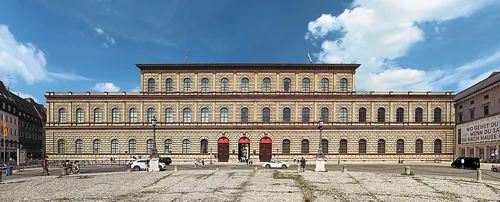
    Munich Residenz, stop 4 on the self-guided walking tour

    Behind these façades lies Germany's largest city palace, home of the Wittelsbach dukes, electors and kings of Bavaria. It has ten courtyards and 130 rooms on display. The Königsbau faces Max-Joseph-Platz, the Alte Residenz faces Residenzstraße, and the Festsaalbau faces the Hofgarten; one wing of it has held the Cuvilliés Theatre since the post-war rebuilding, and the Herkulessaal is the home stage of the Bavarian Radio Symphony Orchestra.

    It began as a punishment. In 1385 the townspeople had to pay for a new castle after a failed uprising against Duke Stephen III and his brothers. The dukes wanted distance from their rebellious citizens and protection from their warlike relatives, so the Neuveste, the new fortress, went up in the far northeastern corner of the walls, ringed by wide moats, with the Silver Tower as its strongest bastion facing the town. From there they could leave straight into open ground without crossing a single city lane.

    Is it worth going in? If you love palace interiors and royal treasure, yes: the museum and the treasury each charge admission, and a combo ticket for both, or one that also covers the Cuvilliés Theatre, saves money. If you only have time for the walk, stroll through the free Hofgarten instead.

    Next comes the longest stretch so far: 900 m, about 12 minutes, to the Eisbachwelle.

    Local name
    Residenz München
    Hours
    Summer (28 March – 19 October): daily 9:00–18:00 (last admission 17:00). Winter (20 October – 27 March): daily 10:00–17:00 (last admission 16:00). Closed 1.1, Shrove Tuesday, 24/25/31.12
    Price
    Residenz Museum 10 EUR (reduced 9 EUR); treasury 10 EUR (reduced 9 EUR); combo museum+treasury 15 EUR (reduced 13 EUR); Cuvilliés Theatre 5 EUR (reduced 4 EUR); total pass museum+treasury+theatre 20 EUR (reduced 16 EUR). Court garden free.
  5. 5

    Eisbachwelle

    Eisbachwelle in Munich, stop 5 on the self-guided walking tour

    Surfers in the middle of a city that is hundreds of kilometres from the sea: at the southern tip of the English Garden, 375 hectares of park, the Eisbach forms a man-made standing wave about one metre high. Surfers in wetsuits wait in line on the bank, drop in one after another and ride the same spot until they fall.

    River surfing here started in 1972, long before anyone allowed it; the city only made it official in 2010. Since then the wave has become a surf spot known around the world, ridden all year. Watching costs nothing, and a few minutes on the bank are among the most unexpected moments of the walk.

    From the wave it's 1020 m, about 14 minutes, back into the old town to the Hofbräuhaus.

    Price
    Free
  6. 6

    Hofbräuhaus

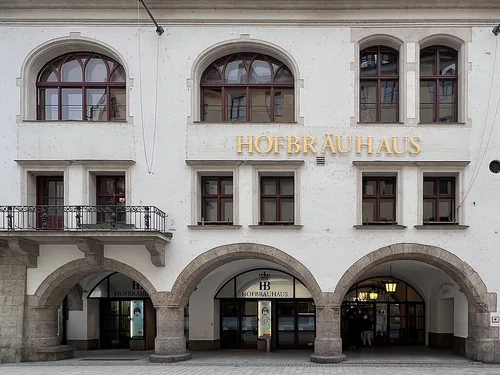
    Hofbräuhaus in Munich, stop 6 on the self-guided walking tour

    It all started with bad beer. Duke William V found Munich's brew so poor that he imported beer from Saxony, until his court found a better answer: its own brewery, founded in 1589. Ludwig I let the general public in from 1828. When the brewery moved to the suburbs, Max Littmann remodelled the building in 1897.

    Bombing in World War II destroyed every room except the historic beer hall, the Schwemme; by the city's 800th anniversary in 1958 the house had been faithfully rebuilt. Its darkest date is 24 February 1920, when Hitler spoke here at the founding of the Nazi Party.

    Step inside; entry is free. Look for the lockers where regulars keep their own stone mugs, listen to the brass band, and you may hear the Hofbräuhaus song from 1935: 'In München steht ein Hofbräuhaus, oans, zwoa, g'suffa!' The menu covers Brezn, Obatzda, Hax'n and Weisswurst, but prices are high, so a look and maybe one drink is enough.

    Only 170 m, about 3 minutes, separate you from the Alter Hof.

    Local name
    Hofbräuhaus am Platzl
    Hours
    Daily: 11:00–00:00
    Price
    Free (entry, food/drinks extra)
  7. 7

    Alter Hof

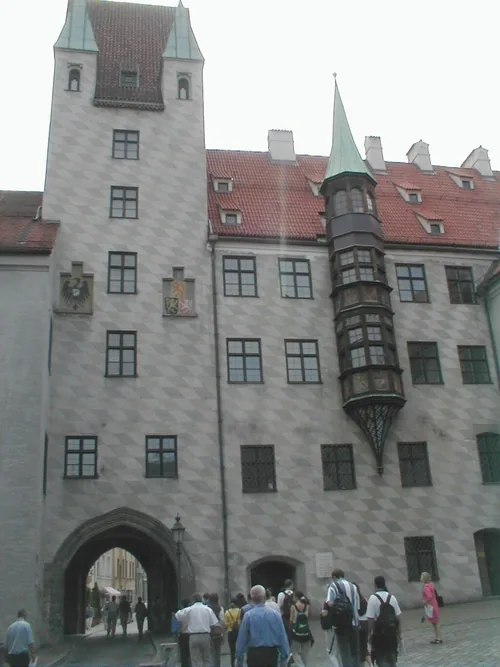
    Alter Hof in Munich, stop 7 on the self-guided walking tour

    This quiet courtyard is where Munich's royal story began. Excavations show a castle here as early as the 12th century. After Bavaria was first divided in 1255 it became the residence of Duke Louis II, and under his son Louis IV, the Holy Roman Emperor, it was the first permanent imperial residence of the Empire. The St. Lorenz Chapel on the north side once held the Wittelsbach regalia, until it was demolished in the 19th century.

    After several uprisings the dukes no longer felt safe in the middle of town and built the Neuveste, the fortress you saw as the Munich Residenz. Duke Sigismund still lived here in the late 15th century and had the courtyard painted with lozenge patterns; William IV finally moved the court for good in the first half of the 16th century. From then on the Alter Hof housed government offices. Look up at the Pfisterstock with its Renaissance gables from 1591, attributed to Wilhelm Egkl.

    Inside there is a free exhibition on the Munich imperial castle, worth fifteen minutes if you want to picture the medieval city. Then it's 280 m, about 4 minutes, to Marienplatz.

    Hours
    Mon–Sat 10:00–18:00; closed Sundays and public holidays
    Price
    Free (exhibition on the Munich Imperial Castle)
  8. 8

    Marienplatz

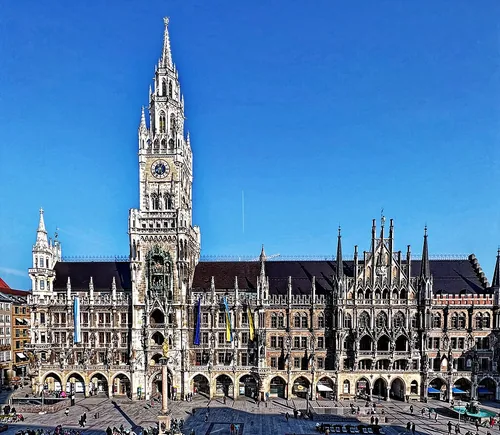
    Marienplatz in Munich, stop 8 on the self-guided walking tour

    Munich's main square since 1158. In the Middle Ages it hosted markets and tournaments and was simply called the market, later Schrannenplatz, the grain market square. When the grain trade moved to a new glass and iron hall in 1853, the square got its present name in 1854.

    The name comes from the Mariensäule in the centre. Elector Maximilian I had vowed to build it if Munich and Landshut were spared in the Thirty Years' War; it went up in 1638 to mark the end of Swedish occupation. The golden Virgin on a crescent moon, Patrona Bavariae, dates from 1590 and once stood in the Frauenkirche. Look at the four putti by Ferdinand Murmann on the corners of the pedestal. It was the first column of its kind north of the Alps.

    The New Town Hall fills the north side, the reconstructed Gothic Old Town Hall the east. The Glockenspiel in the New Town Hall's tower recalls the tournaments once held below and plays several times a day, including at noon. Keep your expectations modest; the window seats of Café Glockenspiel give you a calm view.

    St. Peter's Church is just 160 m away, 2 minutes.

    Hours
    Open 24/7
    Price
    Free
  9. 9

    St. Peter's Church

    St. Peter's Church in Munich, stop 9 on the self-guided walking tour

    St. Peter's is the oldest recorded parish church in Munich, and the city most likely grew from this spot. Its 91-metre tower is affectionately called Alter Peter, Old Peter, and is as much a symbol of Munich as the cathedral.

    The nave is free. The real reason to stop is the tower, which charges a modest fee with reductions for children. From the top you look down on Marienplatz and straight across at the New Town Hall and the two towers of the Frauenkirche, which is why it beats the cathedral tower for a city view.

    Back on the ground, the Viktualienmarkt is only 160 m, 2 minutes, away.

    Hours
    Summer (April–October) daily 9:00–19:30 (last admission 19:00); winter (November–March) Mon–Fri 9:00–18:30 (last admission 18:00), weekends/holidays 9:00–19:30 (last admission 19:00)
    Price
    Nave free; 'Alter Peter' tower 5 EUR (reduced students/seniors 65+/disabled 3 EUR, children 6-18 years 2 EUR, under 6 free, groups of 10+ 3 EUR/person)
  10. 10

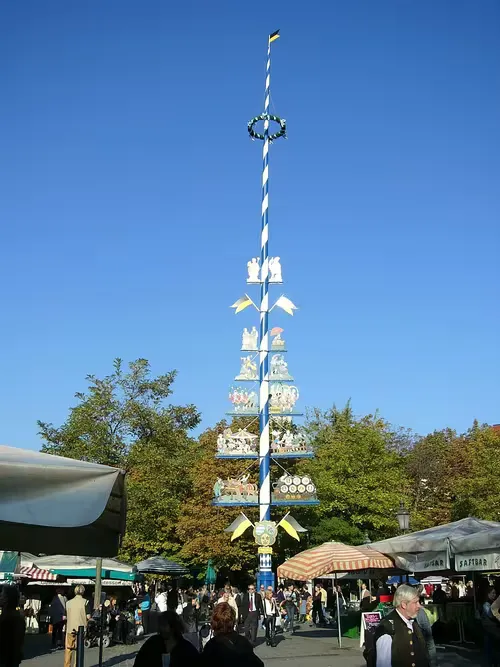
    Viktualienmarkt

    Viktualienmarkt in Munich, stop 10 on the self-guided walking tour

    When the grain market on today's Marienplatz grew too small, King Maximilian I ordered on 2 May 1807 that the green market move here. The city tore down buildings of the Heiliggeist hospice to make room, and the name came later: Viktualien is from the Latin for food. The market had to be enlarged significantly in the 1820s, the fish market moved to Westenriederstraße in 1855, and over time came a butchers' hall, bakery pavilions and a fish hall.

    World War II left the square badly damaged, and there was talk of closing the market for multi-storey buildings. Instead it became a market for gourmets: about 140 stalls and shops selling flowers, exotic fruit, game, cheese, spices, fish and juices.

    This is the natural lunch stop. Buy bread and cheese and take them to the beer garden in the middle of the market.

    From here it's 610 m, about 8 minutes, to the Asamkirche.

    Hours
    Mon–Sat 8:00–20:00 (individual stalls, especially Mondays, partially closed); Sundays closed
    Price
    Free entry (food and goods at the stalls are paid)
  11. 11

    Asamkirche

    Asamkirche in Munich, stop 11 on the self-guided walking tour

    From outside it looks like part of the street: the Baroque façade sits squeezed into the row of houses on Sendlinger Straße and curves gently outward. Its official name is St. Johann Nepomuk. Two brothers, the sculptor Egid Quirin Asam and the painter Cosmas Damian Asam, began it in 1733 and finished it in 1746 as their private church. Nobody commissioned it, so they could build exactly as they wanted; Egid Quirin could even see the altar through a window of his own house next door.

    Inside, the plot is just 22 by 8 m, and yet architecture, painting and sculpture merge into one space. The room grows lighter as your eye rises: the dark pews stand for the world's suffering, the white and blue middle zone was reserved for the emperor, and the hidden lit ceiling belongs to God and eternity. Look up at the fresco of the life of St. Nepomuk, a masterpiece by Cosmas Damian, and at the Trinity lit from behind above the high altar. Its four spiral columns echo Bernini's columns over St. Peter's grave in Rome. The church was also built for young people's confession, with seven confessionals showing allegorical scenes.

    Entry is free. It's 290 m, about 4 minutes, to the end of the walk.

    Hours
    Apr–Oct: daily except Fri 9:00–19:00, Fri 13:00–19:00; Nov–Mar: daily except Fri 9:00–18:00, Fri 13:00–18:00
    Price
    Free
  12. 12

    Sendlinger Tor

    Sendlinger Tor in Munich, stop 12 on the self-guided walking tour

    You finish where travellers once set out: Sendlinger Tor is the southern gate of the old town, and as early as 1318 records name it as the start of the road to Italy. It belonged to the second city wall built under Louis the Bavarian and is first mentioned in 1319. At first it was just a central tower; the two flanking towers were added around 1420 when the outer wall was closed.

    The central tower was torn down in 1808. Arnold Zenetti restored the two remaining towers in neo-Gothic style in 1860, and in 1906 the three gateways made way for one big arch for traffic, with tower portals by Wilhelm Bertsch. The gate came through World War II almost unharmed and was fully restored in the 1980s. Look beside it for a remnant of the old city wall.

    Below the square, six U-Bahn lines and five tram lines take you onward, or the GPS navigation leads you back to Karlsplatz/Stachus if you want to close the loop.

    Hours
    Open 24/7
    Price
    Free
Walking tour route map of Munich Route loaded
Karlsplatz/StachusFrauenkircheOdeonsplatzMunich Residenz+8
All 12 stops are already on the map.
You just press start.
AI Tour Guide

You've read the route. Now walk it with a guide talking in your ear.

Press start wherever you are, even hundreds of kilometres from Munich, and the guide begins telling its stories right away. In the city, pick any of the 12 stops to start from: it leads you there, then talks with you the whole route, asking, listening, remembering, and shaping the tour around your answers.

12stops 5.1km 1 h 10 minwalking 13languages
▶Start the tour free

Free to start · Runs in your browser · No app, no download

Shorter Ways to Walk Munich

Short on time? The route splits neatly at the Hofbräuhaus into a royal half and an old town half.

Palace and river

Stops: 1, 2, 3, 4, 5, 6

For anyone who wants the cathedral, Klenze's grand square, the Wittelsbach palace and the surfers. 46 minutes of walking; the only tickets are the Frauenkirche tower and the Residenz, both optional.

Old town core

Stops: 6, 7, 8, 9, 10, 11, 12

Ideal for an afternoon or with children: the compact heart of Munich in just 23 minutes of walking, with the Glockenspiel, the market and the Asamkirche. Only the Alter Peter tower costs extra.

How Long This Munich Tour Takes with Towers and Lunch

The pure walking time is 1 h 10 min for 5.1 km. The longest legs are the 900 m from the Munich Residenz to the Eisbachwelle and the 1020 m on to the Hofbräuhaus; after that the stops sit close together, often only two or four minutes apart.

If you start at 9:15 and take your time at each stop, you reach the Hofbräuhaus at about 11:10 and Marienplatz just before noon, in time for the Glockenspiel. Add the Alter Peter tower and an hour of lunch at the Viktualienmarkt, and you arrive at Sendlinger Tor around 14:20, roughly five hours in all. A visit to the Residenz museum and treasury adds about two more hours, so on that day either start earlier or choose the palace half only.

Before You Set Off from Karlsplatz

  • Start and finish: The recommended start is Karlsplatz/Stachus, where the S-Bahn trunk line runs beneath the square; the walk ends at Sendlinger Tor with six U-Bahn lines and five tram lines. You can join at any stop, and the GPS navigation takes you back to the start if you want.
  • Best day and time: Not every stop is open every day, so keep the Alter Hof, the Viktualienmarkt and the Residenz in mind when you pick your day. A start around 9:15 gets you to Marienplatz for the noon Glockenspiel.
  • Costs: Walking the route is free. Optional tickets are the Frauenkirche south tower, Alter Peter and the Residenz museum and treasury, with combo tickets that can include the Cuvilliés Theatre. The AI Tour Guide starts with 100 free credits; after that you choose €19.99 all-inclusive for this tour with no time limit, or €5 per hour.
  • Coins: Bring a few euro coins: public toilets in Munich charge a fee, and older machines take only cash.

Food and Breaks Between Stachus and the Market

Munich eats well right along this route, from Weisswurst in the morning to a market lunch with a beer in the garden.

Schneider BräuhausIn the Tal, a classic for Weisswurst. Local protocol: eat it before noon, order by the piece, skip the skin, and pair it with a Brezn, sweet mustard and a Weissbier.
Café TambosiThe café in Klenze's Bazaar Building at Odeonspl. 18, by the Hofgarten, is a pleasant first coffee stop after the cathedral. (Odeonsplatz)
HaxnbauerAt Sparkassenstr. 6, close to the busy centre but not a trap. Order the half pork knuckle with two potato dumplings; it is plenty for one.
Rischart and Café GlockenspielRischart at Marienplatz 18 is the bakery stop; Café Glockenspiel's window seats let you watch the show above the crowd. (Marienplatz)
Viktualienmarkt stalls and beer gardenPick up cheese, bread and fruit at the stalls and eat in the market's beer garden, which also has a much-loved coffee stand. Next door, the Wöhrle horse butcher sells Rossbratwurst for the curious. Café Frischhut nearby, known as Munich's oldest bakery, fries Schmalznudel, a Bavarian doughnut. (Viktualienmarkt)
Toilet feesEven station toilets cost money. Where attendants keep beer hall restrooms clean, leaving 50 cents or a euro is expected and fair.

Tourist Traps to Avoid in Munich's Old Town

  • Eating on Marienplatz and drinking at the Hofbräuhaus: The restaurants directly on the square and the Hofbräuhaus charge tourist prices for beer and pork knuckle. Look in, then eat a few minutes further on at the Viktualienmarkt or at Haxnbauer. (Marienplatz)
  • Clipboard petitions: Young people ask you to sign for a good cause, then demand a donation; sometimes the clipboard distracts you while an accomplice goes for your pocket. Just walk on. (Marienplatz)
  • Mustard and photo tricks: Someone squirts mustard on you or points at bird droppings and offers to help clean up while a partner steals; others ask for a photo, drop the camera and demand money. Decline politely and keep moving.
Walking tour route map of Munich
AI Tour Guide

Your guide is ready at Karlsplatz whenever you are.

Press start and a voice AI Tour Guide takes it from here: leading the route through Munich, telling the stories, and turning your walk into a real back-and-forth conversation. No app or download is needed; it runs in your browser.

12stops 5.1km 1 h 10 minwalking 13languages
▶Start the tour free

Free to start · Runs in your browser · No app, no download

What the AI Tour Guide Adds in Munich

On this route the AI Tour Guide talks you from the salt road at Stachus through six centuries of Wittelsbach power to the Asam brothers' private church. It notices whether you linger over palaces, beer or Baroque art, asks what you'd like more of, and goes deeper there: what became of the dukes after they left the Alter Hof, or how the surfers first found the wave in the Eisbach. Interrupt it whenever something catches your eye.

A Real Conversation A voice AI Tour Guide greets you, leads the whole route, and tells the stories and facts as you walk, asking what you want to see and keeping a real conversation going. Not a recording you press play on.
Map Navigation Follow the route on the map and walk at your own pace. You choose where to start and when to move to the next stop.
Ask Anything Curious about a building you pass? Ask your AI Tour Guide on the spot and the conversation carries on.
13 Languages Switch language anytime. No separate tour needed.
Start free in your browser

Common Questions About Walking Munich

Which tower should I climb, the Frauenkirche or Alter Peter?

Alter Peter at St. Peter's Church is the cheaper climb, and from its top you see the Frauenkirche towers and the New Town Hall right above Marienplatz, which you can't from inside the cathedral tower.

Can I watch the surfers at the Eisbachwelle any time of year?

Yes, watching is free, and the wave is surfed year-round.

Is a Munich City Pass worth it for this walk?

Usually not. Most stops are free, and the pass only pays off with three or more paid attractions in a day. The cheaper Munich Card gives discounts only, so do the math first.

Can I see the Residenz gardens without a ticket?

Yes, the Hofgarten is free; only the museum, the treasury and the Cuvilliés Theatre need tickets.

Where can I go from Munich for a day?

Good next walks are Salzburg, Nuremberg, Regensburg or Augsburg, and Füssen if you are heading for the Alps.

Is the tour really free?

Yes. The whole tour is free: the route, the interactive map and the navigation cost you nothing. Only the voice AI Tour Guide is optional and paid: you test it with 100 free credits, then you pay either €5 per hour or €19.99 for this whole tour, with no time limit. Admission to one of the 12 stops is not included: Munich Residenz charges its own entry fee.

Do I need to download an app?

No. Everything runs in your phone browser. Open the route and start walking, no download and no sign-up required.

Do I need to book the walking tour in advance?

No booking needed. This self-guided tour is available anytime. Open the route in your browser and start walking. The AI Tour Guide works instantly, no app, no reservation required.

What languages is the AI Tour Guide available in?

The AI Tour Guide speaks 13 languages, so you take the tour in your own language and can switch at any time.

Can I skip stops or change the route?

Yes. Skip any stop, spend extra time at places you like, or start the route from any point. It is your walk, you set the pace.
Image credits
▶ Start free in your browser Runs in your browser, no app, no download