Free Walking Tour Graz: Old Town, Hill and Palace

From the medieval market square to a Baroque palace, up Castle Hill and through the city crown: twelve stops that show you how Graz grew.

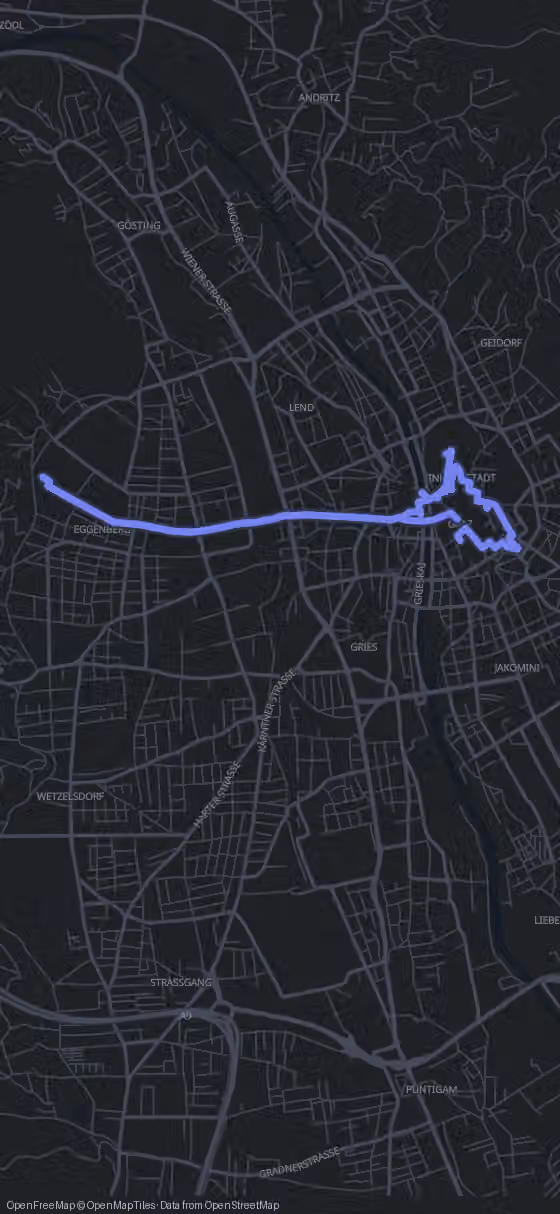
12 Stops 10.9 km ~2 h 37 min walking
Route map for the Graz walking tour
Stop 1 of 12
4.3 km·53 min
Hauptplatz
Head west toward Schloss Eggenberg
Grüß Gott, welcome to Graz. I'm Alex, and the city's beloved clock tower survives because residents paid to save it.
Try this tour with Alex

This Graz Route at a Glance

From the Hauptplatz the route runs out to Schloss Eggenberg on the western edge of Graz, then back via Kunsthaus Graz, the Schlossberg and Graz Cathedral to the Landhaus: 12 stops, 10.9 km, 2 h 37 min of pure walking. With the three museums, plan about eight and a half hours.

The streets, the hill, the cathedral and the castle courtyards are free; you pay entry at Schloss Eggenberg, Kunsthaus Graz and the Styrian Armoury (Landeszeughaus). Route, map and GPS navigation in your browser are free; the AI Tour Guide is optional.

Open free GPS & optional AI Tour Guide
This short shows highlights of the route. All 12 stops follow below.

The Route

Walking Map of Graz: Old Town, Castle Hill and Eggenberg

12 stops 10.9 km 2 h 37 min walking
Tap to load interactive map

The 12 stops along this route

  1. Hauptplatz in Graz, stop 1 on the self-guided walking tour
    1Hauptplatz
  2. Schloss Eggenberg in Graz, stop 2 on the self-guided walking tour
    2Schloss Eggenberg
  3. Kunsthaus Graz, stop 3 on the self-guided walking tour
    3Kunsthaus Graz
  4. Murinsel in Graz, stop 4 on the self-guided walking tour
    4Murinsel
  5. Sackstrasse in Graz, stop 5 on the self-guided walking tour
    5Sackstrasse
  6. Schlossberg in Graz, stop 6 on the self-guided walking tour
    6Schlossberg
  7. Uhrturm (Clock Tower) in Graz, stop 7 on the self-guided walking tour
    7Uhrturm (Clock Tower)
  8. Graz Cathedral, stop 8 on the self-guided walking tour
    8Graz Cathedral
  9. Graz Castle & Double Spiral Staircase, stop 9 on the self-guided walking tour
    9Graz Castle & Double Spiral Staircase
  10. Graz Opera House, stop 10 on the self-guided walking tour
    10Graz Opera House
  11. Styrian Armoury (Landeszeughaus) in Graz, stop 11 on the self-guided walking tour
    11Styrian Armoury (Landeszeughaus)
  12. Landhaus in Graz, stop 12 on the self-guided walking tour
    12Landhaus
  13. That's the full route.

    Walk it with an AI Tour Guide talking you through every one of these streets.

    Start free in your browser
    You made it

Your Graz Walking Tour, Stop by Stop from Hauptplatz to Landhaus

  1. 1

    Hauptplatz

    Hauptplatz in Graz, stop 1 on the self-guided walking tour

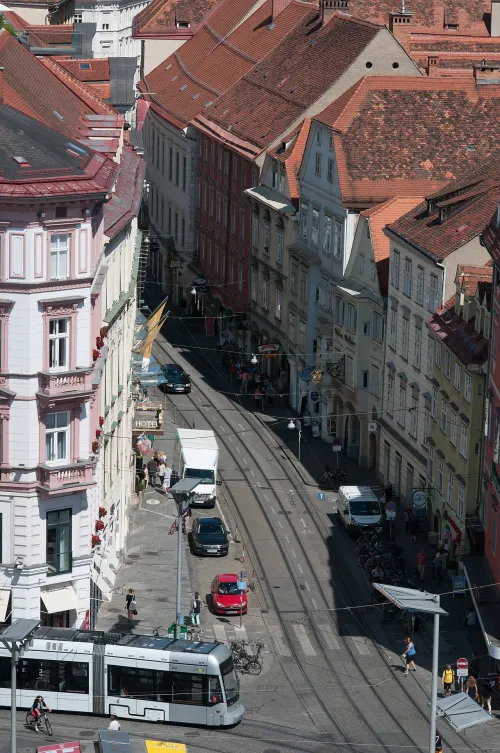
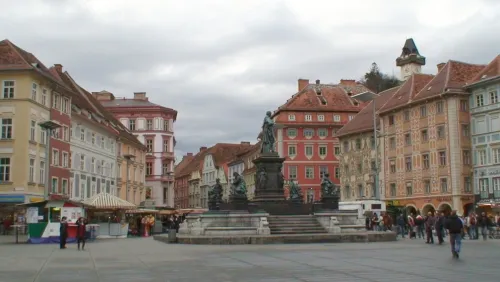
    Start where Graz began as a trading town. Around 1160 Duke Otakar III laid out the Hauptplatz as the city's central market square, and five old streets still branch off it: Sporgasse, Herrengasse, Schmiedgasse, Murgasse and Sackstraße. Look at the houses around you. Behind facades that mix late Gothic, Baroque, Biedermeier and late historicist styles, most have medieval cores, and several carry rich stucco and statues of the Virgin Mary, signs of the piety of the people who lived here.

    The square used to be much bigger. Its trapezoid once stretched as far as today's Landhausgasse, until the Renaissance town hall went up around 1550 and nearly halved it. The town hall you see now is the result of a remodelling finished in 1893 that gave the square its monumental accent. In the middle stands the Archduke Johann Fountain, set up in 1878.

    The stalls around the fountain keep the old market alive. Around 1990 every trader still built their own booth; after years of political, commercial and technical wrangling, the city cut their number around 2002 and replaced them with one uniform model. They sit on hydraulic wheels and supports and are only moved for the biggest festivals. Something you will not find any more: the Trinity Column, donated by Emperor Leopold I in thanks for surviving the plague, once stood where the square meets the Sackstraße, until traffic forced it to move to Karmeliterplatz.

    Now comes the longest leg of the day: 3770 m, about 53 minutes, out to Schloss Eggenberg on the western edge of the city.
    Hours
    Open 24/7
    Price
    Free
  2. 2

    Schloss Eggenberg

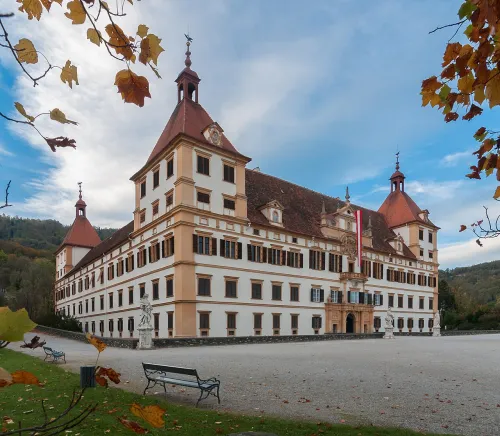
    Schloss Eggenberg in Graz, stop 2 on the self-guided walking tour

    Schloss Eggenberg is the most significant Baroque palace complex in Styria, and the surrounding walls with their huge west-facing portal tell you from the outset that it was built to impress. It stands 381 m above sea level, and since 2010 it has been part of the UNESCO World Heritage listing of Graz, added as an extension of the historic old town.

    At first glance the palace looks like one 17th-century project. It is not. Large parts date back to the late Middle Ages, and building went on through the early modern era. Before 1460 Balthasar Eggenberger, financier to Emperor Frederick III and holder of the imperial minting licence, bought land here, and by 1470 a square Gothic chapel had been built into the tower. His family, the House of Eggenberg, became the mightiest dynasty in Styria, and the palace carries the imprint of their rise.

    Inside, collections of the Universalmuseum Joanneum fill the house and the park. On the ground level the Coin Cabinet occupies Balthasar's former rooms, a neat fit for the man who ran the mint. On the upper level the Alte Galerie spans five centuries of European paintings and sculpture, from the medieval era into the early modern period. In the northern corner of the grounds you find the Planetary Garden, a Lapidarium of Roman stonework and the Archaeology Museum, home of the Cult Wagon of Strettweg.

    Is it worth the ticket? If you have a whole day and enjoy interiors, old masters or archaeology, yes: plan a good hour and a half. If your time in Graz is short, skip it and begin at the Kunsthaus instead. From here it is 3450 m, around 46 minutes, back towards the Mur and Kunsthaus Graz.

    Hours
    Mon: Closed | Tue–Sun: 10:00–18:00
    Price
    16 EUR
  3. 3

    Kunsthaus Graz

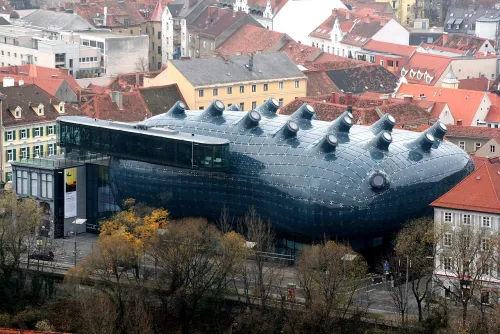
    Kunsthaus Graz, stop 3 on the self-guided walking tour

    You will spot it before you read the name: a blue, bulging shape that stands out against everything around it, which is why locals call it the Friendly Alien. Kunsthaus Graz was built for 2003, when Graz was European Capital of Culture, and designed by Peter Cook and Colin Fournier as a deliberately provocative museum, a textbook case of blob architecture. Its skin is made of iridescent blue acrylic panels that double as solar panels.

    Look for two details. The building incorporates the facade of the Iron House, an iron-framed structure from 1848, so old and new share a wall. On the eastern side sits BIX, short for 'big pixels', a concept by the Berlin architects realities:united: 930 fluorescent lamps behind the acrylic skin, each one adjustable in brightness, turn the building into a giant, low-resolution screen.

    Whether to go in depends on what is showing. The Kunsthaus collects nothing, has no permanent exhibition and no depot of its own. It stages changing international shows of art from the 1960s to today, bringing architecture, design, new media, internet art, film and photography under one roof. If the current exhibition speaks to you, give it an hour; if not, the building itself is the sight, and you see that for free from the street.

    The Murinsel is only 270 m away, about 4 minutes, out on the river.

    Hours
    Mon: Closed | Tue–Sun: 10:00–18:00
    Price
    13 EUR
  4. 4

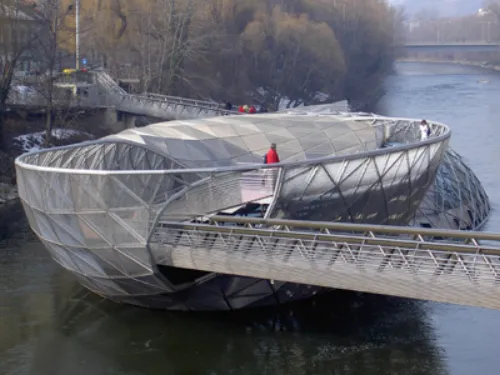
    Murinsel

    Murinsel in Graz, stop 4 on the self-guided walking tour

    The Murinsel is an artificial island, a floating platform in the Mur, opened in January 2003 for the Capital of Culture year. The aim was a second, modern landmark to stand beside the Schlossberg, bringing architecture, public art and the experience of water into the heart of the city. Footbridges reach it from both banks, so you cross the river right through it.

    The idea came from Graz-born Robert Punkenhofer; the New York artist and designer Vito Acconci gave it shape. It is a shell 50 m long and 20 m wide that combines an open-air theatre with a rounded 'dome', as Acconci called it. Inside the dome there is a café and a children's playground, and the whole island is designed for around 350 people.

    One detail worth knowing: the island was not built for eternity. City auditors booked it with a working life of 25 years, its first water-rights permit ran only until December 2012, and they noted that it could be dismantled, transported and sold. It is still here, and the café makes it a good place for a coffee before the old town.

    Cross to the far bank and the Sackstrasse is 180 m, about 3 minutes, away.

    Price
    Free
  5. 5

    Sackstrasse

    Sackstrasse in Graz, stop 5 on the self-guided walking tour

    The Sackstrasse is the oldest street in Graz still in existence, laid out in the early 12th century. It runs north from the Hauptplatz between the Schlossberg and the Mur and is one of the city's main shopping streets. Art has settled here so firmly that a local association named it the Kunst Meile Graz, the art mile, and the nickname has stuck.

    The name tells its story. The street was simply called the 'Sack' because it was a dead end, stopping at the northern town wall by the Reinerhof at number 20. Only when the first Sack Gate was built, between today's numbers 17 and 20, did it gain an exit to the north.

    As Graz grew, so did the Sack. Under Emperor Frederick III the wall was broken through and a 'second Sack' added; small traders, tanners, furriers, shoemakers and millers settled there, far from the wealthy quarters. The open ground in front of the old wall between the first and second Sack is today's Schlossbergplatz. In the 17th century a 'third Sack' followed, reached through a third gate built in 1625, a tower 12 m high with a passage 7 m long. The craftspeople moved further out, while nobles settled in the first Sack and built their palaces there, so the grandest houses are the ones nearest the Hauptplatz.

    From here it is 690 m, about 16 minutes, up to the Schlossberg.

    Hours
    Open 24/7
    Price
    Free
  6. 6

    Schlossberg

    Schlossberg in Graz, stop 6 on the self-guided walking tour

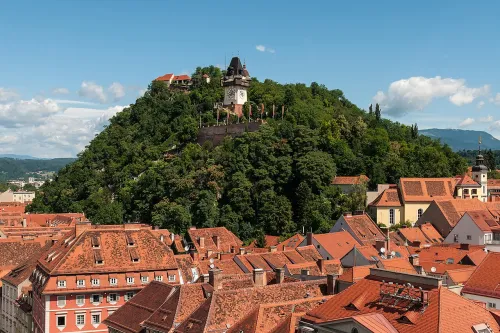
    The Schlossberg, Castle Hill, is the tree-covered rock in the centre of Graz, 473 m above sea level and today a public park with wide views over the city. It has been fortified since at least the 10th century. In the mid-16th century architects from northern Italy built a fortress 400 m long up here, and records show a cable-hauled lift hauling building materials as early as 1528.

    The fortress was never conquered. Even so, Napoleonic forces tore most of it down under the Treaty of Schönbrunn of 1809. Two towers survived because the people of Graz paid a ransom for them: the Uhrturm and the Glockenturm. The bell tower holds Liesl, the heaviest bell in Graz. In 1839 Ludwig von Welden turned the ruins into the park you walk through now.

    Look out for the Türkenbrunnen, an old cistern, and the two surviving bastions. In the former cellar of one bastion sits the Kasemattenbühne, an open-air stage for concerts and performances. There are several cafés on the hill, and next to the top station of the funicular a restaurant looks out over western Graz, so this is an easy place for a break.

    The Uhrturm (Clock Tower) is 380 m away, about 6 minutes, at the southern end of the hill.

    Hours
    Open 24/7
    Price
    Free
  7. 7

    Uhrturm (Clock Tower)

    Uhrturm (Clock Tower) in Graz, stop 7 on the self-guided walking tour

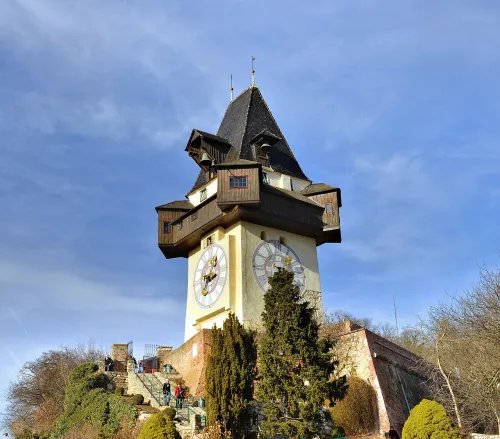
    Here it is, the landmark of Graz: the Uhrturm (Clock Tower), 28 m tall and 73 m higher than the Hauptplatz, on the southwest slope of the Schlossberg. Its four dials are each more than 5 m across, with gilded hands.

    Now look closely at those hands. The big one shows the hours, the small one the minutes, the reverse of what you are used to. Being able to read the hour from far away mattered more, so the hour hand got the bigger size. A first clock with three dials was installed in 1569; in 1712 Michael Sylvester Funck built a new clockwork, accurate enough to show minutes, and a fourth dial was added on the north side.

    The core of the tower probably dates from the 13th century, with a tower first recorded around 1265, which makes it one of the oldest buildings on the hill. It was the highest point of the medieval town wall, which climbed from the Sack Gate up the hill, and it also marked the end of the castle that held the higher, northern part of the Schlossberg. Above the dials runs a wooden gallery from which fire watchers kept an eye on the whole inner city. When Napoleon's troops besieged Graz in 1809, one of the very first cannonballs hit the tower, but it suffered no major damage.

    From here you walk 760 m, about 10 minutes, to Graz Cathedral.

    Hours
    Open 24/7
    Price
    Free
  8. 8

    Graz Cathedral

    Graz Cathedral, stop 8 on the self-guided walking tour

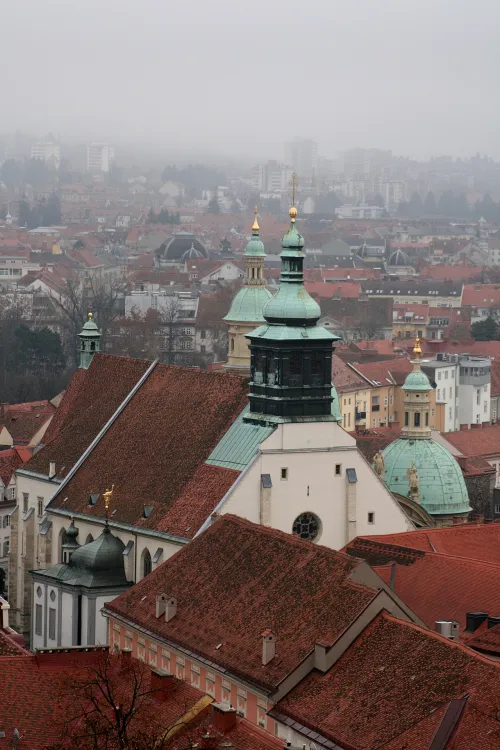
    Graz Cathedral is dedicated to Saint Giles, patron saint of the city, and is the seat of the bishop of Graz-Seckau. A church of Saint Giles is first recorded here in 1174, a fortified chapel outside the town walls of which nothing survives. What you see goes back to 1438, when Emperor Frederick III, who was building his new residence next door, ordered a complete rebuild as his court church. The Gothic church was largely finished by about 1464, probably under the Swabian master builder Hans Niesenberger.

    In 1577 Archduke Charles II of Inner Austria handed the church to the Jesuits, and after the University of Graz was founded in 1585 it also served as the university church. In those Jesuit centuries the Gothic hall gained its Baroque layer. A sacristy came in 1615, four side chapels followed under Habsburg patronage, and in 1786, under the reforms of Joseph II, Graz became a bishop's seat.

    Entry is free and worth twenty minutes. Look for the medieval frescoes and altarpieces, the high Baroque altar by Georg Kraxner, completed in 1733 with its painting of Saint Giles, and the two ivory reliquaries that started life as the bridal chests of Paola Gonzaga. Right next to the cathedral stands the Mausoleum of Emperor Ferdinand II.

    Graz Castle & Double Spiral Staircase is directly opposite, 100 m and 2 minutes away.

    Local name
    Grazer Dom
    Hours
    Mon: 08:00–19:45 | Tue: 11:00–19:45 | Wed–Fri: 08:00–19:45 | Sat: 08:00–19:00 | Sun: 08:00–18:00
    Price
    Free
  9. 9

    Graz Castle & Double Spiral Staircase

    Graz Castle & Double Spiral Staircase, stop 9 on the self-guided walking tour

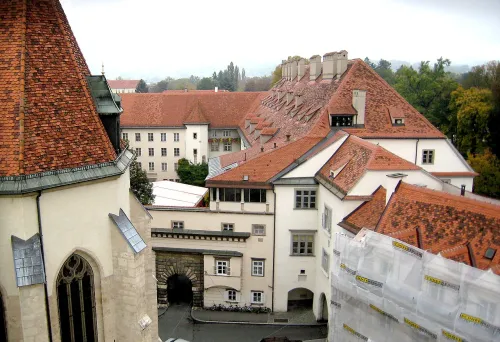
    Graz Castle faces the cathedral, and together with the Mausoleum of Ferdinand II and the former Jesuit college it forms the ensemble known as the Stadtkrone, the city crown, which closes off the old town to the east. Frederick III began building here in 1438, while still Duke Frederick V. Because the castle was of little defensive value, a covered passage linked it with the fortress on the Schlossberg.

    From 1564 Graz was capital of Inner Austria, and the castle, as seat of its archdukes, was rebuilt and enlarged. That chapter closed in 1619, when Archduke Ferdinand II was crowned emperor and moved to Vienna. Neglect followed; by 1822 part of the building was considered unsafe, and some wings were demolished in 1853 and 1854. Since 1922 the castle has been the seat of the Styrian governor. After heavy damage in the Second World War it was rebuilt from 1947, and the Neue Burg was added between 1950 and 1952.

    Most of the building houses government offices, so only the courtyards and the Double Spiral Staircase are open to visitors, free of charge. That is the reason to walk in, and it takes just a few minutes. To the east, the castle garden and the Stadtpark adjoin the line of the old town wall.

    The Graz Opera House is 490 m away, about 7 minutes.

    Local name
    Grazer Burg
    Hours
    Daily: 07:30–20:00
    Price
    Free
  10. 10

    Graz Opera House

    Graz Opera House, stop 10 on the self-guided walking tour

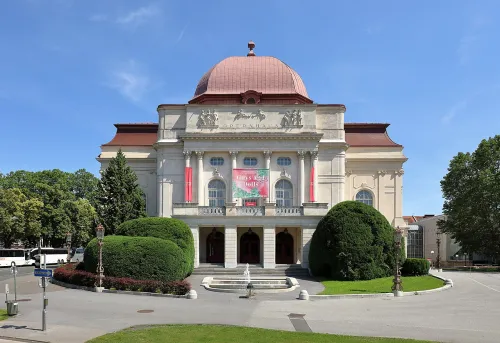
    The Graz Opera House is the work of Ferdinand Fellner and Herman Helmer, built in neo-baroque style and opened in 1899. Plans first proposed in 1887 called for a theatre worthy of the growing city and a 'new home for German art'. The opening night was Schiller's William Tell, followed a few days later by Wagner's Lohengrin.

    Opera in Graz is far older than this building. From the 17th century it was performed in a converted coach house on the Habsburg estates; the National Theatre of 1776 saw many early performances of Mozart's operas; and the direct predecessor of this house was the Thalia Theatre, adapted in 1864 from an old circus hall.

    The building was damaged by bombs in the Second World War, repaired and reopened, and modernised between 1983 and 1985 without changing its original look inside or out. Around 1,200 people fit into the auditorium, and the opera orchestra also gives concerts as the Graz Philharmonic Orchestra. Unless you have a ticket for an evening performance, this is a stop to admire from outside.

    From the opera it is 540 m, about 7 minutes, to the Styrian Armoury, and on the way you walk along the Herrengasse.

    Local name
    Opernhaus Graz
    Hours
    Ticket centre: Mon–Fri 09:00–18:00, Sat 09:00–13:00
    Price
    Performance tickets 3–123 EUR depending on category (2026/27 season)
  11. 11

    Styrian Armoury (Landeszeughaus)

    Styrian Armoury (Landeszeughaus) in Graz, stop 11 on the self-guided walking tour

    The Styrian Armoury (Landeszeughaus) holds 32,000 objects and is the largest armoury in the world that survives largely in its original state. Built in the 1640s to plans by Antonio Solari in early German Baroque style, it was once the central weapons depot of Styria and is now part of the Universalmuseum Joanneum.

    Its purpose was very concrete. The weapons equipped the Styrian levy and supplied the military frontier set up against the Ottoman Empire in what is now Croatia and Hungary. Five floors, each 11.5 m wide and 52.5 m long, held equipment for 16,000 men, stored and maintained in good order. Before this building existed, the estates kept their arms in the old Landhaus and at the city gates, and from 1565 in the roofs of the new Landhaus.

    After the Peace of Karlowitz in 1699 the Ottoman border stabilised and the armoury lost its main job. In 1749 Maria Theresa, centralising the army as part of her reforms, ordered it closed and the whole stock broken up and sent to Vienna. The rows of armour and weapons you see today show that the collection stayed in Graz.

    If historic weapons, armour or military history interest you at all, go in and give it an hour, without leaving it too late in the day. The Landhaus is only 220 m away, about 3 minutes.

    Hours
    Mon: Closed | Tue–Sun: 10:00–18:00
    Price
    12 EUR
  12. 12

    Landhaus

    Landhaus in Graz, stop 12 on the self-guided walking tour

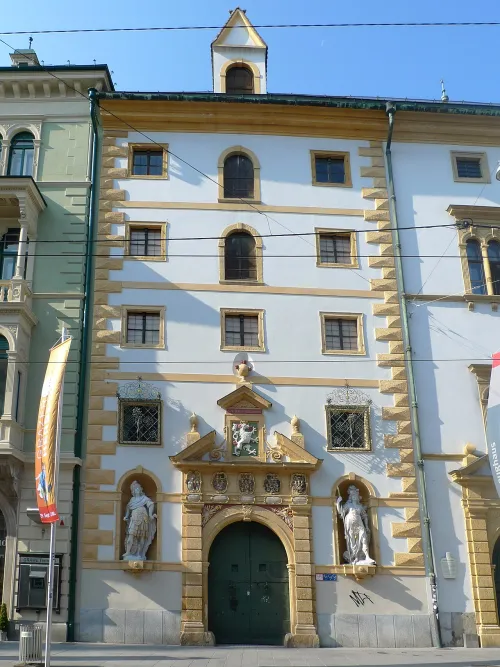
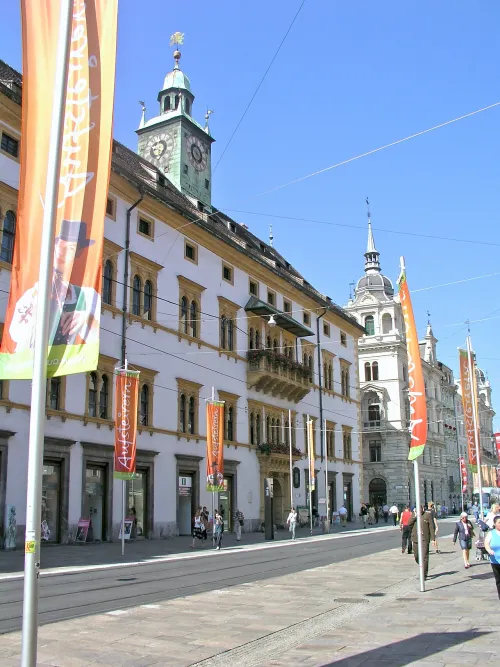
    You finish at the Landhaus on the Herrengasse, former seat of the Styrian estates and one of the most important Renaissance buildings in Central Europe. Walk into the arcaded courtyard, three storeys high, and look at the round-arched windows and airy loggias. The courtyard hosts many events, and the Baroque Landstube inside is still where the Styrian parliament meets.

    The estates bought a town house on the corner of Herrengasse and Landhausgasse as early as 1494 and set up their office and a chapel to Mary in it. They kept running out of room, and there was rivalry too: the estates, which from 1549 openly acted as a Protestant body, faced the Catholic princes in Graz Castle. More houses were bought, and between 1527 and 1531 the builders Balthasar, Hanns and Sebastian Walch created the Knights' Hall on the first floor.

    In 1555 the Italian fortress builder Domenico dell'Allio, who was also working on the Schlossberg fortifications, was commissioned to renew the complex. He built the main wing on the Herrengasse and the great Renaissance courtyard; after his death his foremen Benedikt de la Porta and Peter Tadei carried on with the wing towards the Landhausgasse.

    Remember that the Hauptplatz once reached as far as the Landhausgasse? You are standing at the old edge of the market square where the walk began, which brings Graz full circle.

    Hours
    Open 24/7
    Price
    Free
Walking tour route map of Graz Route loaded
HauptplatzSchloss EggenbergKunsthaus GrazMurinsel+8
All 12 stops are already on the map.
You just press start.
AI Tour Guide

You just read the route. Now walk Graz with a guide in your ear.

Press start wherever you are, even hundreds of kilometres from Graz, and the guide begins telling its stories right away. In the city, pick any of the 12 stops to start from: it leads you there, then talks with you the whole route, asking, listening, remembering, and shaping the tour around your answers.

12stops 10.9km 2 h 37 minwalking 13languages
▶Start the tour free

Free to start · Runs in your browser · No app, no download

Shorter Ways to Walk Graz

Not everyone has a full day in Graz. These versions keep the same order and the same legs, just fewer of them.

Old town without the palace

Stops: 3, 4, 5, 6, 7, 8, 9, 10, 11, 12

For a half day. Start at Kunsthaus Graz and follow the river, the hill and the city crown to the Landhaus: 3.6 km and 58 minutes of walking. You pay entry only at the Kunsthaus and the armoury.

Castle Hill and city crown

Stops: 4, 5, 6, 7, 8, 9

For a free couple of hours: from the Murinsel through the Sackstrasse, over the Schlossberg past the Uhrturm to the cathedral and the castle. 2.1 km and 37 minutes of walking, no tickets needed.

Palace and Kunsthaus

Stops: 1, 2, 3

For lovers of interiors and art: from the Hauptplatz out to Schloss Eggenberg and back to Kunsthaus Graz. 7.2 km and 1 h 39 min of walking, with tickets at both.

How Long Does This Graz Tour Take with Palace and Museums?

Of the 2 h 37 min of pure walking, 1 h 39 min goes on the walk out to Schloss Eggenberg and back. Everything from the Kunsthaus onward sits close together: those remaining legs add up to just 58 minutes.

Give the palace about an hour and a half, the Kunsthaus and the armoury an hour each, and the other stops between ten and thirty minutes. Spend a quarter of an hour on the Hauptplatz from 9:00 and you reach Eggenberg at about 10:08. Leave at 11:38 and you are at the Kunsthaus at 12:24, the armoury at about 16:24 and the Landhaus around 17:30.

The old town version takes about four hours with its two museums, the hill and city crown walk about two hours, and the palace and Kunsthaus version about four and a half hours.

Before You Set Off in Graz

  • Start and finish: The recommended start is the Hauptplatz, the finish is the Landhaus. You can join at any stop; the suggested order simply flows best.
  • Best day: Schloss Eggenberg, Kunsthaus Graz and the Styrian Armoury are not open every day, so pick your day with these three in mind.
  • Start time: Set off around 9:00 so you reach the palace in the morning and still have a full hour in the armoury in the late afternoon.
  • Costs: The walk, the map and the GPS navigation in your browser cost nothing; you only pay admission at the three museums. The AI Tour Guide starts with 100 free credits; after that you choose between this tour all-inclusive for €19.99 with no time limit, or €5 per hour.
  • Getting to Eggenberg: If the long walk out is more than you want, Schloss Eggenberg can also be reached by tram. You lose nothing by walking the rest of the route from the Kunsthaus.
Walking tour route map of Graz
AI Tour Guide

Your guide is ready when you are, right at the Hauptplatz.

Press start and a voice AI Tour Guide takes it from here: leading the route through Graz, telling the stories, and turning your walk into a real back-and-forth conversation. No app or download is needed; it runs in your browser.

12stops 10.9km 2 h 37 minwalking 13languages
▶Start the tour free

Free to start · Runs in your browser · No app, no download

What the AI Tour Guide Adds in Graz

On this route some legs are long, above all the walk out to Eggenberg and back. The AI Tour Guide turns them into conversation: it greets you at the Hauptplatz, tells the stories of each place as you go, asks what interests you and remembers it, so an armour fan hears more in the Landeszeughaus and an architecture fan more about Fellner and Helmer. You can interrupt whenever you like, for instance to ask who Archduke Johann was, whose fountain stands on the Hauptplatz, or what the Cult Wagon of Strettweg was used for.

A Real Conversation A voice AI Tour Guide greets you, leads the whole route, and tells the stories and facts as you walk, asking what you want to see and keeping a real conversation going. Not a recording you press play on.
Map Navigation Follow the route on the map and walk at your own pace. You choose where to start and when to move to the next stop.
Ask Anything Curious about a building you pass? Ask your AI Tour Guide on the spot and the conversation carries on.
13 Languages Switch language anytime. No separate tour needed.
Start free in your browser

Common Questions about Walking Graz

Can I walk through the tunnels under the Schlossberg?

Partly. During the Second World War an extensive tunnel system was dug beneath the hill to protect the people of Graz from air raids. Some passages, including the one from Schlossbergplatz to Karmeliterplatz, are still open; many others are closed to the public.

Can I see a performance at the Graz Opera House?

Yes. Tickets come in a wide range of categories, from cheap seats to the best places in the house, and you can buy them at the ticket centre.

Does the route take me back to the Hauptplatz?

The walk ends at the Landhaus. If you want, the GPS navigation in your browser guides you from there back to the start.

Where can I head next from Graz?

Klagenfurt is 99 km away, Ljubljana 134 km and Vienna 144 km, each with its own walking route.

Is the tour really free?

Yes. The whole tour is free: the route, the interactive map and the navigation cost you nothing. Only the voice AI Tour Guide is optional and paid: you test it with 100 free credits, then you pay either €5 per hour or €19.99 for this whole tour, with no time limit. Admission to 3 of the 12 stops is not included: Schloss Eggenberg, Kunsthaus Graz and Styrian Armoury (Landeszeughaus) charge their own entry fees.

Do I need to download an app?

No. Everything runs in your phone browser. Open the route and start walking, no download and no sign-up required.

Do I need to book the walking tour in advance?

No booking needed. This self-guided tour is available anytime. Open the route in your browser and start walking. The AI Tour Guide works instantly, no app, no reservation required.

What languages is the AI Tour Guide available in?

The AI Tour Guide speaks 13 languages, so you take the tour in your own language and can switch at any time.

Can I skip stops or change the route?

Yes. Skip any stop, spend extra time at places you like, or start the route from any point. It is your walk, you set the pace.
Image credits
▶ Start free in your browser Runs in your browser, no app, no download