Free Walking Tour Klagenfurt: Dragon, Squares & Museums

Start at the dragon that became the city's emblem, cross the oldest square and the market, and finish among Carinthia's art and history collections.

7 Stops 1.8 km ~24 min walking
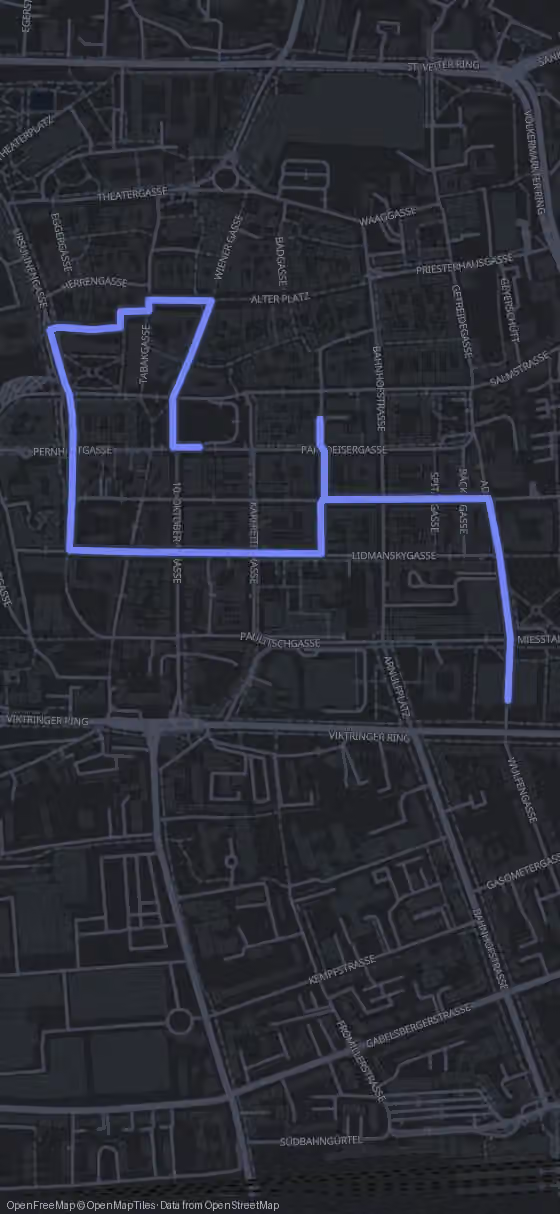
Route map for the Klagenfurt walking tour
Stop 1 of 7
230 m·3 min
Lindwurm Fountain
Head north up the pedestrian zone toward Alter Platz.
Welcome to Klagenfurt. I'm Alex, and our first story begins with a dragon whose face began as a fossil.
Try this tour with Alex

Klagenfurt's Old Town in Seven Stops

Seven stops, 1.8 km and 24 minutes of pure walking: from the Lindwurm Fountain via Alter Platz, the Landhaus, the Benediktinermarkt and Klagenfurt Cathedral to the Museum of Modern Art Carinthia (MMKK) and the kärnten.museum. Plan about two hours outdoors, around five with the museums.

The fountain, the old square, the market and the cathedral are free; the Landhaus and both museums charge admission. The GPS route runs free in your browser, and the optional AI Tour Guide tells the stories as you walk.

Open free GPS & optional AI Tour Guide
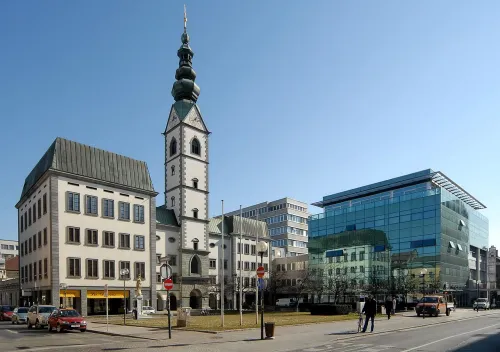
View of Klagenfurt

The Route

Walking Map of Klagenfurt's Old Town Route

7 stops 1.8 km 24 min walking
Tap to load interactive map

The 7 stops along this route

  1. Lindwurm Fountain in Klagenfurt, stop 1 on the self-guided walking tour
    1Lindwurm Fountain
  2. Alter Platz in Klagenfurt, stop 2 on the self-guided walking tour
    2Alter Platz
  3. Landhaus in Klagenfurt, stop 3 on the self-guided walking tour
    3Landhaus
  4. 4Benediktinermarkt
  5. Klagenfurt Cathedral, stop 5 on the self-guided walking tour
    5Klagenfurt Cathedral
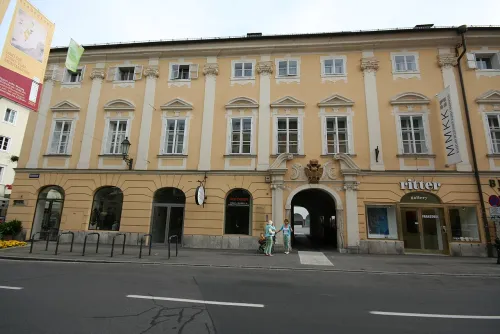
  6. Museum of Modern Art Carinthia (MMKK) in Klagenfurt, stop 6 on the self-guided walking tour
    6Museum of Modern Art Carinthia (MMKK)
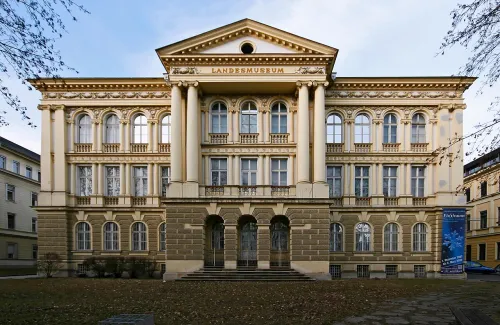
  7. kärnten.museum in Klagenfurt, stop 7 on the self-guided walking tour
    7kärnten.museum
  8. That's the full route.

    Walk it with an AI Tour Guide talking you through every one of these streets.

    Start free in your browser
    You made it

Your Klagenfurt Walking Tour, from the Dragon to the Rudolfinum

  1. 1

    Lindwurm Fountain

    Lindwurm Fountain in Klagenfurt, stop 1 on the self-guided walking tour

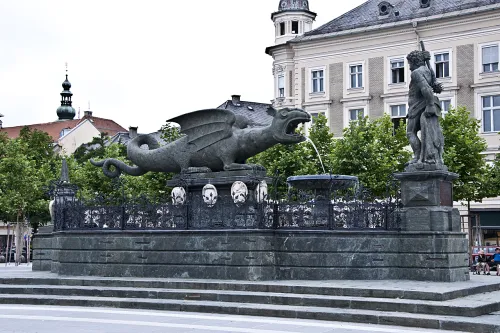
    Start with the city's emblem. A huge dragon, carved from local slate and weighing around six tonnes, rears over a water basin, and beside it stands Hercules, sometimes called the dragon slayer. A decorative wrought iron fence rings the whole group. Locals have a nickname for the beast, “Lindi”, and you will meet it again on Klagenfurt's coat of arms, together with a tower.

    The tower comes from the founding legend. A dragon plagued the land where Klagenfurt was later built. To get rid of it, the duke had a tower built and chained a bull to it as bait. When the dragon came to feed, several knights surrounded it and killed it. Dragon and tower have stood for the city ever since.

    The fountain itself has a more practical origin. A severe fire in 1514 was part of the reason the city wanted a monumental fountain. Work began in 1590, and the monument was only finished in 1636. The dragon is often attributed to the sculptor Ulrich Vogelsang, though nobody can say for sure; Hercules is the work of Michael Hönel.

    Now look closely at the dragon's head, because it has a place in the history of palaeontology. In 1335 the skull of a woolly rhinoceros turned up in a gravel pit outside Klagenfurt, and in 1840 the palaeontologist Franz Unger suggested it was the model for the dragon. That is why the sculpture has been called the earliest reconstruction of an extinct animal. Critics answer that there is no conclusive proof of any link between skull and sculpture, and have dismissed the idea as forced euhemerism. Make up your own mind.

    From the fountain it is 230 m, about 3 minutes, off Neuer Platz to Alter Platz, the older of the two main squares.
    Hours
    24/7
    Price
    Free
  2. 2

    Alter Platz

    Alter Platz in Klagenfurt, stop 2 on the self-guided walking tour

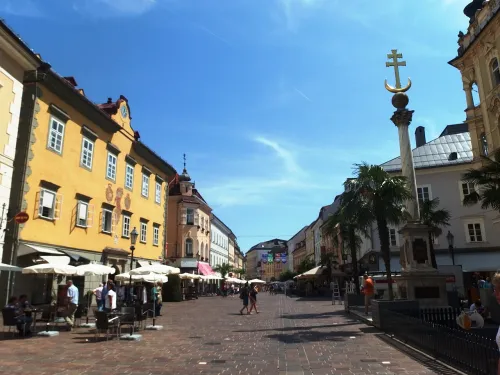
    This is where the town really began. In the mid 13th century, under Bernhard von Spanheim, Klagenfurt moved from the Glanau to the site of today's old town and became a city, and this square became its main square. It lay on the east-west road from Völkermarkt to Villach, and back then it was simply called “the square”.

    Notice its shape. On the east side it once ended at the Völkermarkt Gate, while to the west it widens like a funnel up to the Goldene Gans at number 31. That house is considered the oldest building in Klagenfurt's old town and probably served as the town hall. From 1737 the town hall sat in the Palais Welzer at number 1, until it moved in 1918 to the Palais Orsini-Rosenberg on the newer square.

    That newer square only arrived with the 16th-century expansion that gave the old town its present face: a large rectangular square laid out to the south, first called the Lower Square, while this one became the Upper. The names Old and New stuck later. In 1914 this square was renamed Kaiser-Wilhelm-Platz in honour of the German emperor Wilhelm II, and it kept that name until 1925.

    Keep an eye out for a few details. The plague column near number 28 has stood here since 1965; before that it was on Heiligengeistplatz. The Haus Supersberg at number 4 is where the writer and politician Karl Morré was born in 1832. And at the passage towards the Landhaus, two houses were joined in the 18th century to form the Palais Goëss.

    Walk through that passage: the Landhaus is 190 m away, about 3 minutes.

    Hours
    24/7
    Price
    Free
  3. 3

    Landhaus

    Landhaus in Klagenfurt, stop 3 on the self-guided walking tour

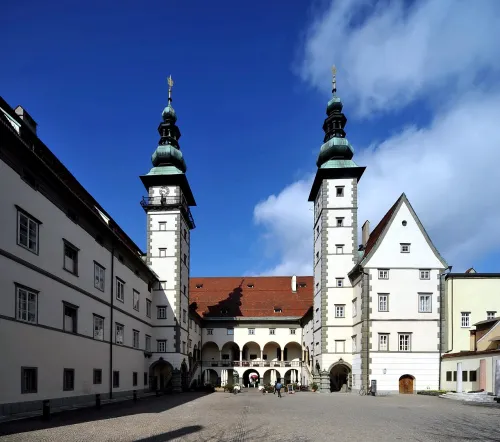
    You are standing at the edge of the oldest part of downtown, between Heiligengeistplatz and Alter Platz. The Landhaus was built between 1574 and 1594 on behalf of the Carinthian estates, the assembly of nobility and high clergy, as part of the city's expansion and fortification. Today it is the seat of the Carinthian state parliament.

    Why here, and why them? In the late 15th and early 16th centuries the Habsburg rulers lived in Vienna or Prague and were rarely seen in Carinthia, so the estates had to deal with Ottoman raids and uprisings themselves. In 1478 peasants rose up against new taxes, and in 1515 rebels from Carniola and southern Styria occupied Althofen and St. Veit, then the capital of Carinthia. The revolts were put down, but the estates came away determined to have a seat of power under their own control.

    They picked Klagenfurt, badly damaged by the fire of 1514, and asked Emperor Maximilian I to hand the city over. Neither the court nor the town had the money to rebuild, so in 1518 Maximilian gave it to the local nobility. Over the following decades the estates rebuilt and fortified the city and made it the new capital of Carinthia. As early as 1527 they dug the Lend Canal, 4.5 km long, to bring water from Lake Wörthersee, feed the city moat begun in 1534 and carry building materials; the expansion itself started that same year.

    The Landhaus charges admission. If this story of a city handed to its own nobility interests you, go in; if you are short on time, the building and its history from outside are enough. Then it is 350 m, about 5 minutes, to the Benediktinermarkt.

    Hours
    Apr 1–Oct 26: Mon–Fri 10:00–16:00; Oct 27–Mar 31: Tue–Fri 10:00–16:00; closed Dec 24–Jan 6
    Price
    7 EUR adults, 5 EUR reduced, free for ages 0–18, 12 EUR family ticket
  4. 4

    Benediktinermarkt

    The square explains its own name. The church here was consecrated in 1624 together with the Franciscan monastery next to it; the Benedictines later took the monastery over, and the square has carried their name ever since. Today the church is the backdrop. The market around it is the reason you are here.

    Timing decides everything. On market days the farmers' stalls and the organic market trade in the morning and are packed away by early afternoon, while the market halls stretch the window into the middle of the day. Plan your day around the market, and this is the kitchen of the route; arrive too late and you are standing on a pleasant, empty square.

    This is the one place on the walk where spending money clearly makes the day better. Whatever you buy here travels well, so pick up something to eat later. From the market it is 260 m, about 4 minutes, to Klagenfurt Cathedral.

    Hours
    Weekly market Thu & Sat 06:00–13:00; Organic market Fri 06:00–13:00; Market halls core hours Mon–Sat 09:00–13:00 (framework hours Mon–Fri 05:00–18:00, Sat 05:00–17:00)
    Price
    Free
  5. 5

    Klagenfurt Cathedral

    Klagenfurt Cathedral, stop 5 on the self-guided walking tour

    This cathedral began life as something quite different. Construction started in 1581 on a Protestant house of prayer dedicated to the Holy Trinity, and it is the largest Protestant church ever built in Austria. For a long time Klagenfurt had only two churches, St. Egid and the hospital church of Heiligengeist outside the walls, and not a single monastery until the Counter-Reformation.

    The Reformation came late but took hold firmly. In 1563 Martin Knorr, the parish priest of Klagenfurt, read the first German mass according to the Augsburg Confession in St. Egid, and three years later he and other Carinthian clergy signed a confession that made the new faith the town's official religion in all but name. Newcomers from Württemberg and Saxony added to the Protestant population.

    Then the tide turned. In 1600, during the Counter-Reformation, the church was closed, and four years later it was handed to the Jesuits, who rededicated it to Saints Peter and Paul and ran it until their order was dissolved in 1773. In 1787 Bishop Franz Xaver von Salm-Reifferscheidt made it the cathedral of the diocese of Gurk.

    Look at the west side: it was long hidden by the Jesuit barracks, a complex that surrounded the church until it was demolished in 1960, after which the newly exposed side was given a proper façade. Admission is free, so stepping inside costs you nothing but a few minutes. The MMKK is only 170 m away, about 2 minutes.

    Local name
    Klagenfurter Dom
    Hours
    Mon–Sat 08:00–17:00, Sun 09:00–20:00
    Price
    Free admission
  6. 6

    Museum of Modern Art Carinthia (MMKK)

    Museum of Modern Art Carinthia (MMKK) in Klagenfurt, stop 6 on the self-guided walking tour

    The MMKK sits in the so-called Klagenfurt Burg, in the rooms of the former Carinthian state gallery. After a thorough renovation it opened here in 2003 and took over the state of Carinthia's art collection. On around 1000 square metres it shows modern and contemporary art in solo and themed exhibitions, with regional, national and international artists.

    The state collection is the backbone, and the names are worth knowing: Maria Lassnig, Kiki Kogelnik, Hermann Nitsch, Arnulf Rainer, Hans Bischoffshausen and Hans Staudacher, with Heimo Zobernig and Hans Schabus for the younger generation. Since 2010 the museum has been led by Christine Wetzlinger-Grundnig.

    Do not miss the castle chapel. Its frescoes are by the Carinthian baroque painter Josef Ferdinand Fromiller, and today artists use the room as a space for projects and installations, so old walls and new work meet directly.

    The MMKK charges admission and suits anyone curious about Austrian art of the last hundred years; if modern art leaves you cold, admire the Burg from outside and move on. The final leg is the longest of the walk: 560 m, about 8 minutes, to the kärnten.museum.

    Hours
    Tue–Sun 10:00–18:00, Thu 10:00–20:00 (holidays until 18:00), Mon closed
    Price
    8 EUR adults, 4 EUR reduced, free for children and youths up to 19 years
  7. 7

    kärnten.museum

    kärnten.museum in Klagenfurt, stop 7 on the self-guided walking tour

    The walk ends at a palace built for collections. The museum traces its founding to 1844, when the History Association for Carinthia was set up and began showing its exhibits in the Landhaus you passed earlier. Four years later a Natural Science Association followed, and from 1861 its exhibits were housed in the Landhaus too.

    The collections soon outgrew the space. Planning for a new building started in 1877, the foundation stone was laid on 24 April 1879, and the Neo-Renaissance building by the Klagenfurt architect Gustav Gugitz opened on 10 July 1884, financed by an interest-free loan from the Carinthian Savings Bank. Crown Prince Rudolf laid the capstone, which is why the house is also called the Rudolfinum.

    The 20th century was hard on it. Bombs badly damaged the building during the Second World War, and it was rebuilt with state money, after which the state of Carinthia took over building, staff and collections. The main house closed in 2014 and reopened on 21 November 2022.

    The museum covers both cultural and natural history and charges admission. It is the place to spend real time if you want the bigger Carinthian story behind everything you have seen on the walk, and after a dragon that may be modelled on a woolly rhinoceros, a museum of natural history is a fitting finish.

    Local name
    Landesmuseum Kärnten
    Hours
    Tue–Sat 10:00–17:00, Thu 10:00–19:00, Sun 11:00–16:00, Mon closed
    Price
    12 EUR adults, 10 EUR reduced, free for ages 0–18, 20 EUR family ticket
Walking tour route map of Klagenfurt Route loaded
Lindwurm FountainAlter PlatzLandhausKlagenfurt Cathedral+3
All 7 stops are already on the map.
You just press start.
AI Tour Guide

You've read the route. Now walk it with a guide talking you through it.

Press start wherever you are, even hundreds of kilometres from Klagenfurt, and the guide begins telling its stories right away. In the city, pick any of the 7 stops to start from: it leads you there, then talks with you the whole route, asking, listening, remembering, and shaping the tour around your answers.

7stops 1.8km 24 minwalking 13languages
▶Start the tour free

Free to start · Runs in your browser · No app, no download

Shorter Ways Through Klagenfurt

Not everyone wants the full route with three paid interiors. These cuts keep the walking short and the story intact.

Free morning: dragon, squares, market and cathedral

Stops: 1, 2, 3, 4, 5

For anyone who wants the old town without paying admission: the fountain, Alter Platz, the Landhaus from outside, the market and the cathedral. About 15 minutes of walking; the only optional ticket is the Landhaus. Best on a market morning.

Art and history afternoon

Stops: 5, 6, 7

For museum lovers: start at the free cathedral, then spend your time inside the MMKK and the kärnten.museum. About 10 minutes of walking, with admission at both museums.

Quick look at the founding story

Stops: 1, 2, 3

For a short stopover: the dragon, the town's first square and the house of the estates who rebuilt the city. About 6 minutes of walking, all free if you stay outside the Landhaus.

How Long This Klagenfurt Tour Takes, With and Without Museums

The pure walking time is 24 minutes for 1.8 km, and the legs are short: most take three to five minutes, and the longest, 560 m from the MMKK to the kärnten.museum, takes about 8 minutes.

If you stay outdoors and only step into the free cathedral and browse the market, plan about two hours. Add a visit inside the Landhaus and proper time in both museums, and the day grows to around five hours. The free morning variant fits into about an hour and a half, the art and history afternoon into roughly three hours, the quick founding story into well under an hour.

Before You Set Off at the Lindwurm

  • Start and finish: The recommended start is the Lindwurm Fountain and the walk ends at the kärnten.museum. You can join at any stop; the order here simply makes the best sense on foot.
  • Best time of day: Go in the morning on a market day: the Benediktinermarkt stalls are packed away by early afternoon, and the museums suit the later part of the day.
  • What costs admission: The Landhaus, the MMKK and the kärnten.museum charge admission. The fountain, Alter Platz, the market and the cathedral are free.
  • Planning the museums: Check the opening days of both museums and the Landhaus before you go, since they do not open every day of the week.
Walking tour route map of Klagenfurt
AI Tour Guide

Your guide is ready at the dragon whenever you are.

Press start and a voice AI Tour Guide takes it from here: leading the route through Klagenfurt, telling the stories, and turning your walk into a real back-and-forth conversation. No app or download is needed; it runs in your browser.

7stops 1.8km 24 minwalking 13languages
▶Start the tour free

Free to start · Runs in your browser · No app, no download

What the AI Tour Guide Adds in Klagenfurt

On this route the AI Tour Guide walks you from the dragon legend through the rise of the Carinthian estates to the Reformation and the city's museums, and keeps track of what catches your interest: linger on the Protestant past of the cathedral, and it picks that thread up again at the Landhaus or the Rudolfinum. You can ask what Karl Morré actually wrote, or how the Lend Canal is used today, and interrupt it any time. It starts with 100 free credits; after that you choose this tour all-inclusive for €19.99 with no time limit, or credits at €5 per hour.

A Real Conversation A voice AI Tour Guide greets you, leads the whole route, and tells the stories and facts as you walk, asking what you want to see and keeping a real conversation going. Not a recording you press play on.
Map Navigation Follow the route on the map and walk at your own pace. You choose where to start and when to move to the next stop.
Ask Anything Curious about a building you pass? Ask your AI Tour Guide on the spot and the conversation carries on.
13 Languages Switch language anytime. No separate tour needed.
Start free in your browser

Common Questions About Klagenfurt

Do children pay admission at the Landhaus and the museums?

No for most young visitors: the Landhaus and the kärnten.museum are free for under-18s, and the MMKK is free for children and young people.

Is there a family ticket?

Yes, both the Landhaus and the kärnten.museum offer a family ticket, which is worth asking for at the desk if you visit as a family with adults paying.

Does the walk reach Lake Wörthersee?

No. The route stays in the old town and ends at the kärnten.museum. The lake's link to the centre is the Lend Canal, dug in 1527 to bring its water into the city.

What makes a good day trip from Klagenfurt?

Villach is 35 km away and has its own walking tour; across the border, Ljubljana is 65 km away.

Is the tour really free?

Yes. The whole tour is free: the route, the interactive map and the navigation cost you nothing. Only the voice AI Tour Guide is optional and paid: you test it with 100 free credits, then you pay either €5 per hour or €19.99 for this whole tour, with no time limit. Admission to 3 of the 7 stops is not included: Landhaus, Museum of Modern Art Carinthia (MMKK) and kärnten.museum charge their own entry fees.

Do I need to download an app?

No. Everything runs in your phone browser. Open the route and start walking, no download and no sign-up required.

Do I need to book the walking tour in advance?

No booking needed. This self-guided tour is available anytime. Open the route in your browser and start walking. The AI Tour Guide works instantly, no app, no reservation required.

What languages is the AI Tour Guide available in?

The AI Tour Guide speaks 13 languages, so you take the tour in your own language and can switch at any time.

Can I skip stops or change the route?

Yes. Skip any stop, spend extra time at places you like, or start the route from any point. It is your walk, you set the pace.
Image credits
▶ Start free in your browser Runs in your browser, no app, no download