Free Walking Tour Eisenstadt: Haydn's Town on Foot

From Haydn's tomb in the Bergkirche to the Esterházy palace in 1.8 km: six stops, two free churches and the house where the composer lived.

6 Stops 1.8 km ~24 min walking
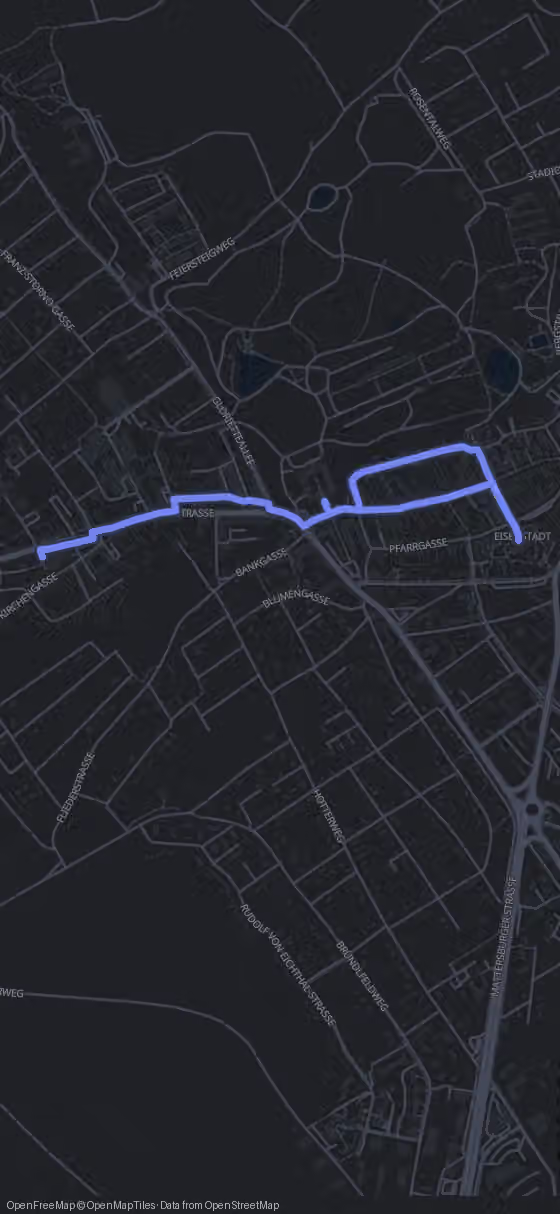
Route map for the Eisenstadt walking tour
Stop 1 of 6
450 m·6 min
Bergkirche Eisenstadt
Head east and downhill toward the Oesterreichisches Juedisches Museum
Welcome to Eisenstadt. I'm Alex, and a quiet house here became a national first for preserving Jewish history.
Try this tour with Alex

This Eisenstadt walk at a glance

Six stops lead from the Bergkirche Eisenstadt past the Oesterreichisches Juedisches Museum, the Hauptstrasse Eisenstadt and the Domkirche St. Martin to the Haydn-Haus Eisenstadt and Schloss Esterházy: 1.8 km, 24 minutes of pure walking, about five hours with the visits that pay off.

Both churches and the Hauptstrasse are free; the two museums and the palace charge admission. Route, map and GPS navigation run free in your browser, and the AI Tour Guide comes along if you want a conversation on the way.

Open free GPS & optional AI Tour Guide
This short shows highlights of the route. All 6 stops follow below.

The Route

Walking map of Eisenstadt: six stops on 1.8 km

6 stops 1.8 km 24 min walking
Tap to load interactive map

The 6 stops along this route

  1. Bergkirche Eisenstadt, stop 1 on the self-guided walking tour
    1Bergkirche Eisenstadt
  2. Oesterreichisches Juedisches Museum in Eisenstadt, stop 2 on the self-guided walking tour
    2Oesterreichisches Juedisches Museum
  3. Hauptstrasse Eisenstadt, stop 3 on the self-guided walking tour
    3Hauptstrasse Eisenstadt
  4. Domkirche St. Martin in Eisenstadt, stop 4 on the self-guided walking tour
    4Domkirche St. Martin
  5. Haydn-Haus Eisenstadt, stop 5 on the self-guided walking tour
    5Haydn-Haus Eisenstadt
  6. Schloss Esterházy in Eisenstadt, stop 6 on the self-guided walking tour
    6Schloss Esterházy
  7. That's the full route.

    Walk it with an AI Tour Guide talking you through every one of these streets.

    Start free in your browser
    You made it

Your Eisenstadt walking tour, from Haydn's tomb to the palace

  1. 1

    Bergkirche Eisenstadt

    Bergkirche Eisenstadt, stop 1 on the self-guided walking tour

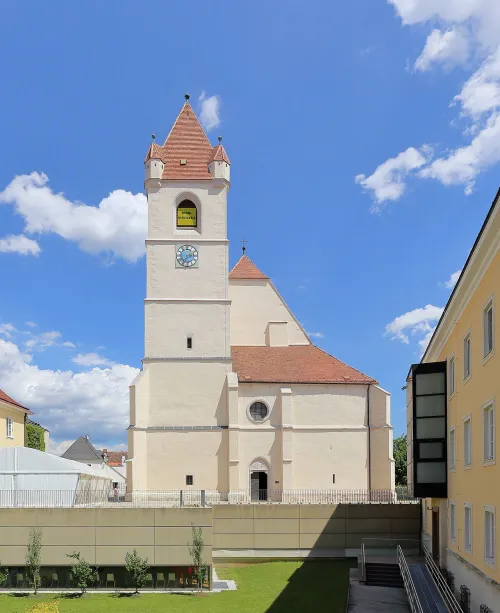
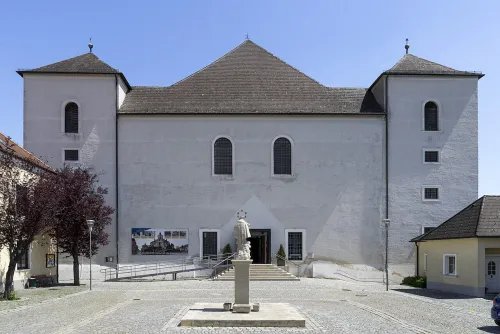
    The Bergkirche looks unusual from the first glance, and it is: it is built in two parts. The church itself is roughly a square, raised on a hill that was made taller with earth heaped up during construction, which is one way to read the "Berg" in its name. Prince Paul Esterházy built it in the early 18th century, when Eisenstadt was the seat of his family.

    Go inside, it is free. The baroque interior plays with painted illusion in pinks and greys, and the dome was frescoed in the late 18th century by J. W. Baumgartner. In a side chapel stands a large marble sarcophagus: the tomb of Joseph Haydn, who spent much of his career working for the Esterházys. Most of his remains have rested here since 1932; his skull only joined them in 1954, with full ceremony.

    Look for the organ too. It is the original instrument by the Viennese maker Gottfried Malleck, restored to the state it was in when Haydn and Beethoven played it at premieres of well-known works. Its old console now sits in the Haydn Museum, which you reach later on this walk.

    East of the church rises the Kalvarienberg, an artificial hill full of passages and grottoes where painted statues show the 24 Stations of the Cross. Franciscan friars made them more than 250 years ago, in loud, vivid colours, and the hill was once a pilgrimage goal praised as the eighth wonder of the world. Visitors still move through it station by station; give it time if folk piety interests you.

    From here it is 450 m, about 6 minutes, to the Jewish Museum, through the old Jewish quarter of Unterberg.
    Hours
    Daily 08:00–17:00
    Price
    free
  2. 2

    Oesterreichisches Juedisches Museum

    Oesterreichisches Juedisches Museum in Eisenstadt, stop 2 on the self-guided walking tour

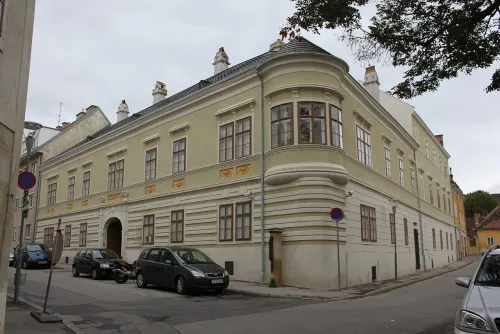
    The Österreichisches Jüdisches Museum at Unterbergstraße 6 has a story of its own. Kurt Schubert, a Catholic professor who led Judaic studies at the University of Vienna, founded it in 1972, and it became the first Jewish museum to open in Austria after 1945. In the climate of the post-war years such projects were often private, money was short, and that is why it ended up in Eisenstadt rather than Vienna. At first it served scholars more than visitors, built around yearly symposiums, and it paved the way for later institutions such as the Jewish Museum Vienna.

    The building matters as much as the collection. This is the Wertheimerhaus, built in 1719 by Samson Wertheimer, a major businessman who served the imperial court in Vienna and was high rabbi in Hungary; the house was commissioned and financed through his service to the Esterházy family. Inside he had a private synagogue with a separate room for women, and that synagogue is part of the exhibition today.

    Going in is worth it if you want to understand the Jewish side of a town usually told only through princes and Haydn. The museum charges admission and is not open every day, so check before you plan around it.

    Next comes the Hauptstrasse, 480 m and 6 minutes away; on the way you pass the Landesmuseum Burgenland and the Markthalle Kulinarium Burgenland.

    Local name
    Österreichisches Jüdisches Museum
    Hours
    Sun–Thu 10:00–17:00 (last admission 16:15), Fri–Sat closed (seasonal 02 May – 26 Oct)
    Price
    8.50 EUR regular, 6.00 EUR reduced
    Website
    ojm.at ↗
  3. 3

    Hauptstrasse Eisenstadt

    Hauptstrasse Eisenstadt, stop 3 on the self-guided walking tour

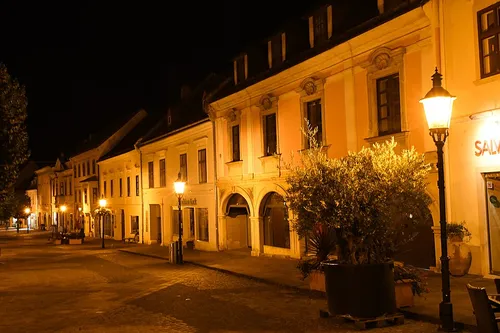
    The Hauptstrasse is the town's pedestrian spine, a shopping street through the historic centre, open at any hour and free. After a church, a hill of grottoes and a museum, this is your pause: nothing here runs on opening times and nothing needs a ticket.

    Sit down, get something to drink and look at your watch. Ahead lie the cathedral, the Haydn-Haus and the palace, close together, so this is the moment to decide whether you go inside all three or keep the palace for the outside view. The cathedral is only 260 m away, about 4 minutes.

    Hours
    24/7
    Price
    Free
  4. 4

    Domkirche St. Martin

    Domkirche St. Martin in Eisenstadt, stop 4 on the self-guided walking tour

    The cathedral carries the town's oldest name. A chapel to Saint Martin of Tours is first recorded in 1264, the year Eisenstadt got its original names: Kleinmartinsdorf in German, Kismarton in Hungarian, "Little Martin's village". Remains of the Romanesque foundation survive under today's choir.

    Look at the building as a fortress. In 1460, with a Turkish attack expected after the fall of Constantinople, town captain Johann Siebenhirter had it rebuilt as a fortified church, and the Gothic work was finished in 1522. A great fire in 1589 left it badly damaged for almost 30 years; rebuilding began in 1610 and ended in 1629.

    Inside, find the large altarpiece by Stefan Dorffmeister from 1777, "The Transfiguration of St. Martin", and the organ that Malleck installed a year later to Joseph Haydn's instructions. The church only became a cathedral in 1960, when the diocese was created; its windows are modern: Franz Deéd's in the presbytery on Christ the King, Margret Bilger's in the nave on the Revelation of St John. The last remodelling, by the architects Lichtblau-Wagner, was consecrated on 12 April 2003.

    Entry is free; 15 minutes are enough unless the windows hold you. The Haydn-Haus is 280 m on, about 4 minutes.

    Hours
    Mon–Fri 09:00–16:30, Sat (Apr–Oct) 09:00–13:00
    Price
    free
  5. 5

    Haydn-Haus Eisenstadt

    Haydn-Haus Eisenstadt, stop 5 on the self-guided walking tour

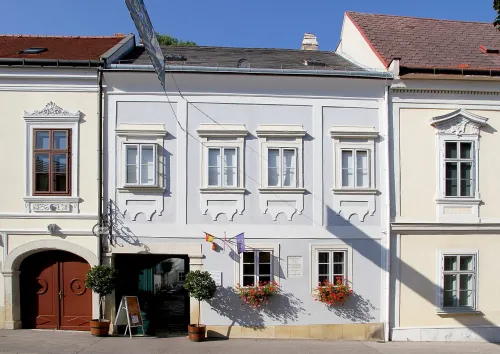
    This modest grey house at Joseph-Haydn-Gasse 21 belonged to Joseph Haydn from 1766 to 1778, while he was Kapellmeister at the Esterházy court. From the street you see a two-storey front, four windows wide, with plain white baroque decoration upstairs and a wide gateway into a small courtyard. A Gothic window uncovered in the front house points to the 16th century; the year 1747 at the cellar entrance marks the last rebuilding before Haydn's time, and a memorial plaque has hung on the house since 1898.

    The story of the purchase is very human. Haydn bought the house in instalments from a widow, who kept living on the ground floor until she died in 1767. When the rest of the price fell due, he had to ask his employer for a loan. The prince also covered the repairs when two town fires hit the house, in 1768 and 1776. Haydn and his wife lived in the five rooms upstairs, and his pupils moved in below. In 1778, when the court moved to Eszterháza, he sold it.

    Today the house holds the Haydn Museum, including the old console of the Bergkirche organ. Go in if Haydn is part of why you came; it charges admission. From here it is 360 m, 5 minutes, to the palace.

    Hours
    Tue–Fri 09:00–17:00, Sat–Sun & holidays 10:00–17:00, Mon closed
    Price
    9 EUR regular, 7 EUR reduced
  6. 6

    Schloss Esterházy

    Schloss Esterházy in Eisenstadt, stop 6 on the self-guided walking tour

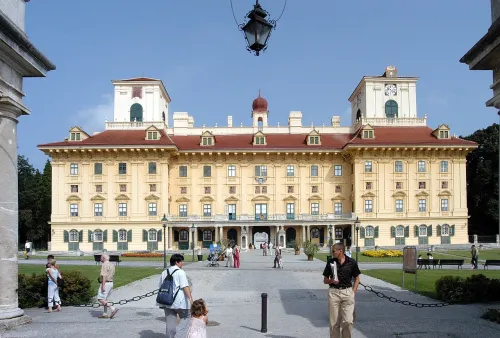
    The palace started as a real castle in the late 13th century. In 1364 it passed to the powerful Kanizsai family, and in 1371 King Louis made it a medieval city castle on the northwest edge of Kismarton. The Esterházys took over in 1622, and for more than 300 years it remained their main residence and the centre of their administration.

    The front you see is the work of Paul Esterházy, who inherited the palace after his elder brother Ladislaus fell at the battle of Vezekény in 1652. His additions took almost ten years, and the rich stucco is by the Italian master Andrea Bertinalli. Later generations changed mostly the interiors; the moats disappeared in the early 19th century, and Nikolaus II, a spendthrift, set out to turn the residence into a Classical building.

    This is where Haydn worked for most of his life, which ties together everything on the route: the prince's church with his tomb, the cathedral organ built to his instructions, the house the prince helped him pay for. If you take only one ticket in Eisenstadt, this is the one for the Esterházy story, with or without a guided tour. The Bergkirche, where you started, is a short walk west.

    Hours
    Daily 10:00–16:00
    Price
    19 EUR adults without tour (25 EUR with tour), 16 EUR reduced (21 EUR with tour)
Walking tour route map of Eisenstadt Route loaded
Bergkirche EisenstadtOesterreichisches Juedisches MuseumHauptstrasse EisenstadtDomkirche St. Martin+2
All 6 stops are already on the map.
You just press start.
AI Tour Guide

You've read the route. Now walk it with a guide in your ear.

Press start wherever you are, even hundreds of kilometres from Eisenstadt, and the guide begins telling its stories right away. In the city, pick any of the 6 stops to start from: it leads you there, then talks with you the whole route, asking, listening, remembering, and shaping the tour around your answers.

6stops 1.8km 24 minwalking 13languages
▶Start the tour free

Free to start · Runs in your browser · No app, no download

Shorter ways through Eisenstadt

Not everyone has five hours or wants three tickets. These versions keep the same line through town and change only where you go inside.

Free Eisenstadt

Stops: 1, 3, 4, 6

For a tight budget: you walk the whole 1.8 km (24 minutes), go inside the Bergkirche and the cathedral, take your break on the Hauptstrasse and see the Wertheimerhaus, the Haydn-Haus and the palace from the outside. No admission at all, about one and a half hours.

Haydn and the Esterházys

Stops: 1, 5, 6

For music lovers: Haydn's tomb in the Bergkirche, his former home and the palace where he worked. Walking time stays 24 minutes because you follow the full line; the Haydn-Haus and the palace charge admission, and the palace also offers a guided tour. Plan about three hours.

Jewish Eisenstadt and the old town

Stops: 1, 2, 3, 4

For a morning without the palace: the Bergkirche, the museum in the Wertheimerhaus with its private synagogue, a break on the Hauptstrasse and the cathedral. 1,190 m and 16 minutes on foot, only the museum charges admission. Around two and a half hours; check that the museum is open on your day.

How long the Eisenstadt tour takes, with and without museums

The legs are short, between 260 and 480 m, so the clock is set by what you go into, not by walking. A realistic full day looks like this: Bergkirche at 9:15 with the Kalvarienberg (45 minutes), the Jewish Museum at 10:06 (an hour), the Hauptstrasse at 11:12 for half an hour, the cathedral at 11:46 (15 minutes), the Haydn-Haus at 12:05 (45 minutes) and the palace at 12:55 for about 75 minutes. You are done around 14:10.

The route runs from one end of the old town to the other and finishes at Schloss Esterházy, which sits a short walk east of the Bergkirche, so you end close to where you began. The free version takes about one and a half hours, the Haydn version about three, the Jewish Eisenstadt morning about two and a half.

Before you set off in Eisenstadt

  • Start and finish: The recommended start is the Bergkirche Eisenstadt, the finish is Schloss Esterházy. You can join at any stop; the order here is simply the one that works best.
  • Best day: Check opening days before you go: the Jewish Museum, the Haydn-Haus and the cathedral are not open for visits every day, and the museum keeps seasonal hours.
  • Time of day: Start around 9:15. A morning start leaves room for everything on the route, palace included.
  • Costs: The Bergkirche, the cathedral and the Hauptstrasse are free. The Jewish Museum, the Haydn-Haus and the palace charge admission, with reduced tickets available and an optional guided tour at the palace. The AI Tour Guide starts with 100 free credits, then either €19.99 for this tour with no time limit or €5 per hour.
Walking tour route map of Eisenstadt
AI Tour Guide

Your guide is ready whenever you start walking

Press start and a voice AI Tour Guide takes it from here: leading the route through Eisenstadt, telling the stories, and turning your walk into a real back-and-forth conversation. No app or download is needed; it runs in your browser.

6stops 1.8km 24 minwalking 13languages
▶Start the tour free

Free to start · Runs in your browser · No app, no download

What the AI Tour Guide adds in Eisenstadt

This route is a story of one family and one composer told across six buildings, and the AI Tour Guide keeps that thread running as a conversation: it greets you at the Bergkirche, tells the stories as you walk, asks what draws you in, remembers whether it's Haydn, the Esterházys or Jewish history, and leans the talk that way. Ask it why Haydn's skull reached his tomb 22 years after the rest of him, or what Margret Bilger's windows in the cathedral show scene by scene, and interrupt whenever something catches your eye.

A Real Conversation A voice AI Tour Guide greets you, leads the whole route, and tells the stories and facts as you walk, asking what you want to see and keeping a real conversation going. Not a recording you press play on.
Map Navigation Follow the route on the map and walk at your own pace. You choose where to start and when to move to the next stop.
Ask Anything Curious about a building you pass? Ask your AI Tour Guide on the spot and the conversation carries on.
13 Languages Switch language anytime. No separate tour needed.
Start free in your browser

Common questions about walking Eisenstadt

Is the Jewish Museum open outside the summer season?

The museum keeps seasonal opening hours. If you visit outside the summer, ask the museum before planning your day around it; the rest of the route works without it.

Is the guided palace ticket worth the extra cost?

The guided ticket costs more than the plain one, for regular and reduced tickets alike. Take it if you want the rooms explained by someone on site; if you mainly want to see the building and its baroque stucco at your own pace, the plain ticket is enough.

Can I combine Eisenstadt with Vienna?

Vienna lies 42 km away, and this walk needs only 24 minutes on foot, so Eisenstadt fits a day out with the free version or the Haydn version. For the capital itself there is a separate walking tour of Vienna.

Is there another city nearby with a walking route?

Bratislava is 55 km from Eisenstadt and has its own route: walking tour of Bratislava.

Is the tour really free?

Yes. The whole tour is free: the route, the interactive map and the navigation cost you nothing. Only the voice AI Tour Guide is optional and paid: you test it with 100 free credits, then you pay either €5 per hour or €19.99 for this whole tour, with no time limit. Admission to 3 of the 6 stops is not included: Oesterreichisches Juedisches Museum, Haydn-Haus Eisenstadt and Schloss Esterházy charge their own entry fees.

Do I need to download an app?

No. Everything runs in your phone browser. Open the route and start walking, no download and no sign-up required.

Do I need to book the walking tour in advance?

No booking needed. This self-guided tour is available anytime. Open the route in your browser and start walking. The AI Tour Guide works instantly, no app, no reservation required.

What languages is the AI Tour Guide available in?

The AI Tour Guide speaks 13 languages, so you take the tour in your own language and can switch at any time.

Can I skip stops or change the route?

Yes. Skip any stop, spend extra time at places you like, or start the route from any point. It is your walk, you set the pace.
Image credits
▶ Start free in your browser Runs in your browser, no app, no download