Free Walking Tour Gubbio: Palaces and Monte Ingino

Roman arches in the grass, a duke's palace, the climb to Saint Ubaldo's basilica on the mountain and the Gothic heart of Piazza Grande, all on foot.

9 Stops 5.8 km ~1 h 44 min walking
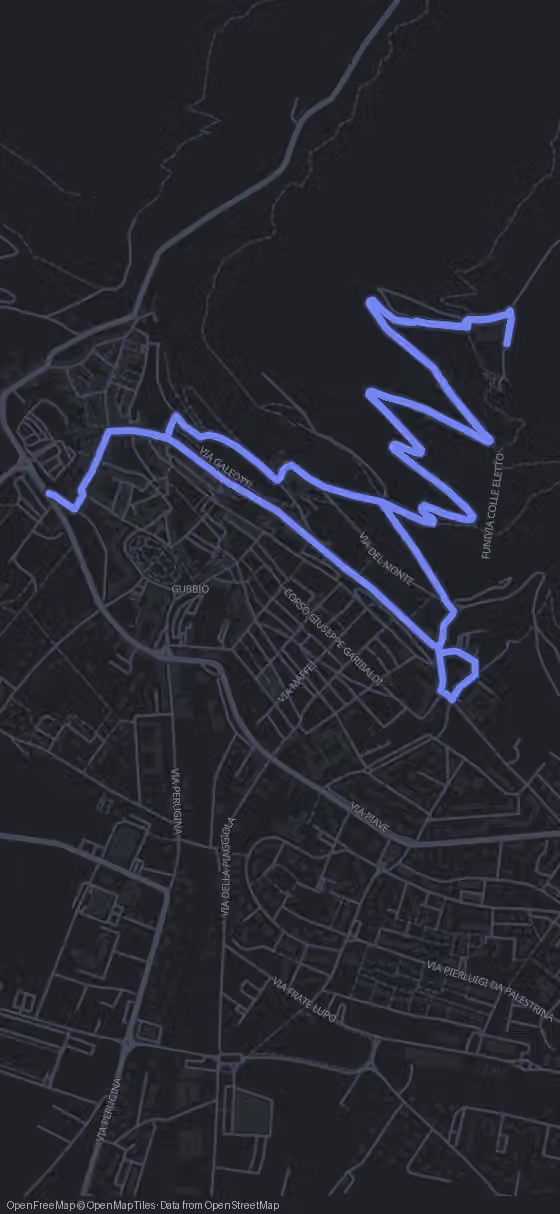
Route map for the Gubbio walking tour
Stop 1 of 9
590 m·7 min
Roman Theatre of Gubbio
Head east and uphill toward Palazzo Ducale di Gubbio
Buongiorno, welcome to Gubbio. I'm Alex, and here a public square quite literally hangs over the valley.
Try this tour with Alex

This Gubbio Route at a Glance

Nine stops on 5.8 km with 1 h 44 min of pure walking: from the Roman Theatre of Gubbio up to the Basilica di Sant'Ubaldo on Monte Ingino and back down to the Palazzo del Bargello. With visits inside, plan a good half day.

The streets, the Cathedral of Gubbio, the basilica and Piazza Grande are free; the theatre, the Palazzo Ducale di Gubbio and the Palazzo dei Consoli charge entry. The GPS route in your browser costs nothing, and the AI Tour Guide is optional.

Open free GPS & optional AI Tour Guide
This short shows highlights of the route. All 9 stops follow below.

The Route

Walking Map of Gubbio, from Theatre to Bargello

9 stops 5.8 km 1 h 44 min walking
Tap to load interactive map

The 9 stops along this route

  1. Roman Theatre of Gubbio, stop 1 on the self-guided walking tour
    1Roman Theatre of Gubbio
  2. Palazzo Ducale di Gubbio, stop 2 on the self-guided walking tour
    2Palazzo Ducale di Gubbio
  3. Cathedral of Gubbio, stop 3 on the self-guided walking tour
    3Cathedral of Gubbio
  4. Basilica di Sant'Ubaldo in Gubbio, stop 4 on the self-guided walking tour
    4Basilica di Sant'Ubaldo
  5. Porta Romana in Gubbio, stop 5 on the self-guided walking tour
    5Porta Romana
  6. Funivia di Gubbio, stop 6 on the self-guided walking tour
    6Funivia di Gubbio
  7. Palazzo dei Consoli in Gubbio, stop 7 on the self-guided walking tour
    7Palazzo dei Consoli
  8. Piazza Grande in Gubbio, stop 8 on the self-guided walking tour
    8Piazza Grande
  9. Palazzo del Bargello in Gubbio, stop 9 on the self-guided walking tour
    9Palazzo del Bargello
  10. That's the full route.

    Walk it with an AI Tour Guide talking you through every one of these streets.

    Start free in your browser
    You made it

Your Gubbio Walking Tour, from Roman Arches to Crossbows

  1. 1

    Roman Theatre of Gubbio

    Roman Theatre of Gubbio, stop 1 on the self-guided walking tour

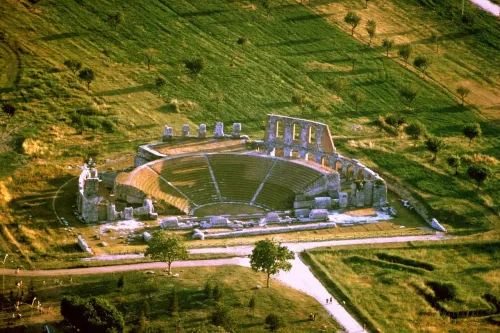
    You start in a grassy park at the edge of the old town, where the arches of the Roman Theatre of Gubbio rise out of the lawn. This was the theatre of Iguvium, the Roman town that became Gubbio, built in the 1st century. What stands today are limestone arcades; originally they formed a two-storey semicircle of 27 arches, and the seating held close to 6,000 people.

    Look at the lower arcade for the vomitorium, the roofed corridor that moved the crowds in and out. In front of the seats, the orchestra was once separated from the stage by a tall podium. Keep in mind that the shape you walk around owes a lot to restorations of the past two centuries, so read it as a reconstruction resting on Roman foundations.

    A ticket makes sense if you want to walk among the arches rather than look at them from the park. Nearby, a small museum, the antiquarium, displays archaeological finds from Gubbio, and in summer the theatre still hosts some outdoor performances.

    From the park it is 590 m, about 11 minutes, into the medieval streets and up to the Palazzo Ducale.
    Local name
    Teatro romano di Gubbio
    Hours
    Tue & Fri 08:30–13:30, Wed & Thu 14:10–19:30, Sat & Sun 08:30–19:30, Mon closed (last entry 30 min before closing)
    Price
    3 EUR full, 2 EUR reduced (ages 18-25); free under 18. Electronic payment only (automatic ticket machine)
  2. 2

    Palazzo Ducale di Gubbio

    Palazzo Ducale di Gubbio, stop 2 on the self-guided walking tour

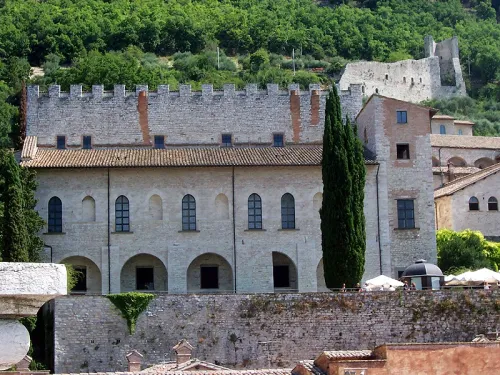
    The Palazzo Ducale di Gubbio, also called the Corte Nuova, faces the cathedral and comes as a surprise in a town this medieval: it is Gubbio's one Renaissance palace. Federico da Montefeltro, Duke of Urbino, had it built from 1470 over older medieval buildings, to plans by the Sienese architect Francesco di Giorgio Martini.

    Two wings, one turned toward the valley and one toward the mountain, are joined by an airy central courtyard. Watch how the warm brick plays against the grey pietra serena, and look closely at the capitals, doorways and fireplaces: their carved friezes are by Bernardino di Nanni dell'Eugenia.

    Inside, the original furnishings are long gone and the ceiling beams were remade, yet details survive: two 17th-century wooden cabinets, inlaid doors and window shutters bearing the Montefeltro arms, and a series of music-making angels. The dukes' rooms keep their monumental fireplaces, and you can see the bath of Battista Sforza, Federico's wife, who died here.

    The palace's treasure is missing. Its studiolo, a small study panelled in wood inlay designed by Francesco di Giorgio and carried out by the Florentine Giuliano da Maiano, was finished under Guidobaldo I and took his name. After several changes of owner it was sold in 1939 to the Metropolitan Museum in New York. In Urbino, the duke's main palace has a studiolo of the same kind.

    A ticket is worth it if Renaissance craftsmanship is your interest. The cathedral is only 130 m away, 3 minutes on foot, and you pass the Giardini Pensili on the way.

    Hours
    Mon 14:00–19:30, Tue–Sun 08:30–19:30 (last entry 30 min before closing)
    Price
    5 EUR full, 2 EUR reduced (EU citizens 18-25); free under 18. Electronic payment only
  3. 3

    Cathedral of Gubbio

    Cathedral of Gubbio, stop 3 on the self-guided walking tour

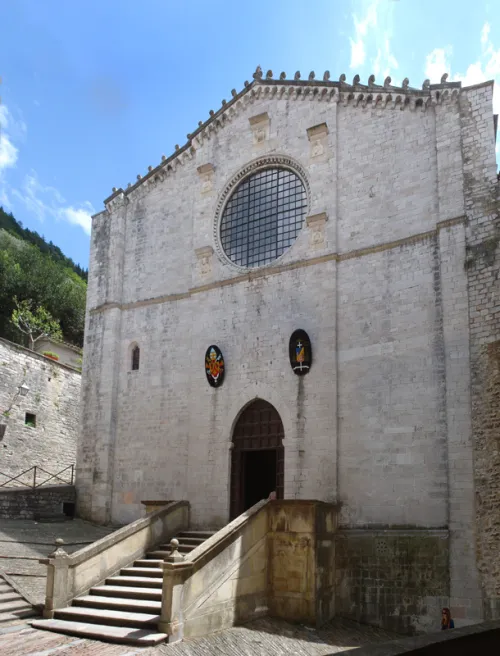
    The Cathedral of Gubbio is dedicated to Saints Marianus and James, martyred at Lambaesis in Numidia. Outside it still wears its original Gothic face, flanked by a sturdy medieval bell tower. Work began around 1190 to plans by Giovanni da Gubbio, on land granted by Bishop Bentivoglio and over a Romanesque church older than the year 1000; the church was essentially finished in 1229 and enlarged in 1336.

    The facade dates from the time of Bishop Pietro Gabrielli in the 14th century, and he had himself buried in a niche on its inner side. Above the pointed doorway, a large window is framed by five 13th-century reliefs: the symbols of the four evangelists and the Lamb of God.

    Inside you find the typical Gubbio layout: a single nave crossed by ten massive pointed arches, a timber truss roof and a rectangular choir. Between 1913 and 1918 restorers removed the Renaissance and Baroque additions, among them twenty Baroque altars paid for by the town's leading families. The paintings in the apse and on the triumphal arch are by Augusto Stoppoloni from those same years.

    More recent restoration brought to light a Gothic tomb, two stone statues of saints and, above all, the original altar: a Roman sarcophagus that medieval craftsmen dressed with small pink marble columns. The relics of the two saints still rest inside it. Entry is free, so go in even if you only have ten minutes.

    Now the route climbs: 1940 m, about 42 minutes, up Monte Ingino to the Basilica di Sant'Ubaldo.

    Local name
    Duomo di Gubbio
    Hours
    Daily: 08:22–19:22
    Price
    Free
  4. 4

    Basilica di Sant'Ubaldo

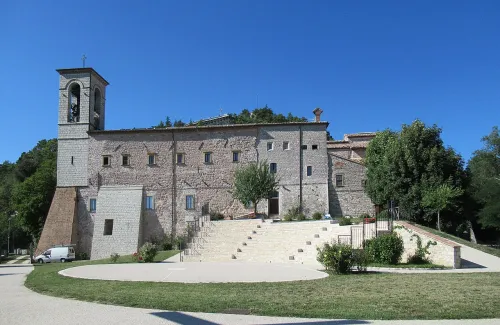
    Basilica di Sant'Ubaldo in Gubbio, stop 4 on the self-guided walking tour

    At the top waits the Basilica di Sant'Ubaldo, the sanctuary on Monte Ingino that keeps the body of Gubbio's patron saint, Ubaldo. It has been a minor basilica since July 1919. The outside is plain; the interest begins once you pass the portal.

    Building started in 1513 over a small earlier church of Saint Ubaldo and the parish church of Saints Gervasius and Protasius, backed by the duchesses of Urbino, Elisabetta and Eleonora Gonzaga, and by Pope Julius II. It was entrusted to the Lateran canons regular, the order Ubaldo himself had belonged to. Passionist fathers took over in 1786, Franciscan friars followed after the Napoleonic suppressions, and on 6 January 2020, after 234 years, the canons returned.

    You first enter a broad brick cloister with arcades and cross vaults, where the lunettes still show traces of 16th-century frescoes. The pillars beside the church entrance stand on bases of palombino marble carved with the arms of the Montefeltro and of Gubbio and the monogram of Christ. Five doors lead in; the three central ones keep their carved pietra serena portals and original carved wooden leaves.

    The church has five aisles, all drawn toward the neo-Gothic high altar of 1884 with its imitation mosaic. Eight small statues of saints tied to the town stand on top, and above them is the urn holding Ubaldo's body, preserved intact. Entry is free, and this is the stop that repays the climb.

    The way back down to Porta Romana is 2210 m, about 35 minutes.

    Hours
    Daily 08:00–19:30
    Price
    Free
  5. 5

    Porta Romana

    Porta Romana in Gubbio, stop 5 on the self-guided walking tour

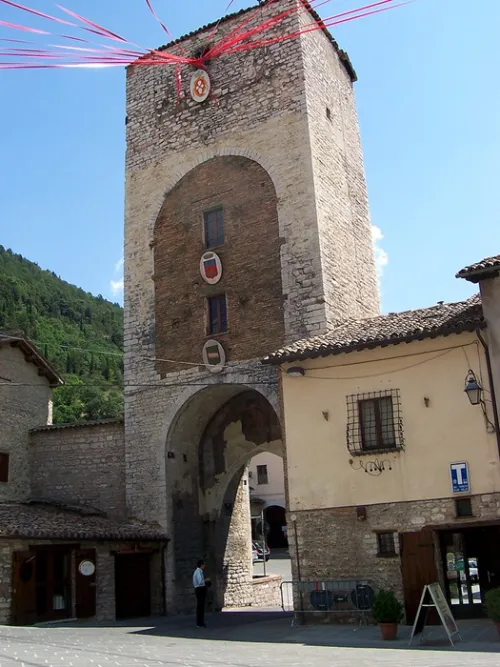
    Back in town, you pass through Porta Romana, a medieval gate that carries a Roman name. Gubbio's actual Roman chapter lies in the park where you started; here the stone belongs to the walled Middle Ages.

    The gate stands on a public street, open at all hours and free. Give it a proper look as you walk through, because from here the route turns back toward the civic heart of Gubbio and the sights crowd close together. The cable car station is 120 m on, a 2 minute walk.

    Hours
    Open 24/7
    Price
    Free
  6. 6

    Funivia di Gubbio

    Funivia di Gubbio, stop 6 on the self-guided walking tour

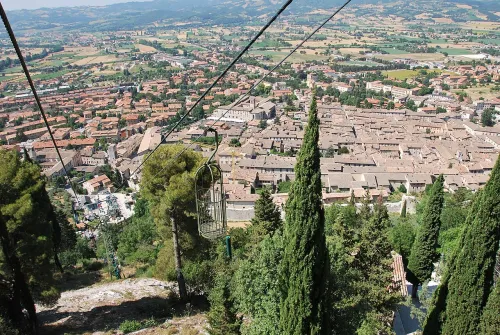
    Here is the quirk of this route: you meet the Funivia di Gubbio after the mountain, not before it. For most visitors the cable car is the way up to Sant'Ubaldo, and its lower station sits right by the gate you just passed.

    You have two choices. If the basilica deserves a second, slower visit, ride up and back again. Otherwise simply walk on, which is what the route assumes. Before planning a ride, check the timetable at the station, since it changes through the year.

    From the station it is 510 m, about 7 minutes, to the Palazzo dei Consoli, passing the Chiesa di San Francesco della Pace and the Museo Diocesano di Gubbio.

    Hours
    Sep 1-13: daily continuous 09:30–19:00; Sep 14-30: Mon–Fri 09:30–13:15 & 14:30–19:00, Sat–Sun continuous 09:00–19:30; seasonal variation throughout the year (closed Wednesdays in winter Nov–Mar)
    Price
    7 EUR round trip
  7. 7

    Palazzo dei Consoli

    Palazzo dei Consoli in Gubbio, stop 7 on the self-guided walking tour

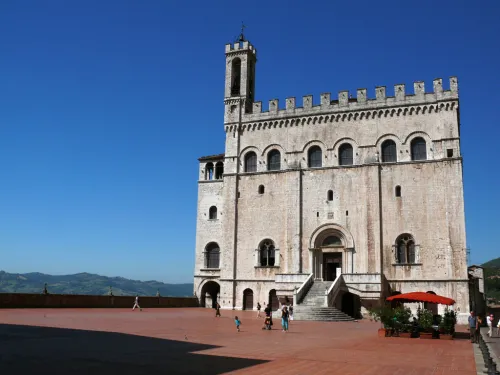
    The Palazzo dei Consoli is the civic face of medieval Gubbio: a Gothic palace raised between 1332 and 1349 to designs by Angelo da Orvieto. It sits on a huge platform built against the hillside, so the building looms over the town, and the square in front of it is really the top of that terrace.

    The facade on the square is white limestone, now tinted by age. Pilasters divide the first floor into thirds; at ground level a massive round-arched portal sits between mullioned windows. Higher up the windows come in pairs, and the crown of merlons rests on a frieze of pointed arches. A square bell tower and a narrow loggia face the valley.

    The portal opens into the arengo, a big barrel-vaulted hall where the citizens met in assembly in the days of the free commune. At the base of the arch, look for four mountains topped by an iron lily: Gubbio's heraldic emblem, which turns up again on the fountain by the Palazzo del Bargello. Municipal records put the building cost at 16,336 lire of Ravenna; in 1888 the historian Lucarelli reckoned that as 643,000 Italian lire.

    Go in if you want to stand in the hall where the medieval town governed itself. During special exhibitions a combined ticket costs more than standard admission.

    Piazza Grande is right outside, 50 m and a minute away.

    Hours
    Daily 10:00–13:00 & 15:00–18:00 (Apr–Oct weekdays); weekends and holidays continuous 10:00–18:00 (ticket office closes 40 min before museum closure)
    Price
    10 EUR full (Biglietto Unico / Mostra Francesco a Gubbio, May 9 - Sep 13, 2026), 7 EUR reduced A (19-25, >15 pax), 5 EUR reduced B (8-19); standard non-exhibition admission is 8 EUR full
  8. 8

    Piazza Grande

    Piazza Grande in Gubbio, stop 8 on the self-guided walking tour

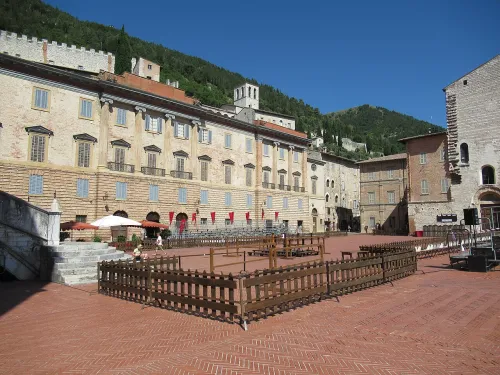
    Walk out and you are on Piazza Grande, less a square than a terrace: the panoramic shelf Gubbio built on its great platform for looking outward. It is open at every hour, free and without gates.

    Opposite the Palazzo dei Consoli stands the Palazzo Pretorio, meant to house the town's prefecture; tradition holds that both palaces came from the same architect. Also on the square is the massive neoclassical brick Palazzo Ranghiasci-Brancaleoni, now a hotel.

    This is the natural pause of the walk. Stand at the edge of the terrace, take in the view and move on when you have had your fill. The Palazzo del Bargello is 230 m away, about 3 minutes down Via dei Consoli.

    Hours
    Open 24/7
    Price
    Free
  9. 9

    Palazzo del Bargello

    Palazzo del Bargello in Gubbio, stop 9 on the self-guided walking tour

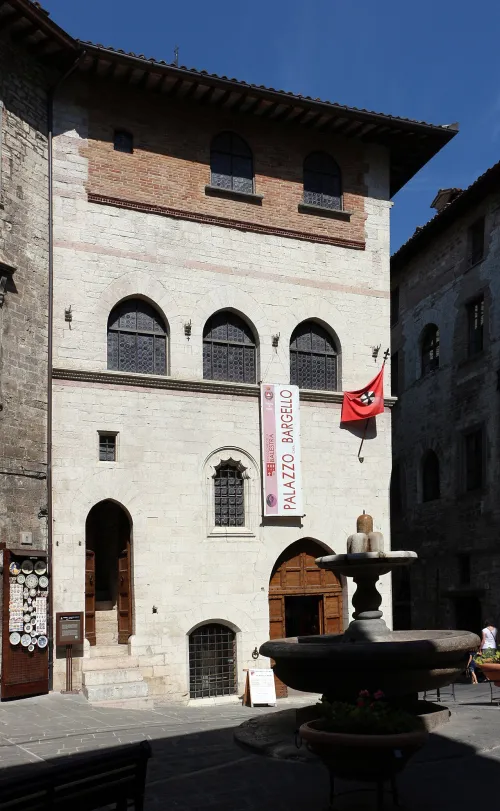
    The walk ends at the Palazzo del Bargello on Via dei Consoli, a three-storey Gothic house from the early 1300s in remarkably good condition. Tradition says it was the home of the bargello, the chief of the local police. Today it is the seat of the Società Balestrieri di Gubbio, the town's crossbowmen, and of the crossbow museum.

    It follows the classic Gubbio house plan with two entrances: the main one led to the shops and cellars, the smaller one to the living quarters. Fine string courses mark the floors, the walls are dressed stone throughout, and one window rests on a curved stone support.

    Beside the large portal, find the narrow porta del morto, the door of the dead, its threshold a little above street level. Tradition says such doors stayed bricked up and were opened only to carry out the coffin of someone who had died in the house. Another reading sees it as an ordinary door to the living rooms, reached by a movable wooden ladder that was taken in at night for safety; once the feuds between Gubbio's families calmed, people walled up the cramped door and used the handier storeroom entrance, reopening the small one only for a coffin.

    In front of the palace stands its namesake fountain from the 16th century, rebuilt in 1862 and known as the Fontana dei Matti, the fountain of the madmen. The exterior is free at any hour; the crossbow exhibition inside charges a small admission. Worth it if medieval weapons and Gubbio's crossbow tradition interest you.

    Hours
    Open 24/7 (exterior); interior crossbow exhibition Tue–Sun 10:30–13:00 & 15:00–18:00 (summer/seasonal)
    Price
    Free (exterior viewing); interior crossbow exhibition 3 EUR full, 2 EUR reduced
Walking tour route map of Gubbio Route loaded
Roman Theatre of GubbioPalazzo Ducale di GubbioCathedral of GubbioBasilica di Sant'Ubaldo+5
All 9 stops are already on the map.
You just press start.
AI Tour Guide

You've read the route. Now walk Gubbio with a guide in your ear.

Press start wherever you are, even hundreds of kilometres from Gubbio, and the guide begins telling its stories right away. In the city, pick any of the 9 stops to start from: it leads you there, then talks with you the whole route, asking, listening, remembering, and shaping the tour around your answers.

9stops 5.8km 1 h 44 minwalking 13languages
▶Start the tour free

Free to start · Runs in your browser · No app, no download

Shorter Ways to Walk Gubbio

Not every day leaves room for the mountain. These shorter versions keep the same order and the same walking times between stops.

Lower town morning

Stops: 1, 2, 3

For a first look with time for interiors: the Roman arches, the duke's Renaissance palace and the cathedral facing it. 14 minutes of walking; tickets for the theatre and the Palazzo Ducale, the cathedral is free.

The pilgrims' climb

Stops: 3, 4, 5

For walkers who mainly want Sant'Ubaldo: from the cathedral up Monte Ingino to the basilica and back down to Porta Romana. 77 minutes of walking and no entry fees.

Piazza Grande hour

Stops: 7, 8, 9

For a short visit or a late arrival: the civic palace, its terrace and the Bargello on Via dei Consoli. 4 minutes of walking; a ticket for the Palazzo dei Consoli and, if you like, the crossbow exhibition.

How Long Does the Gubbio Tour Take, Climb Included?

Pure walking time is 1 h 44 min, but most of it sits in one stretch: the climb to Sant'Ubaldo and the way back down take 77 minutes together. Everywhere else the sights are only a few minutes apart.

With time inside the theatre, the Palazzo Ducale, the cathedral, the basilica and the Palazzo dei Consoli, plus a pause on Piazza Grande, count on about five and a half hours. The lower town alone takes just under two hours with its interiors, the climb with a basilica visit about two hours, and the Piazza Grande trio around an hour and a half if you go inside the Consoli.

Before You Set Off in Gubbio

  • Start and end: Start at the Roman Theatre of Gubbio for the recommended order, though you can join at any stop. The walk ends at the Palazzo del Bargello, and the GPS navigation in your browser can lead you back to the start if you want.
  • Best day and time: Plan the day so you find the theatre, the Palazzo Ducale and the Palazzo dei Consoli open, as their hours differ by weekday. Start around 09:00 and you reach the Consoli around 13:00 and the Bargello at about 14:15.
  • Costs: The streets, the cathedral, the basilica and the squares are free. The theatre, the Palazzo Ducale and the Palazzo dei Consoli charge admission; the crossbow exhibition and the cable car are extras.
Walking tour route map of Gubbio
AI Tour Guide

Your Gubbio guide is ready when you are.

Press start and a voice AI Tour Guide takes it from here: leading the route through Gubbio, telling the stories, and turning your walk into a real back-and-forth conversation. No app or download is needed; it runs in your browser.

9stops 5.8km 1 h 44 minwalking 13languages
▶Start the tour free

Free to start · Runs in your browser · No app, no download

What the AI Tour Guide Adds in Gubbio

On this route the AI Tour Guide turns the long walk up Monte Ingino and back into a conversation: it greets you at the theatre, tells the stories of each place, asks what you want more of and remembers it. Ask who Ubaldo was and why Gubbio made him its patron, or how the madmen's fountain earned its name, and it builds on your answers. You start with 100 free credits; after that, take this tour all-inclusive for €19.99 with no time limit, or pay €5 per hour.

A Real Conversation A voice AI Tour Guide greets you, leads the whole route, and tells the stories and facts as you walk, asking what you want to see and keeping a real conversation going. Not a recording you press play on.
Map Navigation Follow the route on the map and walk at your own pace. You choose where to start and when to move to the next stop.
Ask Anything Curious about a building you pass? Ask your AI Tour Guide on the spot and the conversation carries on.
13 Languages Switch language anytime. No separate tour needed.
Start free in your browser

Common Questions About Visiting Gubbio

Can I pay the entry fees in cash in Gubbio?

Not everywhere. The Roman Theatre and the Palazzo Ducale take electronic payment only, and the theatre sells its tickets from an automatic machine, so carry a card.

Do children and young adults pay less?

Yes. The Roman Theatre, the Palazzo Ducale and the Palazzo dei Consoli all have free or reduced tickets for younger visitors; at the Palazzo Ducale the reduction for young adults applies to EU citizens.

Which towns combine well with Gubbio?

Perugia and Assisi are both 31 km away, and Spoleto lies 70 km off; each has its own free walking route.

Is the tour really free?

Yes. The whole tour is free: the route, the interactive map and the navigation cost you nothing. Only the voice AI Tour Guide is optional and paid: you test it with 100 free credits, then you pay either €5 per hour or €19.99 for this whole tour, with no time limit. Admission to 3 of the 9 stops is not included: Roman Theatre of Gubbio, Palazzo Ducale di Gubbio and Palazzo dei Consoli charge their own entry fees.

Do I need to download an app?

No. Everything runs in your phone browser. Open the route and start walking, no download and no sign-up required.

Do I need to book the walking tour in advance?

No booking needed. This self-guided tour is available anytime. Open the route in your browser and start walking. The AI Tour Guide works instantly, no app, no reservation required.

What languages is the AI Tour Guide available in?

The AI Tour Guide speaks 13 languages, so you take the tour in your own language and can switch at any time.

Can I skip stops or change the route?

Yes. Skip any stop, spend extra time at places you like, or start the route from any point. It is your walk, you set the pace.
Image credits
▶ Start free in your browser Runs in your browser, no app, no download