Free Walking Tour Perugia: Fountain, Fortress, Raphael

A medieval fountain fed by water that runs uphill, a papal fortress you cross underground, a Raphael fresco and an Etruscan gate, all on one walk.

11 Stops 3.5 km ~52 min walking
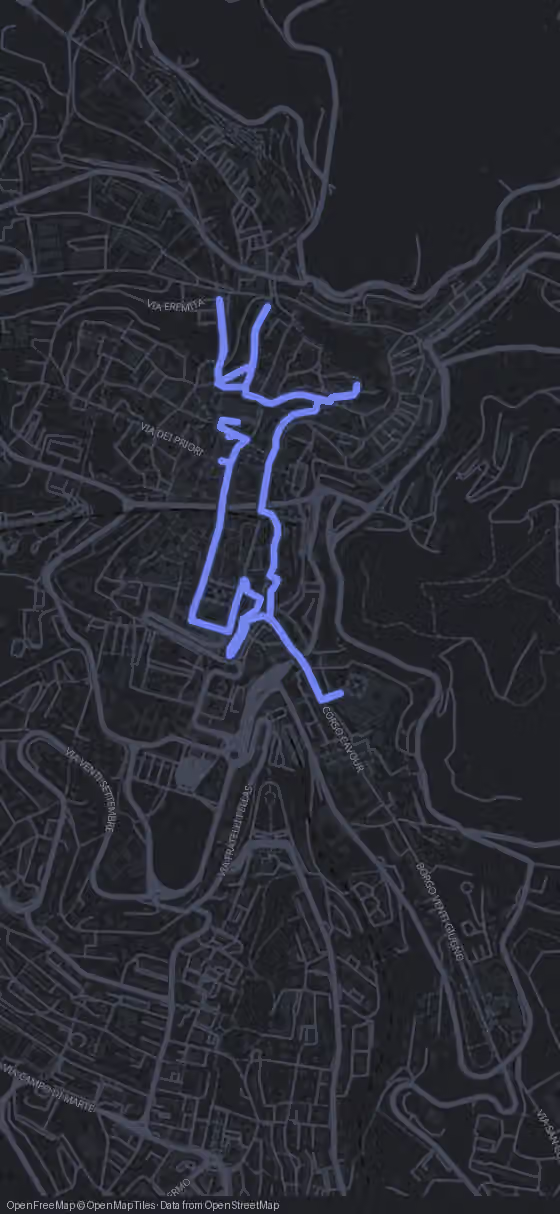
Route map for the Perugia walking tour
Stop 1 of 11
10 m·1 min
Piazza IV Novembre
Head south to the Fontana Maggiore in the center of the square.
Buongiorno, welcome to Perugia. I'm Alex, and people still travel through a medieval quarter buried beneath the city.
Try this tour with Alex

What This Route Covers in Perugia

Eleven stops take you from Piazza IV Novembre through the Rocca Paolina and past the Etruscan Arch to the Cathedral of San Lorenzo: 3.5 km and 52 minutes of pure walking, around four hours with time inside.

Most stops are free; the National Gallery of Umbria charges admission, and the National Archaeological Museum of Umbria is currently closed. The GPS route in your browser is free, and the AI Tour Guide is optional.

Open free GPS & optional AI Tour Guide
This short shows highlights of the route. All 11 stops follow below.

The Route

Walking Map of Perugia's Old Town Route

11 stops 3.5 km 52 min walking
Tap to load interactive map

The 11 stops along this route

  1. Piazza IV Novembre in Perugia, stop 1 on the self-guided walking tour
    1Piazza IV Novembre
  2. Fontana Maggiore in Perugia, stop 2 on the self-guided walking tour
    2Fontana Maggiore
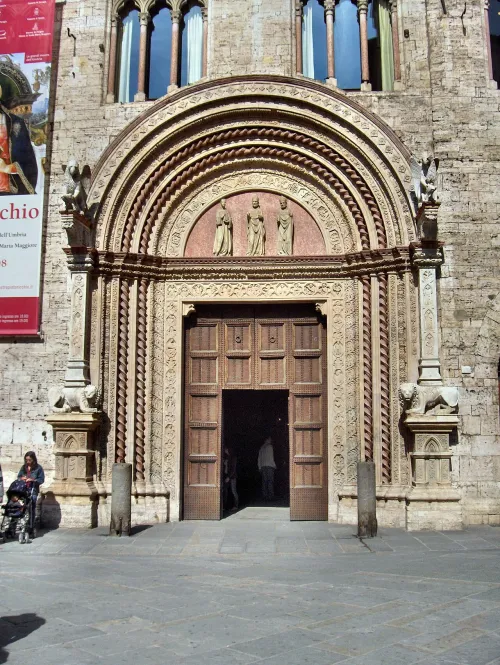
  3. Palazzo dei Priori in Perugia, stop 3 on the self-guided walking tour
    3Palazzo dei Priori
  4. National Gallery of Umbria in Perugia, stop 4 on the self-guided walking tour
    4National Gallery of Umbria
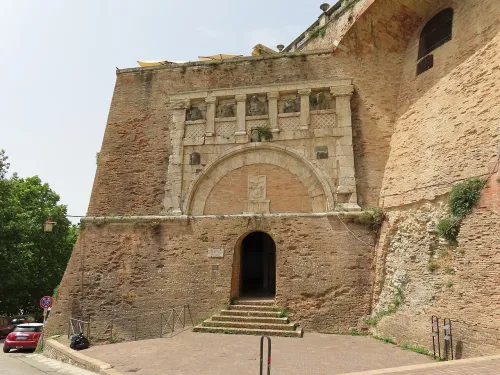
  5. Rocca Paolina in Perugia, stop 5 on the self-guided walking tour
    5Rocca Paolina
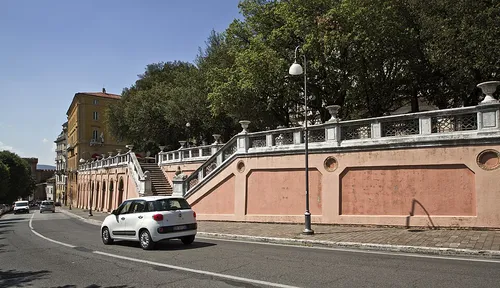
  6. Giardini Carducci in Perugia, stop 6 on the self-guided walking tour
    6Giardini Carducci
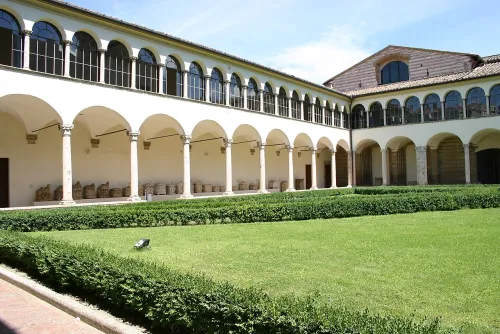
  7. National Archaeological Museum of Umbria in Perugia, stop 7 on the self-guided walking tour
    7National Archaeological Museum of Umbria
  8. Chapel of San Severo in Perugia, stop 8 on the self-guided walking tour
    8Chapel of San Severo
  9. Via dell'Acquedotto in Perugia, stop 9 on the self-guided walking tour
    9Via dell'Acquedotto
  10. Etruscan Arch in Perugia, stop 10 on the self-guided walking tour
    10Etruscan Arch
  11. Cathedral of San Lorenzo in Perugia, stop 11 on the self-guided walking tour
    11Cathedral of San Lorenzo
  12. That's the full route.

    Walk it with an AI Tour Guide talking you through every one of these streets.

    Start free in your browser
    You made it

Your Perugia Walking Tour, Stop by Stop, from Fountain to Cathedral

  1. 1

    Piazza IV Novembre

    Piazza IV Novembre in Perugia, stop 1 on the self-guided walking tour

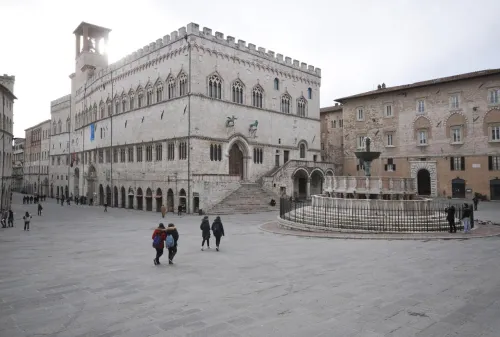
    Stand by the fountain and turn slowly round: this lopsided square is where Perugia has always done its public business. Five main streets of the medieval city meet here, the old Vie Regali, and long before them this was the Roman forum. The ground is not level, and that is part of the effect. The natural slope of the hill sets the cathedral, the town hall and the fountain at different heights, so the square works like a stage on which the city's most important buildings face each other.

    Power gathered here step by step, in the political and the religious sense. In the 10th century the bishop's seat moved to the new church of San Lorenzo, and later the commune put its government buildings on the same square. What you see today is the result of a planned rebuilding of the Platea Comunis, or Platea Magna, carried out by the commune between the 13th and the 15th century to give the old acropolis a new face. In 1253 the square began to be paved in brick, while the work concentrated on enlarging the cathedral and raising the Palazzo dei Priori.

    The square changed shape once more in 1591, when the papal legate Domenico Pinelli cut a new, wider street into it, today's Via Calderini. Its name came much later: after the battle of Castelfidardo, Umbria and the Marche joined the emerging Kingdom of Italy, and the annexation was sealed by the plebiscite of 4 November 1860. Serafino Siepi called it the most beautiful and oldest square in the city, and from the middle you can judge for yourself.

    That middle is your next stop: the Fontana Maggiore stands right in the centre of the square, so you only have to walk up to its rim.
    Hours
    Open 24/7
    Price
    Free
  2. 2

    Fontana Maggiore

    Fontana Maggiore in Perugia, stop 2 on the self-guided walking tour

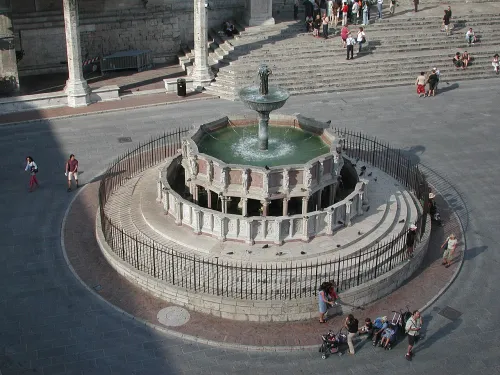
    Walk round the fountain once before you read anything. Two concentric marble basins, both many-sided, sit one above the other, and on top a bronze cup holds a group of three women, the Graces or perhaps nymphs, with an amphora from which the water pours down into the basins. The lower basin has 25 sides with grooved and patterned columns at the corners, and every side carries two relief panels split by a single column. Look for the months of the year: twelve scenes of daily life and farm work, each with its sign of the zodiac, and the labourers shown with real dignity.

    The fountain was built between 1275 and 1277 to celebrate something Perugia had long waited for: water arriving on the hilltop through a new aqueduct. Frà Bevignate da Cingoli designed it, working with the hydraulic engineer Boninsegna Veneziano, who brought the water from Mount Pacciano, several kilometres away, without pumps. The reliefs are by Nicola Pisano and his son Giovanni, the leading sculptors of their time, and the panels went in from 1278. The bronze cup is the work of Rosso Padellaio, a Perugian. The stone came from Assisi, was cut in a workshop and only then assembled here on the square.

    Here is the detail most visitors miss: the earthquake of 1348 damaged the fountain, and when it was put back together the panels went back in random order. So if the months do not follow each other as you walk round, that is history, not your mistake. The fountain was restored again in 1948 and 1949 and once more in the 1990s, and it was admired early on: in 1285 it inspired Jacopo di Grondalo's Sturinalto fountain in Fabriano.

    How the water actually got up here is a story for later, on Via dell'Acquedotto. For now, cross 100 m of the square, a minute's walk, to the long palace facing the fountain.

    Hours
    Open 24/7
    Price
    Free
  3. 3

    Palazzo dei Priori

    Palazzo dei Priori in Perugia, stop 3 on the self-guided walking tour

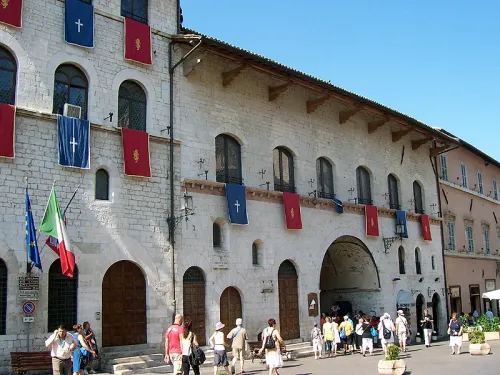
    The Palazzo dei Priori, also called the Palazzo Comunale, is one of the finest public palaces in Italy from the age of the free communes. It fronts the main square and then runs along Corso Vannucci as far as Via Boncambi, so as you walk past it you are following the full length of the medieval town hall.

    The name comes from the Priori, the highest political office in medieval Perugia; this is where they governed. The building has never stopped being a seat of power: part of the city administration still works here today, and the third floor holds the Galleria Nazionale dell'Umbria. Entry to the palace itself is free, so it is worth a look inside even if you are not planning a museum visit.

    Your next stop is in the same building: the entrance to the National Gallery of Umbria is 120 m further on, about two minutes along the palace.

    Hours
    Mon: 09:00–13:00, 15:00–19:00 | Tue: Closed | Wed–Sun: 09:00–13:00, 15:00–19:00
    Price
    Free
  4. 5

    Rocca Paolina

    Rocca Paolina in Perugia, stop 5 on the self-guided walking tour

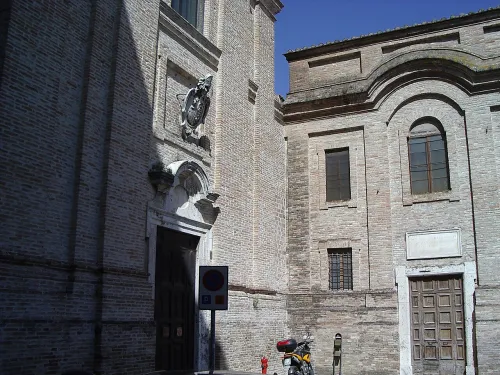
    Walking into the Rocca Paolina feels like slipping under the city. Beneath heavy vaults you move through what were once houses, streets, towers and courtyards of medieval Perugia, swallowed whole by a fortress and turned into its basement. Look out too for the stone remains of the old Giuoco del Pallone, a wooden stadium for a ball game. Entry is free, and the vaulted halls are used for cultural events throughout the year, so you may find an exhibition along the way.

    The fortress was built between 1540 and 1543 for Pope Paul III, to Antonio da Sangallo the Younger and Alessandro Tomassoni da Terni's designs, and until 1860 it stood for papal rule over the city. Its site was chosen as a punishment: it went up over the homes of the Baglioni family, who had defied the pope. For building material, the village of Santa Giuliana outside the walls was pulled down completely, churches and monasteries included. The finished Rocca had three parts: the papal palace, the corridor and the outwork on the landward side.

    The city never forgot. Partly destroyed in 1848, rebuilt in 1860 at the order of Pius IX, the fortress was demolished for good in the decades after Perugia joined the Kingdom of Italy, to make room for Piazza Italia, Via Masi, the Giardini Carducci and Viale Indipendenza. Only the lower levels of the papal palace survived. They were uncovered in 1932 and finished in 1965 as an underground city open to everyone, and since 1983 a pedestrian path with escalators has run right through it.

    Come back up into daylight for the next stop: the Giardini Carducci are 360 m away, about five minutes, laid out on ground the fortress once covered.

    Hours
    Daily: 07:00–20:00
    Price
    Free
  5. 6

    Giardini Carducci

    Giardini Carducci in Perugia, stop 6 on the self-guided walking tour

    After the buried city, the Giardini Carducci are where you actually stop. These gardens, free and always open, sit on part of the ground cleared when the Rocca Paolina was torn down, and they look out over the valley beneath the walls. Find a bench and take a while over it.

    From this edge the height of the city becomes real. Perugia stands at close to 500 metres, and here you understand what that meant for everyone who had to climb up before the escalators existed, and why getting water to the top was such an achievement. On a clear day, look across the valley for Assisi.

    The gardens are also one of Perugia's festival stages: during Umbria Jazz they host free concerts. Outside festival time they are simply a quiet break between the fortress and the second half of the walk.

    From here it is 400 m, about five minutes, to the National Archaeological Museum of Umbria.

    Hours
    Open 24/7
    Price
    Free
  6. 7

    National Archaeological Museum of Umbria

    National Archaeological Museum of Umbria in Perugia, stop 7 on the self-guided walking tour

    The National Archaeological Museum of Umbria, one of the most important archaeological museums in Italy, is currently closed, so this is a stop to see from outside. It occupies the former convent next to the Basilica di San Domenico. The original church rose in the 13th century outside the old city walls, and the present basilica was built alongside it in the 15th century.

    The museum's story starts with a gift. In 1790 Count Francesco Filippo Friggeri left his collection to his home town, and it was first displayed in the Palazzo dei Priori. Giovan Battista Vermiglioli, the first professor of archaeology at the University of Perugia, then brought in many Etruscan pieces, among them the sarcophagus of Sperandio, the Cippus of Perugia and the bronzes of Castel San Mariano. Commune and university shared the collection and showed it at Montemorcino, and it grew into the university's Museum of Antiquities.

    His successors in the chair kept adding finds from excavations and purchases, including prehistoric and Etruscan pieces once owned by Mariano Guardabassi. Giuseppe Bellucci, director until his death in 1921 and several times rector of the university, built up a prehistoric collection that his heirs sold to the province, the city and the state. Only in 1948, under Umberto Calzoni, director from 1925 to 1958, were the pieces finally brought together here in the convent.

    While the doors stay shut, the Etruscans still have their moment on this route, at the Etruscan Arch. Next comes the longest leg of the walk: 920 m, about 15 minutes, to the Chapel of San Severo.

    Local name
    Museo archeologico nazionale dell'Umbria
    Status
    Currently closed
  7. 8

    Chapel of San Severo

    Chapel of San Severo in Perugia, stop 8 on the self-guided walking tour

    The Chapel of San Severo is a tiny museum built round a single work: the fresco of the Trinity and saints, 175 by 389 cm, set in a pointed niche and divided into two levels. What makes it special is that two painters, teacher and pupil, worked on it fifteen years apart.

    Raphael was called here in 1505, the date painted on the fresco, when he was moving between Florence and Perugia and enjoying his first great success with works such as the Baglioni altarpiece, which would soon open the doors of Julius II's Rome to him. The patrons were the two commendatory abbots of the monastery of San Severo: Troilo Baglioni, former bishop of Perugia, and Cardinal Gabriele de' Gabrielli of Gubbio, bishop of Urbino. Not every scholar takes the 1505 date at face value. Raphael's style was still close to the Umbrian school then, while this fresco has a new monumental quality, so the date may mark only the start of work.

    Raphael painted only the upper half. Once settled in Rome he never came back to Perugia, and the wall waited until his death in 1520. Then the job went to his old teacher Perugino, who in 1521 finished the lower half in a deliberately old-fashioned, 15th-century manner. So you see the pupil above and the master beneath. Vasari saw the fresco and remarked on Raphael's conspicuous signature. Part of the painting has been lost over the years, partly through careless restorations in the past.

    The chapel itself is a single room beside today's 18th-century church; it was once part of the left aisle of the 15th-century church. If you care about Raphael, go in, ask at the door about admission, and allow a short visit. Then walk 540 m, about eight minutes, to Via dell'Acquedotto.

    Local name
    Cappella di San Severo
    Hours
    Tue–Sun 10:00–18:00; closed Mondays
  8. 9

    Via dell'Acquedotto

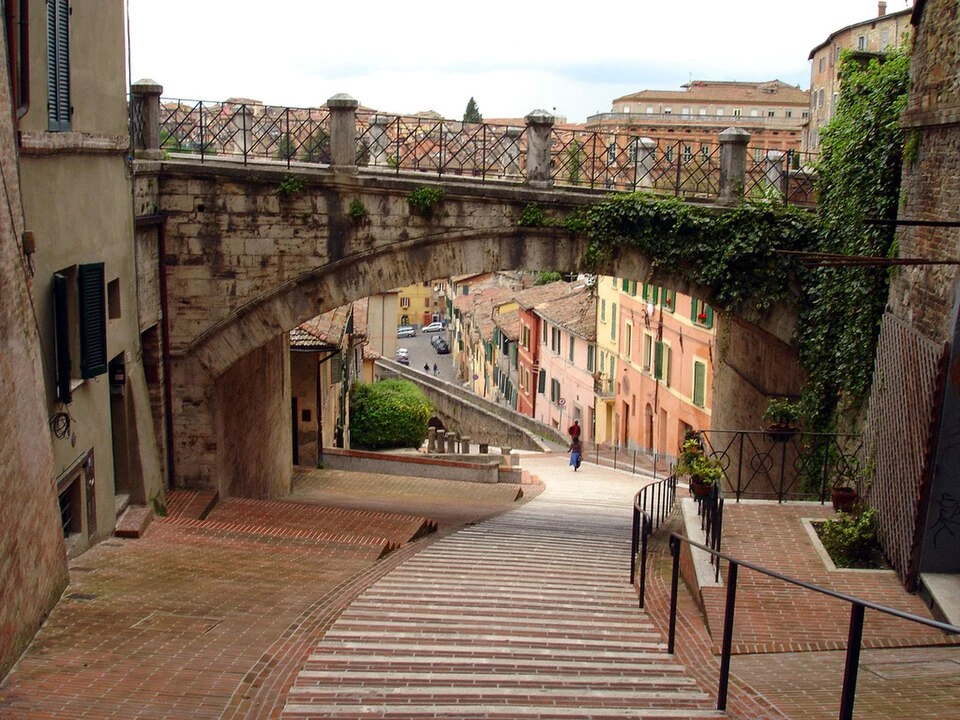
    Via dell'Acquedotto in Perugia, stop 9 on the self-guided walking tour

    Via dell'Acquedotto takes its name from the medieval aqueduct that brought water more than 4 km from Monte Pacciano to the Platea Magna, the main square where you started. Next to the Fontana Maggiore it has always been treated as the poor relative, yet it was a work of huge historical importance and a real technical challenge in its day.

    Across Europe the Roman aqueducts lay in ruins, and the hydraulic know-how of the Greeks, Etruscans and Romans had been forgotten. Perugia's answer was a bold system of communicating vessels joined by a long lead pipe under pressure. Without pumps, working only with gravity, the engineers made the water run in reverse, up the hill. In 1960 Uguccione Ranieri di Sorbello wrote that all over Italy people talked about this extraordinary city where water flows uphill.

    Building began in 1254. After interruptions lasting some twenty years, work resumed in 1277 and was completed on 13 February 1278, when water spurted from the Fontana Maggiore for the first time. Besides lead for the pipe, the builders used rows of limestone and sandstone blocks; the conduit was paved in porphyry, edged with low brick walls and capped with travertine.

    Why go to all that trouble in a city full of water? Perugia had hundreds of wells beneath its old palaces, two of them Etruscan, the Sorbello well in Piazza Piccinino and another in Via Caporali, as well as Roman baths with the Orpheus mosaic and the dyers' spring. But the population grew fast in the 1200s, and a severe drought in the first half of that century pushed the commune to look for water outside the city. From here it is 390 m, about six minutes, to the Etruscan Arch.

    Hours
    Open 24/7
    Price
    Free
  9. 10

    Etruscan Arch

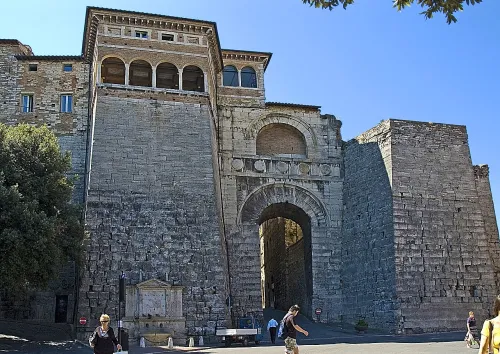
    Etruscan Arch in Perugia, stop 10 on the self-guided walking tour

    The Etruscan Arch, also known as the Arch of Augustus, is one of the seven gates in Perugia's Etruscan walls and the most intact and monumental of them. It was built in the second half of the 4th century BC, and it opens onto the ancient cardo maximus, the main north to south street, which is today's Via Ulisse Rocchi. Stand back far enough to take in the whole gate: this is the oldest layer of the city you meet on the walk.

    Ancient Perusia first appears in history as one of the twelve allied cities of Etruria. It is mentioned for the first time in the account of the war between Etruscans and Romans in 310 or 309 BC. It played a major part in the revolt of 295 BC and, together with Volsinii and Arretium, ancient Arezzo, had to sue for peace the following year. Later it stood by Rome in the Second Punic War, during Hannibal's campaign.

    The gate's second name comes from Rome's civil war. Perugia's leaders were clients of the Antonii, and Lucius, brother of Mark Antony, shut himself up in the city. Octavian, the future Augustus, laid siege to it for seven months around 40 BC. The hilltop town behind its walls was hard to take, Lucius had a strong army and the city was well supplied, but the siege ended with Perugia in flames, reportedly on the advice of Gaius Cestius, called Macedonicus, himself a Perugian. Afterwards Augustus had the gate restored, and it has carried his name ever since.

    The last leg is short: 210 m, about four minutes, to the Cathedral of San Lorenzo.

    Local name
    Arco Etrusco
    Hours
    Open 24/7
    Price
    Free
  10. 11

    Cathedral of San Lorenzo

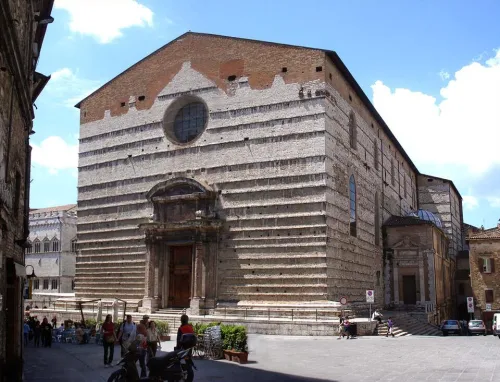
    Cathedral of San Lorenzo in Perugia, stop 11 on the self-guided walking tour

    You finish where you began, on the main square, because Perugia's cathedral does something unusual: it turns its long side, not its front, to the square, facing the Fontana Maggiore and the Palazzo dei Priori. Notice the bare walls. The cladding of white and pink marble diamonds, modelled on Arezzo Cathedral, was never finished; a trial section can still be seen on the main facade.

    On the square side stands the Loggia di Braccio, built in 1423 for Braccio da Montone, an early Renaissance work attributed to Fioravante Fioravanti of Bologna. It once belonged to the Palazzo del Podestà, which burned down in 1534. Under it you can see a stretch of Roman wall and the base of the old bell tower, and the Pietra della Giustizia, the Justice Stone, whose inscription of 1234 announces that the commune had paid off all its public debt.

    Close by is the statue of Pope Julius III by Vincenzo Danti, from 1555. Julius was a hero in Perugia because he restored the city's own magistrates, abolished by Paul III, the pope of the Rocca Paolina. Until the end of the 19th century the statue stood more prominently in Piazza Danti; it was moved aside to make way for the electric tram, opened in 1899.

    A cathedral stood here from 936 to 1060 on the spot of today's transept. The present church, dedicated to San Lorenzo and Sant'Ercolano, follows a design of 1300 by Fra Bevignate, the same man behind the fountain; work began in 1345 and ended in 1490. Since 1986 it has been the seat of the Archdiocese of Perugia and Città della Pieve. Entry is free, so go in: it is a fitting end to the walk, with the whole square at your back.

    Hours
    Mon–Sat 08:30–12:30, 15:30–19:30 | Sun & Holidays 08:30–12:30, 15:00–19:00
    Price
    Free
Walking tour route map of Perugia Route loaded
Piazza IV NovembreFontana MaggiorePalazzo dei PrioriNational Gallery of Umbria+7
All 11 stops are already on the map.
You just press start.
AI Tour Guide

You've read Perugia's route. Now walk it with a guide in your ear.

Press start wherever you are, even hundreds of kilometres from Perugia, and the guide begins telling its stories right away. In the city, pick any of the 11 stops to start from: it leads you there, then talks with you the whole route, asking, listening, remembering, and shaping the tour around your answers.

11stops 3.5km 52 minwalking 13languages
▶Start the tour free

Free to start · Runs in your browser · No app, no download

Shorter Ways to Walk Perugia

Short on time, or here for one theme? Each of these cuts follows the legs of the full route, so the GPS guidance works the same way.

Main square and underground fortress

Stops: 1, 2, 3, 4, 5, 6

For a first afternoon in town: the square, the fountain, the town hall, the gallery and the Rocca Paolina, ending in the Giardini Carducci. About 15 minutes of walking; only the National Gallery of Umbria charges admission, and you can just as well walk past it.

Raphael, water and the Etruscans

Stops: 8, 9, 10, 11

For art and history lovers who have already seen the square: the Chapel of San Severo, the aqueduct, the Etruscan Arch and the cathedral. About 18 minutes of walking; the chapel is the one place where you should ask about admission at the door, the rest is free.

The whole route, outside the museums

Stops: 1, 2, 3, 4, 5, 6, 7, 8, 9, 10, 11

For anyone who wants the full story of the city without a long museum visit: all eleven stops, 52 minutes of walking, and you see the National Gallery of Umbria only from the palace it lives in. Count on about two and a half hours in total.

How Long This Perugia Tour Takes, With and Without the Gallery

Pure walking time is 52 minutes. The legs around the main square are a minute or two each; the longest stretch is the 920 m, 15 minute walk from the National Archaeological Museum of Umbria to the Chapel of San Severo.

With a proper look round the National Gallery of Umbria, which deserves at least an hour, plus time underground in the Rocca Paolina, in the chapel and in the cathedral, plan around four hours. Skip the gallery and the full route fits into about two and a half hours. The square and fortress variant takes roughly an hour and a half with the gallery, well under an hour without it; the Raphael and Etruscan variant takes about an hour.

Before You Set Off in Perugia

  • Start: Piazza IV Novembre, at the Fontana Maggiore. That order tells the story best, but you can join at any stop and the GPS route picks up from there.
  • Finish: The Cathedral of San Lorenzo, whose long side faces Piazza IV Novembre, so you end the walk back on the main square.
  • Time of day: Go while the indoor stops are open: the gallery, the Chapel of San Severo and the cathedral keep their own hours and closing days, so check them on the day you walk. The squares, the fountain, the gardens, the aqueduct and the arch are open around the clock.
  • Admission: The National Gallery of Umbria charges admission; ask at the Chapel of San Severo whether there is a charge. The Palazzo dei Priori, the Rocca Paolina and the cathedral are free, and the National Archaeological Museum of Umbria is currently closed.
  • Arriving by bus: A pedestrian path with escalators runs from the bus station through the Rocca Paolina up to the old acropolis, so you can join the route there.
Walking tour route map of Perugia
AI Tour Guide

Your Perugia guide is ready when you are.

Press start and a voice AI Tour Guide takes it from here: leading the route through Perugia, telling the stories, and turning your walk into a real back-and-forth conversation. No app or download is needed; it runs in your browser.

11stops 3.5km 52 minwalking 13languages
▶Start the tour free

Free to start · Runs in your browser · No app, no download

What the AI Tour Guide Adds on This Route

Perugia layers Etruscans, Romans, popes and painters on top of each other, and the AI Tour Guide walks you through those layers as a conversation. It greets you at the fountain, tells the stories of each place, asks what caught your eye and remembers it: linger over Raphael in San Severo and it will pick up the painters again at the cathedral. You can interrupt it at any moment, for instance to find out which month's panel on the Fontana Maggiore you are standing in front of, or which saints Perugino painted in the lower half of the fresco. You start with 100 free credits; after that you choose between this tour all-inclusive for €19.99 with no time limit, or credits at €5 per hour.

A Real Conversation A voice AI Tour Guide greets you, leads the whole route, and tells the stories and facts as you walk, asking what you want to see and keeping a real conversation going. Not a recording you press play on.
Map Navigation Follow the route on the map and walk at your own pace. You choose where to start and when to move to the next stop.
Ask Anything Curious about a building you pass? Ask your AI Tour Guide on the spot and the conversation carries on.
13 Languages Switch language anytime. No separate tour needed.
Start free in your browser

Common Questions About Walking Perugia

Is the Galleria Nazionale dell'Umbria the same as the National Gallery of Umbria?

Yes. Galleria Nazionale dell'Umbria is the Italian name; the collection fills the upper floors of the Palazzo dei Priori on the main square.

Can I walk the route in the evening?

The outdoor stops, from Piazza IV Novembre and the Fontana Maggiore to the Giardini Carducci, the aqueduct and the Etruscan Arch, are open around the clock. The gallery, the chapel, the cathedral and the Rocca Paolina keep daytime hours, so an evening walk means seeing those from outside.

Can I combine Perugia with Assisi in one day?

Assisi is only 19 km away and has its own free route. If you want both in one day, take one of the shorter Perugia variants and save the gallery for another visit.

Which other Umbrian towns have a walk like this?

Gubbio, Orvieto and Spoleto all have their own free routes with GPS guidance and the optional AI Tour Guide.

Is the tour really free?

Yes. The whole tour is free: the route, the interactive map and the navigation cost you nothing. Only the voice AI Tour Guide is optional and paid: you test it with 100 free credits, then you pay either €5 per hour or €19.99 for this whole tour, with no time limit.

Do I need to download an app?

No. Everything runs in your phone browser. Open the route and start walking, no download and no sign-up required.

Do I need to book the walking tour in advance?

No booking needed. This self-guided tour is available anytime. Open the route in your browser and start walking. The AI Tour Guide works instantly, no app, no reservation required.

What languages is the AI Tour Guide available in?

The AI Tour Guide speaks 13 languages, so you take the tour in your own language and can switch at any time.

Can I skip stops or change the route?

Yes. Skip any stop, spend extra time at places you like, or start the route from any point. It is your walk, you set the pace.
Image credits
▶ Start free in your browser Runs in your browser, no app, no download