

Piazza del Campo
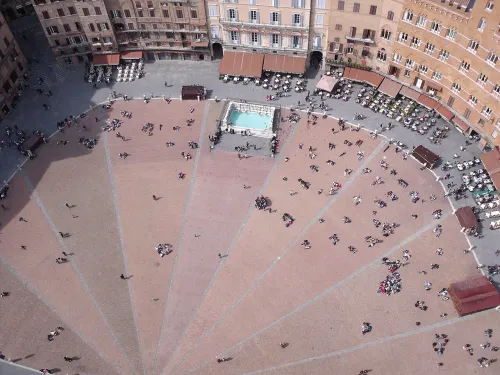
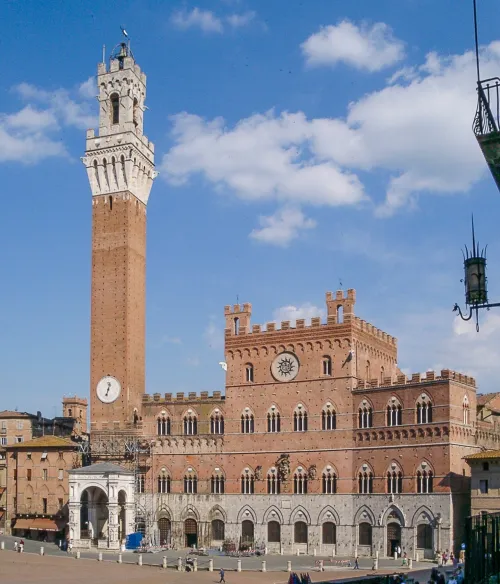
Stand anywhere on the Campo and you will notice the slope first: the square tilts down towards the Palazzo Pubblico like the inside of a scallop shell, ringed by the town hall, its tower and the curved row of noble palaces. The brick paving is divided by eight lines into nine sections, laid out when the square was fully paved in 1349. At the northwest edge stands the Fonte Gaia fountain. The square is free and open around the clock, and it is regarded as one of the great medieval squares of Europe.
The Campo was an open space before the thirteenth century, chosen on sloping ground near the point where the three hillside communities that grew together into Siena met: the Castellare, San Martino and Camollia. It became their common ground, a marketplace and a place for games, fights and races. Despite what you may hear, it does not sit on a Roman forum; Siena was never a significant Roman town.
Its shape is a political statement. Medieval Siena was a rich, self-governing city-state competing with Florence. After beating Florence at Montaperti in 1260, Siena was excommunicated, which hurt its trade badly. When peace returned in 1270, civic pride became the city's answer, and this square, paid for with taxes like the town hall, was its stage. In 1995 the whole historic centre became a UNESCO World Heritage Site for its preserved medieval planning.
Twice a year the Palio horse race thunders around the edge of the square, and the Strade Bianche cycling race finishes here every year. Walk 90 m, about a minute, to the façade at the bottom of the shell.