Free Walking Tour Florence: Arno, David and Duomo

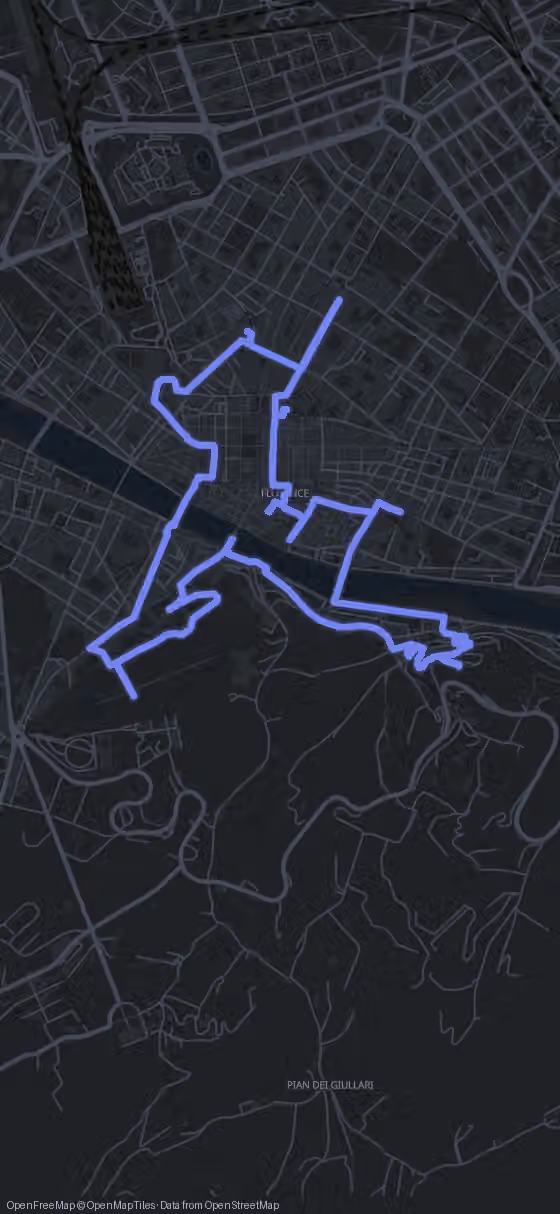
Cross Ponte Vecchio, wander the Boboli paths, meet David and finish the loop on Piazzale Michelangelo: 9.8 km of Florence with a free GPS route.

15 Stops 9.8 km ~2 h 17 min walking
Route map for the Florence walking tour
Stop 1 of 15
430 m·5 min
Ponte Vecchio
Head south-west off the bridge down Via dei Guicciardini toward Palazzo Pitti.
Buongiorno, welcome to Florence. I'm Alex, and this city owes one of its great icons to a wartime decision.
Try this tour with Alex

What This Florence Loop Covers

15 stops on a 9.8 km loop that starts and ends at Ponte Vecchio, crosses the Arno twice and climbs to Piazzale Michelangelo. Pure walking time is 2 h 17 min; with the interiors worth paying for, plan a full day.

The bridge, the squares, the Loggia dei Lanzi, Mercato Centrale and the Florence Cathedral itself cost nothing; museums and most churches charge. The GPS route is free in your browser, and the optional AI Tour Guide can lead the walk as a conversation.

Open free GPS & optional AI Tour Guide
This short shows highlights of the route. All 15 stops follow below.

The Route

Walking Map of Florence: the 9.8 km Loop

15 stops 9.8 km 2 h 17 min walking
Tap to load interactive map

The 15 stops along this route

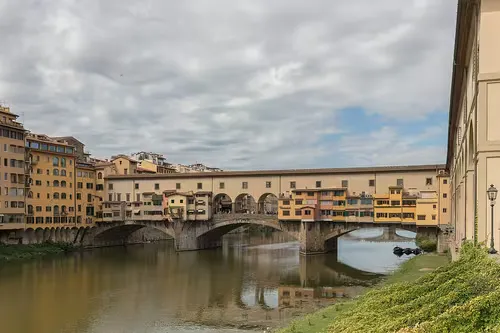
  1. Ponte Vecchio in Florence, stop 1 on the self-guided walking tour
    1Ponte Vecchio
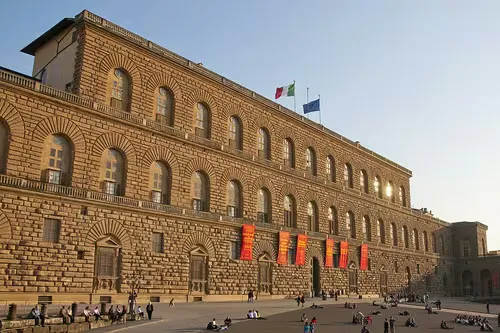
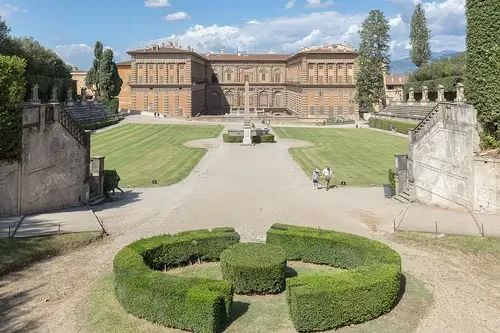
  2. Palazzo Pitti in Florence, stop 2 on the self-guided walking tour
    2Palazzo Pitti
  3. Boboli Gardens in Florence, stop 3 on the self-guided walking tour
    3Boboli Gardens
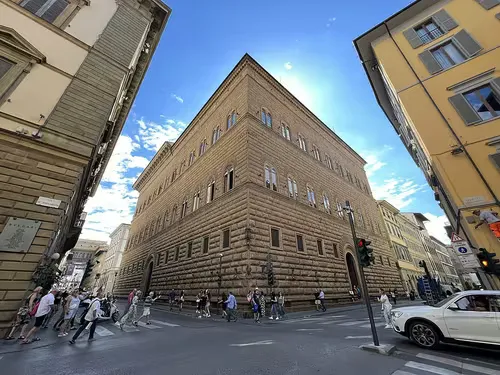
  4. Palazzo Strozzi in Florence, stop 4 on the self-guided walking tour
    4Palazzo Strozzi
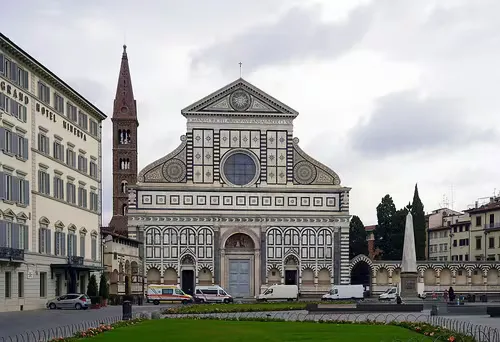
  5. Basilica of Santa Maria Novella in Florence, stop 5 on the self-guided walking tour
    5Basilica of Santa Maria Novella
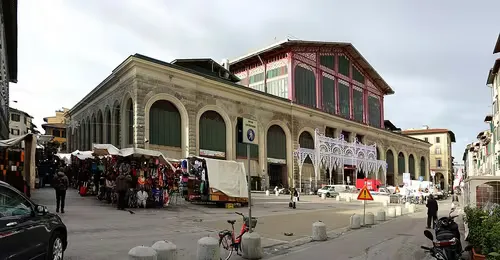
  6. Mercato Centrale in Florence, stop 6 on the self-guided walking tour
    6Mercato Centrale
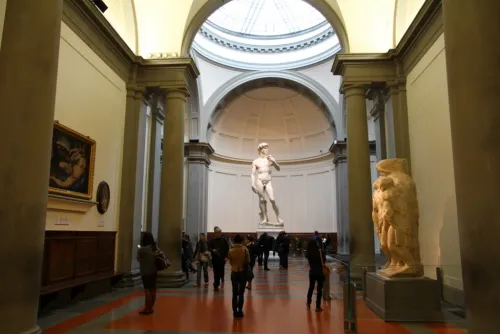
  7. Galleria dell'Accademia in Florence, stop 7 on the self-guided walking tour
    7Galleria dell'Accademia
  8. Florence Cathedral, stop 8 on the self-guided walking tour
    8Florence Cathedral
  9. Piazza del Duomo in Florence, stop 9 on the self-guided walking tour
    9Piazza del Duomo
  10. Piazza della Signoria in Florence, stop 10 on the self-guided walking tour
    10Piazza della Signoria
  11. Palazzo Vecchio in Florence, stop 11 on the self-guided walking tour
    11Palazzo Vecchio
  12. Loggia dei Lanzi in Florence, stop 12 on the self-guided walking tour
    12Loggia dei Lanzi
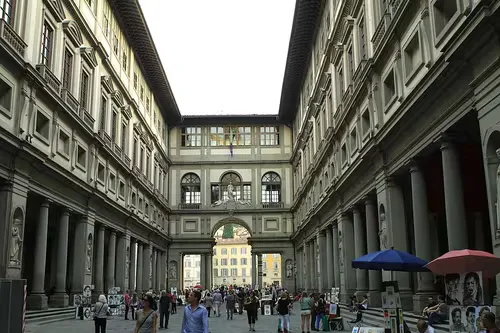
  13. Uffizi Gallery in Florence, stop 13 on the self-guided walking tour
    13Uffizi Gallery
  14. Basilica of Santa Croce in Florence, stop 14 on the self-guided walking tour
    14Basilica of Santa Croce
  15. Piazzale Michelangelo in Florence, stop 15 on the self-guided walking tour
    15Piazzale Michelangelo
  16. That's the full loop.

    Walk it with an AI Tour Guide talking you through every one of these streets.

    Start free in your browser
    You made it

Your Florence Walking Tour, from the Old Bridge to the Hilltop

  1. 1

    Ponte Vecchio

    Ponte Vecchio in Florence, stop 1 on the self-guided walking tour

    You start on the bridge Florence is known for: a stone bridge over the Arno lined on both sides with little shops built right onto it. Look at how they hang over the water on wooden brackets. Building shops on bridges was once common practice; here it survived. The first tenants were butchers, tanners and farmers. Today the windows belong to jewellers, art dealers and souvenir sellers.

    The bridge stands at the narrowest point of the Arno, where the Roman Via Cassia is believed to have crossed the river. The Romans built stone piers with a wooden deck. The bridge first appears in a document of 996, was swept away by a flood in 1117 and rebuilt in stone. Its name came later: when the wooden Ponte alla Carraia went up nearby in 1218, Florentines called that one the New Bridge, and this one became the Old Bridge, the Ponte Vecchio.

    It is also the only bridge in Florence that was spared destruction in the Second World War. From the middle you can see its two neighbours, Ponte Santa Trinita and Ponte alle Grazie.

    The bridge is free and always open, and it is busy for a good reason: it joins the Duomo and Piazza della Signoria on one bank with Palazzo Pitti and Santo Spirito in the Oltrarno on the other. You now cross into the Oltrarno: Palazzo Pitti is 430 m away, about 6 minutes on foot.
    Hours
    Open 24/7
    Price
    Free (public bridge, no admission)
  2. 2

    Palazzo Pitti

    Palazzo Pitti in Florence, stop 2 on the self-guided walking tour

    The massive Renaissance front in front of you started in 1458 as the town house of the banker Luca Pitti. In 1549 the Medici bought it, and it became the main residence of the Grand Dukes of Tuscany, from 1737 the Habsburg-Lorraine. Between 1865 and 1870, while Florence was capital of the new Kingdom of Italy, it served as royal palace for the House of Savoy, until Victor Emmanuel III gave it to the state in 1919.

    Since then it has been a museum complex. The Palatine Gallery hangs masterpieces by Raphael and Titian in the dense style of an 18th-century picture gallery. The Gallery of Modern Art shows the Macchiaioli painters, and there are smaller museums for the Treasury of the Grand Dukes, fashion and costume, porcelain and carriages.

    Is it worth going in? For lovers of Raphael and Titian, yes, but give it a separate morning. On this walk, take in the façade and the square. If you'll see both the palace and the gardens, the combined ticket saves you money.

    From the palace it is 940 m, about 14 minutes, to the Boboli Gardens.

    Hours
    Tue–Sun 8:15–18:30 (last entry 17:30). Closed Monday, 1 Jan, 25 Dec.
    Price
    16 EUR full price (same-day, walk-up); 19 EUR full price (advance online); 2 EUR reduced; free for eligible categories (under-18 EU citizens, disabled visitors, etc.)
  3. 3

    Boboli Gardens

    Boboli Gardens in Florence, stop 3 on the self-guided walking tour

    Boboli began as the grand-ducal garden of Palazzo Pitti and also connects to the Forte di Belvedere, the fortress built to protect the ruler and his family. The Medici, then the Habsburg-Lorraine and the Savoy laid it out between the 16th and 19th centuries over about 45,000 m². It is an Italian garden in the classic sense and an open-air museum, with sculptures ranging from Roman antiquity to the 20th century.

    Close to the palace you are in the oldest, late Renaissance part, designed with a hermetic, alchemical character. Later the long perspective axis of the viottolone was added, from which gravel paths lead to ponds, fountains, nymphaea, small temples and grottoes. Look for the 18th-century Kaffeehaus, a rare rococo building in Tuscany with a view over the city, and the lemon house, still painted in its original Lorraine green.

    Over 800,000 people visit each year, and entry is paid. Give it at least 75 minutes; there are four public entrances, from the Ammannati courtyard of the palace, the Forte di Belvedere, Via Romana and Porta Romana, and you leave via Piazza Pitti.

    Next you cross back over the river: 1340 m, about 18 minutes, to Palazzo Strozzi.

    Hours
    Opens 8:15 daily; closing time varies by season, Jan/Feb/Nov/Dec: 16:30; Mar/Oct (standard time): 17:30; Mar–May & Sep–Oct (DST): 18:30; Jun–Aug: 19:10. Last entry 1h before closing. Closed first and last Monday of each month, and 25 Dec.
    Price
    10 EUR full price (same-day); 13 EUR full price (advance online); 2 EUR reduced; free for eligible categories
  4. 4

    Palazzo Strozzi

    Palazzo Strozzi in Florence, stop 4 on the self-guided walking tour

    This free-standing block of rough-hewn stone was a political statement. Filippo Strozzi the Elder, a rival of the Medici who had returned to Florence in 1466, wanted the most magnificent palace in the city to show his family's standing. He bought and demolished a whole cluster of buildings to make room; Benedetto da Maiano began work in 1489, after a wooden model by Giuliano da Sangallo.

    Filippo died in 1491 and never saw it finished; it was completed in 1538, and in the same year Duke Cosimo I de' Medici confiscated it. The Strozzi got it back only thirty years later. Notice the details later copied all over Europe: paired arched windows, stones in the arches that grow longer towards the keystone, the heavy cornice. Since the palace has streets on all four sides, its plan is strictly symmetrical on both axes, a new problem for Renaissance architects. The arcaded courtyard is by Cronaca, who ran the site until 1504, and the wrought-iron fittings on the walls are famous in their own right.

    Today the palace hosts exhibitions; the ticket price depends on the current show. From here it is 490 m, about 6 minutes, to Santa Maria Novella.

    Hours
    Daily 10:00–20:00, Thursday until 23:00.
    Price
    15 EUR full, 12 EUR reduced, 5 EUR ages 6–18, 20 EUR open-date ticket (current exhibition 'Rothko a Firenze', 14 Mar-23 Aug 2026)
  5. 5

    Basilica of Santa Maria Novella

    Basilica of Santa Maria Novella in Florence, stop 5 on the self-guided walking tour

    Stand back for the façade: geometric patterns in white and green marble, the lower part Gothic, the upper part designed by the Renaissance architect Leon Battista Alberti and finished in 1470. One detail shows how long it all took: the right-hand scroll was only covered in marble in 1920. Along the front run Gothic arcades meant for sarcophagi; the painter Domenico Ghirlandaio is buried in one of them.

    The story begins in 1221, when Dominican friars were given a small oratory, Santa Maria delle Vigne, among fields outside the city walls. They built a new church, the Novella, from the late 13th century; it took almost 200 years and was consecrated in 1420. Rich Florentine families paid for building and decoration and were allowed funeral chapels inside in return.

    Go in if you care about painting. Two works changed art history here: Giotto's Crucifix, which shaped how Christ on the cross was painted for two centuries, and Masaccio's Holy Trinity, the first monumental Renaissance painting to use linear perspective. They alone are worth the entry ticket.

    Mercato Centrale is 590 m away, about 8 minutes, and you pass the Medici Chapels on the way.

    Hours
    Mon–Thu 9:00–17:30, Fri 11:00–17:30, Sat 9:00–17:00, Sun 13:00–17:00 (subject to closures for religious services).
    Price
    7.50 EUR full, 5.00 EUR reduced (ages 11–18)
    Website
    smn.it ↗
  6. 6

    Mercato Centrale

    Mercato Centrale in Florence, stop 6 on the self-guided walking tour

    This iron and glass hall is a product of the years when Florence was capital of Italy and the city was rebuilt. The old market had been torn down to make room for Piazza della Repubblica, so new covered markets were needed, and a whole block of cramped, unhealthy lanes here was cleared. The architect was Giuseppe Mengoni, who also built the Galleria Vittorio Emanuele II in Milan, and he took the Paris Halles as his model. It opened in 1874 with an international agricultural exhibition.

    From outside you see a loggia of ten classical arches on each side, on slender grey stone columns. Inside, light pours in from the high windows under the roof and makes it feel like an open-air market. The stalls were placed with care: butchers, poulterers, delis, bakers and fishmongers each had their area, arranged around the natural ventilation of the three aisles.

    Entry is free. The traditional market fills the ground floor, and the food hall upstairs is the obvious lunch stop on this route. From here it is 640 m, about 9 minutes, to the Galleria dell'Accademia.

    Hours
    Ground-floor traditional market: Mon–Fri 9:00–15:00, Sat 9:00–17:00, closed Sunday and holidays. Upper food hall: Sun–Thu 9:00–23:00, Fri–Sat 9:00–24:00.
    Price
    Free entry
  7. 7

    Galleria dell'Accademia

    Galleria dell'Accademia in Florence, stop 7 on the self-guided walking tour

    You come here for one statue. Michelangelo's David has stood in this gallery since 1873, when it was moved from its outdoor place on Piazza della Signoria, officially for conservation. The plan was a Michelangelo museum for the 400th anniversary of his birth, and around David you still see his four unfinished Prisoners, carved for the tomb of Pope Julius II, and an unfinished Saint Matthew. Look at the Prisoners closely: the figures seem to be pushing their way out of the block.

    The gallery was founded in 1784 by Pietro Leopoldo, Grand Duke of Tuscany. Besides sculpture it holds Florentine paintings from 1300 to 1600 and, since 2001, a collection of musical instruments with pieces by Stradivari, Amati and Cristofori. The Palestrina Pietà arrived in 1939, though experts now doubt it is by Michelangelo. The museum guards its star fiercely: in 2023 it won a lawsuit against a magazine publisher that used David's image without permission.

    With 1.46 million visitors in 2016 it is one of the busiest museums in Italy, so book a timed ticket online; the booking fee saves you a long wait. Allow about 75 minutes. Then walk 660 m, about 9 minutes, to the Florence Cathedral.

    Hours
    Tue–Sun 8:15–18:50, closed Monday.
    Price
    16 EUR + 4 EUR booking fee = 20 EUR standard online ticket; under-18 free; EU citizens 18–25 reduced
  8. 8

    Florence Cathedral

    Florence Cathedral, stop 8 on the self-guided walking tour

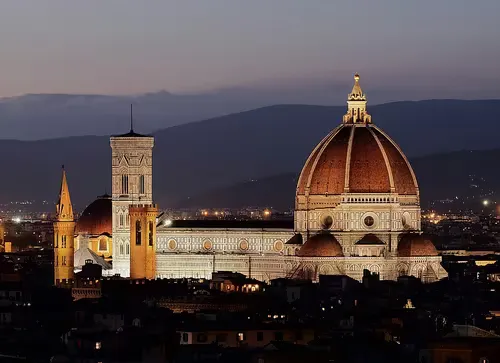
    Santa Maria del Fiore stands on the foundations of Florence's earlier cathedral, Santa Reparata, on a site used for worship since Roman times. Work began in 1296 under Arnolfo di Cambio, stopped and restarted many times under Giotto, Francesco Talenti and Giovanni di Lapo Ghini, and was structurally complete only in 1436. When it was finished it was the largest church in the world, and Brunelleschi's dome is still the largest masonry dome ever built.

    The polychrome marble façade is much younger than it looks: Emilio de Fabris completed it in 1887 in neo-Gothic style. Inside, the nave can feel bare, but look up. The inside of the dome carries the largest frescoed surface ever painted, 3,600 m², by Giorgio Vasari and Federico Zuccari between 1572 and 1579. High above, at the base of the marble lantern, a terrace looks over the city from 91 m.

    Entering the basilica is free and needs no ticket. Dress with shoulders and knees covered. Climbing the dome is a separate ticket that must be booked in advance.

    Step back out: Piazza del Duomo is right in front of you, a minute away.

    Local name
    Cattedrale di Santa Maria del Fiore
    Hours
    Basilica: Mon–Sat approx. 10:15–15:45. Sunday/religious holidays: general sightseeing entry is closed, but the basilica reopens roughly 13:30–16:00 for prayer/worship only. Closed 1 Jan, 25 Dec, and during religious holidays (e.g. 23–24 Jun 2026).
    Price
    Free to enter the cathedral basilica itself (no ticket or reservation required)
  9. 9

    Piazza del Duomo

    Piazza del Duomo in Florence, stop 9 on the self-guided walking tour

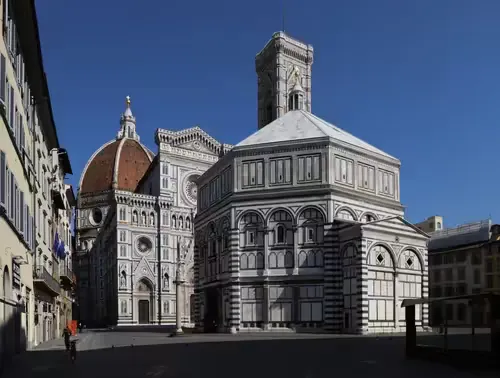
    Now take in the whole ensemble: the cathedral, Giotto's bell tower and the Baptistery of San Giovanni. Strictly speaking it's two squares; an imaginary line between Via de' Martelli and Via Calzaiuoli divides them, and the baptistery stands on Piazza San Giovanni.

    The square once looked very different. It lay outside the Roman walls, and the religious centre moved here only with the early Christian baptistery. Santa Reparata, the first cathedral, stood much closer to the baptistery than today's Duomo, with the bishop's palace right in front of it and a maze of lanes all around. Tradition says the relics of Saint Zenobius, the city's first bishop, were brought here in 430. In the 11th century a portico in front of Santa Reparata left only 17 or 18 metres of open space before the baptistery. Many houses were pulled down at the end of the 13th century to make room for the new cathedral and bell tower.

    Excavations in 1971 and 1972 between the Duomo and the baptistery uncovered a stretch of the Roman walls of Florentia and part of a paved Roman street. The square is free and always open. From here it is 430 m, about 6 minutes, to Piazza della Signoria.

    Hours
    Open 24/7
    Price
    Free (public square)
  10. 10

    Piazza della Signoria

    Piazza della Signoria in Florence, stop 10 on the self-guided walking tour

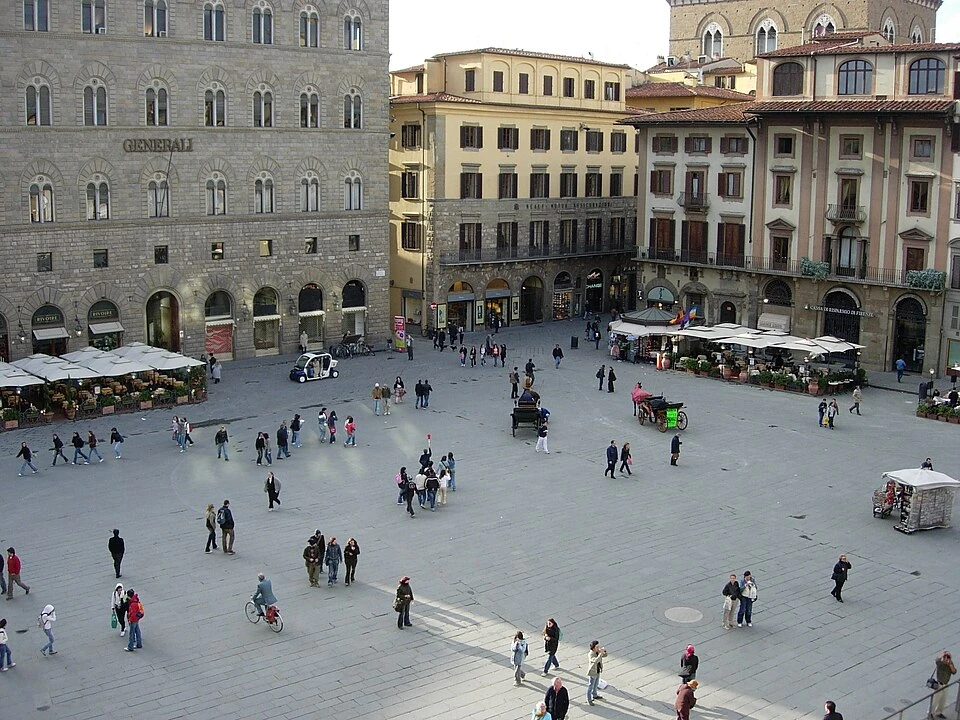
    This W-shaped square is where the Florentine Republic was born and governed, and it is still the political heart of the city. In front of you rises Palazzo Vecchio with its crenellated tower, with a copy of Michelangelo's David at the entrance; the original is the one you just saw at the Accademia. To the side are the Loggia dei Lanzi and the gateway to the Uffizi.

    Look around the edges too. The Palace of the Tribunale della Mercanzia dates from 1359. Palazzo Uguccioni from 1550 has a façade attributed to Raphael, which is odd, since Raphael had been dead for thirty years when it was built. Opposite Palazzo Vecchio stands the palace of Assicurazioni Generali from 1871, built in Renaissance style.

    The square sits at the centre of Florence's historic centre, a UNESCO World Heritage Site since 1982. It is free and open at all hours, and it is a meeting point for Florentines as much as for visitors. Palazzo Vecchio is only 130 m away, about 2 minutes.

    Hours
    Open 24/7
    Price
    Free (public square)
  11. 11

    Palazzo Vecchio

    Palazzo Vecchio in Florence, stop 11 on the self-guided walking tour

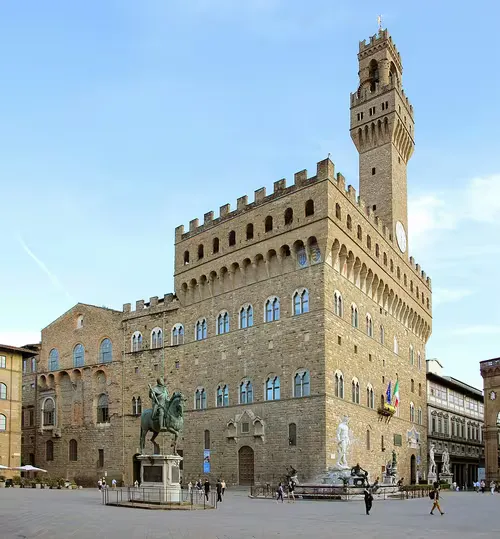
    In 1299 the commune decided to build a palace worthy of the city and safe enough to protect its magistrates in troubled times. Arnolfo di Cambio, also the architect of the Duomo and Santa Croce, built it on the ruins of houses that had belonged to the Uberti family. The chronicler Giovanni Villani called them rebels and Ghibellines and wrote that the palace was built so their homes could never rise there again.

    Read the façade like a fortress: solid rough stone, two rows of Gothic two-light windows, battlements on small arches and corbels. Under the arches run nine painted coats of arms of the Republic, and some openings were made for dropping hot liquids or stones on attackers. In the 15th century Michelozzo added reliefs of the cross and the Florentine lily between the window arches. The name changed with its use: Palazzo della Signoria, del Popolo, dei Priori, Ducale. It became the Old Palace when the Medici duke moved across the Arno to Palazzo Pitti.

    It is still the town hall. The museum charges entry, and the Arnolfo Tower needs a separate ticket and closes in rain. The Loggia dei Lanzi is 120 m away, about 2 minutes.

    Hours
    Mon–Wed & Fri–Sun 9:00–19:00, Thursday 9:00–14:00 (same schedule for museum and tower). Last ticket sold 1h before closing; tower also closes during rain.
    Price
    Museum: 18 EUR full, 12 EUR reduced (ages 18–25/students), free ages 0–17 and other eligible categories. Arnolfo Tower (separate ticket): 20 EUR full, 13 EUR reduced.
  12. 12

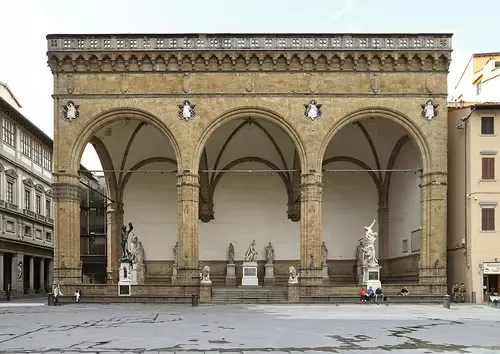
    Loggia dei Lanzi

    Loggia dei Lanzi in Florence, stop 12 on the self-guided walking tour

    Three high, wide arches on clustered columns with Corinthian capitals open onto the square: this is an open-air sculpture gallery of ancient and Renaissance art, free and open at all hours. Its lively design stands in sharp contrast to the severe Palazzo Vecchio next door. Florentines loved the arches so much that Michelangelo proposed continuing them all around the square.

    It was built between 1376 and 1382 by Benci di Cione and Simone Talenti, possibly to a design by Jacopo di Cione, for public assemblies and ceremonies such as the swearing-in of the Gonfaloniere of Justice. It was long wrongly credited to Orcagna. The name comes from Cosimo I's German mercenary pikemen, the Landsknechts, whom Florentines called lanzi and who were quartered here. After the Uffizi went up behind it, Bernardo Buontalenti turned the roof into a terrace from which the Medici could watch ceremonies below.

    Look up under the parapet: the four cardinal virtues, Fortitude, Temperance, Justice and Prudence, by Agnolo Gaddi, set on a blue enamel ground by a monk named Leonardo, with golden stars by Lorenzo di Bicci. The Uffizi Gallery is 300 m on, about 4 minutes.

    Hours
    Open 24/7 (unenclosed, part of Piazza della Signoria)
    Price
    Free (open-air sculpture gallery, no ticket required)
  13. 14

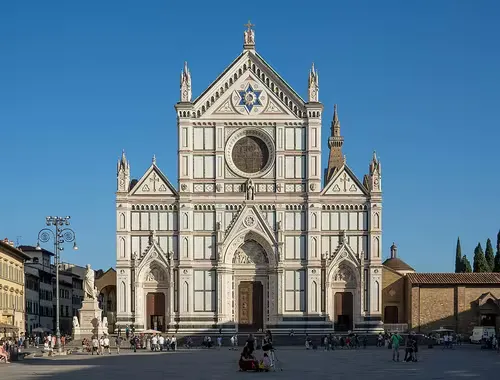
    Basilica of Santa Croce

    Basilica of Santa Croce in Florence, stop 14 on the self-guided walking tour

    Santa Croce is the main Franciscan church of Florence and the largest Franciscan church in the world, built on former marshland outside the old walls. Legend says Saint Francis himself founded it. The present church was begun on 12 May 1294, possibly by Arnolfo di Cambio, paid for by wealthy families and consecrated in 1442. Its plan is a Tau cross, a symbol of Saint Francis, 115 metres long, with a nave and two aisles divided by octagonal columns.

    Italians call it the Temple of the Italian Glories: Michelangelo, Galileo and Machiavelli are buried here, along with the poet Foscolo, the philosopher Gentile and the composer Rossini. Its sixteen chapels are largely frescoed by Giotto and his pupils. Not everything survived: in 1560, after the Counter-Reformation, the choir screen was removed and Vasari rebuilt the area, and on Cosimo I's orders the Bardi Chapel's frescoes of Saint Francis were plastered over.

    In the first cloister stands the Pazzi Chapel, completed in the 1470s with Brunelleschi involved in its plain, unadorned design. It is worth the ticket for the tombs, the Giotto chapels and the Pazzi Chapel.

    Next comes the longest leg: 1590 m, about 24 minutes, past the Horne Museum, across the river and up to Piazzale Michelangelo.

    Hours
    Mon–Sat 9:30–17:30 (no admission after 17:00). Sun & religious holidays: 14:00–17:30. Closed 25 Dec.
    Price
    10 EUR full, 6 EUR reduced (ages 12–17, university students, groups 15+); free under 12, Florence residents, disabled visitors
  14. 15

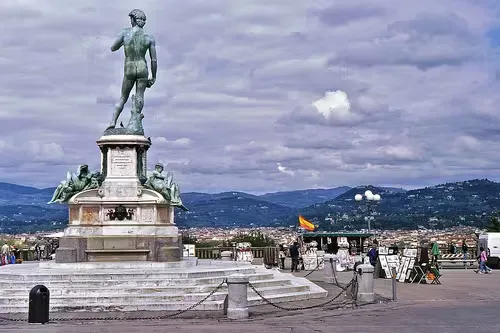
    Piazzale Michelangelo

    Piazzale Michelangelo in Florence, stop 15 on the self-guided walking tour

    The terrace that appears on countless postcards was built from 1869 to designs by Giuseppe Poggi, while Florence was capital of Italy and the city was being remade: riverside promenades along the Arno, boulevards where the 14th-century walls had stood, and on this bank the Viale dei Colli, an 8 km tree-lined panoramic road with this square at its peak. The journalist Yorick chronicled the fast construction and noted that some Florentines grumbled about the cost.

    The square is dedicated to Michelangelo and holds bronze copies of his works in Florence: David and the four allegories from the Medici Chapels at San Lorenzo, all originals in white marble. The monument was hauled up by nine pairs of oxen on 25 June 1873. Poggi also designed the neoclassical loggia overlooking the terrace; it was meant to be a Michelangelo museum that never happened and now houses a restaurant. Between 1890 and 1935 tram tracks ran through here on the line to San Casciano and Greve in Chianti.

    The square is free and open at all hours, and the Rose Garden is right next to it. From here you walk back down to the start: 1500 m, about 21 minutes, to Ponte Vecchio, which closes the loop.

    Hours
    Open 24/7
    Price
    Free (public viewpoint/square)
Walking tour route map of Florence Route loaded
Ponte VecchioPalazzo PittiBoboli GardensPalazzo Strozzi+11
All 15 stops are already on the map.
You just press start.
AI Tour Guide

You've read the Florence loop. Now walk it with a guide in your ear.

Press start wherever you are, even hundreds of kilometres from Florence, and the guide begins telling its stories right away. In the city, pick any of the 15 stops to start from: it leads you there, then talks with you the whole route, asking, listening, remembering, and shaping the tour around your answers.

15stops 9.8km 2 h 17 minwalking 13languages
▶Start the tour free

Free to start · Runs in your browser · No app, no download

Shorter Ways to Walk Florence

The full loop is a long day. If you have less time, these three sections of the route stand well on their own.

The historic core in a morning

Stops: 7, 8, 9, 10, 11, 12, 13

For first-timers with half a day: David at the Galleria dell'Accademia, the Florence Cathedral, Piazza del Duomo, Piazza della Signoria, Palazzo Vecchio, the Loggia dei Lanzi and the Uffizi Gallery. Only 24 minutes of walking. The Accademia ticket is the one entry you'll want; the Cathedral and the squares are free, the Uffizi and Palazzo Vecchio deserve a visit of their own.

Oltrarno, gardens and the view

Stops: 14, 15, 1, 2, 3

For walkers who prefer views and green space to galleries: from the Basilica of Santa Croce up to Piazzale Michelangelo, down to Ponte Vecchio and on to Palazzo Pitti and the Boboli Gardens. About 65 minutes of walking. Santa Croce, Boboli and, if you go in, Palazzo Pitti charge entry.

Palaces, churches and the market

Stops: 4, 5, 6, 7, 8, 9

For a relaxed day north of the river with lunch built in: Palazzo Strozzi, Santa Maria Novella, Mercato Centrale, the Accademia, the Cathedral and Piazza del Duomo. About 33 minutes of walking. Santa Maria Novella and the Accademia charge entry; the market and the Cathedral are free.

How Long This Florence Tour Takes, Interiors Included

Walking alone takes 2 h 17 min for the 9.8 km. What stretches the day is going inside: if you visit the Boboli Gardens, Santa Maria Novella, the Accademia, the Cathedral and Santa Croce and stop for lunch, the loop fills about ten hours.

A plan that works: start at Ponte Vecchio at 9:00 and you reach Boboli at 9:45. Give the garden 75 minutes, Santa Maria Novella 45, eat at Mercato Centrale around 12:30 and book the Accademia for about 13:30. After 75 minutes with David you're in the Cathedral at 14:50. With short pauses on the squares you reach Santa Croce at about 16:45, and after half an hour on the Piazzale you're back at Ponte Vecchio around 18:45.

The Uffizi, the inside of Palazzo Pitti and the Palazzo Vecchio museum don't fit into that day; each is worth its own morning or afternoon. The shorter sections take a morning (the historic core), around three hours with Santa Croce and Boboli (Oltrarno), or an easy half day with lunch (palaces and market).

Before You Set Off in Florence

  • Start and finish: The recommended start is Ponte Vecchio, where the loop also ends. You can join at any stop; the GPS route guides you on from there.
  • Best days: Pick your day with care: the Accademia, the Uffizi, Palazzo Pitti, the Cathedral, Santa Maria Novella and Palazzo Vecchio don't all keep the same opening days and hours.
  • Tickets to book: Reserve a timed slot for the Accademia online. If you want to climb Brunelleschi's dome, book that well ahead too: slots sell out days or weeks in advance.
  • Costs: Walking the route and the GPS navigation are free. The full-day plan with Boboli, Santa Maria Novella, the Accademia and Santa Croce means four paid entries per adult.
  • Church dress code: Cover shoulders and knees; no sandals, hats or sunglasses inside, and bulky backpacks are not allowed in the Cathedral.
  • Water: Bring a bottle and refill it for free at the drinking fountain next to Palazzo Vecchio on Piazza della Signoria. Don't drink from the decorative Neptune Fountain.

Food and Breaks Between the Market and the Squares

The natural lunch stop on this loop is the market; the squares around Palazzo Vecchio are good for a snack or a hot drink later on.

Mercato Centrale, upper food hallCheap and varied, and most people eat standing. It works well for an early lunch before the Accademia. (Mercato Centrale)
All'Antico VinaioA sandwich shop for a quick bite between the Signoria and Santa Croce. (Via dei Neri, near Piazza della Signoria)
RivoireThe classic café on the square, known for its hot chocolate in the winter months. (Piazza della Signoria)
Gelato at La CarraiaTwo flavours at a fair price compared with the shops around the Duomo. (Via de' Benci 24r, Santa Croce)

Tourist Traps to Avoid in Florence on This Loop

  • Gelato without a price tag: Two scoops can get expensive here. Pick the size and check the price before you order, and don't take towering mounds as a sign of quality. (Around the Duomo, Via de' Calzaiuoli and Ponte Vecchio)
  • The 72-hour Duomo ticket: The combined Duomo ticket is valid for 72 hours only. If your dome slot falls outside that window, you can be turned away, so book the slot first. (Florence Cathedral)
  • Firenzecard for the big three: The card is expensive and does not cover the Duomo complex. For just the dome, the Uffizi and David, separate advance tickets come out cheaper; the card only pays off if you really plan several more museums.
Walking tour route map of Florence
AI Tour Guide

Your guide is ready when you are, from Ponte Vecchio onward

Press start and a voice AI Tour Guide takes it from here: leading the route through Florence, telling the stories, and turning your walk into a real back-and-forth conversation. No app or download is needed; it runs in your browser.

15stops 9.8km 2 h 17 minwalking 13languages
▶Start the tour free

Free to start · Runs in your browser · No app, no download

How the AI Tour Guide Walks This Route with You

On a loop this dense, with Medici, republicans and rival bankers on every corner, the AI Tour Guide ties the stops together as one story: it greets you on the bridge, tells each place's history as you arrive, asks what you care about and remembers it, so a Masaccio fan hears more about perspective and a history buff more about the feud between the Strozzi and the Medici. You can interrupt at any moment, for instance to ask how a merchant family earned the right to a chapel in Santa Maria Novella. Start with 100 free credits; after that, choose this tour all-inclusive for 19.99 € with no time limit, or 5 € per hour.

A Real Conversation A voice AI Tour Guide greets you, leads the whole route, and tells the stories and facts as you walk, asking what you want to see and keeping a real conversation going. Not a recording you press play on.
Map Navigation Follow the route on the map and walk at your own pace. You choose where to start and when to move to the next stop.
Ask Anything Curious about a building you pass? Ask your AI Tour Guide on the spot and the conversation carries on.
13 Languages Switch language anytime. No separate tour needed.
Start free in your browser

Common Questions About Walking Florence

Can I see David without booking ahead?

You can try at the desk, but booking online costs only a small fee and saves hours in line. Young visitors get in free or at a reduced rate.

Is there a cheaper way into the Uffizi?

Yes. The afternoon ticket is cheaper and enough for a focused two-hour visit, and young EU citizens pay a reduced rate.

Is a combined ticket worth it for Pitti, Boboli and the Uffizi?

If you'll visit all three, the PassePartout 5 Days costs less than separate advance tickets. Start with the Uffizi and visit the others within the pass's validity.

Is the Accademia bigger than the Uffizi?

No, it's smaller and more specialised: Michelangelo's sculptures, Florentine paintings from 1300 to 1600 and a musical instrument collection. Plan about 75 minutes there, against a half day for the Uffizi.

Which towns make a good second walk from Florence?

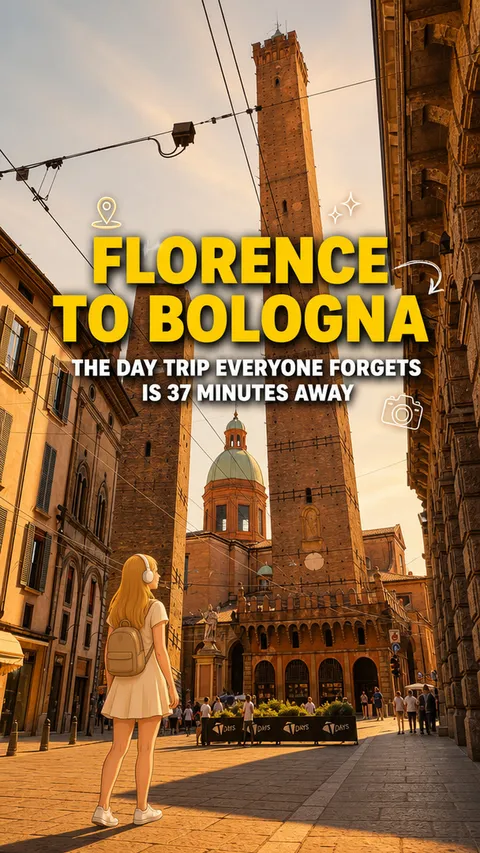
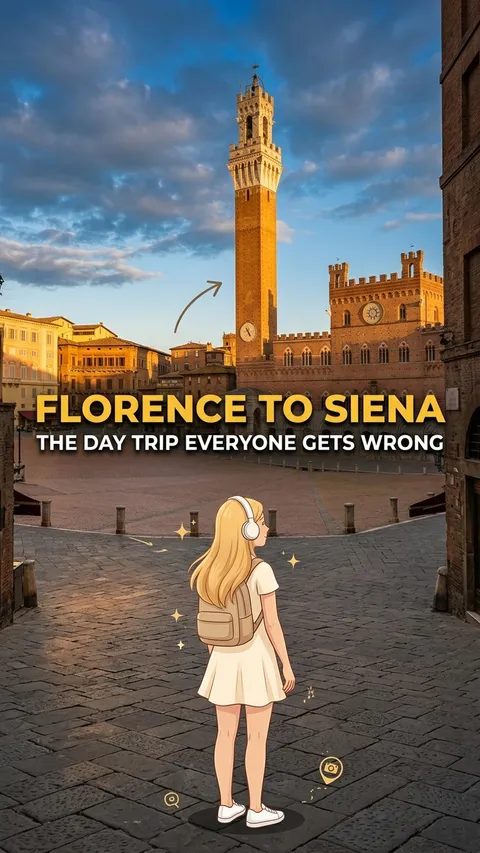
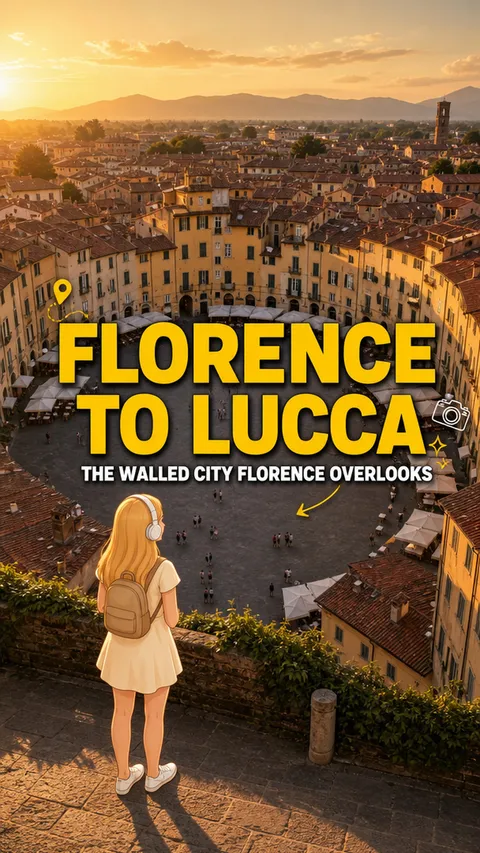
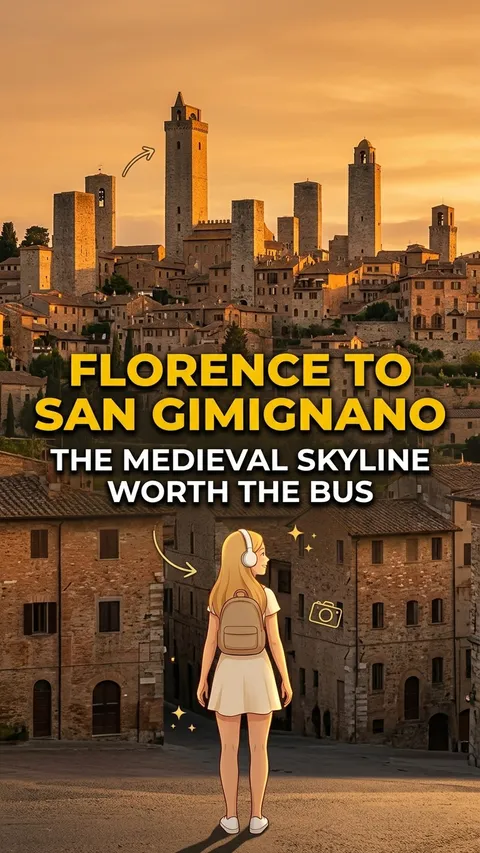
Within about an hour's reach on the map: San Gimignano at 38 km, Siena at 51 km, Lucca at 61 km and Pisa at 69 km, each with its own walking route.

Is the tour really free?

Yes. The whole tour is free: the route, the interactive map and the navigation cost you nothing. Only the voice AI Tour Guide is optional and paid: you test it with 100 free credits, then you pay either €5 per hour or €19.99 for this whole tour, with no time limit. Admission to 8 of the 15 stops is not included: Palazzo Pitti, Boboli Gardens, Palazzo Strozzi, Basilica of Santa Maria Novella, Galleria dell'Accademia, Palazzo Vecchio, Uffizi Gallery and Basilica of Santa Croce charge their own entry fees.

Do I need to download an app?

No. Everything runs in your phone browser. Open the route and start walking, no download and no sign-up required.

Do I need to book the walking tour in advance?

No booking needed. This self-guided tour is available anytime. Open the route in your browser and start walking. The AI Tour Guide works instantly, no app, no reservation required.

What languages is the AI Tour Guide available in?

The AI Tour Guide speaks 13 languages, so you take the tour in your own language and can switch at any time.

Can I skip stops or change the route?

Yes. Skip any stop, spend extra time at places you like, or start the route from any point. It is your walk, you set the pace.
Image credits
▶ Start free in your browser Runs in your browser, no app, no download