Free Walking Tour Rimini: Roman Arch to Fellini's Borgo

From an emperor's gate past a Renaissance temple and a Roman surgeon's house into Fellini's Rimini, ending across a bridge the Romans built.

9 Stops 2.0 km ~27 min walking
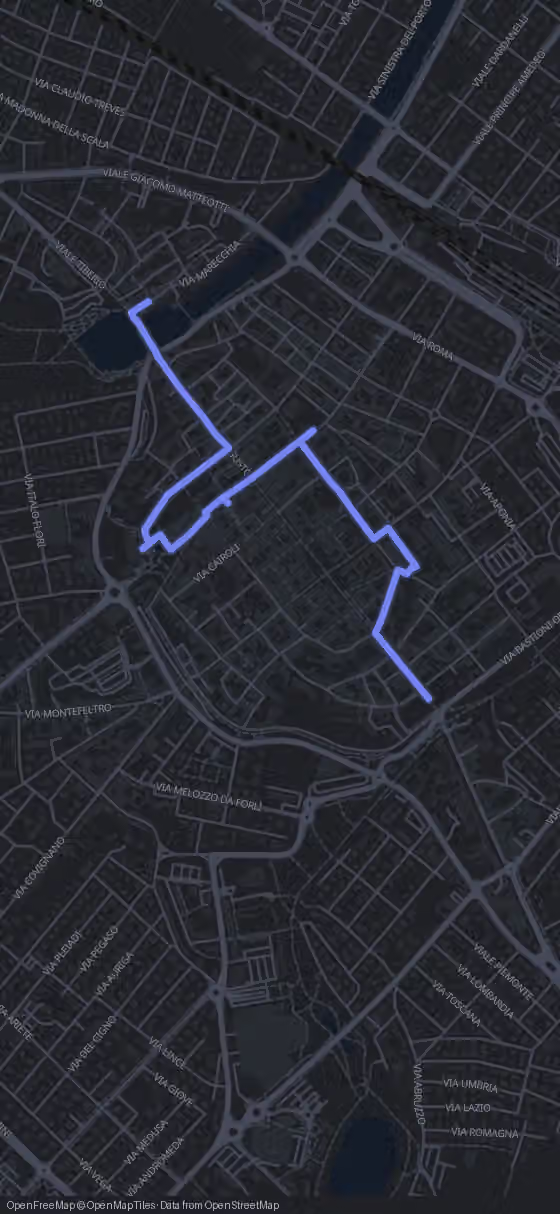
Route map for the Rimini walking tour
Stop 1 of 9
430 m·5 min
Arch of Augustus
Head north up Corso d'Augusto toward Tempio Malatestiano
Ciao, welcome to Rimini. I'm Alex, and beneath this seaside city, ancient working lives keep resurfacing.
Try this tour with Alex

The Route at a Glance

Nine stops lead from the Arch of Augustus to Borgo San Giuliano: 2.0 km and 27 minutes of pure walking, or about four and a half hours if you go inside the museums.

The Tempio Malatestiano, La Vecchia Pescheria, Piazza Cavour, the Tiberius Bridge and the borgo are free; the Domus del Chirurgo, Castel Sismondo and the Fellini Museum charge entry. The GPS route runs free in your browser, and the AI Tour Guide is optional.

Open free GPS & optional AI Tour Guide
View of Rimini

The Route

Walking Map of Rimini's Old Town

9 stops 2.0 km 27 min walking
Tap to load interactive map

The 9 stops along this route

  1. Arch of Augustus in Rimini, stop 1 on the self-guided walking tour
    1Arch of Augustus
  2. Tempio Malatestiano in Rimini, stop 2 on the self-guided walking tour
    2Tempio Malatestiano
  3. Domus del Chirurgo in Rimini, stop 3 on the self-guided walking tour
    3Domus del Chirurgo
  4. La Vecchia Pescheria in Rimini, stop 4 on the self-guided walking tour
    4La Vecchia Pescheria
  5. Piazza Cavour in Rimini, stop 5 on the self-guided walking tour
    5Piazza Cavour
  6. Castel Sismondo in Rimini, stop 6 on the self-guided walking tour
    6Castel Sismondo
  7. Fellini Museum in Rimini, stop 7 on the self-guided walking tour
    7Fellini Museum
  8. Tiberius Bridge in Rimini, stop 8 on the self-guided walking tour
    8Tiberius Bridge
  9. Borgo San Giuliano in Rimini, stop 9 on the self-guided walking tour
    9Borgo San Giuliano
  10. That's the full route.

    Walk it with an AI Tour Guide talking you through every one of these streets.

    Start free in your browser
    You made it

Rimini Walking Tour: The Nine Stops in Order

  1. 1

    Arch of Augustus

    Arch of Augustus in Rimini, stop 1 on the self-guided walking tour

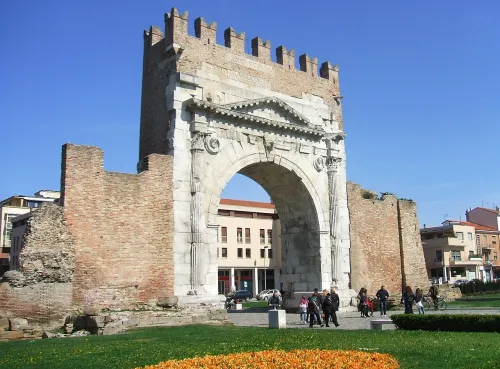
    Start where Roman travellers arrived. The Arch of Augustus, Arco di Augusto to locals, has stood here since 27 BC, the same year Augustus became the first Roman emperor. The Roman Senate commissioned it in his honour, and it marked the northern end of the Via Flaminia, the road to Rome built in 220 BC by Gaius Flaminius. Through this gate the road turned into the town's main street, the decumanus maximus, which you know today as Corso d'Augusto.

    It looks like a triumphal arch, and it is counted as the oldest preserved one in Italy, yet scholars point out that it worked as a city gate rather than a victory monument. It went up while the Via Flaminia was being restored and Ariminum was renamed Colonia Augusta Ariminensis, which tied the town to Augustus for good. It probably replaced an earlier gate about which little is known, and the houses around it were among the most elegantly decorated in Roman Rimini.

    Notice how alone it stands. Under Fascism the city walls and buildings that joined it were demolished, leaving the arch as an isolated monument. Because Rimini sits on a strategic passage along the Adriatic, army after army has marched through here, which is why the art historian Antonio Paolucci called the arch “the eye of Italy's needle”. Together with the Tiberius Bridge, where this walk ends, it appears on the city's coat of arms.

    There is no ticket and no closing time. From here it is 430 metres, about 6 minutes, to the Tempio Malatestiano, where the story jumps some fifteen centuries to the Renaissance lord who left his mark all over Rimini.
    Local name
    Arco di Augusto
    Hours
    Open 24/7
    Price
    Free
  2. 2

    Tempio Malatestiano

    Tempio Malatestiano in Rimini, stop 2 on the self-guided walking tour

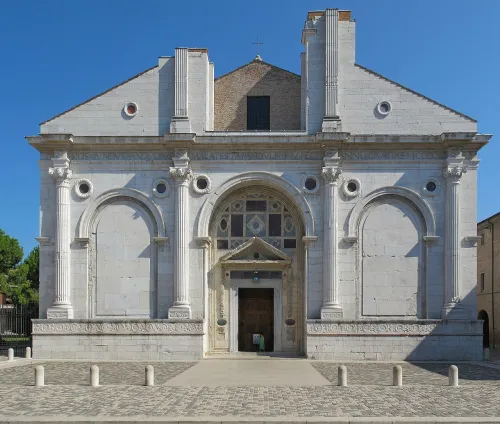
    From outside, the Tempio Malatestiano looks like a Roman monument someone forgot to finish, and that is close to the truth. Officially it is the Cathedral Basilica of Santa Colomba, Rimini's cathedral, but everyone names it after Sigismondo Pandolfo Malatesta. Around 1450 he asked Leon Battista Alberti to rebuild the Gothic church of Saint Francis that stood here. It was Alberti's first church project, and Sigismondo wanted it as a personal mausoleum for himself and Isotta degli Atti, his lover and later his wife.

    Look up at the façade. Its upper part, meant to end in a gable, was never completed, and the great dome modelled on the Pantheon in Rome, shown on a foundation medal of 1450, was never built at all. Sigismondo's fortunes collapsed after his excommunication in 1460, and when he died in 1466 the building stood much as you see it now. The two blind arches beside the entrance were meant for the tombs of Sigismondo and Isotta; their sarcophagi ended up inside instead.

    Even the stone has a past. Alberti designed, the Veronese Matteo di Andrea de' Pasti built, and the marble came from Roman ruins at Sant'Apollinare in Classe near Ravenna and at Fano. To finish the cladding, headstones from the surrounding cemetery were taken too.

    Go inside: entry is free, and even ten minutes are worth it. In the second chapel on the right is a crucifix attributed to Giotto, who probably also painted the central apse of the medieval church. Two churches came before this one on the same site, the 9th-century Santa Maria in Trivio and the 13th-century Franciscan church.

    Next comes Roman Rimini beneath the pavement: the Domus del Chirurgo is 340 metres away, about 5 minutes on foot.

    Hours
    Daily 08:30–12:00, 15:30–18:00 (Sun/holidays until 18:30)
    Price
    Free
  3. 3

    Domus del Chirurgo

    Domus del Chirurgo in Rimini, stop 3 on the self-guided walking tour

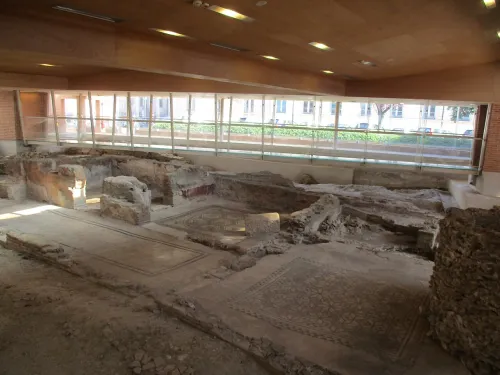
    In spring 1989, gardeners uprooting a tree in Piazza Luigi Ferrari found fragments of fresco caught in its roots, along with a mosaic and Roman ruins. Archaeologists followed, and a systematic dig opened up 700 square metres, with the first mosaics lying about 2.5 metres below today's ground. At the heart of it was a house from the second half of the 2nd century AD: the Domus del Chirurgo, the surgeon's house.

    The name comes from what lay inside. Besides mosaics and frescoes, the excavators found one of the most complete sets of surgical instruments from Roman times, the tools of a doctor who lived and worked in Ariminum.

    The site holds far more than one house. You see walls from the imperial age, a palatial residence from the late Roman and Gothic period, and part of an early medieval Byzantine house. Standing over them, you read Rimini's building history in layers, from the 1st century BC onward.

    Since 7 December 2007 the remains have been shown where they were found, and you walk above them on suspended transparent platforms, looking straight down onto the floors. The visit costs entry and is worth it if Roman everyday life interests you more than grand monuments. If you are mainly here for Fellini, this is the paid stop you can skip with the least regret.

    The old fish market is 240 metres on, about 3 minutes away.

    Hours
    Tue–Sun 10:00–13:00, 16:00–19:00, Mon closed
    Price
    7 EUR full, 5 EUR reduced
  4. 4

    La Vecchia Pescheria

    La Vecchia Pescheria in Rimini, stop 4 on the self-guided walking tour

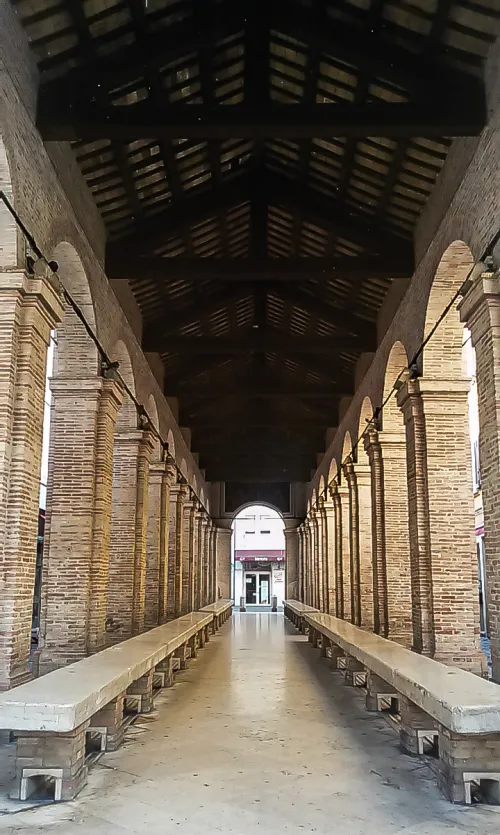
    From a buried surgeon's house to a fish market in three minutes. La Vecchia Pescheria, the old fish market, is an 18th-century open colonnade just off Piazza Cavour, built for the trade that fed this seaside town.

    Because it is open on all sides, it is free to wander at any hour; walk through the colonnade rather than past it. Then it is 30 metres, a single minute, and you are standing in Piazza Cavour.

    Hours
    Open 24/7
    Price
    Free
  5. 5

    Piazza Cavour

    Piazza Cavour in Rimini, stop 5 on the self-guided walking tour

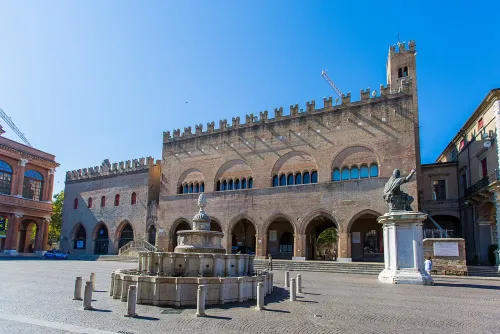
    This is Rimini's main square, the closest thing the city has to a living room. Three names hold the space together: the Fontana della Pigna, the Palazzo dell'Arengo and the Teatro Galli.

    The theatre is more than a backdrop. Between late August and November it is home to the Sagra Musicale Malatestiana, the festival that brings first-rank orchestras into the middle of a beach town, and in autumn its doors open for concerts. In December the square fills with a small Christmas market.

    You are at the halfway point of the walk, and the covered market on the square is the obvious place for a drink or a snack. Make one decision here: how much energy you have left for museums. Castel Sismondo is 230 metres away, about 3 minutes, and the castle and the Fellini Museum are the last big time spenders on the route.

    Hours
    Open 24/7
    Price
    Free
  6. 6

    Castel Sismondo

    Castel Sismondo in Rimini, stop 6 on the self-guided walking tour

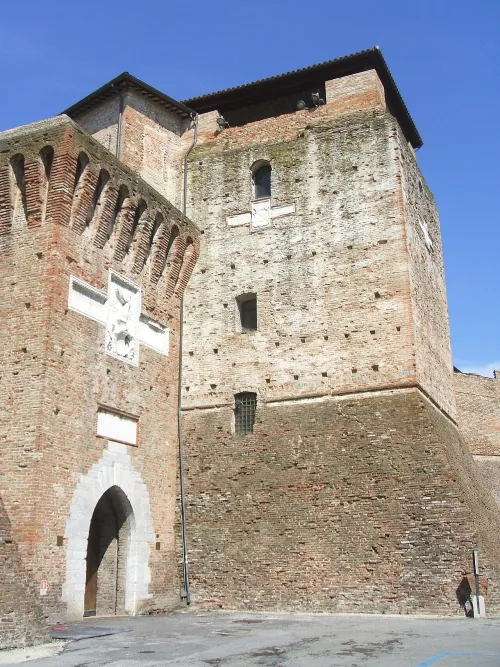
    Sigismondo Pandolfo Malatesta again, this time as a soldier. He began Castel Sismondo in 1437, in a period of great prosperity for his family's lordship, and planned it as fortress and palace at once, built on a grand scale to show the town who was in charge. Court writers praised him as its architect; more likely he inspired and coordinated the project, drawing on his experience as a condottiere.

    He had expert help. In 1438 Filippo Brunelleschi, the most sought-after architect of his day, came to Rimini to inspect the Malatesta fortresses and advised on the work, and the builders Cristoforo Foschi and Matteo Nuti were still on site in 1454.

    Sigismondo did not start from scratch. He used a fortified complex built by his brother and predecessor Galeotto Roberto, 13th-century Malatesta houses and a stretch of the old city wall. A 16th-century historian recorded that he tore down the palaces and homes of his ancestors, sparing only the main palace, and built the new castle around it, probably reusing the rubble.

    What you see is only the central core. Originally a further ring of walls and a moat surrounded it. Inside, three floors now belong to the Fellini Museum, so going in means seeing Fellini's world within Sigismondo's walls; that visit costs entry. From the castle it is 260 metres, about 4 minutes, to the Fellini Museum stop.

    Hours
    Tue–Sun 10:00–13:00, 16:00–19:00, Mon closed
    Price
    10 EUR full, 8 EUR reduced
  7. 7

    Fellini Museum

    Fellini Museum in Rimini, stop 7 on the self-guided walking tour

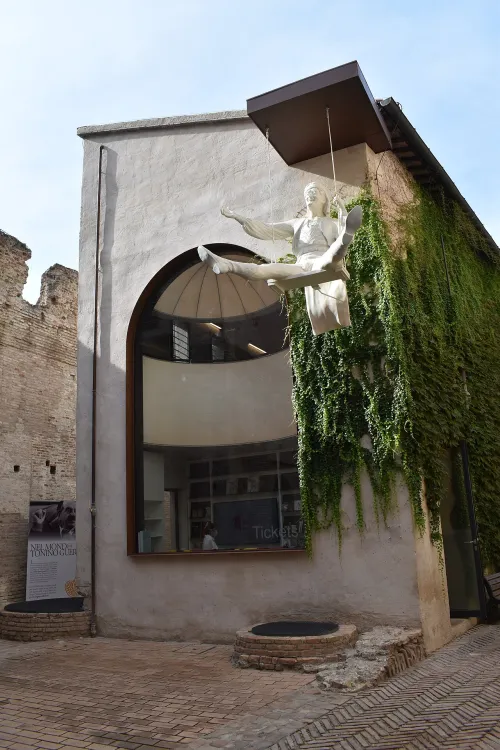
    Federico Fellini was born in Rimini, and for years visitors wondered why the city showed so little of him. Proposals for a museum date back to the mid-1990s, shortly after his death; a temporary Casa Museo Fellini ran from 2009 to 2010. When the Fellini Museum finally opened on 19 August 2021, it was described as filling a void.

    It is spread across three places in the old town: the interior of Castel Sismondo, the square outside it, and the Fulgor Palace with its cinema. On Piazza Malatesta, which the museum calls the Piazza dei Sogni, the square of dreams, a fountain sprays mist as a nod to the Rimini fog of several Fellini films.

    Inside the castle you find Fellini's drawings, music scores by his collaborator Nino Rota, photos, film clips and costumes, plus a giant sculpture of Sylvia, Anita Ekberg's character from La dolce vita. The upper three floors of the Fulgor Palace add more artwork, memorabilia and a digital archive. Outside the Fulgor, on Piazzetta San Martino, stands the golden rhinoceros from And the Ship Sails On.

    Is the ticket worth it? If you know and love even a couple of Fellini's films, yes, take an hour or more. If his name means little to you, the free square, the fog fountain and the rhinoceros give you a taste without paying. Next, the Tiberius Bridge is 320 metres away, about 5 minutes.

    Hours
    Castel Sismondo: Tue–Sun 10:00–13:00, 16:00–19:00; Palazzo del Fulgor: Tue–Sun 10:00–19:00; Mon closed
    Price
    10 EUR full, 8 EUR reduced
  8. 8

    Tiberius Bridge

    Tiberius Bridge in Rimini, stop 8 on the self-guided walking tour

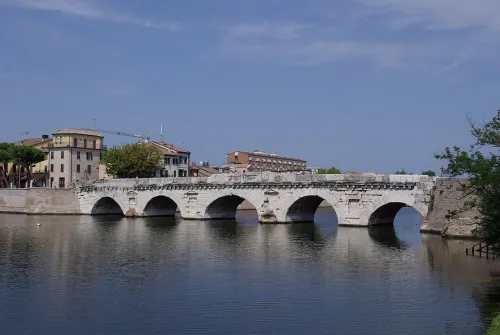
    You started at a Roman gate, and you finish the Roman part of the walk on a Roman bridge. The Ponte di Tiberio dates from the 1st century AD; its more accurate name is the Bridge of Augustus and Tiberius, because it was begun under Augustus and completed in 21 AD, after his death. It stands at the other end of the town's Roman main street from the Arch of Augustus.

    Where the Via Flaminia ended at the arch, the Via Emilia begins here: the bridge is the first stretch of that road. It has been a national monument since 1885 and is one of only two Roman bridges still standing in Romagna; the other crosses the Rubicon. Like the arch, it appears on Rimini's coat of arms.

    The bridge links the city's two historic parts, and it is free and open at all hours. Walk across slowly. Borgo San Giuliano waits on the far side, 90 metres and a minute away.

    Local name
    Ponte di Tiberio
    Hours
    Open 24/7
    Price
    Free
  9. 9

    Borgo San Giuliano

    Borgo San Giuliano in Rimini, stop 9 on the self-guided walking tour

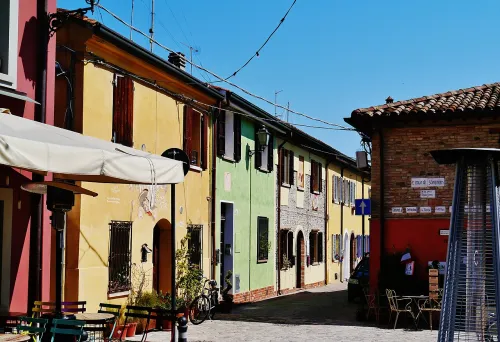
    One minute over the bridge, and Rimini changes its tone. Borgo San Giuliano is the old fishermen's quarter, and its walls are its exhibition: murals across the neighbourhood, several of them devoted to Fellini and his films.

    After emperors, lords and a film director, the walk ends in its quietest stop, which is the right order to do it in. There is no ticket and no closing time; the borgo is open around the clock like the bridge behind you. Wander without a plan and let the route end on its own.

    If you started somewhere in the middle, the GPS navigation still leads you to whatever you skipped. However you finish, you have crossed the city from its Roman gate to the far bank of its Roman bridge.

    Hours
    Open 24/7
    Price
    Free
Walking tour route map of Rimini Route loaded
Arch of AugustusTempio MalatestianoDomus del ChirurgoLa Vecchia Pescheria+5
All 9 stops are already on the map.
You just press start.
AI Tour Guide

You've read the route. Now walk it with a guide in your ear

Press start wherever you are, even hundreds of kilometres from Rimini, and the guide begins telling its stories right away. In the city, pick any of the 9 stops to start from: it leads you there, then talks with you the whole route, asking, listening, remembering, and shaping the tour around your answers.

9stops 2.0km 27 minwalking 13languages
▶Start the tour free

Free to start · Runs in your browser · No app, no download

Shorter Ways to Walk Rimini

Not every day has room for nine stops and three museums. The route splits neatly at Piazza Cavour, and the full walk also works without paying for a single ticket.

Roman and Renaissance Rimini

Stops: 1, 2, 3, 4, 5

For a morning in the oldest layers of the city. From the Arch of Augustus to Piazza Cavour you walk 1,040 metres, about 15 minutes. Only the Domus del Chirurgo charges entry; with a visit inside, plan around two hours.

Castle, Fellini and the old bridge

Stops: 5, 6, 7, 8, 9

For film lovers and anyone starting in the main square. From Piazza Cavour to Borgo San Giuliano you walk 900 metres, about 13 minutes. Castel Sismondo and the Fellini Museum charge entry; with the museum, allow about two and a half hours.

The whole route, free of charge

Stops: 1, 2, 3, 4, 5, 6, 7, 8, 9

For tighter budgets. You walk all nine stops in 27 minutes of walking, go inside the free Tempio Malatestiano and see the Domus del Chirurgo, Castel Sismondo and the Fellini Museum only from outside. The squares around the Fellini sites are open to everyone. Count on a little under three hours.

How Long the Rimini Tour Takes, With and Without Museums

The walking itself is short: 27 minutes in total, and no leg is longer than 6 minutes. The time goes into the stops. The arch, the fish market, the square and the bridge need a quarter of an hour or less each, the Tempio Malatestiano about 25 minutes, and Borgo San Giuliano half an hour if you let yourself wander.

The museums decide the length of your day. The Domus del Chirurgo takes about 45 minutes, the Fellini Museum an hour and a quarter or more for film fans. With both, the full route comes to about four and a half hours; skip the paid interiors and you are done in under three. Piazza Cavour sits right in the middle and is the natural place for a break.

Before You Set Off in Rimini

  • Start: The Arch of Augustus is the recommended start, because the route then follows Rimini's story in order. You can begin at any stop; the GPS navigation leads you on from wherever you are.
  • Finish: Borgo San Giuliano, just across the Tiberius Bridge. If you like, the GPS navigation in your browser takes you back to the Arch of Augustus.
  • Time of day: Walk during the day if you want to go inside. The Tempio Malatestiano, the Domus del Chirurgo and the castle museum keep set opening hours, so check them before you leave. The arch, the fish market, the square, the bridge and the borgo are open around the clock.
  • Tickets: Three stops charge entry: the Domus del Chirurgo, Castel Sismondo and the Fellini Museum. Everything else is free, including the cathedral.

Day Trips from Rimini Worth Your Time

Out in the morning, back by night. Every route here fits in one full day.

Walking tour route map of Rimini
AI Tour Guide

A Guide for Rimini, Ready Whenever You Are

Press start and a voice AI Tour Guide takes it from here: leading the route through Rimini, telling the stories, and turning your walk into a real back-and-forth conversation. No app or download is needed; it runs in your browser.

9stops 2.0km 27 minwalking 13languages
▶Start the tour free

Free to start · Runs in your browser · No app, no download

What the AI Tour Guide Adds in Rimini

This walk jumps between Roman emperors, a Renaissance lord and a film director, and the AI Tour Guide ties them together as a conversation. It greets you at the arch, tells the stories as you reach each place, asks what you are curious about and remembers it, so a Fellini fan hears more about the films and a history buff more about Ariminum. Interrupt it whenever you like, for instance to ask why the pope excommunicated Sigismondo or which Fellini film to watch tonight. It never changes your route. You start with 100 free credits; after that you choose this tour all-inclusive for €19.99 with no time limit, or credits at €5 per hour.

A Real Conversation A voice AI Tour Guide greets you, leads the whole route, and tells the stories and facts as you walk, asking what you want to see and keeping a real conversation going. Not a recording you press play on.
Map Navigation Follow the route on the map and walk at your own pace. You choose where to start and when to move to the next stop.
Ask Anything Curious about a building you pass? Ask your AI Tour Guide on the spot and the conversation carries on.
13 Languages Switch language anytime. No separate tour needed.
Start free in your browser

Common Questions About Walking Rimini

Are the Roman surgical instruments on display at the Domus del Chirurgo?

The excavated site with its mosaics and walls stays where it was found, but the finds themselves, including the surgical instruments, are kept at the Museo della Città di Rimini.

When does the fog fountain at the Fellini Museum run?

The fountain on Piazza Malatesta, the Piazza dei Sogni outside the castle, sprays mist every half hour. If you arrive just after it, wait a little; the square is free to enter.

Can I watch a Fellini film in Rimini?

Yes. The Cinemino on the ground floor of the Fulgor Palace, part of the Fellini Museum, shows Fellini films in rotation.

Which towns make a good day trip from Rimini?

Ravenna fits this walk well, since marble for the Tempio Malatestiano was taken from Roman ruins at Sant'Apollinare in Classe nearby. Urbino is the closest Renaissance town, and Bologna makes a full city day.

Is the tour really free?

Yes. The whole tour is free: the route, the interactive map and the navigation cost you nothing. Only the voice AI Tour Guide is optional and paid: you test it with 100 free credits, then you pay either €5 per hour or €19.99 for this whole tour, with no time limit. Admission to 3 of the 9 stops is not included: Domus del Chirurgo, Castel Sismondo and Fellini Museum charge their own entry fees.

Do I need to download an app?

No. Everything runs in your phone browser. Open the route and start walking, no download and no sign-up required.

Do I need to book the walking tour in advance?

No booking needed. This self-guided tour is available anytime. Open the route in your browser and start walking. The AI Tour Guide works instantly, no app, no reservation required.

What languages is the AI Tour Guide available in?

The AI Tour Guide speaks 13 languages, so you take the tour in your own language and can switch at any time.

Can I skip stops or change the route?

Yes. Skip any stop, spend extra time at places you like, or start the route from any point. It is your walk, you set the pace.
Image credits
▶ Start free in your browser Runs in your browser, no app, no download