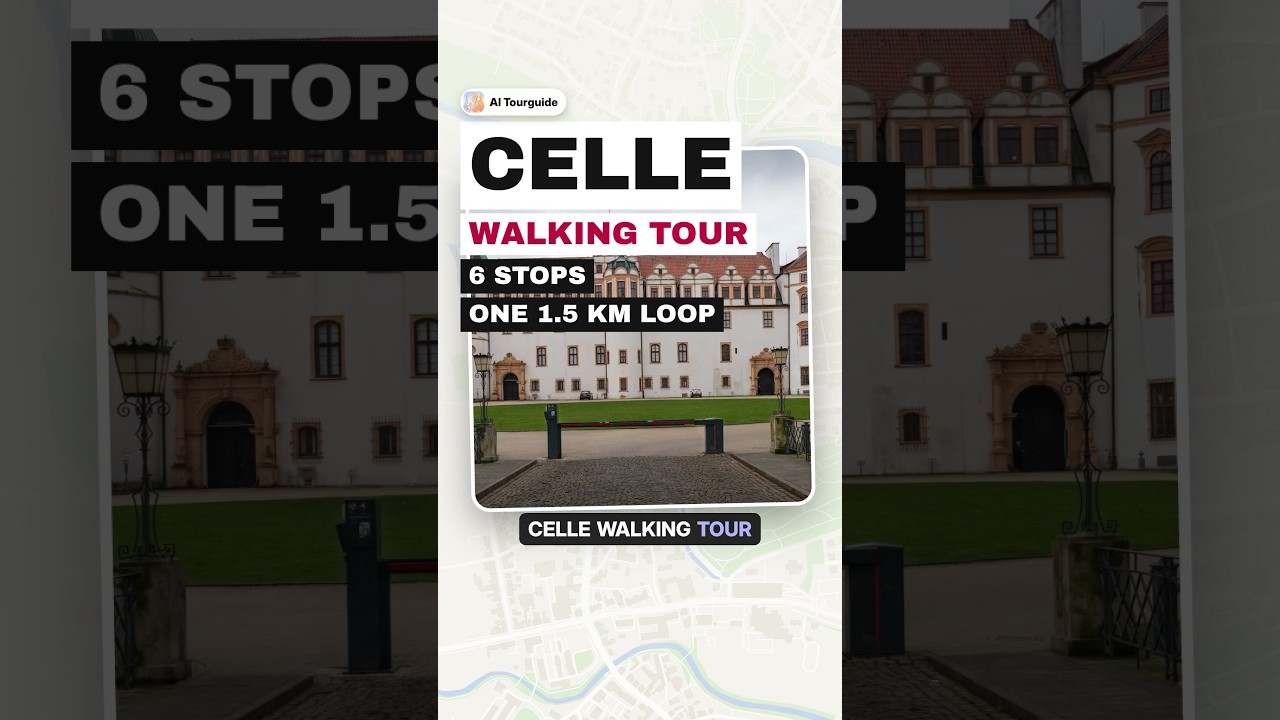
Free Walking Tour Celle: From Castle to Französischer Garten

Six stops on 1.5 km: from the ducal castle past a Baroque church and a half-timbered synagogue of 1740 to the Französischer Garten, with free GPS navigation.

6 Stops 1.5 km ~21 min walking
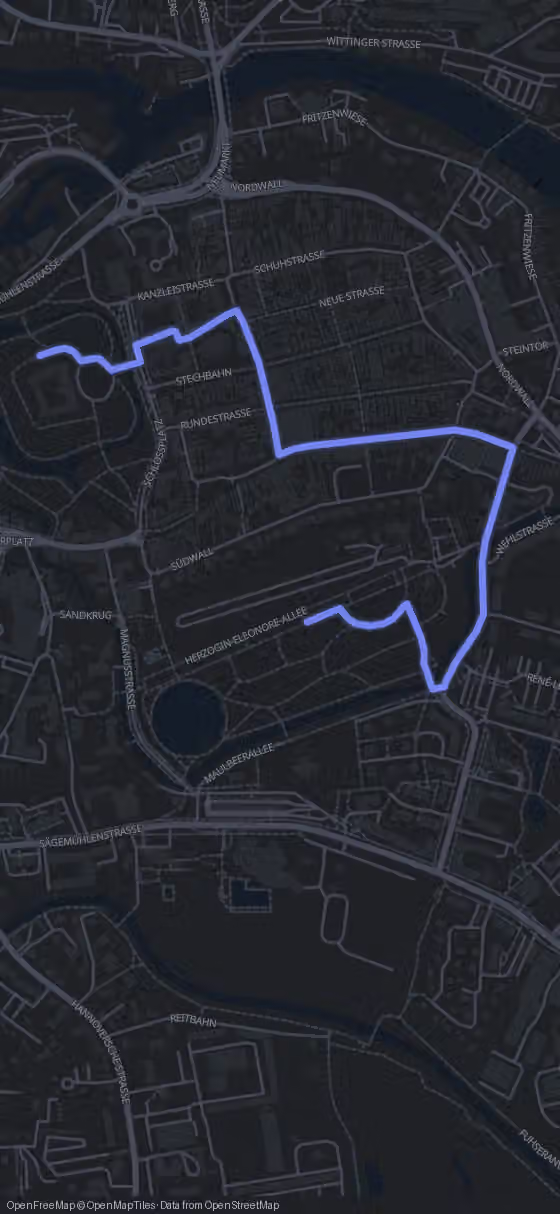
Route map for the Celle walking tour
Stop 1 of 6
270 m·3 min
Celler Schloss
Head east across the square toward the Bomann-Museum
Welcome to Celle. I'm Alex, and these timber-framed streets hide a remarkable story of survival.
Try this tour with Alex

Celle's Old Town Walk at a Glance

Six stops, 1.5 km, 21 minutes of pure walking: from the Celler Schloss past the Bomann-Museum, the Stadtkirche St. Marien, the Alter Provisor and the Synagoge Celle to the Französischer Garten. With both museums, plan close to four hours.

Only the castle and the Bomann-Museum charge admission; the church, the shop, the synagogue and the park are free. Route, map and GPS navigation in your browser cost nothing, and the AI Tour Guide is optional: it leads the walk as a conversation.

Open free GPS & optional AI Tour Guide
This short shows highlights of the route. All 6 stops follow below.

The Route

Walking Map of Celle: Castle, Old Town and Park

6 stops 1.5 km 21 min walking
Tap to load interactive map

The 6 stops along this route

  1. Celler Schloss, stop 1 on the self-guided walking tour
    1Celler Schloss
  2. Bomann-Museum in Celle, stop 2 on the self-guided walking tour
    2Bomann-Museum
  3. Stadtkirche St. Marien in Celle, stop 3 on the self-guided walking tour
    3Stadtkirche St. Marien
  4. Alter Provisor in Celle, stop 4 on the self-guided walking tour
    4Alter Provisor
  5. Synagoge Celle, stop 5 on the self-guided walking tour
    5Synagoge Celle
  6. Französischer Garten in Celle, stop 6 on the self-guided walking tour
    6Französischer Garten
  7. That's the full route.

    Walk it with an AI Tour Guide talking you through every one of these streets.

    Start free in your browser
    You made it

The Celle Walking Tour in Six Stops

  1. 1

    Celler Schloss

    Celler Schloss, stop 1 on the self-guided walking tour

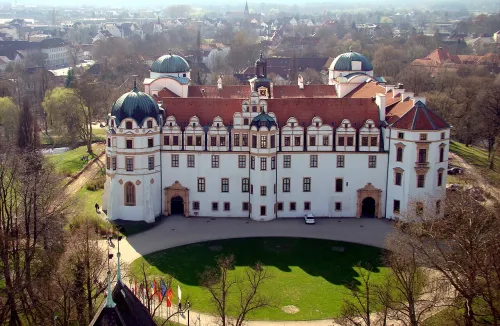
    Begin at the Celler Schloss and look up at the roofline first: a ring of gables runs around the roofs, and the domed towers have an unusual shape. Both go back to Duke George William, who from 1670 remodelled the old Renaissance seat into a modern residence and, to recall his years in Italy, had the façades copied from Venetian buildings. The quadrangular building around a rectangular courtyard is the largest castle in the southern Lüneburg Heath.

    The story starts much earlier. Around 980 a Brunonen count built a fortified tower called Kellu to guard a ford over the River Aller. Otto the Strict extended it in 1292, and the cellar vault and lower floors of that watch tower still survive beneath the castle theatre. In 1378, after the War of the Lüneburg Succession, the Dukes of Brunswick-Lüneburg moved their residence here from Lüneburg and began turning the moated fortress into a palace.

    Frederick the Pious expanded it in the 1470s and the chapel was consecrated in 1485. From 1530 Ernest I the Confessor had it decorated in Renaissance style, while ramparts and bastions pushed the defences further out. By then it had massive corner towers, a large main tower and the features of Weser Renaissance, the shell that George William later dressed in Venetian clothes.

    Is it worth going in? Admission is charged, with reduced tickets and free entry for children and pupils. If the ducal court is the reason you came to Celle, give it about an hour.

    From here it is 270 m, about 4 minutes, across the former outer bailey to the Bomann-Museum, which faces the castle on the Schlossplatz.
    Hours
    May–October: Tue–Sun 10:00–17:00; November–April: Tue–Sun 11:00–16:00; 1st-3rd Advent weekends: 10:00–17:00; Mon closed
    Price
    10.00 EUR regular, 7.00 EUR reduced, free for children and pupils; with guided tour: 12.00 EUR regular, 10.00 EUR reduced; combination ticket (Residenzmuseum + Bomann-Museum + Kunstmuseum Celle): 15.00 EUR regular, 10.00 EUR reduced
  2. 2

    Bomann-Museum

    Bomann-Museum in Celle, stop 2 on the self-guided walking tour

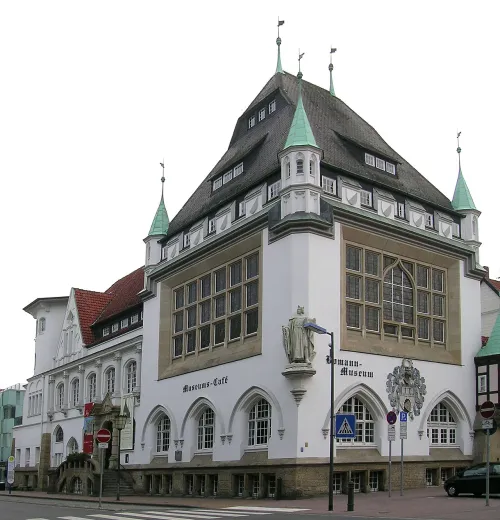
    Study the façade before you go in. The building is a deliberate collage of styles: castle and townhouse, solid masonry and half-timbering, Gothic and Renaissance details, partly assembled from reused older parts. Hanover architect Alfred Sasse built it between 1903 and 1907, with founder Wilhelm Bomann heavily involved in the plans. The writer Hermann Löns mocked it as a 'veritable architectural pudding'. On the north side you will notice a bare platform: a prominent tower spire stood there until it was taken down in 1929 because it had become unsafe.

    The museum began in 1892 as the 'Patriotic Museum' in the Bergstraße and took its founder's name in 1928. Today it is one of the largest city museums in Lower Saxony, devoted to folk life and to the history of the region and the town. Emperor Wilhelm II toured the new building in 1908 and 1911 and donated a monumental mural by the Berlin painter Carl Röchling showing the Battle of the Göhrde of 16 September 1813, where Prussia and Hanover fought side by side. Half-timbered houses on the Stechbahn, among them the former widows' house of the parish, were added before 1926.

    The museum charges admission, with reduced tickets and free entry for children and pupils. Allow an hour if local history interests you; if there is time for only one museum, choose between the courtly world of the castle and the townspeople's story told here.

    The Stadtkirche St. Marien is a mere 20 m away, a minute on foot.

    Hours
    Tue–Sun 11:00–17:00, Mon closed
    Price
    8.00 EUR regular, 5.00 EUR reduced; combination ticket (Bomann-Museum + Kunstmuseum Celle + Residenzmuseum): 15.00 EUR regular, 10.00 EUR reduced; free for children and pupils; free admission on the last Saturday of each month
  3. 3

    Stadtkirche St. Marien

    Stadtkirche St. Marien in Celle, stop 3 on the self-guided walking tour

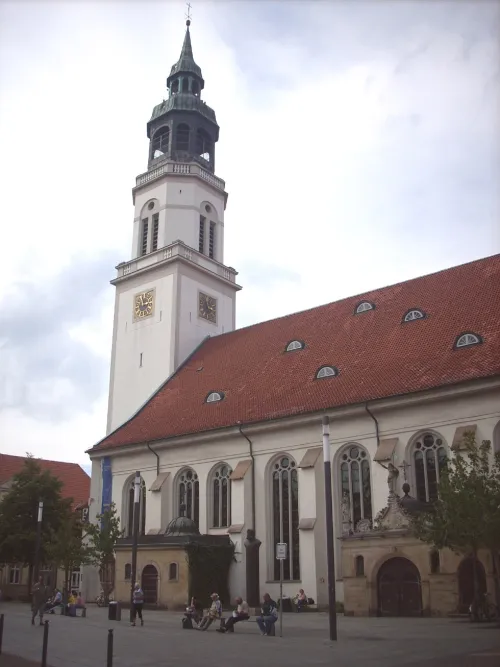
    From outside, the Stadtkirche St. Marien looks plain: a three-aisled hall church of brick and fieldstone, without a transept. Building began soon after 1300, once Duke Otto the Strict had given up Altencelle and founded a new settlement four kilometres to the northwest, the town you are standing in. The choir was consecrated in 1308, and the nave grew through the 14th century.

    Inside, the mood changes completely. Between 1676 and 1698 the church was thoroughly remodelled in Baroque style: Tornielli and other craftsmen working at the castle covered the barrel-vaulted wooden ceiling with stucco panels, gave the octagonal pillars stucco capitals and placed ten sandstone apostles on the brackets above, joined by Peter and Paul at the chancel arch. Look at that arch for the oldest work in the church, a late medieval crucifixion group from around 1500 with Mary and John beneath the cross. In the choir, the original Gothic rib vaulting still shows most clearly under the stucco.

    This became a Protestant preaching church when Duke Ernest the Confessor and his superintendent general Urbanus Rhegius brought the Reformation to the Lüneburg and Celle lands. Beneath the choir lies the ducal crypt of 1576, closed to the public. Among those buried there are Duchess Eleonore, Princess Sophie Dorothea and Caroline Mathilde, Queen of Denmark, whose memorial you will meet again in the Französischer Garten.

    Entry is free; the optional tower climb is paid separately. Plan about 20 minutes, then walk 420 m, around 6 minutes, to the Alter Provisor.

    Hours
    Tue–Sat 11:00–17:00, Sun after morning service, Mon closed
    Price
    Free (church entry free; optional tower climb 2.00 EUR adults, 1.00 EUR children)
  4. 4

    Alter Provisor

    Alter Provisor in Celle, stop 4 on the self-guided walking tour

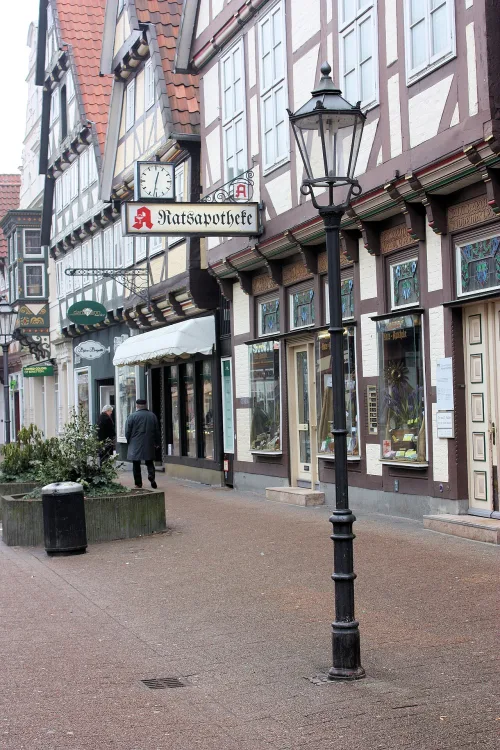
    The Alter Provisor is a shop in a restored half-timbered building, opened in November 2014 and named after Celle's own herbal liqueur. A 'Provisor' was the pharmacist or senior assistant in charge of a pharmacy, which already tells you where the drink comes from.

    The recipe goes back to an aqua vitae, a 'water of life', in the recipe book of the pharmacist Otto Kaiser, who ran the Rottmann pharmacy in the early 20th century. In 1910 it was renamed Ratsapotheke and taken over by Carl Greve, who first produced the liqueur in larger quantities. Jost Greve gave it the name Alter Provisor in 1980, registered the trademark and made it from 1973 until 2013. In January 2014, in its 165th year, the Ratsapotheke closed. The brand passed to a new company, was produced for a while in Reutlingen, and since August 2014 has been made in northern Germany again.

    The liqueur itself is strong and bitter: 50 percent alcohol, 10 percent sugar, and extracts of Asian spice plants and native medicinal herbs. Entry is free. Ten minutes are enough unless you are looking for a souvenir with a story.

    From here it is 200 m, about 3 minutes, to the Synagoge Celle.

    Hours
    Tue–Fri 10:00–18:00, Sat 10:00–16:00, Sun–Mon closed
    Price
    Free
  5. 5

    Synagoge Celle

    Synagoge Celle, stop 5 on the self-guided walking tour

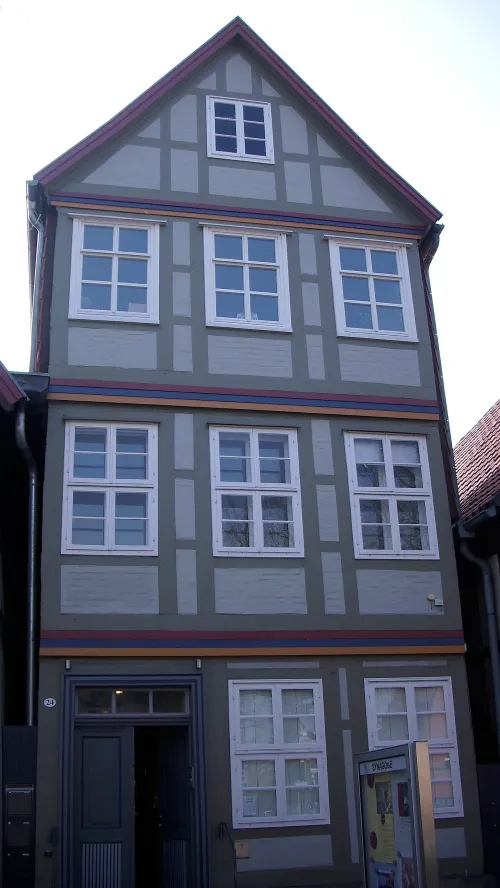
    The Synagoge Celle does not announce itself. It was built around 1740 in the half-timbered style typical of Celle and is the oldest surviving half-timbered synagogue in Lower Saxony. Jews in the Duchy of Brunswick-Lüneburg were permitted to build synagogues from 1737; a year later the community bought two plots here. A major restoration in 1883 added leaded glass.

    In the November pogroms of 1938 the interior was wrecked, and ritual objects were thrown into the street and burned. The building was not set alight only because the attackers feared the fire would spread to the neighbouring houses and the tightly packed half-timbered old town. It then served as a storeroom, and from 1942 the remaining members of the Jewish community were housed in the front buildings until their deportation. Look down at the pavement in front of Im Kreise 23 and 24: Stolpersteine laid in 2004 remember them, including two Russian prisoners of war, Jakob Gerschez and David Klatschko, who had last been forced labourers in Oldau.

    Services resumed in 1945. The town bought the buildings in 1969, restored them together with the two front houses between 1972 and 1974, and on 20 June 1974 Rabbi Nathan Peter Levinson of Heidelberg rededicated the synagogue. Since 1996 the front houses have held changing exhibitions and a documentation of Jewish life in Celle.

    Admission is free. Give it half an hour, longer if you want to read the documentation. Then walk 630 m, about 8 minutes, to the Französischer Garten.

    Hours
    Tue–Fri 11:00–16:00, Sun 11:00–16:00, Mon & Sat closed
    Price
    Free (general museum admission free; booked group tours via Stadtarchiv 65.00 EUR, school groups free)
    Website
    celle.de ↗
  6. 6

    Französischer Garten

    Französischer Garten in Celle, stop 6 on the self-guided walking tour

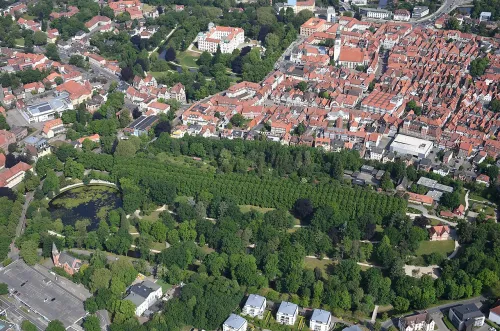
    The walk ends in the Französischer Garten, a historic public park on the southern edge of the old town, protected as a listed monument, open around the clock and free. Along its north side runs the Herzogin-Eleonore-Allee, a four-row avenue of lime trees about 330 m long; a mulberry avenue closes the garden off to the south.

    At the western end lies the circular pond, first shown in this form in 1770; before that there were four rectangular ponds. It measures 95 m across, two old weeping willows stand on a small island, and the multi-jet fountain in the middle is lit in the evening. In front of the pond, the enclosed rose garden still recalls the layout of the former Baroque garden.

    In the eastern part stand a small Renaissance palace built in 1611, an open-air stage and the memorial to Caroline Mathilde, the Danish queen banished to Celle, carved by Adam Friedrich Oeser in 1784 from Crottendorf marble. After the crypt of the Stadtkirche St. Marien, this is where her story comes full circle.

    Along the east and south edges flows the Magnusgraben, dug in 1370 as part of the town fortifications and named after Duke Magnus. It branches off the Aller east of Celle, feeds the big pond and, by way of the town moat, the moat of the castle where you started. If you want to head back there, the GPS navigation in your browser leads you to the Celler Schloss.

    Hours
    24/7
    Price
    Free
Walking tour route map of Celle Route loaded
Celler SchlossBomann-MuseumStadtkirche St. MarienAlter Provisor+2
All 6 stops are already on the map.
You just press start.
AI Tour Guide

You know the route now. Walk it with a guide who talks with you.

Press start wherever you are, even hundreds of kilometres from Celle, and the guide begins telling its stories right away. In the city, pick any of the 6 stops to start from: it leads you there, then talks with you the whole route, asking, listening, remembering, and shaping the tour around your answers.

6stops 1.5km 21 minwalking 13languages
▶Start the tour free

Free to start · Runs in your browser · No app, no download

Shorter Ways Through Celle

Not everyone wants the dukes and the old town in one go. These two halves of the route stand on their own.

Court and museums

Stops: 1, 2, 3

For visitors who came for the ducal residence and local history. Only 5 minutes of walking between the Celler Schloss, the Bomann-Museum and the Stadtkirche St. Marien; admission at the castle and the museum, the church is free.

Old town, Jewish Celle and the park

Stops: 3, 4, 5, 6

For a free walk without museum tickets: from the Stadtkirche St. Marien past the Alter Provisor and the Synagoge Celle to the Französischer Garten, 17 minutes of walking, no admission anywhere except the optional church tower.

How Long the Celle Tour Takes, With and Without Museums

The walking itself takes 21 minutes. The legs are short: the Bomann-Museum and the church stand just 20 m apart, and the longest stretch is the last one, from the synagogue to the park.

Give the castle and the Bomann-Museum an hour each, the church 20 minutes, the Alter Provisor 10, the synagogue and the park half an hour each, and the full route takes about 3 hours 50 minutes. Starting at 11:00 on a weekday, you reach the synagogue at about 13:45.

The court and museums variant takes about two and a half hours with both museums; the old town variant is done in just under two hours.

Before You Set Off in Celle

  • Start: The Celler Schloss is the recommended start, but you can join at any stop; the order of the walk is the recommended one.
  • Finish: The Französischer Garten. If you want to return to the castle, the GPS navigation in your browser leads you back.
  • Best days: Plan it for the middle of the week; that is when you can see every stop on the route.
  • Time of day: Start in the late morning, when the castle and the Bomann-Museum are open.
  • Costs: The walk and four of the six stops are free. If you plan both museums, the combination ticket, also available at a reduced rate, covers the Residenzmuseum in the castle, the Bomann-Museum and the Kunstmuseum Celle.
Walking tour route map of Celle
AI Tour Guide

Your guide is ready at the castle when you are.

Press start and a voice AI Tour Guide takes it from here: leading the route through Celle, telling the stories, and turning your walk into a real back-and-forth conversation. No app or download is needed; it runs in your browser.

6stops 1.5km 21 minwalking 13languages
▶Start the tour free

Free to start · Runs in your browser · No app, no download

What the AI Tour Guide Adds in Celle

On this route the AI Tour Guide ties the threads together as you walk: it picks up Caroline Mathilde at the church and brings her back in the park, asks whether the court or Jewish Celle draws you more, and shifts its stories to match. It remembers what you told it and goes into what the walk leaves open, such as what Duke George William brought back from Italy besides façades, or how daily life in the ducal residence looked. You start with 100 free credits; after that, this tour costs €19.99 all-inclusive with no time limit, or €5 per hour.

A Real Conversation A voice AI Tour Guide greets you, leads the whole route, and tells the stories and facts as you walk, asking what you want to see and keeping a real conversation going. Not a recording you press play on.
Map Navigation Follow the route on the map and walk at your own pace. You choose where to start and when to move to the next stop.
Ask Anything Curious about a building you pass? Ask your AI Tour Guide on the spot and the conversation carries on.
13 Languages Switch language anytime. No separate tour needed.
Start free in your browser

Common Questions About Celle

Can I join a guided tour inside the Celler Schloss?

Yes. You can book admission with a guided tour instead of the regular ticket; it costs a little more and is also available at a reduced rate.

Is the Synagoge Celle still used for worship?

Yes. Since 1997 the re-founded Jewish community of Celle has used it for services and meetings, and the Celle Society for Christian-Jewish Cooperation organises many public events there. Groups can book a guided visit through the Stadtarchiv; school groups are free.

Which city walk pairs well with Celle?

Celle fits into half a day, so a second walk is easy to add: Hanover is 37 km away and Brunswick 50 km.

Is the tour really free?

Yes. The whole tour is free: the route, the interactive map and the navigation cost you nothing. Only the voice AI Tour Guide is optional and paid: you test it with 100 free credits, then you pay either €5 per hour or €19.99 for this whole tour, with no time limit. Admission to 2 of the 6 stops is not included: Celler Schloss and Bomann-Museum charge their own entry fees.

Do I need to download an app?

No. Everything runs in your phone browser. Open the route and start walking, no download and no sign-up required.

Do I need to book the walking tour in advance?

No booking needed. This self-guided tour is available anytime. Open the route in your browser and start walking. The AI Tour Guide works instantly, no app, no reservation required.

What languages is the AI Tour Guide available in?

The AI Tour Guide speaks 13 languages, so you take the tour in your own language and can switch at any time.

Can I skip stops or change the route?

Yes. Skip any stop, spend extra time at places you like, or start the route from any point. It is your walk, you set the pace.
Image credits
▶ Start free in your browser Runs in your browser, no app, no download