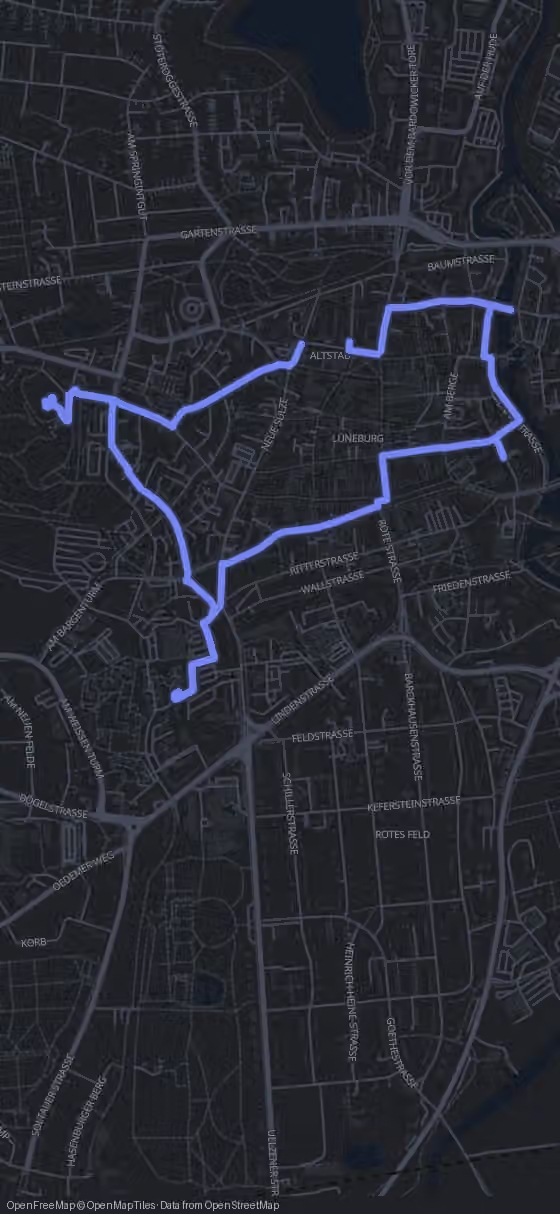
Squares, church, hill and crane are free; only the Salzmuseum and the town hall interior, seen on a guided tour, charge admission. The GPS route runs free in your browser, the AI Tour Guide is optional.
Your Lüneburg Walking Tour, Stop by Stop: From Salt Dome to Harbour Crane
1
Altes Rathaus
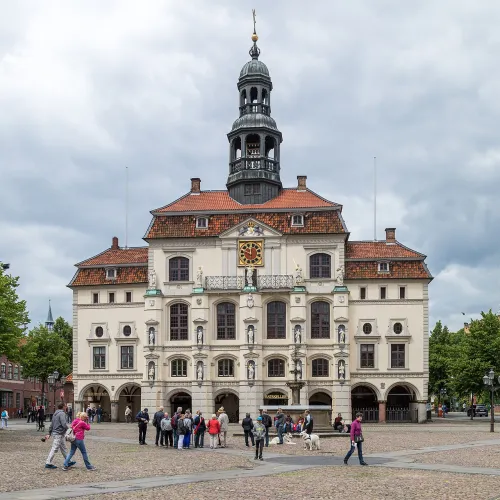
Your walk begins at the Altes Rathaus with a choice rather than a ticket. The exterior costs nothing and asks nothing of you; the interior is open only on guided tours. That split between looking and going in runs through half of this route, so decide here what kind of day you want: facade reader or door opener.
If you want the inside, plan it before you come. The tours charge admission, and the times are not posted in advance, so ask the Tourist Information which slots they have, and book one or simply enjoy the street view.
Either way, give the facade an unhurried look before you leave. The money you save here works harder at the Salzmuseum later in the day. From the town hall it is 830 m and 13 min to the Kalkberg, where the whole story of Lüneburg's wealth literally comes up out of the ground.
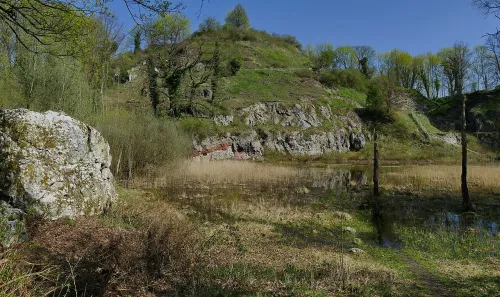
The Kalkberg looks like a modest hill with rough, pale rock walls, but it is the cap rock of a salt dome. About 250 million years ago the Zechstein Sea left its sediments here. Later the lighter salts flowed together and pushed upwards through the younger rock, tilting and folding the layers as they rose. Near the surface, groundwater washed out the salt and left behind the harder carbonates and sulphates, mostly gypsum. That is what you are standing on.
The steep, jagged walls are no natural cliff: they are the scars of an old quarry. For centuries people cut away most of the hill to use the gypsum as building material, and in the Middle Ages it was a working gypsum mine. The quarry finally closed in 1923, as the deposits ran thin and the gypsum contained more and more anhydrite.
Long before the quarrymen, power sat up here. Until February 1371 a castle crowned the Kalkberg, and the Principality of Lüneburg-Brunswick was governed from it. In the Lüneburg War of Succession the castle was destroyed, together with the nearby monastery.
Today it is a nature reserve and a favourite meeting place for locals. On just 3.6 hectares grow over 180 species of flowering plants, some of them warmth- and chalk-loving types otherwise found only in south-central Europe, and bats live in several small caves. Entry is free. Then follow the salt underground in spirit: 1200 m and 16 min to the Deutsches Salzmuseum.
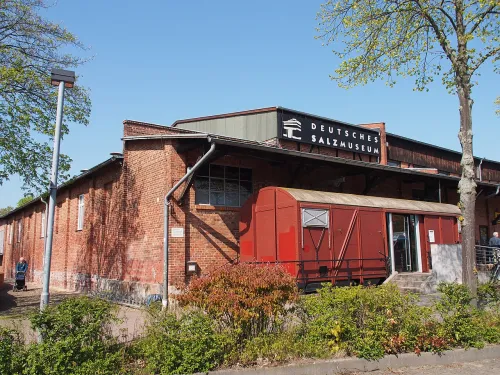
The salt that rose under the Kalkberg was brought up as brine and boiled here. The Deutsches Salzmuseum stands on the site of the Lüneburg saline, which it presents as the oldest and once the largest industrial enterprise in Central Europe. Production only stopped in 1980, and the buildings are still there as an industrial monument.
Look around before you go in. The boiling house was built from 1923 to 1925, the same years the quarry on the Kalkberg shut down, and it worked until 1980. Two brine tanks from the early 19th century sit on a remnant of the old town rampart. The well house over the brine shaft was designed in 1832 by Friedrich Heinrich Laves, and the donkey stable, whose older part probably dates from 1852, once belonged to a chemical factory linked to the saline and was moved here from a site further west.
Inside, the permanent exhibition fills part of the boiling house in four sections: salt in general, the Middle Ages and early modern period, the 19th century and the 20th century. Special exhibitions use the donkey stable. The highlight is the reconstructed medieval boiling hut, where staff in historical dress show how salt was boiled in wood-fired lead pans. In 1991 the museum received the Council of Europe Museum Prize.
Is it worth the entrance fee? If you want to understand why this town was rich, yes: allow about an hour and a half. From here it is 890 m and 12 min to Am Sande, and on the way you pass the Brauereimuseum Lüneburg, a reminder that beer was traded here too.
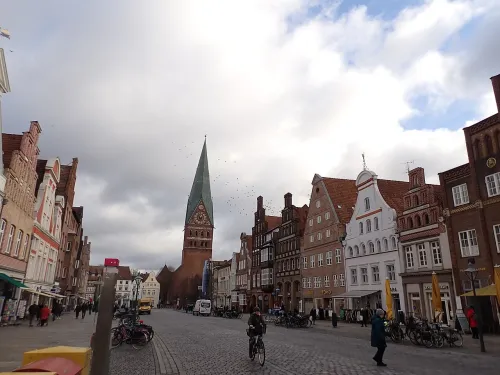
Am Sande is a long, open square, about 225 metres from end to end and between 30 and 40 metres wide, lined mostly with medieval merchants' houses. Let your eyes run along the rooflines: Gothic gables stand next to curving Baroque scroll gables. The ground falls gently towards the church at the eastern end.
The name is plain history. When the square was first mentioned in 1229 as “in harena”, it was unpaved: literally “on the sand”. It grew up as the link between the Modestorpe settlement, the settlement at the Kalkberg and the saline, so you have just walked its reason for existing. The trade roads to Magdeburg and Brunswick and to Hamburg and Lübeck also crossed here, which made it a place where goods changed hands.
A fee schedule from 1500 shows how busy it was. Salt was handled in the house at Am Sande 45, beer was traded here from 1421 and grain from 1570, and documents also record fish and building timber. The house numbers start on the western side with number 1 and run anticlockwise.
Two buildings frame the view. At the western end stands the Haus Schütting, a former brewery finished in 1548 in black and white glazed brick, today home to the Chamber of Industry and Commerce. At the eastern end rises the 108 metre tower of St. Johanniskirche, only 400 m and 5 min away.
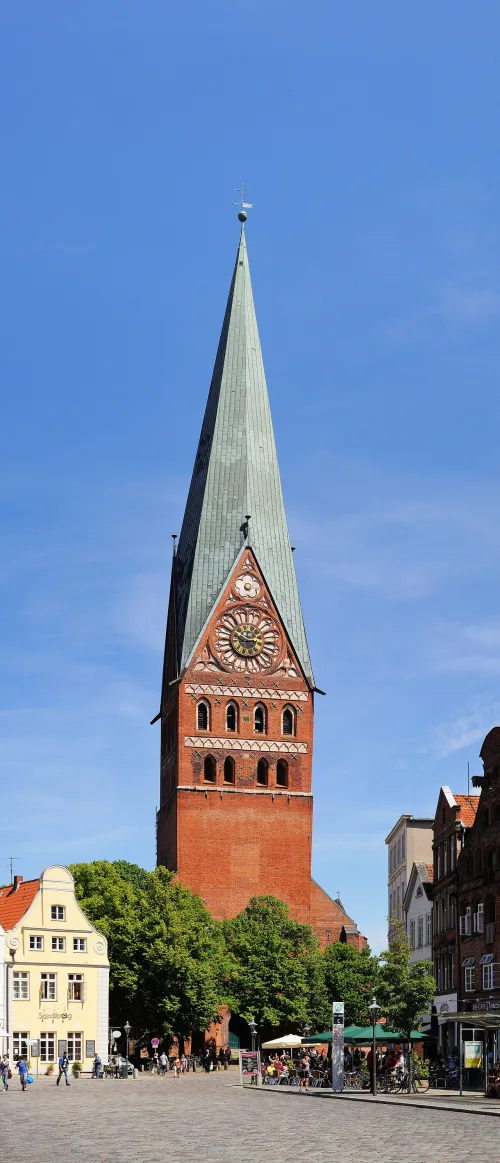
St. Johanniskirche is the oldest Lutheran church in Lüneburg and a fine example of northern German Brick Gothic, which puts it on the European Route of Brick Gothic. The five-naved hall church went up between 1300 and 1370 and was repaired in 1420; its outer shell owes much to rebuilding in 1765.
Look up at the 108 metre spire. From every side it seems to lean, because the timber frame of its upper part is twisted like a corkscrew. Lüneburg nearly had a cathedral here: in the early 15th century Conrad of Soltau, as Prince-Bishop of Verden, tried to make St. Johannis his new cathedral. The city council and the Prince of Lüneburg blocked it, wary of another power meddling in local affairs.
Inside, the organ is the reason music lovers come. It was finished in 1553 by Hendrik Niehoff and Jasper Johansen, rebuilt in 1714 by Matthias Dropa, a pupil of Arp Schnitger, and again in the later 20th century by Rudolf von Beckerath. Christian Flor played it, and Georg Böhm was organist from 1698 to 1733. From 1700 to 1702 the young Johann Sebastian Bach lived at a school attached to the nearby Michaeliskirche, and documents suggest that Böhm gave him organ lessons right here.
Also find the Elisabeth Chapel, whose stained glass Charles Crodel made in 1969. Entry is free, and twenty minutes is enough for most visitors. Then turn towards the river: the Stintmarkt is 360 m and 5 min away.
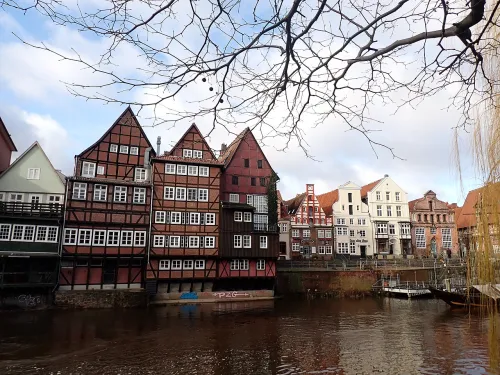
One turn away from the church square and the town changes character. The Stintmarkt lies in the Wasserviertel, Lüneburg's water quarter, and this stretch of the route is about lanes and atmosphere rather than monuments. It is free and open at any hour, so linger as long as you like.
Its own story is quiet, but the one that explains it waits just 110 m and 1 min further on, through the Wasserviertel, at the old harbour crane.
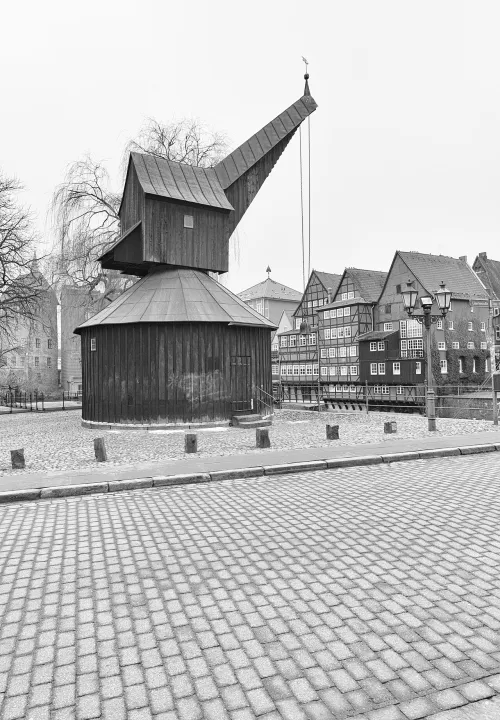
The Alter Kran stands at the former harbour on the Ilmenau and is one of Lüneburg's landmarks. When it was built in 1797, it was among the most powerful cranes in all of northern Germany. Its load-bearing timber frame is clad in boards against the weather, and the roof is covered in copper sheets.
Take a closer look at how it works. The round base, eight metres across, is fixed; the upper part with the jib turns on top of it, much like a Dutch windmill. Four sandstone blocks of about 200 kg each act as counterweight. Inside, men walked a double treadwheel five metres in diameter, which drove a nine metre vertical shaft, which in turn powered the chain winch at the top.
A crane stood on this spot as early as 1330. Its main job was the saline: shipping out the salt, above all via the Stecknitz canal to Lübeck, and landing the firewood the boiling houses burned. It shared the work with the smaller winches of the warehouse next door, then the Heringshaus and today called the Altes Kaufhaus. A council ordinance set which goods went to which crane and how much “crane money” was owed.
The crane was rebuilt and altered many times. In the winter of 1795 a flood with drifting ice badly damaged it, along with the neighbouring bridge, and in the summer of 1797 it was rebuilt in the form you see, almost unchanged since. From here it is 490 m and 7 min to the last stop, past the Wochenmarkt Lüneburg.
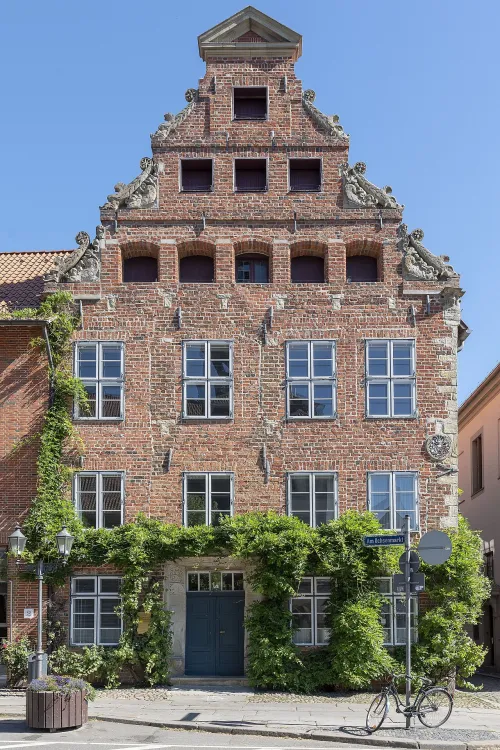
The Heinrich-Heine-Haus at Am Ochsenmarkt is a patrician house of the 15th and 16th centuries, and its walls hold far more than one poet. Remains in the cellar point to a building from around 1300. In 1484 a neighbouring house passed to the salt master Hans Witzendorff as the dowry of his wife Ilsabe Lange, granddaughter of mayor Hinrik Lange, and around 1500 the Witzendorffs built a new house on the remains of both. From 1531 to 1534 the reformer Urbanus Rhegius lived here.
Around 1565 the house was doubled in size. In 1592 it passed to Friedrich von Weyhe, ducal chancellor at Celle. In 1779 the council surgeon and theatre patron Christian Gotthard Niemeitz bought it and let travelling troupes perform in the Rococo medallion hall on the upper floor. The banker Wolf Abraham Ahrons bought it in 1810, and the front door probably dates from his time.
Heine's parents lived on the upper floor from 1822 to 1826. His father Samson was ill with epilepsy, and on 2 July 1822 the Hanoverian government granted the couple a provisional residence permit. Heinrich first came on 21 May 1823 to help his mother Betty with the care. He mocked Lüneburg as the “residence of boredom”, yet kept coming back during his student years, sometimes for months. A memorial plaque went up in 1901.
Here the walk ends, and the GPS navigation can lead you back to the Altes Rathaus if you want to close the loop.
All 8 stops are already on the map. You just press start.
AI Tour Guide
You just read the route. Now walk Lüneburg with a guide in your ear.
Press start wherever you are, even hundreds of kilometres from Lüneburg, and the guide begins telling its stories right away. In the city, pick any of the 8 stops to start from: it leads you there, then talks with you the whole route, asking, listening, remembering, and shaping the tour around your answers.
Free to start · Runs in your browser · No app, no download
Shorter Ways to Walk Lüneburg
Not every day has room for all eight stops. These cuts follow the route order, so the GPS navigation still leads you from stop to stop.
Salt and stone
Stops: 1, 2, 3
For anyone who came for the salt story. From the Altes Rathaus over the Kalkberg to the Deutsches Salzmuseum: 2,030 m and 29 min of walking. The museum is the one ticket you need; add a town hall tour if you have booked one.
Old town and water quarter
Stops: 4, 5, 6, 7, 8
For a free afternoon stroll. From Am Sande through St. Johanniskirche, the Stintmarkt and the Alter Kran to the Heinrich-Heine-Haus: 1,360 m and 18 min of walking, no entrance fees at all.
The full route
Stops: 1, 2, 3, 4, 5, 6, 7, 8
For a whole day in Lüneburg. All 4.3 km and 59 min of walking, with the Salzmuseum as the main paid visit and the town hall interior as an optional extra on a guided tour.
How Long Does This Lüneburg Tour Take with the Salt Museum?
The walking itself takes 59 min. What stretches the day is what you stop for: half an hour on the Kalkberg, an hour and a half in the Salzmuseum, twenty minutes inside St. Johanniskirche and shorter looks elsewhere add up to roughly four and a quarter hours.
A sample day: start at the Altes Rathaus at 10:45, reach the Kalkberg at 11:13, the Salzmuseum at 11:59, leave it at 13:29, stand on Am Sande at 13:41, enter the church at 14:01, reach the Stintmarkt at 14:26, the Alter Kran at 14:37 and the Heinrich-Heine-Haus at 14:54. You are done at about 15:05.
Skip the museum interior and the full route shrinks to just under three hours. The salt variant fills about two and a half hours with the museum visit, the old town and water quarter variant about an hour and a quarter.
Before You Set Off in Lüneburg
Start and finish: The recommended start is the Altes Rathaus, but you can join at any stop. The route ends at the Heinrich-Heine-Haus; the GPS navigation leads you back to the start if you want.
Best day: Pick a day when the Kalkberg and the Salzmuseum are open and town hall tours are running; all three have a weekly rest day.
Time of day: Start in the late morning: the Kalkberg is open when you arrive, and you still have time for the Salzmuseum and the church before they close.
Costs: The walk, the map and the GPS route cost nothing. Entrance fees apply only at the Salzmuseum and for the town hall tour. The AI Tour Guide starts with 100 free credits; after that, choose this tour all-inclusive for €19.99 with no time limit, or €5 per hour.
AI Tour Guide
Your guide is ready when you are, from the Kalkberg to the crane.
Press start and a voice AI Tour Guide takes it from here: leading the route through Lüneburg, telling the stories, and turning your walk into a real back-and-forth conversation. No app or download is needed; it runs in your browser.
Free to start · Runs in your browser · No app, no download
What the AI Tour Guide Adds in Lüneburg
On this route the AI Tour Guide ties the stops into one story: the hill the salt pushed up, the saline that boiled it, the square that traded it and the crane that shipped it. It greets you, tells the stories as you walk, asks what caught your attention and follows that thread. Wondering how the Lüneburg War of Succession ended, or what a working day at a lead boiling pan felt like? Just ask, and interrupt whenever you like.
A Real Conversation
A voice AI Tour Guide greets you, leads the whole route, and tells the stories and facts as you walk, asking what you want to see and keeping a real conversation going. Not a recording you press play on.
Map Navigation
Follow the route on the map and walk at your own pace. You choose where to start and when to move to the next stop.
Ask Anything
Curious about a building you pass? Ask your AI Tour Guide on the spot and the conversation carries on.
13 Languages
Switch language anytime. No separate tour needed.
Only if they are older. The town hall tour is free under 17, the Salzmuseum under 18, and every other stop costs nothing.
Is the Heinrich-Heine-Haus a museum?
No. It is in use by city offices and cultural institutions and holds a flat for writers on residency, so treat it as a facade stop with a story.
Can I see the Alter Kran's design anywhere else?
Yes. A replica was built in 1977 at the Hanseatic harbour in Stade, where it houses an information centre on the town's history, and a working replica stands in the lifting gear museum in Witten.
Where can I go next from Lüneburg?
Hamburg is 43 km away, Lübeck, where Lüneburg's salt once went by canal, 71 km, and Celle 73 km.
Is the tour really free?
Yes. The whole tour is free: the route, the interactive map and the navigation cost you nothing. Only the voice AI Tour Guide is optional and paid: you test it with 100 free credits, then you pay either €5 per hour or €19.99 for this whole tour, with no time limit. Admission to 2 of the 8 stops is not included: Altes Rathaus and Deutsches Salzmuseum charge their own entry fees.
Do I need to download an app?
No. Everything runs in your phone browser. Open the route and start walking, no download and no sign-up required.
Do I need to book the walking tour in advance?
No booking needed. This self-guided tour is available anytime. Open the route in your browser and start walking. The AI Tour Guide works instantly, no app, no reservation required.
What languages is the AI Tour Guide available in?
The AI Tour Guide speaks 13 languages, so you take the tour in your own language and can switch at any time.
Can I skip stops or change the route?
Yes. Skip any stop, spend extra time at places you like, or start the route from any point. It is your walk, you set the pace.