

Bremer Rathaus
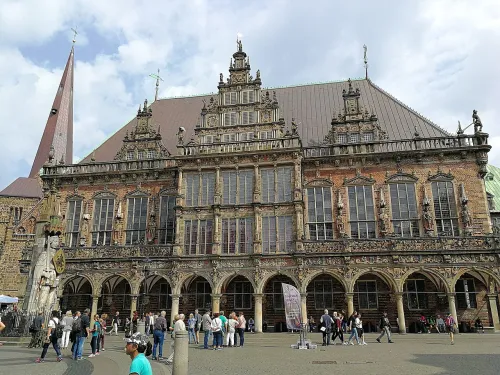
You start on the market square, in front of the building where Bremen is still governed: the town hall is the seat of the President of the Senate and Mayor. Take in the long facade first. Its core is a 15th century hall, a rectangular two-storey building measuring 41.5 by 15.8 m, and it counts among the key examples of Brick Gothic and Weser Renaissance architecture in Europe. Since July 2004 it has been a UNESCO World Heritage Site together with the Roland in front of it, recognised for its architecture and as a testimony to civic self-government in the Holy Roman Empire.
Inside, the ground floor is one large hall carried on oak pillars, where merchants traded and theatre was once staged; the upper floor held the main festival hall. Bremen had a town hall before this one, at the southern end of the block between Liebfrauenkirchhof, Obernstraße and Sögestraße, the old "Pig Street". Records call it a "domus theatralis", a show house, in 1229, and from 1251 a "domus consularis", the councillors' house. An arch across Sögestraße and a mason's repair suggest it was built of stone, and so early that it must have been Romanesque.
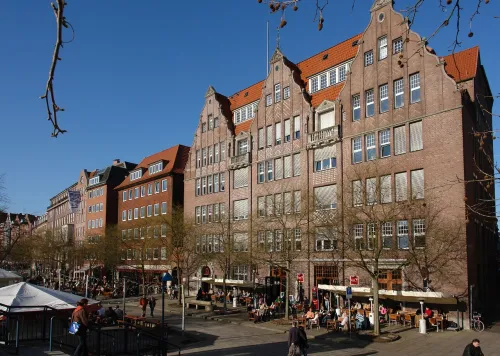
Is it worth going in? The interior is only shown on paid guided tours, and a BremenCARD gets you a discount. If architecture or the story of civic freedom draws you, this is the one paid interior to plan your day around; otherwise the facade does the job. Before moving on, turn around: opposite stands the Schütting, the old guildhall that still houses the chamber of commerce, and on the southeastern side of the square sits the Bürgerschaft, the state parliament.
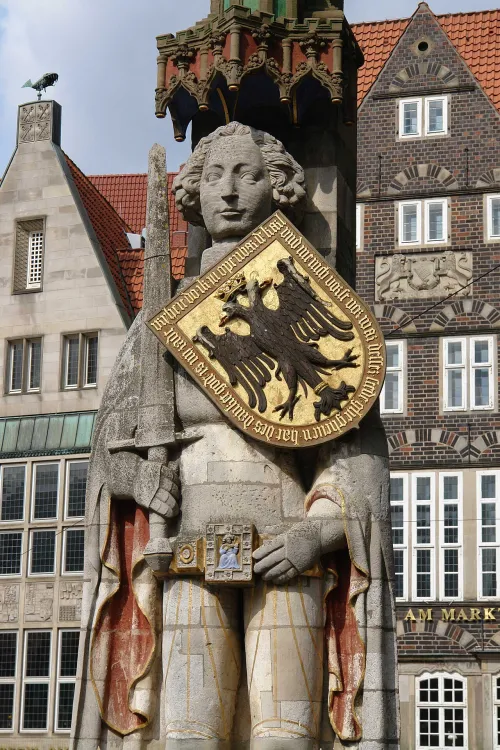
Your next stop is barely ten metres away, standing guard right in front of the town hall.