Free Walking Tour Katowice: Cathedral to Spodek

From a cathedral that took decades to finish and an 1888 park to a concert hall on old mining land, ending under the flying saucer of the Spodek.

6 Stops 6.2 km ~1 h 27 min walking
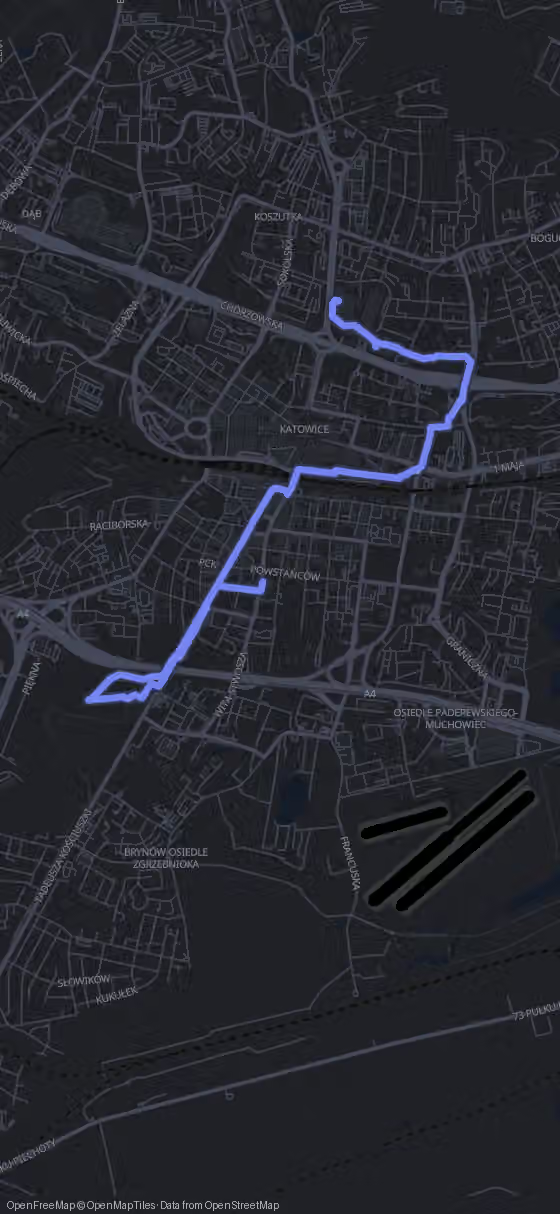
Route map for the Katowice walking tour
Stop 1 of 6
1.5 km·18 min
Cathedral of Christ the King
Head south-west toward Kościuszko Park
Dzień dobry, welcome to Katowice. I'm Alex, and our first landmark carries a whole era of upheaval in its walls.
Try this tour with Alex

This Katowice Route at a Glance

Six stops lead from the Cathedral of Christ the King through Kościuszko Park and Mariacka Street to the Silesian Museum, the NOSPR Concert Hall and the Spodek. The route covers 6.2 km with 1 h 27 min of pure walking; with a museum visit, plan a little over five hours.

The cathedral, the park and Mariacka Street are free. The museum charges admission, and the concert hall and arena open their interiors for ticketed events. The GPS route runs free in your browser; the AI Tour Guide is optional.

Open free GPS & optional AI Tour Guide
View of Katowice

The Route

Walking Map of Katowice: Six Stops from Cathedral to Saucer

6 stops 6.2 km 1 h 27 min walking
Tap to load interactive map

The 6 stops along this route

  1. Cathedral of Christ the King in Katowice, stop 1 on the self-guided walking tour
    1Cathedral of Christ the King
  2. Kościuszko Park in Katowice, stop 2 on the self-guided walking tour
    2Kościuszko Park
  3. Mariacka Street in Katowice, stop 3 on the self-guided walking tour
    3Mariacka Street
  4. Silesian Museum in Katowice, stop 4 on the self-guided walking tour
    4Silesian Museum
  5. NOSPR Concert Hall in Katowice, stop 5 on the self-guided walking tour
    5NOSPR Concert Hall
  6. Spodek in Katowice, stop 6 on the self-guided walking tour
    6Spodek
  7. That's the full route.

    Walk it with an AI Tour Guide talking you through every one of these streets.

    Start free in your browser
    You made it

Your Katowice Walking Tour, Stop by Stop, from Dome to Culture Zone

  1. 1

    Cathedral of Christ the King

    Cathedral of Christ the King in Katowice, stop 1 on the self-guided walking tour

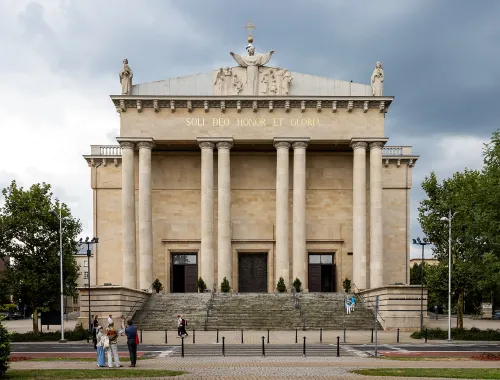
    Begin at the Cathedral of Christ the King and take a moment for its sheer size: 101 m long and 50 m wide, it is the largest cathedral in Poland and one of the country's biggest churches. The design leans on classicism, so expect calm, heavy forms rather than pointed Gothic spires. Entry is free, so the walk begins without spending a thing.

    Why did Katowice need a new cathedral at all? Until 1922 the town, then Kattowitz, belonged to Prussian Silesia and to the German diocese of Breslau. When it passed to the newly founded Polish state, Breslau could no longer run its churches. An apostolic administrator came first, then in 1925 the diocese of Katowice was founded, with the parish church of St Peter and Paul in the south of the city standing in as cathedral.

    A design competition had already been held in 1924 without a convincing winner. In the end the commission went to the young Zygmunt Gawlik, with the experienced Franciszek Mączyński placed at his side, both architects from Kraków. Their model was the size of the dome: 106 m to the tip, meant to make it, alongside Częstochowa, the tallest ‘tower’ in Poland.

    Building was slow and stubborn. Foundation work began on 5 May 1927, but the cornerstone was only laid on 4 September 1932. Two years later the walls stood 6 m high, and on 5 May 1938 the choir was finished and used as a church. Then the war stopped everything: the Wehrmacht occupied eastern Upper Silesia, money and materials were withdrawn. Work resumed in May 1946 despite the shortages, and the cathedral was completed in 1955.

    Give yourself about 20 minutes inside; it is worth it for anyone, believer or not, simply for the scale of a building that outlasted a war. From here it is 1480 m, about 22 minutes, to the green slopes of Kościuszko Park.
    Local name
    Archikatedra Chrystusa Króla
    Hours
    Daily: 06:30–19:00
    Price
    Free
  2. 2

    Kościuszko Park

    Kościuszko Park in Katowice, stop 2 on the self-guided walking tour

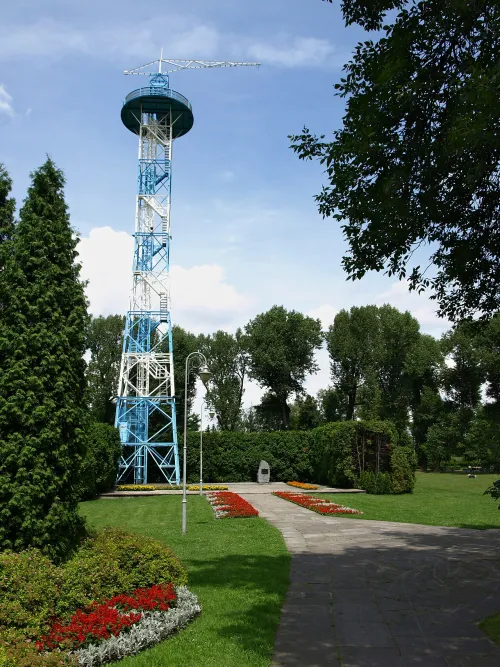
    Kościuszko Park is counted as the most valuable green space in Katowice, for its history as much as for its nature and landscape. Its beginnings go back to 1888, it is laid out in the manner of an English landscape park, and since 1993 it has been a listed monument. It is free and open around the clock.

    As you walk, look for the landmarks scattered between the trees: the church of St Michael the Archangel, a parachute tower, the monument to Tadeusz Kościuszko and a range of sports and leisure grounds. The church stands on Beata Hill, the highest point of the park at a little over 323 m above sea level.

    Beata Hill hides a detail most visitors walk straight past: the watershed between the Vistula and the Oder runs across it. Rain falling on one side ends up heading for one river system, rain on the other side for the second. Under your feet lies the Upper Silesian basin, sandstone and shale with seams of hard coal, the same coal that will come up again at the end of this walk.

    Plan around 40 minutes if you want to reach the church on the hill and see the monument; less if you just want a green pause before the city. Then comes the longest leg of the route: 2470 m, about 33 minutes, into the centre and Mariacka Street.

    Local name
    Park im. Tadeusza Kościuszki
    Hours
    Open 24/7
    Price
    Free
  3. 3

    Mariacka Street

    Mariacka Street in Katowice, stop 3 on the self-guided walking tour

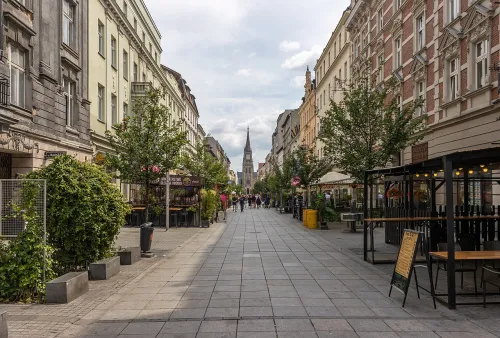
    Mariacka Street takes its name from St Mary's Church, the Kościół Mariacki, which closes the view at its far end. Since 2008 the whole street has been pedestrian. It was built up in the second half of the 19th century following the 1875 town plan by Nepilla, as one of the closed blocks east of the market square.

    For long stretches of its life it carried a German name. From 1876 until 1922, and again between 1939 and 1945, it was Richard-Holtze-Straße, named for Richard Holtze, chairman of the town council, who was celebrating 25 years as a doctor when the street was named after him. In the late 19th century the Kasulke restaurant did business here.

    Watch the house numbers, because the stories are attached to them. At number 18, on 27 January 1901, Willy Fritsch was born, later one of the great stars of early German cinema. Before the First World War the Hotel Savoy opened at numbers 4 and 6; in its restaurant on 20 June 1922 Wojciech Korfanty and Józef Rymer met Stanisław Szeptycki at a ceremonial breakfast, just as the city was passing to Poland. The Savoy lasted until 1939.

    Between the wars the street was full of money and sugar: a branch of the Silesian Bank at number 24, the Hotel Europejski built at number 15 in 1930 and 1931, and Walenty Rybka's Astoria confectionery at number 1. The street is free and always open; 20 minutes is enough to walk it end to end and read the façades. From here it is 1240 m, about 18 minutes, to the Silesian Museum.

    Local name
    Ulica Mariacka
    Hours
    Open 24/7
    Price
    Free
  4. 4

    Silesian Museum

    Silesian Museum in Katowice, stop 4 on the self-guided walking tour

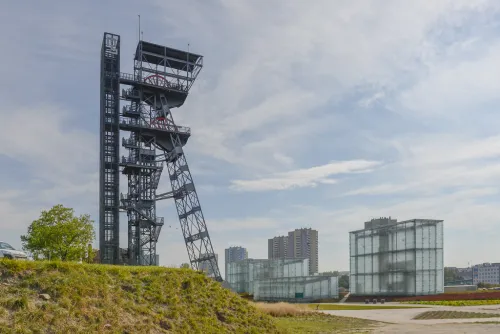
    The Silesian Museum has had an unsettled life. It was founded on 23 January 1929 by a resolution of the Silesian Parliament and worked until the outbreak of war in 1939. Between 1945 and 1950 it was briefly revived in Bytom, restored in Katowice only in 1984, and since 2015 it has occupied this complex of buildings in the Bogucice district.

    Its strongest collections are Polish painting from before and after 1945, with works by Józef Chełmoński, Artur Grottger, Tadeusz Makowski, Jacek Malczewski, Jan Matejko, Józef Mehoffer and Stanisław Wyspiański. Add non-professional art, artistic and documentary photography, Polish posters, ethnography and Polish stage design. In 2012 the museum opened its first permanent route for blind and visually impaired visitors.

    The museum sees its task as a dialogue with the past of Upper Silesia: a region shaped by industry and by many cultures living side by side. If you want to understand what you have walked through so far, this is the place, and it is the one interior on the route worth real time. Admission is charged and covers both the permanent and temporary exhibitions. Budget about two hours, less if only the paintings draw you.

    From the museum it is 530 m, about 8 minutes, through the Culture Zone, Strefa Kultury, to the NOSPR Concert Hall.

    Local name
    Muzeum Śląskie
    Hours
    Tue–Sun 10:00–20:00, Mon closed
    Price
    29 PLN normal, 19 PLN reduced (permanent and temporary exhibitions)
  5. 5

    NOSPR Concert Hall

    NOSPR Concert Hall in Katowice, stop 5 on the self-guided walking tour

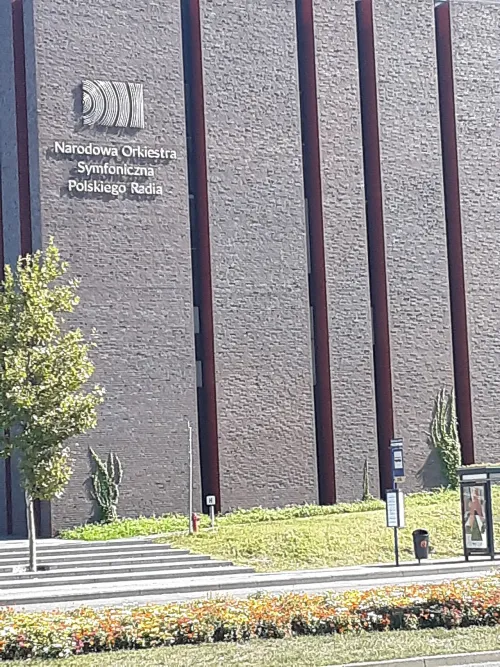
    The NOSPR Concert Hall is the home of the Polish National Radio Symphony Orchestra, at 1 Wojciech Kilar Square. It opened on 1 October 2014 on ground that once served as the timber yard of the Katowice Coal Mine, and together with the International Congress Centre and the Silesian Museum it forms the core of the Culture Zone.

    Its architect, Tomasz Konior, comes from Katowice and drew on the building heritage of Upper Silesia, above all the Nikiszowiec workers' housing estate. Look at the façade with that in mind: this is a concert hall that wants to remember the miners' homes rather than hide them. The design has collected numerous architecture awards.

    When it opened it was the largest concert and recording complex in Poland, and in 2019 it joined the European Concert Hall Organisation. The interior opens for ticketed events, so if music is your thing, an evening concert is the real way to experience it; prices and programme are at the box office. For everyone else, the outside is free and a quarter of an hour well spent.

    A pedestrian bridge links the hall to the congress centre and the Spodek. The last leg is the shortest: 470 m, about 7 minutes.

  6. 6

    Spodek

    Spodek in Katowice, stop 6 on the self-guided walking tour

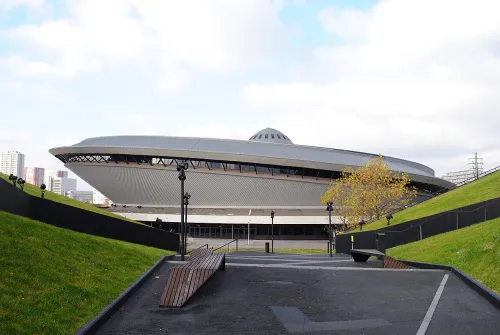
    The Spodek is the building everyone in Katowice knows. Its name means ‘saucer’ in Polish, and also flying saucer, which is exactly what its shape suggests. It opened on 9 May 1971, matters especially to younger generations and has even served as an unofficial city logo on posters promoting the redevelopment of Katowice.

    The idea dates from 1955, when Katowice was temporarily renamed Stalinogród. After a design contest the arena was first meant for the outskirts, but the regional council wanted it near the centre. The chosen site was a mining waste dump rated ‘2A’, meaning medium mining damage with the risk of local cave-ins. Digging the foundations, workers went through coal instead of soil.

    Then came the rumours: the dome would collapse as soon as the scaffolding came down. In 1964 construction was halted for 18 months. When the supports were finally removed, the architects and chief engineers stood inside the dome to make their point. Before the public was let in, 3,500 soldiers marched through the hall as an endurance test, and the vibration readings came out fine. The architects Maciej Gintowt and Maciej Krasiński built it on the principle of tensegrity, making it one of the first major structures to use it.

    Besides the main dome the complex has a gym, an ice rink and a hotel. The arena holds around 11,500 people, in practice 10,000 or even 8,000 once a stage blocks the view, and it was the largest indoor venue of its kind in Poland until Tauron Arena opened in 2014. Concerts are frequent and ice hockey clubs play here in winter; to get inside you need an event ticket. From the outside, at the end of your walk, it is free and hard to stop looking at.

Walking tour route map of Katowice Route loaded
Cathedral of Christ the KingKościuszko ParkMariacka StreetSilesian Museum+2
All 6 stops are already on the map.
You just press start.
AI Tour Guide

You just read the route. Now walk it from the cathedral to the Spodek with a guide in your ear.

Press start wherever you are, even hundreds of kilometres from Katowice, and the guide begins telling its stories right away. In the city, pick any of the 6 stops to start from: it leads you there, then talks with you the whole route, asking, listening, remembering, and shaping the tour around your answers.

6stops 6.2km 1 h 27 minwalking 13languages
▶Start the tour free

Free to start · Runs in your browser · No app, no download

Shorter Ways Through Katowice

Not every day has five hours in it. These cuts keep the route's logic and drop whole sections instead of rushing through all of them.

Culture Zone only

Stops: 4, 5, 6

For a short visit or a rainy afternoon: the Silesian Museum, the NOSPR Concert Hall and the Spodek sit close together, 1000 m and 15 minutes of walking in total. The museum is the only admission you pay; plan around two hours if you go in.

City centre and Culture Zone

Stops: 3, 4, 5, 6

For anyone who wants the street life and the modern landmarks but not the long walk out to the park: start on Mariacka Street and finish at the Spodek, 2240 m and 33 minutes on foot. Admission again only at the museum.

Cathedral, park and old street

Stops: 1, 2, 3

For a free morning outdoors: the cathedral, Kościuszko Park and Mariacka Street, 3950 m and 55 minutes of walking, with no admission at all. Good on a day when the museum is closed.

How Long Does This Katowice Tour Take, With and Without the Museum?

The pure walking time is 1 h 27 min over 6.2 km, and the longest leg is the one from Kościuszko Park into the centre. Give the cathedral about 20 minutes, the park 40, Mariacka Street 20, the museum two hours and the concert hall and the Spodek a quarter of an hour each, and you land at a little over five hours. Skip the museum and it is closer to three and a half.

A realistic day: leave the cathedral at 09:20, walk the park from 09:42, reach Mariacka Street at 10:55 and the Silesian Museum at 11:33. Leave the museum at 13:33 and you stand in front of the Spodek shortly after 14:00. The shorter variants take 15, 33 or 55 minutes of walking plus whatever time you spend at each place.

Before You Set Off in Katowice

  • Start: The Cathedral of Christ the King is the recommended start, and the order of the route is the recommended one, but you can join at any stop.
  • Finish: The walk ends at the Spodek in the Culture Zone, right next to the concert hall and the museum.
  • Best day: If you want to see inside the Silesian Museum, pick a day when it is open; the rest of the route works on any day.
  • Time of day: A 09:00 start at the cathedral brings you to the museum before noon, with plenty of the day left for the collections.
  • Costs: The walk itself, the cathedral, the park and Mariacka Street cost nothing. The museum charges admission. The concert hall and the Spodek need event tickets. Route, map and GPS navigation are free; the AI Tour Guide starts with 100 free credits, after that you choose this tour all-inclusive for €19.99 with no time limit, or €5 per hour.
Walking tour route map of Katowice
AI Tour Guide

Your guide is ready when you are, from the first church door to the last concrete curve.

Press start and a voice AI Tour Guide takes it from here: leading the route through Katowice, telling the stories, and turning your walk into a real back-and-forth conversation. No app or download is needed; it runs in your browser.

6stops 6.2km 1 h 27 minwalking 13languages
▶Start the tour free

Free to start · Runs in your browser · No app, no download

What the AI Tour Guide Adds Between Cathedral and Spodek

This route jumps from Prussian Kattowitz to the years when the city was called Stalinogród and on to a concert hall built on mine land. The AI Tour Guide carries that thread as a conversation: it greets you, tells the stories as you walk, asks what caught your eye and follows up on it. Ask how tensegrity actually holds up the Spodek's roof, or which painter to look for first in the Silesian Museum, and interrupt whenever you like.

A Real Conversation A voice AI Tour Guide greets you, leads the whole route, and tells the stories and facts as you walk, asking what you want to see and keeping a real conversation going. Not a recording you press play on.
Map Navigation Follow the route on the map and walk at your own pace. You choose where to start and when to move to the next stop.
Ask Anything Curious about a building you pass? Ask your AI Tour Guide on the spot and the conversation carries on.
13 Languages Switch language anytime. No separate tour needed.
Start free in your browser

Common Questions About Walking Katowice

Can I combine Katowice with Krakow?

Yes, as a separate day. Krakow is 69 km away and has its own free route: walking tour of Krakow. Częstochowa at 62 km is another option.

Is there a reduced ticket at the Silesian Museum?

Yes, there is a reduced ticket, and like the normal one it covers the permanent and temporary exhibitions.

Can I walk Kościuszko Park in the evening?

The park is open around the clock and free. If you also want to see inside the cathedral, plan it for earlier in the day.

Is the tour really free?

Yes. The whole tour is free: the route, the interactive map and the navigation cost you nothing. Only the voice AI Tour Guide is optional and paid: you test it with 100 free credits, then you pay either €5 per hour or €19.99 for this whole tour, with no time limit. Admission to 3 of the 6 stops is not included: Silesian Museum, NOSPR Concert Hall and Spodek charge their own entry fees.

Do I need to download an app?

No. Everything runs in your phone browser. Open the route and start walking, no download and no sign-up required.

Do I need to book the walking tour in advance?

No booking needed. This self-guided tour is available anytime. Open the route in your browser and start walking. The AI Tour Guide works instantly, no app, no reservation required.

What languages is the AI Tour Guide available in?

The AI Tour Guide speaks 13 languages, so you take the tour in your own language and can switch at any time.

Can I skip stops or change the route?

Yes. Skip any stop, spend extra time at places you like, or start the route from any point. It is your walk, you set the pace.
Image credits
▶ Start free in your browser Runs in your browser, no app, no download