

Ventas Rumba
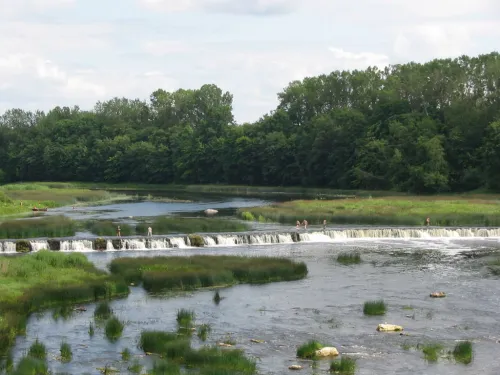
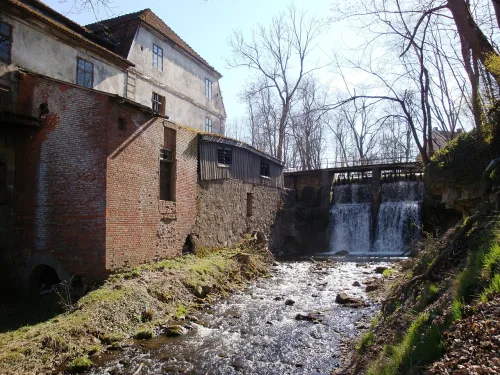
Start at the water. Ventas Rumba is Europe's widest waterfall: 249 metres across, spreading to 275 metres in the spring floods, yet only between 1.80 and 2.20 metres high, depending on how full the Venta is. Stand on the bank and let your eye travel along the edge from one side to the other; it takes a while. It's open at any hour and costs nothing.
What you're looking at is Devonian dolomite. The lower layer is more brittle and wears away faster, so the harder top layer hangs out over it until chunks break off and drop into the river. That's why the falls creep slowly upstream, and why the middle, where the current is strongest, has pulled back further than the sides. Look for that gentle curve in the edge line.
Kuldīga exists because of this ledge. Boats on the Venta's medieval trade route couldn't get past it, so the town grew up right here. In the middle of the 17th century Duke Jacob Kettler of Courland wanted a way around and started digging a bypass on the right bank, but the dolomite was too hard and the work too slow. His unfinished canal only fills in spring, when the high water turns a strip of land into Martin's island. Legend adds a louder chapter: the Duke tried to blow the waterfall up, the first blast only shifted its edge, and the shock cracked the walls of his own palace near the river. He gave up.
In the 19th century the Russian Empire tried again, as part of a plan to join the Baltic and the Black Sea by way of the Venta, Neman and Dnieper. Turkish prisoners of war were set to dig, and the rock won once more. On top of that, the Venta turned out to be neither wide nor deep enough for shipping.
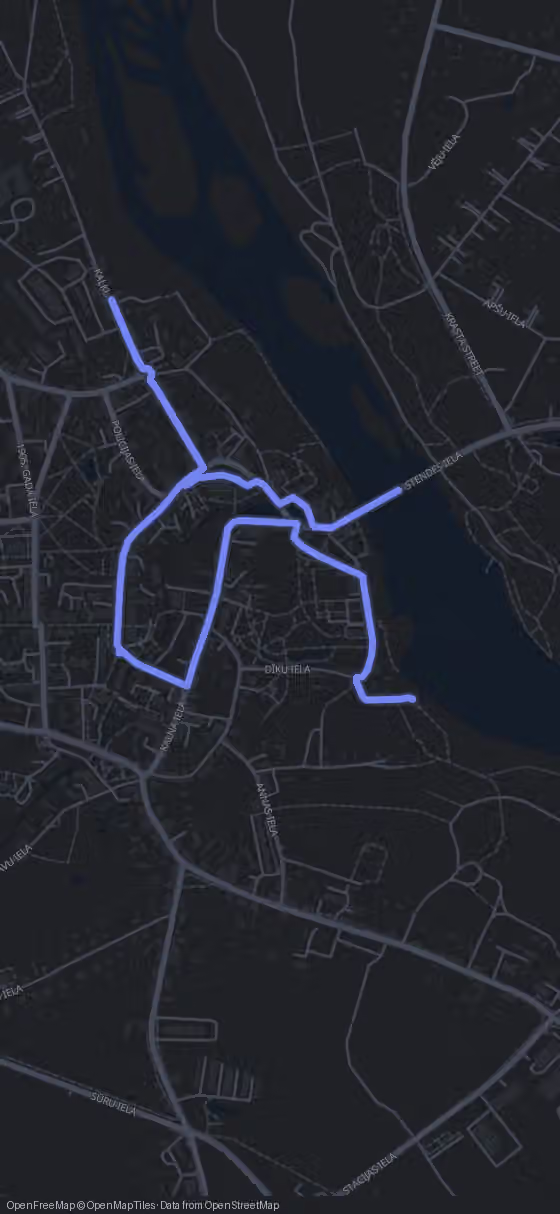
From here it's 860 m, about 12 minutes, into the centre. On the way you pass the Kuldīga District Museum and the Live Museum The Story of Ancient Kuldīga, worth remembering if you want to dig deeper into the town later.