Free Walking Tour Passau: Three Rivers and a Fortress

From the cathedral's giant organ to the tip where three rivers meet and up to the bishops' fortress: 2.7 km through Passau at your own pace.

8 Stops 2.7 km ~42 min walking
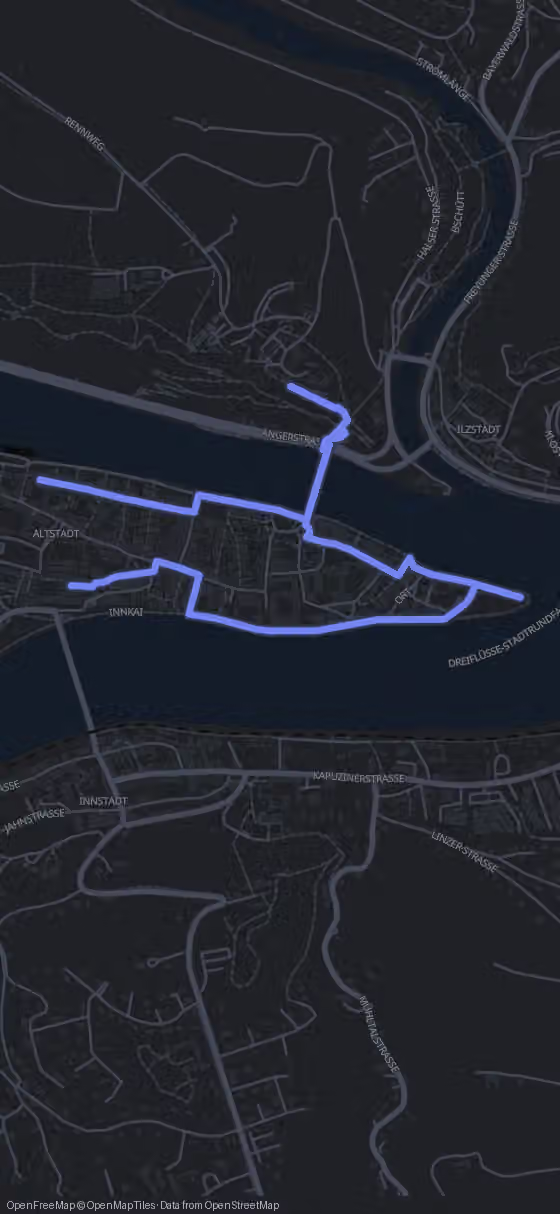
Route map for the Passau walking tour
Stop 1 of 8
200 m·3 min
Dom St. Stephan
Head east out the west front toward Residenzplatz
Welcome to Passau. I'm Alex, and one small river tower here survived disasters that consumed much of the city.
Try this tour with Alex

This Passau Route at a Glance

Eight stops on foot: from Dom St. Stephan via Residenzplatz, Innkai, Schaiblingsturm and Dreiflüsseeck across to Veste Oberhaus, then back to the Altes Rathaus and Hollgasse. The route covers 2.7 km with 42 min of pure walking; with visits, plan about three and a half hours.

Everything is free except the museum at Veste Oberhaus. Route, map and GPS navigation run free in your browser, and the AI Tour Guide is an optional extra.

Open free GPS & optional AI Tour Guide
This short shows highlights of the route. All 8 stops follow below.

The Route

Walking Map of Passau, Cathedral to Hollgasse

8 stops 2.7 km 42 min walking
Tap to load interactive map

The 8 stops along this route

  1. Dom St. Stephan in Passau, stop 1 on the self-guided walking tour
    1Dom St. Stephan
  2. Residenzplatz in Passau, stop 2 on the self-guided walking tour
    2Residenzplatz
  3. Innkai in Passau, stop 3 on the self-guided walking tour
    3Innkai
  4. Schaiblingsturm in Passau, stop 4 on the self-guided walking tour
    4Schaiblingsturm
  5. Dreiflüsseeck in Passau, stop 5 on the self-guided walking tour
    5Dreiflüsseeck
  6. Veste Oberhaus in Passau, stop 6 on the self-guided walking tour
    6Veste Oberhaus
  7. Altes Rathaus in Passau, stop 7 on the self-guided walking tour
    7Altes Rathaus
  8. Hollgasse in Passau, stop 8 on the self-guided walking tour
    8Hollgasse
  9. That's the full route.

    Walk it with an AI Tour Guide talking you through every one of these streets.

    Start free in your browser
    You made it

Your Passau Walking Tour, from Cathedral to Painted Lane

  1. 1

    Dom St. Stephan

    Dom St. Stephan in Passau, stop 1 on the self-guided walking tour

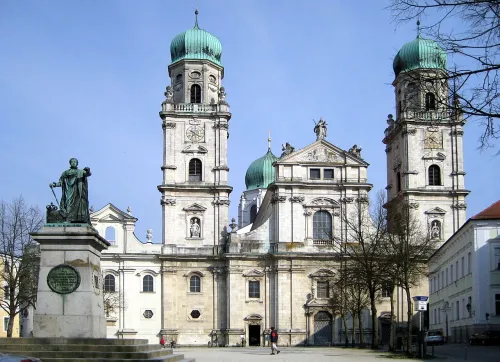
    Begin where Passau has worshipped for almost thirteen centuries. Churches have stood on this spot since 730, and the one in front of you is a baroque rebuild after disaster: a fire in 1662 destroyed its predecessor, construction started in 1668 and the work was finished in 1693. Only the late Gothic eastern end survived the blaze, so it is worth walking around the building to see two eras joined in one church, roughly 100 metres long. It is the seat of the Catholic Bishop of Passau and the main church of his diocese.

    The baroque look is the work of an Italian team. Carlo Lurago drew up the overall plan, Giovanni Battista Carlone handled the interior decoration and Carpoforo Tencalla painted the frescos. Going inside is free, and you should: this is the stop where a longer look pays off for almost everyone.

    Then there is the organ. It was once the largest in the world, and although newer instruments such as Wanamaker's organ in the United States have overtaken it, it is still the largest church organ outside the U.S. Today it has 17,774 pipes and 233 registers, all playable from the five-manual general console in the gallery. In truth it is several organs of different tonal styles, added to over the years, with six consoles in total. Midday and evening organ concerts cost a ticket; if organ music moves you, plan your morning around one.

    Listen for the bells as well. Eight large bells hang in the two towers. The biggest, the Pummerin, weighs 7,550 kg and was cast in 1952; it shares the south tower with the Sturmerin from 1733. Every quarter hour the Elfuhrglocken chime, and on the full hour the Predigtglocke and the Sturmerin strike the count in turn.

    From the cathedral it is only 200 m, about 3 minutes, to Residenzplatz, and on the way you pass the Domschatz- und Diözesanmuseum.
    Hours
    Daily: 06:30–19:00
    Price
    Free (church visit); midday organ concerts 6.00 EUR (reduced 3.00 EUR), evening organ concerts 12.00 EUR (reduced 6.00 EUR)
  2. 2

    Residenzplatz

    Residenzplatz in Passau, stop 2 on the self-guided walking tour

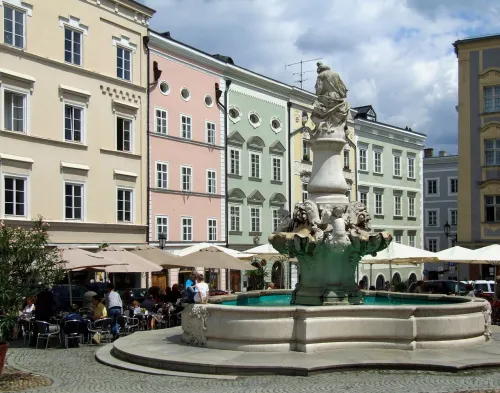
    A couple of minutes from the cathedral you step onto Residenzplatz, a cobbled square that is always open and free. Its landmark is the Wittelsbach fountain in the middle. Nothing here asks for a ticket or a timetable, and on this walk that is exactly its role: a breather between the weight of the cathedral and the openness of the river.

    Keep the square in mind, though; an older fountain that once stood here turns up again later on the route. Cross at whatever pace suits you. The Innkai is 310 m away, about 4 minutes.

    Hours
    Always open
    Price
    Free
  3. 3

    Innkai

    Innkai in Passau, stop 3 on the self-guided walking tour

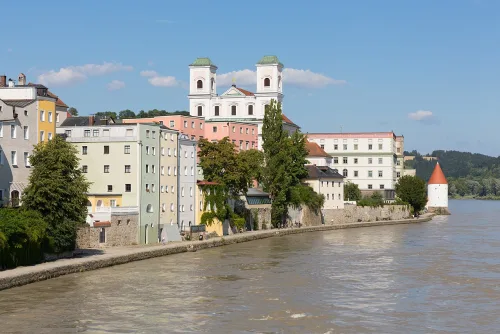
    At the quay the town stops and the Inn takes over, running green out of the Alps. That colour changes with the months: high snowmelt in spring makes it glow, while late in summer it fades. If the river looks painted today, you picked a good time.

    The quay is a stone promenade lined with chestnuts and lindens, which blossom in May. In high summer it turns into an oven, because the embankment throws the midday heat back at you, so walk it early or late on hot days.

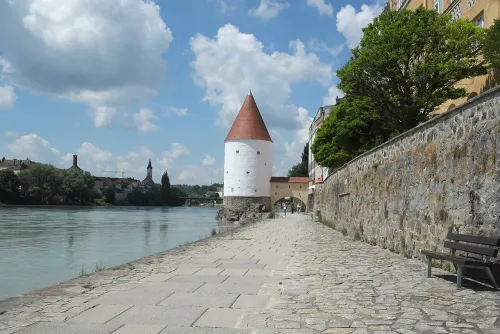
    Look ahead along the water. At the end of the quay stands a white medieval tower where salt once came off the boats. That is the Schaiblingsturm, only 70 m and a minute away.

    Hours
    Open 24/7
    Price
    Free
  4. 4

    Schaiblingsturm

    Schaiblingsturm in Passau, stop 4 on the self-guided walking tour

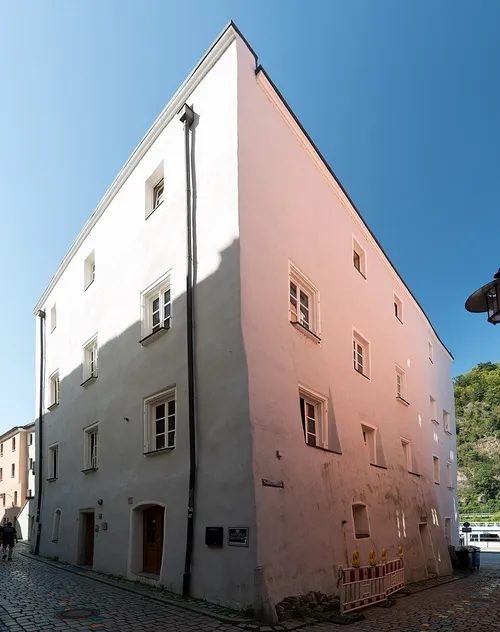
    This white tower has stood on its rock by the Inn since 1250. It was built as a defensive tower and is part of the medieval town wall, today a listed monument. After a renovation in the 15th century it took on a more commercial job: it served as a salt store, and in the years of the salt trade ships and rafts tied up here to load and unload.

    The tower has outlasted a lot. It came through the two great town fires of 1662 and 1680 unharmed, partly thanks to its exposed position on the water; even the wooden roof structure survived. The first of those fires is the one that destroyed the cathedral before the present church. Until 1957 a rope ferry ran from here across the Inn to the Innstadt district.

    The bright white you see is no accident. In 2004 the lime and sand render was restored to its original colour. You can only admire the tower from the quay: since the 20th century it has belonged to the Gymnasium Leopoldinum, a secondary school, is reached only through the school and is used for a few school events and workshops.

    From the tower it is 390 m, about 5 minutes, to the tip of the peninsula at the Dreiflüsseeck.

    Hours
    Open 24/7
    Price
    Free (exterior, viewable from the Innkai; interior not open to the public)
  5. 5

    Dreiflüsseeck

    Dreiflüsseeck in Passau, stop 5 on the self-guided walking tour

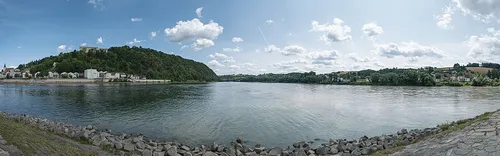
    This is the Ortspitze, the very tip of the peninsula, where the Danube, the Inn and the Ilz stop being three rivers and start arguing about direction. On a good day you see all three colours at once: the brown Danube, the green Inn and the near-black Ilz. Spring gives the sharpest edges; later in the year the water settles its differences more quietly.

    Do not judge the scene from the bank alone. The better angle is from the raised path behind the tip, on the quay side, where you look down on the collision instead of across it. Boats also leave from the landing stage here if you want to see the meeting from the water.

    Look up across the Danube and you will see where you are heading: the fortress on the hill. It is 840 m and about 15 minutes to Veste Oberhaus, and on the way you pass the Museum Moderner Kunst Wörlen.

    Hours
    Open 24/7
    Price
    Free
  6. 6

    Veste Oberhaus

    Veste Oberhaus in Passau, stop 6 on the self-guided walking tour

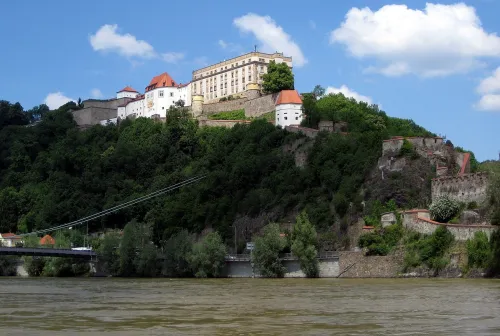
    From up here the bishops kept an eye on their town. Ulrich II, the first prince-bishop of Passau, founded the fortress in 1219 on St. Georgsberg, where a chapel to St. George had stood before. It was meant to show off the military power of the bishopric and his raised rank in the Holy Roman Empire, granted in 1217, and to protect him from enemies outside and from within: the citizens of Passau who wanted their town to become a free imperial city. Below it, on the promontory between the Danube and the Ilz, sits Veste Niederhaus, part of the same fortress system.

    The walls tell a story of constant upgrades. As siege techniques improved, the fortress was renovated and extended again and again, starting in 1255, so it now shows fortification techniques from the 13th to the early 19th century. Look for the date 1499 on the facade, which marks one of those rebuilds. Under a series of bishops it grew from a Gothic citadel into an early Renaissance residence, then a fortified princely castle and, in the era of the Turkish invasions, a regional fortress.

    It was attacked five times between 1250 and 1482 and never taken. Twice, in 1298 and 1367, the attackers were the people of Passau themselves, rising against their bishop. A darker chapter followed between 1535 and 1540, when many Anabaptists were held in the dungeon for their faith. During that imprisonment the Ausbund hymnal took shape, and Amish congregations still sing from it today.

    Today the fortress houses a museum and a youth hostel. The museum costs admission and is worth it if fortifications, the prince-bishops or that Amish connection interest you; if you are short on time, the walls and the view of the town are free to enjoy from outside. Back down in the old town the Altes Rathaus is 600 m away, about 10 minutes, past the Glasmuseum Passau.

    Hours
    Mon–Fri: 09:00–17:00 | Sat–Sun: 10:00–18:00
    Price
    7 EUR (adults), 5 EUR reduced, children under 6 free, 14 EUR family ticket (incl. observation tower)
  7. 7

    Altes Rathaus

    Altes Rathaus in Passau, stop 7 on the self-guided walking tour

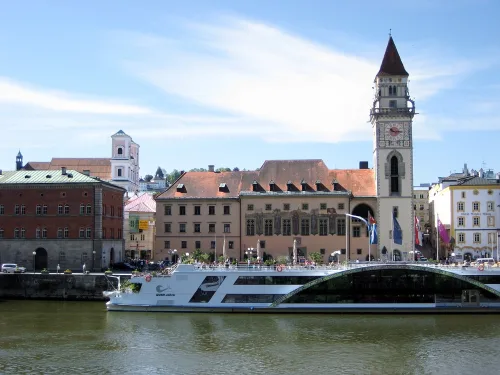
    After the bishops' fortress comes the citizens' answer. You might wonder why the town hall sits at the edge of the old town by the Danube rather than in its centre. It fits Passau's history: here the clergy called the tune, every attempt by the burghers to win their freedom failed, armed ones included, and the town never became a free imperial city.

    The building itself goes back to 1298, the same year the citizens stormed the fortress, when they won this house in an uprising against the prince-bishop. The hall building in Venetian style dates from 1405. Its original facade frescoes of 1446 were replaced in 1922 by Joseph Hengge's murals of Emperor Ludwig the Bavarian with four banner bearers. In the courtyard stands the Liendlbrunnen from 1555, the fountain that once stood on Residenzplatz.

    The whole complex was pieced together from eight buildings over time. Its southern end is the former Kuenburg Palace, built in the early 1680s by Bartholomäus Opstal. The open square with its view of the Danube is fairly new: until 1819 a town kitchen and a house blocked it, the square was called Fischmarkt, and instead of the river you looked at the town wall.

    The facade is free to view at any time and a carillon plays twice a day, while the historic halls are currently closed. From here it is 260 m, about 4 minutes, to Hollgasse.

    Local name
    Passauer Rathaus
    Hours
    Exterior viewable at any time; carillon daily at 11:30 and 14:30; historic halls currently closed
    Price
    Free (façade and exterior); guided tours of the Rathaussäle bookable via Tourist-Information
  8. 8

    Hollgasse

    Hollgasse in Passau, stop 8 on the self-guided walking tour

    The route ends on a lane that doubles as a gallery floor. Hollgasse is a pedestrian street where artists have painted the cobblestones and studios line the walls. The lane is always open; the galleries and studios keep their own hours, so treat whatever is open as a bonus. The painted stones are the point.

    Pause a moment and look back on the day: a bishop's cathedral, a cobbled square, a green river, a salt tower, three rivers meeting, a fortress and the burghers' town hall. You are back in the middle of the old town, and if you want to return to the cathedral, the GPS navigation in your browser will lead you there.

    Hours
    Open 24/7 (public lane; individual galleries and studios keep their own hours)
    Price
    Free
Walking tour route map of Passau Route loaded
Dom St. StephanResidenzplatzInnkaiSchaiblingsturm+4
All 8 stops are already on the map.
You just press start.
AI Tour Guide

You know the route now. Walk it with a guide in your ear.

Press start wherever you are, even hundreds of kilometres from Passau, and the guide begins telling its stories right away. In the city, pick any of the 8 stops to start from: it leads you there, then talks with you the whole route, asking, listening, remembering, and shaping the tour around your answers.

8stops 2.7km 42 minwalking 13languages
▶Start the tour free

Free to start · Runs in your browser · No app, no download

Shorter Ways Through Passau

Not every day has room for the whole loop. These three versions follow the same order and cut where it makes sense.

Cathedral and the rivers

Stops: 1, 2, 3, 4, 5

For a short visit or a first evening: the cathedral, the square, the Inn quay, the salt tower and the confluence. 970 m and 13 minutes of walking, about an hour and a half with a proper look inside the cathedral. Nothing here charges admission; only an organ concert would cost a ticket.

Fortress and the burghers' town

Stops: 5, 6, 7, 8

For history readers who already know the cathedral: from the confluence across to the fortress, then down to the town hall and the painted lane. 1.7 km and 29 minutes of walking, about two and a half hours including the fortress museum, which is the one stop with admission.

The full loop without the fortress museum

Stops: 1, 2, 3, 4, 5, 6, 7, 8

For anyone on a tight budget or with limited time: walk every stop, look at Veste Oberhaus from outside and skip the museum. Still 42 minutes of walking, about two and a half hours in total, and no admission at all.

How Long This Passau Tour Takes, With and Without the Fortress

The walking itself is short: 42 minutes for the whole 2.7 km. What stretches the day are the two places worth going inside. Give the cathedral around 40 minutes, longer if you catch an organ concert, and the fortress museum at Veste Oberhaus about an hour and a quarter. Add short pauses at the open stops and you arrive at roughly three and a half hours.

Skip the fortress museum and the same route takes about two and a half hours. The riverside half alone, from the cathedral to the confluence, fits into an hour and a half; the fortress half from the confluence to Hollgasse takes about two and a half hours with the museum. A boat round trip from the confluence adds about 45 minutes plus waiting time.

Before You Set Off in Passau

  • Start and finish: The recommended start is Dom St. Stephan, and the route ends in Hollgasse in the old town. You can join at any stop; from Hollgasse the GPS navigation in your browser can lead you back to the cathedral if you want.
  • Time of day: Start early enough to reach Veste Oberhaus while the museum is open. In July and August walk the Innkai in the morning or late afternoon, because the stone embankment throws the midday heat back at you.
  • Best season for the rivers: April and May bring the strongest contrast between the green Inn and the Danube; by late summer the colours soften.
  • What costs admission: Only the museum at Veste Oberhaus. The cathedral is free to enter, organ concerts there cost extra, and the historic halls of the Altes Rathaus are currently closed.
Walking tour route map of Passau
AI Tour Guide

Your Passau guide is ready when you are.

Press start and a voice AI Tour Guide takes it from here: leading the route through Passau, telling the stories, and turning your walk into a real back-and-forth conversation. No app or download is needed; it runs in your browser.

8stops 2.7km 42 minwalking 13languages
▶Start the tour free

Free to start · Runs in your browser · No app, no download

What the AI Tour Guide Adds in Passau

This route tells one long story: bishops on the hill, burghers in the town, salt on the rivers. The AI Tour Guide walks it with you as a conversation. It greets you at the cathedral, tells the stories of each place, asks what catches your interest and follows that thread, whether it is how salt boats were unloaded on the Inn, what daily life looked like for a prisoner in the fortress dungeon, or how the burghers ran their town under a prince-bishop. You can interrupt at any point. Start with the 100 free credits; after that choose this tour all-inclusive for €19.99 with no time limit, or credits at €5 per hour.

A Real Conversation A voice AI Tour Guide greets you, leads the whole route, and tells the stories and facts as you walk, asking what you want to see and keeping a real conversation going. Not a recording you press play on.
Map Navigation Follow the route on the map and walk at your own pace. You choose where to start and when to move to the next stop.
Ask Anything Curious about a building you pass? Ask your AI Tour Guide on the spot and the conversation carries on.
13 Languages Switch language anytime. No separate tour needed.
Start free in your browser

Common Questions About Passau

When are the river colours at the confluence strongest?

In April and May, when the Inn runs high with Alpine snowmelt, the green Inn, brown Danube and near-black Ilz show the sharpest edges. By August the waters blend and the contrast fades.

Can I see the confluence from the water?

Yes. Boats leave from the landing stage at the Dreiflüsseeck for a round trip of about 45 minutes that shows the meeting of the rivers from the water. You buy the ticket at the landing stage; on a clear colour day in spring it is worth it, in a muddy week you can skip it.

Can I combine Passau with another city?

Easily. Linz is 67 km down the Danube, Český Krumlov is the same distance away, and Regensburg lies 112 km upriver. Each has its own free walking route.

Is the tour really free?

Yes. The whole tour is free: the route, the interactive map and the navigation cost you nothing. Only the voice AI Tour Guide is optional and paid: you test it with 100 free credits, then you pay either €5 per hour or €19.99 for this whole tour, with no time limit. Admission to one of the 8 stops is not included: Veste Oberhaus charges its own entry fee.

Do I need to download an app?

No. Everything runs in your phone browser. Open the route and start walking, no download and no sign-up required.

Do I need to book the walking tour in advance?

No booking needed. This self-guided tour is available anytime. Open the route in your browser and start walking. The AI Tour Guide works instantly, no app, no reservation required.

What languages is the AI Tour Guide available in?

The AI Tour Guide speaks 13 languages, so you take the tour in your own language and can switch at any time.

Can I skip stops or change the route?

Yes. Skip any stop, spend extra time at places you like, or start the route from any point. It is your walk, you set the pace.
Image credits
▶ Start free in your browser Runs in your browser, no app, no download