Free Walking Tour Nuremberg: Castle, Dürer and the River

From the emperors' castle to Dürer's front door, past a painted Gothic fountain, a bridge named after the executioner and Germany's largest half-timbered building.

14 Stops 5.2 km ~1 h 11 min walking
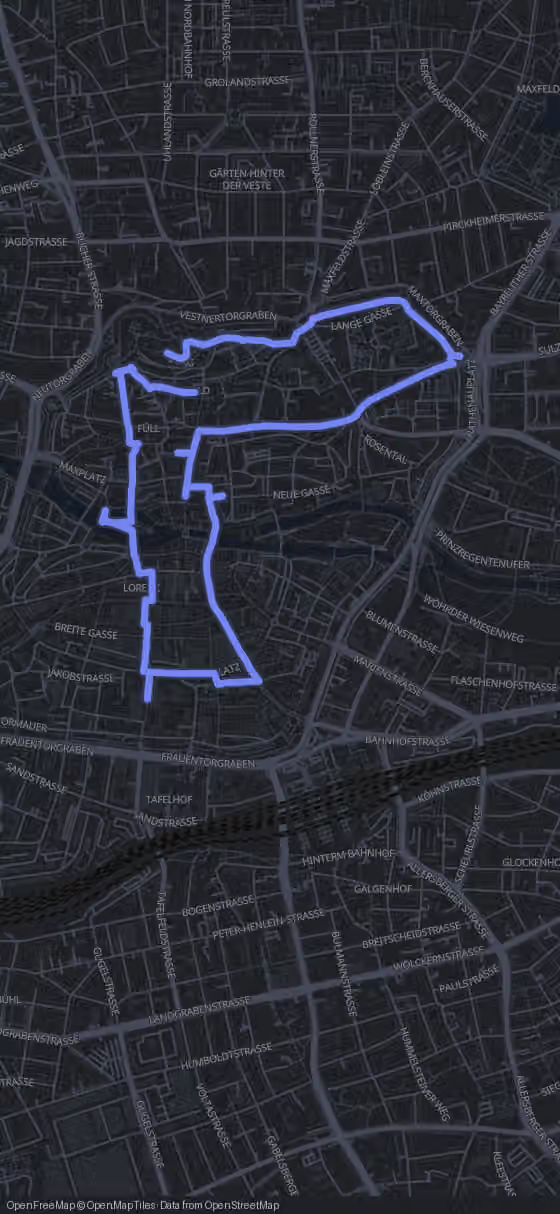
Route map for the Nuremberg walking tour
Stop 1 of 14
1.1 km·13 min
Kaiserburg
Head east along the castle ridge toward the Stadtmauer.
Welcome to Nuremberg. I'm Alex, and a riverside tower here once housed an official the city forced to live apart.
Try this tour with Alex

What This Nuremberg Walk Covers

Fourteen stops lead from the Kaiserburg through the Hauptmarkt and across the Pegnitz to the Germanisches Nationalmuseum, then back north over the river to the Stadtmuseum Fembohaus. The route covers 5.2 km with 1 h 11 min of pure walking; with time at each stop and one or two interiors, plan about four hours.

The walls, squares, bridge, Frauenkirche and Lorenzkirche are free. The Kaiserburg, Sebalduskirche, Albrecht-Dürer-Haus and both museums charge entry. Route, map and GPS navigation run free in your browser; the AI Tour Guide is optional.

Open free GPS & optional AI Tour Guide
This short shows highlights of the route. All 14 stops follow below.

The Route

Walking Map of Nuremberg's Old Town Route

14 stops 5.2 km 1 h 11 min walking
Tap to load interactive map

The 14 stops along this route

  1. Kaiserburg in Nuremberg, stop 1 on the self-guided walking tour
    1Kaiserburg
  2. Stadtmauer in Nuremberg, stop 2 on the self-guided walking tour
    2Stadtmauer
  3. Sebalduskirche in Nuremberg, stop 3 on the self-guided walking tour
    3Sebalduskirche
  4. Hauptmarkt in Nuremberg, stop 4 on the self-guided walking tour
    4Hauptmarkt
  5. Schöner Brunnen in Nuremberg, stop 5 on the self-guided walking tour
    5Schöner Brunnen
  6. Frauenkirche in Nuremberg, stop 6 on the self-guided walking tour
    6Frauenkirche
  7. Lorenzkirche in Nuremberg, stop 7 on the self-guided walking tour
    7Lorenzkirche
  8. Königstraße in Nuremberg, stop 8 on the self-guided walking tour
    8Königstraße
  9. Germanisches Nationalmuseum in Nuremberg, stop 9 on the self-guided walking tour
    9Germanisches Nationalmuseum
  10. Henkersteg in Nuremberg, stop 10 on the self-guided walking tour
    10Henkersteg
  11. Weinstadl in Nuremberg, stop 11 on the self-guided walking tour
    11Weinstadl
  12. Albrecht-Dürer-Haus in Nuremberg, stop 12 on the self-guided walking tour
    12Albrecht-Dürer-Haus
  13. Tiergärtnertorplatz in Nuremberg, stop 13 on the self-guided walking tour
    13Tiergärtnertorplatz
  14. Stadtmuseum Fembohaus in Nuremberg, stop 14 on the self-guided walking tour
    14Stadtmuseum Fembohaus
  15. That's the full route.

    Walk it with an AI Tour Guide talking you through every one of these streets.

    Start free in your browser
    You made it

Your Nuremberg Walking Tour Stop by Stop, from Castle to Burgstraße

  1. 1

    Kaiserburg

    Kaiserburg in Nuremberg, stop 1 on the self-guided walking tour

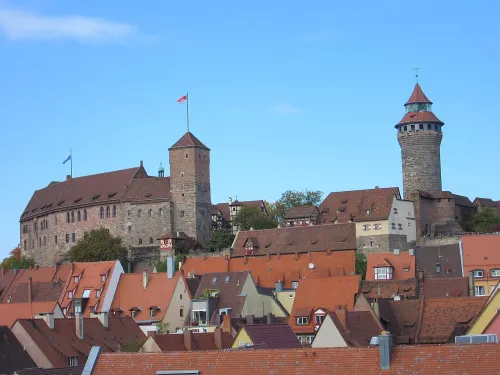
    Start where Nuremberg's power started: on the sandstone ridge that carries the Kaiserburg above the old town. The usual way up is Burgstraße, which ends at the foot of the rock. From there a wide footpath takes you into the outer courtyard through the Heavenly Gate, the Himmelstor, beside the Hasenburg tower, named after a Bohemian noble family. Together with the city walls, this castle counts among the most formidable medieval fortifications in Europe.

    Medieval German kings had no capital. They travelled from one imperial castle to the next, and Nuremberg became one of the important ones: over the following centuries every German king and emperor stayed here, most of them more than once. That is why the castle stood for the power of the Holy Roman Empire and for the special role of the Imperial City below it.

    What you see grew in layers. The first fortified buildings went up around 1000, followed by a castle under the Salian emperors, a new one under the Hohenstaufen, and late medieval rebuilding of the Palas, the great residential hall. The complex has three parts: the imperial castle itself, the former Burgraves' castle and the buildings the Imperial City added on the eastern side.

    After the Thirty Years' War the castle lost its importance. The 19th century, in love with the Middle Ages, added touches of its own, and in 1936 the Nazis had it “returned to its original state” ahead of their party rally. Air raids in 1944 and 1945 left a large part in ruins, and rebuilding took some thirty years, so much of what looks medieval is careful restoration.

    The ticket covers the Palas with its double chapel and the Kaiserburg Museum. If the emperors are why you came to Nuremberg, go in; if you mainly want the old town, the walls and the ridge already tell the story. From here it is 1070 m, about 14 minutes, to the Stadtmauer, the ring the castle is built into.
    Local name
    Nürnberger Burg
    Hours
    Summer (April–September) daily 9:00–18:00; winter (October–March) daily 10:00–16:00; last admission approx. 60 min before closing; closed 1 January, Shrove Tuesday, 24/25/31 December
    Price
    7 EUR (Palas with double chapel + Kaiserburg Museum; reduced 6 EUR ; under 18 free)
  2. 2

    Stadtmauer

    Stadtmauer in Nuremberg, stop 2 on the self-guided walking tour

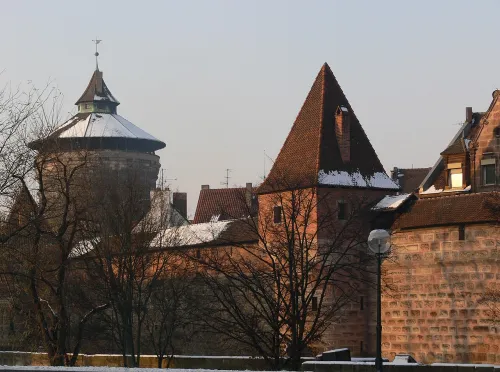
    The Kaiserburg is not a fortress on its own: in the north, the whole castle complex is woven into the city wall. Building began in the 12th century and officially ended in the 16th. The ring once ran 5 kilometres around the old town, and about 4 kilometres still stand, which makes the wall one of the city's most important architectural monuments.

    Nuremberg started as two towns. In the 13th century the settlements on either side of the Pegnitz, around St. Sebald and around St. Lorenz, were fortified separately. Only between 1320 and 1325 were they joined by walls across the river; the executioner's tower and the water tower in the west and the debtor's tower in the east date from that link. By 1400 the wall was complete as a crooked parallelogram, with a gate tower at each of its four corners.

    Look at it as a system rather than a single wall. From the inside out came the high wall, then in front of it the kennel, a level strip 15 metres wide, then the kennel wall rising from the moat, and finally the moat itself. It was dug from around 1430 after the Hussite Wars and finished in 1452, on average 12 metres deep and up to 20 metres wide, yet it was never filled with water. Old pictures show about 130 towers along wall and moat.

    People came in through gate towers such as the Laufer Tor, Frauentor, Spittlertor and Neutor, or through small pedestrian passages like the Hallertürlein and the Wöhrder Türlein. Still standing are the Tiergärtner Tor near the castle, the Laufer Schlagturm in the east and the White Tower on the Lorenz side, and in several places remnants of the old moat.

    The wall is free and always there. Next comes the Sebalduskirche, 1000 m away, about 13 minutes, the parish church of the Sebald half of town.

    Local name
    Stadtmauer Nürnberg
    Hours
    Open 24/7
    Price
    Free
  3. 3

    Sebalduskirche

    Sebalduskirche in Nuremberg, stop 3 on the self-guided walking tour

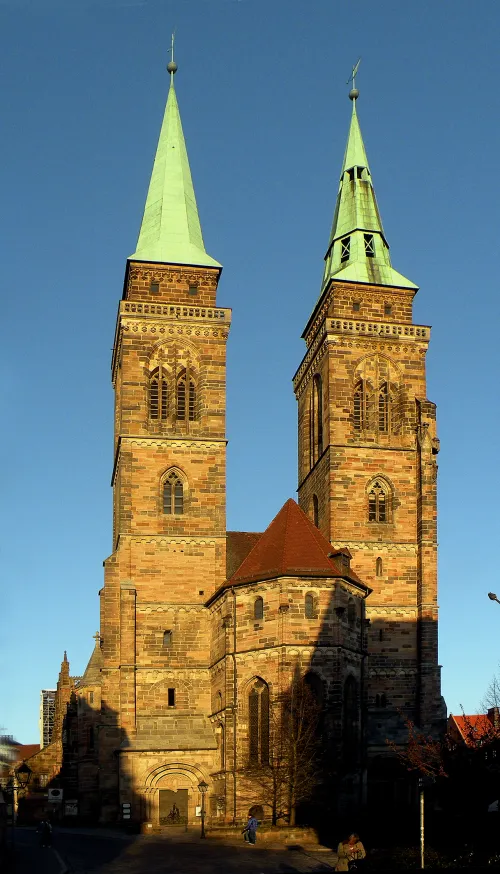
    St. Sebald stands on Albrecht-Dürer-Platz, facing the old city hall, and it is one of the oldest and most important churches in Nuremberg. It is named after Sebaldus, an 8th-century hermit and missionary who became the city's patron saint. Building began in 1225, the church became a parish church in 1255 and was finished in the 1270s. It has been Lutheran since the Reformation.

    You can read the building from its changes. It began as a Romanesque basilica with two choirs. In the 14th century the side aisles were widened and the steeples raised, and between 1358 and 1379 the late Gothic hall chancel was added. The two towers came in the 15th century, galleries and a Baroque makeover of the interior in the middle of the 17th.

    The church was badly damaged in the Second World War and restored, but some of its old furnishings came through: the Shrine of St. Sebaldus, works by Veit Stoss and the stained glass windows. Look also for the well-known epitaph of the Tucher family.

    Music mattered here. The church had an organ by the 14th century; Heinrich Traxdorf built the main organ in 1440 and 1441, it was rebuilt in 1691, and its case was destroyed in a bombing raid on 2 January 1945. The instrument you hear today, with four manuals and 84 organ stops, was installed in 1975 by a builder from Cologne. The organist's post at St. Sebald was the most important of its kind in the city and was held by several notable composers.

    Going in costs a fee. It is worth it for the shrine, the Veit Stoss works and the glass, especially if medieval craftsmanship is your thing. The Hauptmarkt is only 180 m away, about 2 minutes.

    Local name
    St. Sebald
    Hours
    Mar–Dec: daily 09:30–18:00; Jan–Feb: daily 09:30–16:00
    Price
    EUR 5 adult; EUR 2.50 reduced; free for children
  4. 4

    Hauptmarkt

    Hauptmarkt in Nuremberg, stop 4 on the self-guided walking tour

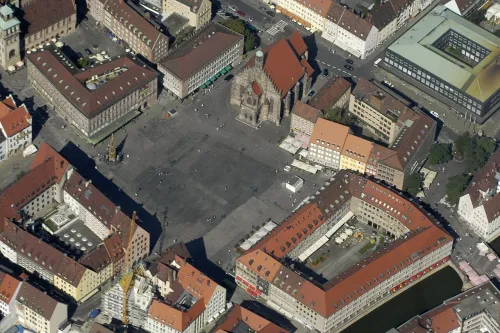
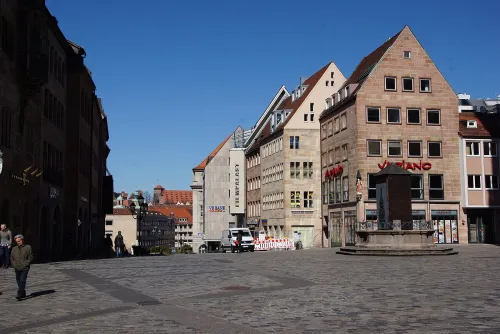
    The Hauptmarkt is the central square of the old town: roughly 5,000 square metres, almost entirely pedestrian, a rough trapezoid on the Sebald side of the Pegnitz with the city hall at its northwest corner. On weekdays the market stalls stand here; when the Christkindlesmarkt or another market takes over, the weekly stalls move into the surrounding pedestrian streets.

    Its origin is a dark one. In the 12th century this ground was marshland on the river bank, and Jews, probably driven out of the Rhineland, were given the swamp to settle. Once the two wall rings were joined around 1320, the Jewish quarter lay in the very middle of the city. In 1349, with the consent of Emperor Charles IV, a pogrom killed almost 600 Jews and destroyed the ghetto.

    On the site of the demolished houses the city laid out two market squares: the Obstmarkt to the northeast and this one, first called the Green Market or Great Market. Keep that in mind when you reach the church on its eastern side.

    Until the Second World War the square was architecturally outstanding. Most of it was destroyed, and the post-war rebuilding was plain and makeshift, so today the landmarks carry the weight: the Frauenkirche and the Schöner Brunnen, just 40 m away, about a minute's walk.

    Hours
    Always open
    Price
    Free
  5. 5

    Schöner Brunnen

    Schöner Brunnen in Nuremberg, stop 5 on the self-guided walking tour

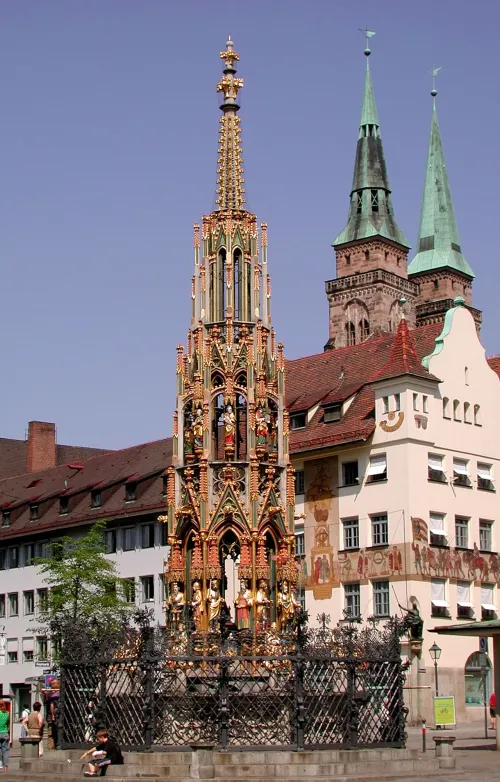
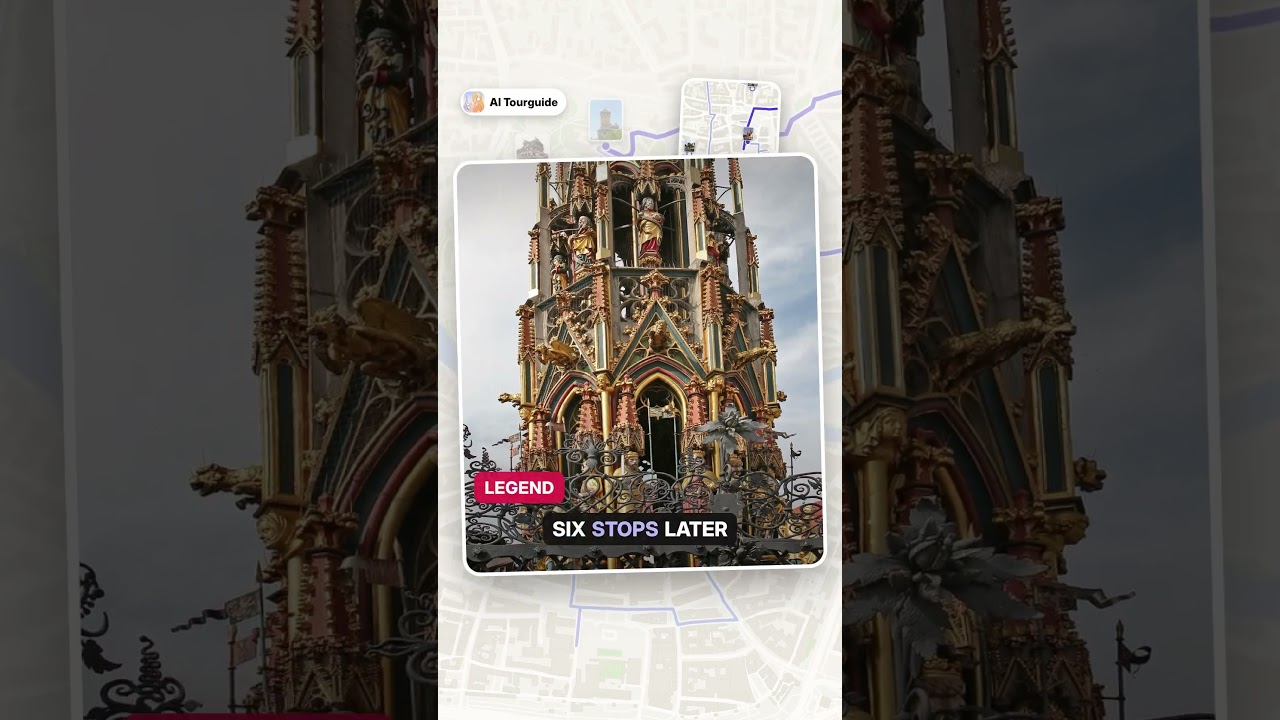
    The Beautiful Fountain stands at the edge of the Hauptmarkt next to the city hall: about 19 metres tall and shaped like a Gothic church spire bristling with pinnacles. It was built between 1385 and 1396, by Heinrich Beheim according to one tradition, by the brothers Georg and Fritz Rupprecht together with Sebald Schonhofer according to another.

    What you see is not the medieval original. The fountain was restored several times, first between 1822 and 1824 by the sculptor Jacob Daniel Burgschmiet, and a full sandstone copy followed in the 1830s. Today's fountain is a brightly painted copy in shell limestone made in 1903. The surviving pieces of the stone original are kept in the Germanisches Nationalmuseum, so you meet the fountain again later on this walk.

    In the Second World War it was sealed in a concrete casing and came through the air raids unharmed. In 2006, for the football World Cup, the artist Olaf Metzel wrapped it in a sculpture of stacked stadium seats called Auf Wiedersehen, and supporters and opponents argued bitterly over it. Between 1902 and 1934 the square also had a Baroque counterpart, the Neptune Fountain, until the Nazi city administration had it taken down.

    Now find the brass ring set seamlessly into the iron grille. Legend ties it to Master Kuhn, who made the grille. His apprentice courted Kuhn's daughter Margret, but Kuhn would not give his child to a poor lad, threw him out and declared that nothing would ever come of it; the ring is said to have found its way into the grille because of that quarrel.

    From the fountain it is 130 m, about 2 minutes, to the Frauenkirche; on the way you cross the ground of the Trempelmarkt and the Christkindlesmarkt.

    Hours
    Open 24/7
    Price
    Free
  6. 6

    Frauenkirche

    Frauenkirche in Nuremberg, stop 6 on the self-guided walking tour

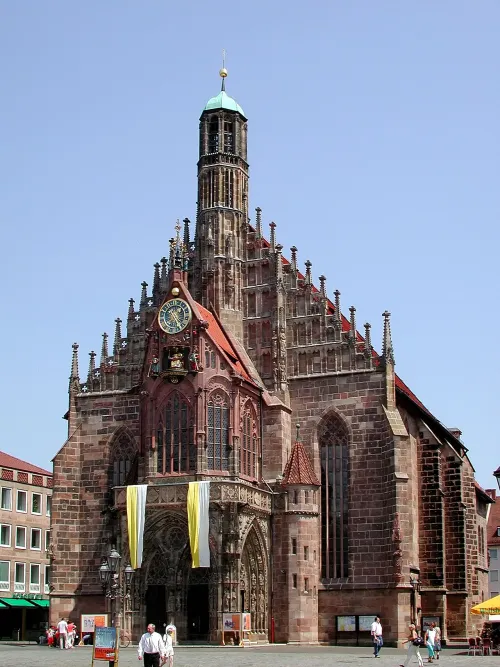
    The Frauenkirche, the Church of Our Lady, stands on the eastern side of the market. It is brick Gothic, built on the initiative of Emperor Charles IV between 1352 and 1362, probably to designs by Peter Parler. Its site belongs to the square's story: after the Black Death of 1349 and the pogrom, Charles ordered the synagogue destroyed to make way for the market, and the church was built on its rubble.

    Charles wanted a church for imperial ceremonies, and you can still see it. Look at the porch with its balcony, and at how plain the front is apart from coats of arms: the Holy Roman Empire, the seven Electors, Nuremberg and Rome, where the emperors were crowned. Adam Kraft designed the west gable, built between 1506 and 1508.

    In 1361 Charles's son Wenceslas was baptised here, and for the occasion the Imperial Regalia and the imperial reliquaries were shown to the people; references to Wenceslas run through the sculpture. From 1423 the regalia were kept permanently in Nuremberg and displayed once a year from a wooden platform built for that purpose.

    Entry is free. Inside, look for the Tucher Altar of around 1440, originally the high altar of the Augustinian church of St. Vitus, and two monuments by Adam Kraft from around 1498. Many sculptures have been heavily restored. It has been a Catholic parish church since 1810. Even if churches are not your thing, ten minutes here explain the whole square.

    The Lorenzkirche is 350 m away, about 5 minutes, across the Pegnitz in the other half of the old town.

    Hours
    Mon–Tue: 10:00–17:00 | Wed–Thu: 09:00–18:00 | Fri–Sat: 10:00–18:00 | Sun: 12:00–18:00
    Price
    Free
  7. 7

    Lorenzkirche

    Lorenzkirche in Nuremberg, stop 7 on the self-guided walking tour

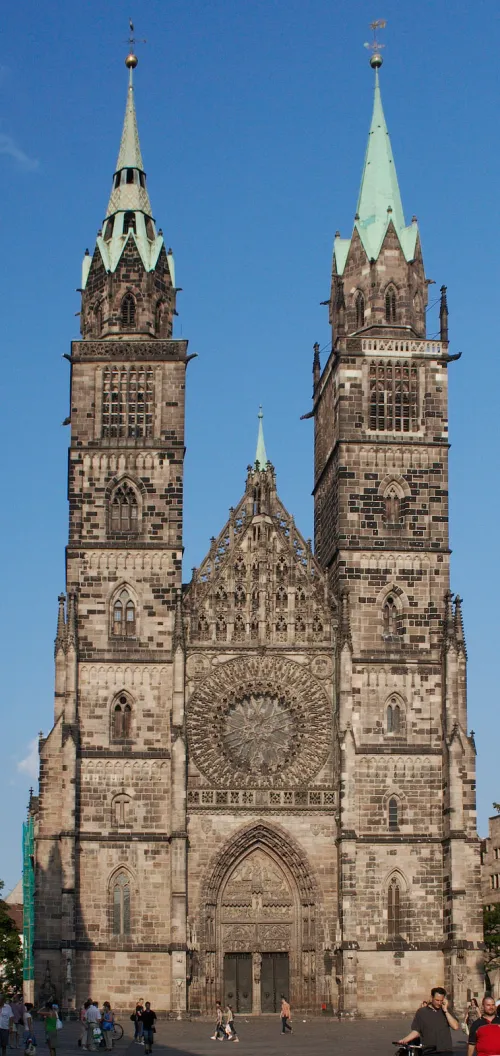
    Across the river you are in the second of Nuremberg's two old towns. The Lorenz settlement had its own walls in the 13th century, and St. Lorenz, dedicated to Saint Lawrence, is its great medieval church, built for the former free imperial city. Today it is one of the most prominent churches of the Evangelical Lutheran Church in Bavaria.

    Like St. Sebald on the other bank, it was badly damaged in the Second World War and later restored. Entry is free, so if you paid to see the Sebalduskirche, step in here too and compare the parish churches of the two halves of the city.

    Then follow Königstraße, 330 m away, about 4 minutes.

    Local name
    St. Lorenz
    Hours
    Mon–Sat: 09:00–17:30 | Sun: 13:00–15:30
    Price
    Free
  8. 8

    Königstraße

    Königstraße in Nuremberg, stop 8 on the self-guided walking tour

    A connector, and an honest one. Königstraße carries you out of the church quarter and deeper into the southern half of the old town, towards the museum district. After the density of the market and the churches, take it at half speed and let it be an ordinary street for a while.

    It is 400 m, about 6 minutes, to the Germanisches Nationalmuseum, Germany's largest museum of cultural history. A clear head is worth more there than another church interior.

    Hours
    Always open
    Price
    Free
  9. 9

    Germanisches Nationalmuseum

    Germanisches Nationalmuseum in Nuremberg, stop 9 on the self-guided walking tour

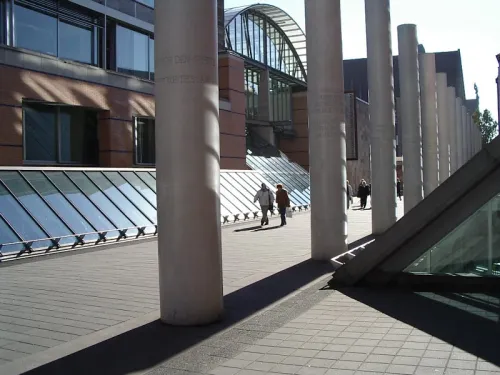
    The museum sits in the south of the old town, between Kornmarkt and Frauentormauer, along the medieval city wall. Its entrance hall is on Kartäusergasse, which the Israeli sculptor Dani Karavan turned into the Way of Human Rights. Walk through it slowly before you decide whether to go in.

    It was founded in 1852 by a group led by the Franconian baron Hans von und zu Aufsess, who wanted a “well-ordered compendium of all available source material for German history, literature and art”. The first exhibits were stored in the Tiergärtnertor tower, which you pass near the end of this walk.

    The name needs context. In 1846 linguists and historians, among them the Brothers Grimm, Leopold Ranke and Jacob Burckhardt, met in Frankfurt and chose “Germanistik” as an umbrella term for the study of German-speaking culture. After the revolutions of 1848 and 1849 failed to unite Germany, the museum's name kept alive the idea of a shared culture defined by language, a progressive concept at the time. Only in 1871, when the German Empire was founded, was “national” added to the name.

    Today it is Germany's largest museum of cultural history, with some 1.3 million objects including library and prints, of which around 25,000 are on show. Among them are the surviving pieces of the original Schöner Brunnen. Entry costs a fee. On this walk, choose a few rooms and give it an hour; if cultural history is your passion, come back with a whole morning.

    From here it is 730 m, about 10 minutes, back north to the river and the Henkersteg.

    Hours
    Mon: Closed | Tue: 10:00–18:00 | Wed: 10:00–20:30 | Thu–Sun: 10:00–18:00
    Price
    10 EUR (reduced 6 EUR ; under 18 free; free on Wednesdays from 17:30)
    Website
    gnm.de ↗
  10. 10

    Henkersteg

    Henkersteg in Nuremberg, stop 10 on the self-guided walking tour

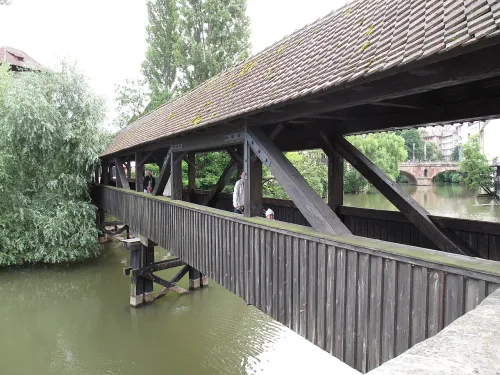
    The Henkersteg, also called the Long Footbridge, is a wooden bridge over the Pegnitz. It begins at the Henkerturm on the Trödelmarkt, an island in the river, and crosses to the St. Lorenz side, where it lands on Unschlittplatz beside the Unschlitthaus.

    The name comes from the tower: it was once the home of the imperial city's executioner, on what was then the Säumarkt, the pig market, and is now the Trödelmarkt. A first wooden footbridge was built here in 1457 for pedestrians, over the southern arm of the Pegnitz at the penultimate city wall.

    In January 1595 floodwater and drifting ice battered the bridges over the Pegnitz. At the end of that month the Henkersteg collapsed while people stood on it watching, and eight onlookers were swept away and died. Afterwards three arches of the old wall were torn down and the footbridge was rebuilt further west as a covered wooden bridge, which is why it ends at Unschlittplatz today.

    It was renewed or rebuilt in 1657, 1671, 1761 and 1776, badly damaged in the war and reconstructed in 1954. The crossing is free and always open; walk it slowly and look at the roof timbers and the water. The Weinstadl is only 20 m away.

    Hours
    Open 24/7
    Price
    Free
  11. 11

    Weinstadl

    Weinstadl in Nuremberg, stop 11 on the self-guided walking tour

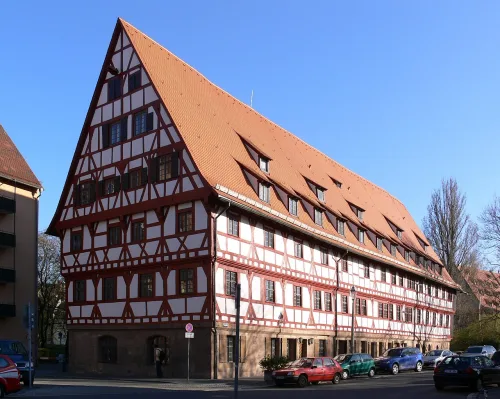
    The long half-timbered building on Maxplatz, by the Maxbrücke and opposite the Trödelmarkt island, is the Weinstadl. At 48 metres long it is the largest half-timbered building in Germany. Read it from the ground up: a sandstone ground floor, two half-timbered storeys, then a saddle roof with three levels of its own. On the end facing the Pegnitz hang wooden galleries with metal gargoyles, and on the east side a striking roof dormer from 1448 with a pointed-arch window.

    It was built between 1446 and 1448, outside what was then the city wall, for a charitable purpose: during Holy Week, people with leprosy were housed and fed here for three days, paid for by an endowment from 1394. Since it stood empty the rest of the year, nuns from Pillenreuth took refuge here in times of war.

    When the Holy Week meals moved to St. Johannis in 1575, the building filled up: craftsmen, poor families, a women's spinning house and a sick ward lived and worked here over time. From about 1571 the ground floor served as the imperial city's wine store, which gave the building its name. The sick ward moved out in 1627.

    A bombing raid on 3 October 1944 hit it hard. Since 1950 the Weinstadl and the water tower attached to it have been a student residence with 74 places, so there is no way inside; the outside is the point anyway, and it costs nothing.

    From here it is 630 m, about 10 minutes, to the Albrecht-Dürer-Haus, passing the Spielzeugmuseum Nürnberg on the way.

    Local name
    Weinstadel
    Hours
    Open 24/7 (exterior view anytime; today a student residence, no interior access)
    Price
    Free (exterior view; not publicly accessible)
  12. 12

    Albrecht-Dürer-Haus

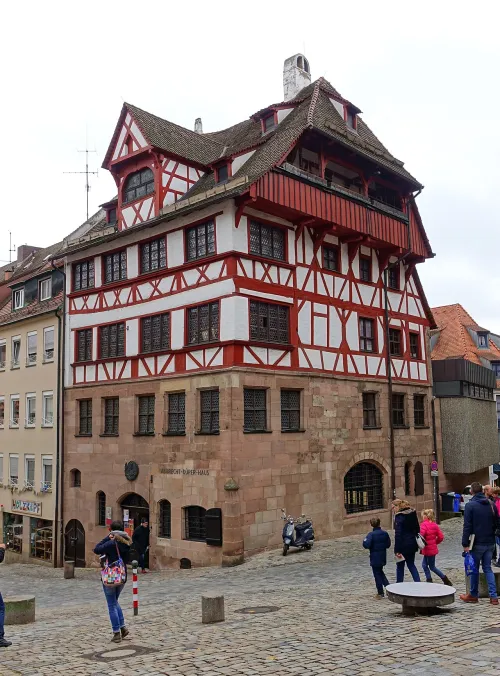
    Albrecht-Dürer-Haus in Nuremberg, stop 12 on the self-guided walking tour

    On the corner where the old Zistelgasse meets the square in front of the Tiergärtner Tor stands the house where Albrecht Dürer lived and worked from 1509 until his death in 1528. Its oldest beams were dated by tree rings to 1418, so it was built around 1420. Look at its four floors: the lower two in sandstone, the upper two in half-timbering, under a half-hipped roof with a street-side dormer. That dormer was reconstructed in the 19th century because people believed, very likely wrongly, that Dürer's workshop had been there.

    Before Dürer came an astronomer. In 1501 the merchant Bernhard Walther bought the house and gave the upper floors and roof essentially their present form. In the gable facing the town he had several small windows put in for his astronomical work. A contract with the neighbours, still in the city archive, forbade him to tip anything out of those new windows onto their roof.

    In 1509 the Walther family sold the house to Dürer for 275 guilders. He lived here with his wife Agnes, his mother Barbara and an unknown number of apprentices, journeymen and servants. Afterwards the house changed hands at least 24 times, in 1791 a carpenter lived in it, and yet people never stopped calling it the Dürer house.

    After the war damage was repaired, it opened as a museum in 1949, and the city's graphic collection stages special exhibitions here. Entry costs a fee. If Dürer is one reason you came to Nuremberg, go in: these are the rooms where he lived and worked for almost two decades.

    The Tiergärtnertorplatz is just 50 m away, past the Pilatushaus.

    Hours
    Tue–Sun 10:00–18:00; Mon closed (except July–September and during the Christkindlesmarkt: then also Mon 10:00–18:00)
    Price
    EUR 7.50 adult; EUR 2.50 reduced; EUR 8 family; group EUR 7
  13. 13

    Tiergärtnertorplatz

    Tiergärtnertorplatz in Nuremberg, stop 13 on the self-guided walking tour

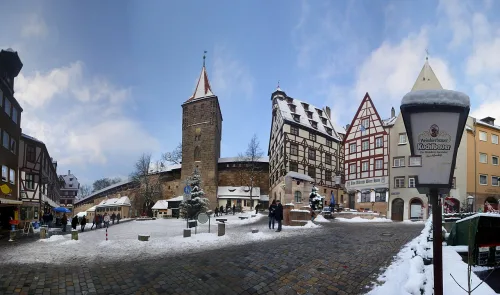
    This small square is surrounded by half-timbered and sandstone houses, among them the Albrecht-Dürer-Haus and the Pilatushaus, and four lanes run down the hill from it like spokes. Above it rises the Tiergärtnertor, part of the city wall just south of the Kaiserburg. Its name recalls a former game enclosure of the burgraves in the nearby moat.

    The square gate tower dates back to the late 13th century and once had a barbican in front of it. This was Nuremberg's main gate to the northwest, where the roads to Erlangen, Bamberg, Thuringia and Saxony began. The two upper floors with their polygonal oriels were added in 1516.

    When the castle bastion was rebuilt in the middle of the 16th century, the barbican disappeared. A new approach was made to the west through a curved tunnel, and the original gate was walled up. In 1894 the outer gate was greatly enlarged. From 1852 the newly founded Germanisches Museum used the tower as the store for its very first exhibits.

    The square is free and always open, and it is a good place to pause before the last stop. The Stadtmuseum Fembohaus is 240 m away, about 3 minutes, past the Historische Felsengänge Nürnberg.

    Hours
    Always open
    Price
    Free
  14. 14

    Stadtmuseum Fembohaus

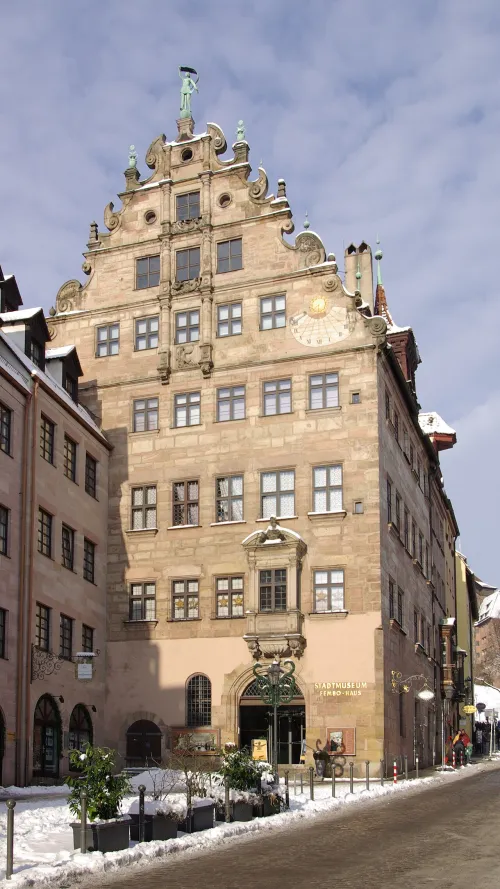
    Stadtmuseum Fembohaus in Nuremberg, stop 14 on the self-guided walking tour

    The Fembohaus at Burgstraße 15 is the only surviving large merchant's house of the late Renaissance in Nuremberg. It was built between 1591 and 1596, probably to plans by Jakob Wolff the Elder, for the Dutch merchant Philipp van Oyrl. He had bought the plot in 1590, had the old building torn down and was granted citizenship in 1592. The new house became the seat of his family and of the trading company he founded.

    In 1668 the patrician Christof Jakob Behaim married Maria Sabina Pellerin, van Oyrl's great-granddaughter, who brought the house into the marriage. Behaim had it remodelled in grand Baroque style: the Italian stuccoist Carlo Moretti Brentano created the large Baroque ceiling on the second floor, and an unknown master painted the ballroom ceiling on the third floor with scenes from Ovid's Metamorphoses.

    In 1735 the house passed to the heirs of the cartographer Johann Baptist Homann, whose map printing and publishing house was then the most important in Germany. They ran it here under the name Homännische Erben.

    Today the city museum tells 950 years of Nuremberg's history. Entry costs a fee, and it makes a fitting finale: after a day of single places, this is where the whole story comes together. You are on Burgstraße, the street that leads up to the Kaiserburg, and the GPS navigation can take you back to the start if you wish.

    Hours
    Mon: Closed | Tue–Fri: 10:00–17:00 | Sat–Sun: 10:00–18:00
    Price
    EUR 7.50 adult; EUR 2.50 reduced; EUR 2 resident; EUR 8 family; group EUR 2 / EUR 7; combined ticket EUR 15 / EUR 13
Walking tour route map of Nuremberg Route loaded
KaiserburgStadtmauerSebalduskircheHauptmarkt+10
All 14 stops are already on the map.
You just press start.
AI Tour Guide

You've read the route through Nuremberg. Now walk it with a guide in your ear.

Press start wherever you are, even hundreds of kilometres from Nuremberg, and the guide begins telling its stories right away. In the city, pick any of the 14 stops to start from: it leads you there, then talks with you the whole route, asking, listening, remembering, and shaping the tour around your answers.

14stops 5.2km 1 h 11 minwalking 13languages
▶Start the tour free

Free to start · Runs in your browser · No app, no download

Shorter Ways to Walk Nuremberg's Old Town

The route splits naturally into three sections. Each works on its own, and the GPS navigation guides you from stop to stop wherever you join.

Castle, walls and churches

Stops: 1, 2, 3, 4, 5, 6, 7

For first-timers who want the emperors and the medieval city in one go. From the Kaiserburg to the Lorenzkirche is 37 minutes of walking. The Kaiserburg and the Sebalduskirche charge entry; walls, market, fountain, Frauenkirche and Lorenzkirche are free.

Market to museum

Stops: 4, 5, 6, 7, 8, 9

For a rainy day or anyone who wants to give the Germanisches Nationalmuseum real time. From the Hauptmarkt to the museum is 18 minutes of walking, and only the museum charges entry.

River and Dürer quarter

Stops: 10, 11, 12, 13, 14

For art lovers and a relaxed afternoon: executioner's bridge, wine store, Dürer's house, the old northwest gate and a merchant's palace. Just 15 minutes of walking; the Albrecht-Dürer-Haus and the Stadtmuseum Fembohaus charge entry.

How Long Does This Nuremberg Tour Take, With and Without Interiors?

The 5.2 km add up to 1 h 11 min of pure walking. If you look at every stop from outside and keep moving, the whole route takes about two and a half hours. Go inside the Kaiserburg and one of the houses near the Tiergärtnertor and you are at about four hours.

The Germanisches Nationalmuseum does not fit neatly into a walk. Either give it an hour and choose a few rooms, or keep it for a separate morning or afternoon and walk past today.

For the sections: castle to Lorenzkirche is about two and a half hours with the Kaiserburg inside; market to museum depends almost entirely on your museum time; the river and Dürer quarter takes about two hours with both houses.

Before You Set Off from the Kaiserburg

  • Start: The Kaiserburg is the recommended start: you begin with the emperors and the walls, and the rest of the city's story follows from them. You can join at any stop.
  • Finish: The walk ends at the Stadtmuseum Fembohaus on Burgstraße, the same street that leads up to the castle. The GPS navigation can take you back to the start if you wish.
  • Time of day: Start in the morning if you plan to go inside anywhere, so the museums are still open and you still have energy for them.
  • Entry: The Kaiserburg, Sebalduskirche, Germanisches Nationalmuseum, Albrecht-Dürer-Haus and Stadtmuseum Fembohaus charge entry. Everything else is free; the Weinstadl is a student residence you see from outside only.
Walking tour route map of Nuremberg
AI Tour Guide

Your guide is ready at the castle gate whenever you are.

Press start and a voice AI Tour Guide takes it from here: leading the route through Nuremberg, telling the stories, and turning your walk into a real back-and-forth conversation. No app or download is needed; it runs in your browser.

14stops 5.2km 1 h 11 minwalking 13languages
▶Start the tour free

Free to start · Runs in your browser · No app, no download

What the AI Tour Guide Adds Between Castle and River

On a route that runs from emperors to executioners, the AI Tour Guide talks with you like a guide walking at your side: it greets you at the castle, tells the stories as you go, notices whether you lean towards Dürer and the art or towards walls and wars, and steers the conversation that way. You can interrupt at any moment, for example to ask what became of the apprentice in the brass ring legend, or which composers held the organist's post at St. Sebald. You start with 100 free credits; after that, take this tour all-inclusive for €19.99 with no time limit, or pay €5 per hour.

A Real Conversation A voice AI Tour Guide greets you, leads the whole route, and tells the stories and facts as you walk, asking what you want to see and keeping a real conversation going. Not a recording you press play on.
Map Navigation Follow the route on the map and walk at your own pace. You choose where to start and when to move to the next stop.
Ask Anything Curious about a building you pass? Ask your AI Tour Guide on the spot and the conversation carries on.
13 Languages Switch language anytime. No separate tour needed.
Start free in your browser

Common Questions About Walking Nuremberg's Old Town

Can I walk the route in reverse, starting at the Fembohaus?

Yes. The Stadtmuseum Fembohaus stands on Burgstraße, the street that leads up to the Kaiserburg, so both ends lie on the same street. In reverse you finish with the museum, the churches and the castle instead of the river and Dürer.

If I only go inside one place, which should it be?

For emperors and fortifications, the Kaiserburg. For art and the man himself, the Albrecht-Dürer-Haus. For the whole city story under one roof, the Stadtmuseum Fembohaus. The Frauenkirche and Lorenzkirche are free, so they don't count against your budget.

Is the walk good with children?

Under-18s get into the Kaiserburg and the Germanisches Nationalmuseum free, and children enter the Sebalduskirche free. Short legs can split the route into the three sections and do one per day.

Which towns near Nuremberg make a good day trip?

Bamberg is 51 km away, Rothenburg ob der Tauber 66 km and Regensburg 88 km. Each has its own walking route with free GPS navigation.

Is the tour really free?

Yes. The whole tour is free: the route, the interactive map and the navigation cost you nothing. Only the voice AI Tour Guide is optional and paid: you test it with 100 free credits, then you pay either €5 per hour or €19.99 for this whole tour, with no time limit. Admission to 5 of the 14 stops is not included: Kaiserburg, Sebalduskirche, Germanisches Nationalmuseum, Albrecht-Dürer-Haus and Stadtmuseum Fembohaus charge their own entry fees.

Do I need to download an app?

No. Everything runs in your phone browser. Open the route and start walking, no download and no sign-up required.

Do I need to book the walking tour in advance?

No booking needed. This self-guided tour is available anytime. Open the route in your browser and start walking. The AI Tour Guide works instantly, no app, no reservation required.

What languages is the AI Tour Guide available in?

The AI Tour Guide speaks 13 languages, so you take the tour in your own language and can switch at any time.

Can I skip stops or change the route?

Yes. Skip any stop, spend extra time at places you like, or start the route from any point. It is your walk, you set the pace.
Image credits
▶ Start free in your browser Runs in your browser, no app, no download