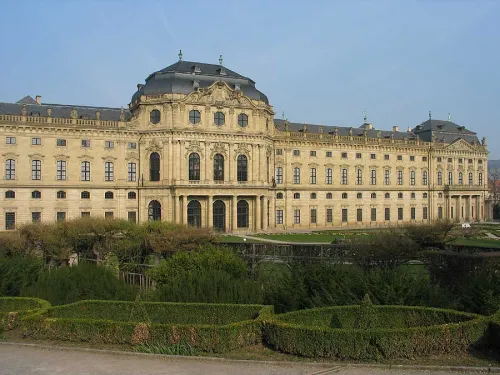
Free Walking Tour Würzburg: Palace, Fortress, Old Bridge

From Tiepolo's frescoes in the prince-bishops' palace up to their hilltop fortress and back over the statue-lined bridge to the market: ten stops, 4.0 km.

10 Stops 4.0 km ~1 h 1 min walking
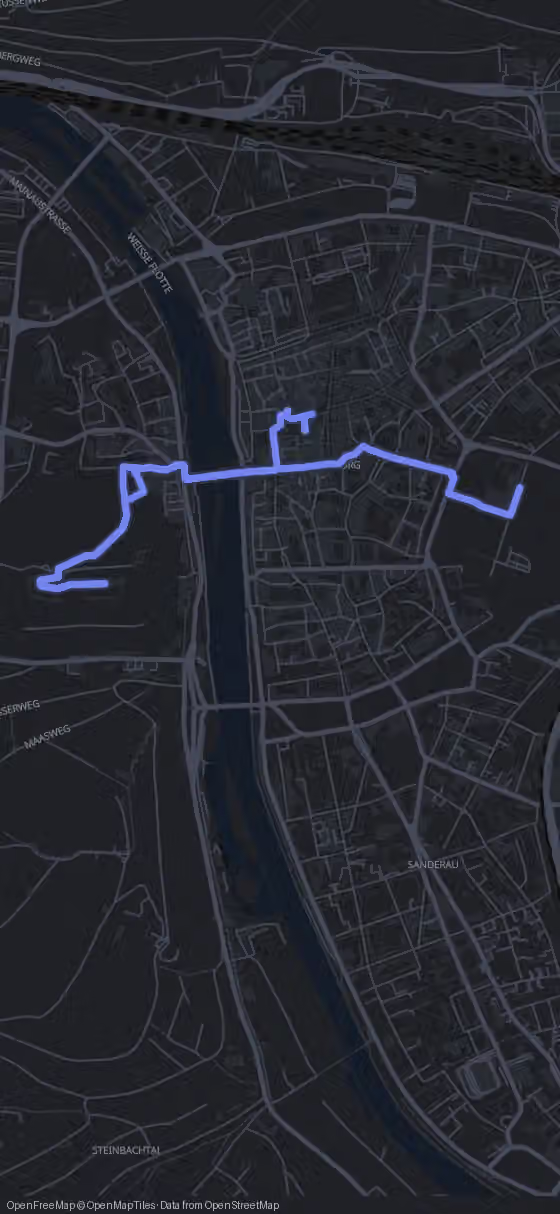
Route map for the Würzburg walking tour
Stop 1 of 10
A few steps·1 min
Würzburger Residenz
Head north out the back of the Residenz into the Hofgarten
Welcome to Würzburg. I'm Alex, and the palace masterpiece here survived a night that reduced the city to ruins.
Try this tour with Alex

Würzburg on Foot: The Route at a Glance

Ten stops from the Würzburger Residenz to the Falkenhaus on the Marktplatz: 4.0 km and 1 h 1 min of pure walking, with the longest leg climbing to Festung Marienberg across the Main. With the palace and the museum inside, plan most of a day; seeing the paid sights from outside, about three hours.

The Hofgarten, Dom St. Kilian, the Neumünster, the Alte Mainbrücke and the Marienkapelle are free; the Residenz, the castle tour and the Museum für Franken charge entry. The GPS route in your browser is free, the AI Tour Guide optional.

Open free GPS & optional AI Tour Guide
View of Würzburg

The Route

Würzburg Walking Map: Residenz to Marktplatz

10 stops 4.0 km 1 h 1 min walking
Tap to load interactive map

The 10 stops along this route

  1. Würzburger Residenz, stop 1 on the self-guided walking tour
    1Würzburger Residenz
  2. Hofgarten in Würzburg, stop 2 on the self-guided walking tour
    2Hofgarten
  3. Dom St. Kilian in Würzburg, stop 3 on the self-guided walking tour
    3Dom St. Kilian
  4. Neumünster in Würzburg, stop 4 on the self-guided walking tour
    4Neumünster
  5. Festung Marienberg in Würzburg, stop 5 on the self-guided walking tour
    5Festung Marienberg
  6. Museum für Franken in Würzburg, stop 6 on the self-guided walking tour
    6Museum für Franken
  7. Alte Mainbrücke in Würzburg, stop 7 on the self-guided walking tour
    7Alte Mainbrücke
  8. Marienkapelle in Würzburg, stop 8 on the self-guided walking tour
    8Marienkapelle
  9. Marktplatz in Würzburg, stop 9 on the self-guided walking tour
    9Marktplatz
  10. Falkenhaus in Würzburg, stop 10 on the self-guided walking tour
    10Falkenhaus
  11. That's the full route.

    Walk it with an AI Tour Guide talking you through every one of these streets.

    Start free in your browser
    You made it

Your Würzburg Walking Tour Stops, from Palace to Market

  1. 1

    Würzburger Residenz

    Würzburger Residenz, stop 1 on the self-guided walking tour

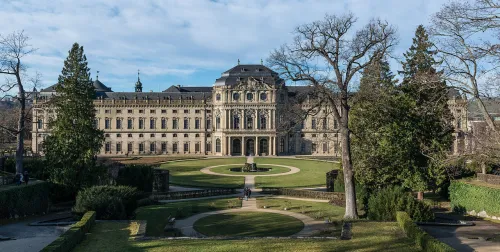
    Start where the prince-bishops wanted all of Europe to look. The Würzburger Residenz was commissioned in 1720 by Prince-Bishop Johann Philipp Franz von Schönborn and his brother Friedrich Carl, and completed in 1744. Balthasar Neumann, the bishop's court architect, led the work, but he did not plan alone: Johann Lukas von Hildebrandt and Maximilian von Welsch brought the Austrian and southern German Baroque, Robert de Cotte and Germain Boffrand the French taste. The palace in front of you is the result of that conversation between two schools.

    The money came from a lawsuit. In the year he took office, Johann Philipp Franz won 600,000 florins in court, a fortune at the time, and he wanted a palace to match Versailles or Schönbrunn instead of the small one his court had just moved into. His uncle Lothar Franz von Schönborn, Elector of Mainz, cheered him on and confessed to suffering from a 'Bauwurm', a building bug. Before all this, the prince-bishops had lived up in the fortress across the river, where this walk takes you later.

    Inside is the reason to buy a ticket. The Venetian painter Giovanni Battista Tiepolo, helped by his son Domenico, painted frescoes here, and the chapel and the Imperial Hall count among the masterworks of Baroque and Rococo art. Your ticket includes a guided tour, and if you only go inside one building today, make it this one. British bombs badly damaged the palace in World War II, restoration has continued since 1945, and in 1981 the Residenz became a UNESCO World Heritage Site.

    Napoleon reportedly called it the largest parsonage in Europe, which says a lot about bishops who lived like kings. When you come out, the Hofgarten is only a minute away, right at the palace.
    Hours
    April–October: daily 9:00–18:00 (ticket office closes 17:15) | November–March: daily 10:00–16:30 (ticket office closes 16:00)
    Price
    10 EUR, reduced 9 EUR (under 18 free; includes guided tour)
  2. 2

    Hofgarten

    Hofgarten in Würzburg, stop 2 on the self-guided walking tour

    The Hofgarten is the palace's Baroque garden, laid out for the same rulers who built the Residenz, and walking in costs nothing. After the gilded rooms and frescoes, this is where the route breathes. On a hot summer day it is also the stretch with real shade, so it is a good place to sit for a while before the churches and the climb to the fortress.

    If you are in Würzburg in late June, look out for the Weinfest im Hofgarten: the state wine cellars set up their tables between the parterres, the formal flower beds, and entry is free. On any other day the garden is simply a calm green pause between palace and old town.

    From here it is 720 metres, about 10 minutes on foot, to Dom St. Kilian.

    Local name
    Hofgarten Residenz Würzburg
    Hours
    Daily until nightfall (at most until 20:00)
    Price
    Free
  3. 3

    Dom St. Kilian

    Dom St. Kilian in Würzburg, stop 3 on the self-guided walking tour

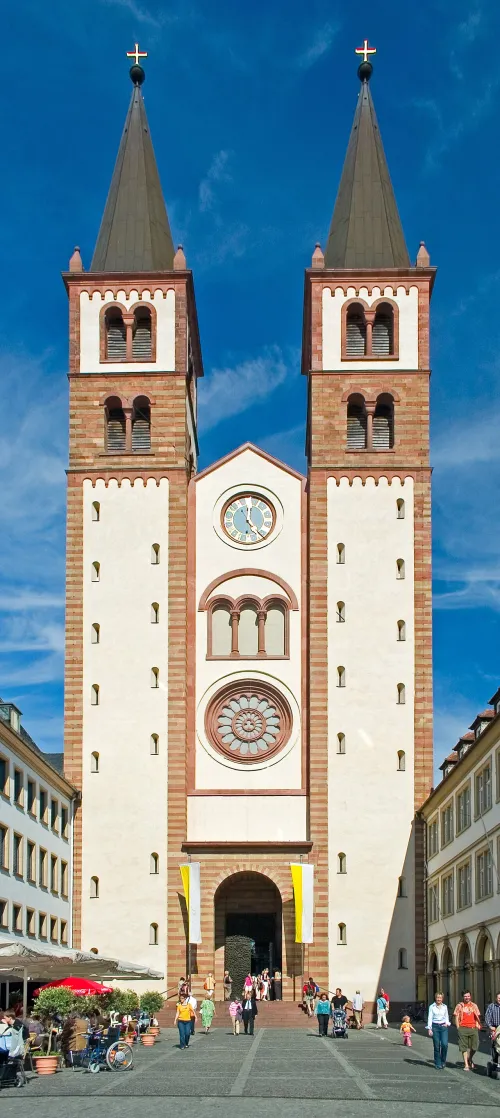
    Dom St. Kilian is the seat of the Bishop of Würzburg and, at 103 metres long, the fourth largest Romanesque church building in Germany. The building you stand in is the third cathedral on this site: Bishop Bruno began it in 1040, died in an accident in 1045, and his successor Adalbero finished it in 1075. Further rebuilding, especially after 1133, meant it was only consecrated in 1187. Its Romanesque cross-shaped plan has survived every change since.

    The story goes back further still. Burchard, the city's first bishop, transferred the relics of Kilian and his companions Totnan and Colman to an earlier cathedral here on 8 July 752, and the skulls of the three saints are still kept in the high altar. For centuries the cathedral was also the burial place of the prince-bishops, and in the Middle Ages its cathedral school ranked among the most important in the Holy Roman Empire, alongside those of Liège and Worms.

    Look for the layers. The side aisles were reworked in late Gothic style around 1500, a Baroque makeover began in 1627, and the stuccoist Pietro Magno added his decoration between 1701 and 1704. Tilman Riemenschneider left work here too. Balthasar Neumann, the architect of the Residenz, built the burial chapel for the Schönborn bishops north of the transept between 1721 and 1734, so the family behind the palace rests here.

    British bombs heavily damaged the cathedral in March 1945, and what you see was rebuilt after the war. Entry is free, and even a short visit is worth it. The Neumünster is just 30 metres away, a minute's walk, and you pass the Museum am Dom on the way.

    Local name
    Würzburger Dom
    Hours
    Daily 8:00–18:00 (Sundays until 19:30 after evening mass)
    Price
    Free
  4. 4

    Neumünster

    Neumünster in Würzburg, stop 4 on the self-guided walking tour

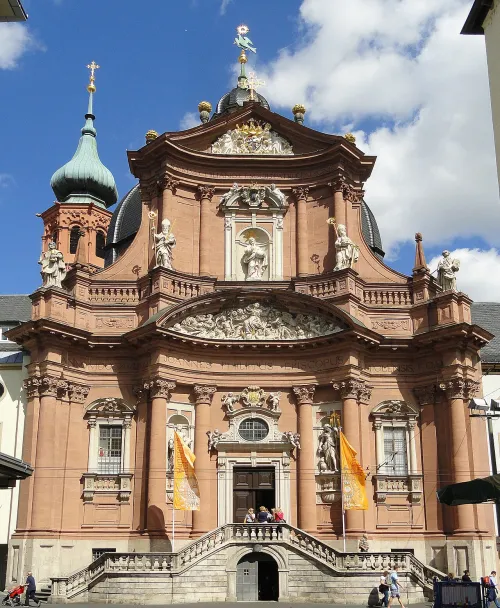
    The Neumünster stands where, by tradition, the Franconian Apostles Kilian, Colman and Totnan were martyred. The first church here was probably built under Bishop Meningoz to mark that place. Burchard and later Meningoz himself were buried in it, and the inscription on Meningoz's sarcophagus is the oldest post-Roman inscription in Franconia. In 1057 Bishop Adalbero, the man who finished the cathedral next door, founded a college of canons here, and the Romanesque church was completed three years later.

    From outside, the Baroque west façade catches your eye: Josef Greising built it between 1711 and 1716. From 1725 the brothers Johann Baptist and Dominikus Zimmermann redesigned the interior. The church has had strange chapters too: after secularisation it served as a munitions depot until 1821, and it only became a parish church in its own right in 1908.

    The 1945 bombing destroyed much of the interior, including Tilman Riemenschneider's busts of the Franconian Apostles, which are now copies. Because the damage was lighter than at the cathedral, the Neumünster served as the bishop's seat from 1950 until the cathedral reopened in 1967. A renovation between 2009 and 2011 restored Baroque elements and added modern art by Michael Triegel and Hann Trier, a contrast that makes the free visit inside worthwhile.

    Before you move on, find the Lusamgärtchen at the north end of the church, a small garden in the canons' former cemetery and cloister. The minstrel Walther von der Vogelweide was probably buried here, and a monument remembers him. Then comes the longest leg of the walk: 1560 metres, about 26 minutes, to Festung Marienberg on its hill across the Main.

    Hours
    Open: Mon–Sat 6:00–18:00, Sun & holidays 7:00–18:00 | visiting hours: Mon–Sat 8:00–17:00, Sun & holidays 10:00–17:00
    Price
    Free
  5. 5

    Festung Marienberg

    Festung Marienberg in Würzburg, stop 5 on the self-guided walking tour

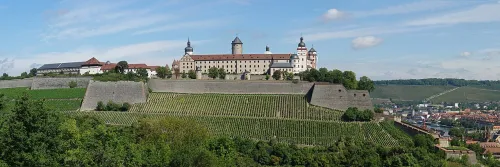
    Festung Marienberg sits on a spur of the Marienberg, a hill 266 metres high that rises about 100 metres above the Main, with vineyards on the slopes around it. It is the symbol of Würzburg, and for nearly five centuries it was home to the prince-bishops before they moved down to the Residenz where you started.

    People fortified this hill long before any bishop. Around 1000 BC members of the Urnfield culture built a Celtic refuge castle here. Finds suggest that the later Hallstatt people traded with Ancient Greece and that around 500 BC the hill marked an extreme northern point of the wine trade of the time. Suevi, Marcomanni, Alemanni and Burgundians took turns controlling the area before the Franks arrived in the 6th century. A 7th-century document mentions Uburzi, the fortification on the hill, and from that name came Würzburg; the name Marienberg only came into use in the High Middle Ages.

    Most of what stands today is Renaissance and Baroque, built between the 16th and 18th centuries. After Gustavus Adolphus of Sweden conquered the area in 1631 during the Thirty Years' War, the castle was rebuilt as a Baroque residence. Once the bishops had left, it still saw fighting in the wars of the late 18th and 19th centuries. British bombs badly damaged it in March 1945, and it was only fully rebuilt in 1990.

    The outdoor grounds are free, so you can walk around the fortress at no cost. The castle tour of about 60 minutes costs extra and is worth it if you want more than walls. The fortress houses two museums, and the Museum für Franken is the next stop, a minute away.

    Hours
    Outdoor area: April–October Tue–Sun 9:00–18:00, Mon closed | November–March Tue–Sun 10:00–16:30, Mon closed
    Price
    Outdoor grounds free | castle tour (approx. 60 min): 5 EUR regular, 4 EUR reduced (under 18 free)
  6. 6

    Museum für Franken

    Museum für Franken in Würzburg, stop 6 on the self-guided walking tour

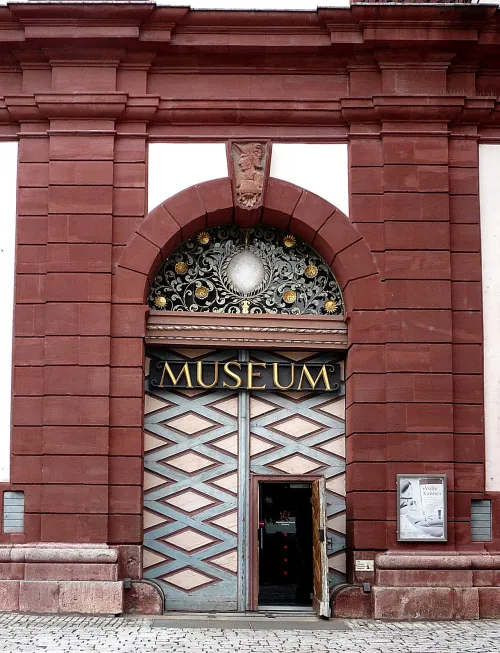
    The Museum für Franken lies in the outer part of the fortress, between the Schönborntor and the Echtertor gates. It counts among the great art collections of Bavaria and is regarded as a German museum of international standing. In 45 rooms you see paintings, sculptures and crafts from Würzburg and Mainfranken, the Franconian lands along the Main, from early times to the 19th century.

    It used to be called the Mainfränkisches Museum. Its roots reach back to 1831, when the Historical Society for the Untermainkreis was founded; the society's antiquarium, built on the collecting of Würzburg citizens, became the city's first public art collection. An earlier home was a former university chemistry institute on Maxstraße, where the collections opened as the Fränkisches Luitpoldmuseum on 17 May 1913. Since 1 January 2017 the Free State of Bavaria has run the museum, and by 2032 it is to become a state museum covering all of Franconia, Würzburg's own history included.

    Who should go in? Anyone who noticed Tilman Riemenschneider's name at the cathedral and the Neumünster, because the museum holds major works by Franconian artists, his originals from the Marienkapelle among them. The museum charges entry. If you have no patience for museums today, skip it and give the time to the bridge and the market instead.

    From here it is 1140 metres, about 17 minutes, back down to the river and the Alte Mainbrücke.

    Hours
    April–October: Tue–Sun 10:00–17:00, Mon closed | November–March: Tue–Sun 10:00–16:00, Mon closed
    Price
    5 EUR regular, 4 EUR reduced, Sundays 1 EUR, children and youth (0-17 years) free
  7. 7

    Alte Mainbrücke

    Alte Mainbrücke in Würzburg, stop 7 on the self-guided walking tour

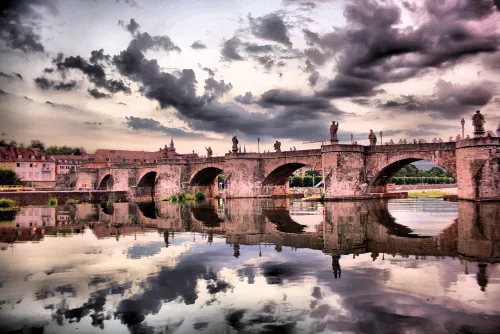
    The Alte Mainbrücke is the oldest bridge over the Main in Würzburg and was the city's only river crossing until 1886. It links the old town on the right bank with the fortress you just left, and today it is used by people on foot and on bikes.

    Before there was a bridge there was a ferry. Around 1120 the cathedral and city master builder Enzelin built the first Romanesque stone bridge here. Legend says that while its foundations were laid, workers found the statues of a pagan Freya shrine that Kilian and his companions had thrown into the river. That bridge stood for almost 350 years, but floods in 1342 and 1442 and the timber logs floated down the Main battered it until it was replaced.

    Work on the bridge you are walking on began in 1476, and its limestone piers were finished in 1488. The arches between them were wooden at first, partly for defence; from 1512 they were replaced by stone vaults, a job that dragged on until 1703 for lack of money. Until the 18th century the bridge was fortified and almost completely lined with booths, and a bridge gate stood at its western end until 1869.

    The stone figures are the bridge's signature. With them, in the 18th century, Würzburg continued a tradition that began in Rome at the Ponte Sant'Angelo and that Prague followed at Charles Bridge. Crossing is free, so take your time. Then it is 400 metres, about 5 minutes, to the Marienkapelle.

    Hours
    Always open
    Price
    Free
  8. 8

    Marienkapelle

    Marienkapelle in Würzburg, stop 8 on the self-guided walking tour

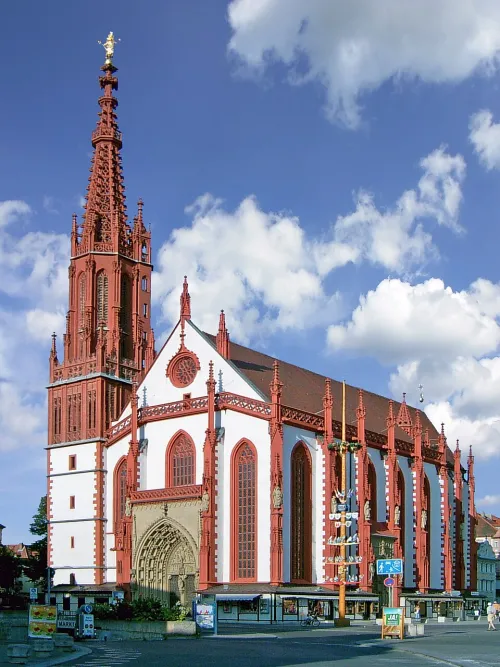
    The Marienkapelle on the Unterer Markt looks like a church, but by status it is a chapel because it has no parish of its own; today the parishes of the cathedral and the Neumünster look after it. It was built in the Gothic style in the 14th century.

    Its story begins with a crime. On 21 April 1349 the synagogue that stood on this site was destroyed in a pogrom against the city's Jews. What was built right afterwards is unclear, and nobody knows whether the chapel to Mary was meant as atonement for the murders. Construction of the present church began in 1377 under Bishop Gerhard von Schwarzburg. The choir was reportedly consecrated in 1392, and by 1441 the building was largely complete, because Bishop Sigismund von Sachsen, driven from the cathedral, used it as his church. That same year work on the tower began under Eberhard Friedberger, and its roof followed in 1479.

    For a time a knightly society, the Fürspänger, claimed the chapel, and as late as the 17th century it was still known as the knights' chapel. In 1945 its interior burned out in the bombing; it was rebuilt in the 1950s and reconsecrated in 1962.

    Go inside, it is free. The Adam and Eve sculptures by Tilman Riemenschneider here are copies; the originals are in the Museum für Franken up at the fortress. And Balthasar Neumann, the architect of the Residenz where your walk began, is buried in this chapel. The Marktplatz is 120 metres on, about 2 minutes.

    Hours
    Daily: 09:00–18:00
    Price
    Free
  9. 9

    Marktplatz

    Marktplatz in Würzburg, stop 9 on the self-guided walking tour

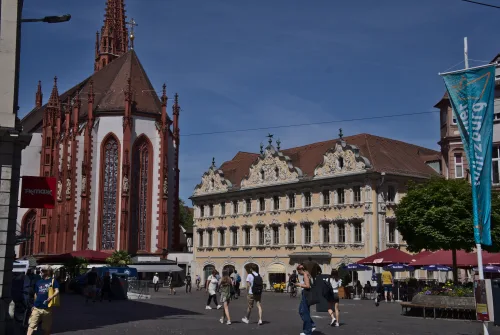
    The Marktplatz, the Oberer and the Unterer Markt together, is the room Würzburg actually lives in. The weekly market is at its best early in the day, and weekday late mornings give you the quiet version of the square.

    The calendar changes it again and again: the Weindorf wine festival fills it in late May and early June, the Weinparade runs from late August into September, and from late November roughly 100 Christmas market stalls stand in front of the Marienkapelle and the Falkenhaus.

    No ticket, no queue, no schedule to keep. Walk both halves of the square and let the day decide how long you stay. The Falkenhaus is 70 metres away, about a minute, past the stalls of the Wochenmarkt Würzburg if it is a market day.

    Hours
    Always open
    Price
    Free
  10. 10

    Falkenhaus

    Falkenhaus in Würzburg, stop 10 on the self-guided walking tour

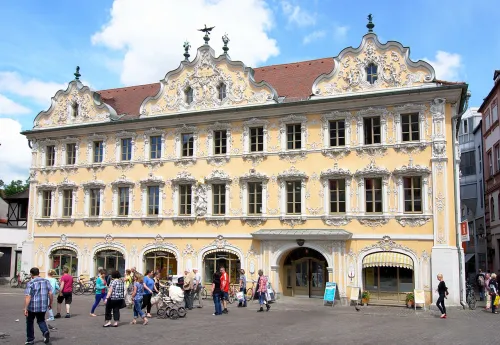
    The Falkenhaus is the house with the three-gabled Rococo façade and its rich stucco on the upper market, right next to the Marienkapelle. From 1338 the building, then called the Hof zur Burgpfarre, housed the cathedral's parish priest.

    In 1735 the innkeeper Franz Thomas Meißner bought it and ran it as the inn Zum Falken. It was his widow who had the stucco façade built in 1751, and until the 19th century the house held Würzburg's only concert and dance hall.

    On 16 March 1945 the house burned out completely in the bombing and parts of the façade collapsed. In 1947 the government architect Rudolf Schlick argued for rebuilding it, and in the early 1950s the city reconstructed the façade from old photographs, a reconstruction regarded as exemplary, while the inside was adapted to modern use. Decades later there was talk of absorbing the house into a department store complex, which would have left the façade as a mere screen.

    Since 1952 the Falkenhaus has housed the tourist information and the city library, and going in is free, which makes it a practical last stop for maps and tips. Your walk ends here; if you want, the GPS navigation in your browser guides you back to the Residenz.

    Hours
    1 May to 31 October: Mon–Fri 10:00–18:00, Sat/Sun/holidays 10:00–14:00 | 1 November to 30 April: Mon–Wed & Fri 10:00–16:00, Thu 10:00–18:00, Sat 10:00–14:00, Sun/holidays closed
    Price
    Free
Walking tour route map of Würzburg Route loaded
Würzburger ResidenzHofgartenDom St. KilianNeumünster+6
All 10 stops are already on the map.
You just press start.
AI Tour Guide

You know the route now. Walk it with a guide in your ear.

Press start wherever you are, even hundreds of kilometres from Würzburg, and the guide begins telling its stories right away. In the city, pick any of the 10 stops to start from: it leads you there, then talks with you the whole route, asking, listening, remembering, and shaping the tour around your answers.

10stops 4.0km 1 h 1 minwalking 13languages
▶Start the tour free

Free to start · Runs in your browser · No app, no download

Shorter Ways Through Würzburg

Not every day has room for a palace, a fortress and a museum. These three versions keep the order of the full walk and cut where it makes sense.

Palace and cathedral morning

Stops: 1, 2, 3, 4

For a short visit focused on the prince-bishops' town: the Residenz, its garden, the cathedral and the Neumünster. About 12 minutes of walking in all; only the Residenz charges entry.

Fortress and old town

Stops: 5, 6, 7, 8, 9, 10

For anyone who has seen the Residenz before or wants the hill, the river and the market: start at Festung Marienberg and finish at the Falkenhaus. About 26 minutes of walking; only the castle tour and the Museum für Franken charge entry, the fortress grounds are free.

All ten stops, free entries only

Stops: 1, 2, 3, 4, 5, 6, 7, 8, 9, 10

For a tight budget: the full 1 h 1 min walk, seeing the Residenz, the castle and the museum from outside and going into the free churches, the garden and the Falkenhaus.

How Long the Würzburg Tour Takes, With and Without Interiors

Pure walking time is 1 h 1 min over 4.0 km, and most of it sits in two legs: 26 minutes up to the fortress and 17 minutes back down to the bridge. Everything else is a stroll of a few minutes, often just one.

With the guided Residenz tour, the castle tour of about 60 minutes and a proper look at the Museum für Franken, plan around seven hours including breaks. Keeping to the free interiors and the outsides, about three hours is realistic. The palace and cathedral morning takes around two and a half hours with the Residenz tour; the fortress and old town version around four hours with both paid visits.

Before You Set Off from the Residenz

  • Start and finish: The Würzburger Residenz is the recommended start, but you can join at any stop. The walk ends at the Falkenhaus on the Marktplatz, and the GPS navigation in your browser can guide you back to the start if you like.
  • Time of day: Set off in the morning if you want to go inside the Residenz and the Museum für Franken, so both visits fit comfortably into the day.
  • Entry fees: The Residenz (guided tour included), the castle tour at Festung Marienberg and the Museum für Franken charge entry, and under 18s go free at all three. Everything else, the fortress grounds included, is free.
Walking tour route map of Würzburg
AI Tour Guide

Your guide is ready at the Residenz whenever you are.

Press start and a voice AI Tour Guide takes it from here: leading the route through Würzburg, telling the stories, and turning your walk into a real back-and-forth conversation. No app or download is needed; it runs in your browser.

10stops 4.0km 1 h 1 minwalking 13languages
▶Start the tour free

Free to start · Runs in your browser · No app, no download

What the AI Tour Guide Adds on This Walk

On this walk the AI Tour Guide turns the page into a conversation: it greets you at the Residenz, tells the stories of each place as you arrive, asks what caught your interest and remembers it. If the Schönborn family hooks you, it keeps following their trail through palace, cathedral and fortress; if you would rather hear how life on the bridge looked when booths lined it, say so and the talk shifts. You can interrupt at any time, and the route stays the same. You start with 100 free credits; after that you choose this tour all-inclusive for €19.99 with no time limit, or credits at €5 per hour.

A Real Conversation A voice AI Tour Guide greets you, leads the whole route, and tells the stories and facts as you walk, asking what you want to see and keeping a real conversation going. Not a recording you press play on.
Map Navigation Follow the route on the map and walk at your own pace. You choose where to start and when to move to the next stop.
Ask Anything Curious about a building you pass? Ask your AI Tour Guide on the spot and the conversation carries on.
13 Languages Switch language anytime. No separate tour needed.
Start free in your browser

Common Questions About Walking Würzburg

What can I combine with Würzburg on a day trip?

Two towns pair well with a Würzburg visit: Rothenburg ob der Tauber, about 50 km away, and Bamberg, about 69 km away, each with its own free walking route.

Can I do part of the walk in the evening?

Yes, the second half suits later hours: the Alte Mainbrücke and the Marktplatz are open around the clock. The interiors keep daytime hours, so do the Residenz and the fortress first.

How much of what I see was rebuilt after 1945?

A great deal. The bombing of March 1945 hit the Residenz, the cathedral, the Neumünster, the fortress, the Marienkapelle and the Falkenhaus. Restoration at the Residenz has continued since 1945, and the fortress was only fully rebuilt in 1990.

Is the tour really free?

Yes. The whole tour is free: the route, the interactive map and the navigation cost you nothing. Only the voice AI Tour Guide is optional and paid: you test it with 100 free credits, then you pay either €5 per hour or €19.99 for this whole tour, with no time limit. Admission to 2 of the 10 stops is not included: Würzburger Residenz and Museum für Franken charge their own entry fees.

Do I need to download an app?

No. Everything runs in your phone browser. Open the route and start walking, no download and no sign-up required.

Do I need to book the walking tour in advance?

No booking needed. This self-guided tour is available anytime. Open the route in your browser and start walking. The AI Tour Guide works instantly, no app, no reservation required.

What languages is the AI Tour Guide available in?

The AI Tour Guide speaks 13 languages, so you take the tour in your own language and can switch at any time.

Can I skip stops or change the route?

Yes. Skip any stop, spend extra time at places you like, or start the route from any point. It is your walk, you set the pace.
Image credits
▶ Start free in your browser Runs in your browser, no app, no download