



Münster St. Georg
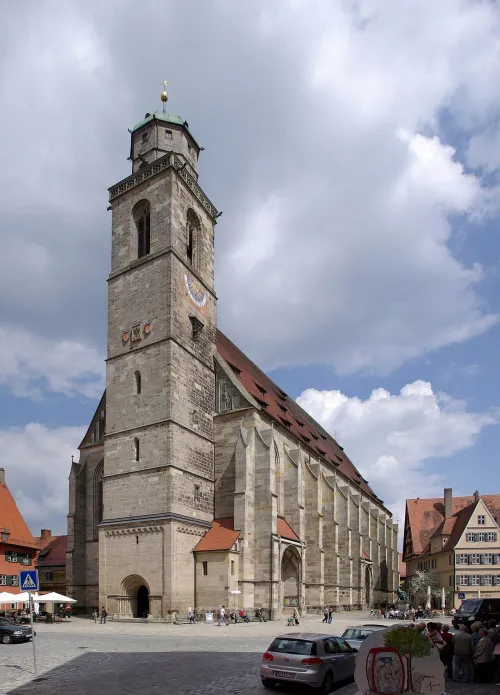
Your walk begins in the middle of the old town at Münster St. Georg, a three-aisled late Gothic hall church. It went up between 1448 and 1499 to plans by the master builder Niclaus Eseler, and in 2018 it was declared a monument of national importance. Before you go in, walk round to the outside of the choir, because the best story is written on the stone.
On a central choir pillar a five-line inscription records the laying of the first stone: in the year of the Lord 1448, on the Tuesday after Mid-Lent, which was 5 March. Between that inscription and a console carrying a bust of Eseler himself sits a double sundial from around 1450, the oldest east-facing sundial in Europe. The builder, the date and the time of day, all on one pillar.
The church stands on layers of earlier ones. Foundations uncovered in 1977/78 belong to a predecessor probably from 1142/46, likely dedicated to St Ursula. Around 1227 a freestanding bell tower with a Romanesque round-arched portal was added, raised around 1238 and joined to the church; between 1323 and 1341 a 70 m church already dedicated to St George replaced it. Eseler's builders kept services running by putting up the new choir and nave around the old ones and only then tearing those down.
That explains the odd towers. The old one survived and was raised until 1550; the new tower never got past its ground floor, and a planned tower on the north side stayed a stump. The west front dates from 1469. Entry is free, so go in even if you only have a few minutes. Then it is 520 m, about 7 min, to the first gate.