Free Walking Tour Regensburg: Dom, Danube and Romans

Ten stops, 3.8 km: a Gothic cathedral, a 50 metre patrician tower, a 12th century bridge over the Danube and sausages beside it, ending at a Roman gate.

10 Stops 3.8 km ~53 min walking
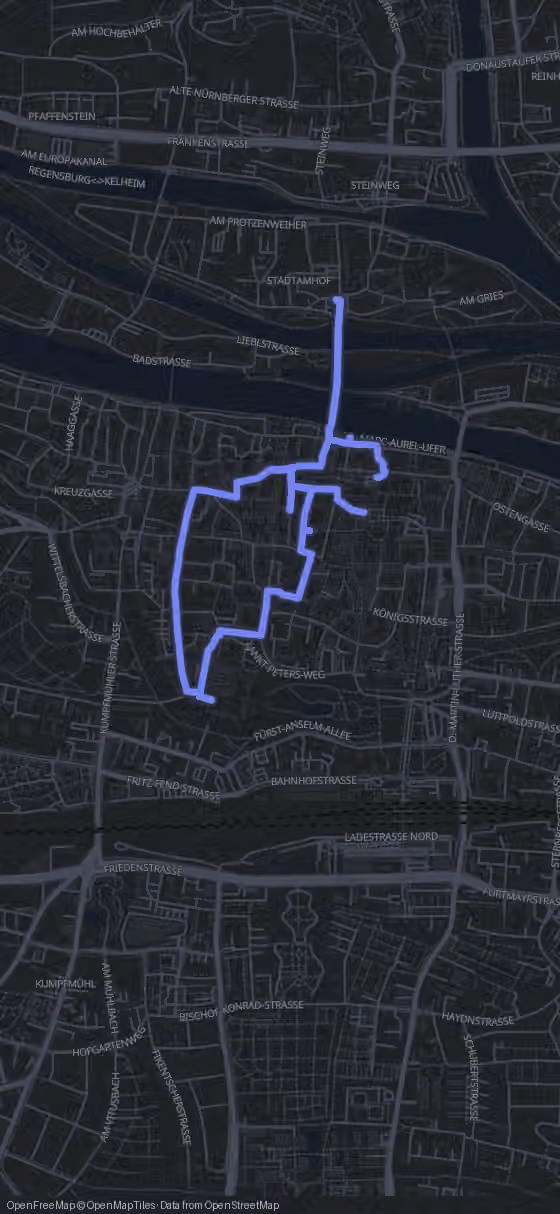
Route map for the Regensburg walking tour
Stop 1 of 10
240 m·3 min
Regensburger Dom St. Peter
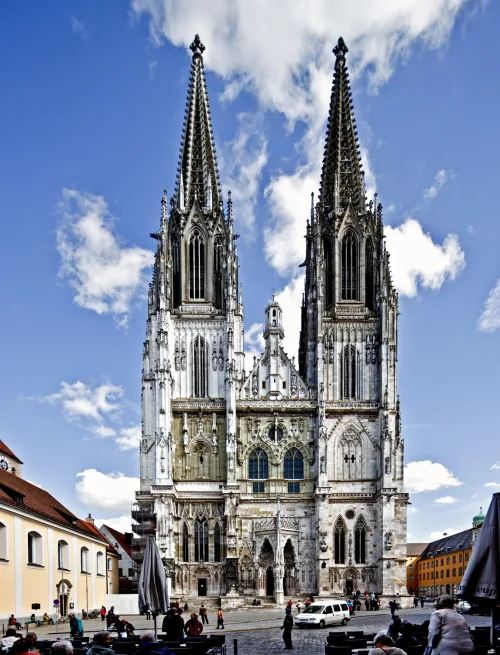
Head west toward the Altes Rathaus
Willkommen, welcome to Regensburg. I'm Alex, and the paving beneath our route hides the remains of a vanished community.
Try this tour with Alex

Regensburg on Foot: The Route at a Glance

Ten stops lead you from Regensburger Dom St. Peter through the Old Town squares, over the Danube to Stadtamhof and back to the Roman gate Porta Praetoria. The route is 3.8 km with 53 minutes of pure walking; plan about two and a half hours, or around five with the interior tours.

Most stops are free. The Altes Rathaus (guided tours only) and Schloss Thurn und Taxis charge admission. Route, map and GPS navigation are free in your browser; the AI Tour Guide is optional and tells the stories as you walk.

Open free GPS & optional AI Tour Guide
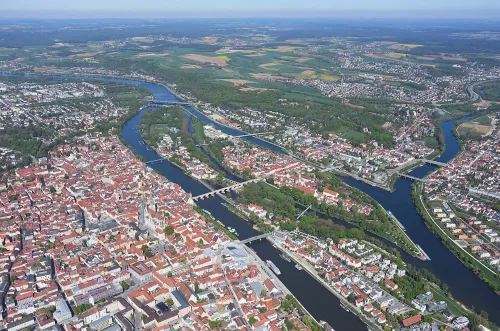
View of Regensburg

The Route

Walking Map of Regensburg: From the Cathedral to the Roman Gate

10 stops 3.8 km 53 min walking
Tap to load interactive map

The 10 stops along this route

  1. Regensburger Dom St. Peter, stop 1 on the self-guided walking tour
    1Regensburger Dom St. Peter
  2. Altes Rathaus in Regensburg, stop 2 on the self-guided walking tour
    2Altes Rathaus
  3. Neupfarrplatz in Regensburg, stop 3 on the self-guided walking tour
    3Neupfarrplatz
  4. Schloss Thurn und Taxis in Regensburg, stop 4 on the self-guided walking tour
    4Schloss Thurn und Taxis
  5. Haidplatz in Regensburg, stop 5 on the self-guided walking tour
    5Haidplatz
  6. Goldener Turm in Regensburg, stop 6 on the self-guided walking tour
    6Goldener Turm
  7. Stadtamhof in Regensburg, stop 7 on the self-guided walking tour
    7Stadtamhof
  8. Steinerne Brücke in Regensburg, stop 8 on the self-guided walking tour
    8Steinerne Brücke
  9. Historische Wurstkuchl in Regensburg, stop 9 on the self-guided walking tour
    9Historische Wurstkuchl
  10. Porta Praetoria in Regensburg, stop 10 on the self-guided walking tour
    10Porta Praetoria
  11. That's the full route.

    Walk it with an AI Tour Guide talking you through every one of these streets.

    Start free in your browser
    You made it

Your Regensburg Walking Tour, Square by Square and Over the Danube

  1. 1

    Regensburger Dom St. Peter

    Regensburger Dom St. Peter, stop 1 on the self-guided walking tour

    Your walk starts at the Regensburger Dom St. Peter, the seat of the Catholic Diocese of Regensburg and one of the key works of Gothic architecture in Bavaria. Stand in front of the west facade and look up: two towers rise above it, and buttresses and pinnacles carry the weight of the vaulting. The main west entrance in front of you was completed between 1385 and 1415.

    The story starts with an older church, Niedermünster, built around 700 a short way to the west. It held the tomb of Erhard of Regensburg but began as a chapel for the ducal family. When it burned down in 1273, Regensburg was wealthy enough to build something far bigger. From 1280 the works were led by an architect trained in France, which is why the cathedral looks French: a nave in three parts, buttresses, vaulting and twin towers over the facade. The three choirs were in use by 1320, and most of the building was finished around 1520.

    One of the builders, Mathes Roriczer, wrote down a method called ad quadratum: working out heights from the ground plan with a series of polygons. He used it to find the proportions of the pinnacles, so the spires you see are geometry on paper turned into stone.

    Going in is free, and even ten minutes inside are worth it. In the 17th century the cupola over the crossing and other parts were remodelled in Baroque style, and the frescoes of the All Saints' Chapel disappeared under plaster until the 19th century. Between 1828 and 1841 King Ludwig I of Bavaria had the cathedral returned to a Neo-Gothic look.

    From here it is 330 m, about 5 minutes, to the Altes Rathaus; on the way you pass the Document Neupfarrplatz, a small museum space.
    Hours
    Always open
    Price
    Free
  2. 2

    Altes Rathaus

    Altes Rathaus in Regensburg, stop 2 on the self-guided walking tour

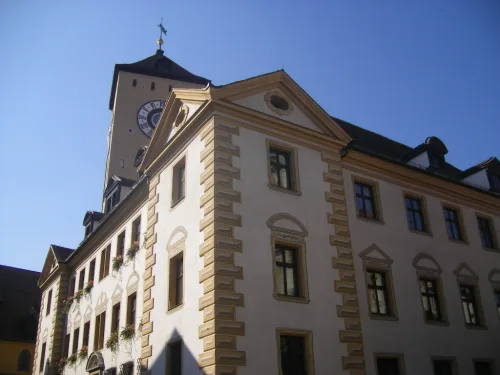
    The Altes Rathaus is really three buildings from different centuries. To the south stands the Reichssaal building with its oriel window, next to it the portal building with the gateway, and east of the passage the oldest part, built like a patrician house, with the town hall tower. The mayor still has his reception hall in that oldest wing, and the registry office is there too.

    The room that made this building famous is the Reichssaal on the upper floor, where the envoys of the Perpetual Imperial Diet once assembled. Two raised stone figures called Schutz and Trutz guard the way to that floor, where the rooms of the museum on the history of the Imperial Diets open off. Below ground you can see prison cells and a torture chamber.

    Is it worth going in? The interior can only be seen on a guided tour, which costs admission. If the politics of the old empire or the darker side of medieval justice interest you, yes. If you are short on time, the facades and the square cost nothing, and the tourist information sits on the ground floor of the Reichssaal building.

    Turn toward the Kohlenmarkt, the square to the east. Until 1706 a market tower stood there, the heart of a busy market that stretched north to the Fischmarkt on the Danube. After it burned down, Baroque extensions to the town hall went up, leaving a small square now called Zieroldsplatz with a copy of the monument to Don Juan de Austria. The Kohlenmarkt itself has a large fountain today.

    The next leg is short: 290 m, about 4 minutes, to the Neupfarrplatz.

    Hours
    Only by guided tour. Apr–Oct: daily 09:30–16:00 (tours every 30 min) | Nov–Mar: daily 10:00–15:30 (fewer tours)
    Price
    7.50 EUR (reduced 4 EUR, family 15 EUR)
  3. 3

    Neupfarrplatz

    Neupfarrplatz in Regensburg, stop 3 on the self-guided walking tour

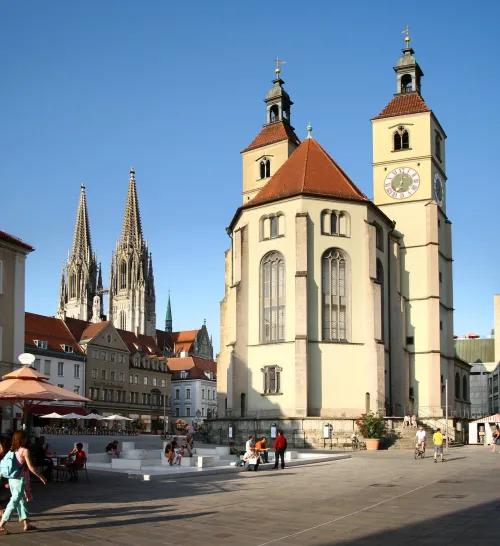
    The Neupfarrplatz is the big open square in the middle of the Old Town, a little south of the cathedral. It takes its name from the Protestant Neupfarrkirche that stands on it.

    This square exists because of an act of destruction. Jews had settled here around the year 1000. In 1519 they were expelled, and the citizens tore down all their houses and the synagogue, carried off the stones and used them as building material. The open space and the church that shapes it grew out of that expulsion, and it is worth pausing for a moment with that in mind.

    In the cramped Old Town the large square later became the place for gatherings and markets. The 20th century weighed heavily on it: bunkers, firefighting water reserves and toilets were built beneath it. Around 1970 many listed old buildings were demolished shortly before Bavaria's monument protection law came into force, and a department store, shops and banks rose around the edge, bringing traffic with them.

    Now look down at the paving. The line of the western wall of the Roman legionary camp Castra Regina is marked in it. The Wahlenstraße, which begins near the Altes Rathaus and ends here, follows the course of that wall, so you have been walking along the edge of a Roman camp. Residenzstraße and Gesandtenstraße also end on the square; the electric city bus uses them today.

    Next comes the longest leg of the route: 790 m, about 11 minutes, to Schloss Thurn und Taxis.

    Hours
    Always open
    Price
    Free
  4. 4

    Schloss Thurn und Taxis

    Schloss Thurn und Taxis in Regensburg, stop 4 on the self-guided walking tour

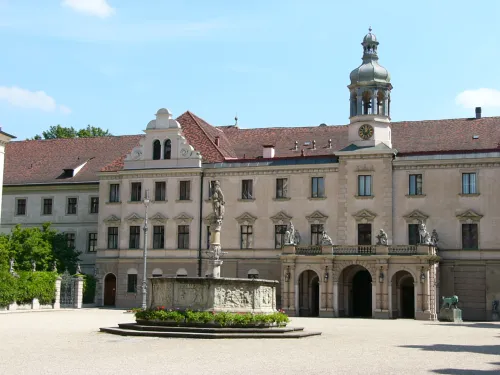
    Schloss Thurn und Taxis, also called Schloss St. Emmeram, is the palace of the princely house of Thurn und Taxis. What you see largely took shape in building work at the end of the 19th century, when new wings were added and the buildings of the former monastery of St. Emmeram were converted.

    The monastery itself was much older. It was founded in the 8th century, gained imperial immediacy in 1295, and from 1658 its prince-abbots had their own vote in the Perpetual Imperial Diet. With secularisation in 1803/1812 the monastery buildings passed to the Thurn und Taxis family, though a few monks stayed on after 1803.

    How did a postal family end up in a monastery? As hereditary postmasters general of the Holy Roman Empire they had sat in the council of imperial princes since 1704, and from 1741 until the empire ended in 1806 they served as principal commissioner, the emperor's representative at the Imperial Diet in Regensburg. Prince Alexander Ferdinand first rented the Freisinger Hof on Emmeramsplatz in 1743. After it burned in 1792, the family moved into the building at Emmeramsplatz 8, again as tenants of the prince-abbot. When the empire and the Diet ended in 1806, they very nearly left for Frankfurt am Main, where their postal business still had its headquarters.

    Going in costs admission, and the state rooms and the cloister can only be seen on a guided tour of about 90 minutes. It pays off if you enjoy princely interiors and monastery architecture; if not, the exterior and the story are enough, and you save a large block of time. Every year the palace also hosts the Thurn und Taxis Schlossfestspiele, where stars such as Elton John, Eros Ramazzotti and Anna Netrebko have performed.

    From the palace you walk 730 m, about 10 minutes, back into the Old Town to the Haidplatz.

    Local name
    Schloss St. Emmeram
    Hours
    Daily: 10:00–16:30
    Price
    17 EUR (reduced 14 EUR; children up to age 10 free with an adult). State rooms and cloister only by guided tour (approx. 90 min, daily 10:30, 12:30, 14:30, 16:30)
  5. 5

    Haidplatz

    Haidplatz in Regensburg, stop 5 on the self-guided walking tour

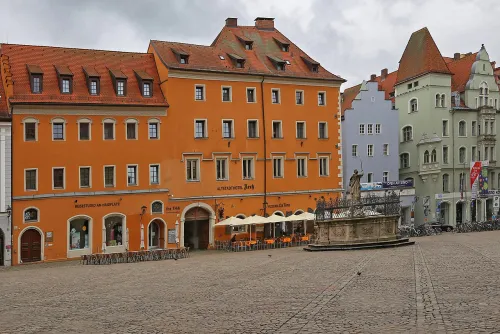
    The Haidplatz is one of the large squares of the Old Town, and its name is older than the square. It comes from the Old High German Heida, land overgrown with shrubs: the ground that lay outside the western wall of the Roman camp Castra Regina, in front of its west gate, the Porta principalis sinistra.

    After the Romans left the neighbouring camp, settlement spread over the area during the early Middle Ages. By the late Middle Ages large buildings framed the square, and it became the place for public events.

    The 20th century was less kind. As more people lived in the Old Town and car traffic grew, the Haidplatz turned into a popular car park. Only the traffic calming of the 1990s gave it back its value as a place where locals and visitors simply sit and spend time.

    The square is the centre of a whole chain of squares. From the Alter Kornmarkt in the east it runs through the Domplatz, Krauterer Markt, Kohlenmarkt, Watmarkt and Rathausplatz, and the short Neue Waag-Gasse links that chain to the Haidplatz. To the west the Ludwigsstraße continues to the Arnulfsplatz; until 1830 a gate stood at that link, the Ruozanburgtor, later rebuilt and known as the clock tower or Neue Uhr.

    The next stop is 340 m away, about 5 minutes: the Goldener Turm.

    Hours
    Open 24/7
    Price
    Free
  6. 6

    Goldener Turm

    Goldener Turm in Regensburg, stop 6 on the self-guided walking tour

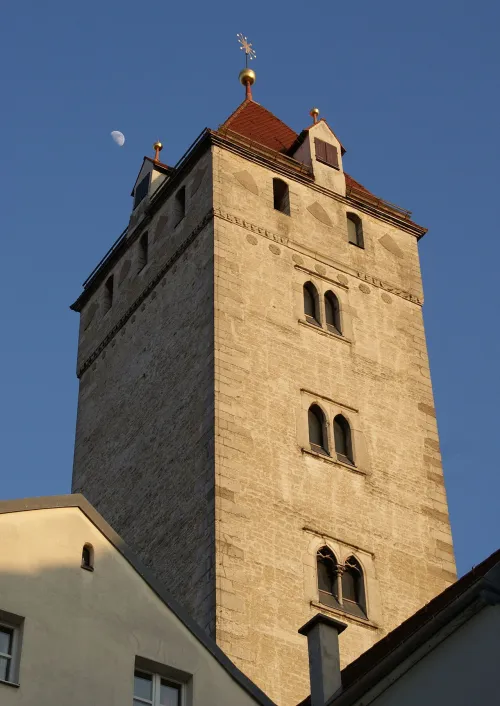
    The Goldener Turm at Wahlenstraße 14 is one of Regensburg's patrician towers, built in the Middle Ages by rich families as status symbols. Nine storeys and 50 metres high, it was the tallest house tower north of the Alps and became a landmark of the city alongside the cathedral and the Steinerne Brücke. It belonged to a four-winged town castle named after its owners, the Haymo or Waller house.

    You can read its growth in the walls. The lower four storeys date from around 1250, rubble masonry with dressed corner stones. After 1300 the upper floors with battlements were added, and the pyramid roof came around 1600. Only the east face toward the Wahlenstraße was the show facade, with its varied window shapes. In the 16th century it was painted with frescoes of Landsknecht soldiers and the city arms, just like the town hall; remains could still be traced in 1950.

    Don't miss the courtyard, which you can enter freely from the Wahlenstraße. Around 1600 it was framed on three sides by Renaissance arcades, later given Baroque loggias that were closed in the 19th century. The building itself is a student residence owned by the Studentenwerk and not open to visitors. Hidden at the top, under the pyramid roof, is a tower room made of painted wooden panels, conserved in 2019.

    For all its grandeur, the tower was only used to a limited extent as living space, in the 18th century. Its name comes from an inn that ran in the building in the 17th century.

    From here it is 670 m, about 9 minutes, to Stadtamhof on the north bank of the Danube. The bridge gets its proper moment on the way back.

    Hours
    Open 24/7
    Price
    Free (courtyard freely accessible from Wahlenstraße; interior is a student residence, not open to visitors)
  7. 7

    Stadtamhof

    Stadtamhof in Regensburg, stop 7 on the self-guided walking tour

    Stadtamhof was a town of its own for centuries: a ducal and later electoral Bavarian town on the north bank of the Danube. It only became part of Regensburg on 1 April 1924, and even then it remained the seat of its own district office until October 1929.

    Since 13 July 2006 it shares UNESCO World Heritage status with the Old Town, listed as the Old Town of Regensburg with Stadtamhof. With 0.66 km² it is the smallest of Regensburg's 18 districts, and fewer visitors make it across than to the squares you have just seen.

    Where the bridge lands is the St. Katharinenplatz by the Katharinenspital. Until 1809 the Schwarzer Turm stood here, the northern tower of the city's fortifications, destroyed during the Battle of Regensburg. From here the broad main street, sometimes used as a market, runs 200 m north and ends at a gate of pylons on the street Am Protzenweiher.

    That street name recalls the old flood channel of the Danube. Since 1978 the Europakanal, part of the Main-Danube Canal project, has run in that channel, which is why larger boats no longer need to pass the old bridge. The district is free and open at all hours, so take your time on the main street.

    Then walk 300 m, about 4 minutes, back to the Steinerne Brücke.

    Hours
    Always open (public historic district, part of the UNESCO World Heritage site, accessible 24/7)
    Price
    Free
  8. 8

    Steinerne Brücke

    Steinerne Brücke in Regensburg, stop 8 on the self-guided walking tour

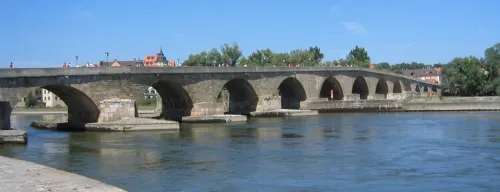
    The Steinerne Brücke, the Stone Bridge, crosses both arms of the Danube and links the Old Town with Stadtamhof. For more than 800 years, until the 1930s, it was the city's only bridge over the river, and it remains an emblem of Regensburg and a masterpiece of medieval building. Remarkably, it went up in only eleven years, probably between 1135 and 1146.

    Before it, Charlemagne had a wooden bridge built about 100 metres east of today's crossing, but it could not cope with the traffic and was vulnerable to floods. The stone bridge solved that, and soon after its completion Louis VII of France and his army used it to cross the Danube on their way to the Second Crusade.

    For shipping, though, the bridge was a problem, as Napoleon noted in 1809. Its arches create strong currents, so underpowered boats heading upstream had to be towed past. From 1916 an electric system drew ships under the bridge; it was removed in 1964. As early as 1904 someone even proposed tearing the bridge down. Today only excursion and leisure boats pass beneath it, and since its renovation in 2010 only pedestrians and cyclists may use it. From the bridge you can also get down to the island of Oberer Wöhrd.

    At the Old Town end, look at the buildings set against the bridge: the Amberg salt store from the early 16th century and the Regensburg salt store from the early 17th century. The south end may once have been the site of an ancient city gate.

    Your next stop is just 170 m, about 2 minutes, away: the Historische Wurstkuchl.

    Hours
    Open 24/7
    Price
    Free
  9. 9

    Historische Wurstkuchl

    Historische Wurstkuchl in Regensburg, stop 9 on the self-guided walking tour

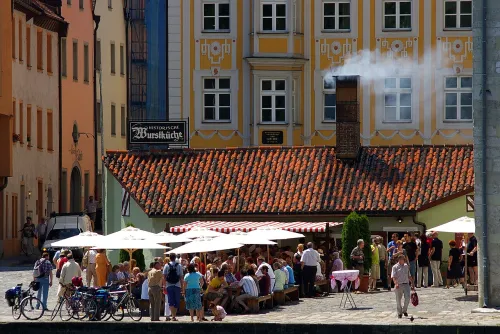
    Right beside the bridge, the Historische Wurstkuchl is considered the oldest sausage kitchen in the world. While the Steinerne Brücke was being built, a building is said to have stood here that may have served as site office and canteen for the workers. Two documents from 1378 mention a cook called Konrad at the Stone Bridge, Chunrat der Choch vor prukk.

    The old cookshop was torn down in 1616 to make room for the salt store, but a new one soon followed on the same spot, using the city wall as its back wall; it appears on a city view from 1626. A new building went up in 1651, and the owners are known by name from then on, ending with the Schricker family, who ran it until 1990.

    When the salt store was renovated in 1986, builders found the kitchen's old waste pit, full of bones from cattle, pigs, goats, sheep, hares and poultry. Meat has been cooked on this spot for more than 850 years. The specialisation in bratwurst came in the 19th century; around 1900 smoked meat with sauerkraut was still on offer too.

    Today the sausages come from the house butchery, and the mustard and sauerkraut are made in-house as well. The classic order is small bratwursts on sauerkraut with sweet homemade mustard, with a Kipferl roll from the traditional Regensburg bakery Schwarzer. If you want one meal on this route, this is the natural place for it.

    From the Wurstkuchl it is 200 m, about 3 minutes, to the final stop, the Porta Praetoria.

    Hours
    Daily: 10:00–19:00
  10. 10

    Porta Praetoria

    Porta Praetoria in Regensburg, stop 10 on the self-guided walking tour

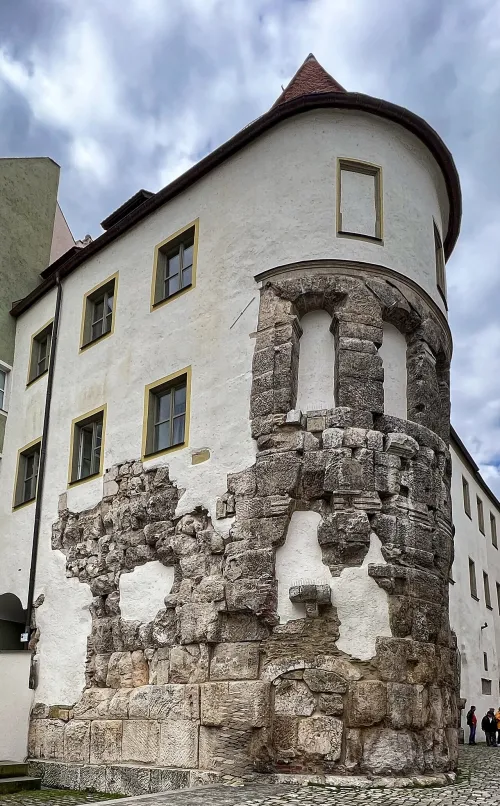
    You finish where Regensburg began. The Porta Praetoria is the visible remains of the north gate of Castra Regina, the Roman legionary camp built in the 2nd century. For a long time nobody could see it: after 1650 the gate was absorbed into the walls of a brewery building east of the Bischofshof. Only in 1885, when the brewery was demolished, were the substantial remains rediscovered and uncovered.

    The camp was founded under Emperor Marcus Aurelius on the south bank of the Danube, a little west of where the Regen flows in, which gave it its name: camp by the river Regen. It was a response to the Marcomannic Wars, which required the Third Italian Legion to be stationed here, and it was completed in 179. The city of Regensburg grew out of this camp during the Middle Ages.

    Like most legionary camps of its size, Castra Regina had four gates. The Porta Praetoria was the main gate, normally facing the enemy; here it faced north toward the Danube, which is why a document from 932 already calls it Porta Aquarum, the water gate. Together with the larger Porta Nigra in Trier and two gates in Autun, it is one of the few Roman gates surviving north of the Alps.

    The soldiers took pride in such gates. A building inscription from a fort in North Africa, dated 222, puts it this way: as the gem is set in gold, so the gate adorns the camp. Think back to the wall line in the paving of the Neupfarrplatz and the name of the Haidplatz, and you can trace the camp's outline through the whole walk.

    The route ends here. If you want to return to the cathedral, the GPS navigation in your browser can lead you back to the start.

    Hours
    Open 24/7
    Price
    Free
Walking tour route map of Regensburg Route loaded
Regensburger Dom St. PeterAltes RathausNeupfarrplatzSchloss Thurn und Taxis+6
All 10 stops are already on the map.
You just press start.
AI Tour Guide

You know the route now. Walk it with a guide in your ear.

Press start wherever you are, even hundreds of kilometres from Regensburg, and the guide begins telling its stories right away. In the city, pick any of the 10 stops to start from: it leads you there, then talks with you the whole route, asking, listening, remembering, and shaping the tour around your answers.

10stops 3.8km 53 minwalking 13languages
▶Start the tour free

Free to start · Runs in your browser · No app, no download

Shorter Ways Through Regensburg

Not every day has room for the full route. These two shorter versions follow the route order, and you can pick up the rest another time.

Danube and Romans

Stops: 6, 7, 8, 9, 10

For anyone with an hour to spare or arriving late in the day. From the Goldener Turm over the river to Stadtamhof, back across the Steinerne Brücke, past the Historische Wurstkuchl to the Porta Praetoria: 1,340 m and 18 minutes of walking. No admission anywhere; you only pay if you stop for sausages.

Cathedral, Town Hall and Palace

Stops: 1, 2, 3, 4

For those who want to go inside. From the Regensburger Dom St. Peter via the Altes Rathaus and the Neupfarrplatz to Schloss Thurn und Taxis: 1,410 m and 20 minutes of walking. The cathedral is free; the Altes Rathaus and the palace each cost admission and are visited on guided tours, so plan for half a day.

The full route with both tours

Stops: 1, 2, 3, 4, 5, 6, 7, 8, 9, 10

For a full Regensburg day. All ten stops with 53 minutes of walking, the Altes Rathaus and palace tours and a sausage lunch at the Historische Wurstkuchl. Start in the morning to fit in both guided tours.

How Long Does This Regensburg Tour Take, With and Without Interiors?

The walking adds up to 53 minutes over 3.8 km. The two longest legs come in the middle: 790 m and 11 minutes from the Neupfarrplatz out to Schloss Thurn und Taxis, then 730 m and 10 minutes back into the Old Town to the Haidplatz. Along the river the stops are short hops of a few minutes each.

If you look at every stop from outside, step into the cathedral and the courtyard of the Goldener Turm, you need about two and a half hours. Add the guided tour of the palace, which takes about 90 minutes, the Altes Rathaus tour and a sausage lunch, and you are at around five hours.

The Danube and Romans version takes about an hour, a little longer with a meal. The cathedral, town hall and palace version needs half a day because of the two guided tours.

Before You Set Off in Regensburg

  • Start: The recommended start is the Regensburger Dom St. Peter. You can join at any stop; the order here is simply the one that flows best.
  • Finish: The route ends at the Porta Praetoria. If you want to get back to the cathedral, the GPS navigation in your browser can lead you there.
  • Time of day: If you plan to go inside the Altes Rathaus and Schloss Thurn und Taxis, start in the morning: both are visited on guided tours at set times, so check them before you leave.
  • Admission: The Altes Rathaus and Schloss Thurn und Taxis charge admission. The cathedral, the squares, the courtyard of the Goldener Turm, Stadtamhof, the bridge and the Roman gate are free; at the Historische Wurstkuchl you pay for what you eat.
Walking tour route map of Regensburg
AI Tour Guide

Your guide is ready when you reach the cathedral.

Press start and a voice AI Tour Guide takes it from here: leading the route through Regensburg, telling the stories, and turning your walk into a real back-and-forth conversation. No app or download is needed; it runs in your browser.

10stops 3.8km 53 minwalking 13languages
▶Start the tour free

Free to start · Runs in your browser · No app, no download

What the AI Tour Guide Adds on This Route

The AI Tour Guide walks this route with you as a conversation. It greets you at the cathedral, tells the stories of each place, asks what you want to hear more of and remembers it, so by the Steinerne Brücke the talk is about your interests. You can interrupt at any time, for example to ask what daily life looked like for the soldiers of the Roman legion, or what the envoys at the Imperial Diet actually argued about. You start with 100 free credits; after that you choose between this tour all-inclusive for €19.99 with no time limit, or credits at €5 per hour.

A Real Conversation A voice AI Tour Guide greets you, leads the whole route, and tells the stories and facts as you walk, asking what you want to see and keeping a real conversation going. Not a recording you press play on.
Map Navigation Follow the route on the map and walk at your own pace. You choose where to start and when to move to the next stop.
Ask Anything Curious about a building you pass? Ask your AI Tour Guide on the spot and the conversation carries on.
13 Languages Switch language anytime. No separate tour needed.
Start free in your browser

Common Questions Before Walking Regensburg

If I only have time for one interior, which should it be?

Choose the Altes Rathaus if the old empire, its envoys and the prison cells below ground interest you. Choose Schloss Thurn und Taxis if you prefer princely rooms and a monastery cloister, and have about 90 minutes for the guided tour.

Can I walk the route in the evening?

Yes, for most of it. The cathedral from outside, the squares, Stadtamhof, the bridge and the Porta Praetoria are open around the clock. Only the interiors of the Altes Rathaus and the palace and the Historische Wurstkuchl keep fixed hours.

Is the route good for children?

The torture chamber in the Altes Rathaus, the Roman gate and a sausage by the river tend to work well with children. At Schloss Thurn und Taxis children up to age 10 go free with an adult.

Which towns combine well with a day in Regensburg?

Landshut is 54 km away and Nuremberg 88 km. For another Danube town, Passau lies 112 km downstream.

Is the tour really free?

Yes. The whole tour is free: the route, the interactive map and the navigation cost you nothing. Only the voice AI Tour Guide is optional and paid: you test it with 100 free credits, then you pay either €5 per hour or €19.99 for this whole tour, with no time limit.

Do I need to download an app?

No. Everything runs in your phone browser. Open the route and start walking, no download and no sign-up required.

Do I need to book the walking tour in advance?

No booking needed. This self-guided tour is available anytime. Open the route in your browser and start walking. The AI Tour Guide works instantly, no app, no reservation required.

What languages is the AI Tour Guide available in?

The AI Tour Guide speaks 13 languages, so you take the tour in your own language and can switch at any time.

Can I skip stops or change the route?

Yes. Skip any stop, spend extra time at places you like, or start the route from any point. It is your walk, you set the pace.
Image credits
▶ Start free in your browser Runs in your browser, no app, no download