Free Walking Tour Parma: Farnese Park to Correggio's Dome

From the Farnese dukes' park to Correggio's painted dome and Antelami's pink marble Baptistery: one compact walk through Parma's opera, cheese and art.

8 Stops 2.9 km ~40 min walking
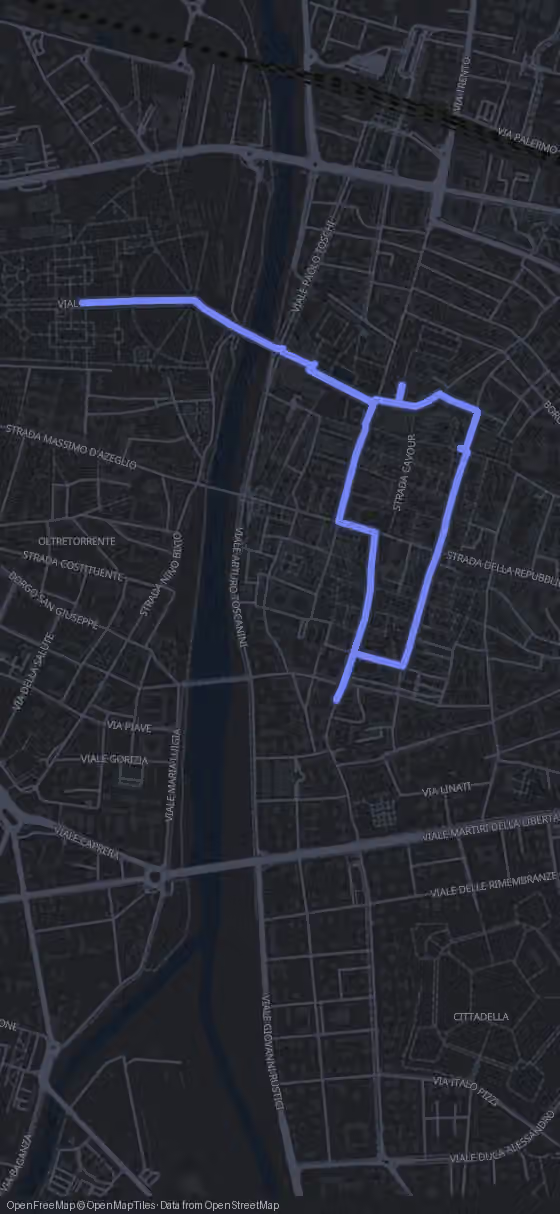
Route map for the Parma walking tour
Stop 1 of 8
860 m·11 min
Parco Ducale
Head south-east toward the Teatro Regio di Parma
Ciao, welcome to Parma. I'm Alex, and this city's opera tradition takes every note personally.
Try this tour with Alex

This Parma Walk at a Glance

Eight stops lead from Parco Ducale to Palazzo della Pilotta: 2.9 km and 40 minutes of pure walking, about three and a half hours with the interiors worth paying for. Parma Cathedral and the open-air stops are free; the Teatro Regio di Parma, the Baptistery of Parma and the Pilotta charge entry, and the Camera di San Paolo is currently closed.

Route, map and GPS navigation in your browser are free and lead you from stop to stop. The AI Tour Guide is optional and tells the stories as a conversation.

Open free GPS & optional AI Tour Guide
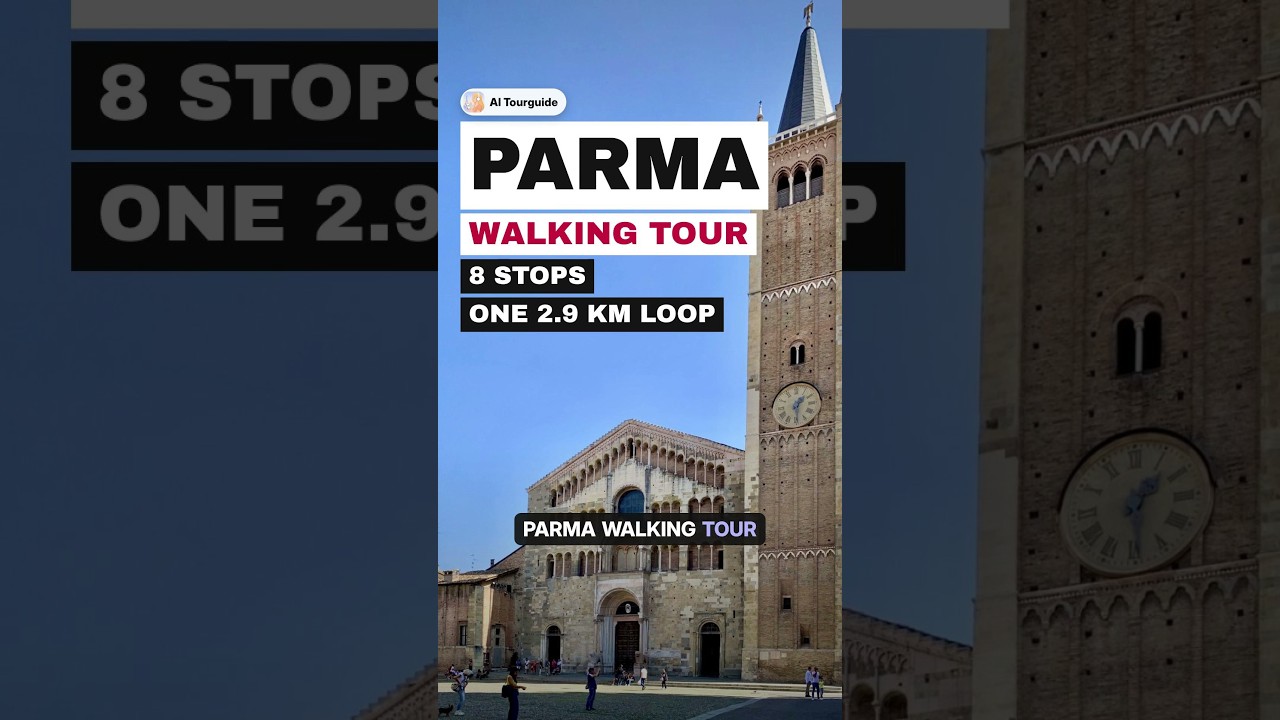
This short shows highlights of the route. All 8 stops follow below.

The Route

Walking Map of Parma: From the Park to the Pilotta

8 stops 2.9 km 40 min walking
Tap to load interactive map

The 8 stops along this route

  1. Parco Ducale in Parma, stop 1 on the self-guided walking tour
    1Parco Ducale
  2. Teatro Regio di Parma, stop 2 on the self-guided walking tour
    2Teatro Regio di Parma
  3. Piazza Garibaldi in Parma, stop 3 on the self-guided walking tour
    3Piazza Garibaldi
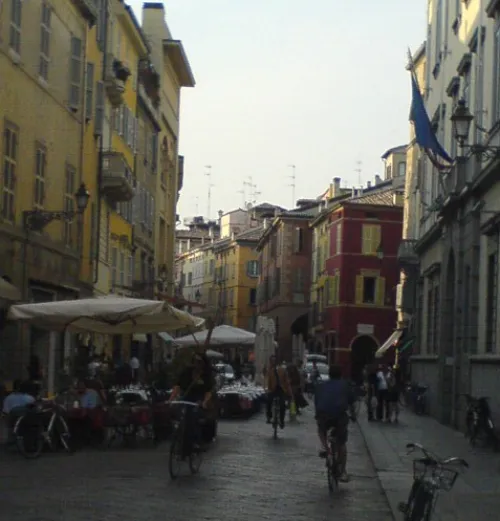
  4. Strada Farini in Parma, stop 4 on the self-guided walking tour
    4Strada Farini
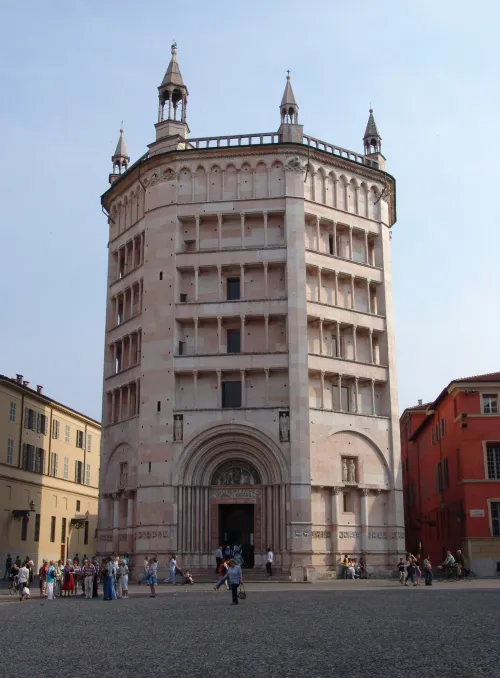
  5. Baptistery of Parma, stop 5 on the self-guided walking tour
    5Baptistery of Parma
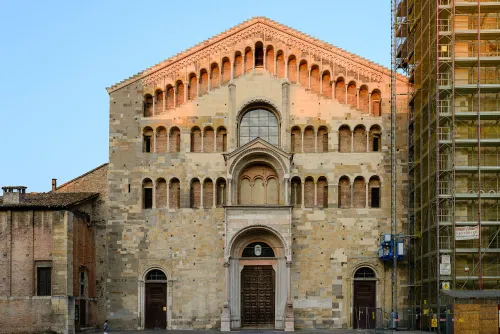
  6. Parma Cathedral, stop 6 on the self-guided walking tour
    6Parma Cathedral
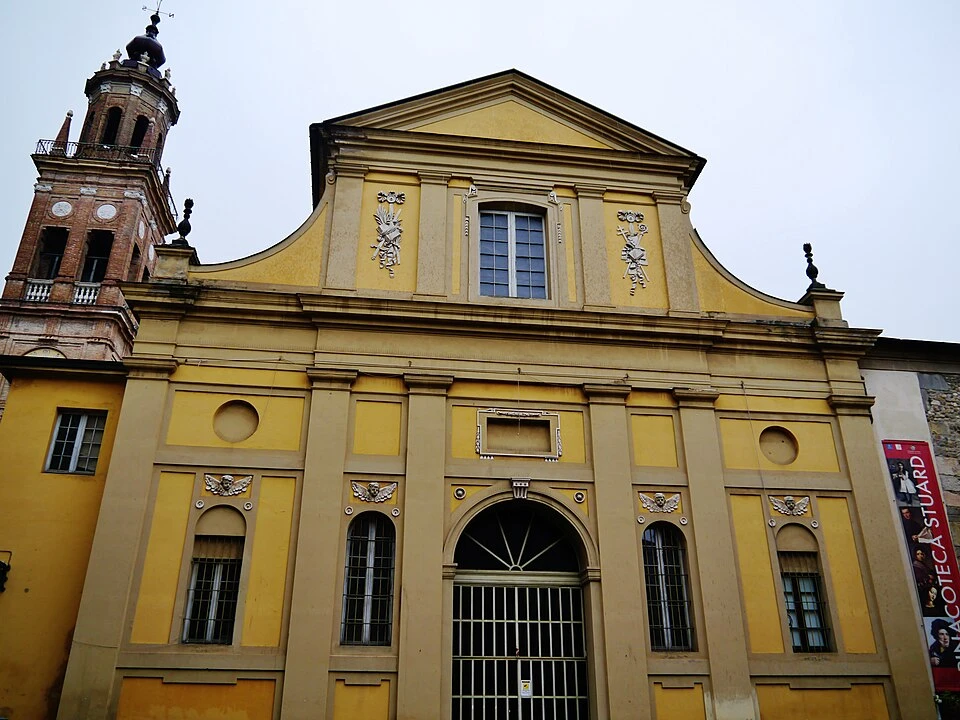
  7. Camera di San Paolo in Parma, stop 7 on the self-guided walking tour
    7Camera di San Paolo
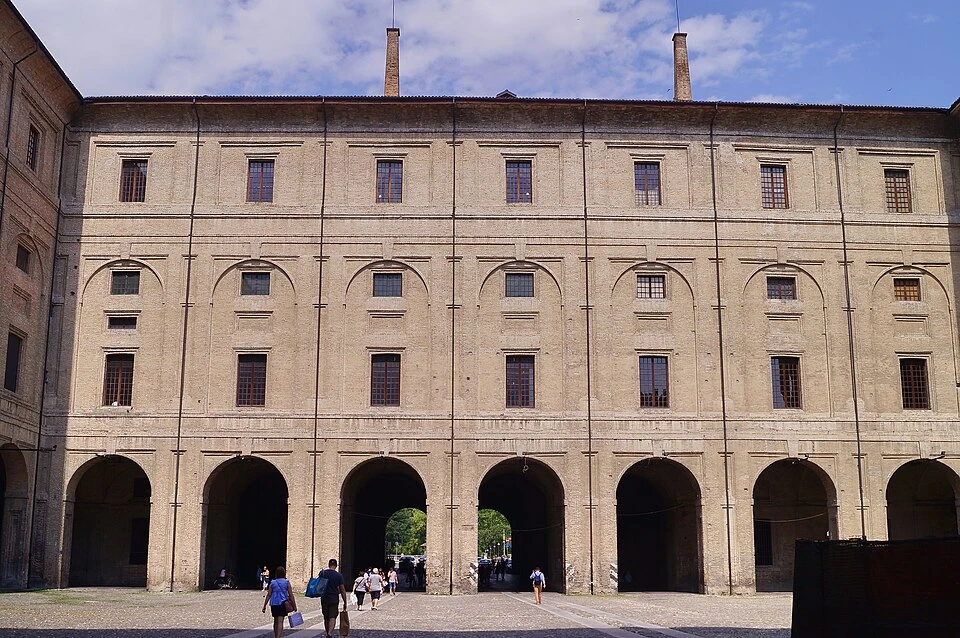
  8. Palazzo della Pilotta in Parma, stop 8 on the self-guided walking tour
    8Palazzo della Pilotta
  9. That's the full route.

    Walk it with an AI Tour Guide talking you through every one of these streets.

    Start free in your browser
    You made it

The Parma Walking Tour Stop by Stop, from Opera to Correggio

  1. 1

    Parco Ducale

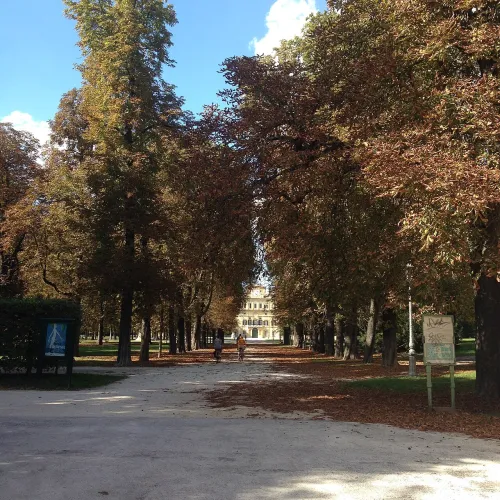
    Parco Ducale in Parma, stop 1 on the self-guided walking tour

    Begin where the Farnese dukes came to enjoy themselves. Parco Ducale, known to locals simply as “il giardino”, covers 208,700 square metres in the Oltretorrente district, close to the Parma stream. It costs nothing to walk in, and it makes a calm, green warm-up before the stone, opera and frescoes of the centre.

    Duke Ottavio Farnese was the first to imagine a park here, in 1561. He built a new villa where the 14th century Castello della Ghiara of Bernabò Visconti had stood, bought up the surrounding land and pulled down the buildings on it, sparing only the Renaissance Palazzetto Eucherio Sanvitale. The first garden followed a central avenue lined up with the façade of the new Palazzo del Giardino, designed by Vignola, with symmetrical flowerbeds and fountains on either side. Soon came hedges of rosemary and myrtle, oaks, plane trees, fruit trees and even vegetables, plus potted citrus trees that spent the winter months in heated shelters.

    More than a century later the park became a stage. For the 1690 wedding of his son Odoardo II Farnese to Dorotea Sofia of Neuburg, Duke Ranuccio II had Domenico Valmagini create a large oval fish pond with a small island in the middle, at the end of the main avenue. The point was spectacle: mock naval battles, the naumachie, staged on the water for the court. Between 1710 and 1731 the dukes went further, with shows in the park in which lions, tigers and other wild animals were made to fight.

    The fun ended with the family. When the Farnese line died out in 1731, the park slid into decline, and in 1745, during the War of the Austrian Succession, the troops of Prince Lobkowicz cut down every old tree, even those on the island in the pond, and burned them to feed their fires.

    From here it is 870 m, about 12 minutes, to the Teatro Regio di Parma. On the way you pass the National Gallery of Parma, the Teatro Farnese, the Bodoni Museum and the Museo Glauco Lombardi.
    Hours
    Daily 06:00–24:00 (Apr–Oct), daily 07:00–20:00 (Nov–Mar)
    Price
    Free
  2. 2

    Teatro Regio di Parma

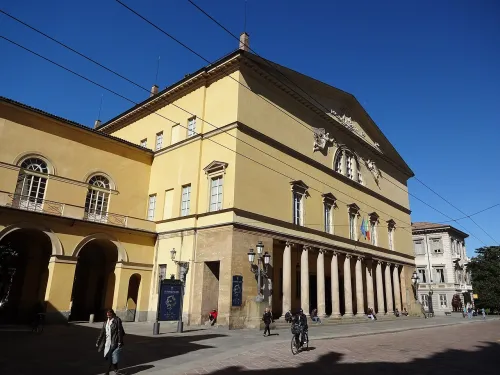
    Teatro Regio di Parma, stop 2 on the self-guided walking tour

    Parma takes its opera personally, and this is where it does so. The Teatro Regio di Parma was built as the Nuovo Teatro Ducale, the New Ducal Theatre, replacing a “small and narrow” ducal theatre from 1688 inside the Palazzo di Riserva. It opened on 16 May 1829 with the premiere of Vincenzo Bellini's Zaira.

    That opening night has a story. The house first asked Rossini to write the inaugural work, but he was too busy, so the task fell to Bellini. Zaira was staged seven more times and still never won over the Parma public. Rossini got his season anyway: three of his operas played in that first year, Moïse et Pharaon, Semiramide and Il barbiere di Siviglia.

    The new house rose to prominence after 1829, above all once Giuseppe Verdi, born near Busseto some thirty kilometres away, had become famous. The conductor Arturo Toscanini was born in Parma in 1867. Less known abroad than La Scala or La Fenice, the Regio is counted by opera lovers among the true homes of the Italian tradition, and its well-informed audience is famous for letting singers know exactly what it thinks, and not only from the gallery.

    Inside, the auditorium seats 1,400, with four tiers of boxes topped by a gallery. Visits cost entry. If opera means something to you, go in; if not, the exterior and the story are enough, and you save your time for the Baptistery. Piazza Garibaldi is only 240 m away, about 3 minutes on foot.

    Hours
    Tue–Sat 09:30–12:30, 14:30–17:00, Sun–Mon closed
    Price
    12 EUR full, 8 EUR reduced (under 30, over 65), 3 EUR under 18, free under 6
  3. 3

    Piazza Garibaldi

    Piazza Garibaldi in Parma, stop 3 on the self-guided walking tour

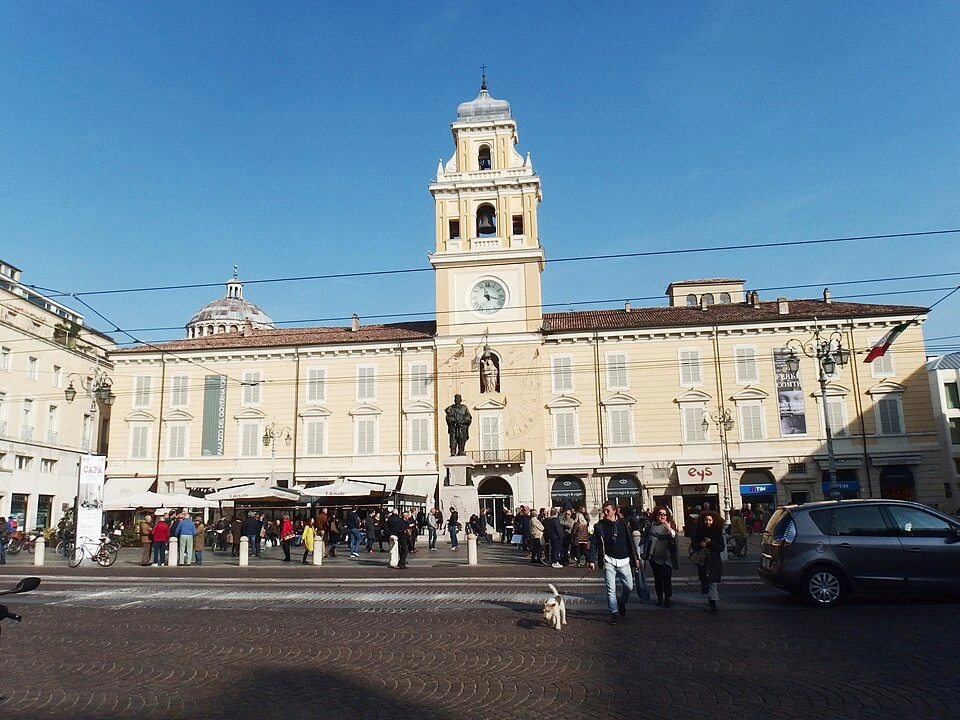
    Three minutes on and you are in the room where Parma does its living. Piazza Garibaldi is the city's main square, free to all, and the stage for everything civic: at New Year the city counts down here, and in December the Christmas market of Natale a Parma moves in with stalls and lights.

    In the early evening the aperitivo tables fill up, which tells you how to use this square: as a pause, not a sight to tick off. On this walk it is the natural coffee stop, so take it.

    From here the route tightens. Strada Farini is 400 m away, about 6 minutes, and after that the sacred core of the city is waiting.

    Hours
    24/7
    Price
    Free
  4. 4

    Strada Farini

    Strada Farini in Parma, stop 4 on the self-guided walking tour

    Strada Farini is a pedestrian street south of Piazza Garibaldi, made for walking slowly. This is the shopping stretch of the route, and above all the cheese stretch: the formaggerie here sell Parmigiano Reggiano the way other streets sell shoes. If you want to take a piece home, this is the place to buy it, and Saturday morning is when the street is at its liveliest.

    Two honest warnings. In August this street is a shadow of itself: the trattorias and delis around here close for their ferie, for anything up to four weeks around Ferragosto, so a food stop planned for August can easily end at a shut door. And in October and early November, look south on a clear day: from this part of the city the Apennine hills show their autumn colours, a quiet reminder of how close the mountains are.

    From here it is 750 m, about 10 minutes, to the Baptistery of Parma. You arrive on Piazza Duomo, where Baptistery and Cathedral stand side by side.

    Hours
    24/7
    Price
    Free
  5. 5

    Baptistery of Parma

    Baptistery of Parma, stop 5 on the self-guided walking tour

    Before you buy a ticket, walk once around the outside. The Baptistery of Parma is an octagon of pink Verona marble with four tiers of open loggias and eight turrets on top; in May 2022 the tallest of them was scanned in 3D from the air to support conservation work. Architecturally it marks the shift from Romanesque to Gothic, and it is counted among the most important medieval monuments in Europe.

    The city council commissioned Benedetto Antelami to build it in 1196, and the people of Parma took the project to heart quite literally: men set stones into the foundations in memory of their families. Look at the lowest band of the walls, ringed with reliefs of animals and fabulous beasts: sea monsters, centaurs, mermaids and unicorns.

    Then read the three portals. The Portal of the Virgin faces north onto the cathedral square and is named for the Virgin and Child in its lunette; its door shows the Adoration of the Magi and an angel telling Joseph to flee to Egypt, and the bishop used it for his solemn entrance. The Portal of Judgment, facing west, shows the Redeemer enthroned. The Door of Life, facing south, has an unexpected scene in its lunette: a man eating honey up a tree.

    Inside is the reason to pay the entry. The domed ceiling is divided into six concentric bands of frescoes, with a red circle at the centre for the upper heaven and sixteen rays coming down from the keystone, one for each of the sixteen arches around the walls. Each arch frames a painted scene from the 13th and 14th centuries, many of them ex votos. In the middle stands the large octagonal basin of Verona marble, made for baptism by immersion; a font in the south-western niche has served for baptism by pouring since the 14th century. If you pay for one interior on this walk, make it this one. The Cathedral is 40 m away, a one-minute walk.

    Local name
    Battistero di Parma
    Hours
    Daily 10:00–18:00
    Price
    12 EUR full, 10 EUR reduced (students, over 65, teachers), free under 13
  6. 6

    Parma Cathedral

    Parma Cathedral, stop 6 on the self-guided walking tour

    Parma Cathedral is free to enter, which makes it the easiest yes of the day. Start with the wide sandstone façade, completed in 1178, with three floors of loggias and three portals whose doors Luchino Bianchino carved in 1494. The two great marble lions supporting the columns of the portal arch date from 1281, the work of Giambono da Bissone. Between the central and the right doors lies the tomb of the mathematician Biagio Pelacani, who died in 1416.

    Look up at the Gothic bell tower, built between 1284 and 1294 and topped by a gilt copper angel. A twin tower was planned for the left side, but it was never begun.

    The church is older than it looks. A basilica probably existed in the 6th century; after a fire destroyed the early Christian basilica in August 1058, Bishop Cadalo broke ground for a new cathedral on a different site, consecrated by Pope Paschal II in 1106. An earthquake in 1117 damaged it badly, and what survives of that original building is in the presbytery, the transept, the choir, the apses and some sculpture fragments.

    Inside, the plan is a Latin cross with a nave and two aisles, and the presbytery and transept are raised to make room for the crypt underneath. Take time over the capitals, carved with leaves, mythological figures, war scenes and Bible stories, and over the frescoes along the nave and apse by Lattanzio Gambara and Bernardino Gatti. Then look up into the dome: Antonio da Correggio's illusionistic fresco there became hugely influential.

    Keep Correggio in mind. The Camera di San Paolo, 300 m and about 4 minutes away, is where his Parma story began.

    Local name
    Duomo di Parma
    Hours
    Daily 07:45–19:20
    Price
    Free
  7. 7

    Camera di San Paolo

    Camera di San Paolo in Parma, stop 7 on the self-guided walking tour

    The Camera di San Paolo is currently closed, so this is a stop for the story. Inside the former Monastery of San Paolo is a single room whose vault and fireplace Correggio painted, and it is where his rise began.

    In the early 16th century the Benedictine convent of San Paolo was one of the wealthiest and most influential religious houses in Parma. Its abbess, Giovanna Piacenza, set about improving and decorating it. In 1514 Alessandro Araldi painted the vault of her private apartment with biblical and mythological subjects. A few years later she ordered a similar but more up-to-date scheme for the room next door and gave it to Correggio, who had moved to Parma around 1519. Nobody knows how the two came into contact.

    Correggio finished in 1520. The work echoes Raphael's rooms in the Vatican Palace and shows affinities with Leonardo da Vinci, though no trip to Rome or Milan by the painter is documented. It made him one of the most celebrated painters in Italy and led on to the domes of Parma Cathedral and San Giovanni Evangelista. It also shaped local artists such as Parmigianino, notably in his work in the Rocca of Fontanellato.

    Then the room vanished from view. In 1524 the convent was placed under enclosure, with no male visitors allowed, and for some two centuries nobody outside knew the frescoes existed. Only in 1774 did the painter and art historian Anton Raphael Mengs study them, and from then on the room was known as an important example of late Renaissance painting. The Palazzo della Pilotta is 280 m on, about 4 minutes.

    Status
    Currently closed
  8. 8

    Palazzo della Pilotta

    Palazzo della Pilotta in Parma, stop 8 on the self-guided walking tour

    The walk ends at the Palazzo della Pilotta, a sprawling complex between the Piazzale della Pace and the Lungoparma. Its odd name comes from pelota, the ball game once played here by Spanish soldiers stationed in Parma. Begun around 1583, in the last years of Duke Ottavio Farnese, it grew around a corridor linking the Rocchetta keep, whose traces you can still see next to the river Parma, to the Ducal Palace. That palace, started in 1622 under Duke Ranuccio I, was never completed; the façade on Piazza della Ghiaia is missing.

    The complex has three courtyards: the Cortile della Pilotta, the Cortile del Guazzatoio, originally named after the pelota game, and the Cortile della Racchetta. It was built to hold stables, grooms' quarters, an academy hall and a great hall that became the Teatro Farnese. That theatre, built in 1618, was used only nine times, the last in October 1732; it then fell into neglect, was damaged by American bombing in the Second World War and rebuilt in 1966.

    Elizabeth Farnese, Queen of Spain, was born here in 1692. When Farnese rule ended, Duke Charles I, later King of Spain, had much of the palace's movable treasure taken to Naples in the 1730s. The Biblioteca Palatina was established here by 1769. On the site of the old church of San Pietro Martire the Reinach Theatre opened in 1871; renamed Teatro Paganini in 1939, it was almost completely destroyed, together with parts of the palace, in an air raid in May 1944.

    The Piazzale della Pace took its present form between 1986 and 2001, designed by the Swiss architect Mario Botta: a large garden and a fountain that follows the outline of the vanished church of San Pietro. The museums of the complex charge entry; give them at least an hour if you go in. When you are done, the GPS navigation in your browser can lead you back to Parco Ducale.

    Hours
    Tue–Sun 09:00–19:00, Mon closed
    Price
    18 EUR full, 14 EUR group reduced (10-30 adults), 2 EUR reduced (EU citizens 18-24), free under 18
Walking tour route map of Parma Route loaded
Parco DucaleTeatro Regio di ParmaPiazza GaribaldiStrada Farini+4
All 8 stops are already on the map.
You just press start.
AI Tour Guide

You've read the route. Now walk Parma with a guide in your ear.

Press start wherever you are, even hundreds of kilometres from Parma, and the guide begins telling its stories right away. In the city, pick any of the 8 stops to start from: it leads you there, then talks with you the whole route, asking, listening, remembering, and shaping the tour around your answers.

8stops 2.9km 40 minwalking 13languages
▶Start the tour free

Free to start · Runs in your browser · No app, no download

Shorter Ways to Walk Parma

Short on time or keeping to a budget? These cuts keep the walk coherent.

The sacred core and the Farnese palace

Stops: 5, 6, 7, 8

For art lovers with limited time: Antelami's Baptistery, Correggio's Cathedral, the story of the Camera di San Paolo and the Pilotta. About 9 minutes of walking in total. The Baptistery and the Pilotta charge entry; the Cathedral is free.

Park, opera and cheese

Stops: 1, 2, 3, 4

A relaxed morning for food lovers: the ducal park, the opera house, a coffee on Piazza Garibaldi and the cheese shops of Strada Farini. About 21 minutes of walking. Only the Teatro Regio costs entry, and only if you go inside.

The whole route from the outside

Stops: 1, 2, 3, 4, 5, 6, 7, 8

For a tight budget: all eight stops, 40 minutes of walking, no tickets at all. You still get Parma Cathedral's interior with the Correggio dome, since it is free.

How Long Does This Parma Tour Take with the Interiors?

The 2.9 km take 40 minutes of pure walking, and the stages are short: the longest is the 870 m from the park to the opera house, and from Piazza Garibaldi onwards nothing is more than 10 minutes apart. Realistically, plan about three and a half hours: a stroll in the park, a coffee on Piazza Garibaldi, a browse along Strada Farini, half an hour in the Baptistery, about as long in the Cathedral and an hour in the Pilotta. A visit inside the Teatro Regio adds to that.

The sacred core variant takes a little over two hours, the park, opera and cheese morning about an hour and a quarter, and the whole route from the outside about an hour and a half.

Before You Set Off in Parma

  • Start: Parco Ducale is the recommended start. You can join at any stop, but the suggested order runs from the park through the centre to the Pilotta.
  • End: Palazzo della Pilotta. If you need to get back to the park, the GPS navigation in your browser can lead you there.
  • Time of day: Start in the morning so the interiors you want fit in comfortably without rushing.
  • Tickets: Three sights charge entry, so choose: the Baptistery for its frescoes, the Pilotta for its museums, the Teatro Regio if you love opera.
Walking tour route map of Parma
AI Tour Guide

In Parma, your guide is ready when you are.

Press start and a voice AI Tour Guide takes it from here: leading the route through Parma, telling the stories, and turning your walk into a real back-and-forth conversation. No app or download is needed; it runs in your browser.

8stops 2.9km 40 minwalking 13languages
▶Start the tour free

Free to start · Runs in your browser · No app, no download

What the AI Tour Guide Adds in Parma

Parma's stories pile up fast: the Farnese, Correggio, the opera. The AI Tour Guide greets you at Parco Ducale, tells you about each place as a conversation, asks what you think and remembers whether you lean toward art, music or food, then shifts its stories to match. Wondering why a mathematician lies in the Cathedral's façade, or what the honey-eating man on the Baptistery is about? Just interrupt and ask. You start with 100 free credits; after that, take this tour all-inclusive for €19.99 with no time limit, or pay €5 per hour.

A Real Conversation A voice AI Tour Guide greets you, leads the whole route, and tells the stories and facts as you walk, asking what you want to see and keeping a real conversation going. Not a recording you press play on.
Map Navigation Follow the route on the map and walk at your own pace. You choose where to start and when to move to the next stop.
Ask Anything Curious about a building you pass? Ask your AI Tour Guide on the spot and the conversation carries on.
13 Languages Switch language anytime. No separate tour needed.
Start free in your browser

Common Questions About Walking Parma

When is opera season at the Teatro Regio?

The company stages about four operas a season, from mid January to April, and since 2003 it has held a Verdi Festival every October. If you want to hear a performance rather than just see the hall, plan your visit around those dates.

Can I see inside the Camera di San Paolo?

Not at the moment: it is currently closed. On this walk, Correggio's dome in Parma Cathedral is the place to see his work, and it is free.

Which cities nearby can I combine with Parma?

Modena is 50 km away and Mantua 54 km, both with their own walking tours. Bologna and Verona are both 88 km away.

Is the tour really free?

Yes. The whole tour is free: the route, the interactive map and the navigation cost you nothing. Only the voice AI Tour Guide is optional and paid: you test it with 100 free credits, then you pay either €5 per hour or €19.99 for this whole tour, with no time limit. Admission to 3 of the 8 stops is not included: Teatro Regio di Parma, Baptistery of Parma and Palazzo della Pilotta charge their own entry fees.

Do I need to download an app?

No. Everything runs in your phone browser. Open the route and start walking, no download and no sign-up required.

Do I need to book the walking tour in advance?

No booking needed. This self-guided tour is available anytime. Open the route in your browser and start walking. The AI Tour Guide works instantly, no app, no reservation required.

What languages is the AI Tour Guide available in?

The AI Tour Guide speaks 13 languages, so you take the tour in your own language and can switch at any time.

Can I skip stops or change the route?

Yes. Skip any stop, spend extra time at places you like, or start the route from any point. It is your walk, you set the pace.
Image credits
▶ Start free in your browser Runs in your browser, no app, no download