Free Walking Tour Mantua: Gonzaga Palaces & Squares

From the Gonzaga court on Piazza Sordello to Giulio Romano's Palazzo Te and a clock from 1473: ten stops, 4.3 km, at your own pace.

10 Stops 4.3 km ~1 h walking
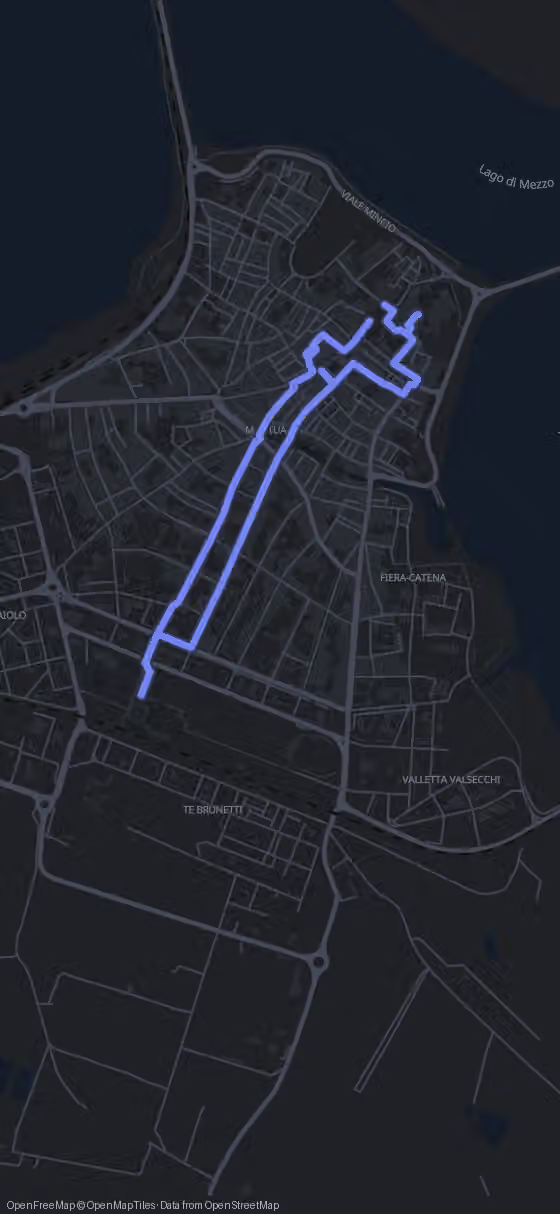
Route map for the Mantua walking tour
Stop 1 of 10
310 m·4 min
Piazza Sordello
Head south-west toward Basilica di Sant'Andrea
Ciao, welcome to Mantua. I'm Alex, and a tiny theatre here once impressed Mozart's father more than the concert itself.
Try this tour with Alex

Mantua on Foot: What This Route Covers

Ten stops on foot, from Piazza Sordello to Mantua Cathedral: 4.3 km and 1 h of pure walking. If you go inside the two great palaces, plan a full day of about seven hours.

The squares and churches are free. Tickets apply at Palazzo Te, the Torre dell'Orologio, the Teatro Scientifico Bibiena and the Ducal Palace. The route with map and GPS navigation runs free in your browser; the AI Tour Guide is optional.

Open free GPS & optional AI Tour Guide
View of Mantua

The Route

Walking Map of Mantua: Ten Stops from Piazza Sordello

10 stops 4.3 km 1 h walking
Tap to load interactive map

The 10 stops along this route

  1. Piazza Sordello in Mantua, stop 1 on the self-guided walking tour
    1Piazza Sordello
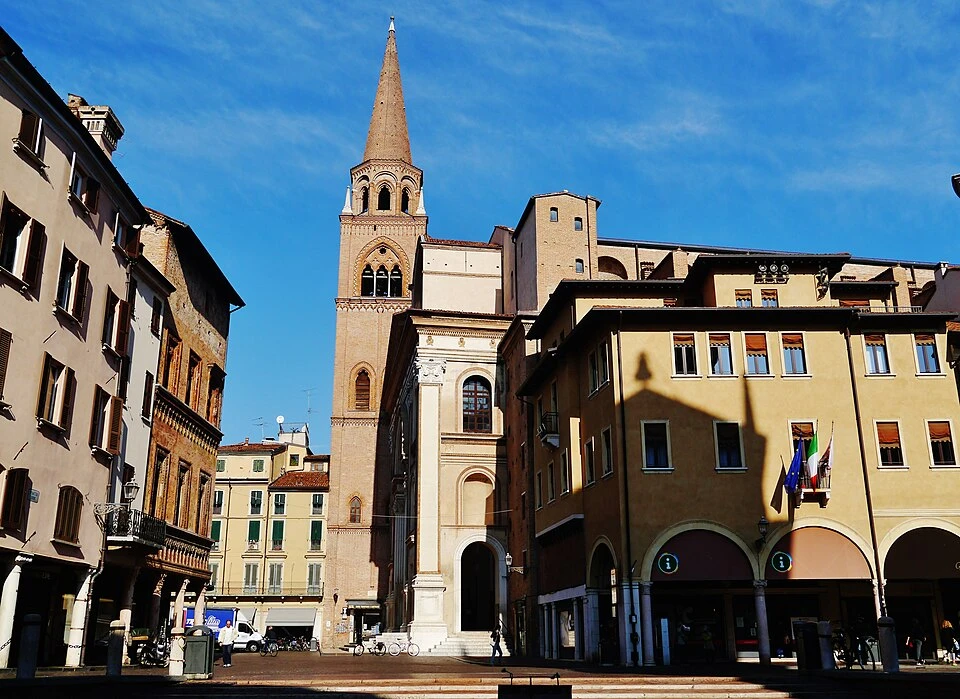
  2. Basilica di Sant'Andrea in Mantua, stop 2 on the self-guided walking tour
    2Basilica di Sant'Andrea
  3. Palazzo Te in Mantua, stop 3 on the self-guided walking tour
    3Palazzo Te
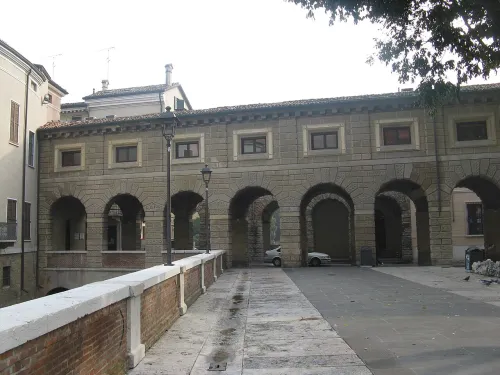
  4. Pescherie di Giulio Romano in Mantua, stop 4 on the self-guided walking tour
    4Pescherie di Giulio Romano
  5. Piazza delle Erbe in Mantua, stop 5 on the self-guided walking tour
    5Piazza delle Erbe
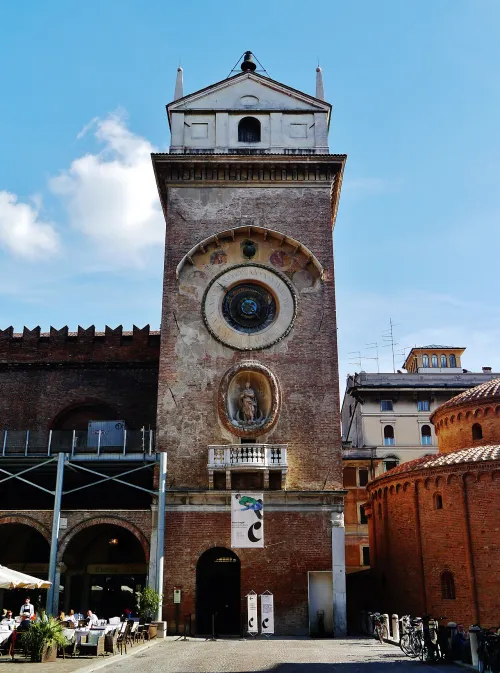
  6. Torre dell'Orologio in Mantua, stop 6 on the self-guided walking tour
    6Torre dell'Orologio
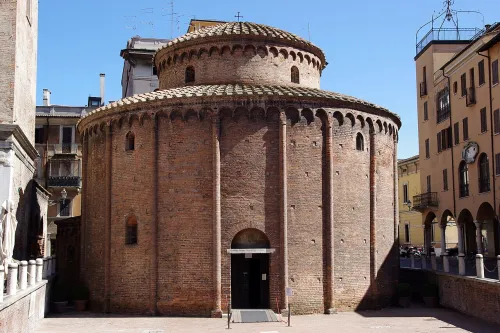
  7. Rotonda di San Lorenzo in Mantua, stop 7 on the self-guided walking tour
    7Rotonda di San Lorenzo
  8. Teatro Scientifico Bibiena in Mantua, stop 8 on the self-guided walking tour
    8Teatro Scientifico Bibiena
  9. Ducal Palace in Mantua, stop 9 on the self-guided walking tour
    9Ducal Palace
  10. Mantua Cathedral, stop 10 on the self-guided walking tour
    10Mantua Cathedral
  11. That's the full route.

    Walk it with an AI Tour Guide talking you through every one of these streets.

    Start free in your browser
    You made it

Your Mantua Walking Tour, Stop by Stop from Sordello to the Duomo

  1. 1

    Piazza Sordello

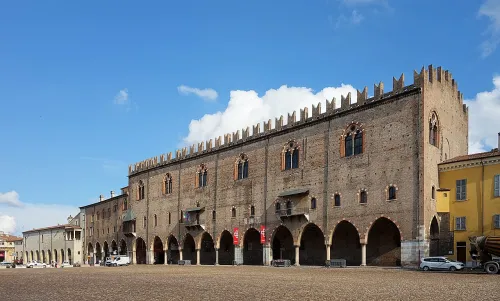
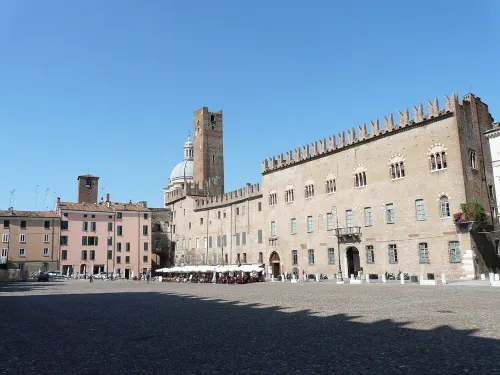
    Piazza Sordello in Mantua, stop 1 on the self-guided walking tour

    Start where Mantua's power sat for centuries. Piazza Sordello is named after Sordello da Goito, a 13th-century poet from the Mantua area, and for hundreds of years it was the centre of the city's political, social and religious life. Face the cathedral: its façade dates from the 1700s, while the massive bell tower beside it gives away its medieval origin. You will step inside that church at the very end of the walk.

    The square was a deliberate creation. It was laid out in 1330 as Piazza di San Pietro, after old houses were cleared from between two parallel streets that still followed the plan of the Roman town. One of them, the Strada Magna, ran from the vault of San Pietro to the cathedral. Most of what you see is late medieval, with 18th-century additions such as the cathedral front and the bishop's palace.

    On your left as you face the cathedral, the palaces follow one another: Palazzo Acerbi with the Torre della Gabbia rising over it, then Palazzo Bonacolsi (Castiglioni), both with round-arched triple windows and two portals, one round-arched and one Renaissance. Next come the Ca' degli Uberti and the Palazzo Vescovile, also called Palazzo Bianchi, beside the cathedral. Opposite stands the crenellated Palazzo del Capitano, older than 1328, the year the Gonzaga rose to power. It became the first core of the Ducal Palace; the Domus Magna next to it shares its 15th-century double-arched windows.

    One thing you will not see: an exedra closed off the north side until 1901, when it was pulled down so carts could pass more easily. From here it is 310 m, about 4 minutes, to the Basilica di Sant'Andrea.
    Hours
    Open 24/7
    Price
    Free
  2. 2

    Basilica di Sant'Andrea

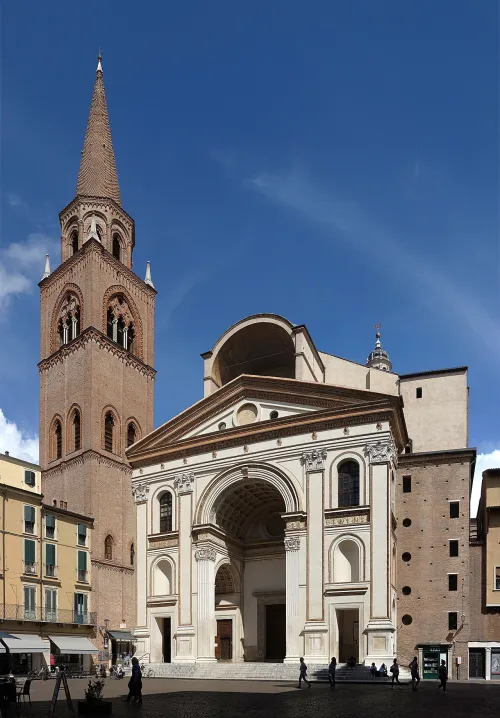
    Basilica di Sant'Andrea in Mantua, stop 2 on the self-guided walking tour

    The Basilica di Sant'Andrea looms over Piazza Mantegna, and its front deserves a slow look before you go in. Leon Battista Alberti modelled it on the ancient Arch of Trajan at Ancona: one large central arch, smaller openings left and right, Corinthian pilasters. Look closely for the novelty: fluted columns of a lower order combined with taller, unfluted pilasters of a giant order. Over the pediment sits a vaulted structure whose purpose nobody knows for sure; most likely it shaded the window behind it.

    The façade is mostly brick finished with hardened stucco, built against a bell tower from 1414, the last remnant of the Benedictine monastery that once stood here. Ludovico III Gonzaga commissioned the church and work began in 1472. Finishing it took 328 years. Later changes altered Alberti's plan: the side arms were added in 1597, when the crypt was also completed. Still, it counts as one of Alberti's most complete works and one of the major works of 15th-century Renaissance architecture in Northern Italy.

    Go in: entry is free. The interior repeats the triumphal arch of the façade, with high arches alternating with much lower square-topped openings. Then look up at the barrel vault over the nave, one of the first built on such a monumental scale since antiquity. The coffers up there are painted: Alberti probably wanted real ones, but the money ran out. The church also keeps the relic venerated as the Blood of Christ.

    Now comes the longest stretch of the walk: 1470 m, about 20 minutes, out to Palazzo Te, which was built just outside the old city walls. On the way you pass the Casa del Mantegna and the Museo Civico di Palazzo San Sebastiano.

    Hours
    Daily 08:00–19:00
    Price
    Free
  3. 3

    Palazzo Te

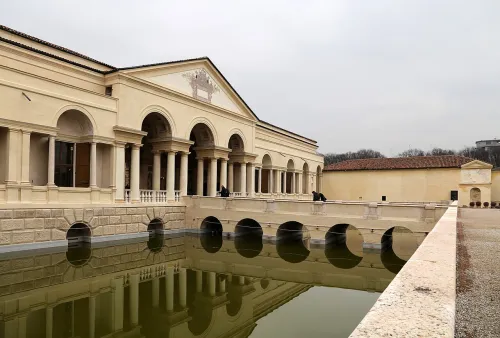
    Palazzo Te in Mantua, stop 3 on the self-guided walking tour

    Palazzo Te was built for pleasure, not for government. Federico II Gonzaga, Marquess of Mantua, had it built between 1524 and 1534 on the site of the family stables he had set up at Isola del Te, on the edge of the marshes outside the walls. His architect was Giulio Romano, a pupil of Raphael, and this palace is acknowledged as his masterpiece and a key example of Mannerist architecture.

    From outside it looks simple: a square house around a cloistered courtyard, its shell raised in just eighteen months. A formal garden completed it, framed by colonnaded outbuildings that end in a semicircular colonnade, the Exedra. The real work came afterwards. For ten years plasterers, carvers and fresco painters, among them local painters such as Benedetto Pagni and Rinaldo Mantovano working under Romano, covered almost every surface of the loggias and salons.

    Its luck ran out in July 1630, during the War of the Mantuan Succession. An imperial army of 36,000 Landsknecht mercenaries sacked Mantua over three days and brought one of the worst plagues in history with them. The palace was looted from top to bottom and left an empty shell, with nymphs, gods, goddesses and giants on the walls of echoing rooms.

    Is it worth the ticket? If you care about Renaissance painting, yes: if you pay for only one interior besides the Ducal Palace, make it this one, and allow about an hour and a half.

    Afterwards you walk 1160 m, about 16 minutes, back into the centre to the Pescherie di Giulio Romano, passing the Museo Tazio Nuvolari.

    Hours
    Mon 09:00–19:00, Tue 13:00–19:00, Wed–Sun 09:00–19:00
    Price
    15 EUR full, 11 EUR reduced, 7 EUR special reduced (ages 12-18, university students), free under 12
  4. 4

    Pescherie di Giulio Romano

    Pescherie di Giulio Romano in Mantua, stop 4 on the self-guided walking tour

    Giulio Romano again, this time in the service of the city's fish trade. The Pescherie were built in 1536 to his design: two arcaded porticoes with round arches in his typical rusticated stonework, topped by an attic with rectangular windows framed by pilasters.

    They stand on either side of the medieval bridge over the Rio, the waterway that crosses Mantua from Lake Superiore to Lake Inferiore, so the fish was sold right by the water. They were linked to the Beccherie, the public slaughterhouse Romano designed in the same years between the Pescherie bridge and the San Silvestro bridge. It was demolished in 1872 to make way for a pedestrian passage, but a long row of its columns was saved there, the last trace of the building.

    Towards the end of the 19th century the Pescherie were restored as well and lost their original use. The loggia opens only at certain times, free of charge; otherwise you take in the arcades from the bridge.

    Piazza delle Erbe is 340 m away, about 5 minutes on foot.

    Hours
    Sat–Sun 15:30–19:00
    Price
    Free
  5. 5

    Piazza delle Erbe

    Piazza delle Erbe in Mantua, stop 5 on the self-guided walking tour

    Piazza delle Erbe, or simply Piazza Erbe, is the square of the medieval commune. It took shape in the late 12th century, when the city grew beyond the Voltone di San Pietro and so beyond the old Roman town around today's Piazza Sordello. A large plot east of the Sant'Andrea monastery served as the Forum Boarium, the cattle market.

    Once the livestock moved to the outskirts, the area along the Via di Sant'Andrea, today's Via Broletto, where shops were already rented to merchants, was split in two by the Palazzo del Podestà, also called Palazzo del Broletto, and became the commune's administrative heart. The Palazzo della Ragione rose on the east side. When first the Bonacolsi and then the Gonzaga took over, power moved to the new Piazza San Pietro, today's Piazza Sordello.

    Walk along the merchants' row: over the centuries it gained porticoes in late Gothic and Renaissance style. Look for the Casa del Mercante, built in 1455 for Giovan Boniforte da Concorezzo, with terracotta decoration in late Gothic and Venetian style that shows best in the pointed tips over the windows. The 14th-century Torre del Salaro rises over it. That mix of periods side by side is the real charm of the square.

    The clock tower is 30 m away, a one-minute walk.

    Hours
    Open 24/7
    Price
    Free
  6. 6

    Torre dell'Orologio

    Torre dell'Orologio in Mantua, stop 6 on the self-guided walking tour

    Look up at the Torre dell'Orologio, attached to the Palazzo della Ragione. Luca Fancelli, a Florentine architect working for Ludovico III Gonzaga, built it in 1472 and 1473 on the foundations of a 13th-century structure. In 1473 the astronomical clock by the Mantuan mathematician Bartolomeo Manfredi was installed.

    Now read the dial, about 15 metres up under its arched canopy. The outer ring counts the hours from I to XXIIII. The inset ring, with 12 white and 12 black divisions, shows the unequal hours, daylight and night each split into twelve. Inside it a disc carries the signs of the zodiac, and another, numbered up to 29 in threes, gives the day of the lunar month. At the centre sits Latona, mother of Apollo and Diana, the Sun and the Moon, with open arms and a deer at her feet. Of the 12 round frescoes of the quadrivium arts that once framed the dial, only the four under the canopy survive; a metal moon sphere replaced the one at the top.

    The clock ran for nearly a century until it failed in 1560; the mathematician and astronomer Francesco Filopono repaired it. It stopped again in 1700 and was restored only in 1989, by Alberto Gorla. The Immaculate Madonna under the dial and the marble balcony date from the early 17th century, and the bell on top strikes the hours. The 2012 Emilia earthquakes damaged the tower, which was closed during the repairs.

    Inside, the Museum of Time shows old parts of the mechanism, and the top gives views over the city and the surrounding lakes. The ticket is cheap, so it is an easy yes if you like clockwork or views. The Rotonda di San Lorenzo is just 10 m away.

    Hours
    Tue–Fri 10:00–13:00, 15:00–18:00, Sat–Sun 10:00–18:00, Mon closed
    Price
    3 EUR full, 1.50 EUR reduced (under 26, over 65, groups 10-25), free under 12
  7. 7

    Rotonda di San Lorenzo

    Rotonda di San Lorenzo in Mantua, stop 7 on the self-guided walking tour

    Low, round and built of brick, the Rotonda di San Lorenzo lies about 1.5 metres lower than the neighbouring Palazzo della Ragione, which went up only about 150 years later. That difference suggests it stands on the foundations of an ancient building, probably a round temple. Tradition, though not proven, says work began in 1083 at the initiative of Matilda of Canossa. Like almost all medieval round churches it follows the model of the Church of the Holy Sepulchre in Jerusalem, a link that underlined its role alongside the Blood of Christ relic kept in Sant'Andrea.

    Its later history is bumpy. Alterations by Leon Battista Alberti and Giulio Romano are generally regarded as a failure, and in 1579 the church was closed for worship because it was unsafe. For centuries it served as a storeroom and fell into decay, until it was reconstructed between 1908 and 1911. In 1926 it was entrusted to the Dominicans, and since then it has been open again as a parish church.

    Outside, the lower part is articulated by 16 engaged shafts, with a smaller central drum on top; both end in a round-arch frieze with a small dentil frieze over it, though how much of this is original can no longer be settled. Inside, 14 brick round piers without capitals stand alongside two reused ancient columns with capitals flanking the east-facing apse. The upper gallery is largely the invention of the restorers, so read it as an early 20th-century idea of the Middle Ages.

    Entry is free, and ten minutes inside are enough. The Teatro Scientifico Bibiena is 320 m away, about 4 minutes.

    Hours
    Mon–Fri 10:00–13:00, 14:00–18:00, Sat–Sun & holidays 10:00–19:00
    Price
    Free
  8. 8

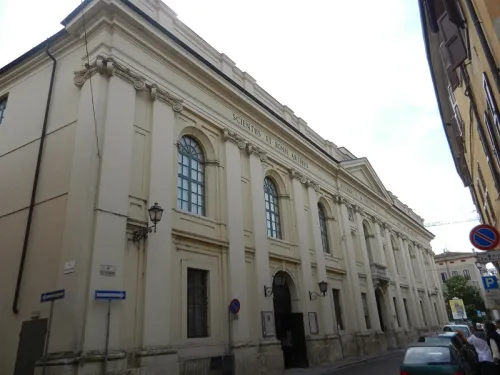
    Teatro Scientifico Bibiena

    Teatro Scientifico Bibiena in Mantua, stop 8 on the self-guided walking tour

    From the street you would hardly guess what waits inside. The Teatro Scientifico Bibiena, known locally as Teatro Bibiena, was built between 1767 and 1769 by Antonio Galli da Bibbiena for the Accademia dei Timidi, commissioned by its rector, Count Carlo Ottavio di Colloredo. The façade, designed by Piermarini and executed by Paolo Pozzo, followed between 1773 and 1775.

    It is called scientific because it was meant for academic meetings on learning and education, in the spirit of the Enlightenment, though concerts and performances were planned too. Building took only two years, and the theatre opened on 3 December 1769 with the cantata Virgilio e Manto by Luigi Gatti. Bibbiena, son of the Baroque stage designer Ferdinando, had already built the new theatre in Bologna and designed the façade of San Barnaba in Mantua. Here he was architect and painter at once: he personally painted the many boxes with monochrome figures. The hall seats 338.

    The site has older roots. A palace of Ferrante I Gonzaga, count of Guastalla, imperial general during the Sack of Rome and later viceroy of Sicily, stood here. His son Cesare founded the Accademia degli Invaghiti in his home in 1562; it became the Invitti in 1610 and the Timidi in 1648. Today the building also houses the Accademia Nazionale Virgiliana, the city's oldest cultural institution.

    The ticket is inexpensive, and it is a short, rewarding stop. Next, walk 430 m, about 6 minutes, to the Ducal Palace, passing the Giardino dei Cani.

    Local name
    Teatro Bibiena
    Hours
    15 Mar – 15 Nov: Tue–Fri 10:00–13:00, 15:00–18:00, Sat–Sun & holidays 10:00–18:00; 16 Nov – 14 Mar: Tue–Sun 10:00–13:00, 15:00–18:00; Mon closed
    Price
    3 EUR full, 1.50 EUR reduced, free under 12
  9. 9

    Ducal Palace

    Ducal Palace in Mantua, stop 9 on the self-guided walking tour

    From 1308 the Ducal Palace was the official residence of the lords of Mantua, first the Bonacolsi, then the Gonzaga as lords, marquesses and finally dukes. It housed the ruling Gonzaga, his wife, their legitimate firstborn, the other legitimate children until adulthood, and distinguished guests. Its oldest core is the Palazzo del Capitano you saw on Piazza Sordello.

    Each duke wanted a wing for himself and his art collections, and the result is one of Europe's largest palaces: more than 500 rooms, 7 gardens and 8 courtyards. From 1556 Duke Guglielmo had his surveyor Giovanni Battista Bertani tie the separate buildings into a single complex reaching from the shore of Lake Inferiore to Piazza Sordello. After Bertani's death in 1576, Bernardino Facciotto finished the job, linking gardens, squares, loggias, galleries, exedras and courtyards. Under Austrian rule, from Maria Theresa onwards, it became the Royal Palace.

    This is the second big ticket of the day, and the one to plan around. There is a complete route with the Camera degli Sposi and a cheaper reduced route without the Castle and the Camera; young visitors go free. If you have the time, take the complete route and allow about two hours.

    Mantua Cathedral is 270 m away, about 4 minutes.

    Hours
    Tue–Sun 08:15–19:15, Mon closed
    Price
    18 EUR full (complete route with Camera degli Sposi), 11 EUR reduced route (without Castle/Camera), free under 18
  10. 10

    Mantua Cathedral

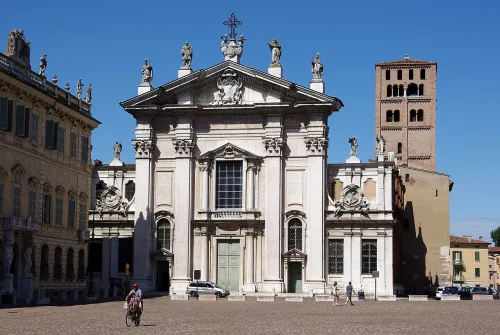
    Mantua Cathedral, stop 10 on the self-guided walking tour

    You finish at Mantua Cathedral, the Duomo di Mantova, whose 18th-century façade you saw from Piazza Sordello at the start. It is dedicated to Saint Peter and is the seat of the Bishop of Mantua. A church probably stood here in Early Christian times; its successor burned in 894 and was quickly rebuilt.

    Bishop Manfredo began a Romanesque rebuilding in 1132, and the bell tower was finished before 1150; together with some wall sections it is all that remains of that church. In 1395 Francesco I Gonzaga celebrated the birth of his firstborn son by ordering a Gothic façade from the Venetian brothers Jacobello and Pierpaolo dalle Masegne. Only the right flank of their work survives. Along the south side, look for the gables decorated with rose windows that run up to the Romanesque bell tower.

    After another fire in 1545, Cardinal Ercole Gonzaga, then regent of the duchy, called in Giulio Romano. He left the façade and outer walls standing but reshaped the interior on the model of the early Christian St Peter's in Rome; after his death in 1546 Bertani carried on. The organ was built by Hans Tugi around 1503. During the French occupation the cathedral suffered heavy Napoleonic looting.

    Entry is free, and it works as a calm last stop even late in the day. Fifteen minutes inside are enough to see how Giulio Romano treated a church compared with his palace.

    Local name
    Duomo di Mantova
    Hours
    Daily 07:00–19:00
    Price
    Free
Walking tour route map of Mantua Route loaded
Piazza SordelloBasilica di Sant'AndreaPalazzo TePescherie di Giulio Romano+6
All 10 stops are already on the map.
You just press start.
AI Tour Guide

You know the route now. Walk Mantua with a guide in your ear.

Press start wherever you are, even hundreds of kilometres from Mantua, and the guide begins telling its stories right away. In the city, pick any of the 10 stops to start from: it leads you there, then talks with you the whole route, asking, listening, remembering, and shaping the tour around your answers.

10stops 4.3km 1 hwalking 13languages
▶Start the tour free

Free to start · Runs in your browser · No app, no download

Shorter Ways to Walk Mantua

The full route links palaces at opposite ends of the old town. If your time is short, split it into a morning or an afternoon.

The whole Gonzaga day

Stops: 1, 2, 3, 4, 5, 6, 7, 8, 9, 10

For art lovers with a full day. 1 h of walking in total; tickets at Palazzo Te, the Torre dell'Orologio, the Teatro Scientifico Bibiena and the Ducal Palace, everything else free.

Historic centre only

Stops: 4, 5, 6, 7, 8, 9, 10

For an afternoon, or a day without Palazzo Te: start at the Pescherie di Giulio Romano and walk 1.4 km, about 21 minutes, to the Cathedral. Free: the Pescherie, Piazza delle Erbe, the Rotonda and the Cathedral; tickets for the clock tower, the Bibiena theatre and the Ducal Palace.

A morning with Alberti and Giulio Romano

Stops: 1, 2, 3

For a focused half day: Piazza Sordello, Sant'Andrea and Palazzo Te, 1.78 km and about 24 minutes of walking. The only ticket is Palazzo Te.

How Long Does This Mantua Tour Take with Both Palaces?

The 4.3 km take 1 h of pure walking. More than half of that is the trip out to Palazzo Te and back: 20 minutes there from Sant'Andrea, 16 back to the Pescherie. After that everything is a matter of minutes, with the clock tower and the Rotonda practically touching.

The full-day estimate assumes an hour and a half inside Palazzo Te, two hours in the Ducal Palace and short visits elsewhere. See both palaces only from outside and the walk takes around three hours. The historic-centre variant fills about four hours including the Ducal Palace, the morning variant about two and a half.

Before You Set Off in Mantua

  • Start and finish: Piazza Sordello is the recommended start, but you can join at any stop. The walk ends at Mantua Cathedral, and the free GPS navigation in your browser will lead you back to the start if you like.
  • Best days: Pick a day when the Ducal Palace, the Torre dell'Orologio, the Teatro Scientifico Bibiena and Palazzo Te are all open, since not every stop opens every day.
  • Timing: Start at 09:00 on Piazza Sordello, give the square ten minutes and Sant'Andrea twenty, and you reach Palazzo Te shortly before 10:00. The Ducal Palace deserves about two hours, so don't leave it too late in the day.
  • Costs: Walk, map and GPS route are free, as are both squares, Sant'Andrea, the Pescherie, the Rotonda and the Cathedral. Tickets are needed for Palazzo Te, the clock tower, the Bibiena theatre and the Ducal Palace. The AI Tour Guide is optional: 100 free credits to start, then either this tour all-inclusive for €19.99 with no time limit, or €5 per hour.
Walking tour route map of Mantua
AI Tour Guide

Your Mantua Guide Is Ready When You Are

Press start and a voice AI Tour Guide takes it from here: leading the route through Mantua, telling the stories, and turning your walk into a real back-and-forth conversation. No app or download is needed; it runs in your browser.

10stops 4.3km 1 hwalking 13languages
▶Start the tour free

Free to start · Runs in your browser · No app, no download

What the AI Tour Guide Adds in Mantua

On this route the AI Tour Guide turns four centuries of Gonzaga rule into one running conversation. It greets you on Piazza Sordello, picks up threads between the stops and asks what you want more of: the frescoes, the clockwork, the family feuds. It can tell you about the poet Sordello behind the square's name or about Matilda of Canossa, while the route itself stays exactly as it is, and you can interrupt it whenever something catches your eye.

A Real Conversation A voice AI Tour Guide greets you, leads the whole route, and tells the stories and facts as you walk, asking what you want to see and keeping a real conversation going. Not a recording you press play on.
Map Navigation Follow the route on the map and walk at your own pace. You choose where to start and when to move to the next stop.
Ask Anything Curious about a building you pass? Ask your AI Tour Guide on the spot and the conversation carries on.
13 Languages Switch language anytime. No separate tour needed.
Start free in your browser

Common Questions About Visiting Mantua

Why is it called Palazzo Te?

It is named after Il Te, the suburb where it was built. The word most likely comes from Lombard tejee or tejé, a linden grove that once grew there, or from Latin attegia, a hut. Vasari spelled it Palazzo del T, and English-speaking art historians still often say Palazzo del Te.

Are there reduced tickets for children and students?

Yes. Children go free at Palazzo Te, the Torre dell'Orologio and the Teatro Bibiena, and young visitors go free at the Ducal Palace. Palazzo Te, the clock tower and the Bibiena theatre also offer reduced tickets; at Palazzo Te these include university students.

Which buildings on the walk are by Giulio Romano?

Palazzo Te is his masterpiece and the Pescherie his fish market of 1536. After the fire of 1545 he reshaped the interior of the Cathedral, and he also altered the Rotonda di San Lorenzo, with results generally judged a failure.

Where can I go next from Mantua?

Verona is 35 km away and Parma 54 km; both have their own free walking routes. Modena is 58 km away.

Is the tour really free?

Yes. The whole tour is free: the route, the interactive map and the navigation cost you nothing. Only the voice AI Tour Guide is optional and paid: you test it with 100 free credits, then you pay either €5 per hour or €19.99 for this whole tour, with no time limit. Admission to 4 of the 10 stops is not included: Palazzo Te, Torre dell'Orologio, Teatro Scientifico Bibiena and Ducal Palace charge their own entry fees.

Do I need to download an app?

No. Everything runs in your phone browser. Open the route and start walking, no download and no sign-up required.

Do I need to book the walking tour in advance?

No booking needed. This self-guided tour is available anytime. Open the route in your browser and start walking. The AI Tour Guide works instantly, no app, no reservation required.

What languages is the AI Tour Guide available in?

The AI Tour Guide speaks 13 languages, so you take the tour in your own language and can switch at any time.

Can I skip stops or change the route?

Yes. Skip any stop, spend extra time at places you like, or start the route from any point. It is your walk, you set the pace.
Image credits
▶ Start free in your browser Runs in your browser, no app, no download